We know God can do anything. So how do you react when He doesn’t do something that you beg him to? When your loved one isn’t healed? When your heartbreak feels unbearable and then something else piles on top of that? When you just don’t know how to go on, yet you have to anyway?
I’ve been going through a rough patch emotionally, especially over the past few weeks but really for a few months now. And I feel like God has thrown me some songs as “lifelines” in this time. First it was “I Am Not Alone” by Kari Jobe and more recently it was “Even If” by MercyMe.
I know You’re able and I know You can
Save through the fire with Your mighty hand
But even if You don’t
My hope is You alone
I know the sorrow, and I know the hurt
Would all go away if You’d just say the word
But even if You don’t
My hope is You alone
I didn’t much want to sing this when it popped into my head. Actually, I couldn’t at first since all I remembered was the “But even if you don’t” line. But I looked the song up, grasping for some hope to anchor my soul, and after playing through it a few times I could breath and pray again. I’ll admit, though, that there was still a part of me crying out, “Why?” when I thought about Him choosing not to take away the sorrow and hurt. And it’s okay to do that. As my counselor said, God is big enough to handle it when His kids are frustrated with Him.
Hope is one of the key things that gets us through the times when we’re frustrated with God and don’t understand what He’s doing. And it’s something I don’t think we talk about enough. Paul tells us “faith, hope and love remain” (1 Cor. 13:13, WEB). They’re all three virtues that aren’t going away, but we talk about faith and love a whole lot more than hope. Which is a shame, because hope is something that’s very much needed in this world. Read more →
Today’s guest post is by Dani Fisher of A Vapor In The Wind. We met when she contacted me in response to my project about Christianity and MBTI types and I’m thrilled to have her sharing on this blog today.
There are five stages of grief—denial, bargaining, anger, depression, and acceptance. Maybe you are familiar with these stages. If you have suffered any sort of traumatic life event or loss, you know these stages do not necessarily appear in this order. I would add one more stage to this whole process of grief—guilt. While in every big or small scenario of grief, guilt is not necessarily present, I would argue that when it comes to the loss of a loved one, there is always some manifestation of guilt. There is always something you regret, no matter how wonderful your relationship with your loved one might have been. This was my experience and for a long time I was unsure of what to do with my regret, how to respond to it and how to carry it.
When my brother died, one of the first things my father said was, “We have no regrets.” He was right. By all objective standards, my family had no regrets in the life and death of my younger brother. My brother was an exceptional seventeen-year-old. He had a good relationship with his parents and siblings. I would contend that “good” does not do justice to the friendship my brother and father shared. The name Benjamin means “son of my right hand” and Ben fulfilled his name in every respect – he was my father’s right hand man. My brother was full of joy and ambition. He possessed one of the greatest servant-hearted spirits and work-ethics of anyone I have ever known. He was the person you could count on in a crisis. If you needed his help, he would show up and follow through and I know so many of his friends and family can testify to the number of times he dropped everything to help someone in need.
More importantly, my brother loved Jesus and he loved the church. We had the privilege and joy of hearing his personal profession of faith and witnessing the evidence of his faith and the fruit of the Spirit in his character and his works. I still envy the grace and lightheartedness with which my brother moved through life. It’s something I continually aspire to.
Ultimately, we had no regrets. My brother’s life was secured in Christ and because of that there was only glory in the blink of an eye for him the night he died. Certainly we had nothing to regret.
Nevertheless, regret is an inevitable symptom of loss in a fallen, sinful world. For me it was a multitude of little things that, when accumulated, resulted in a great weight of guilt. There were the angry, hurtful words I wish I had never said – the encouraging, supportive words I should have said more – the affection and love I wish I had demonstrated more openly, thoughtfully, and generously. There were all the things we said we would together do but never did – all the little ways I should have been a better sister and friend to him. Read more →
I started writing this post nearly a year ago, after losing a dear friend, but I couldn’t finish it then. While I was grieving and watching the people around me grieve, I started wondering if the ways individuals respond to grief might be influenced by personality type. Once I started thinking about it, I was surprised that it wasn’t something I’d already read about in my personality studies.
People experience grief in such different ways that it would make sense for someone to try and find commonalities between how each personality type deals with grief. Maybe then we could come up with a self-help method for the grieving process more individualized than the inadequate and outdated 5 stages of grief model.
A few Google searchers later, I’d found plenty of forum topics where people who shared personality types were getting together to compare notes on how they deal with grief. I also found the following on the official Myers-Briggs website:
There have been many books written about personality type and grief, and it is perhaps one of the most profound uses of type. Understanding one’s personality type helps a person recognize why certain expressions of grief are better suited to his or her personal journey through this difficult process.
Recovery from Loss is specifically written for people who are grieving the loss of a spouse. It proposes a 20-step model for dealing with grief, and does address the role of personality type. However, the authors’ ideas are drawn from general knowledge of how different types respond to stressful situations rather than on actual research. They suggest this would be a profitable study, but do not undertake such a study themselves.
For such a study, I found a The Relationship Between Grief and Personality — A Quantitative Study by Lisa Prosser-Dodds, who presented this study of 239 individuals’ responses to grief as part of her PhD (I’m assuming it was also the starting point for her soon-coming book). Her study asks, ” Is there a difference in grief response between groups with differing MBTI personality types?” According to her, previous explorations of the MBTI’s role in grief are very few. She mentions four:
a 1990 study of 51 bereaved mothers that said, “Extroverts reported higher levels of coping resources and focused on Social, Cognitive, Emotional and Spiritual resources.” The sample group mainly consisted of Extroverts and Feelers.
a 1999 study of 14 people who had lost a spouse. This study “found differences in styles of grieving between varying personality types” but not “a significant use of inferior function,” which we would expect to show up in times of stress.
the 1990 book Recovery From Loss, which I’ve alredy mentioned. Prosser-Dodds thinks their 20-step recovery model is presented “at a level of intellectual requirement that most grievers might become unable to digest,” and notes their observations are “not grounded in empirical data.”
the 1994 book Voices of Loss, compiling first-hand accounts of grief and loss (not necessarily due to death) from various personality types. It is also “not based upon empirical data.”
What We Can Learn
If you’re interested in reading part of Prosser-Dodd’s study, her summary of results begins on page 68 of this PDF document. The aspect of her findings that I found most surprising was that “When the dominant function aspect of the personality was compared, none of the results showed significant differences. All six subscales and the total scale scores failed to support the hypothesis.” Given Naomi Quenk’s writings on the role of inferior functions in times of stress, this is quite shocking. I would have assumed eruptions of the shadow played a key role in grief, but our dominant function might actually have more to do with how we grieve than our inferior functions.
Instead, “the results that showed the most significant differences were with the predictor variable functional pairs (NT, ST, NF and SF).” This probably wouldn’t have surprised Isabel Myers, since that is the method she used to divide personality types into four groups: “ST- Practical and Matter of Fact Types,” “SF – Sympathetic and Friendly Types,” “NF – Enthusiastic and Insightful Types,” and “NT – Logical and Ingenious Types.”
NF Types
Prosser-Dodd found that NF types had “higher levels of despair, disorganization and detachment” in their grief response, as wells as “slightly less personal growth.” NF type tend to feel things deeply in general, so it is hardly surprising that our grief response involves high levels of emotion. They are, however, better able than thinking types to find meaning in the tragedy of loss and regain balance in relation to the world.
NT Types
Intuitive Thinkers scored lowest on all aspects measured by the Integration of Stressful Life Events Scale. This measures the ability to make meaning out of a loss and to find one’s footing in the world while recovering. Prosser-Dodd said that considering NT types as “as the logical and strategic types, it would follow they might struggle with a comprehension of the loss in general and perhaps find it difficult to regain their footing in world following a loss.”
SF and ST Types
On the scales of despair, disorganization, and detachment the ST and SF types scored in between the NF and NT types, with SF types just a bit higher than ST types. Interestingly, ST types were the most likely to use a loss for personal growth. SFs scored higher than STs in being able to find their footing in the world and make meaning out of a loss (they’re better at this than NF types, as well).
A good friend of mine, named Kimberly, was in a fatal car accident Thursday morning. I know only a few details. She wasn’t feeling well, but drove to work any way — she wouldn’t have wanted to let her employer down by calling in sick unless she was too ill to stand. There was ice on the road, and she swerved. Someone in an oncoming car hit her (he was taken to the hospital and is expected to recover). She was killed instantly.
I had one of my regular posts all planned out, but I couldn’t write it. I couldn’t just pretend everything is normal. It’s not. This kind of accident could happen to anyone, but it didn’t. It happened to Kimberly.
Kimberly was a peacemaker who loved to help people, and she seemed to attract those who needed her. She often wondered why friends, acquaintances, and people she had never even met would seek her out to share their problems. I think I know at least part of the reason why. They knew she would listen to them. If you needed to talk, you could trust that Kimberly was listening. And once you were one of Kimberly’s friends, she wasn’t just content to listen and not do anything. She could recognize when people started rehashing grievances in an unhealthy way, and she would challenge you to change. If your life was falling apart, Kimberly would help you re-build it.
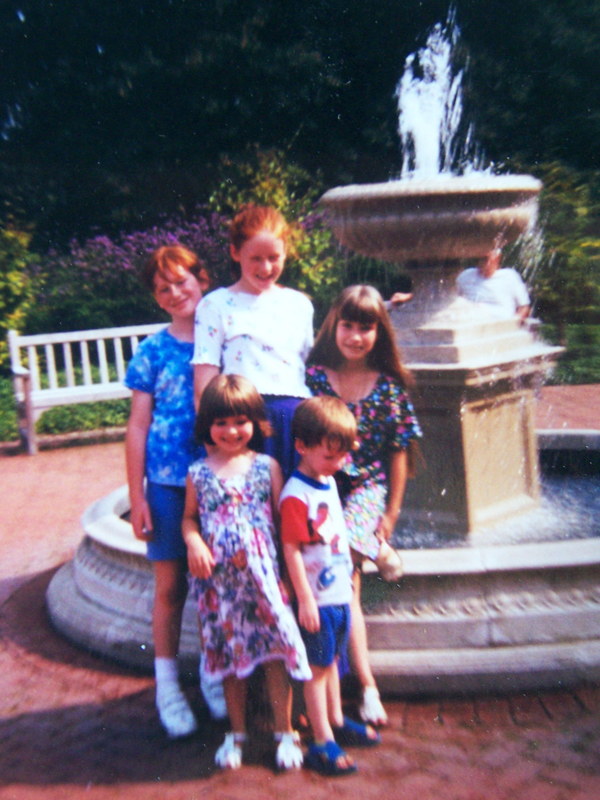
A picture of us as children. My sister, I, and Kimberly are in back. Kimberly’s sister and my brother are in front.
I can’t really remember a time before I knew Kimberly. I know such a time existed because I vaguely remember her family moving to Ohio, but I don’t have distinct memories of a time before she was my friend. As I grew up, I lost touch with most of my childhood friends for various reasons, but not with Kimberly. If you had asked me just a few days ago who I would have as my bridesmaids in a hypothetical future wedding, Kimberly is one of only four girls who would have instantly come to mind.
In the past few years, mainly because of distance and college and work schedules, we did not see each other as much as I wish we had. I have a very fond memory of going to see Tangled with her and my sister, then eating lunch at Applebees. Why didn’t we do the same for Frozen? I’m sure we could have managed to find a day that would have worked, but everyone is so busy and we have all the time in the world, right?
She was 22 years old, and very close to graduating from college. Her degree would have been in computer science engineering. When she and my sister started talking about engineering, math, or science, I couldn’t follow even half the conversation. I’d just sit there wondering how two people could be so enthusiastic about discussing equations that would send most people into a panic if they were asked to solve it. She also wrote poetry, which I could never convince her to let me read.
There’s a phrase that keeps running through my mind: “in sure and certain hope of the resurrection into eternal life.” It’s from the funeral service in The Book of Common Prayer. I think I’ve probably heard it more in films than in real life, but for some reason that’s what keeps popping into my head.
earth to earth, ashes to ashes, dust to dust; in sure and certain hope of the Resurrection to eternal life, through our Lord Jesus Christ; who shall change our vile body, that it may be like unto his glorious body, according to the mighty working, whereby he is able to subdue all things to himself.
On Thursday night there were three passages of scripture I turned to: “…the Father of mercies and God of all comfort…” (2 Cor. 1:3-7); “…even so God will bring with Him those who sleep in Jesus…” (1 Thes. 4:13-18); “…now Christ is risen from the dead, and has become the firstfruits of those who have fallen asleep…”(1 Cor. 15:12-56). Paul says, “If in this life only we have hope in Christ, we are of all men most miserable” (1 Cor. 15:19, KJV). I would hate to try going through something like this without the hope and peace that God is ready to pour out in us — this is miserable enough as it is. For Kimberly, the next thing she knows will be a glorious resurrected life with God. For us still here, we hurt. And we miss her.
Please pray for Kimberly’s family — her father, mother, and younger sister, as well as aunts, uncles, cousins, and grandparents.


 Like An Anchor