Approaching God’s Kingdom Like A Child

You know that story from the gospels where Jesus welcomes children to Him and blesses them? And the other one where he calls a child to Him and tells His disciples they must become like children?

Those are some of the most familiar stories from the gospel accounts. And if you spend much time in church, listening to messages online, or reading Christian blogs, articles, and books then you’ve likely heard someone talk about the child-like faith that these stories teach us. We need to believe like little children, we’ve learned, who trustingly accept what God tells us.

I’ve been reading a book called Misreading Scripture with Individualist Eyes: Patronage, Honor, and Shame in the Biblical World by E. Randolph Richards and Richard James (click here to read another post inspired by that book). They have a different reading of the moment where Jesus calls a child to teach His disciples a lesson. It surprised me a little, so I wanted to take another look at these two moments. When we read closely, we realize that while these events might teach us lessons about faith, Jesus highlights a different focus for what we’re supposed to learn.

Who is the greatest?

Matthew and Mark both record a moment when Jesus used a child to teach His disciples a lesson. The disciples had a question about who would be the greatest. In Matthew’s account, they directly ask,  “Who is the greatest in the kingdom of heaven?” (Matt. 18:1, NET). In Mark’s account, Jesus “asked them, ‘What were you discussing on the way?’ But they were silent, for on the way they had argued with one another about who was the greatest” (Mark 9:33-34, NET). It seems likely this was the same incident (both conversations happen after arriving in Capernaum [Matt. 17:24; Mark 9:33]), just with different levels of detail recorded by Matthew and Mark.

 He called a child, had him stand among them, and said, “I tell you the truth, unless you turn around and become like little children, you will never enter the kingdom of heaven! Whoever then humbles himself like this little child is the greatest in the kingdom of heaven. And whoever welcomes a child like this in my name welcomes me.”

Matthew 18:2-5, NET

After he sat down, he called the twelve and said to them, “If anyone wants to be first, he must be last of all and servant of all.” He took a little child and had him stand among them. Taking him in his arms, he said to them, “Whoever welcomes one of these little children in my name welcomes me, and whoever welcomes me does not welcome me but the one who sent me.”

Mark 9:35-37, NET

Often when I hear people discuss this verse and the other story (which we’ll look at in a moment), they say something like, “Jesus tells us to be like little children, so let’s ask ourselves, what are children like?” Then we talk about things like innocence, accepting faith, and trust in the Father. But Jesus isn’t talking about faith, at least not directly. He directly states that He’s talking about humility (and, to be fair, I have also heard teachers point this out). Often, though, we seem to read over this point.

In our culture, we value a child’s simple faith, believing without facts. Aside from the questionable value of believing without facts, the passage isn’t about faith. It is about seeking status and honor. The disciples were arguing about who is greatest, and Jesus urges them to become like children, who are not concerned with worldly status. … Jesus doesn’t mean to “have simple faith” but to show a lack of concern about seeking status.

Misreading Scripture with Individualist Eyes, Richards and James, p. 137

I’m not quite sure where the idea that this passage is about simple faith came from. For one thing, children are curious; they question everything (as anyone can attest who’s fallen into a cycle of “why?” questions when speaking with a child). For another, Jesus very clearly says this lesson is about humility. If you want to be the greatest, then you need to stop worrying about your status and embrace childlike humility. That’s what we’re supposed to learn from this story.

Receive the Kingdom Like A Child

There is one other story where Jesus calls children to Him and then teaches His followers a lesson. Maybe the idea that this is about faith comes from that other story. Matthew, Mark, and Luke all record this account. We’ll read Mark’s to start (it’s similar to Matthew’s, but just a little more detailed).

 Now people were bringing little children to him for him to touch, but the disciples scolded those who brought them. But when Jesus saw this, he was indignant and said to them, “Let the little children come to me and do not try to stop them, for the kingdom of God belongs to such as these. I tell you the truth, whoever does not receive the kingdom of God like a child will never enter it.” After he took the children in his arms, he placed his hands on them and blessed them.

Mark 10:13-16, NET

Once again, Jesus doesn’t mention faith. He does mention receiving “the kingdom of God like a child,” though. Receiving God’s kingdom involves faith (i.e. active trust in God that results in loyal actions), but once again the context can give us more information about the specific lesson Jesus is teaching here.

In two gospels accounts, the lead-in to this event involves people questioning Jesus about Moses’s writings on divorce (Matt. 19:3-12; Mark 10:2-12; Luke records only a shortened version of Jesus’s answer to this question in Luke 16:18). That doesn’t seem all that relevant for the topic of receiving God’s kingdom like a child. Luke, however, prefaces this event by recording one of Jesus’s parables.

He also spoke this parable to certain people who were convinced of their own righteousness, and who despised all others. “Two men went up into the temple to pray; one was a Pharisee, and the other was a tax collector. The Pharisee stood and prayed to himself like this: ‘God, I thank you that I am not like the rest of men, extortionists, unrighteous, adulterers, or even like this tax collector. I fast twice a week. I give tithes of all that I get.’ But the tax collector, standing far away, wouldn’t even lift up his eyes to heaven, but beat his breast, saying, ‘God, be merciful to me, a sinner!’ I tell you, this man went down to his house justified rather than the other; for everyone who exalts himself will be humbled, but he who humbles himself will be exalted.”

They were also bringing their babies to him, that he might touch them. But when the disciples saw it, they rebuked them. Jesus summoned them, saying, “Allow the little children to come to me, and don’t hinder them, for God’s Kingdom belongs to such as these. Most certainly, I tell you, whoever doesn’t receive God’s Kingdom like a little child, he will in no way enter into it.”

Luke 18:9-17, WEB

In Luke’s gospel at least, the context once again is humility. Stop thinking so much of yourself or how you compare to others and be more like a child. We need to get out of our own way. God’s kingdom belongs to those who come to Him with humility, more focused on their relationship with Him than on any worldly concerns like one-upping your neighbor.

From My Youth

The lesson Jesus teaches about receiving God’s kingdom like a child is reinforced by a conversation Jesus has with a wealthy, important young man immediately after blessing the children. This conversation is recorded in all three gospels (Matt. 19:16-30; Mark 10:17-31; Luke 18:18-30). This young man comes to Jesus asking a question we can all relate to, “What shall I do to inherit eternal life?” (Luke 18:18, NET) Jesus tells him to do God’s commandments, and the man counters, “All these things I have observed from my youth. What do I still lack?” (Matt. 19:20, NET).

I relate to this question a lot, particularly in Matthew’s account with the addition of “what do I still lack?” I grew up in church and never left. I certainly haven’t been perfect, but I’ve worked to keep God’s commands from my youth and repented of the (many) times I slipped. I know there’s plenty of perfecting and growing that I need to do. But sometimes it would be nice for God to clearly tell me, “Hey, here’s what you really need to keep working on.”

Jesus looking at him loved him, and said to him, “One thing you lack. Go, sell whatever you have, and give to the poor, and you will have treasure in heaven; and come, follow me, taking up the cross.”

But his face fell at that saying, and he went away sorrowful, for he was one who had great possessions. Jesus looked around, and said to his disciples, “How difficult it is for those who have riches to enter into God’s Kingdom!”

Mark 10:21-23 NET

Sometimes we ask a question about ourselves and discover we don’t really want to know the answer. For this specific young man, Jesus told him he needed to let go of all the stuff he was holding on to, give it away generously, and follow Jesus alone. We don’t know if the young man ultimately heeded Jesus’s advice or not, but based on the fact that he walked away sorrowful it seems that he chose his earthly riches over the kingdom of God.

Now remember, we’re reading this in the context of Jesus saying, “whoever does not receive the kingdom of God like a child will never enter it.” Matthew, Mark, and Luke all expected their readers to go straight from one story to the other. And I suspect they wanted us to notice overlapping themes and lessons. Jesus told people they needed to be more like children. Then this young man comes to Jesus, Jesus tells him to keep the commandments, and the man says he’s been doing that since he was a youth. In other words, since he was a child. But now he knows there’s something missing, and Jesus told him what it was. At some point, he’d started trusting his riches rather than following God.

The disciples were amazed at his words. But Jesus answered again, “Children, how hard it is for those who trust in riches to enter into God’s Kingdom! It is easier for a camel to go through a needle’s eye than for a rich man to enter into God’s Kingdom.”

They were exceedingly astonished, saying to him, “Then who can be saved?”

Jesus, looking at them, said, “With men it is impossible, but not with God, for all things are possible with God.”

Mark 10:24-27, NET

One-Downmanship

In the one story where Jesus teaches a lesson using a child as an example, He’s correcting His disciples for wanting to be the greatest. In the next, He stops His disciples from trying to exclude children and says the kingdom belongs to those like them. For this latter story, all three gospels recording the story immediately move into Jesus’s conversation with a young man who kept the commands from his youth but now trusts in his riches. And in Luke’s account, this all comes after a parable about “people who were convinced of their own righteousness, and who despised all others.”

Taken together, we can start to see patterns emerging from the lessons Jesus teaches. We learn what it means to God for His children to be child-like in a positive sense.

Children (typically) don’t care about status. They don’t look down on others for not being righteous enough. They don’t trust in riches to save them. That’s what we’re to learn from and emulate in children. And, it turns out, that’s one of the lessons Jesus modeled as well.

In his death on the cross, Jesus didn’t consider defending his status something of importance. This is not a repudiation of honor. Note that God honors Jesus for having this value (Phil 2:9). Jesus is modeling a new value: one-downmanship. The world values one-upmanship and honors those who pursue it. The world thinks about who should submit to me. The Christian message is to ponder to whom should I submit. Rather than thinking of those under my authority, we should be only thinking of those under whose authority I am.

Misreading Scripture with Individualist Eyes, Richard and James, p. 172

The way Richards and James phrase this really struck a cord with me. Sometimes (and I say this to my shame), I struggle with feeling like my writings (and me) don’t get the attention they “deserve.” I want to be more important and be recognized for my work. But that’s not the right attitude. That’s not how the children Jesus used to teach His disciples acted, that’s not how Jesus told His people to act (Mark 12:38-40; Luke 14:7-11), and that’s not how Jesus acts or thinks.

Therefore, if there is any encouragement in Christ, any comfort provided by love, any fellowship in the Spirit, any affection or mercy, complete my joy and be of the same mind, by having the same love, being united in spirit, and having one purpose. Instead of being motivated by selfish ambition or vanity, each of you should, in humility, be moved to treat one another as more important than yourself. Each of you should be concerned not only about your own interests, but about the interests of others as well. You should have the same attitude toward one another that Christ Jesus had,

who though he existed in the form of God
did not regard equality with God
as something to be grasped,
but emptied himself
by taking on the form of a slave,
by looking like other men,
and by sharing in human nature.
He humbled himself,
by becoming obedient to the point of death
—even death on a cross!
As a result God highly exalted him
and gave him the name
that is above every name,
so that at the name of Jesus
every knee will bow
—in heaven and on earth and under the earth—
and every tongue confess
that Jesus Christ is Lord
to the glory of God the Father.

So then, my dear friends, just as you have always obeyed, not only in my presence but even more in my absence, continue working out your salvation with awe and reverence, for the one bringing forth in you both the desire and the effort—for the sake of his good pleasure—is God. Do everything without grumbling or arguing, so that you may be blameless and pure, children of God without blemish though you live in a crooked and perverse society, in which you shine as lights in the world.

Philippians 2:1-15, NET

We shouldn’t be concerned about how other people see us, about our status compared to others, or one-upping people around us. Rather, we should focus on using the gifts God has generously given us to serve others in Jesus’s body, the church. If there was ever anyone with the right to lord it over other people, it would have been Jesus, but He did just the opposite. He humbled Himself in service, and it’s His example that we’re supposed to follow.

You’ve probably read Philippians 2:5 before as, “Let this mind be in you, which was also in Christ Jesus” (KJV) but the NET and several other modern translations correctly capture that Paul’s emphasis in this passage is on mimicking Jesus’s attitude toward other people. (For a thorough scholarly analysis of this verse, see Participating in Christ by Michael J. Gorman, where he proposes the translation, “Cultivate this mindset–this way of thinking feeling, and acting–in your community, which is in fact a community in the Messiah Jesus.”) Paul is pointing out that the way God’s people behave in community is vastly different than how people in the world act. Instead, they behave like Jesus who submitted Himself to the Father’s authority, died a humiliating death to pay the penalty for our sins, and told His followers to have the mindset of little children.

Humility is a vital character trait for people who want to be in a relationship with God, for “God opposes the proud, but he gives grace to the humble” (James 4:6; 1 Peter 5:5, NET). In Greek, “oppose” is translated from antitassomai (G498), which means “to range in battle against” (Thayer). If we’re proud and arrogant, then we’re enemies of God rather than loving children. But if we’re humble, then we’re going to focus on the right things. We’ll come to Jesus and relate to our brothers and sisters in the faith like little children.


Featured image by Pexels from Pixabay

Pride and Opposition v. Humility and Grace

There’s a proverb that both Peter and James quote in their epistles. It goes like this: “God opposes the proud, but he gives grace to the humble” (James 4:6; 1 Peter 5:5, NET). Here, we see two different reactions that God has to two different human attitudes. On the one hand, He offers grace when we’re humble (the mindset needed to acknowledge that we need His grace). On the other hand, He is in opposition to the proud (a mindset that sets itself in opposition to God).

God cares a great deal about the state of our hearts, how we relate to Him, and the way we behave. Once God opens our eyes to His truth and begins a relationship with us, we still have choices to make. We can live as His friends or we can keep doing things that would make us His enemies. There are many verses addressing this idea, but these provide a particularly succinct summary.

The Proverbs Context

Both Peter and James are quoting Proverbs 3:34. Many proverbs stand on their own, but this one is part of a larger message of instruction that begins, “My son, don’t forget my teaching; but let your heart keep my commandments” (Prov. 3:1, WEB). Readers are admonished to pay careful attention to sound teachings, trust in the Lord rather than themselves, and accept correction from the Lord as required (something only possible with a humble attitude). We’re also told to prioritize wisdom and use it in our dealings with others. The passage ends with some warnings.

Don’t envy the man of violence.
    Choose none of his ways.
For the perverse is an abomination to Yahweh,
    but his friendship is with the upright.
Yahweh’s curse is in the house of the wicked,
    but he blesses the habitation of the righteous.
Surely he mocks the mockers,
    but he gives grace to the humble.
The wise will inherit glory,
    but shame will be the promotion of fools.

Proverbs 3:31-35, WEB

The phrase “he mocks the mockers” is what was translated into Greek as “he opposes the proud.” In Hebrew, “mocks” and “mockers” are from the same word, luts (H3887). The basic meaning is to scorn or mock. By showing it as the opposite of humility, this proverb indicates “that the particular type of wickedness of the scorner is pride” (Theological Wordbook of the Old Testament, entry 1113). Proverbs 21:24 also bears out this connection: “The proud and arrogant man—“Scoffer” is his name—he works in the arrogance of pride.”

It makes me think of the verse in Hosea that says, “The pride of Israel testifies to his face” (Hos. 5:5, WEB). God’s people had been proud, and haughty, and think they know best but their pride stands testament to their misdeeds. Keep reading in chapter 5, and you’ll see God sounding a battle cry to go out and “pour out my wrath on them like water” (Hos. 5:10, WEB). That imagery of God going out in battle against the proud is what we find in the Greek translations of Proverbs 3:34.

As mentioned earlier, the New Testament quotes of this proverb read, “God opposes the proud, but he gives grace to the humble” (James 4:6; 1 Peter 5:5, NET). In Greek, “oppose” is translated from antitassomai (G498), which means “to range in battle against” (Thayer). That’s also the word used in the Septuagint when they translated Proverbs 3:34 into Greek. It seems to have been well understood that the right way to translate God’s response to pride-filled scorners was as fierce opposition.

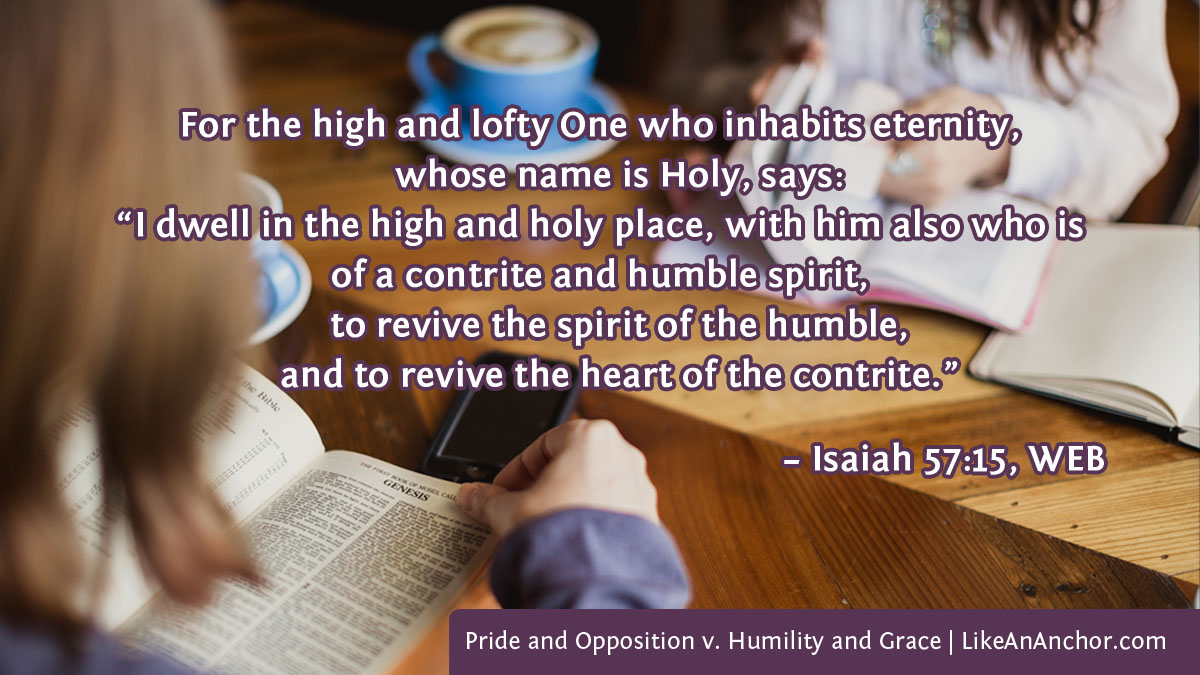
Image of two women studying their Bibles overlaid with text from Isaiah 57:15, WEB version:  "For the high and lofty One who inhabits eternity, whose name is Holy, says: 'I dwell in the high and holy place, with him also who is of a contrite and humble spirit, to revive the spirit of the humble, and to revive the heart of the contrite.'"
Image by Shaun Menary from Lightstock

Proverbs 3:34 In James

Let’s look at the passage where James quotes this proverb. It’s the verse that inspired me to take a closer look at this topic (interestingly, I’d made myself a note to study grace and pride next, and then the sermon I heard last Sabbath also covered pride). We’ll start reading several verses before the quote for context.

Where do the conflicts and where do the quarrels among you come from? Is it not from this, from your passions that battle inside you? You desire and you do not have; you murder and envy and you cannot obtain; you quarrel and fight. You do not have because you do not ask; you ask and do not receive because you ask wrongly, so you can spend it on your passions.

Adulterers, do you not know that friendship with the world means hostility toward God? So whoever decides to be the world’s friend makes himself God’s enemy. Or do you think the scripture means nothing when it says, “The spirit that God caused to live within us has an envious yearning”? But he gives greater grace. Therefore it says, “God opposes the proud, but he gives grace to the humble.” So submit to God. But resist the devil and he will flee from you. Draw near to God and he will draw near to you. Cleanse your hands, you sinners, and make your hearts pure, you double-minded. Grieve, mourn, and weep. Turn your laughter into mourning and your joy into despair. Humble yourselves before the Lord and he will exalt you.

James 4:1-10, NET (bold italics mark a quote from Prov. 3:34)

The phrase “but he gives greater grace” puzzles me. Why not simply “grace;” isn’t that already great? What is “greater grace,” and why is it contrasted with the human spirit that lives in us? Then, why does that contrast lead into Proverbs 3:34 with a “therefore.” James clearly sees these concepts as both interconnected and very meaningful for us, so it seems like something we’d benefit from puzzling out.

Let’s go through this passage again. First, James calls attention to the source of conflicts among believers (the audience he’s addressing is the “brothers and sisters” in “the twelve tribes dispersed abroad” [Jas. 1:1-2, NET]). The root cause of these issues is wrong passions and desires for things of the world. It is a basic truth that loving and lusting after worldly things makes you God’s enemy. You can’t befriend the world and stay a friend of God.

Though James references scripture when he says, “The spirit that God caused to live within us has an envious yearning,” it doesn’t exactly match any Old Testament verse. The NET translators point out, “No OT verse is worded exactly this way. This is either a statement about the general teaching of scripture or a quotation from an ancient translation of the Hebrew text that no longer exists today” (note on James 3:5). We do know from scripture that God breathed life into man in the garden of Eden, and that there is a big difference between that human spirit and the holy spirit of God (Gen. 2:7; 1 Cor. 2). In Jeremiah, God said, “The heart is deceitful above all things and it is exceedingly corrupt” (Jer. 17:9, WEB). Another translation phrases this line, “The human mind is more deceitful than anything else. It is incurably bad” (Jer. 17:9, NET). Perhaps that verse in Jeremiah was one of the scriptures James had in mind when we wrote his letter.

When you focus in on descriptions like “hostility toward God,” “envious yearning,” “exceedingly corrupt,” and “incurably bad,” it makes more sense why we desperately need grace that stands in sharp contrast to that human spirit inside us. In Greek, the word translated “greater” is meison (G3187), the comparative form of megas (G3187; root of the English word “mega”). It describes something that is “greater, larger, elder, stronger” (Thayer’s dictionary, entry G3187). The grace God gives us is bigger, older, stronger, and so much greater than the problems we face within or outside of ourselves. I think the emphasis here is that while human nature can be terribly wicked and hostile to God, His grace is surpassingly greater. He can fix even the most prideful, quarrelsome person if they are willing to cleanse their hands, purify their hearts, “grieve, mourn, and weep” over their sins, and admit they need His grace.

Image of a man praying in a church overlaid with text from Proverbs 16:5-6, WEB version:  “Everyone who is proud in heart is an abomination to Yahweh: they shall certainly not be unpunished. By mercy and truth iniquity is atoned for. By the fear of Yahweh men depart from evil.”
Image by Matt Vasquez from Lightstock

Proverbs 3:34 In 1 Peter

When Peter quotes this proverb, he also focuses on how people in the church interact with each other. His emphasis is not so much on the depravity of human nature and the necessity of repentant humility, though. He’s urging his readers–particularly those in leadership–to care for others without lording over them. Really, though, submission and humility is a subject that’s relevant for everyone, as supported by the proverbs quote.

 So as your fellow elder and a witness of Christ’s sufferings and as one who shares in the glory that will be revealed, I urge the elders among you: Give a shepherd’s care to God’s flock among you, exercising oversight not merely as a duty but willingly under God’s direction, not for shameful profit but eagerly. And do not lord it over those entrusted to you, but be examples to the flock. Then when the Chief Shepherd appears, you will receive the crown of glory that never fades away.

In the same way, you who are younger, be subject to the elders. And all of you, clothe yourselves with humility toward one another, because God opposes the proud but gives grace to the humble. 

1 Peter 5:1-5, NET (bold italics mark quote from Prov. 3:34)

There’s a Rick Warren quote that says, “Humility is not thinking less of yourself, but thinking of yourself less” (The Purpose Driven Life, Day 19). Similarly, C.S. Lewis wrote that “if you meet a really humble man … He will not be thinking about humility: he will not be thinking about himself at all” (Mere Christianity, Book 3, Chapter 8). Our focus shouldn’t be on ourselves, but on doing the will of God. We need to realize that pride is a sin, confront it in our lives (identifying it, repenting of it, and asking God to help us change), and move forward with living lives patterned after God’s holiness. That will help us in our relationships with others. It will open us up to God’s grace. And it even helps us in our spiritual battles (which James also mentioned when he said, “resist the devil and he will flee from you”).

Image of a woman reading the Bible with the blog's title text and the words  "When we humbly admit pride is a problem and ask God for help keeping it out of our lives, He graciously aids us with all our cares and empowers us to win spiritual battles."
Image by Pearl from Lightstock

And all of you, clothe yourselves with humility toward one another, because God opposes the proud but gives grace to the humble. And God will exalt you in due time, if you humble yourselves under his mighty hand by casting all your cares on him because he cares for you. Be sober and alert. Your enemy the devil, like a roaring lion, is on the prowl looking for someone to devour. Resist him, strong in your faith, because you know that your brothers and sisters throughout the world are enduring the same kinds of suffering. And, after you have suffered for a little while, the God of all grace who called you to his eternal glory in Christ will himself restore, confirm, strengthen, and establish you. To him belongs the power forever. Amen.

1 Peter 5:5-11, NET (bold italics mark quote from Prov. 3:34; italics may be an allusion to Ps 22:13)

I’ve been wrapping up final copyedits this week on the Like An Anchor Study Guide: Armor of God book (which I’d planned to release last month, but I temporarily lost all my editing notes when we moved), so this feels like a particularly relevant passage right now. One of the things we need to realize when approaching spiritual warfare is that we can’t do it on our own. Thinking you can stand up against the roaring lion all by yourself is a recipe for disaster. We need to humble ourselves before the Almighty and entrust Him with all our cares. Then we can stand against His adversary while wearing His armor (Eph. 6:10-18).

Also, notice that Peter once again calls our attention to “the God of all grace” before wrapping up his letter. It is God’s charis–favor within a reciprocal covenant relationship–that enables us to live humble, victorious lives. His “greater grace” makes it possible for us to overcome pride in ourselves and to resist our adversary the devil, who was so proud he thought he could overthrow God. When we give into that same sin of pride, we’re putting ourselves on the wrong side of that battle. But when we humbly admit pride is a problem and ask God for help getting rid of it and keeping it out of our lives, He graciously aids us with all our cares and empowers us to win spiritual battles.


Featured image by Matt Vasquez from Lightstock

God Chose You Even Knowing You’ll Mess Up

This Sabbath follows shortly after the Passover–a day when we remember Jesus’s death and His sacrifice for sins. He told us to keep that day “in remembrance of me” with the symbols of His new covenant. As we think about His sacrifice, we’re forced to consider the terrible price that justice for humanity’s sins–including our sins–demanded. Jesus died an excruciating death. He endured that with His eyes fixed on “the joy set out for him” because He knew that sacrifice was needed to grow His and His father’s family.

Recognizing the high price Jesus paid for us should humble us deeply and move us to genuine repentance. It should also boggle our minds with a realization of His overflowing love. God has been inviting people into His family for thousands of years even though He knew the cost of that welcome. Moreover, He still chooses us today knowing that even after we receive the gift of forgiveness we’ll mess up again. Thankfully, Jesus’s perfect sacrifice keeps covering those sins when we repent after making a mistake; He doesn’t need to be sacrifice again each time we slip-up (Hebrews 10:1-18). God chooses us and keeps showing us mercy even knowing we’ll mess up. This is a kind of love that people rarely offer to each other, but the Creator of all things gives it to us.

A History of Gracious Relationships

Long ago, God chose to form a covenant with Abraham and with his children. Those descendants grew into a nation called Israel, and God delivered them from Egypt on the first Passover. About 50 days later (very likely on the day of Pentecost), God made a covenant with them as well. About 40 years later, when Israel was finally ready to go into the promised land, God had this conversation with Moses:

“Behold, you shall sleep with your fathers. This people will rise up and play the prostitute after the strange gods of the land where they go to be among them, and will forsake me and break my covenant which I have made with them. Then my anger shall be kindled against them in that day, and I will forsake them, and I will hide my face from them, and they shall be devoured, and many evils and troubles shall come on them; so that they will say in that day, ‘Haven’t these evils come on us because our God is not among us?’ I will surely hide my face in that day for all the evil which they have done, in that they have turned to other gods.

“Now therefore write this song for yourselves, and teach it to the children of Israel. Put it in their mouths, that this song may be a witness for me against the children of Israel. For when I have brought them into the land which I swore to their fathers, flowing with milk and honey, and they have eaten and filled themselves, and grown fat, then they will turn to other gods, and serve them, and despise me, and break my covenant. It will happen, when many evils and troubles have come on them, that this song will testify before them as a witness; for it will not be forgotten out of the mouths of their descendants; for I know their ways and what they are doing today, before I have brought them into the land which I promised them.”

Deut. 31:16-21, WEB

God knew Israel wouldn’t be faithful, but He chose them anyway and told them to keep coming back to Him when (not if) they strayed from the right path. Similarly, He choses us knowing we’ll make mistakes and already planning to keep welcoming us each time we turn back to Him repentantly asking for forgiveness. When we begin this relationship with God He asks us for faithfulness, we promise to be faithful, and He accepts that promise even though he knows we’ll slip up and He’ll need to forgive us again.

Even at my best, my faithfulness involves falling, picking myself up (or Him picking me up), and then recommitting to walking with God. I’m encouraged looking at centuries of Bible history that records God’s grace-fueled relationships with people. There’s so much forgiveness available from God; so many calls in His word for people to keep coming back to Him. The whole process of us trying to be faithful to God is enabled by His faithfulness.

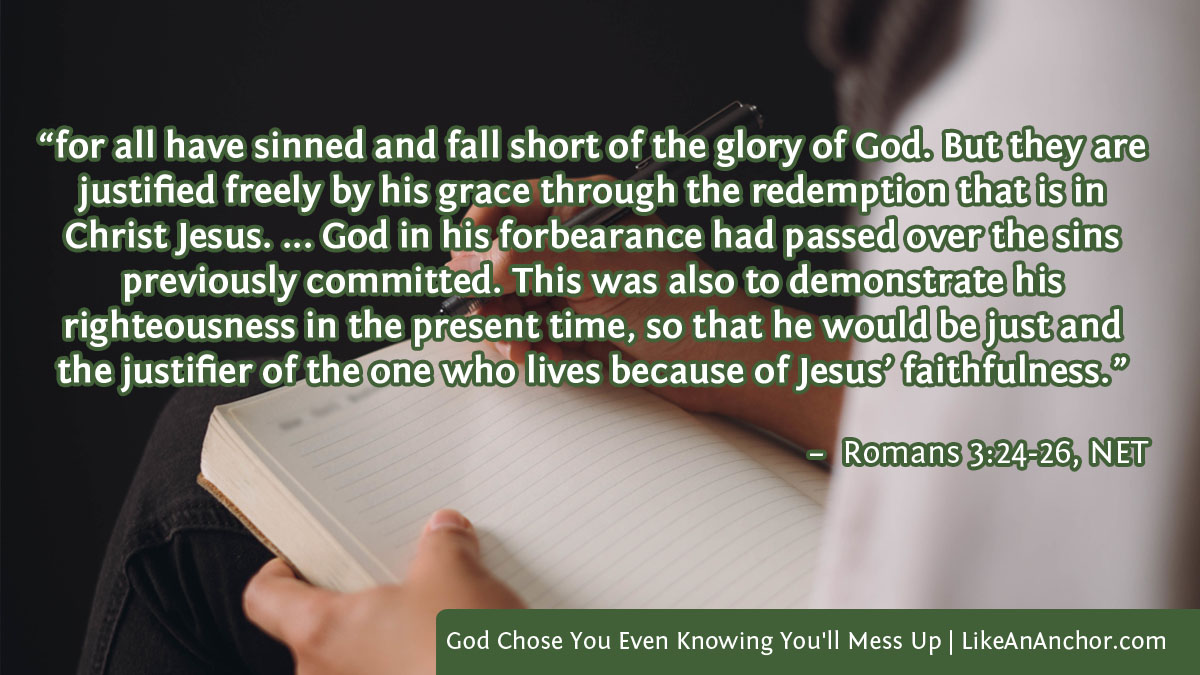
Image of a woman writing in a notebook, with text from Romans 3:24-26,  NET version: “for all have sinned and fall short of the glory of God. But they are justified freely by his grace through the redemption that is in Christ Jesus. ... God in his forbearance had passed over the sins previously committed. This was also to demonstrate his righteousness in the present time, so that he would be just and the justifier of the one who lives because of Jesus’ faithfulness.”
Image by Corey David Robinson from Lightstock

Saved Before We Were Good

Paul’s letter to Rome is one of the Bible books that I find most fascinating. There’s so much packed into this letter about our relationship with God and how His expectations for us work in the New Covenant. Paul spends quite a bit of time discussing the topic of God choosing us even though it’s still a battle for us to live in the spirit rather than in the flesh.

Therefore, since we have been declared righteous by faith, we have peace with God through our Lord Jesus Christ, through whom we have also obtained access into this grace in which we stand, and we rejoice in the hope of God’s glory. Not only this, but we also rejoice in sufferings, knowing that suffering produces endurance, and endurance, character, and character, hope. And hope does not disappoint, because the love of God has been poured out in our hearts through the Holy Spirit who was given to us.

For while we were still helpless, at the right time Christ died for the ungodly. (For rarely will anyone die for a righteous person, though for a good person perhaps someone might possibly dare to die.) But God demonstrates his own love for us, in that while we were still sinners, Christ died for us. Much more then, because we have now been declared righteous by his blood, we will be saved through him from God’s wrath. For if while we were enemies we were reconciled to God through the death of his Son, how much more, since we have been reconciled, will we be saved by his life? Not only this, but we also rejoice in God through our Lord Jesus Christ, through whom we have now received this reconciliation.

Romans 5:1-11, NET

God’s love is so amazing. No one could reasonably expect someone as perfect or as important as God to die for people like us. Most human beings would hesitate to die even for a good person, and we weren’t even good (Rom. 3:24-26). We are family, though, because God the Father decided He wants us to be His children. He claims us as His, justifies us even though we fall short of His glory, and gives us life through Jesus’s faithfulness.

Image of a smiling woman with her arm raised in worship with text from Lamentations 3:22-23, TLV version: “Because of the mercies of Adonai
    we will not be consumed,
    for His compassions never fail.
They are new every morning!
    Great is Your faithfulness.”
Image by Pearl from Lightstock

Mercies and Great Faithfulness

It’s incredible to think of how much God loves us and of the high price He was willing to pay to remove our sins and get us into His family. Knowing that God chose us despite our past sins and even though we aren’t perfect yet should both humble and inspire us.

It’s a strange sort of balance that we’re to have in our thinking. We’re supposed to be confident while acknowledging we have no power or strength on our own. We can fully embrace our importance to God, yet we must never become puffed up and self-important. We get to be heirs in God’s family alongside Jesus, but we must give thanks for God’s mercy and continue following His example rather than boasting about what He has given us.

Image of a man praying with the blog's title text and the words "Knowing that God chose us despite our past sins and even though we aren't perfect yet should both humble and inspire us."
Image by WhoisliketheLord Studio from Lightstock

So in the same way at the present time there is a remnant chosen by grace. And if it is by grace, it is no longer by works, otherwise grace would no longer be grace. What then? Israel failed to obtain what it was diligently seeking, but the elect obtained it. The rest were hardened …

But if you boast, remember that you do not support the root, but the root supports you. Then you will say, “The branches were broken off so that I could be grafted in.” Granted! They were broken off because of their unbelief, but you stand by faith. Do not be arrogant, but fear! For if God did not spare the natural branches, perhaps he will not spare you. Notice therefore the kindness and harshness of God—harshness toward those who have fallen, but God’s kindness toward you, provided you continue in his kindness; otherwise you also will be cut off. And even they—if they do not continue in their unbelief—will be grafted in, for God is able to graft them in again.

Romans 11:5-6, 18-21, NET

Here, Paul explains to his readers that even though many of the the peoples descended from ancient Israel turned their backs on God, He hasn’t given up on anyone. Rather, the Lord “has consigned all people to disobedience so that he may show mercy to them all” (Rom. 11:32, NET). This is a tricky verse, but I think it means that God chooses to treat people who ignore Him or who’ve broken covenants their ancestors made with Him as if they are ignorant and disobedient rather than unredeemably wicked. We’re accountable for what we know and what we do (see Rom. 2-3), but God still chooses mercy over judgment whenever He can (James 2:13).

As we embrace our godly identities more and more fully, we also become more and more like God. And the better we understand His holiness the more easily we see how far from being like Him we really are even as we get better at living His way of life. Alongside that comes an increased appreciation for the incredible gifts of His faithfulness, forgiveness, and mercy that keep guiding us back to Him when we miss the mark. God isn’t surprised that we aren’t perfect yet. He chose us anyway, and He keeps choosing us. We can take comfort in that, knowing that He’s just as invested (and often more so) in getting us into His kingdom as we are in being there.

Featured image by Shaun Menary from Lightstock

Song Recommendation: “Who Am I?” by Casting Crowns

The Beatitudes, Part One: Blessed Are The Poor In Spirit

We’re only two weeks away from the first of the fall holy days on God’s sacred calendar. Yom Teruah (Day of Trumpets, also called Rosh Hashanah) is on September 19th this year. Yom Kippur (Day of Atonement) follows ten days later. Traditionally, those ten days and the month leading up to Yom Teruah are a time of reflection and self-examination for Jewish and Messianic believers.

There’s been a lot to distract us lately. I wanted to bring my Bible study back to basics, and also use that as a tool to look at myself and how I’m doing as we move into this fall holy day season. Today’s post is the first of a series on the Beatitudes. As an interesting note, I looked up the word history for “beatitudes” in the Online Etymology Dictionary and found that it comes into English “from Middle French béatitude (15c.) and directly from Latin beatitudinem.” It means “a state of blessedness” not, as some clever speakers have said, a “be-attitude” (as in, an attitude you’re supposed to “be”).

No Glory In Ourselves

The beatitudes come at the beginning of the sermon on the Mount, which Jesus delivered to His disciples after withdrawing from the multitude and traveling up onto a mountain (Matt. 4:23-5:2).

“Blessed are the poor in spirit, for theirs is the Kingdom of Heaven.” (Matt. 5:3, all scriptures from WEB translation)

Jesus had a few Greek words He could have picked that would translate into English as “poor.” The one He used is ptochos (G4434). It means “reduced to beggary,” destitute, helpless, powerless, “lacking in anything” (Thayer’s dictionary). This does not refer to someone who is poor but still able to earn a subsistence. The ptochos have nothing (Zodhiates’s dictionary).

Adding “in spirit” means Jesus isn’t talking about physical poverty, though. Being “poor in spirit” involves acknowledging our own spiritual helplessness. We don’t have to be destitute physically, but we do need to realize that none of the physical stuff we have (or don’t have) can stop us from being spiritually destitute.

Yahweh says, “Don’t let the wise man glory in his wisdom. Don’t let the mighty man glory in his might. Don’t let the rich man glory in his riches. But let him who glories glory in this, that he has understanding, and knows me, that I am Yahweh who exercises loving kindness, justice, and righteousness in the earth, for I delight in these things,” says Yahweh. (Jer. 9:23-24)

Blessed are those who don’t let intellect, might, wealthy, or worldly prestige get in the way of their commitment to God. It can be hard to have an accurate view of your spiritual helplessness if you’re wise, mighty, or noble, but we must all become “poor in spirit” if we are to live with God (1 Cor. 1:25-31).

The Right Attitude for Dwelling With God

God is looking for those who have a poor, or humble, spirit. He always has been, and this wasn’t a new Concept for Jesus’s Jewish audience.

For the high and lofty One who inhabits eternity, whose name is Holy, says: “I dwell in the high and holy place, with him also who is of a contrite and humble spirit, to revive the spirit of the humble, and to revive the heart of the contrite.” (Is. 57:15)

God is so mighty, so powerful, so much higher than us. The more we understand Him and His greatness, the easier it is to be of a poor, humble, contrite spirit. Nothing we are is impressive compared to God, and we have nothing worth offering Him but ourselves.

Yahweh says, “Heaven is my throne, and the earth is my footstool. What kind of house will you build to me? Where will I rest? For my hand has made all these things, and so all these things came to be,” says Yahweh: “but I will look to this man, even to he who is poor and of a contrite spirit, and who trembles at my word.” (Is 66:1-2)

Having an understanding of our own relative unimportance and our spiritual helplessness are vital to a relationship with God. He doesn’t work with people who don’t want Him or who refuse to acknowledge they need Him. It is the “poor in spirit” who catch His eye, and they’re invited to dwell with Him forever.

Their’s Is The Kingdom

Not everyone is “given to know the mysteries of the kingdom of heaven” (Matt. 13:10-16). You need an invitation from God, and you need to respond to that invitation by turning to Him and becoming “as little children,” “for the Kingdom of Heaven belongs to ones like these” (Matt. 18:3-4; 19:14).

Therefore, brothers, be more diligent to make your calling and election sure. For if you do these things, you will never stumble. For thus you will be richly supplied with the entrance into the eternal Kingdom of our Lord and Savior, Jesus Christ. (2 Pet. 1:10-11)

God is seeking in us the humility and trusting nature of a child that knows all their needs will be met by loving parents. He wants us to grow and thrive and do great things, but the starting place for all that is a recognition of our spiritual helplessness. We need Him, and we need to know that we need Him in order to inherit the kingdom He has prepared for His people.

Featured image credit: Chris Mainland via Lightstock

The Fruit Of Gentleness

Meekness, gentleness, and mildness get a bad rap in today’s society. People tend to think of them as synonyms for being weak or boring. A door mat. But those three words I opened with are all possible translations of the Greek word praotes (G4236), which is listed as part of the fruit of the spirit in Galatians 5:22-23.

The spirit of God is not weak or boring. It is full of power, and it is also “love, joy, peace, patience, kindness, goodness, faith, gentleness, and self-control.” Indeed, though we may not think of these traits as “powerful,” we cannot display them all unless we’re empowered by God. It takes a great deal of inner strength, commitment, and willingness to be transformed by God to live-out the fruit of His spirit, including gentleness.

The Meekness of Christ

In his second letter to the Corinthians, Paul opened one of his lines of thought with the words, “I Paul, myself, entreat you by the humility and gentleness of Christ” (2 Cor. 10:1, WEB). The traits of gentleness, humility, and meekness that the world spurns are key to understanding Jesus Christ’s character. Read more

Make Pleasing God Your Lifestyle By Desiring What He Requires

Last Sabbath, I was at a young adult weekend centered on the theme “Desire What The Lord Requires.” All the seminars focused on Michah 6:8, which reads:

He has shown you, O man, what is good. What does Yahweh require of you, but to act justly, to love mercy, and to walk humbly with your God? (WEB)

One speaker mentioned something that really stuck in my mind. In this passage, God doesn’t tell His people to be just, merciful, and humble. He uses specific verbs instructing us to act, love, and walk in certain ways. This passage is focused on actions that come from developing God’s character. It goes beyond being like God to actively walking with Him. And though it doesn’t say so here, this should be something that we want to do rather than something we do just because it’s a requirement. God has always been concerned with the state of our hearts and the motives behind why we follow Him. We please Him when we do what He requires willingly and desire the same things He does.Make Pleasing God Your Lifestyle By Desiring What He Requires | marissabaker.wordpress.com

Act Justly

Matthew Henry’s and Adam Clarke’s commentaries says that to do or act justly means “to give to all their due.” Giving everyone what they are “due” from us includes giving God all our hearts, minds, souls, and strength, treating our neighbors as we would like to be treated, and also treating ourselves the way God intends.

Basically, acting justly is summed up in the two greatest commands (Matt. 22:36-40). That’s because the concept of justice is tied to God’s law, and the entire law hangs on the commands Jesus shared about how to love God and our neighbors. Read more