I have issues with trust. I knew this to a certain extent, but being in a relationship has brought it to the forefront of my attention. My boyfriend wants to build the kind of trust that I’ve always wanted in a relationship, which is fantastic. But it’s harder to get there than I was expecting and that’s frustrating for both of us. I probably feel safer with him than anyone else who I haven’t known a minimum of 10 years and yet I still feel nervous opening up to him and being “me” around him.
As I mentioned a few weeks ago, I love Brené Brown’s TED talks. Since writing that post, I’ve read her book The Gifts of Imperfection and I’m halfway through Daring Greatly. Since I’ve been confronting some deep-seated fear issues as well as this trust thing, they’ve been really good books for me. They’re tough, though. For example, she has a list of 10 things that “Wholehearted” people who believe in their worthiness do. I’ve only got one down pretty good and maybe half of two others. And that’s even though all 10 points on the list are things that, in theory, I agree are good and which I’ve considered worth pursuing for quite some time.
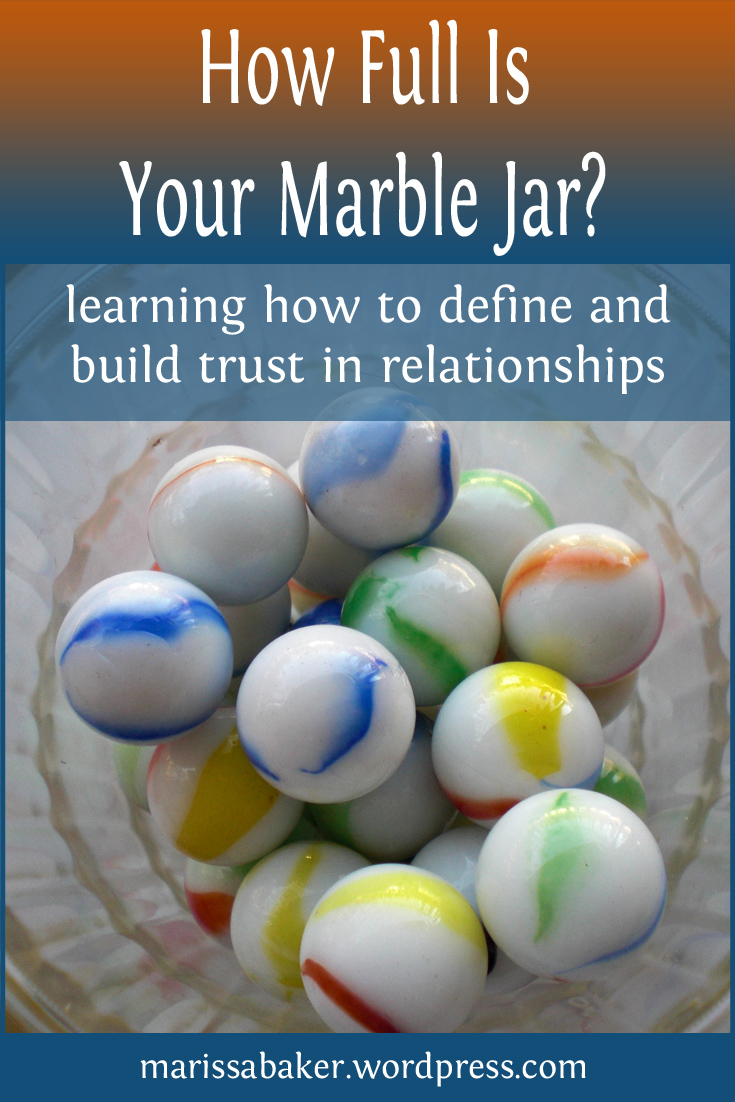
Earlier this year, Brené Brown gave a talk called “The Anatomy of Trust.” In this talk, she tells a story that she also relates in Daring Greatly about her daughter experiencing a betrayal of trust at school. You can click here to read the full story or just watch the video below, but in short summary the situation got so bad that the teacher took marbles out of the Marble Jar (marbles go in when the kids are making good choices and come out if they’re breaking rules, acting out, etc.). Read more →
Disclaimer: some of the links in this post are affiliate links. This means that, at no additional cost to you, I will receive a commission if you click on the link and make a purchase on that website.
INFJ personality types* often live with ridiculous amounts of guilt. We feel guilty about things we did and didn’t say or do. We feel guilty about how the people around us feel and how they react to us, about our own short comings, and even about our successes.
Everyone experiences a certain amount of guilt. But it does seem like one of the more common struggles for INFJs. Most people attribute this propensity for guilt to INFJ perfectionism, saying that if we fail to make something “perfect” we’ll feel guilty about it. But it’s a bit more complex than that (a fact which, I’m sure, will surprise no one familiar with INFJs).
The INFJ mind is very good at coming up with reasons we should feel guilty. Our Introverted Intuition seeks out patterns in our own behavior. Our Extroverted Feeling picks up on how we make others feel and evaluates our actions in light of how people “should” be. Our Introverted Thinking is quite happy to analyze our faults to death. And that pesky Extroverted Sensing adds even more guilt by whispering that all this shouldn’t matter and we could just go have fun. Read more →
Think INFJs are hard to figure out? Have you found yourself puzzled by an INFJ’s contradictory words and behavior? Well there’s no need to worry any more. I’ve got your quick, easy, and not-at-all-confusing guide to finding out if an INFJ agrees with you. No more will those mysterious unicorns of the personality type world confuse you in conversation. No longer will their confrontation-avoidance leave you wondering whether an INFJ actually agrees with what you’re saying or is simply making you think they do so you won’t get upset with them.
Nodding mostly means we’re listening to you, so this could really go either way. Cross-check with other signs.
Eye Contact
Making eye contact typically means the INFJ agrees with you. Not making eye contact could mean one of three things: they disagree with you, they don’t care, or they agree with you but don’t want to admit it.
Non-Committal Sounds
An INFJ who’s making sounds like “um-hum” while glancing away looking for an escape doesn’t agree with you. But if they’re making the same sound with eye-contact while leaning toward you and smiling, then you’re good. Probably. Read more →
There are very few things I enjoy more than bringing home a new blanket and burrowing deep into its soft, fluffy folds. The Big One throws from Kohls are my particular weakness — oversized, incredibly soft, and occasionally on sale for $10. I can’t get enough of them. They’re scattered around the house. I rarely sit down even in the summer without draping one over my legs. I sleep with one inside my sheets so I can feel the soft plushness against my skin.
If you’re familiar with Myers-Briggs personality types and what I just shared about fluffy blankets was all you had to go from in typing me, you’d probably say I was a Sensing type. After all, S-types are the ones that pay attention to and enjoy sensory details. Intuitive are too head-in-the-clouds to care about things like this (if you want to be hard on them) or they have “better things to think about” (if you’re more of an intuition snob).
But I’m an INFJ, which means Extroverted Sensing is the mental function I’m least comfortable with. So why am I obsessed with texture? Because it’s not just fluffy blankets. If you walk through a store with me you’ll see I touch clothing, purses, blankets, etc. as I walk by. I once bought a purse just because the leather felt soft as butter (that description doesn’t make much sense, but it’s what popped into my head at the time).
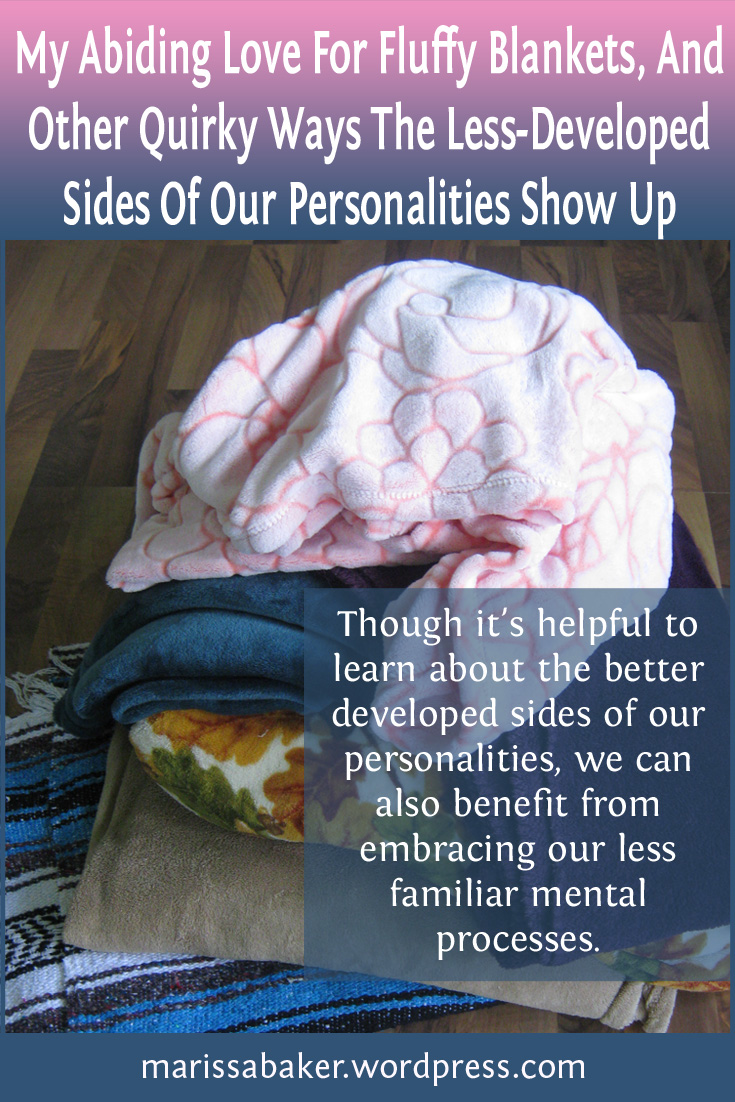
real photo of my fluffy blanket collection
Disclaimer: some of the links in this post are affiliate links. This means that, at no additional cost to you, I will receive a commission if you click on the link and make a purchase on that website.
The thing is, our inferior functions aren’t just hiding somewhere waiting to show up and wreck your life when you get stressed. That’s why I like Personality Hacker’s car model,* which describes your fourth-favorite mental process as a 3-year-old. When things are going wrong the screaming 3-year-old is going to consume all your time. This is more scientifically called being “in the grip” of your inferior process. But when you’re pretty well balanced it’ll be napping or happily cooing in the backseat (perhaps while stroking a plush throw).
You’ll probably never be really comfortable or effective at using your inferior function for day-to-day living. But you can befriend that side of your psyche instead of trying to ignore it or seeing it as an enemy. You can also focus on developing your inferior function, as I suggested in my post “Getting In Touch With Your Sensing Side” for INFJs and INTJ. And you can also enjoy and accept the quirky little ways it’s already showing up in your life.
Maybe you’re a dominant intuitive who loves sensory details like fabric texture or subtle spices in food.
Maybe you’re a dominant sensor and you enjoy escaping into theoretical worlds through fantasy and sci-fi.
Maybe you’re a dominant feeler who’s fascinated by computer programing or logic puzzles.
Maybe you’re a dominant thinker and spend your down-time reading touching stories about people’s lives.
fluffy blankets + pillows = heaven
As helpful as it is to learn about the better developed sides of our personalities, it’s not all that useful to identify with them completely. If an INFJ thinks of themselves only as an introverted intuitive who makes decisions based on their feelings, they’ll be ignoring key aspects of their personalities. And when we do that, we not only cheat ourselves of growth potential but also start drawing more rigid “us versus them” lines in our minds. I mean that in the sense of ideas like, “I’m an intuitive, so I can’t communicated with sensors.” But if we can recognize that our personalities are deeply nuanced, we’ll also realize we have more in common with “other people” than we might have thought at first.
Personality types aren’t meant to make you think of yourself as better than everyone else. They’re meant to help you recognize your unique gifts and also appreciate the gifts of other people (hence the title of Isabel Myers’ book, Gifts Differing). And once they help you discover the ways you’re different the typology framework can also help you discover ways you’re similar to other people. Even a type that you share no letters with and seems your complete opposite (INFJ and ESTP, for example) shares the same mental processes as you, just in a different order.
Do any of you see your inferior function showing up in your habits, quirks, and preferences? What sort of things do you do and enjoy that aren’t “typical” for your personality type?
A few weeks ago a fellow INFJ named Bo Miller contacted me and asked if he could interview me on his new podcast. After picking my jaw up off the floor and texting my boyfriend to share that I was equal parts terrified and excited, Bo and I started a conversation that led to this interview. Our conversation focused on how INFJs can understand and learn to use their Extroverted Feeling and Introverted Thinking functions.
I already shared this link on my Facebook page, but in addition to the podcast I have a special treat for you all today as well. Bo is a Certified Myers-Briggs practitioner and the creator of iSpeakPeople.com as well as The INFJ Personality Show. He recently published The INFJ Personality Guide and would love to give you a free copy. I haven’t read it yet myself, but from my conversations with him I’m pretty well convinced it’s going to be really good. I hope you’ll grab a copy and check out his website. Here’s more info:
In The INFJ Personality guide, you’ll discover…
• Your greatest strengths
• Your weaknesses
• Why the rest of the world thinks differently than you
• Why you’re so good at discerning people’s thoughts, motivations, and feelings
• How to set better boundaries
• How to cultivate healthy relationships
• What to do when you get down or depressed
• Career advice
• How to manage your thoughts
• How to make your creative ideas, insights, and visions a reality
• How to communicate more effectively with other personality types
• How to handle criticism without getting your feelings hurt
The guide is divided into three sections:
• INFJ preferences
• INFJ functions
• How to develop your personality and reach your potential
So you want to date an INFJ. I’m not quite sure whether to congratulate you or pat you consolingly on the shoulder. Perhaps both.
Assuming you want this relationship to go well, one of the most important things you can do is try to understand your INFJ love-interest. We’re the rarest personality type and we often feel misunderstood and alone. Showing us that’s not going to happen with you will instantly endear you to an INFJ’s heart.
And so here you are learning about the 15 things INFJs really want you to know as you begin a relationship with us. They might not all be equally true of every INFJ, but this list is the result of feedback from and discussion with nearly 20 different INFJs so you’re getting a pretty good idea of what we’d like to say to you.
Even though I’m an INFJ myself and I’ve written a fairly successful book about the INFJ personality type, I still like to get feedback from other INFJs before writing a post like this. And so I want to say a big “Thank you” to everyone in the Facebook group INFJs Are Awesome who responded to my question about what they thought people should know before dating an INFJ. You guys helped make this post so much better than if it were just me typing away my thoughts in a vacuum.
1) We take relationships very seriously
While there are some INFJs who will have one-night-stands or enter casual relationships, most of us are interested in something long-term. If you’re not willing to take the relationships seriously we need to know that up-front so we can make a decision about whether or not to bother with you. Most of us know how to be alone and we’d rather stay single than settle for a relationship that just adds stress and anxiety to our lives. We also have a vision for how we want our lives to go and we’ll be going into a relationship trying to figure out how you might fit in with that vision.
2) We need to feel safe and accepted
This one is huge for INFJs. If you’re not a safe person for us to be around then we either 1) won’t enter a relationship with you or 2) will be trying to get out of the relationship. We desperately need to know you won’t dismiss us. We don’t actually expect you to fully understand all our quirks, nuances, and oddities but we need to know you will accept and even love them. We need to know you’re interested in getting to know the “real” version of us and that you won’t run away when we start opening up. Similarly, we typically have strong values and we’re looking for someone who lines up with them. INFJs can be very accepting of other people’s differences, but the closer you get to us the more closely we want you to line-up with our core beliefs. Read more →


 Like An Anchor