Part Two: “Unofficial” Disney Princesses MBTI Chart

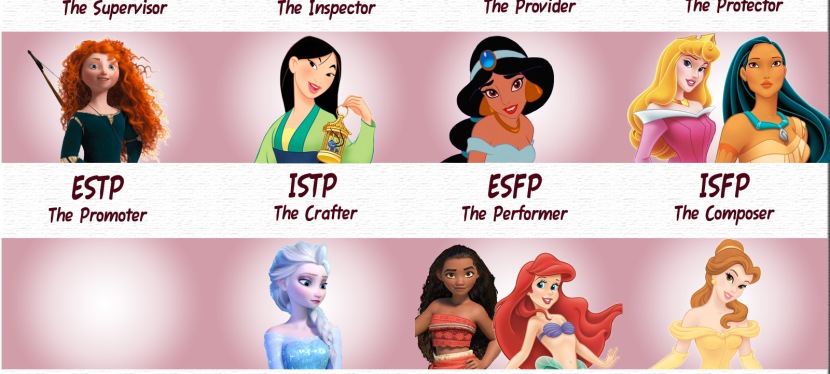
Last week, I updated an old post called The Missing Disney Princesses with a brand new MBTI Chart featuring the 14 official princesses (well, technically there are 11 official princesses, plus Anna and Elsa who have their own line, and Moana who hasn’t been crowned yet. So it was more like the “Official + New/Popular Princesses Chart”).

There are other Disney women, though, who’ve been completely snubbed by the Disney princess line-up and I wanted to include those as well. I had them on a separate chart in my previous post and I wanted to follow that pattern this time as well. Eilonwy and Alice were the most requested characters I left out last time, so I’m adding them. And I’ve also added a character no one asked about from my favorite underappreciated Disney films — Maid Marion from Robin Hood.Updated Disney Princesses MBTI Chart, Part Two | marissabaker.wordpress.com

Note: I’m not using anything from sequel films (just to help narrow-down the typing choices), so that’s why you won’t see Ariel’s daughter Melody (for example). I also type using cogitative functions. If you’re not familiar with that aspect of Myers-Briggs theory, click here and here for a two-part introduction. Read on for detailed explanations for why I chose these types for the unofficial princesses, and click here for the post about the other princesses.
Read more

Updated Disney Princesses MBTI Chart

A couple years ago, I made a Myers-Briggs chart called The Missing Disney Princesses that quickly became one of the more popular posts on my blog. Now (finally!!!) I get to update it to include our new princess, Moana.

But I’m not just adding Moana to my chart. I’m also moving around a few of the other princesses. Last time, my focus was on showing that we don’t see all the personality types represented by the Disney princesses. Both Intuitive and Thinking types are under represented among Disney’s ladies. That’s still the case, but this time my focus is on explaining why I typed each princess the way I did.

In the two years since publishing the last chart, I’ve learned more about Myers-Briggs typing. I’ve also re-watched several of these movies, considered comments from readers on the previous post, and asked advice from fellow personality type and Disney enthusiasts. In response, I’ve re-typed several characters (which is noted and explained in the individual character discussions).Updated Disney Princesses MBTI Chart | marissabaker.wordpress.com

Note: I type using cogitative functions. If you’re not familiar with that aspect of Myers-Briggs theory, click here and here for a two-part introduction. Read on for detailed explanations for why I chose these types for each character. Read more

The Problem of Being Too Agreeable

INFJs place a high value on interpersonal harmony. Often, that manifests (especially in less mature/confident INFJs) as an unwillingness to just flat-out turn someone down. We’d much rather use “maybe,” “someday,” and “that might be nice” rather than “no,” “never,” and “I don’t think so.”

But that can back-fire on us and create discord in friendships. Other types can interpret our “maybes” as commitments, then get upset at us for breaking our word. Or they might recognize that we’re brushing them off and become frustrated by our refusal to give them a direct answer. Our attempts to avoid conflict can actually make things worse.

click to read article, "The Problem of Being Too Agreeable" | marissabaker.wordpress.com
Photo credit: “Smile Harder” by Kevin Galens, CC BY-SA via Flickr

Last week, we talked about one problem that can plague INFJ friendships — the fact that we have a tendency drop out of contact with our friends. It’s fairly easily explained from the INFJ’s perspective, but it can have an unintentional affect of hurting the people around us. Another similar (and in some ways related) problem is our temptation to noncommittally agree with what we think people want to hear, then ignore them and hope they forget about it. Read more

The Vanishing INFJ

I’ve written before about how other types can be friends with an INFJ. But there’s another side to that dynamic: what INFJs are like as friends. We can be fantastic friends — fun, engaging, good listeners, intensely loyal. But sometimes we’re not the best sort of friends and often, that’s the INFJ’s fault.

There are some things I love about being an INFJ personality type. And then there are other aspects which aren’t so nice, and some of those can negatively impact our friendships if we’re not careful. Today, I’m speaking of our tendency to drop out of contact with people.

click to read article, "The Vanishing INFJ?" | marissabaker.wordpress.com
photo credit: Tony Lam Hoang via StockSnap

Unique Mental Wiring

INFJs are a curious mix of mental processes. We’re most comfortable using Introverted Intuition (also called “Perspectives”). This is focused on collecting information about how the world works, processing it internally, and making speculative leaps about what it means. Basically, it’s advanced pattern recognition.

That’s paired with Extroverted Feeling (aka “Harmony”). This mental process is in-tune with other people’s feelings and wants to make sure their needs get met. It’s generally the first mental place INFJs go when trying to make a decision, asking, “How will this affect other people and my relationship with them?” When well-developed in an INFJ, they can be so outgoing and social that they seem like extroverts.

But we might also skip this process and spend more time in our tertiary Introverted Thinking (aka “Accuracy”). That one’s more about analyzing of facts, trying to make things “make sense to me.” It’s also impersonal. When INFJs spend more time inside their heads than on developing our extroverted side, we can stay in an introverted Intuition-Thinking loop.

Distracted By The Inner World

Using our Intuitive and Thinking process together isn’t always a bad thing for the INFJ. Our Extroverted Feeling side is important to develop so we can make decisions more easily, maintain friendships, and experience personal growth. But we to also need alone time to re-charge and it can be a good way to process data. It only becomes a problem sometimes when we get “stuck” in our introverted side. Read more

Religion and the INFJ

I’ve often seen INFJs described as an intensely spiritual type. Yet a little while ago, in an online INFJ group, someone posted that most INFJs are atheist or agnostic. Being a type that appreciates truth, someone else set up a poll trying to see if that was really the case.

It’s a small, volunteer sample group, but the results were interesting. 36% identified as atheist, agnostic or non-religious. That’s the same percentage that identified with a Christian religious sect. The remaining 28% identified as “spiritual” or with a non-Christian religion.

click to read article, "Religion and the INFJ" | marissabaker.wordpress.com
image credit: Amanda Jordan via StockSnap

INFJs approach religion much like we approach everything else: with an open, inquisitive mind looking for patterns, especially those relating to people. Our relationship with spirituality largely depends on how we were raised and the direction our lives took from there. But it also depends on our journeys of personal growth, how the religions we encounter line-up with our convictions, and whether or not faith “makes sense” to us.

The Hypocrisy Factor

Many INFJs I’ve seen talking about being non-religious started out in a church of some sort and then left. As with many people who leave churches, hypocrisy is often cited as the reason. INFJs are exceptionally good at detecting deception. We can read people well and pick up on inconsistencies in their patterns of behavior very quickly. At the same time, we want to believe the best of people and it can take a long time for us to admit someone who we value would betray us. Read more

Could Unselfishness Be The First Step To Overcoming Shyness?

Once again, I failed to introduce myself to someone. I’m 27 years old — by now I should have mastered the incredibly complicated art of walking up to someone visiting my own church group and simply saying, “Hi, I’m Marissa. Welcome. What’s your name?”

It would probably come out more as a squeaky “Hi” followed by awkward silence as I frantically tried to come up with words resembling normal small talk.

*sigh* So much for INFJs being “the most extroverted introvert.” Perhaps some INFJs are, but I’m not. I’m shy. I thought it was getting better, but apparently I still need more work battling my social anxiety.

click to read article, "Could Unselfishness Be The First Step To Overcoming Shyness?" | marissabaker.wordpress.com
photo credit: “Viene and friends” by Barry Pousman, CC BY via Flickr

Introversion is healthy for introverts. Shyness … not so much

Despite Google’s antiquated definition of introvert as “a shy, reticent person,” shyness and introversion are far from the same thing. “Shyness is the fear of negative judgment, and introversion is a preference for quiet, minimally stimulating environments” (quote from “Are You Shy, Introverted, Both, or Neither (and Why Does It Matter)?” by Susan Cain). Shyness produces anxiety in social situations, while introversion means you lose energy when around other people. The traits often go together, but extroverts can also be shy.

Introverts who aren’t shy still prefer the inner world of thoughts and ideas to the outer world of people and things, but they’re capable of socializing and even enjoy it. Extroverts who are shy want to spend their time in the outer world, but they’re scared of people.

One of the most genuinely friendly extroverted women I know was once shy. For her, the turning point from shy to social was when she realized her fear of talking was rooted in self-focus. It was about “I’m scared to talk with people,” or “Socializing makes me nervous,” or “What if they don’t like me?” Read more