Over the past couple weeks, without even looking for them, I’ve stumbled upon two blogs talking about Myers-Briggs types for fictional characters. One is a Tumbler called MBTI in Fiction. The other is a blog titled A Little Bit of Personality, with a series of posts analyzing heroic archetypes.
I’ve been intrigued by the characters each of these writers choose to type as INFJs. Neither of these writer’s are INFJs themselves (the writer from “MBTI in Fiction” is an ENTJ and the writer of “A Little Bit of Personality” is an ENTP), and it’s interesting to see who non-INFJs think are INFJs. I don’t always agree with them, but it’s interesting.
Loki
This was the first post I saw from MBTI in Fiction. My initial reaction was, “There’s no way Loki and I have the same personality type.” But I agree that he’s an introvert, and I don’t think he’s logical or grounded enough to be either an S or a T type, so that leaves us with INFJ or INFP. (Some people type him as an INTJ Mastermind, but he seems to rely on Extroverted Feeling more than Extroverted Thinking as a function).
Both INFJs and INFPs feel everything very deeply and trust their intuition. However, INFPs tend to keep their emotions to themselves, though feelings will inform all their actions. Outwardly, they appear “receptive and non-judgmental.” INFJs prefer to approach the world through Introverted Intuition (Ni), followed by Extroverted Feeling (Fe). They are the rarest type, often question their sanity, rely strongly on their intuitions about people, and tend to talk about their feelings. Dr. A.J. Drenth’s profile includes this descriptions, which I think sounds a lot like Loki (as played by Tom Hiddleston in The Avengers):
INFJs are far less serious inwardly than they may appear outwardly. Their inner world is well described as playful, imaginative, colorful, mischievous, and daring. Characterized by Perceiving rather than Judging, it is far less controlled and regulated than that of INFPs. INFJs love playing with ideas, perspectives, theories, images, symbols, and metaphors.
Another reason I’ve been won-over to typing Loki as an INFJ is because of the description of INFJ villains on A Little Bit of Personality’s page. It really does sound like Loki, and the last line hits a little too close to home for me to brush this analysis off as written by someone who just doesn’t understand INFJs.
When turned to villainy, the INFJ is *creepy*! There isn’t really any other word for it. Dark Paladins are the best of manipulators because they are incredibly intuitive about people and can apply their mild-manneredness to going under the radar as long as they need to, manipulating others who would never suspect them. Because they are so good at this and *know* it, pure-hearted INFJ’s often wonder if they are secretly evil and manipulative at heart, like one day they’ll wake up and realize they were bad all along.
Future Posts?
I was planning on covering several characters, but after I started writing Loki I decided one would be enough for a single post. Maybe I’ll write more at some other time, if anyone is interested. Are there any characters you’ve been thinking are INFJs? Would you be interested in me typing non-INFJ characters?
In keeping with my decision to blog every day of the Feast of Tabernacles, I’m going to share a story from a previous Feast for today’s post. I originally wrote this account to read aloud in a creative non-fiction class in 2011. The only thing I’ve edited from that version is changing the guys’ names, and my sister asked for her name to be taken out.
It was so hot in Panama City Beach that my glasses would steam up stepping outside from the air conditioned hotel. My family was there two years ago, in the fall, meeting with a church group that had chosen Florida as the location to observe the week-long Feast of Tabernacles, one of our annual Holy Days. Just a couple days into the Feast, my sister and I met two brothers, Quentin and Declan. Somehow, in the course of our conversation, the idea of kayaking on a nearby lagoon came up. Not entirely comfortable going anywhere with two guys we’d hardly known more than an hour, I was trying to politely refuse when Quentin suggested our whole family come. Well, surely he couldn’t be that dangerous if he was willing to include our Dad, Mom, and younger brother, so my sister and I agreed to the plan and invited the two brothers to eat lunch with our family in the condominium.
Of course, something had to go wrong. Mommy sliced her finger open on a can of pineapple, not too seriously, but enough to keep her from kayaking. Since she was laid-up, Daddy and my brother also stayed behind and my sister and I set out with Quentin and Declan. We split the cost of kayak rentals, but still, (or so my mother informs me) it was my first “date” as well as my first time kayaking. As it turned out, I enjoyed the kayaking part a lot more than the “dating” part. Quentin and I shared one kayak, and Declan and my sister shared the other. Both brothers had quickly lost interest in my sister after learning she was under 18, and I learned later that Declan and my sister hardly spoke the whole kayaking venture. By the time we got back to the hotel, I was convinced that lagging conversation would have been preferable to mine and Quentin’s discussion.
The kayaking adventure began promisingly. We watched pelicans ungracefully plop into the ocean and laughed at terns diving like missiles honing in on fish in the water below. The water was so clear you could look through the ripples and see fish swimming through snaky sea-grass while crabs skittered along the sandy bottom. Occasionally, a fish would randomly leap from the water, as if it was so happy to be alive that simply swimming was no longer enough and it had to take flight.
We had stopped paddling for a moment to take in the scenery when Quentin suddenly asked, “Have you heard of the book The Five Love Languages?”
I drew out my “Yes…?” like a question, which he took as permission to reveal that his love language was “Quality Time.” Then, as if the conversation were not awkward enough already, he went on to explaining that he particularly liked time spent with someone in a natural setting.
You mean like a lagoon in Florida, alone with someone you met just THREE HOURS AGO? I thought while mumbling something non-committal. Picking up my paddle, I cut short the conversation by steering our kayak back towards my sister’s and Declan’s kayak, vowing there was no way I was going to tell Quentin one of my primary love languages was “Touch”.
We had a lovely first day of the Feast yesterday. Our little group is live-streaming from Pacific Church of God, and the sermon yesterday was excellent. Mr. Railston’s main theme was using the Feast to make a positive difference in the lives of other people, instead of focusing on “what can I do for me this Feast?” Our focus should be on rejoicing with others and giving them reason to rejoice, not simply making ourselves happy.
There were two scriptures that particularly stood out to me. In a discussion of Matt. 22:35-40, Mr. Railston pointed out that the first great commandment, loving God, could be done in isolation. The second great commandment, to love your neighbor as yourself, must be fulfilled in the presence of other people. And here’s the second scripture:
We know that we have passed from death to life, because we love the brethren. He who does not love his brother abides in death. (1 John 3:14)
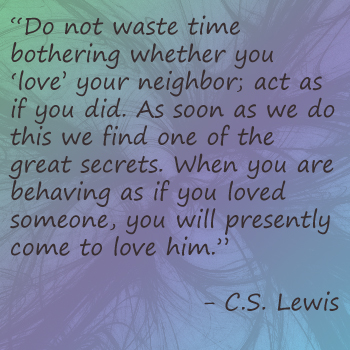
I’ve studied the subject of love in the Bible often, but I hadn’t thought much about the scripture in 1 John, or about the fact that we need to be around people to love them. It’s not that I really expected to love my brethren as a hermit — I just hadn’t thought of it in those words. I tend toward a more introspective approach to life, and my first reaction is to worry about changing myself and bringing “every thought into submission.” While it is important to be personally working toward perfection, I think my approach should probably be a little closer to C.S. Lewis’s councel to “not waste time bothering whether you ‘love’ your neighbor; act as if you did.” Sometimes action has to come before we feel like doing something or we think we’re perfectly ready.
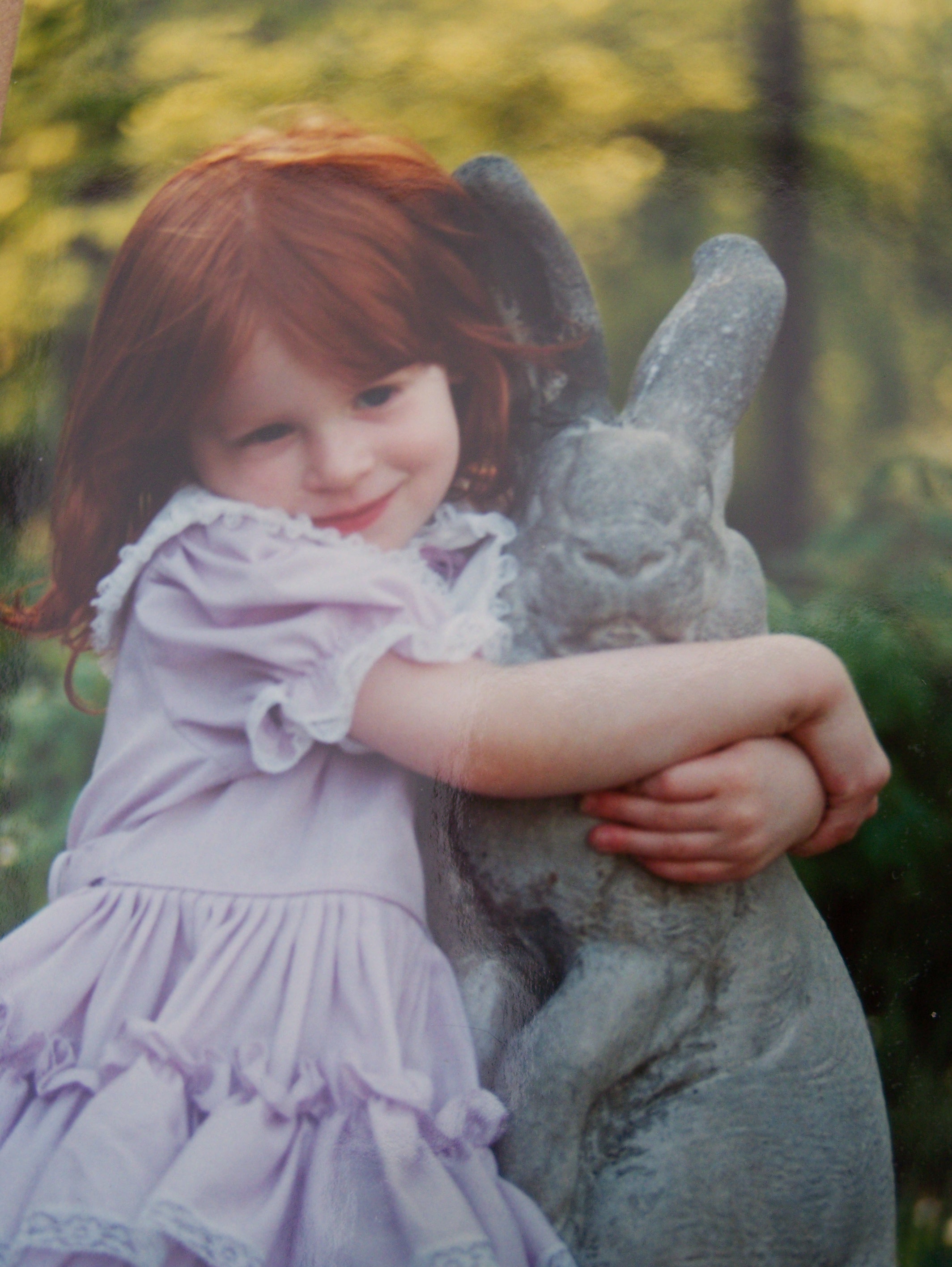
Once upon a time, there was a little girl named Marissa whose parents were worried about her going to kindergarten. She was going to be away from home all day, five days a week for the first time in her life. So her mother enrolled her in a summer school program where she would only be gone half a day, to help her get accustomed to being away from home.
Every time Marissa was dropped off at this school, her little sister would cry because Marissa was being abandoned. Years later, there are only two things Marissa remembers about this experience. One was that the teachers wanted her to take naps on a thin blue pad in the middle of a large room filled with strange people. She never slept because she was too nervous, but she had to lay there anyway. The second is hiding under the playset outside the school when all the children were sent outside so she wouldn’t have to face the other children (her mother says one of the boys hit her, but she must have blocked this memory).
One day, when Marissa’s mother picked her up from school, Marissa was crying. She asked, “Have I been away long enough? Can I come home now?” This broke her father’s heart, and he decreed that Marissa would never have to go back to school again.
After this short summer, I was homeschooled through all twelve years of elementary, middle, and high school. My sister also graduated from our homeschool, and my brother is currently finishing up high school at home. I’m one of those homeschooling success stories who went to college, earned better grades there than I did in high school from my mom, and earned my B.A. along with an undergrad research project that I’ve been assured could have gotten me into grad school and on track for my English PhD.
Socializing Homeschoolers
The previous paragraph aside, my goal today is not to defend the academic merits of homeschooling. I want to talk about socialization. Last week, a friend shared with me a great blog post that covered everything from the hypocrisy of America’s talk about “diversity,” to the merits of homeschooling, to defending introverts. In this post, Matt Walsh addressed the frequent claim that we need to send our children to public schools so they can “be socialized.”
In fact, kids who are homeschooled tend to be much better in “social situations” because they learned how to socialize from adults, rather than aping the personality traits of their peers. Public school doesn’t make kids “sociable,” and I think you could more accurately argue for the opposite. The whole concept that we need to send our children to government facilities to be “socialized” makes me shudder. Our children aren’t animals, and I wish we’d stop speaking about them as if they were.
This is a common argument from homeschool families and homeschooling supporters. I don’t exactly want to argue against it, but I have to admit my experiences are somewhat different. While the homeschooled me was quite comfortable socializing with adults and people younger than me, I was never very comfortable in my peer group (a fact that hasn’t changed much, though I’m a little more confident around other young people since going through college). The flip side of this is public school kids I’ve met who ignore younger kids and make no effort to hide the fact that they don’t want to talk with adults. There are, of course, both homeschoolers and public schoolers who are comfortable socializing with anyone and everyone (I suspect this is a personality-type thing more than a where-they-went-to-school thing).
Introverts in School
In a book titled Introvert Power, Laurie Helgoe (who holds a PhD in psychology) discusses the pressures that introverts face in an extroverted society, including the public school system.
In an extroverted society, we rarely see ourselves in the mirror. We get alienating feedback. Alienating feedback comes in the form of repeated encouragement to join or talk, puzzled expressions, well-intended concern, and sometimes, all-out pointing and laughing. … Alienating feedback happens where neighborhoods, schools, and offices provide no place to retreat. Alienating feedback happens when our quiet spaces and wilderness sanctuaries are seen as places to colonize.
Unfortunately, I don’t have her book in front of me at the moment and can’t find the other quote I wanted online. I’ll have to make do with a paraphrase. In her discussion of the school system, Helgoe talks about how the emphasis on group projects and participation in class can sabotage introverted children’s efforts to learn. Her idea isn’t to completely do away with this kind of work, but that schools should cater to different learning needs instead of trying to fit everyone into the extrovert-ideal mold. In the absence of such an education environment, she suggest homeschooling can be the best environment for an introverted child to learn because it allows them to utilize their strengths and can more easily be designed to fit individual children.
Though I did have friends my age while growing up — most through church, a few through homeschool groups — I did not really interact with a wide variety of people my age until I started college. There, I got a taste of what it might have been like for me to have gone to public school. After settling into life at college, I usually ate alone while reading, talked in class only when I was called on or had an idea I really wanted to share, and socialized with a few people one-on-one or in (very) small groups. And, in spite of the teacher who proclaimed that people eating alone was the most pathetic thing in the world because at heart we are (or should be) social animals, I was content with the level of socialization I enjoyed/avoided at college.
I don’t know exactly what would have happened had I been in public school instead of homeschooled those twelve years. If thrown into the social environment of public school while growing up, I might have made friends and “crawled out of my shell.” However, I suspect it would have been much more like my summer school experience and my first quarter of college, except without the confidence gained by twelve years of studying on my own and being told it was okay to be bookish. My basic personality would not have altered, but I would have felt pressured to hide my quietness and conform instead of being supported in my personal growth. Like Beatrix Potter says in this quote, “Thank goodness I was never sent to school; it would have rubbed off some of the originality.” The world doesn’t need cookie-cutter minions popped out of identical molds and taught identical things. It needs a wide variety of people who have been given the chance to shine using their individual talents. And that is something homeschooling is uniquely suited to do.
Over the past few weeks, it has become apparent from comments on this blog and Word Press’s statistics that my writings about INFJs, introverts, and personality type are by far the most popular. Even though it’s been two full months since I wrote Things You Should Know About INFJs, it gets more than twice as many views per week than the newer posts. Since INFJs are one of the personality types most likely to read about themselves and look for answers about how they think, I guess this shouldn’t be surprising.
Am I An INFJ?
INFJoe has a great website with personality comics. Click on the image to visit his website
If this is a question you’ve asked yourself, that’s a pretty good sign you’re an NF type. If we accept David Keirsey‘s ideas on personality type, NF Idealists are by far the most likely type to be searching for identity.
Do you know your Myers-Briggs type? How did you discover it and in what way, if any, has this knowledge affected you?
I discovered my personality type was INFJ after taking a free test based on the MBTI around the time I graduated high school. Since taking the official test wasn’t an option at the time, I tracked down several free versions online (here’s one that’s pretty good) to compare results. Then, I read many descriptions of INFJ types online and in books, and they fit me so well that I’m certain this type is correct.
Signs You’re An INFJ
Here are a few results I found while glancing over a forum on TypeologyCentral called “You know you’re an INFJ when…” It is 231 pages long, was started in 2008, and is still active. These are all quotes from the first two pages.
You’re convinced you can make positive change for humanity happen if you just keep working on your vision…
You’ve figured out that you don’t fit any other type well.
Had a co-worker this summer tell me about her cheating on her husband. You know, after knowing her for all of a week. It seems like everyone wants to share any dark/weird stories with me.
You can’t act on something you know logically is the right course of action until its ethically justified for you.
You’re pretty sure something is a lost cause, but you have to try anyway for conscience sake.
To a certain extent, all these are true for me (the third one as a general principle — random strangers confiding weirdly personal things with little or no encouragement). The top points on my personal list are a little different, however. The following are typical of most INFJs, and ring especially true for me.
Conflict is tremendously uncomfortable. Even tense moments are hard (especially, for some reason, while eating dinner)
You have a well developed “rich inner world” and/or the feeling that you belong in a fantasy world rather than the real one
It seems easy to pick up on other people’s emotions and mirror them while you are talking.
You’re a spiritual/religious person who frequently ponders deep and/or abstract ideas
You are fascinated by personality types and enjoy figuring out what other people’s types are
There a struggle between needing to be around people so you can connect with them and share your thoughts, and an introvert’s desire for alone time
If you’re an INFJ, what would you add to this list? What convinced you this type is the one that fits you?
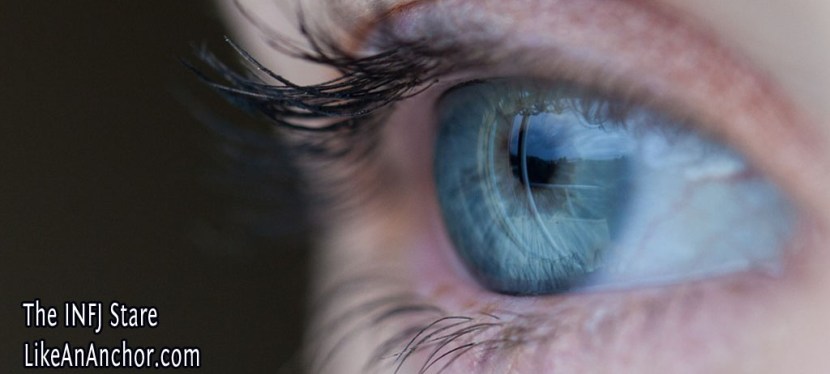
Last week, I noticed that one of the Google searches that led to my blog was “INFJ stare.” My reaction was, “We have a stare?” I immediately posted the question to Facebook and performed a Google search of my own. One of my friends sent me this image of the dreaded “INFJ Death Stare:”
Apparently, only non-INFJs consider this a “stare of death.” We INFJs don’t really think about it much at all until someone points it out. But other types do notice. In one forum I found, an ISTP asked, “What’s going on in your head when you do it? Why do INFJ girls stare at me after every other thing I say? It makes me feel like I’m creeping them out or something, but they continue to talk to me regardless how creepy I may/may not be.”
What’s Going On Behind The Stare
Among INFJs, the consensus is that we don’t meant to give you a death stare. It’s simply our default thinking expression. The INFJs who know that they stare actually spend quite a bit of time trying not to creep people out with it. We’re awkward enough as it is without having to worry about people asking why we’re giving them the death stare.
This isn’t the same thing as “resting bitch face.” People don’t generally describe the INFJ death stare as being rude or angry. It’s just hard for other people to read. And once I’d read several comments along those line, I realized I do indeed have an INFJ stare. I just didn’t realize it at first because the people who’ve asked me about it generally describe it as “spacing out.”
According to an analysis on infjs.com, eyes are the “most prevailing part” of a perception-dominant type’s faces. The typical INFJ will maintain a very steady focus on people or objects for long stretches of time, and when we shift our gaze to something new our whole head turns to look. Of the infamous stare, this writer says, “The eyes fall into a dream-like state and stare off into the distance. The eyes will appear to be looking through the object of it’s focus, rather than being fixated on it.”
One of the results that I found while looking up INFJ stares was an extensive two-part analysis of why Benedict Cumberbatch might be an INFJ. That’s where I found this gif. It’s no secret that I’m a fan of his, but this was a little over-the-top-obsessed even for me. I did, however, find it an amusing read. It also demonstrates that INFJ eyes are apparently interesting enough that some people will spend hours of time analyzing them.
While listening to a church service this past weekend, I realized I was making an effort to soften my eyes and smile a little instead of just staring at the speaker. I hadn’t really thought about before, but I have been trying to teach myself a more open and welcoming “default expression.” My sister once described this as my “interview face.” I suppose even though I hadn’t been thinking that I had a “death stare,” I still realized it made people uncomfortable and was trying to change it.
If you’re an INFJ, you’re probably already trying not to make people uncomfortable with you’re staring (which also makes it more effective when you want to give someone a death stare, since they won’t have seen it before).
If you’re talking to an INFJ and we do start staring off into the distance or through you, try not to be offended by it. We really don’t mean to make you uncomfortable. At least, not usually 😉
 This was the first post I saw from MBTI in Fiction. My initial reaction was, “There’s no way Loki and I have the same personality type.” But I agree that he’s an introvert, and I don’t think he’s logical or grounded enough to be either an S or a T type, so that leaves us with INFJ or INFP. (Some people type him as an INTJ Mastermind, but he seems to rely on Extroverted Feeling more than Extroverted Thinking as a function).




 Even though there’s a “J” in INFJ, we’re a Perception-Dominant type Introverted intuition is a perceiving function, and that’s what we lead with (
 Like An Anchor