Religion and the INFJ

I’ve often seen INFJs described as an intensely spiritual type. Yet a little while ago, in an online INFJ group, someone posted that most INFJs are atheist or agnostic. Being a type that appreciates truth, someone else set up a poll trying to see if that was really the case.

It’s a small, volunteer sample group, but the results were interesting. 36% identified as atheist, agnostic or non-religious. That’s the same percentage that identified with a Christian religious sect. The remaining 28% identified as “spiritual” or with a non-Christian religion.

click to read article, "Religion and the INFJ" | marissabaker.wordpress.com
image credit: Amanda Jordan via StockSnap

INFJs approach religion much like we approach everything else: with an open, inquisitive mind looking for patterns, especially those relating to people. Our relationship with spirituality largely depends on how we were raised and the direction our lives took from there. But it also depends on our journeys of personal growth, how the religions we encounter line-up with our convictions, and whether or not faith “makes sense” to us.

The Hypocrisy Factor

Many INFJs I’ve seen talking about being non-religious started out in a church of some sort and then left. As with many people who leave churches, hypocrisy is often cited as the reason. INFJs are exceptionally good at detecting deception. We can read people well and pick up on inconsistencies in their patterns of behavior very quickly. At the same time, we want to believe the best of people and it can take a long time for us to admit someone who we value would betray us. Read more
Could Unselfishness Be The First Step To Overcoming Shyness?

Once again, I failed to introduce myself to someone. I’m 27 years old — by now I should have mastered the incredibly complicated art of walking up to someone visiting my own church group and simply saying, “Hi, I’m Marissa. Welcome. What’s your name?”

It would probably come out more as a squeaky “Hi” followed by awkward silence as I frantically tried to come up with words resembling normal small talk.

*sigh* So much for INFJs being “the most extroverted introvert.” Perhaps some INFJs are, but I’m not. I’m shy. I thought it was getting better, but apparently I still need more work battling my social anxiety.

click to read article, "Could Unselfishness Be The First Step To Overcoming Shyness?" | marissabaker.wordpress.com
photo credit: “Viene and friends” by Barry Pousman, CC BY via Flickr

Introversion is healthy for introverts. Shyness … not so much

Despite Google’s antiquated definition of introvert as “a shy, reticent person,” shyness and introversion are far from the same thing. “Shyness is the fear of negative judgment, and introversion is a preference for quiet, minimally stimulating environments” (quote from “Are You Shy, Introverted, Both, or Neither (and Why Does It Matter)?” by Susan Cain). Shyness produces anxiety in social situations, while introversion means you lose energy when around other people. The traits often go together, but extroverts can also be shy.

Introverts who aren’t shy still prefer the inner world of thoughts and ideas to the outer world of people and things, but they’re capable of socializing and even enjoy it. Extroverts who are shy want to spend their time in the outer world, but they’re scared of people.

One of the most genuinely friendly extroverted women I know was once shy. For her, the turning point from shy to social was when she realized her fear of talking was rooted in self-focus. It was about “I’m scared to talk with people,” or “Socializing makes me nervous,” or “What if they don’t like me?” Read more

How Do You Know When To “Door Slam” Someone?

Have you ever cut someone out of your life because you were 100% done with that relationship? Then you’ve done a door slam. Anyone can door slam someone else, but it’s INFJs who are most “famous” (infamous?) for it in personality type circles. The INFJ Door Slam involves deciding not to invest any more time or emotional energy into another person. It’s also pretty final.

When you’re struggling with a hurtful and/or decaying relationship it’s always hard to know how to handle things. Do I slam the door on them and avoid more hurt? Do I try to address the problem and patch things up? The more self-aware I become, the more I realize that I have the capability to emotionally hurt those close to me and that I don’t want to do that. Sometimes relationships have to end, but perhaps it’s worth taking a little extra time to step back and ask how you can protect yourself while minimizing the damage you do to the other person.

While the door slam can be a healthy defense mechanism (like if you need to get out of a relationship with a narcissistic personality that’s controlling and manipulating you), it can also be a way of avoiding conflict. Much as we hate conflict, it’s sometimes necessary to rebuild a friendship that might actually be valuable if you’d put time and effort into fixing things. But how can you tell the difference between relationships you should fight for and ones you need to let go?

Are You Being Hurt?

That’s the first question. For a type known for their lie-detecting skills, INFJs are surprisingly prone to ending up in relationships with people who are not trustworthy. We can be far too inclined toward initially giving people the benefit of the doubt and then holding on to people who aren’t healthy for us. This might be because we feel that we need to help them, or because we see the person they want to be rather than who they are, or because we don’t feel that we have the energy to get out of the relationship. Read more

Finding Community In Variety

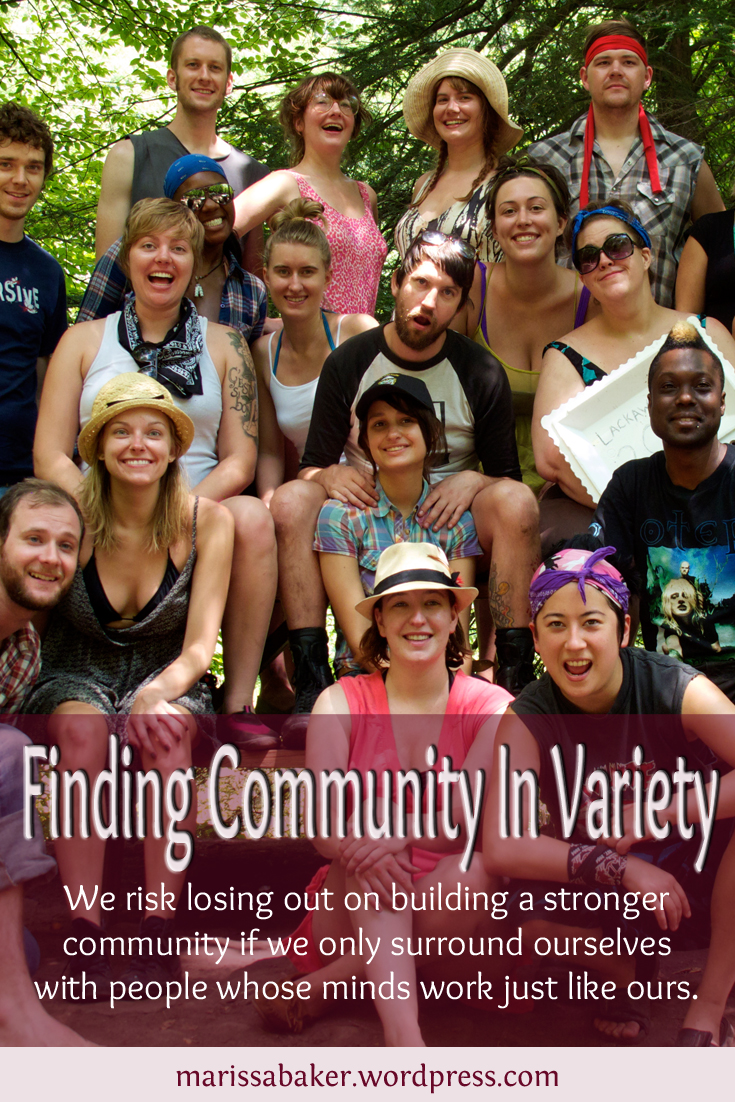
There’s something magical about meeting a person who “gets” you. It’s like your minds work on the same wavelength and you’re instantly talking as if you’re old friends. The two of you think so much alike that there’s no struggle to explain yourself.

This sort of connection often has to do with personality type. Our Myers-Briggs types describe the way our minds work (click here for tips on finding your true Myers-Briggs type). When we meet someone else whose brain processes the word in a similar way, we’re likely to experience a connection with them, especially if we have overlapping interests.

click to read article, "Finding Community In Variety" | marissabaker.wordpress.com
photo credit: “Camp Photo 1” by Matthew Hurst, CC BY-SA via Flickr

In contrast, when we seem to clash with someone for no reason it often has to do with differences in how we process the world. To use a fictional example from the Marvel Cinematic Universe, Steve Rogers and Tony Stark don’t just conflict ideologically. Their ISFJ and ENTP types are exact opposites, which means the mental process Steve is most comfortable using is the one Tony finds most stressful (and vice versa).

Many of us seek to surround ourselves with people who think like us. They’re the people we’re most comfortable with, the ones who identify with us, the ones with similar priorities and goals. Often this type of community is based around interests, such as spending time with people in your church, joining a bird watching club, or hanging out with friends at a ballgame. Personality similarities in these groups are typically accidental.

For those with rare personality types, though, it’s hard to find communities of like-minded people. Only about 30% of the population is made up of Intuitive types, and among those INTJ and INFJ are the rarest. How do you find community when only 1-4% of the world’s population thinks like you? Read more

Maybe The Telephone Isn’t An Enemy

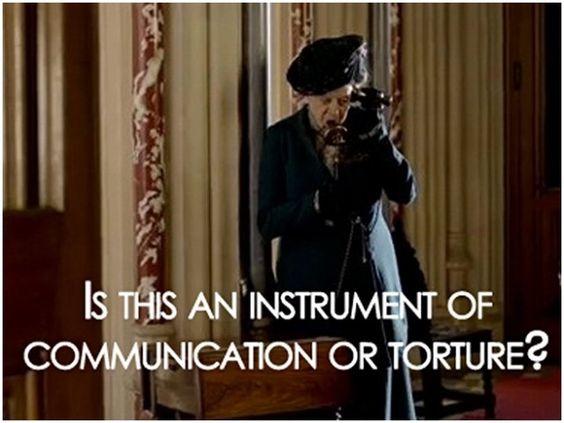
Some of you might think that title is strange, but my fellow introverts will understand. The hours of mental preparation that go into making a two minute phone call. The sense of dread when the phone rings and you aren’t ready to talk with someone. The pressure of sounding engaged and alert while thinking fast enough to avoid awkward silences. Most of us view the telephone in much the same way the Dowager Countess of Grantham does.

some thoughts for introverts. Click to read article, "Maybe The Telephone Isn't An Enemy" | marissabaker.wordpress.comBut I had a truly enjoyable phone conversation with a friend this weekend, and I realized this wasn’t an isolated incident. When he asked for my number my first instinct was panic, then I realized there wasn’t any reason to. I talk with my sister on the phone for hours almost every day. I chat with my dance team when we’re coordinating practice times. I enjoy the unexpected call from my cousin or a select group of friends. Chatting on the phone really isn’t all that scary.

Now, in the interest of full disclosure, I am in many ways a stereotypical introvert in regards to the telephone. We don’t have caller ID on the landline and the calls are rarely for me, so I refuse to answer when it rings unless I recognize the voice and want to talk with them now. My cell phone is set so it doesn’t even ring unless the number is in my contacts list and, in general, I much prefer written communication. There are times, however, when telephones are a preferable method of communication. Read more

An Open Letter to Socially Timid Highly Sensitive People

I’m so excited to share with you my first article published on Introvert, Dear. Read an excerpt below, then follow the “Read More” link for the full article.

Dear fellow highly sensitive person,

Like many of you, I didn’t know I was a highly sensitive person (HSP) for a long while. I just knew I was “different.” For me, this was particularly marked in social situations. Other people went shopping together to unwind, but I felt tense in brightly lit malls bombarded by flashing advertisements, milling crowds, and heavy perfumes. My friends didn’t wince at dances when the music was turned up, they danced harder. My classmates in college seemed like they could relax and focus, while I noticed the flickering lights, the quality of air, the spot on the professor’s shirt, the scratch of pencils on paper.

Sound familiar? If you were like me, you were sure this wasn’t normal—but you weren’t sure what to do about it. I couldn’t understand why it was so hard to get over my shyness and start acting like other people. I had discovered my Myers-Briggs personality type was INFJ when I was preparing to graduate high school as a homeschooler, but it wasn’t until I was floundering through the social landscape of college that I started really researching it. I began at the library, desperately digging through books, looking for ways to cope with my introversion. …. Read More