Thoughts on Sharing the Gospel

As I mentioned in my email newsletter that went out this past Wednesday, I’ve been reading quite a bit of New Testament historical fiction. One of the series–Angela Hunt’s “Jerusalem Road”— made me think about is how weird it would have been to live at the time of Jesus. We look back from our modern perspective and think it would have been amazing to be alive at that time and have the chance to actually meet and talk with Jesus. But I wonder if it’s more likely we’d have been confused and perplexed by this seemingly ordinary man who suddenly started performing miracles and who claimed to be the literal Son of God.

It’s hard for me to imagine not knowing Jesus is the Messiah (the Hebrew word for “Christ,” which means “anointed”). I grew up going to church. Not only that, I grew up in a culture that was shaped by Christianity and where most people I met had at least a basic understanding of who Jesus is and what Christians believe. It’s so natural for me to think of Him as the Son of God and accept that He lived, died, and rose from the dead. But that all would have been brand-new to early 1st century people.

As our modern culture moves farther and farther away from Christianity, more and more people don’t have much–if any–Christian cultural background or Bible knowledge. Those of us in the U.S. and similar countries can’t really assume anymore that if we talk with someone about our faith they’ll have any foundational Biblical knowledge to build on. It’ll be more like Paul preaching to Gentiles who’d never heard of Jesus and thought Yahweh was only a God for the Jews than it is like Peter preaching to Jewish people who already had a faith background but needed to hear how Jesus is relevant to them.

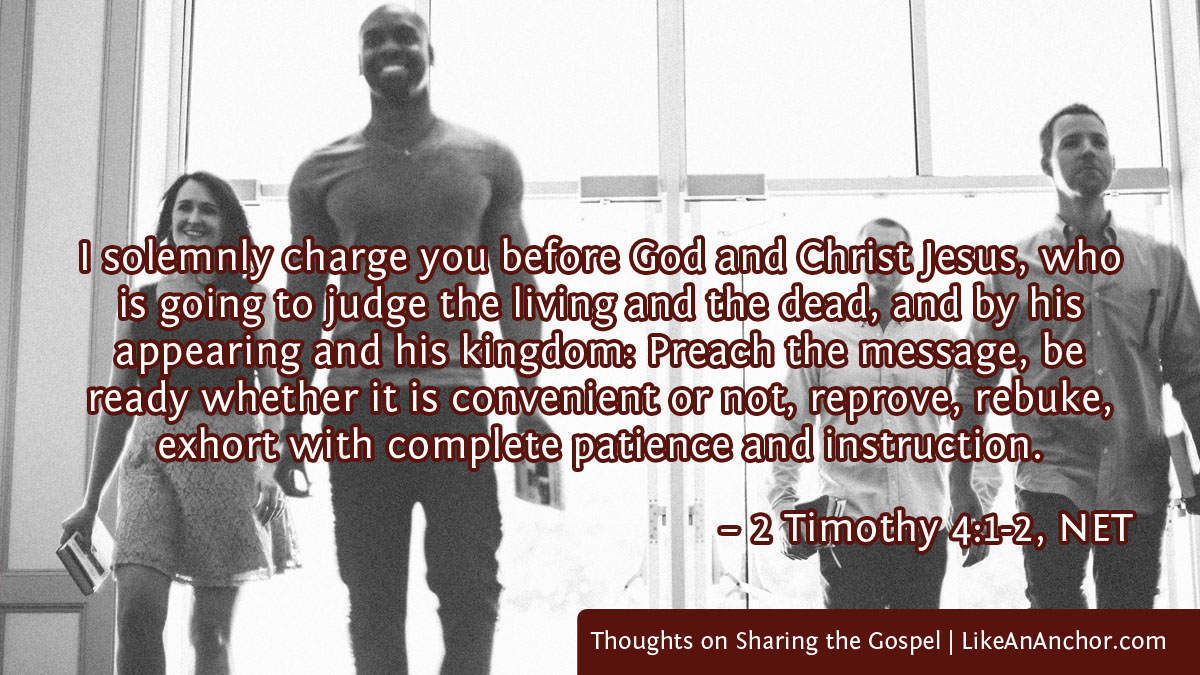
Image of four smiling people walking toward the camera overlaid with text from  2 Tim. 4:1-2, NET version: "I solemnly charge you before God and Christ Jesus, who is going to judge the living and the dead, and by his 
appearing and his kingdom: Preach the message, be ready whether it is convenient or not, reprove, rebuke, exhort with complete patience and instruction."
Image by Matt Vasquez from Lightstock

What Are the Gospels Doing?

I’ve also been pondering a related thought, this time about sharing Jesus with someone rejecting Him rather than someone who never knew about Him. I know of someone who was Christian but is now adopting Jewish beliefs, and I’ve heard that this person challenged someone to prove that Jesus is the Messiah and the Son of God using only the Old Testament. In many ways, that’s a ridiculous thing to ask. You can prove just from the Old Testament that there is a promised Messiah coming, but if you’re going to prove that it’s Jesus you need to cite evidence that His life lines up with those prophecies. As I thought about this topic more, I realized this is exactly the point of the gospels. They’re there to convince readers of who Jesus is.

Now Jesus performed many other miraculous signs in the presence of the disciples, which are not recorded in this book. But these are recorded so that you may believe that Jesus is the Christ, the Son of God, and that by believing you may have life in his name.

John 2o:30-31, NET

Have you ever noticed how many times the gospel writers (especially Matthew) say things like, “it is written” or “that it might be fulfilled”? They’re constantly referencing back to the Old Testament writings and linking them to Jesus, showing that He fulfilled prophecies. Just like Jesus came to fill the law and the prophets to the fullest and just like He had to open His disciples eyes to understand the scriptures about Himself (Matt. 5:17-20; Luke 24:25-48), so are the gospel accounts there to open up the scriptures for us and show that Jesus is the Messiah. Of course, God the Father is the one who opens minds to comprehend these truths (John 6:44), but He also responds to those who diligently seek Him (Matt. 7:7-11) and expects His people to help share His truths with the world (Matt. 28:18-20; 2 Tim. 4:1-2).

Preaching the Word of Christ

Image of two people studying a Bible together, overlaid with blog's title text and the words, "Pondering ways that talking about God today is similar to the first century."
Image by Anggie from Lightstock

I feel like a lot of times when we talk about our faith, we want to jump right into the details. We like to explain what makes our church’s Christianity different from other churches. We want to make sure people know God has expectations for them and their conduct if they commit to following Him. But that only matters to people if they already know about Christianity and they already care what God thinks about them. If they don’t have that already, they need to hear the gospel–the good news about who Jesus is and what He taught–before all the details about how to follow Him.

 For with the heart one believes and thus has righteousness and with the mouth one confesses and thus has salvation. For the scripture says, “Everyone who believes in him will not be put to shame.” For there is no distinction between the Jew and the Greek, for the same Lord is Lord of all, who richly blesses all who call on him. For everyone who calls on the name of the Lord will be saved.

How are they to call on one they have not believed in? And how are they to believe in one they have not heard of? And how are they to hear without someone preaching to them? And how are they to preach unless they are sent? As it is written, “How timely is the arrival of those who proclaim the good news.” But not all have obeyed the good news, for Isaiah says, “Lord, who has believed our report?” Consequently faith comes from what is heard, and what is heard comes through the preached word of Christ.

Romans 10:10-17, NET (bold italics mark quotations from Isa 28:16; Joel 2:32; Isa 52:7; Nah 1:15; Isa 53:1)

The details about how to follow Jesus are important–He included many of those “how-to” details in His message, and His followers filled in more information in their letters that make up the rest of the New Testament. But at it’s core, the gospel is very simple. People hear the preached word of Christ, they respond in faith and obey the good news, and their belief results in righteous living. Remember, God’s sincere desire is that everyone turn away from wickedness, turn to Him, and choose life (1 Tim. 2:1-4; 2 Peter 3:9; Eze. 18:21-32). That should be our desire as well, and the ways we talk about Him should reflect that.

I know this wasn’t really my typical blog post format this week. It was more musings and reflections than a topical Bible study. I just really struggled coming up with a topic this week, and so I wrote about the ideas my thoughts kept coming back to pondering.


Featured image by Ben White from Lightstock

Song Recommendation: “The Basics of Life” by 4HIM (a song I haven’t thought about in probably 10 years, but which popped into my head while writing this post)

Why Does 1 Corinthians 11 Matter Today?

In the first letter we have that Paul sent to the Corinthians, he wrote to address some specific things. Firstly, there were serious issues in this church. They were divided, arguing, and following different human teachers. They also had a big issue with tolerating sin, even priding themselves on how forbearing they were toward a man in their congregation living and sleeping with his stepmother. Paul had to set them right, and he did so by comparing them to ancient Israel and explaining how the Passover and Festival of Unleavened Bread apply to the New Covenant church.

In the midst of all this, Paul also talked about proper conduct within a church community. One of those passages is labeled in the chapter and verse model of our modern Bibles as 1 Corinthians 11:1-16. It’s a passage most people skip over because it has to do with headcoverings and hair length for men and women. It’s the only place in the New Testament where this topic comes up, and it’s one that generates a lot of debate, offense, and division so we tend to ignore it completely. But we miss something important if we skip this passage, even if we don’t agree on how to interpret it.

The Headcovering Passage

People often approach this passage as just being about women’s headcoverings, but it’s addressed just as much to men. Paul opened this discussion by saying, “Be imitators of me, just as I also am of Christ” and praising the Corinthians for maintaining “the traditions just as I passed them on to you” (1 Cor. 11:1, 2, NET). He then made a statement about authority in the churches (the ecclesia, or called-out ones) of God.

But I want you to know that Christ is the head of every man, and the man is the head of a woman, and God is the head of Christ. Any man who prays or prophesies with his head covered disgraces his head. But any woman who prays or prophesies with her head uncovered disgraces her head, for it is one and the same thing as having a shaved head. 

1 Corinthians 11:3-5, NET

In my studies on this topic, I learned that culturally, Jewish men and women covered their heads with scarves or prayer shawls while Greek/Gentile men and women tended not to cover (though they could, mostly as a fashion choice). This passage would have involved a change for Jewish men as well as Gentile women. Men who covered their heads while praying needed to stop, and women who didn’t cover their heads while praying needed to start. Full disclosure, I do cover my head when at a church gathering or praying and studying at home. You can click here to learn more about why and the research I did into the topic.

Context For Paul’s Next Commands About Women

So why can’t we just skip over this divisive passage? For one thing, it’s part of the Bible and if we admit the Bible is the inspired word of God, then there is value in every part of it even if we’re not yet sure what to make of it. This is a significant reason to pay attention to 1 Corinthians 11:1-16, but it’s not the one that we’re going to focus on today. In this post, I want to focus on the important context clues this passage provides for interpreting other parts of the letter.

As the letter continued, Paul covered instructions for keeping Passover correctly (1 Cor. 11:17-34), spiritual gifts and unity in the body (1 Cor. 12), the “more excellent way” of agape love (1 Cor. 13), the use of prophecy or “inspired speaking” in the church (1 Cor. 14:1-25), and proper, orderly conduct during a church meeting (1 Cor. 14:26-40). Paul didn’t address the topic of women again directly until chapter 14, but since he started out this part of the letter by addressing how men and women properly pray and prophecy in the church (men with their heads uncovered, women with their heads covered), we can assume the discussions about keeping Passover, having spiritual gifts and using them properly, and love are addressed equally to men and women in the church. The NET even uses the phrase “brothers and sisters” when Paul addresses believers, because the whole church group is included when Paul uses the word “brethren” (adelphoi in Greek). We all have key roles to play, and very similar responsibilities and gifts.

Then, we come to a place where Paul again addressed women and men separately, with different instructions for each. It’s one of the infamous passages about women being silent in church.

What should you do then, brothers and sisters? When you come together, each one has a song, has a lesson, has a revelation, has a tongue, has an interpretation. Let all these things be done for the strengthening of the church. … Two or three prophets should speak and the others should evaluate what is said. … For you can all prophesy one after another, so all can learn and be encouraged. Indeed, the spirits of the prophets are subject to the prophets, for God is not characterized by disorder but by peace.

As in all the churches of the saints, the women should be silent in the churches, for they are not permitted to speak. Rather, let them be in submission, as in fact the law says. If they want to find out about something, they should ask their husbands at home, because it is disgraceful for a woman to speak in church.

1 Corinthians 14:26, 29, 31-35, NET

If you read Paul’s statement about women being silent by itself, it sounds like women shouldn’t say a word the whole time they’re at a gathering of believers. This doesn’t make sense in the context of other scriptures, which show women were deeply involved in the churches. This is where 1 Corinthians 11 can provide much-needed context to help us figure out what Paul is likely saying in this passage.

“In light of 11:2-16, which gives permission for women to pray or prophesy in the church meetings, the silence commanded here seems not to involve the absolute prohibition of a woman addressing the assembly. Therefore (1) some take be silent to mean not taking an authoritative teaching role as 1 Tim 2 indicates, but (2) the better suggestion is to relate it to the preceding regulations about evaluating the prophets (v. 29). Here Paul would be indicating that the women should not speak up during such an evaluation, since such questioning would be in violation of the submission to male leadership that the OT calls for (the law, e.g., Gen 2:18).”

NET study note on 1 Cor. 14:34

Whether you think women should cover their heads today or not, the fact is that 1 Corinthians 11 addresses the proper way for women to pray and/or prophecy. Obviously women can, and frequently do throughout the scriptures, pray and prophecy outside of church meetings. But the context of this section of scripture is how to do things in the churches, when believers are gathered together, as for a formal church service. It follows, then, that Paul talks about how women can properly pray and prophecy in church in 1 Corinthians 11, then addresses a time when silence is more appropriate in 1 Corinthians 14.

Culture Adds More Context

It also helps to take the cultural context into account when looking at Paul’s writings. Now, there are right and wrong ways to do this. Sometimes, people say that Paul just had a backwards view of women because he was influenced by his culture and so we don’t need to listen to him anymore. But in reality, some of his writings indicate he was pretty radical compared to the culture of his day.

Likewise the women are to dress in suitable apparel, with modesty and self-control. Their adornment must not be with braided hair and gold or pearls or expensive clothing, but with good deeds, as is proper for women who profess reverence for God. A woman must learn quietly with all submissiveness. But I do not allow a woman to teach or exercise authority over a man. She must remain quiet.

1 Timothy 2:9-12, NET

We read this today and we might feel offended that he’d say women have to be quiet and submissive and can’t teach. People of Paul’s day, though, would have read “a woman must learn” and been shocked by that. This statement “was a radical and liberating departure from the Jewish view that women were not to learn the law” (NET footnote on 1 Tim. 2:12). Some Jewish girls received Torah instruction while they were young and if they had a good family they might have learned a little more, but women weren’t generally taught very much and they certainly weren’t selected for advanced study with respected rabbis.

Jesus’s interactions with women as spiritual equals was unusual, and Paul continued His practice. He also assured his readers, though, that women serving in the church, preaching the gospel, and learning God’s words did not mean that women were suddenly going to start taking over roles that God entrusted to men. Women are to learn, yes, but they will also be submissive in the sense that God expects. Women can pray and prophecy, but they won’t (or shouldn’t) be disrupting church meetings or usurping male roles.

We often miss it today with our modern perspectives, but Paul isn’t advocating for either the subjugation of women or for doing away with gender roles in 1 Corinthians and 1 Timothy. It’s actually a more balanced view than we often find in churches today, which in many cases either try to follow society in doing away with different roles for men and women entirely, or follow traditional (mis)interpretations of Paul that bar women from being involved. However you interpret the passage on hair length and headcoverings, it provides much-needed context assuring us that women were deeply involved in the New Testament church and they still can be in the churches today.


Featured image by StockSnap from Pixabay

Song Recommendation: “This Girl” by Lauren Daigle

What Is Your Motivation for Obeying God?

When we think about obedience to God, we often get stuck at the should we or shouldn’t we level. Some say obedience isn’t necessary because Jesus got rid of the law (an argument we’ve refuted extensively on this blog). Others say that we still need to obey God, and the New Testament writings show that they’re right to do so.

But why? There are a host of proposed reasons. Because He tells us to. Because we fear Him. Because we love Him. Because He might strike us dead if we don’t. Because He owns us. Because He created us. Because His law is good.

There’s some truth to each of these “whys.” There’s one, though, that the Biblical writers treat as the core source of our motivation for following God. And it’s one that highlights the vital importance that God places on relationships.

Love at the Core of the Law

When Jesus walked on this earth, He didn’t directly answer the questions, “Do we still need to obey God?” No one thought to ask Him that; they assumed obedience would still matter. He did address the question, though, by saying that He didn’t come to destroy the law and that those who obey God’s commands will be great in His kingdom (Matt. 5:17-20). He described “those who hear the word of God and obey it” as “blessed” (Luke 11:28, NET). He also charged His disciples to teach obedience when they passed on His teachings to others (Matt. 28:19-20).

One of the questions someone did ask Jesus was about the most important commandment. By the time Jesus came to this earth, Jewish people were following even more commands than the ones God gave them when He led ancient Israel out of Egypt. There were rabbinical writings and Jewish traditions piled up on top of God’s laws, at times clarifying them and other times expanding them and making them burdensome. Jesus rejected those additions and traditions of men, but even among the commands that did originate with God He highlighted two as being the most important.

Now one of the experts in the law came and heard them debating. When he saw that Jesus answered them well, he asked him, “Which commandment is the most important of all?” Jesus answered, “The most important is: ‘Listen, Israel, the Lord our God, the Lord is oneLove the Lord your God with all your heart, with all your soul, with all your mind, and with all your strength.’ The second is: ‘Love your neighbor as yourself.’ There is no other commandment greater than these.” 

The expert in the law said to him, “That is true, Teacher; you are right to say that he is one, and there is no one else besides him. And to love him with all your heart, with all your mind, and with all your strength and to love your neighbor as yourself is more important than all burnt offerings and sacrifices.” When Jesus saw that he had answered thoughtfully, he said to him, “You are not far from the kingdom of God.” Then no one dared any longer to question him.

Mark 12:28-34, NET (bold italics mark quotations from Lev. 19:18; Deut. 4:35; 6:4-5 ; Josh 22:5)

Notice Jesus doesn’t say God’s other laws aren’t important. Rather, He highlights “love the Lord” and “love your neighbor” as the core laws at the center of all the other laws. Love is the reason or motive behind the rest of God’s law, and if you did that perfectly you’d naturally be keeping the other laws as well. These are God’s main commands; the rest is details on how to love Him and love others.

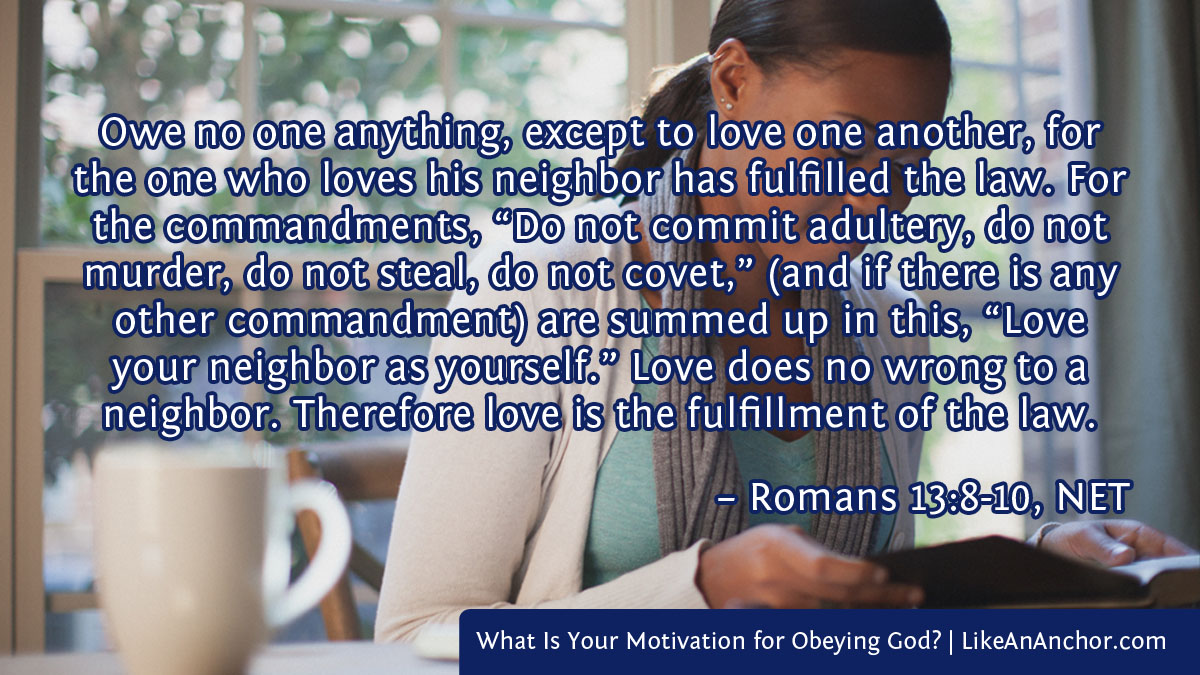
Image of a woman reading the Bible overlaid with text from Rom. 13:8-10, NET version: "Owe no one anything, except to love one another, for the one who loves his neighbor has fulfilled the law. For the commandments, “Do not commit adultery, do not murder, do not steal, do not covet,” (and if there is any other commandment) are summed up in this, “Love your neighbor as yourself.” Love does no wrong to a neighbor. Therefore love is the fulfillment of the law."
Image by Pearl from Lightstock

We Obey Because We Love

In addition to placing love at the center of God’s laws, Jesus revealed that love should be our motivation for keeping the commandments.

“If you love me, you will obey my commandments. …

“The person who has my commandments and obeys them is the one who loves me. The one who loves me will be loved by my Father, and I will love him and will reveal myself to him.” …

“If anyone loves me, he will obey my word, and my Father will love him, and we will come to him and take up residence with him. The person who does not love me does not obey my words.”

John 14:15, 21-24, NET

Relationship with God is connected to obedience and law in a way that modern readers likely find strange. We think of grace as something with no strings attached, but Biblical writers thought of it as something that established a relationship with commitments and expectations. If we’re not obeying God, then we don’t really know Him.

 Now by this we know that we have come to know God: if we keep his commandments. The one who says “I have come to know God” and yet does not keep his commandments is a liar, and the truth is not in such a person. But whoever obeys his word, truly in this person the love of God has been perfected. By this we know that we are in him. The one who says he resides in God ought himself to walk just as Jesus walked.

1 John 2:3-6, NET

We declare by our choices whether we are children of God who practice righteousness, or children of the devil who practice lawlessness (1 John 3:8-10). It’s a scary thought, but Jesus indicated there will be people at the final judgement who thought that they were right with God but to whom He will say, “I never knew you. Go away from me, you lawbreakers!” (Mat. 7:23, NET). We don’t want to end up in that position, where we think we’re good enough Christians but in reality we don’t have a relationship with Jesus.

Getting To the Heart Of Obedience

Image of a man reading a book, overlaid with blog's title text and the words, "The entire universe belongs to God, yet He loves us and chose us to be His people. In return, He asks for our hearts. We should love Him so much that we want to obey Him."
Image by Creative Clicks Photography from Lightstock

Those words of caution bring us around to the other possible reasons for obeying God that we proposed in the introduction. God has the right to expect certain things from us because He created us and the whole universe. He is sovereign, and He knows best what “dos” and “don’ts” lead to a good outcome. He’s also a powerful God of justice who promises to bring divine judgment down on those who do not obey.

Those aspects of His character are just as real as the love and mercy aspects. We should obey God because of who He is and because we have a proper fear and respect for Him. He has the right to tell us what to do, and “because He says so” is a valid reason for obedience (Ps. 100:3; Rev. 5:9; 1 Cor 6:19-20; Rom. 6:15-23). Fear of the Lord–a proper respect for His power, might, and justice–is also a valid reason (Acts 5:1-11; Heb. 10:26-31). But at the same time, those aren’t the foundational reasons for our obedience.

To put it another way, God doesn’t want fear and duty to be the only or primary way that we relate to Him. For some of us, they might be a starting point for why we obey God. Eventually, though, they should take a back-seat to love as our motivation. We obey because we love God and want a relationship with Him, and we show our love by keeping His commands.

 Now, Israel, what does Yahweh your God require of you, but to fear Yahweh your God, to walk in all his ways, to love him, and to serve Yahweh your God with all your heart and with all your soul, to keep Yahweh’s commandments and statutes, which I command you today for your good? Behold, to Yahweh your God belongs heaven, the heaven of heavens, and the earth, with all that is therein. Only Yahweh had a delight in your fathers to love them, and he chose their offspring after them, even you above all peoples, as it is today.

Deuteronomy 10:12-15, WEB

This passage is addressed to ancient Israel as God’s covenant people, but we’re included in that group because we’ve been grafted into the New Covenant people of spiritual Israel through the Messiah. God’s expectations are the same for us. The entire universe belongs to Him, yet He loved us and chose us to be His people. In return, He asks for our hearts. We should love Him so much that we want to obey Him even without considering His rights as sovereign Lord and His just consequences for disobedience (even though those two things are no less real).


Featured image by Inbetween from Lightstock

Song Recommendation: “Build My Life” by Pat Barrett

Learning To Wholly Follow the Lord

Last week, I heard a message about Caleb’s example and how he “wholly followed” God. I noticed one of the translations on my Bible app said “fully followed,” so out of curiosity I looked up other translations and noticed something interesting about the LEB version.

“No one of these men of this evil generation will see the good land that I swore to give to your ancestors, except Caleb, the son of Jephunneh; he himself shall see it, and to him I will give the land upon which he has trodden and to his sons because he followed Yahweh unreservedly.”

Deuteronomy 1:35-36, LEB (italics in original)

That italicized phrase is the one that’s typically translated something like, “he has wholly followed Yahweh” (Deut. 1:36, WEB). In the LEB, there’s a footnote on this phrase that says, “Literally ‘he filled his hands after Yahweh.'” That caught my attention. I know in Hebrew, words often paint a “picture” that helps the reader visualize what’s going on. For example, the word for anger has to do with flaring nostrils and being “slow to anger” literally means having a “long nose.” Today, I’d like to look more deeply at what we can learn about following God wholly, or “filling our hands after” Him.

Fully Committed to Follow God

The phrase “wholly followed” or “filled hands after” comes from two Hebrew words: mâlê’ (H4390) and ‘achar (H310). It’s used of Caleb five times (Num. 14:24; 32:12; Deut. 1:36; Josh. 14:9, 14). By contrast, the Israelites other than Caleb and Joshua did not “wholly follow Me” (Num. 32:11, WEB). Similarly, Solomon “didn’t go fully after Yahweh, as David his father did” (1 Kings 11:6, WEB). An NET footnote about Solomon describes this phrase as an “idiomatic statement” that “reads in Hebrew, ‘he did not fill up after'” God (footnote on 1 Kings 11:6). That’s very similar to the LEB note saying this phrase literally means, “he filled his hands after Yahweh.”

Digging deeper into these two words in the Theological Wordbook of the Old Testament (TWOT), we see that mâlê’ is a common verb (used 249 times) with two basic meanings: to fill up something spatially (e.g. oil filling a jar [2 Kings 4:6]) or temporally (e.g. the days of pregnancy being fulfilled [Gen. 25:24]) (TWOT entry 1195). Sometimes, it’s used figuratively of things that fill the earth such as violence and sin (Gen. 6:13; Jer. 16:18; 51:5; 8:17; Mic. 6:12) or God’s presence, glory, kindness, and knowledge (Num. 14:21; Ps. 33:5; 72:19; Is. 6:3; 11:9; Jer. 23:24; Hab. 3:3).

Mâlê’ is also used of someone’s words being fulfilled (i.e. they did what they said they would do). The phrase “‘to fill one’s hand’ (with sacrifices) is ‘to consecrate’ one’s service” (Ex. 32:29; 1 Chr. 29:5). It’s used for priests being consecrated to God. In other words, they “filled their hands” toward Him. It’s also used of the Levites who obeyed Moses after the Golden Calf incident, and in this case it’s “an expression meant to say that they had been faithful to God even though it turned them against family and friends” (NET footnote on Ex. 32:29). That’s also what Caleb did–he was faithful to God even when the entire rest of the nation and all the other spies except Joshua rebelled against Yahweh’s command.

The second word in this phrase, ‘achar, basically means “after.” It can mean “behind {of place)” or “afterwards (of time)” (Thayer’s Dictionary, H310). Beyond that, I can’t find much information about this word. The TWOT discusses ‘achar only briefly, spending more time on other derivatives of the word ahar (entry 68). Interestingly, ‘achar is related to the Hebrew word for time, ‘aharit (TWOT 68g). In Hebrew, the idea of time is like “the view a man has when he is rowing a boat. He sees where he has been and backs into the future” (Wolff, qtd. by TWOT).

As I ponder these definitions, I picture someone with their whole life full of God, like someone who’s got their hands so full they can’t pick up anything else. And then, filled up with focus on God, they faithfully follow after Him to the places He’s going and the future He’s leading them toward. I find it interesting that there’s also an element of uncertainty; people “filled up after God” are wholly committed to Him, but don’t know what the future holds. They’re goin to follow Him no matter where He leads.

Image of a man pushing open double glass doors to step outside, overlaid with text from Numbers 14:24, NET version: " Only my servant Caleb, because he had a different spirit and has followed me fully—I will bring him into the land where he had gone, and his descendants will possess it."
Image by Pearl from Lightstock

Full Hearts and Hands

With all the talk about filling up hands when following God in these footnotes and dictionary entries, I started looking into the Hebrew word for “hand” and reading verses where it’s used alongside mâlê’ (H4390). There aren’t very many, but the ones I did find are interesting. For example, human hands can be full of “wickedness,” “bribes,” and “blood” (Ps. 26:10; Is. 1:15, WEB). In sharp contrast, God’s “right hand is full of righteousness” (Ps. 48:10, WEB).

I’ve also seen the phrase mâlê’ +‘achar translated “wholeheartedly follow,” so I looked up times that mâlê’ is paired with “heart” as well. Much like with “hands,” human hearts aren’t typically filled with anything good. Solomon said, “the heart of the sons of men is full of evil, and madness is in their heart while they live” (Ecc. 9:3, WEB). Similarly, Haman “dared presume (mâlê’) in his heart to” conspire against the Jews (Est. 7:5, WEB). Without God’s influence, human hearts are full of things contrary to God’s nature.

It’s not human’s base-line nature to “fully follow” God with their hands or heart. That’s why it’s so unusual to have someone like Caleb or David fully commit to following God. For us to follow the Lord like that takes dedication and faith on our part, and assistance from God Himself.

In Solomon’s prayer at the temple dedication, he said, “Blessed is Yahweh, the God of Israel, who spoke with his mouth to David your father, and has with his hand fulfilled it” (1 Kings 8:15, WEB). That’s the word mâlê’ used in the sense of fully following through on a promise. “Hand” here is yâd (H3027), which literally means a person’s hand but also figuratively refers to “strength, power” (Brown-Driver-Briggs dictionary). God has the strength and power to follow-through on His promises. His hand working in our lives can help us to fully follow Him as well.

After God delivered Israel from slavery in Egypt, He entrusted the people to make a tabernacle (the precursor to Solomon’s temple). Specifically, he commissioned Bezalel of Judah and Ahisamach of Dan to spearhead the construction of the tabernacle tent, ark of the covenant, priestly garments, and other holy items. In doing so, He chose a man who was “wise-hearted” and then “filled (mâlê’) him with the Spirit of God, in wisdom, and in understanding, and in knowledge, and in all kinds of workmanship” (Ex. 31:3, WEB; see also Ex. 28:3; 31:1-11; 35:30-35). These men were already wise in their hearts, but they also needed God to fill them up with His Spirit in order to do the work that He wanted them to do.

Image of a person sitting on a couch studying a Bible laid on a coffee table overlaid with text from Romans 15:13, NET version: "Now may the God of hope fill you with all joy and peace as you believe in him, so that you may abound in hope by the power of the Holy Spirit."
Image by Chris Mainland from Lightstock

That Which Fills You Bears Fruit

The New Testament also has some things to say about what fills our hearts and the intensity of our commitment to God. Whatever it is that fills up our hearts is going to come out eventually.

“For no good tree bears bad fruit, nor again does a bad tree bear good fruit, for each tree is known by its own fruit. For figs are not gathered from thorns, nor are grapes picked from brambles. The good person out of the good treasury of his heart produces good, and the evil person out of his evil treasury produces evil, for his mouth speaks from what fills his heart.”

Luke 6:43-46, NET

Like in the Old Testament, there are things that can influence what fills our hearts. For example, Peter confronted Ananias because “Satan filled your heart to lie to the Holy Spirit” (Acts 5:3, NET). In contrast, God fills people up with His Holy Spirit (Luke 1:41, 67; Acts 2:4; 4:31; 9:17; 13:52; Eph. 5:18). He also fills us with other good things, like joy, peace, and knowledge (Rom. 15:13).

 For this reason we also, from the day we heard about you, have not ceased praying for you and asking God to fill you with the knowledge of his will in all spiritual wisdom and understanding, so that you may live worthily of the Lord and please him in all respects—bearing fruit in every good deed, growing in the knowledge of God, being strengthened with all power according to his glorious might for the display of all patience and steadfastness, joyfully giving thanks to the Father who has qualified you to share in the saints’ inheritance in the light.

Colossians 1:9-12, NET

The Greek word translated “fill” in these verses is pleroo (G4137). It means “to make full,” fill up to the fullest extent, “to make complete in every particular,” “to carry through to the end,” and “to fulfill” in the sense of bringing something into realization or effect (Thayer’s dictionary). It doesn’t paint the same word-picture with filled up hands as the Hebrew word does, but it means basically the same thing. It refers to something being as full as it can possibly get. When it’s God that fills up the “treasury of a heart,” then the fruit produced is going to be good.

Fully Involve Yourself

Image of a woman walking along railroad tracks, overlaid with blog's title text and the words, "In the Old Testament, Caleb received praise from God for “wholly following” Him. We should have a similar level of commitment today."
Image by Kristen McDow from Lightstock

As I wrapped up this study, I thought of what Jesus called the greatest commandment. He said, “The most important is: ‘Listen, Israel, the Lord our God, the Lord is oneLove the Lord your God with all your heart, with all your soul, with all your mind, and with all your strength‘” (Mark 12:29-30, NET, bold italics mark a quotation from Deut. 6:4-5). Heart, soul, mind, and strength is basically everything you have. You should love God wholly, the same way that Caleb followed Him.

In the Old Testament verse that Jesus quotes, there are three Hebrew words used. We’re to love God with all our heart (leb [H3824], inner person, including thoughts and feelings), soul (nephesh [H5315], yourself as a living being), and might (me’od [H3966], force, might, “muchness”). We’re supposed to put our all into this. Everything that makes us who we are, our entire lives, and all of the “muchness” that we have. That sounds a lot like being having our hearts and hands full of following God.

The Father and Jesus are fully committed to accomplishing their plan to bring human beings into their family. They’re all-in, to the point that Jesus died in our place to make it possible for us to receive forgiveness and live new lives that (if all goes as it’s meant to) will result in us becoming “like him” and seeing “him just as he is” (1 John 3:2, NET). They expect us to demonstrate commitment to Them as well. One way we do this is by “wholly following” the Lord, no matter what the future holds or what other people around us might say.


Featured image by Brightside Creative from Lightstock

Faithfully Continuing Toward Salvation in the End Times

I’d been trying to decide what topic to write about this week, and then one morning I woke up with this phrase running through my head: “our salvation is now nearer than when we became believers.” I think I might have been dreaming about editing a blog post, since I woke up feeling like I needed to add it to an article. I couldn’t think of an existing post that needed editing, so I decided to look up where the quote came from, check out the context, and see where that took me.

Owe no one anything, except to love one another, for the one who loves his neighbor has fulfilled the law. For the commandments, “Do not commit adultery, do not murder, do not steal, do not covet,” (and if there is any other commandment) are summed up in this, “Love your neighbor as yourself.” Love does no wrong to a neighbor. Therefore love is the fulfillment of the law.

And do this because we know the time, that it is already the hour for us to awake from sleep, for our salvation is now nearer than when we became believers. The night has advanced toward dawn; the day is near. So then we must lay aside the works of darkness, and put on the weapons of light. Let us live decently as in the daytime, not in carousing and drunkenness, not in sexual immorality and sensuality, not in discord and jealousy. Instead, put on the Lord Jesus Christ, and make no provision for the flesh to arouse its desires.

Romans 13:8-14, NET (bold italics mark quotations from  Ex. 20:13-15, 17; Deut. 5:17-19, 21; Lev. 19:18

I quote the first part of this passage a lot, but I always stop after the part about love fulfilling the law. If you keep reading, Paul adds a sense of urgency to his instruction to fulfill the law by loving each other. We should “do this because we know the time.” What does that mean? And if Paul could say, “the day is near” to readers almost 2,000 years ago, what would he say to us today?

Image of a man studying the Bible overlaid with text from James 5:7-8, NET version: "So be patient, brothers and sisters, until the Lord’s return. Think of how the farmer waits for the precious fruit of the ground and is patient for it until it receives the early and late rains. You also be patient and strengthen your hearts, for the Lord’s return is near."
Image by Chris Mainland from Lightstock

Getting Ready For the End

As you read the New Testament, it seems clear that the apostles originally thought Jesus’s second coming would happen in their lifetimes, but that they eventually realized it was farther off in the future. That didn’t soften their sense of urgency, though. Paul probably wrote Romans around 57 A.D. and John wrote his letters around 100 A.D., and yet they both have the same sense of urgency (dates from Britannica.com).

Do this, knowing the time, that it is already time for you to awaken out of sleep, for salvation is now nearer to us than when we first believed. The night is far gone, and the day is near. Let’s therefore throw off the deeds of darkness, and let’s put on the armor of light.

Romans 13:10-11, WEB

 Little children, these are the end times, and as you heard that the Antichrist is coming, even now many antichrists have arisen. By this we know that it is the final hour. 

1 John 2:18, WEB

One of the things that we can learn from this sense or urgency is that even if Jesus doesn’t return in our lifetimes, it’s useful to live as if He will. This is the final hour. The Day of the Lord is near. We do live in the end times. Whether Jesus returns in our lifetimes or not, we have a finite amount of time for our human lives here on this earth. And if God has opened our eyes to the truth, we’ve entered a relationship with Him and committed to following Him in this life, then we’re part of His house and His judgement starts with us.

For the culmination of all things is near. So be self-controlled and sober-minded for the sake of prayer. Above all keep your love for one another fervent, because love covers a multitude of sins.

1 Peter 4:7-8, NET (bold italics mark a quotation from Prov. 10:12)

But let none of you suffer as a murderer or thief or criminal or as a troublemaker. But if you suffer as a Christian, do not be ashamed, but glorify God that you bear such a name. For it is time for judgment to begin, starting with the house of God. And if it starts with us, what will be the fate of those who are disobedient to the gospel of God? And if the righteous are barely saved, what will become of the ungodly and sinners? So then let those who suffer according to the will of God entrust their souls to a faithful Creator as they do good.

1 Peter 4:15-19, NET (bold italics mark a quotation from Prov. 11:31)

As the church of God (the faithful, believing body of Jesus Christ), we’re judged based on how we live our lives here on this earth. What happens to unbelievers is a little more vague, but their resurrection happens at a different time and their judgement is handled a little differently (see “Rethinking Hell: A Clearer View of God’s Judgement“). For us, though, this is our time to learn about God and live His way of life, with the hopeful expectation that in the final judgement after the resurrection we’ll hear “well done, good and faithful servant” (“Rethinking Heaven: Capturing A Vision Of The Resurrection“).

Heading Toward Salvation

Image of a woman walking along railroad tracks, overlaid with the blog post's title text and the words, "Whether Jesus returns in our lifetimes or not, we should live with a sense of urgency and awareness in our walk as believers."
Image by Anggie from Lightstock

One of the interesting things about the verse we started with in Romans 13 is that Paul says, “our salvation is now nearer than when we became believers.” Modern Christianity tends to treat salvation as a thing that happens when you commit to Jesus Christ, but the New Testament writers treat salvation as a process that begins with our commitment to follow God for the rest of our lives (Phil 3:8-16, for example). This topic comes up in some of the most sobering warnings that Biblical writers deliver to New Covenant Christians.

Therefore leaving the teaching of the first principles of Christ, let’s press on to perfection—not laying again a foundation of repentance from dead works, of faith toward God, of the teaching of baptisms, of laying on of hands, of resurrection of the dead, and of eternal judgment. This will we do, if God permits. For concerning those who were once enlightened and tasted of the heavenly gift, and were made partakers of the Holy Spirit, and tasted the good word of God and the powers of the age to come, and then fell away, it is impossible to renew them again to repentance; seeing they crucify the Son of God for themselves again, and put him to open shame. For the land which has drunk the rain that comes often on it and produces a crop suitable for them for whose sake it is also tilled, receives blessing from God; but if it bears thorns and thistles, it is rejected and near being cursed, whose end is to be burned.

Hebrews 6:1-8, WEB

It is vital that we press on once the salvation process begins, building on the elementary principles we first learned. We’re supposed to grow as believers and become more and more like God the Father and Jesus Christ. If we’re not growing, then we’re falling away and that’s a dangerous thing. Notice, though, what the author of Hebrews says right after issuing this sobering warning.

But, beloved, we are persuaded of better things for you, and things that accompany salvation, even though we speak like this. For God is not unrighteous, so as to forget your work and the labor of love which you showed toward his name, in that you served the saints, and still do serve them. We desire that each one of you may show the same diligence to the fullness of hope even to the end, that you won’t be sluggish, but imitators of those who through faith and perseverance inherited the promises.

Hebrews 6:9-12, WEB

Though the author penned these warnings, he’s sure that the people he’s writing to are doing “better things … that accompany salvation.” The warning isn’t because he thinks they’re all about to miss out on eternal life, but because he wants them to be awake, diligent, and press on faithfully “even to the end.”

As we look at the world around us, many Christians feel that things are getting so bad it must be close to Jesus’s return. We’re not the first generation to feel this way, but whether we’re right or not we should live with a sense of urgency in our walk as believers. We’re not supposed to be afraid, but we are supposed to be aware of the dangers in complacency. It’s our duty to keep following God faithfully, holding onto the hope He has given us firmly, and keep learning and growing as part of our living, dynamic relationship with the Father and Jesus.


Featured image by Pearl from Lightstock

What An Incredible Privilege To Have A Relationship With God

After I posted last week’s article, “What Happened to the Ritual Uncleanness Laws After Jesus’s Sacrifice?” I continued meditating on the ramifications of the changes we talked about in that post. I find it especially amazing to think about the difference in how easy it is to access God now.

For example, let’s say I lived during a time in the Old Testament history when Israel was mostly faithful to God and there was a temple with priests serving in it. Something wonderful happens, and I want to thank Yahweh for this gift. I can just pray, but I’m not King David or a prophet and probably don’t have the gift of the Holy Spirit and so maybe it doesn’t feel like that’s the best way to get God’s attention. But I know that the Torah says people can offer an offering to Yahweh with thanksgiving as the motivation (Lev. 7:11-15). I get everything ready to take that offering to the priests, but then my period starts. Now, I’m ritually unclean for at least the next 7 days and I can’t go into the temple or touch any holy thing. If I bled longer than that, I’d have to count 7 days after the bleeding stops, then go to the priest with “two turtledoves, or two young pigeons” as an offering to become ritually clean again. There are actually quite a lot of things that can make me “unclean,” blocking my access to God. Even when I’m clean, I don’t have the same access that a priest would or even a prophet. God doesn’t talk with me, unless I find myself in very unusual circumstances.

Today, if I want to thank God for something, I can do so very easily. I can approach the Father directly in prayer through the name of Jesus Christ whenever I want, and it’s as if I’m stepping into the most holy parts of the temple to come into God’s presence (John 16:23-27; Heb. 10:19-22). There aren’t restrictions on when I can do that, or things that make me so unclean I can’t come to Him in prayer. Even if I sin (which results in a type of defilement that still damages relationship with God), I still get to go to God directly through Jesus to repent and ask for forgiveness (1 John 1:5-10; 2:1-6). I don’t have to go through any other person or do any rituals in order to access God.

I think we take that level of access to God for granted. It doesn’t seem unusual to us; that’s just how it’s always been because we’ve only experienced a relationship with Him under the New Covenant and not under the Old. But when we study Old Testament believers, even considering all the things we have in common with them, it also highlights how much changed with Jesus’s sacrifice. This sort of study can give us a greater appreciation of everything that God the Father and Jesus the Lamb have done for us.

Image of a group of people holding hands to pray overlaid with text from 2 Cor. 6:16-18, NET version:  For we are the temple of the living God, just as God said, “I will live in them and will walk among them, and I will be their God, and they will be my people.” ... I will welcome you, and I will be a father to you, and you will be my sons and daughters,” says the All-Powerful Lord.
Image by Claudine Chaussé from Lightstock

A New, More Relational Covenant

If you’re reading this the day that it posted on my blog, then tomorrow night (the evening of April 21/beginning of Nisan 14) is when we’ll be keeping the Passover this year. When we keep the Passover as New Covenant Christians, it’s in remembrance of Jesus’s pivotal sacrifice and the commencement of the New Covenant.

For I received from the Lord what I also passed on to you, that the Lord Jesus on the night in which he was betrayed took bread, and after he had given thanks he broke it and said, “This is my body, which is for you. Do this in remembrance of me.” In the same way, he also took the cup after supper, saying, “This cup is the new covenant in my blood. Do this, every time you drink it, in remembrance of me.” For every time you eat this bread and drink the cup, you proclaim the Lord’s death until he comes.

1 Corinthians 11:23-26, NET

We’ll be gathering together to remember Jesus and what He did to enact a new covenant, which we’ve agreed to participate in. Passover commemorates the major turning point in God’s plan. For thousands of years, He’d promised His people that He would fix the relationship between them and replace the covenant that they broke with one that was even better. When Jesus died, that happened. The promised Messiah became the once-for-all-time sacrifice that forgives sin, the only High Priest we’ll ever need, and the Head of the body of believers that is the temple where God dwells.

But now Jesus has obtained a superior ministry, since the covenant that he mediates is also better and is enacted on better promises. For if that first covenant had been faultless, no one would have looked for a second one. But showing its fault, God says to them,

Look, the days are coming, says the Lord, when I will complete a new covenant with the house of Israel and with the house of Judah.
It will not be like the covenant that I made with their fathers, on the day when I took them by the hand to lead them out of Egypt, because they did not continue in my covenant and I had no regard for them, says the Lord.
For this is the covenant that I will establish with the house of Israel after those days, says the LordI will put my laws in their minds and I will inscribe them on their heartsAnd I will be their God and they will be my people.
And there will be no need at all for each one to teach his countryman or each one to teach his brother saying, ‘Know the Lord,’ since they will all know me, from the least to the greatest.
For I will be merciful toward their evil deeds, and their sins I will remember no longer.”

Hebrews 8:6-12, NET (bold italics mark a quotation from Jer 31:31-34)

God wants a deep relationship with His people. Notice His focus when describing the New Covenant. He’s writing His laws inside their minds and hearts (not just on scrolls they could hear someone else read). He’s inviting them to call Him their God and claiming them as His people. He promises, “they will all know me.” He also says He’ll be merciful to them and forget the sins that they should justly be punished for. He wants a new kind of relationship with people, one where they know Him at a heart-level and experience relational intimacy with Him. We have that new relationship now, or at least the opportunity for it, and we should appreciate what a great blessing that is.

Image of a man pushing open doors and stepping outside overlaid with text from Psalm 42:1-2, NET version:  As a deer longs for streams of water, so I long for you, O God! I thirst for God, I say, “When will I be able to go and appear in God’s presence?”
Image by Pearl from Lightstock

Longing For God’s Presence

In the Old Testament, people placed a very high value on the privilege of encountering God’s presence, perhaps because it was more difficult for an average person to do that. They marvel that they’re able to visit God’s tabernacle or temple. They express delight in having any contact whatsoever with Yahweh. If God actually talked with them, they were awestruck and terrified.

David, one of God’s closest friends in the Old Testament, placed a very high value on the unique relationship he had with Yahweh. Speaking of himself, the king, he sang to God, “You make him glad with joy in your presence” (Ps. 21:6, WEB). When he committed a grave sin, he prayed, “Don’t throw me from your presence, and don’t take your Holy Spirit from me” (Ps. 51:11, WEB). David knew not to take God’s presence in his life for granted. It was precious, something to hold onto and value highly. Other psalmists had similar responses (Psalm 42:1-4; 73:28; 84:1-12).

How lovely are your dwellings,
    Yahweh of Armies!
My soul longs, and even faints for the courts of Yahweh.
    My heart and my flesh cry out for the living God. …

Blessed are those who dwell in your house.
    They are always praising you. …

For a day in your courts is better than a thousand.
    I would rather be a doorkeeper in the house of my God,
    than to dwell in the tents of wickedness.

Psalm 84:1-2, 4, 10, WEB

When was the last time you genuinely longed for God this way? When you cried out for Him because you wanted to be in His presence, not because you wanted something from Him? When you wanted to be near Him, praising Him alongside His other covenant people? When you’d rather be at God’s house or temple (in the New Covenant, that temple is His people) for even just one day than have a thousand days anywhere else?

I’ve sang this psalm before (“Better Is One Day” and “Doorkeeper“), but I think I’ve been guilty of leaving the sentiment in the psalm behind after the music ends. Sometimes I forget to ask God to be with me unless I’m feeling lonely or hurt or in need of something from Him. I’m not always excited to go to church services and sing to God, at least not so excited that it overshadows how much I look forward to anything else.

Better To Walk With God Than Any Other Way

Image of a woman with her hand raised, overlaid with blog's title text and the words, "Rather than take the close, personal relationship we have with God for granted, we should be incredibly thankful for our access to Him."
Image by Anggie from Lightstock

In the New Testament, expressions of thankfulness for the privilege of a close relationship with God seem quieter than the ones we find in the Old Testament. The New Testament doesn’t record new psalms or songs that highlight enthusiastic praises. Most of the New Testament is letters, and if we’re not paying close attention we might miss the passionate emotion behind those letters. But look at how Paul talked about his feelings regarding Jesus’s relationship with him.

 If someone thinks he has good reasons to put confidence in human credentials, I have more … But these assets I have come to regard as liabilities because of Christ. More than that, I now regard all things as liabilities compared to the far greater value of knowing Christ Jesus my Lord, for whom I have suffered the loss of all things—indeed, I regard them as dung!—that I may gain Christ, and be found in him, not because I have my own righteousness derived from the law, but because I have the righteousness that comes by way of Christ’s faithfulness—a righteousness from God that is in fact based on Christ’s faithfulness. My aim is to know him, to experience the power of his resurrection, to share in his sufferings, and to be like him in his death, and so, somehow, to attain to the resurrection from the dead.

Philippians 3:4, 7-11, NET

Paul is expressing a very similar sentiment to what we see in Psalm 84, it’s just not as poetical. His main goal is to know Jesus and become like Him. Nothing else can possibly compare to the great honor of being “found in Him,” no matter how impressive it might look from a human perspective.

See how great a love the Father has given to us, that we should be called children of God! For this cause the world doesn’t know us, because it didn’t know him. Beloved, now we are children of God. It is not yet revealed what we will be; but we know that when he is revealed, we will be like him; for we will see him just as he is.

1 John 3:1-2, WEB

When we really let it sink in that God is making us His children, we should marvel at the greatness of His love. We’ll even get to be like Him in the future and “see him just as he is.” This is a level of closeness and relationship that the people in the Old Testament could only dream about; the psalms rarely mention God as a Father-figure (Ps. 2:7; 68:5; 89:26; 103:13) and the promise “I will be a father to you, and you will be my sons and daughters” wasn’t explicitly clear until the New Covenant (2 Cor. 6:18, NET). The faithful Old Covenant believers will get to experience the same future that we do–they’ll “be made perfect together with us” (Heb. 11:39-40, NET)–but we have a fuller taste during our human lives of the relationship that God wants to have with His people.

Rather than take the close, personal relationship we have with God for granted, we should be even more thankful for our access to God than the people writing Psalms were. It’s incredible that we can talk to and spend time with the creator of the universe, and that He wants us to call Him our Abba, Father (Rom. 8:15). What an incredible privilege to have such a relationship with God!


Featured image by Pearl from Lightstock