Walk in the Way

“Walk” is an often used analogy for the Christian life. We talk about walking with Jesus and sing about walking in the light. Sometimes it becomes a sort of cute religious-speak phrase, using “walk of faith” as a metaphor for living as a Christian. But it’s also a description of a serious commitment. Two can’t walk together unless they’ve met and agreed to the walk (Amos 3:3). Walking in the Christian way means meeting and getting to know God, then agreeing to faithfully, absolutely follow the words and example of Jesus.

Closely related to walking is the notion of having a way of life. There’s a right way and many wrong ways to live, and those two options are described in the Bible as different “ways” (i.e. paths) where we can walk. This concept is so important that Christianity was called the Way throughout much of Acts (Acts 9:2; 16:17; 18:25-26; 19:9, 23; 22:4; 24:14, 22).

Two Ways to Walk

Early in His ministry, Jesus talked about these two ways in His sermon on the Mount. As He offered reconciliation and relationship with God to humanity, He also laid out what God expects from people who want those things. We need to actively seek Him and choose to walk in His ways.

Enter through the narrow gate, because the gate is wide and the way is spacious that leads to destruction, and there are many who enter through it. How narrow is the gate and difficult the way that leads to life, and there are few who find it!

Matt. 7:13-14, NET

This passage puts me in mind of one from Isaiah that counsels readers to “Seek the Lord while he makes himself available” (Is. 55:6, NET). There’s a sense of urgency here, urging us not to get distracted but to focus on seeking God now. Thankfully for us, He does a lot to make Himself accessible. Unfortunately, many people don’t find the way of life; they walked right by it even when Jesus was walking among them personally.

Jesus said to him, “I am the way, the truth, and the life. No one comes to the Father, except through me. If you have known me, you will know my Father too. And from now on you do know him and have seen him.”

Philip said, “Lord, show us the Father, and we will be content.”

Jesus replied, “Have I been with you for so long, and you have not known me, Philip? The person who has seen me has seen the Father! How can you say, ‘Show us the Father’? Do you not believe that I am in the Father, and the Father is in me?”

John 14:6-10, WEB

This conversation took place a few years after the sermon we just quoted, at His last Passover with His disciples. Here, Jesus got more specific about how to find the Way. He’s the one true Way to a relationship with the Father, and therefore to eternal life (John 17:3, see also Heb. 10:19-21). It’s not a complicated idea, but even so “there are few who find” the narrow way to life. Even the disciples like Philip took a long time to understand how this worked.
Walking with Jesus, Like Jesus

The ones who do find the Way and start down that path to eternal life begin a walk with Jesus that’s meant to be life-long. As John says, “he who says he remains in him ought himself also to walk just like he walked” (1 John 2:6, WEB). We want to be like the people Jesus talks about in the letter to Sardis who “didn’t defile their garments” and “will walk with me in white, for they are worthy” (Rev. 3:4, WEB). Jesus empowers us to walk with Him and in Him, as God has done with people throughout human history who respond to His call.

“I will strengthen them in Yahweh;
and they will walk up and down in his name,” says Yahweh.

Zechariah 10:12, WEB

For we are the temple of the living God, just as God said, “I will live in them and will walk among them, and I will be their God, and they will be my people.”

2 Corinthians 6:16, NET, referencing Lev. 26:12; and Ezk. 37:27

God wants to walk with us. He wants a relationship as we live our lives according to His ways. This is something He’s always wanted to have with His people, and accomplishing the reconciliation that makes such a walk possible is one reason Jesus came and died for our sins. We’re made holy so that we can walk with God, in the name of God.

How To Walk

So far, we’ve spoken in general terms about walking with God. We know this means walking in His ways and walking with Jesus. This gives us a pattern to follow–our walk imitates the way Jesus walked. The Bible also gives more specific instructions for how to walk which can help us understand exactly what walking like Jesus means in our day-to-day lives.

In light

Walking in the light is the type of walk that shows up most often in scripture. Psalm 119:105 praises the Lord saying, “Your word is a lamp to my feet, and a light for my path” (WEB). Isaiah calls for people to “come, and let’s walk in the light of Yahweh” (Is. 2:5, WEB). He also prophesied Jesus coming as a Light to the world (Is. 9:2); a title Jesus connected with our ability to walk in the light rather than in darkness (John 8:12; 11:9-10; 12:35). Similarly, Paul instructs us to “Walk as children of light” because the Lord has called us out of darkness (Eph. 5:8, WEB). God’s word is a light to show us the right way to walk. He Himself is also Light, and that’s supposed to show up in how we walk as well.

If we say we have fellowship with him and yet keep on walking in the darkness, we are lying and not practicing the truth. But if we walk in the light as he himself is in the light, we have fellowship with one another and the blood of Jesus his Son cleanses us from all sin.

1 John 1:6-7, NET
In integrity

Closely related to walking in the Light is the notion of walking with integrity. In this section, I’ve also included passages that tell us to walk with uprightness and to walk in the Lord’s commands since those ideas are so connected. Psalms and Proverbs highlight this idea more than any other section of the Bible (Ps. 101:2, 6; 119:35; Prov. 4:14; 8:20; 14:2; 19:1; 28:6, 18, 26). Walking with a mindfulness of the Lord’s commands and a commitment to doing the best we can to follow Jesus’s perfect example of blameless integrity is key to our ongoing Christian walk.

(Now this is love: that we walk according to his commandments.) This is the commandment, just as you have heard from the beginning; thus you should walk in it.

2 John 1:6, NET
In the spirit

For New Testament believers, walking in the Light and following the commands of God with integrity also involves walking in the spirit. We’re to keep the law not with a rote, outward sort of obedience but with obedience that comes out of a heart changed by the Spirit of God working in us. It’s a fulfilment of prophecies where the Lord said, “I will put my Spirit within you, and cause you to walk in my statutes” (Ezk. 36:26-27, WEB). Now, those who belong to Jesus walk in the Spirit (2 Cor. 12:17-18; Gal. 5:16-17, 24-25).

There is therefore now no condemnation to those who are in Christ Jesus, who don’t walk according to the flesh, but according to the Spirit. For the law of the Spirit of life in Christ Jesus made me free from the law of sin and of death. For what the law couldn’t do, in that it was weak through the flesh, God did, sending his own Son in the likeness of sinful flesh and for sin, he condemned sin in the flesh; that the ordinance of the law might be fulfilled in us, who walk not after the flesh, but after the Spirit.

Rom. 8:1-4, WEB
In love

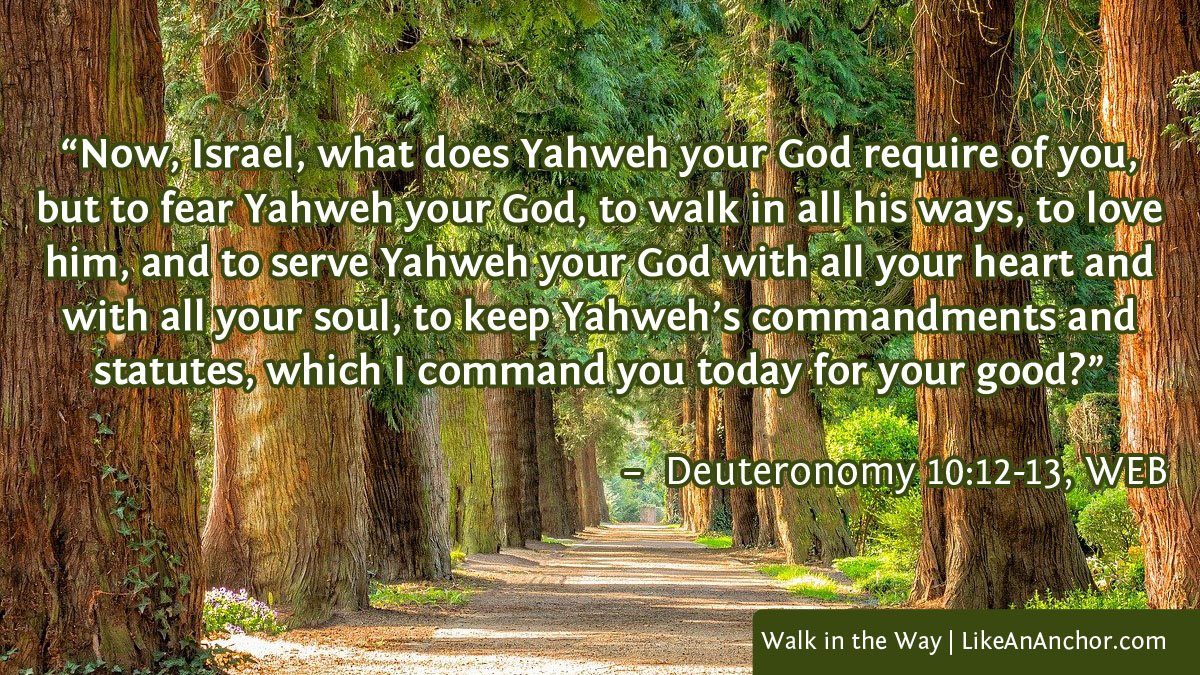
As we walk in the Light and in the Spirit, keeping God’s word with integrity, His character traits become more and more a part of us. One of those most important character traits is love (1 John 4:8, 16), and so it’s not surprising to find that love is the most excellent way to walk (1 Cor. 12:31-13:13). It involves walking according to His commandments (Deut. 10:12-13; 2 John 1:6) and it’s preeminent among other instructions such as putting on compassion, kindness, and humility (Col. 3:12-17).

Be therefore imitators of God, as beloved children. Walk in love, even as Christ also loved us and gave himself up for us, an offering and a sacrifice to God for a sweet-smelling fragrance.

Ephesians 5:1-2, WEB

Walking Fearlessly with God

There’s one final thing I want to mention about walking with God. When we’re walking in God’s ways, it affects not only the way we live our lives but also the way we experience life. There’s power, security, and peace that comes along with walking in the ways of the Lord even if we’re “walking” through physical dangers (Ps. 138:7; Is. 40:31).

Even though I walk through the valley of the shadow of death,
I will fear no evil, for you are with me.
Your rod and your staff,
they comfort me.

Psalm 23:4, WEB

When you pass through the waters, I will be with you,
and through the rivers, they will not overflow you.
When you walk through the fire, you will not be burned,
and flame will not scorch you.

Isaiah 43:2, WEB

When we’re walking with God, we can walk without fear no matter what’s going on in the world around us. We can walk knowing that He is traveling alongside us. We can walk with strength to face whatever comes, as well as wisdom, integrity, love, and light. Walking in the Way of God benefits us in incredible ways that reach beyond this life we’re living right now.

Featured image by SplitShire from Pixabay

Song Recommendation: “Walk in the Light” Ted Pearce

A Tale of Two Lions

Lions might seem like an odd topic for a Bible study. I don’t usually spend a whole lot of time thinking about lions unless I’m building a habitat in Planet Zoo or thinking about rewatching The Lion King. But then last week, I heard an excellent sermon about the lion that Peter talks about in his first letter. Peter warns, “Your adversary, the devil, walks around like a roaring lion, seeking whom he may devour” (1 Pet. 5:8, WEB). Hearing about this “roaring lion,” the people he preys on, and the way to guard against him got me thinking of another Lion mentioned in the Bible–Jesus as the Lion of the tribe of Judah.

I was shocked when I did a word search for “lion” in the Bible and found over 100 verses. I hadn’t realized there were so many lions in the Bible. There are animal lions like the ones Samson and David slew and the ones that didn’t eat Daniel (Jud. 14:5-6; 1 Sam. 17:34-35; Dan. 6:16-22). There are vicious, wicked people who are compared to dangerous lions (Ps. 7:1-2; 22:13, 21; 57:4; 2 Tim. 4:17). There are accounts of God protecting His people from both real and metaphorical lions (Ps. 91:13; Heb. 11:32-33). Comparisons between people and lions are used as compliments and blessings (Deut. 33:20, 22; Num. 24:8-9; 2 Sam. 1:23), or as criticisms and warnings (Ps. 10:9; Prov. 28:15; Eze. 22:25). Lions figure prominently as a creature that’s local to areas where the Bible writers lived. They presented a very real danger and their use in these writings would have been readily understood by the hearers.

With all the mentions of lions in the Bible, another thing that surprised me is that the the Lion of Judah and the comparison between the devil and a lion aren’t mentioned very often. There’s really only one or two verses each that explicitly discuss those two lions. That doesn’t make these ideas any less important, but it did surprise me. I think, though, that these two uses of lion build on overall patterns in the Bible of using lions to talk about stand-out examples of goodness and wickedness.

Wicked Lions

One of the most prominent ways that lions are used in the Bible is to describe the dangerous natures of wicked people. In several psalms, the writers compare their adversaries to lions, highlighting the danger they face as they cry out for God to protect and deliver them (Ps. 10:9; 17:12; 22:13, 21; 35:17; 57:4; 58:6).

Yahweh, my God, I take refuge in you.
Save me from all those who pursue me, and deliver me,
lest they tear apart my soul like a lion,
ripping it in pieces, while there is no one to deliver.

Psalm 7:1-2, WEB

The imagery of God’s people being hunted by lions who threaten to “tear apart my soul” lays groundwork of lions standing-in for human or spiritual threats that likely influenced Peter’s letter. This imagery also shows up in prophecy (Jer. 50:17, 44).

Raise a signal flag that tells people to go to Zion.
Run for safety! Do not delay!
For I am about to bring disaster out of the north.
It will bring great destruction.
Like a lion that has come up from its lair
the one who destroys nations has set out from his home base.
He is coming out to lay your land waste.
Your cities will become ruins and lie uninhabited.

Isaiah 4:6-7, NET

It is against this backdrop that Peter writes to his first-century audience of Jews and Gentile converts. Most would have been familiar with the Old Testament writings, and those who might not have been before conversion would be learning from those scriptures. Peter’s comparison of the devil to a lion works even without the OT background, but it’s even more effective when we know the history of how lions were used in scripture.

Good and Mighty Lions

In sharp contrast to the depictions of dangerous, wicked lions stands Bible verses about people who are like mighty, powerful lions. In David’s lament for Saul and Jonathan he says, “They were stronger than lions” (2 Sam. 1:23, WEB). Proverbs tells us “the righteous are as bold as a lion” (Prov. 28:1, WEB). Most of Ezekiel 19 compares Israel to a lioness (Ezekiel 19:1-9). Moses’s blessings on the tribes of Gad and Dan speak of them as a lioness and a lion (Deut. 33:20-22). Most notable, though, is this passage from Jacob’s prophecy for his sons.

Judah is a lion’s cub.
From the prey, my son, you have gone up.
He stooped down, he crouched as a lion,
as a lioness.
Who will rouse him up?
The scepter will not depart from Judah,
nor the ruler’s staff from between his feet,
until he comes to whom it belongs.
The obedience of the peoples will be to him.

Genesis 49:9-10, WEB

I wonder if perhaps this prophecy, with its connection between lions and kingship in the tribe of Judah, is why Solomon had 12 lions on his throne (1 Kings 10:19-20). It’s ultimate fulfilment, though, comes through Jesus Christ.

Then one of the elders said to me, “Do not weep! See, the Lion of the tribe of Judah, the Root of David, has triumphed. He is able to open the scroll and its seven seals.”

Revelation 5:5, NET

Jesus is identified elsewhere in scripture as both David’s son and his Lord (Matt. 1:1; 22:43-46; Acts 2:22-36; Rom. 1:1-4). He inherits the kingship covenant that God made with David’s decedents as well as the blessings spoken of here in Genesis. And though Revelation 5:1-14 is the only time Jesus is explicitly identified as the Lion of Judah, it’s not the first time God reveals Himself as a lion.

The Lord as a Lion

The verses talking about God as a lion stand out for their sharp contrasts. On the one hand, people like Job and Hezekiah talk about God attacking them as if He were a lion (Job 10:16; Is. 38:13). But then on the other hand, God reveals Himself as a powerful, protecting lion.

This is what the Lord says to me:

“As a lion growls,
a great lion over its prey—
and though a whole band of shepherds
is called together against it,
it is not frightened by their shouts
or disturbed by their clamor—
so the Lord Almighty will come down
to do battle on Mount Zion and on its heights.
Like birds hovering overhead,
the Lord Almighty will shield Jerusalem;
he will shield it and deliver it,
he will ‘pass over’ it and will rescue it.”

Isaiah 31:4-5, NET

The imagery of God as a protecting lion are more rare, though, than times when He compares Himself to an angry, vengeful lion (Jer. 25:37-38; 49:19; Hos. 5:14-15; 11:10; 13:6-8). We don’t often like to think of God as dangerous, but if we don’t realize that He’s a God of justice and wrath as well as mercy and love then we run the grave danger of underestimating Him. God’s self-revelation in scripture is nuanced (for example, when Jesus is called Lion of Judah He appears in the next verse as a Lamb who was slain [Rev. 5:5-6]). It’s impossible to put Him into just one box, or even to fully comprehend all the facets of His character right now with our human minds.

The peaceful meadows will be laid waste
because of the fierce anger of the Lord.
Like a lion he will leave his lair,
and their land will become desolate
because of the sword of the oppressor
and because of the Lord’s fierce anger.

Jeremiah 25:37-38, NET

The descriptions of the Lord as a Lion remind me of a quote from C.S. Lewis’s The Lion, the Witch, and the Wardrobe. When Susan learns that Aslan is a lion, she asks if he is “safe.” Mr. Bever replies, “Who said anything about safe? ‘Course he isn’t safe. But he’s good. He’s the King, I tell you.”

Someone as powerful as a lion can’t really be called “safe.” But do we want a toothless, tamed God? I want to worship the Lord who is powerful and mighty enough to totally conquer an enemy described as a roaring lion that prowls around looking for a chance to devour everyone. When you’ve got a lion after you, it’s reassuring to have a Lion at your side. Especially one who is Good and who has already triumphed over the enemy as the Lamb slain to redeem us from sin (Rev. 5:5-14).

Featured image by Alexas_Fotos on Pixabay

Song Recommendation: “Unto the Lamb” by Julie Meyer

Judge Yourself (and Others) as You Would Like God to Judge You

I hadn’t planned to write any more about Paul’s teachings on the topic of self-judgement. I only found three passages on that topic, after all; what more was there to say? But after I received a request from a reader to keep studying that topic, I prayed about it and these verses came to mind:

You shall love your neighbor as yourself.

Mark 12:31; Leviticus 19:18, WEB

Treat others in the same way that you would want them to treat you.

Luke 6:31, NET

At first glance, these principles don’t seem to have much to do with judgement. But then I remembered my study about what “You shall love your neighbor as yourself” teaches us about the positive aspects of self-love. Perhaps something similar is going on with the idea of judgement. Paul only talks about judging ourselves a few times, but he spends quite a bit of time discussing how we are (and are not) to judge other people. It would make sense that if you’re going to judge others in certain situations that you should be judging yourself similarly, and we’ll see from looking at Jesus’s words in the gospels that this is the case. We can take what we learn from Jesus’s instructions to treat others how we want to be treated and apply it to this topic of self-judgement.

How You Love Yourself

It’s been four years since I posted a study on the idea of how you love yourself, so let’s do a quick review. When Jesus says to love your neighbor as you love yourself, it implies that we know how to love ourselves. Many of us feel guilty about the idea of loving ourselves since it sounds selfish, but it’s not when we love in the correct way. As I wrote four years ago,

Real love never stops with yourself. If you’re the only object of your love and you always put yourself first, then you have a problem. That’s what it means to be selfish and self-centered. But avoiding selfishness doesn’t mean you refuse to take care of yourself. We’re to offer ourselves to God as a living sacrifice, not abuse ourselves. If you never meet your own needs or do those loving things mentioned in 1 Corinthians 13 for yourself, then you’re going to burn-out. And God loves you way too much to want that.

“As You Love Yourself”

Jesus tells us to agape others the same way we do ourselves. Agape is the word most often used of God’s love for people. It’s unconditional, benevolent, and always seeks good things for the person being loved. The better we understand how God loves us, the better we’ll treat ourselves, and the better we’ll understand how to love others properly. Having the right kind of love for ourselves helps us know how to love other people the way God loves both them and us. And because love is foundational to the types of relationships God has with us and which He wants us to have with other people, understanding love helps us understand all the other interpersonal topics we can study in the Bible, including judgement.

How You’ll Be Judged

In relation to judgement, Jesus gives us a similar principle to “Treat others in the same way that you would want them to treat you” and “love your neighbor as yourself.” Here’s what He says on the topic during the sermon on the mount:

Don’t judge, so that you won’t be judged. For with whatever judgment you judge, you will be judged; and with whatever measure you measure, it will be measured to you. Why do you see the speck that is in your brother’s eye, but don’t consider the beam that is in your own eye? Or how will you tell your brother, ‘Let me remove the speck from your eye,’ and behold, the beam is in your own eye? You hypocrite! First remove the beam out of your own eye, and then you can see clearly to remove the speck out of your brother’s eye.

Matthew 7:1-5, WEB

Judging others properly must first start with judging ourselves. Judgement, particularly of others, should be done cautiously, always keeping in mind that we’ll receive the same type of judgement that we show other people. It’s so important that we judge correctly that before telling us how to judge, Jesus warns it’s probably better not to judge at all. Especially for us human beings, who don’t have the perfect perspective needed to understand other people’s motivations and actions, it’s better to error on the side of mercy than judgement. As James says, “judgment is without mercy to him who has shown no mercy. Mercy triumphs over judgment” (2:13, WEB).

Jesus’s words here in the sermon on the mount show that the way we judge others is directly related to how we’ll be judged by God. It is also related to how we judge ourselves. We have a big problem if we’re eager to judge others but never turn that examining, critical perspective on ourselves.

Image of men having a discussion with Bibles in foreground, with text from Romans 14:10-12, WEB version: " But you, why do you judge your brother? Or you again, why do you despise your brother? For we will all stand before the judgment seat of Christ. For it is written,

“‘As I live,’ says the Lord, ‘to me every knee will bow.
    Every tongue will confess to God.’” So then each one of us will give account of himself to God."
Image by Claudine Chaussé from Lightstock

Paul on Judgement Within The Church

Echoing Jesus’s words in the Sermon on the Mount, Paul also counsels his readers to examine themselves and consider the things which they might need to remove from their lives. As Jesus did, Paul directly relates this idea to the topic of how God will judge us.

But if we examined ourselves, we would not be judged. But when we are judged by the Lord, we are disciplined so that we may not be condemned with the world.

1 CORINTHIANS 11:31-32, NET

As I mentioned when we looked at this verse a couple weeks ago, “examined” is translated from diakrino. In this verse it could be translated “if we took a proper view” or “formed a just estimate of ourselves” (Zodhiates’s dictionary entry G1253). It involves the idea of separating, making distinctions, and judging thoroughly. Paul encourages a type of self-judgment that involves seeing ourselves accurately rather than seeking to condemn anyone. When used properly, this type of judgement works alongside God’s accurate judgement of us to help make us more and more like Him.

Interestingly, Paul makes this point in the same letter where he most directly addresses the topic of judging other people. In 1 Corinthians, one of his reasons for writing the congregation is to tell them they need to deal with a sin-problem in their group. One of the men in the church was sleeping with his father’s wife. The church tolerated this sin and even became arrogant about how they handled the problem. In no uncertain terms, Paul told this church group they needed to put that person out of the congregation because we have a responsibility to judge those within the church (1 Cor. 5). God is in charge of ultimate judgement, but because we have His holy spirit there are certain discernment-based judgements we can make, such as not allowing an unrepentant sinner to continue fellowshipping with the group. The key there is “unrepentant”–those who acknowledge their sin, repent, and turn back to God should be shown mercy immediately and welcomed back with love (2 Cor. 2).

Judge Yourself First

So how does all this relate to self-judgement? The first thing that comes to my mind is that since there are certain things Paul says we can judge others for, then we need to make sure we’re judging ourselves on those things first. As Jesus said, we can’t see clearly enough to help another person with their problems when we’re blinded by our own flaws and faults. In keeping with this, Paul has some scathing things to say about people who judge others without examining themselves.

Therefore you are without excuse, whoever you are, when you judge someone else. For on whatever grounds you judge another, you condemn yourself, because you who judge practice the same things. Now we know that God’s judgment is in accordance with truth against those who practice such things. And do you think, whoever you are, when you judge those who practice such things and yet do them yourself, that you will escape God’s judgment? Or do you have contempt for the wealth of his kindness, forbearance, and patience, and yet do not know that God’s kindness leads you to repentance?

Romans 2:1-4, NET

We need to keep in mind that God is judging us today and He’ll pass judgement on our lives at the end (1 Pet. 4:17). That knowledge should remind us to examine ourselves carefully and be cautious when judging others. As in other areas of our lives, we need to balance love and truth, justice and mercy the same way that God does. We need to pray for an accurate view of ourselves in the light of God’s truth, yet also show ourselves mercy once we’ve repented and started to change (much as Paul did by not judging himself). Self-examination and self-discernment are important tools God gives us to help keep ourselves rightly aligned as we live in relationship with Him.

Featured image by Inbetween from Lightstock

Compassion: A Month-Long Scripture Writing Study

I have another scripture writing list for you all today, along with a continuation of the study we started last week with “God’s Parental Compassion.” As with my other Free 30-Day Scripture Writing Plans, I started out by studying all the words in the Bible (English, Greek, and Hebrew) related to the topic. I narrowed that down to about 50-60 scriptures, then started praying and stitching them together to get the 31-day list that I’m sharing here for the month of December.

If you write all these verses out, then go back and read through them they should form something like a narrative. It made me so happy to see that emerge; as I’ve talked about many times before, I love to think of the Bible as a “love story” that God is sharing with us and using to invite us to live with Him as part of a great narrative He’s composing. The fact that story arcs within scripture connect so well is one of the greatest proofs that the Bible is a cohesive “God-breathed” text. For example, I start off this study with these three scriptures:

But a certain Samaritan, as he traveled, came where he was. When he saw him, he was moved with compassion, came to him, and bound up his wounds, pouring on oil and wine. He set him on his own animal, brought him to an inn, and took care of him. …Now which of these three do you think seemed to be a neighbor to him who fell among the robbers?”

He said, “He who showed mercy on him.”

Then Jesus said to him, “Go and do likewise.”

Luke 10:33-34, 36-37, WEB

But whoever has the world’s possessions and sees his fellow Christian in need and shuts off his compassion against him, how can the love of God reside in such a person?

1 John 3:17, NET

A traveler came to the rich man, and he spared to take of his own flock and of his own herd, to prepare for the wayfaring man who had come to him, but took the poor man’s lamb, and prepared it for the man who had come to him.”

David’s anger burned hot against the man, and he said to Nathan, “As Yahweh lives, the man who has done this deserves to die! He must restore the lamb fourfold, because he did this thing, and because he had no pity!”

2 Samuel 12:4-6, WEB

Jesus’s parable, John’s reminder, and David’s reaction to the prophet Nathan’s story all highlight the same idea–God places a high value on His people showing compassion. Compassion is one of the things that shows whether we are or are not becoming more like God. And if we learn (as David did) that we’ve failed to show compassion we ought to repent and ask God for His compassion, as David does in the next verse on my list:

Have mercy on me, O God, because of your loyal love.
Because of your great compassion, wipe away my rebellious acts.
Wash away my wrongdoing.
Cleanse me of my sin.

Psalm 51:1-2, NET

Compassion is one of God’s most prominent character traits. It’s closely associated with His mercy and His loyal, covenant love. We benefit so much from God’s compassion. The more we realize how much compassion He shows us, the more motivated we should be to show similar compassion to others. Ultimately, I think that’s what this study of compassion is about–learning more about God’s compassion so that we can properly appreciate what He does for us and model that character trait in out own lives. I hope you’ll consider joining me for this month-long study.

Click here to download a printable scripture list:

Featured image by Corey David Robinson from Lightstock

Song Recommendation: “Great is Thy Faithfulness”

God’s Parental Compassion

I started studying compassion this week and discovered something that seemed a bit odd at first. There are two main Hebrew words translated “compassion” in the Bible, and one of them is also translated “womb.” For example, these two verses use the exact same word:

even by the God of your father, who will help you,
by the Almighty, who will bless you,
with blessings of heaven above,
blessings of the deep that lies below,
blessings of the breasts, and of the womb (rachum).

Genesis 49:25, WEB

Yahweh, remember your tender mercies (rachum) and your loving kindness,
for they are from old times.

Psalm 25:6, WEB

To English speakers, “womb” and “compassion” are entirely different words. We might associate compassion with feminine traits, but other than that there’s not much connection. In Hebrew, though, this word describes love you feel deep in your guts. Racham (H7356), along with closely related words like raham (H7355) and rachum (H7349), are all part of the same word-family (Theological Wordbook of the Old Testament [TWOT] 2146). They refer “to deep love (usually of a ‘superior’ for and ‘inferior’).” It’s the sort of love/mercy/pity/compassion that people feel for each other because “they are human beings (Jer 50:42) and which is most easily prompted by small babies (Isa 13:18) or other helpless people” (TWOT).

Love for the Little Ones

Racham and related words are only rarely used “of men” (TWOT), though it does describe the type of love that a mother has for her children (1 Kings 3:26). Far more often, this word is used to describe how God feels, particularly as a parent toward people who owe their birth to Him (Is. 46:3-4). That’s all of humanity, really–He’s our Creator even if we’re not yet in a parent-child relationship with Him. He sees us as children who belong to Him.

“Can a woman forget her nursing child,
that she should not have compassion on the son of her womb?
Yes, these may forget,
yet I will not forget you!

Isaiah 49:15, WEB

God feels towards us the way a good mother feels towards her children. Even though God always presents Himself as male, women are also made in His image and many traits that we think of as “feminine” are traits of God. His love is perfect and far surpasses even the best parents.

Like a father has compassion on his children,
so Yahweh has compassion on those who fear him.

Psalm 103:13, WEB

Note that in this verse, the Psalmist specifies that “Yahweh has compassion on those who fear him.” It’s similar to how we’ve talked in the past about different types of love that God has for people. Though He has agape for everyone–benevolent love that always seeks good things/outcomes for the people loved– He only has phileo–familial affection based on shared interests–with those who’ve responded to His invitation to enter a relationship with Him (see “Not All God’s Love Is Unconditional: How To Become A Friend Of God”). We’re all little children in God’s eyes and, for those of us in relationship with Him, we’re recipients of a special, familial love that invovles reliable compassion and mercy.

Love that We Can Count On

One of the things that makes God’s love so precious is that we can count on it never to fail. His compassion and mercy aren’t going anywhere and we have abundant evidence in the Bible (and often from our own lives as well) that this is true. He even considers this character trait part of His name (Ex. 33:19; 34:6; Deut 4:31). One example of His rachum can be found in God holding Himself back from destroying ancient Israel no matter how many times they betrayed and forsook Him (Neh. 9:17-19, 27-31). There’s even more evidence in the Psalms, where the writers speak of God’s mercy, recall times when He had compassion on them, and ask for more mercy when they miss the mark (here’s a link to Psalms with rachem words).

It is because of Yahweh’s loving kindnesses that we are not consumed,
because his compassion doesn’t fail.
They are new every morning.
Great is your faithfulness.

Lamentations 3:22-23, WEB

This is still true for us today. Already, we’re the people Hosea prophesied of “who had not obtained mercy, but now have obtained mercy” (Hos. 2:23; 1 Pet. 2:9-10). And if we’re in distress, even if we’ve done something He tells us is wrong, we can count on Yahweh’s great mercies (2 Sam. 24:13-14; Ps. 51:1). That’s a promise backed-up by the sacrifice of Jesus Christ, who came to earth bringing the most incredible proof of our Father’s deep mercy and compassion (Luke 1.76-79; Eph. 2:4-6; Tit 3.4-7).

Just like a little child can trust in a good, responsible mother or father, so we can trust in God. In fact, we must be like little children if we want to inherit the Kingdom of Heaven (Matt. 8:2-4). The more we grow to see Him as our Father and ourselves as completely dependent on Him, the more easily His compassion and mercy flows toward us.

Featured image by Shaun Menary from Lightstock

Paul on the Topic of Self-Judgement

 I was chatting with some friends at church last week, and we started trying to figure out what Paul meant when he said he didn’t judge himself. Bible-readers know a lot about Paul’s history, and we can come up with plenty of reasons why he might have judgmental, condemning thoughts about himself and his past actions. He persecuted the church of God! Shouldn’t he judge himself for that? And yet it seems that he didn’t.

What did Paul mean when he said “I do not even judge myself”? And what might that mean for us as we look back on our own past sins and failures?

Judicial Investigation of the Self

Paul spends quite a bit of time in his epistles talking about judgement–judgements we’re supposed to make as we exercise discernment, judgements we shouldn’t make since we’re not permitted to condemn others, and judgements that God will make of us at the end times. There are only three passages that I’ve found where Paul specifically addresses self-judgement. We could perhaps include passages about self-examination, but that seems to be a separate concept.

The three passages we’ll look at all use the Greek word krino or one of its derivatives. This word means “to judge, to form an opinion after separating and considering the particulars of a case,” and it can include the passing of judgment as well (Zodhiates’ Word Study Dictionary, entry G2919). A related word, which Paul uses in the passage where he says he doesn’t judge himself, is anakrino. This word means “to judicially investigate,” “examine accurately and carefully,” and “to question in order to pass a judicial sentence” (Zodhiates, G350).

So for me, it is a minor matter that I am judged (anakrino) by you or by any human court. In fact, I do not even judge (anakrino) myself. For I am not aware of anything against myself, but I am not acquitted because of this. The one who judges (anakrino) me is the Lord. So then, do not judge (krino)anything before the time. Wait until the Lord comes. He will bring to light the hidden things of darkness and reveal the motives of hearts. Then each will receive recognition from God.

1 Corinthians 4:3-5, NET

For context, Paul has been talking about divisions in the church (1 Cor. 1:10-17; 2:1-5; 3:1-9) and the need for individuals to take responsibility for their own spiritual journeys (1 Cor. 2:6-16; 3:10-23). We belong to God and ought to follow Him, not some human no matter how impressive his qualifications. So now here in 1 Corinthians 4:1-21, Paul is talking about the apostles’ ministry using a courtroom analogy. He doesn’t care if others presume to “judicially investigate him,” and he doesn’t do that to himself either–that’s something he leaves to God because He’s the one with the perspective needed to pass an accurate and righteous judgment. Finally, Paul gives us warning not to judge (krino) anything before the Lord comes and reveals “the motives of hearts.” 

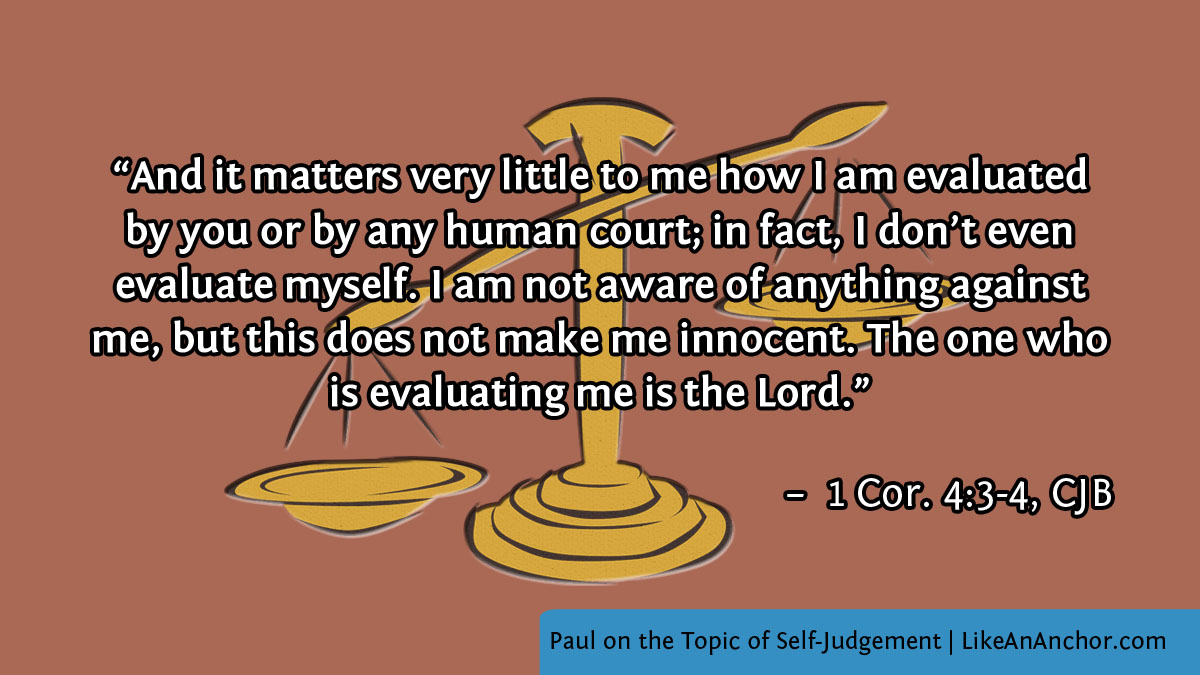
Image of scales, with text from 1 Cor. 4:3-4, CJB version: "And it matters very little to me how I am evaluated by you or by any human court; in fact, I don’t even evaluate myself. 4 I am not aware of anything against me, but this does not make me innocent. The one who is evaluating me is the Lord."
Image by OpenClipart-Vectors from Pixabay

Taking a Proper View of Ourselves

Later in this same letter, Paul returns to the idea of judging ourselves when he’s talking about Passover. This is one of the self-examination passages I mentioned earlier (1 Cor. 11:26-30), but it also talks about self-judgement. Paul starts wrapping that discussion up with these lines:

But if we examined ourselves, we would not be judged. But when we are judged by the Lord, we are disciplined so that we may not be condemned with the world.

1 Corinthians 11:31-32, NET

“Examined” here is diakrino, and Zodhiates says that in this verse it could be translated “if we took a proper view” or “formed a just estimate of ourselves” (G1253). More generally, it means “to separate thoroughly, discriminate, make to differ, judge thoroughly.” It seems from these verses that there is a certain type of self-judgment Paul encourages, but it’s one that involves seeing ourselves accurately rather than seeking to condemn. It works alongside God’s accurate judgement (krino) to make us more and more like Him.

When Paul says he doesn’t judge himself, it doesn’t mean he ignores who he is. He knows he persecuted the church and is only an apostle by God’s grace (1 Cor. 15:9-10; Eph. 3:8). He realizes that he needs to keep moving forward in faith with Jesus’s righteousness applied to him, not become complacent (Phil. 3:8-14). But he doesn’t let a realistic look at himself lead to getting stuck in self-condemnation. Paul knows he has received God’s grace. He knows he has righteousness that comes from Jesus. That’s what lets him say he doesn’t judge himself and isn’t aware of any charge against him. 

For us, this seems to indicate that we shouldn’t beat ourselves up over past mistakes. When God says He has removed our sins and forgiven us, He really means it (Ps. 103:12; Rom. 3:25). He’s not going to say our sins are gone, covered and paid in full by Jesus’s blood and then hold those over us in a judicial examination of our character. We need to have a realistic view of ourselves and not forget the things that we once did (so that we can learn from them, not do them again, and appreciate the magnitude of God’s forgiveness), but we’re not to keep judging ourselves for things in our pasts. 

Avoiding Judgmental Doubt

The final passage where Paul talks about self-judgement is found in Romans. For context, this is the section in chapter 14 where Paul is discussing mutual respect in the church. He exhorts readers not to judge others, but rather to take a close look at their own lives. “Each of us will give an account of himself to God,” and we ought to care more about that than pointing condemning fingers at God’s other servants. It’s our responsibility to “be fully convinced in” our own minds about the choices we make and act in a way guided by faith. (Rom. 14:1-12). We’re also to respect when people make other choices in matters where God hasn’t given clear guidelines one way or the other (the example Paul uses here is eating meat vs. eating only vegetables). Whichever choice we make, though, we need to be careful we don’t act in a way that causes others to stumble. Indeed, we ought to refrain from doing anything that would harm other believers (Rom. 14:13-21).

The faith you have, keep to yourself before God. Blessed is the one who does not judge (krino) himself by what he approves. But the man who doubts is condemned (katakrinio) if he eats, because he does not do so from faith, and whatever is not from faith is sin.

Romans 14:22-23, NET

Since it’s linked to doubt, it seems here that not judging yourself is basically the same thing as not letting doubt take you to the point where you aren’t even walking in faith anymore. If we take self-judgement to an unhealthy extreme, then we could be so caught-up in it that we can’t live the vibrant lives of faith that God has planned for us. That leads to being “condemned;” another derivative of krino. It means “to pronounce sentence against, condemn, adjudge guilty” (Zodhiates G2632) and “to judge worthy of punishment” (Thayer).

It’s not easy to live a life of faith if we’re constantly second-guessing and beating ourselves up. Self-examination is vital, and when we discover something in ourselves that isn’t in line with God’s righteousness a certain amount of self-judgment can be productive if it brings us to repentance. But constant self-judgment–condemning ourselves for sins Jesus has already removed or questioning every choice over and over–is not productive. We don’t need to keep tormenting ourselves with past mistakes. Focus on actively engaging in your relationship with God, striving to follow Jesus’s example, and faithfully repenting when you miss the mark. Then, as Paul did, leave the judgement on your life in God’s hands.

Featured image by OpenClipart-Vectors from Pixabay