Joy and Return in Yom Kippur and Sukkot

Last week, we talked about the time between Yom Teruah (Day of Trumpets) and Yom Kippur (Day of Atonement) as a traditional time of return and repentance. Now with Yom Kippur behind us and Sukkot (the Feast of Tabernacles) fast approaching ,we turn to a new theme: rejoicing.

Yom Kippur is widely considered the most solemn holy day by Jews and by Christians who observe God’s holy days. It’s a time of fasting, of strictly observed rest from labor, of prayer, and reminders of Christ’s work atoning for our sins as we look forward to His return and to Satan being locked away. It is followed just five days later by the most joyful of God’s festivals. While the first and last day of Sukkot are sabbaths of “solemn rest,” they’re accompanied by the command, “you shall rejoice before Yahweh your god seven days” (Lev. 23:39-40, WEB).

Why joy? We know joy is a fruit of God’s spirit–it’s something that should be part of our developing spiritual character all year-round. We talk about joy as something which God gives us that cannot be shaken by trials or external circumstances (Gal. 5:22; James 1:2; 1 Pet. 1:8; 4:13). But why the specific command to rejoice during Sukkot right after the solemnity of Yom Kippur?

Rejoice for Redemption

Jesus revealed Himself as God who heals sorrow, binds up wounds, and comforts the lost (Luke 4:17-21). This role connects with prophesies in Isaiah which speak of a Messiah who will come and do great things for His people. Part of these hopeful, joyful prophecies were fulfilled in Jesus’s first coming, and we still wait for others.

Then Yahweh’s ransomed ones will return,
and come with singing to Zion;
and everlasting joy will be on their heads.
They will obtain gladness and joy,
and sorrow and sighing will flee away.”

Isiah 35:10, WEB

Christians who keep Sukkot connect it to the Millennial reign of Jesus Christ pictured in Revelation 20:1-6. Isiah 35 is one of the millennial passages that hints at what that time will be like (see also Is. 11:1-16; 65:11-25; 51:11-12; 52:7-9). Even before that time arrives, though, we have reason for great joy (Is. 51:11-12; 52:7-9).

I have blotted out, as a thick cloud, your transgressions,
and, as a cloud, your sins.
Return to me, for I have redeemed you.

Sing, you heavens, for Yahweh has done it!
Shout, you lower parts of the earth!
Break out into singing, you mountains, O forest, all of your trees,
for Yahweh has redeemed Jacob,
and will glorify himself in Israel.

Isaiah 44:22-23, WEB

Realizing how great Jesus’s sacrifice is and what He gave up to redeem us should leave us in awe, humbled by His goodness and selflessness. We should also respond with great joy, particularly after our return and repentence . He loves us, redeems us, and wants us to thrive. How could that not turn our “mourning into joy”? (Jer. 31:11-14).

Turn Mourning into Joyful Dance

We don’t have to wait for Christ’s second coming to experience the joy of knowing God, being loved by Him, and having Him save us. For example, in Psalm 30 David recounts the work of God in his life, singing “at the dedication of the temple” (v. 1) about the ways God responded to his calls for aid.

Weeping may stay for the night,
but joy comes in the morning. …

You have turned my mourning into dancing for me.
You have removed my sackcloth, and clothed me with gladness,
to the end that my heart may sing praise to you, and not be silent.
Yahweh my God, I will give thanks to you forever!

Psalm 30:5, 11-12, WEB

New Testament writers also assure us that we can have joy. In John’s gospel, Jesus shares that He’s leaving His joy with His followers so that their “joy may be made full” (John 15:11; 17:23). He also assures them that even though they “will weep and lament” because of His death, their “sorrow will be turned to joy” that no one can take away because of His resurrection (John 16:20-22).

We also know the resurrected Messiah and have access to a joy that no one can take away. He still works with us today, giving us His joy as we increase “in the knowledge of God, strengthened with all power, according to the might of his glory, for all endurance and perseverance with joy” (Col. 1:9-10). And when we walk with Him, we also align ourselves toward future joy the same way He did when He walked on this earth (Heb. 12:1-2).

Joy in Returning

Image by bluebeyphoto from Lightstock

Just as the trumpet call of Yom Teruah reminds us to repent and turn to the Lord, humbling ourselves and accepting Jesus’s atoning sacrifice pictured in Yom Kippur, so our “godly sorrow produces repentance to salvation” today (2 Cor. 7:9-10). That is something to rejoice about! Over and over, the prophets record that God’s people follow a pattern of wandering from God, repenting with sorry, then being filled with joy and gladness as they reconnect with God. That cycle is pictured in these fall holy days, both on an individual level and looking forward into the future of all humanity.

One of the truths I’ve been meditating on and marveling at this past week is that God works with an ever expanding number of people. He created two–Adam and Eve. Then He saved Noah and his family–eight people–in the flood and made a covenant with Noah. Then He worked with Abraham and his descendants to make him into a great nation we call ancient Israel–one precious people that God later made a covenant with at Mount Sinai after rescuing them from Egypt. People outside Israel could join themselves to that covenant, but for the most part God worked with just one nation. Then Jesus came and entrusted His followers with the message that salvation is open to everyone in the world, regardless of their background. Today, God is working with a group of people called out from among all the nations of the world. And in the future, He will show the entire world who He is, resurrect those who died without knowing Him, and give all an opportunity to choose life with Him (see “Rethinking Heaven: Capturing A Vision Of The Resurrection” and “Rethinking Hell: A Clearer View of God’s Judgement“).

“Yet even now,” says Yahweh, “turn to me with all your heart,
and with fasting, and with weeping, and with mourning.”
Tear your heart, and not your garments,
and turn to Yahweh, your God;
for he is gracious and merciful,
slow to anger, and abundant in loving kindness,
and relents from sending calamity. …
Blow the trumpet in Zion!
Sanctify a fast.
Call a solemn assembly. …

Be glad and rejoice, for Yahweh has done great things. …
Be glad then, you children of Zion,
and rejoice in Yahweh, your God;
for he gives you the early rain in just measure,
and he causes the rain to come down for you,
the early rain and the latter rain,
as before.

Joel 2:12-13, 15, 22-23, WEB

God has great joy in seeing people turn from their wickedness and choose life (Eze. 18:23; Luke 15:7,10). The Bible represents this change in our way of life as a return to the Lord, and when we repent and turn to Him with sincerity there is great joy for us as well. Interestingly, at least one prophet connects that joy with coming back to keeping the feasts of the Lord (Zech. 1:3-4; 8:3, 19; 10:7-9; 14:8-9, 16-20). Let’s rejoice in these days and in the knowledge that the Lord loves us. He redeems us, welcomes us into His family, and promises to share His everlasting life and joy with us if only we’ll return to Him.

Featured image by Pearl from Lightstock

Song Recommendation: “Praise You With The Dance” by Casting Crowns

A Day of Return and Repentance

On the Hebrew calendar, today is Shabbat Shuvah–the Sabbath of return. That’s the name for the weekly Sabbath that falls during the 10 Days of Awe between Yom Teruah (Day of Trumpets) and Yom Kippur (Day of Atonement). Traditionally, it’s a time for reflection and prayer, particularly on the concept of repentance.

On the Gregorian calendar, today is September 11 and this year marks 20 years since the attack on the World Trade Center and the Pentagon. I was 12 years old, and one thing I remember from the aftermath of that attack is how many people turned to God for comfort and answers. Churches filled, Christians talked about revival, but it all petered out pretty quickly. Life went back to something like normal; it was easy to forget the United States was fighting a war unless someone you knew was involved, or to overlook the extra security measures unless you had to fly on a plane. It must have seemed similarly easy to forget how much people felt they needed God and continue a trend (particularly among young people) of leaving churches and abandoning belief in a single faith.

Ancient Israel followed a similar pattern in the stories recorded for us in the Bible. They started out as a godly nation, then strayed from God, came back when things got bad, and then forsook God again. I don’t want to spend too much time drawing parallels with any modern nation, though. The New Testament characterizes the Christian community (not a nation like the United States) as “spiritual Israel;” people who are citizens of God’s heavenly country and who live as foreigners among the nations of the world (Phil. 3:20; Heb. 11:13-16). We’re the ones that Paul is talking to when he writes about Ancient Israel and says, “These things happened to them as examples and were written for our instruction, on whom the ends of the ages have come” (1 Cor. 10:1-12, NET). We don’t know when this “age” will end, exactly, but we do know that we’re now closer to the time of Jesus’s return than Paul was when he wrote his letter to the Corinthians. If they needed to learn from stories of Israel as “the end of the ages” drew near, so do we.

(Re)Turning to God

In modern Hebrew, teshuvah is the word for repentance. It’s root is shuva or shub–a verb used “over 1050 times” in the Old Testament. Of those, the word is used “in a covenantal context” 164 times (TWOT entry 2340). Though this word for “return” is used in a variety of ways, the most theologically significant meaning is as a repentance idiom. In other words, when we repent we return to God (and our covenant with Him) and turn away from sin.

To be sure, there is no systematic spelling out of the doctrine of repentance in the OT. It is illustrated (Ps 51) more than anything else. Yet the fact that people are called “to turn” either “to” or “away from” implies that sin is not an ineradicable stain, but by turning, a God-given power, a sinner can redirect his destiny. There are two sides to understanding conversion, the free sovereign act of God’s mercy and man’s going beyond contrition and sorrow to a conscious decision of turning to God. The latter includes repudiation for all sin and affirmation of God’s total will for one’s life.

Theological Wordbook of the Old Testament, entry 2340

Themes of return and repentance, as spoken of here in this dictionary entry, figure prominently in the prophets’ writings. Hosea, for example, says, “Return, O Israel, to the Lord your God, for your sin has been your downfall! Return to the Lord and repent!” (Hos. 14:1-2, NET). You’ll find similar calls in other prophets’ writings as they share God’s call for His people to come back to Him after they’ve forgotten Him and been unfaithful. Hosea even gives guidelines for how to do this: “But you must return to your God, by maintaining love and justice and by waiting for your God to return to you” (Hos. 12:6, NET). A key way we can return to God is by prioritizing love and justice (which puts me in mind of Mic. 6:8 and Luke 11:42). Then, all we have to do is wait on the Lord. God is faithful, and when we turn to Him He will turn to us as well.

A Warning Shout

Image by Engin Akyurt from Pixabay

As we approach Yom Kippur, many believers will read Isaiah 58, which is a passage about genuine fasting. This passaged begins the same way that the fall holy day season did with Yom Teruah on the first day of this Hebrew month–with shouts and trumpet blasting.

“Shout loudly! Don’t be quiet!
Yell as loudly as a trumpet!
Confront my people with their rebellious deeds;
confront Jacob’s family with their sin.
They seek me day after day;
they want to know my requirements,
like a nation that does what is right
and does not reject the law of their God.

Isaiah 58:1-2, NET

God instructs Isaiah to use his voice as a teruah–a loud shout or trumpet blast–to deliver a warning. These people said they wanted to know God, but they didn’t actually listen to Him. He’s calling them to turn away from wickedness and toward Him with genuine fasting and respect for God’s holy times (Is. 58:3-14). That sort of thing isn’t just in the Old Testament. Jesus speaks of dealing with similar people who “have shut their eyes, so that they would not see with their eyes and hear with their ears and understand with their hearts and turn, and I would heal them” (Matt. 13:14-15, NET).

We don’t want to be like that. We need to “turn around and become like little children” (Matt. 18:1-3, NET), who “turn back” to faith after we make mistakes (Luke 22:31-34, NET), and who “turn to the Lord” to have the “veil” removed so we can understand God’s word and His glory (2 Cor. 3:15-18, NET). When we repent, we confess “the name of the Lord” and “turn away from evil” (2 Tim. 2:19, NET). The process of repentance is more clearly articulated in the New Testament, but it’s essentially the same that it has always been. Repenting involves turning a way from one thing (sin) and turning to another (God).

Let’s use the Days of Awe this year to take a close look at ourselves. I think we can all find ways that we haven’t walked perfectly with God over this past year. Thankfully, God holds open the possibility for return. While we can repent and return to God any time of the year, this season we’re in now is particularly focused on reminding us to do that. Let’s remember God, return to Him, and commit to remaining faithful.

Featured image by reenablack from Pixabay

Song Recommendation: “Who I Am” by Casting Crowns

Hear the Trumpet Sound

In just a few days, we’re observing Yom Teruah–the Day of Trumpets (you may also know this day as Rosh Hashanah). As the earliest New Testament believers did, Messianic Jews and many other Christians today will gather to blow shofars and celebrate a day that God describes as holy to Him. We’ll do this because we want to honor God and show our love for Him by obeying His commands, yet we don’t know very much about this day or why God wants us to mark it. The most detailed description we have is this:

Yahweh spoke to Moses, saying, “Speak to the children of Israel, saying, ‘In the seventh month, on the first day of the month, there shall be a solemn rest for you, a memorial of blowing of trumpets, a holy convocation. You shall do no regular work. You shall offer an offering made by fire to Yahweh.’”

Leviticus 23:23-25, WEB

There are many theories about this day. Some say it pictures the time when “the Lord himself will come back from heaven with a shout of command, with the voice of the archangel, and with the trumpet of God” (1 Thes. 4:16, NET), like a Jewish bridegroom arriving to marry his betrothed. Others say its a day picturing freedom, release from debts, and joyful shouts. Or perhaps it’s simply a call to prepare for Yom Kippur (JewishLink.com). Some teach that it marks the sixth day of creation and is intended to wake us up, reminding us to turn to the Lord and pray we be inscribed in the Lamb’s book of life (Hebrew4Christians.com).

First and Second Creation

Image by LoggaWiggler from Pixabay

This idea of a connection between Yom Teruah and the sixth day of creation comes from Jewish mishnah writings rather than scripture, but if that tradition is true it would connect neatly with the second coming. As the author of Hebrew4Christians points out, this reading would mean Yom Teruah “commemorates both the creation of the universe by Adonai as well as the ‘calling up’ of the new creation at the behest of Yeshua, when the sound of the heavenly shofar inaugurates the anticipated End of Days.”

Paul also draws a link between Adam–the first human being God created–and Jesus Christ–the first person raised from the dead in a spirit body. There’s an orderliness to this comparison, “for just as in Adam all die, so also in Christ all will be made alive. But each in his own order: Christ, the firstfruits; then when Christ comes, those who belong to him” (1 Cor. 15:20-25, NET). We’ve born the image of the man made of dust, created by God on the sixth day in Genesis 1, and we will “also bear the image of the man of heaven” (1 Cor. 15:42-53, NET).

Something marvelous is going to happen in the future. We, who are fleshy like the first created man, will change. We’ll become spirit, like the Firstfruit from the Dead, Jesus Christ who lived as a human being, died, and then rose a spirit being. And that will happen “in a moment, in the blinking of an eye, at the last trumpet” (1 Cor. 15:52). We can debate the exact timing of that change (and many have), but it doesn’t seem much of a stretch to associate it, or at least a blasted reminder that this change is coming, with Yom Teruah.

The King is Coming!

The connection between trumpets and Jesus’s second coming is perhaps the simplest explanation for this day’s meaning that we can offer. The spring holy days (Passover, Unleavened Bread, and Pentecost) pointed toward and now call us to remember Jesus’s first coming. The fall holy days point to a time in the future when God Himself will dwell with people; when Jesus Himself will return with the sound of trumpets, shofar blasts, and shouts.

The trumpets and shofars used to make the “alarm, signal,” “shout,” or “blast” that’s described by the word teruah figure prominently in scripture (H8643, BDB definition). Often, this word refers to the sound made by a shofar, or ram’s horn (TWOT entry 2449c). The shofar was used when Israel met with God at Mount Sinai (Ex. 19:16-20). It’s what the priest blew when Jericho fell and Gideon went up against Midian (Josh. 6:4-20; Judg. 7:16-22). The shofar was used for signals in battle and to sound an alarm, and it’s often used figuratively as well as literally (Judg. 3:27; 2 Sam. 18:16; 20:1; Neh. 4:20; Is. 58:1; Jer. 4:19, 21; 6:1, 17; Ezk. 33:3-6; Hos. 5:8; 8:1; Joel 2:1; Amos 3:6). Israel also used shofars when anointing a new king (1 Kings 1:34, 39; 2 Kings 9:13), and it played a key role in praise and covenant making with God (2 Chron. 15:13-14; Ps. 81:3; 98:6; 150:3; Joel 2:15).

Shofar blasts are connected to kingship, to warnings for Israel to return to God, and to proper expression of joy after returning. They serve as a warning and reminder as well as a tool for worship. So let’s keep this holy day with all those meanings in mind. Let the Day of Trumpets wake us up from spiritual sleep, renewing our commitment to wait faithfully for the Bridegroom. Let that day remind us to prepare and use the days between now and Yom Kippur (the Day of Atonement) wisely. And let’s also celebrate joyfully, remembering the goodness of God in creating us and promising to recreate us in His spiritual likeness. This world which is so full of frightening and wicked things will not last forever. Someday, our Lord will return with trumpet blasts and we will be changed, fully born into His spiritual family. And that gives us great reason for joy as we begin another fall holy day season.

Featured image by Ri Butov from Pixabay

New 30-Day Scripture Writing Plan: “Big Questions”

I’ve been so fascinated by the topic of “big questions” that I’ve added another monthly scripture writing list to the resources on this blog. You can read my other posts on this topic here:

Like the other scripture lists on this blog, “Big Questions” has a list of 30 scriptures that you can write out one per day for a month. At first, I thought about alternating “question-scriptures” with in-Bible answers to those questions, but I ended up just sticking with the questions. Many of them have answers right there in the next few verses, or later in the same books. Others are answered elsewhere in the Bible. For most, though, I have not included the “answer-scriptures” on this list.

I hope that by leaving this scripture writing list more open-ended, it will invite you to search out answers to those questions in the scriptures and/or meditate on how you’ve answered those sorts of questions for yourself. If you want to take the extra time, you might choose to write some of the answer scripturas as well or use this list to inspire a deeper study into one or more of the questions.

Download “Big Questions” scripture writing list here:

Weathering the Storms of Life with Jesus Onboard

As I’ve studied “big questions” over the past couple of weeks, one in particular stuck in my mind. It’s a question the disciples asked Jesus during a big storm while they were crossing the Sea of Galilee in boat.

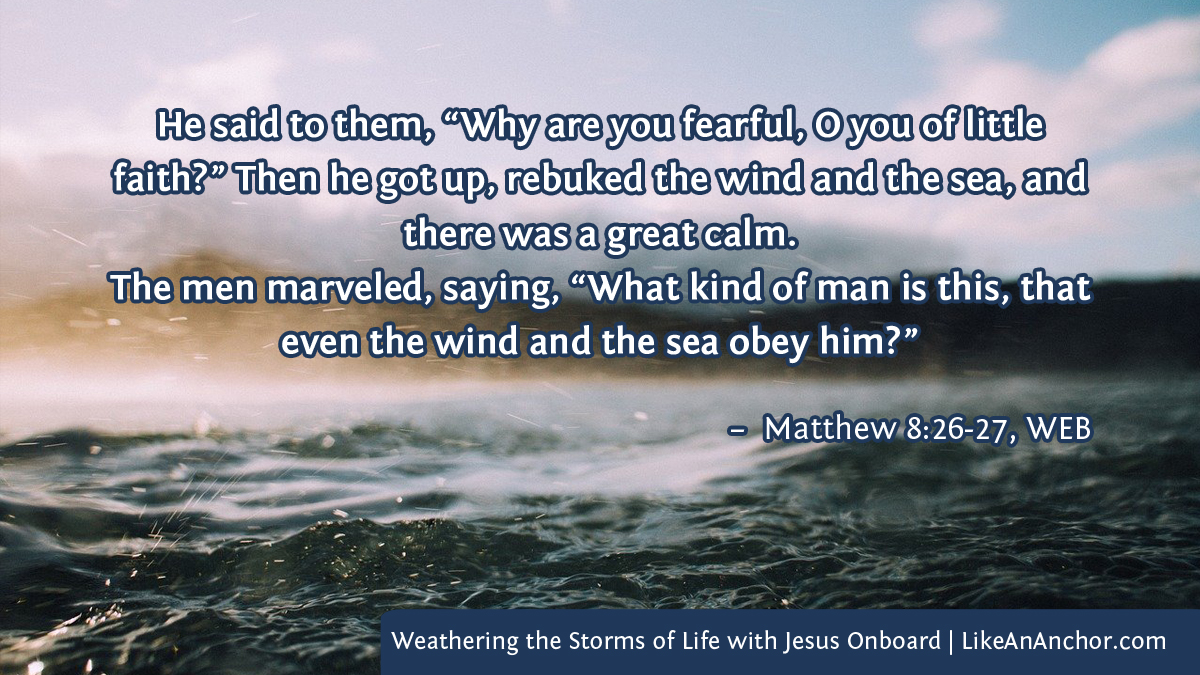
Now a great windstorm developed and the waves were breaking into the boat, so that the boat was nearly swamped. But he was in the stern, sleeping on a cushion. They woke him up and said to him, “Teacher, don’t you care that we are about to die?” So he got up and rebuked the wind, and said to the sea, “Be quiet! Calm down!” Then the wind stopped, and it was dead calm. And he said to them, “Why are you cowardly? Do you still not have faith?” They were overwhelmed by fear and said to one another, “Who then is this? Even the wind and sea obey him!”

Mark 4:35-41, NET

There are a few questions in this story. The disciples ask Jesus, “Don’t you care that we are all about to die?” I’m not sure they even expected Him to do anything other than wake up and reassure them. But then He calmed the storm, and had questions for them. He asked, “Why are you cowardly? Do you still not have faith?” From His perspective, there’d never been anything to worry about. That the disciples were worried showed they didn’t yet fully trust in Him or His power. Then the final question is one the disciples asked among themselves: “Who then is this?” Typical rabbis could not order a storm to stop and have it obey. This teacher they were following was clearly different than the usual prophets or rabbis.

Image by Pexels from Pixabay

Commander and Creator

The Jews of Jesus’s day, including His disciples, were typically very familiar with the words of the Old Testament. Some of those words likely came to mind during this storm and miracle. In Job, God describes Himself as the one who “laid the foundations of the earth,” “shut up the sea with doors,” and “made clouds its garment” (Job 38:1-11). Psalms describe Him as the one who “walks on the wings of the wind” and “makes lightnings with the rain” (Psalms 104:3; 135:7). In the prophets, He’s the one who keeps the sea and its waves in check, causes the waves to “stir up and roar,” and “makes storm clouds” (Jer. 5:22; 31:35; Zech, 10:1). Perhaps the scripture most likely to come to the disciples’ minds, though, is in Psalms.

Those who go down to the sea in ships,
who do business in great waters;
These see Yahweh’s deeds,
and his wonders in the deep.
For he commands, and raises the stormy wind,
which lifts up its waves.
They mount up to the sky; they go down again to the depths.
Their soul melts away because of trouble.
They reel back and forth, and stagger like a drunken man,
and are at their wits’ end.
Then they cry to Yahweh in their trouble,
and he brings them out of their distress.
He makes the storm a calm,
so that its waves are still.

Psalm 107:23-29, WEB

No wonder Jesus’s disciples were “overwhelmed by fear” even after He proved they weren’t going to die in a storm. He’d just done something only Yahweh could do. By calming the sea, Jesus illustrated He was God here on earth in the flesh.

Image by Pexels from Pixabay

Storm-Maker and Anchor

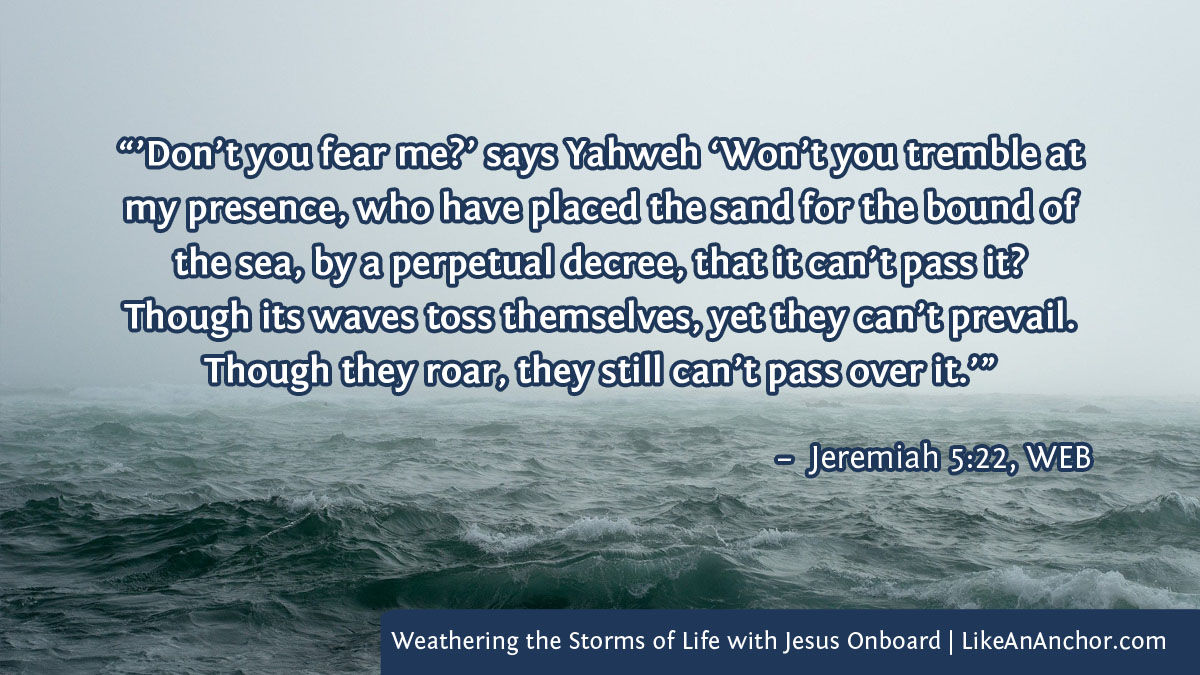
In scripture, waves and storms are used as metaphors for great trials. God’s anger and judgement on persistently sinful people are linked to storms (Is. 28:2; 29:6; 30:30; Jer. 23:19; 30:23; Ezk. 30:3; Joel 2:2; Nah. 1:3). David speaks of being surrounded by “waves of death” and “floods of ungodliness” (2 Sam. 22:5; Ps. 18:4). Both David (figuratively for despair and possibly depression) and Johan (in a more literal sense) talk about being in the depths of the sea with “waves and billows” passing over them (Ps. 42:7; Jon. 2:3). In all these verses, the storms are representative of great trials or hardships.

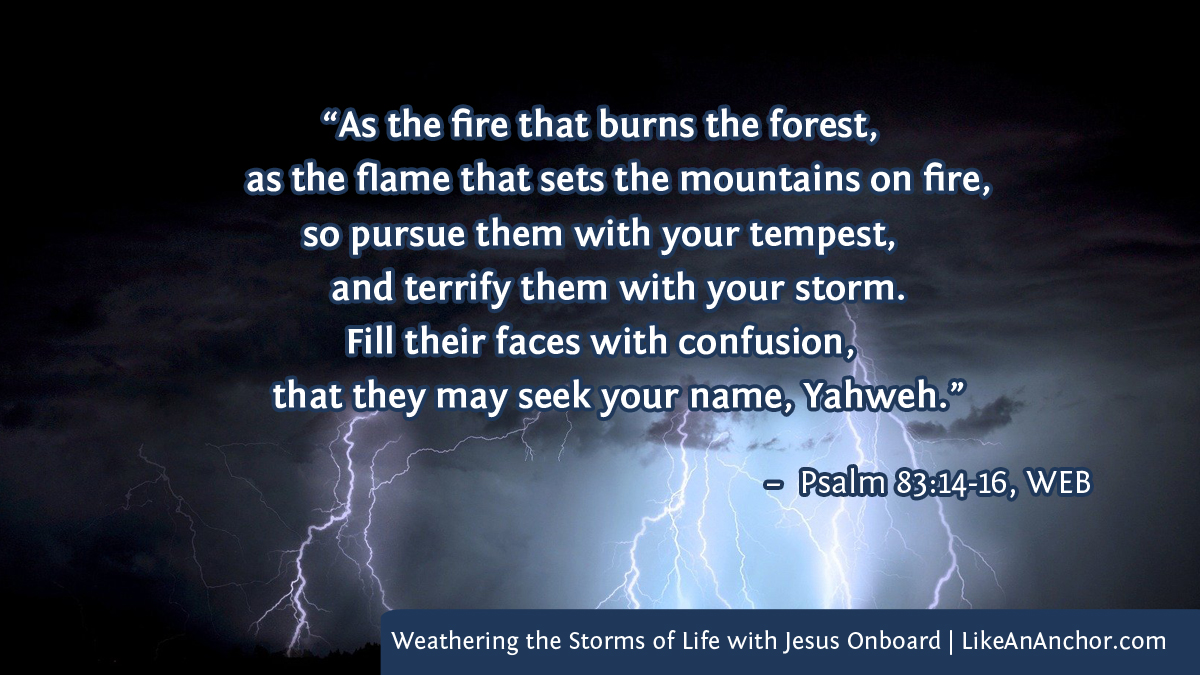
The purpose of such tempest and storms is “that they may seek your name, Yahweh” (Ps. 83:15-16). We’re to learn from the storms of life to listen to Yahweh and turn to Him for shelter and safety. Those who don’t learn that lesson may make “a shipwreck concerning the faith” and eventually find that God does not listen to their cries for help during storms (Prov. 1:24-29; Zech. 7:13-14; 1 Tim. 1:19). As the writer of Hebrews said, though, I am “persuaded of better things for you, and things that accompany salvation, even though we speak like this” (Heb. 6:9, WEB). Bible teachers don’t share warnings in order to condemn; we share them as reminders to keep faithfully seeking God. The righteous stand firm in the whirlwind and storm since they are founded on the Rock, and that is what I want for myself, for you, and for all who follow the Lord (Prov. 10:25; Matt. 7:24-27).

Keep Jesus in your boat, and the storms of life have no power over you. You might get tossed around and nearly swamped, as the disciples were when they cried out asking if Jesus cared that they were dying, but ultimately there’s nothing to worry about. Faith and hope anchor our souls (Heb. 6:19; 10:23).

Image by Keli Black from Pixabay

Hold Fast

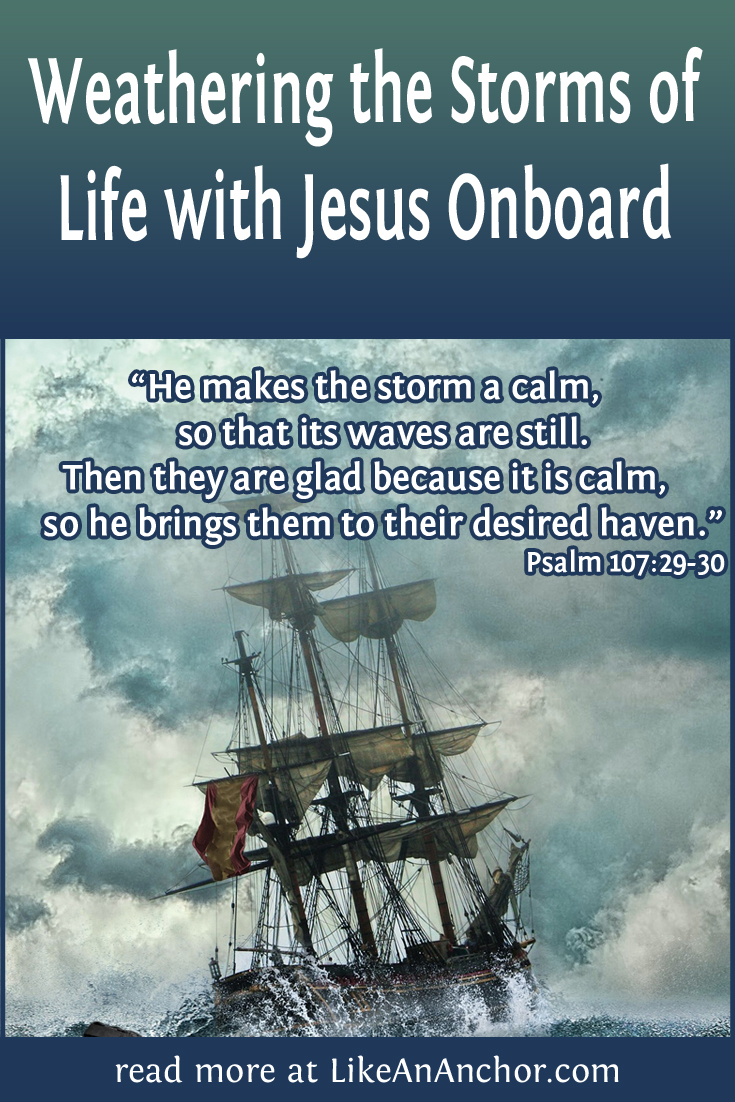
With Jesus on board our ships, we can weather the storms of life. Working together in unity, He and His Father are the same God who created the seas and storms, and rule over them (Gen. 1:6-8; Job 28:23-27; Ps. 93:3-4; Eph. 3:8-9). They are the ones who’ve seen faithful people through earth-shaking storms and who still the roaring sea (Ps. 46:2-3; 65:7; 89:9; 107:29-30). Today, He still saves and anchors us so that “we are no longer to be children, tossed back and forth by waves and carried about by every wind of teaching by the trickery of people who craftily carry out their deceitful schemes” (Eph. 4:14, NET).

Image by Comfreak from Pixabay

Yahweh, you are my God. I will exalt you! I will praise your name, for you have done wonderful things, things planned long ago, in complete faithfulness and truth. … For you have been a stronghold to the poor, a stronghold to the needy in his distress, a refuge from the storm, a shade from the heat, when the blast of the dreaded ones is like a storm against the wall.

Isaiah 25:1, 4, WEB

If we’re in the middle of a storm and asking God, “Don’t you care that we are about to die?” the answer is two-fold. First, God tells us we don’t need to worry so much; He’s got this. Second, He assures us that He definitely does care; He cares so much that Jesus came to this world and lived and died as a human being to save those who believe in Him and give them everlasting life.

As we face the storm-like trials of our lives, remember that Jesus is there with us in our boats. Even if it seems like He’s fallen asleep and isn’t paying attention, He still has us in His power and under His protection. Hold fast to Him, and He’ll get us through.

He has said, “I will never leave you and I will never abandon you.” So we can say with confidence, “The Lord is my helper, and I will not be afraid. What can people do to me?”

Heb. 13:5-6, NET

Featured image by Enrique Meseguer from Pixabay

Big Questions of the Bible

Since last week’s post, inspired by the big questions Leo Tolstoy asked in his book A Confession, I’ve been thinking about the questions that people in the Bible asked. From the sorts of questions recorded in Job, Psalms, Ecclesiastes, and elsewhere in scripture, it seems clear that God is okay with us asking Him things such as “Why am I here?”, “What is the purpose of suffering?”, and “What ought I do with my life?”

Today, we still have a lot of questions for God. Some of them are specific, such as “Why did that bad thing happen to me?” or “How can I decided what the next step for my life is?” Others are more general, the sorts of things that most thinking people wondered at some point in their lives, such as “What is the meaning of life?” and “Where do I fit into the universe?”

It often seems like these types of questions are too big to answer and so we shouldn’t try to ask them. Or it might seem as if we’re the only ones who haven’t figured this out yet, since everyone else seems like they’re functioning just fine. But we’re all asking questions and we all have things we’re uncertain about, just like people in the Bible. Even the “heroes of faith” like Job and David asked big questions, some of which seem audacious to us. We might expect God to get angry or offended at questions like “Why did you make me like this?” or “What do you think you’re doing, letting this terrible thing happen to me?” But throughout scripture, God shows remarkable patience with His people’s questions and also a willingness to answer. One of the most amazing things about Job’s story, for example, isn’t that Job asked questions about his suffering; it’s that God showed up to give an answer and ask questions of His own.

If you search for question marks in the Bible, you come back with 3,256 results in the WEB translation and 2,990 in the NET. The exact number varies depending on how translators choose to interpret phrases and where they put punctuation marks, but however you figure it up that’s a lot of questions. We can’t cover them all in one post, and not all fit in the “big questions” category. I’ve picked out four types of these questions I want to look at today, and there are plenty more that we could examine. If this inspires you to do a study on questions for yourself, I’d love to hear about it in the comments below or in an email.

Image by Free-Photos from Pixabay

What is the point of anything?

In his darkest trials, Job asked why he’d even been born if this is what was going to happen (Job 3:11-16; 6:11-13; 10:18). It wasn’t a self-destructive thought for him, but it does seem to be one of frustration and despair. Why even live if suffering is the main result? What’s the point of being born, and living, and dying in a world where such terrible things can happen to good people?

Similarly, Solomon in Ecclesiastes wonders what the point is of living and working here on earth (Ecc. 1:3; 3:9; 4:8). Life seems to just go on and on with no real profit or gain, especially if you’re working alone rather than in a community. If there’s no satisfaction, or wealth, or any sort of meaningful profit then it’s all “vanity. Yes, it is a miserable business” (Ecc. 4:8, WEB). Others ask this type of question more specifically, wondering “What is the point of serving God?” (Job 21:15; Mal. 3:13-14).

God counters this sort of thinking with a question of His own: “Why do you spend money for that which is not bread, and your labor for that which doesn’t satisfy? Listen diligently to me, and eat that which is good, and let your soul delight itself in richness” (Is. 55:2, WEB). In other words, if our lives and efforts seems pointless it’s because we’re devoting them to the wrong sorts of things. This reminds me of one of Tolstoy’s observations in A Confession* that I wrote about last week. He realized that just because it felt as if his life wasn’t meaningful that didn’t mean all life had no meaning.

Another answer that God offers to this question is a clearer picture of Himself. He answered Job’s questions about the meaning of life and the purpose of suffering by revealing Himself to Job more fully (for an interesting take on that aspect of Job, see Philip Yancey’s The Bible Jesus Read*). It might seem an oddly indirect answer to us, but it’s one that appeared to satisfy Job. The clearer we can see and understand God, the more meaningful life seems.

*please note that this is an affiliate link, which means I'll earn a small commission (at no extra cost to you) if you purchase this book.
Image from Lightstock by Jantanee

Does God really care?

Faith in God answers a lot of life’s big questions. But it also brings up new questions. Once you believe that God exists and that He’s all powerful, it often follows that we wonder why He lets certain things happen. Why is there suffering? Why are there wars? How could a loving God allow such terrible things? Doesn’t He care?

The psalms are full of these sorts of questions. “Why do you stand far off, Yahweh?  Why do you hide yourself in times of trouble?” (Ps. 10:1, WEB), “My God, my God, why have you forsaken me?” (Ps. 22:1, WEB), and many more questions like these echo through history in the cries of many hurting people today (Ps. 13:1; 43:2; 44:24; 74:1, 11; 89:46; 108:11). We wonder why it seems that God leaves us alone in our times of trouble, and why it seems like He’s ignoring our cries for help (Lam 5:20; Hab. 1:2). Doesn’t He care about us at all?

There’s a story of a time when Jesus and his disciples were on a boat and a storm blew up. Jesus was sleeping through it, but they woke Him with the question, “Teacher, don’t you care that we are dying?” (Mark 4:38, WEB). Jesus hadn’t been worried at all, but at their question He got up and stopped the storm. I suspect there’s a reason Jesus wasn’t worried. With God on our side, the storms of life don’t present a real danger to us. Even if He seems to not be paying attention, He’s still very present and protective. He has the power to stop the storms instantly, and sometimes He does to show us His power and reliability, but things are still going to work together for good in the end even if He decides to let us go through the storms.

Perhaps a better question would be, “Why does God care so much?” There’s tons of evidence that God cares deeply about humanity. The main proof of that is found in Jesus’s sacrifice–God cares enough about us to die in our place. With that perspective in mind, our question may become “What are we that God should even think of us, much less care so much about us?” (Job 7:17; Ps. 8:4; Heb. 2:6). It’s awe-inspiring to think about the creator of the universe wanting us to be part of His family simply because He loves so much.

Image by Free-Photos from Pixabay

Why isn’t God doing things the way I want?

This next question is closely related to the last one. We wonder how long our trials will last, sure it would be better if God stepped in now and took care of things for us. We wonder how long it will be until the end comes, since it seems like the sooner the better for Jesus to return and stop pain, suffering, death, and evil. Similarly, we may question God’s planning and timing in other areas, wondering if He is unfair in the things that He commands or the way He interacts with people.

Even though these questions can sound like a lack of faith or an accusation, they’re still questions that it’s okay to ask. Jesus didn’t get upset when His disciples said, “Tell us, when will these things be? What is the sign of your coming, and of the end of the age?”–He just answered their question (Matt. 24:3, WEB). Yahweh didn’t cut-off Moses for asking, “How long must this suffering last?” (Ps. 90:13, NET). We can ask these things. It only becomes problematic when we decided the answer must be that God is wrong and we’re right.

Tolstoy talks about the insanity of this attitude by comparing “learned and liberal” people who reject God to kids who tear apart a watch without understanding how to put it back together, then complain that it doesn’t work. That’s similar to the analogies found in the Bible. When people accuse God of unfairness or of not knowing what He’s doing, God turns some big questions back on them. He says, “You turn things upside down!” It’s not for the creation to question the Creator and decide that He’s the one who lacks understanding. “Yet the house of Israel says, ‘The way of the Lord is not fair.’ House of Israel, aren’t my ways fair? Aren’t your ways unfair?” (Job 8:3; Is. 29:16; Jer. 2:5; Ezk. 18:23-29). God’s not the problem here; our limited understanding and lack of trust are what’s to blame.

What must I do now?

A rich young man once asked Jesus, “Good teacher, what good thing shall I do, that I may have eternal life?” When Jesus replied that this man should keep the commandments, he responded, ““All these things I have observed from my youth. What do I still lack?” (Matt. 19:16-20; Mark 10:17-21; Luke 18:18-23). That question is at the top of my list for things I’d like to ask God and get a clear answer on right now. I grew up in the church and didn’t really have a rebellious phase (though that doesn’t mean I haven’t sinned/missed the mark on God’s commandments). But I do sympathize with this young man. I’ve been following God my whole life; what do I still lack?

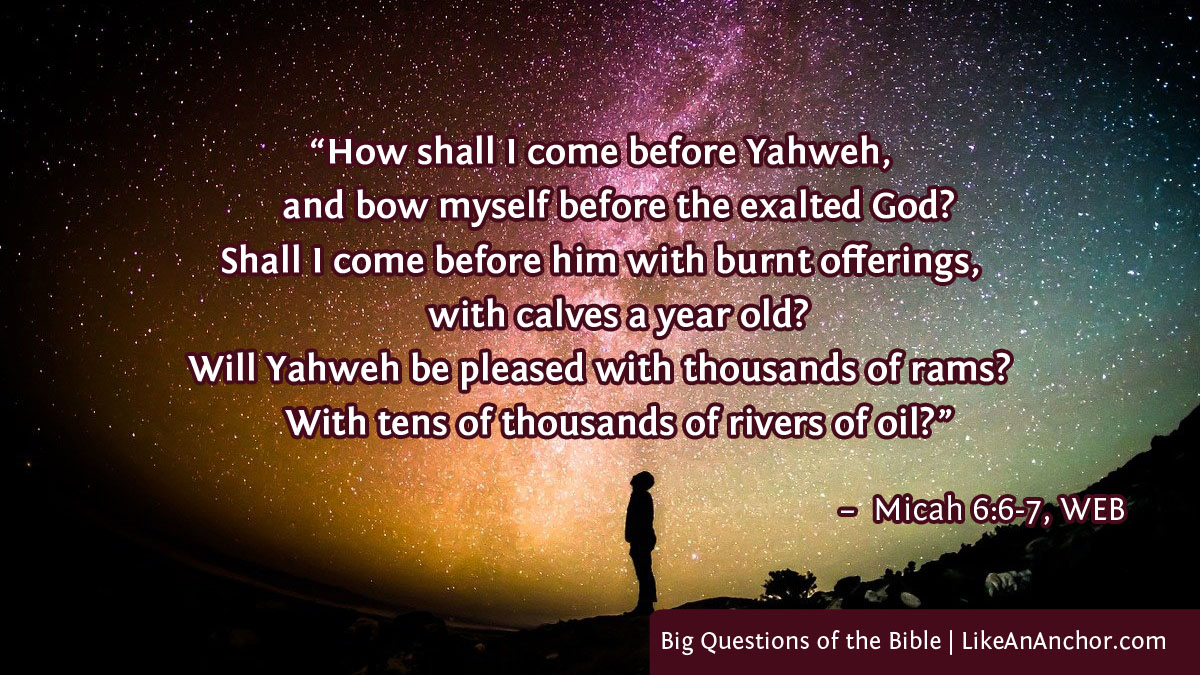
Whether you’re just starting out your journey as a Christian–like those in Acts whose response to hearing the gospel was, “What shall we do?” (Acts 2:37; 16:30)– or you’ve been following God for many years, the question of what to do now is a good one. Throughout scripture, people asked questions like, “How can man be just with God?”, “Where does wisdom come from?”, “Where is the good way?”, and “How shall I come before Yahweh?” (Job 9:2; 28:12, 20; Ps. 119:9; Jer. 6:16; Mic. 6:6-8). We treat these questions like they’re very complicated, but God gives us simple answers.

He has shown you, O man, what is good.
What does Yahweh require of you, but to act justly,
to love mercy, and to walk humbly with your God?

Micah 6:8, WEB

Jesus reiterates the simplicity of this point in the gospels. His answer to “How can we know the way?” is “I am the way, the truth, and the life” (John 14:5-6, WEB). His answer to “Which is the greatest commandment in the law?” and “What shall I do to inherit eternal life?” is to love God and love your neighbor (Matt. 22:35-40; Luke 10:25-29). It’s not that complicated.

God welcomes His people to engage with Him in real, dynamic relationship. Part of that relationship involves asking questions. If we have concerns, we’re invited to take them to God. If we have questions about Him or for Him, we ought to ask and then seek answers from Him through prayer, Bible study, meditation on the Word, and fasting.

Featured image from Lightstock by Jantanee