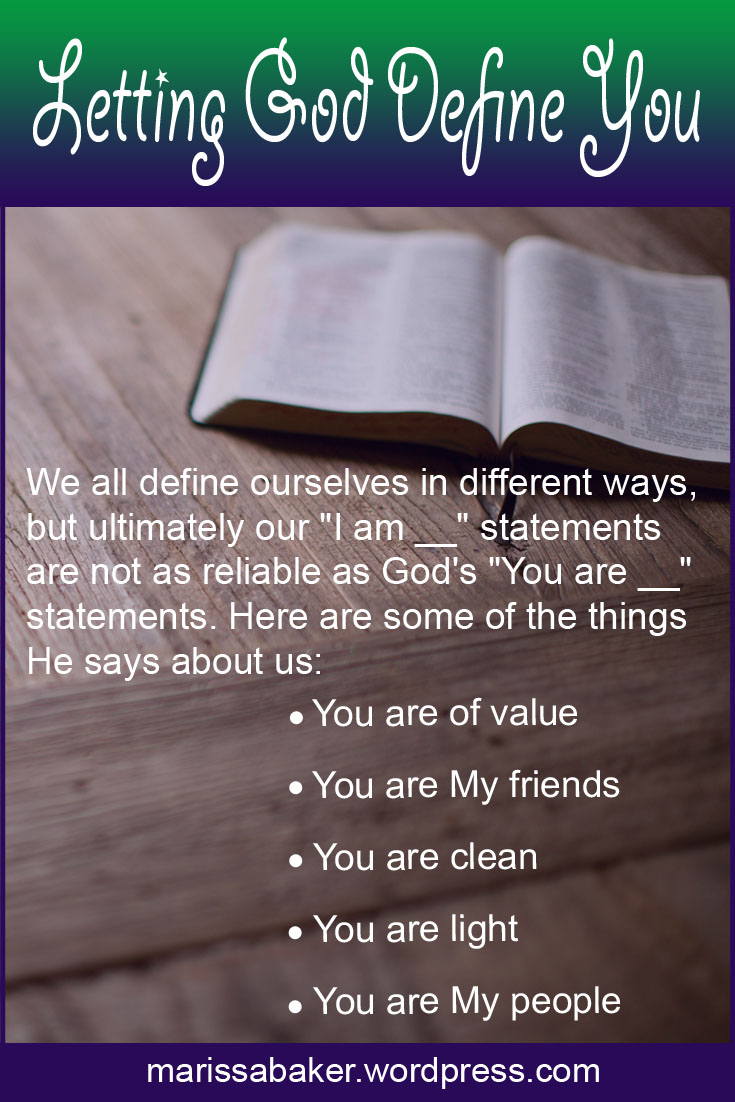
Letting God Define You

How do you define yourself? We all finish our “I am __” statements in different ways. We can go with something fairly basic, such as “I am a writer/sister/Christian.” That’s often how we introduce ourselves to people. But there are also less flattering “I am” statements that we tell ourselves. “I am anxious; I am too fat/skinny/unhealthy; I am a sinner not good enough for God.” Or sometimes we go with more positive self-affirmations: “I am a good friend; I am confident in using my gifts; I am a redeemed and forgiven child of God.”

How does God define you? Scripture reminds us in several passages that our “I am” is not as reliable as God’s “you are” (see 1 Sam. 16:7, Is. 55:8-9 and Jer. 17:9-10). He knows us better than we know ourselves and He can give us insight into His perspective. If we ask, He’ll reveal things about ourselves to us directly as well as through His word.

Some of the “you are” statements God makes about people are critical, such as when He describes all humans as sinner under a death penalty or rebukes Israel for their rebellion (Rom. 3:23; 6:23; Is. 1:18-25). But while part of God’s perspective on us involves seeing our faults, that’s not all He sees. For those in relationship with Him, His “you are” statements are overwhelmingly positive. There’s certainly a place for acknowledging our sins, abhorring ourselves, and repenting as Job did (Job 42:5-6). But we’re not to stay downcast. God wants us to have a realistic view of ourselves, and He values us far too highly for this view to not involve some incredibly positive things.Letting God Define You | marissabaker.wordpress.com
You Are Of Value

Aren’t five sparrows sold for two assaria coins? Not one of them is forgotten by God. But the very hairs of your head are all numbered. Therefore don’t be afraid. You are of more value than many sparrows. (Luke 12:6-7, WEB)

Our God cares even when a sparrow dies. But we’re not just another animal crawling around the earth that gets a moment of attention from Him. We’re valued highly — so highly that the Father and Son think you’re worth the price of Jesus’ life. And They thought that even before you were saved (Rom. 5:6-8). Read more
Our Christian Nationality

A number of years ago I was sitting in a church service listening to the minister introduce his sermon topic for the day. One of the first things he said was, “Close your Bibles and put them on the floor. I’ve got something to tell you this morning.” Smacks of Bibles hitting linoleum is a sound I hope never to hear again. While teenage me wasn’t brave enough to stand up and walk out, I did keep my Bible open in my lap so I could do my own study while he lectured on American history.

The United States of America, rather than something out of the Bible, should feel like a strange topic for a sermon. And yet I’ve heard other sermons, though much less extreme, preached about this topic on a fairly regular basis. Typically, it’s presented as something like “the Biblical history of our country” or “America’s Christian heritage.” The speakers usually do turn to scriptures, but they may spend more time quoting founding fathers and presidents than they do Jesus.

Now, please don’t misunderstand me. This isn’t a rant against my country or an article condemning people who love the U.S. of A (which is why I didn’t post this 4th of July weekend, though it would have probably gotten more views then). Nor am I saying Christians teachers shouldn’t quote writings outside the Bible. My concern is that patriotism for our physical nation has gotten muddled up with our Christian faith as if the two are, or should be, interconnected. But I don’t think they should be.Our Christian Nationality | marissabaker.wordpress.com

Not Of The World

When Jesus walked this earth, He said He was “not of this world” (John 8:23, KJV). At the Passover, He started describing His followers that way as well (John 15:19; 17:14-16). We still have to live in this world, as Paul points out in 1 Cor. 5:10, but we don’t belong to it.

“We know that we are of God, and the whole world lieth in wickedness” (1 John 5:19, KJV). The present world is evil because it has fallen into sin and is under Satan’s sway (Gal. 1:4; John 14:30). I think most Christians would agree with that at least to a certain extent, otherwise we’d have no need for a Savior. But often, we think of this world’s evil as an abstraction. The world “out there” is wicked, “society” is evil, or there’s a spirit of wickedness at large “somewhere.” But maybe my neighborhood, this city, our country isn’t really all that bad.

Here in the U.S., we don’t yet face the sort of persecution that would serve as a constant reminder that this world isn’t a Christian’s home. I’m thankful for that, but I also wonder if it has made us lose sight of some important truths. The United States was founded with some Christian principles and a guarantee of a religious freedom, but it was never a “Christian nation” and it hadn’t even looked like one for a long time. And while you have the right as an American to get involved in pushing your country toward where you’d like it to go and a duty as a Christian to stand up for what’s right in God’s sight, this physical nation isn’t where we owe our primary allegiance. Read more

Is Your Church The Same As God’s Church?

How do you define “church”? A building where Christians worship, the clergy of a religious body, all the believers in a religion, a specific denomination, a public worship gathering — those are all definitions we use in the English language. If we say we “go to church,” we either mean the building or the service. If we say of a group, “this is my church,” we’re generally telling people which denomination we’re part of. If we say someone chose the church as a career path, we mean they went into the clergy.

But those definitions don’t really get at what “church” means in the Bible. In fact, the only part of our English definition that overlaps with the Greek word’s definition is “the whole body of Christians” (Merriam-Webster 3a). And because there’s such a difference, I think it’s important to look at what the New Testament writers were talking about when they discussed the church. We want to learn about how God sees His church, not just how human beings define it today.

Called Out Ones

In the New Testament, “church” is translated from ekklesia (G1577). It’s a compound word that literally means a “calling out” (Strong’s Dictionary). In general, it’s used of a “gathering of citizens called out from their homes into some public place.” In the church-specific sense, it’s “an assembly of Christians” that gathers in a specific place or “the whole body of Christians scattered throughout the earth” (Thayer’s Dictionary). Read more

I’m A Christian … Now What?

What do you do after becoming a Christian? You’ve acknowledged your need for a savior, repented of your past sins, confessed Jesus Christ as your Lord and Savior, and received the gift of God’s grace. The foundations are in place. Now what?

There are some Christians, even Christian teachers, who don’t really know how to answer this question. Those who teach we have no role to play in our salvations and that nothing’s expected of us after conversion are left in a tough pickle. One could, according to this theory, have someone convert to Christianity then go out lying, sleeping around, and stealing but still be considered saved as a part of God’s family. And even the good people who wouldn’t dream of doing something like that are still left with the question, “What do I do now?”

God answers this question for us in the pages of His Bible. You can’t do anything to make God owe you salvation; it is a gift that He chooses to give freely to those who respond to His call. But once you’ve been given this gift your life is supposed to change. Salvation transforms the way you live and gives us a purpose.

I'm A Christian ... Now What? | marissabaker.wordpress.com
Photo credits: Bart Lumber via Flickr and Neely Wang via Lightstock

Choose A Way

In Acts, Christians are described as people who follow “the way” of the Lord (Acts 9:2; 18:25-26; 19:9, 23; 22:4; 24:14, 22). It’s a metaphorical use of the Greek word hodos (G3598), meaning “a course of conduct.” When used literally, hodos refers to the roadway you travel on a journey. In both cases, use of this word implies motion, travel, and activity.

Christians aren’t meant to stagnate. They’re meant to walk through life in a certain way. We get to choose whether we’ll walk in the ways of men or the way of God. And God’s instructions in the New Testament for how to walk look a  lot like His laws about how to behave from the Old Testament. The law can’t bring salvation and it was never intended to. But it was a revelation of God’s character and He hasn’t changed. Our conduct still matters to Him.

Ephesians is a fantastic place to start diving deeper into this topic.  Here, Paul reminds his readers that they “once walked according to the course of this world.” They were “children of disobedience” influenced by God’s adversary and acting in ways contrary to God’s teachings (Eph. 2:2-3, WEB).

But God, being rich in mercy, for his great love with which he loved us, even when we were dead through our trespasses, made us alive together with Christ (by grace you have been saved)(Eph. 2:4-5, WEB)

Trespasses — sin — kills people. That’s why the choice of whether or not to follow God has always been presented as a choice between life and death (Deut. 30:15-18). Grace lets us choose life even after we’ve done things worthy of death. But it doesn’t give us license to sin or permission to sit around twiddling our thumbs. Read more

That Which Every Joint Supplies: INFP Christians

This is my third post in a series about Christians of different Myers-Briggs types. When you start talking with people in the churches, it quickly becomes clear that while we share a common faith there is quite a variety among us as well. Some of that has to do with background, some with the denomination we’re part (or not part) of, and some with personality. And if we want our churches to be a welcoming place for all people who seek to know Jesus, it’s a good idea for us to understand how different personality types relate to their faith.

Our walks with God don’t all look the same. We’re influenced by our backgrounds, variations in beliefs, and individual personalities. And even though the goal is for us all to become “like God,” that doesn’t mean we become indistinguishable from each other. God created great variety in people and I believe He did that for a reason. So let’s spend today’s post hearing from and talking about the unique perspectives of INFP Christians.

I heard from five INFPs who responded to most of the questions I asked. In general, INFPs are private people and I’m not surprised that the response rate was lower than what I saw for the INFJ post and the ENFP post I wrote earlier. One INFP who I talked with in-person said she wouldn’t feel comfortable submitting even an anonymous response. Still, I hope any INFP Christians reading this post will feel safe commenting and adding their thoughts to the conversation. I’d love to hear from more of you! Read more

Which Criminal Are You?

When Jesus died, He hung on the cross between two criminals. In Greek, the word is kakourgos, a compound of evil+doer. This refers to someone who’s employment is practicing wrong things. While we might not have personally broken laws that would make us criminals in our societies, we have more in common with at least one of these two men than you might think.

Every human being has “sinned and come short of the glory of God” (Rom. 3:23, KJV). Because “sin is the transgression of the law,” this also makes us all law breakers (1 John 3:4, KJV). Like these criminals, we have practiced things that were not right. And when we recognize that fact, we also realize that “the compensation due sin is death, but the gift of God is eternal life in Christ Jesus our Lord” (Rom. 6:23, LEB). Like the criminals, we’re facing death and Jesus is there. But how do we respond to Him?

Which Criminal Are You? | marissabaker.wordpress.com
Photo credit: Dennis Hill via Flickr, CC BY

Pride v. Humility

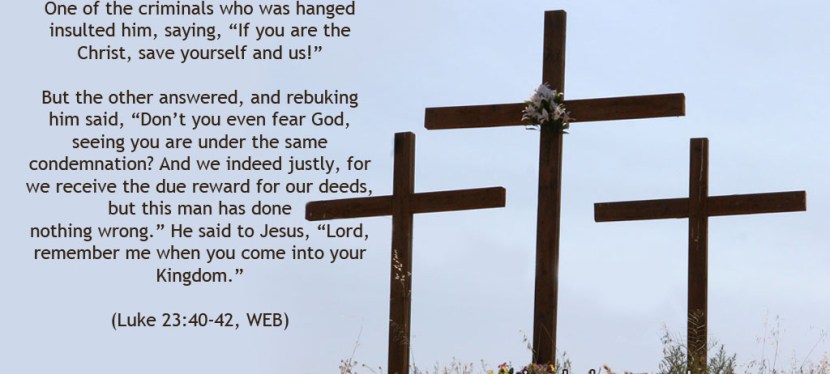
One of the criminals who was hanged insulted him, saying, “If you are the Christ, save yourself and us!” (Luke 23:39, WEB)

One criminal resented what was going on and attacked his fellow sufferer. Matthew Henry describes him as “hardened to the last.” Even his own agony “did not humble his proud spirit nor teach to give good language.”

In contrast, the other criminal was “softened at the last.” He acknowledges the justice of their punishment as “the due reward for our deeds” (Luke 32:41, WEB). He’s much more humble, willing to accept the consequences of his actions and admit their wrongness. This basic attitude difference sets the stage for other differences between these two men. Read more