May Your Kingdom Come

When I wrote about the phrase “hallowed be your name” at the beginning of Jesus’s model prayer (also known as the Lord’s Prayer), I hadn’t intended to write any follow up posts. But I recently found myself pondering the next phrase in that prayer: “may your kingdom come,” and I wanted to study that more deeply as well.

I notice that when I pray, I tend to add a sentiment like “your kingdom come, your will be done” at the end of my prayers. I don’t think this is unusual. I remember reading a book about prayer where the author said he does the same thing, feeling it makes a better summation than an opening idea. Still, Jesus put this phrase at the beginning of His model prayer. We don’t have to follow that model exactly (it’s a guide and outline rather than a prayer to just repeat word-for-word all the time), but I have to think there’s a reason He organized the model prayer the way that He did.

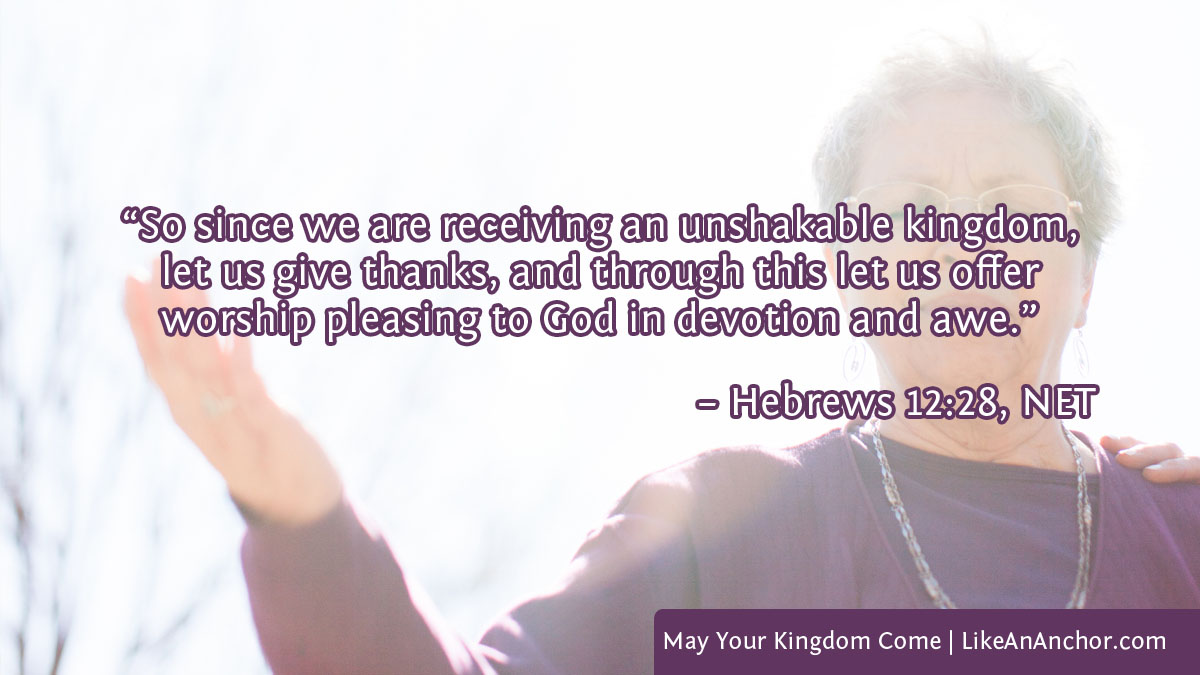
Image of a woman with her hands lifted in praise overlaid with text from Heb. 12:28, NET version: "So since we are receiving an unshakable kingdom, let us give thanks, and through this let us offer worship pleasing to God in devotion and awe."
Image by Pearl from Lightstock

Prioritizing the Kingdom

Two gospels record the model prayer. In Matthew, Jesus gives this outline as part of the Sermon on the Mount when He’s talking about good and bad examples for how to pray (Matt. 6:5-15). In Luke, He uses this prayer to respond to a disciple’s request that Jesus teach them to pray (Luke 11:1-13). Both versions are about the same, though Luke’s is a little shorter depending on the translation (it seems that later manuscripts borrowed from Matthew’s gospel to expand the prayer in Luke’s [NET footnotes on Luke 11:2, 4). Let’s look at the version recorded by Matthew.

So pray this way:
Our Father in heaven, may your name be honored,
may your kingdom come,
may your will be done on earth as it is in heaven.
Give us today our daily bread,
and forgive us our debts, as we ourselves have forgiven our debtors.
And do not lead us into temptation, but deliver us from the evil one

Matthew 6:9-13, NET

We begin by addressing “our Father in heaven.” It’s an intimate, relational way to speak to the one true God. Also, by saying “our” instead of “my,” we’re reminded that He’s the Father of a whole family that we’re part of. “May your name be honored” continues properly aligning how we view and approach God. We should regard Him as holy, and we should also pray that others come to the same realization.

Then, Jesus says, “may your kingdom come.” It’s the first thing He prays for after acknowledging God’s holiness. I wonder if He prioritizes this part of the prayer for the same reason that He counsels us to prioritize God’s kingdom just a little later in this Sermon on the Mount.

So then, don’t worry saying, ‘What will we eat?’ or ‘What will we drink?’ or ‘What will we wear?’ For the unconverted pursue these things, and your heavenly Father knows that you need them. But above all pursue his kingdom and righteousness, and all these things will be given to you as well. So then, do not worry about tomorrow, for tomorrow will worry about itself. Today has enough trouble of its own.

Matthew 6:31-34, NET

We shouldn’t get preoccupied by worry about physical things. God already knows that we need them and we can trust Him to take care of us. More of our focus should be on pursuing His kingdom and righteousness. Other translations often use the phrase “seek first” (Matt. 6:33, WEB). If we arrange our prayers so all of our requests for ourselves crowd into the first part of the prayer and then tack on “your kingdom come” at the end, maybe that’s a sign that we’ve gotten into the habit of prioritizing something other than His kingdom and righteousness.

Image of a man reading the Bible overlaid with text from Matt. 7:21, NET version: "Not everyone who says to me, ‘Lord, Lord,’ will enter into the kingdom of heaven—only the one who does the will of my Father in heaven.”
Image by Matt Vasquez from Lightstock

What Is the Kingdom?

What does it mean to “seek first” or “pursue” God’s kingdom? To answer that, we first need to understand what His kingdom is. Jesus spoke often about the kingdom in the gospels (especially as recorded by Matthew and Luke). At the beginning of His public ministry, “Jesus began to preach this message: ‘Repent, for the kingdom of heaven is near!'” (Matt. 4:17, NET). He came here to preach the good news about God’s kingdom (Matt. 4:23; 9:35; Luke 4:42-44; 8:1). The kingdom of heaven, or God’s kingdom, is a central part of the gospel message.

The kingdom of God is both a future thing and a present reality. It’s where we’re heading, and it’s also our homeland right now. For example, John’s opening salutation in Revelation says Jesus has already “appointed us as a kingdom, as priests serving his God and Father” (Rev. 1:6, NET). But we’re also still waiting on the future time when the seventh angel will sound his trumpet and voices proclaim, “The kingdom of the world has become the kingdom of our Lord and of his Christ, and he will reign for ever and ever” (Rev. 11:15, NET). When we entered into a covenant relationship with God, we placed ourselves under His authority and became citizens of the kingdom of heaven (Phil. 3:20) even though that kingdom isn’t physically present on earth yet.

giving thanks to the Father who has qualified you to share in the saints’ inheritance in the light. He delivered us from the power of darkness and transferred us to the kingdom of the Son he loves, in whom we have redemption, the forgiveness of sins.

Colossians 1:12-14, NET

The kingdom of God is where God rules and where His people belong. Right now, it’s growing in the world in little pockets. It’s like yeast kneaded in flour, grain sowed in a field, or hidden treasure (Matt. 13:23-51). In certain senses, the kingdom is already here among us. It “came near” when Jesus or His followers arrived in a city to preach the good news and heal the sick. At one point, Jesus even said “the kingdom of God is in your midst” (Luke 10:9-11; 11:19-20; 17:20-21). But at the same time, He had to correct people who “supposed that God’s Kingdom would be revealed immediately” (Luke 19:11, NET; see Luke 19:9-28). The kingdom was there in Jesus, it’s here now in His people, but Jesus hasn’t yet visibly taken up the authority God the Father has given Him to directly rule the entire world.

We’re still waiting on the full realization of the promise that Jesus “will be great, and will be called the Son of the Most High, and the Lord God will give him the throne of his father David. He will reign over the house of Jacob forever, and his kingdom will never end” (Luke 1:32-33, NET). Most of that has already happened. We’re just waiting for His kingdom to fully arrive here on this earth (Luke 21:5-36; 1 Cor. 15:20-28). When we pray, “may your kingdom come,” we’re looking forward to that time.

Keep On-Track Toward the Kingdom

Image of a man reading a Bible, overlaid with blog's title text and the words, "Praying, "may your kingdom come,"  helps put our lives into perspective and focuses us on our goal."
Image by Anggie from Lightstock

In the future, Jesus will come, separate out the kingdom-people, and settle accounts with them (Matt. 18:23-35; 20:1-16; 25:1-46). He’s hoping to pass good judgement and welcome them fully into His kingdom, but there are also warnings. You don’t get into the kingdom of God at the end of the age unless you’re doing God’s will, living righteously, and producing good fruit (Matt. 5:18-20; 7:21; 18:1-3; 21:43-22:14). In other words, as Paul says, those practicing unrighteous things have no inheritance in the kingdom (1 Cor. 6:9-10; Gal. 5:19-21; Eph. 5:5). The warnings are to motivate us out of complacency so that we actually live the lives that God called us to live, not to terrify us.

“Do not be afraid, little flock, for your Father is well pleased to give you the kingdom. Sell your possessions and give to the poor. Provide yourselves purses that do not wear out—a treasure in heaven that never decreases, where no thief approaches and no moth destroys. For where your treasure is, there your heart will be also.”

Luke 12:32-34, NET

God chose us out of this world and made us “heirs of the kingdom that he promised to those who love him” (Jas. 2:5, NET). That has already happened. We could choose to leave that kingdom, but God is highly invested in making sure we stay part of His family. His kingdom is unshakable (Heb. 12:28) and He can bring us “safely into His heavenly kingdom” (2 Tim. 4:18, NET). We just need to do our part to “live in a way worthy of God who calls you to his own kingdom and his glory” (1 Thess. 2:12, NET).

 Therefore, brothers and sisters, make every effort to be sure of your calling and election. For by doing this you will never stumble into sin. For thus an entrance into the eternal kingdom of our Lord and Savior, Jesus Christ, will be richly provided for you.

2 Peter 1:10-11, NET

By praying, “may your kingdom come,” we remind ourselves of our goal. It helps put our lives into perspective to remember that we belong in God’s kingdom and, because we’re under His authority, we’re supposed to live a certain way. It also helps us remember not to get bogged down in the day-to-day stuff, and instead remember that we’re part of something bigger and longer-lasting than this present world.


Featured image by Prixel Creative from Lightstock

The Gift of Recognizing Blessings

Our God is so generous with His blessings, and not only with those following Him. As Jesus points out, the Father “causes His sun to rise on the evil and the good, and sends rain on the righteous and the unrighteous” (Matt. 5:45, NET). It’s part of Him being perfect (Matt. 5:48). There are a lot of people who enjoy those sorts of universal blessings and don’t recognize where they come from. Even more heartbreaking, there are people who follow God, receive extra blessings, and still don’t recognize it.

As part of God’s church, we’re called out of the world and told to live like resident aliens in the countries where we reside. We’re now citizens of God’s heavenly kingdom. But the influences of the world and culture we grew up in still affect us, often in unconscious ways. One of those ways involves the idea that real things should be observable, testable, and explainable. We assume things have a natural, rational explanation behind them. Even as Christians, we’re often quick to see something good or even wonderful happen and say, “well that was lucky” or “what a coincidence” or “I’m sure there’s reasonable explanation.”

Recognizing God’s blessings in our lives requires a mindset shift. It also involves accepting and applying some of those blessings. For example, the blessings of internal peace and getting to see things from God’s perspective make it much easier for us to recognize all His blessings in our lives. It’s heartbreaking to see someone who is richly blessed, yet thinks that God doesn’t care about them because they either can’t see the good things happening in their lives or assumes the good is a result of their own hard work, luck, or some natural quirk of the universe.

Image of two people sitting across from each other with books on the table between them, overlaid with text from James 1:17, WEB version: "Every good gift and every perfect gift is from above, coming down from the Father of lights, with whom can be no variation, nor turning shadow."
Image by Claudine Chaussé from Lightstock

Seeing the Source of Good

Think about the good things in your life. Some of them might be obvious blessings from God. For me, that’s my husband and baby–a blessing that I prayed for for many years before I married and got pregnant. Some might be less obvious, like living in a home you payed for with your own money, having pets that you went out and adopted, or the garden growing outside because the weather’s been good for vegetables this year. For those things, it might be easier to think your actions resulted in the good things or that it was just something that happened.

 It shall be, when Yahweh your God brings you into the land which he swore to your fathers, to Abraham, to Isaac, and to Jacob, to give you, great and goodly cities which you didn’t build, and houses full of all good things which you didn’t fill, and cisterns dug out which you didn’t dig, vineyards and olive trees which you didn’t plant, and you shall eat and be full; then beware lest you forget Yahweh, who brought you out of the land of Egypt, out of the house of bondage. You shall fear Yahweh your God; and you shall serve him, and shall swear by his name. 

Deuteronomy 6:10-13, WEB

When ancient Israel was about to enter the promised land, Moses warned them about complacency and forgetfulness. When things are going well and God delivers on the promised blessings, human beings tend to forget where those blessings came from. We think we made them happen, or we deserve them, or that this is just the way life is supposed to be.

Do not be led astray, my dear brothers and sisters. All generous giving and every perfect gift is from above, coming down from the Father of lights, with whom there is no variation or the slightest hint of change.

James 1:16-17, NET

Both the act of generous giving and the gifts we receive have their source in the Father. And lest we think that good things in our lives aren’t gifts–that they were earned by us rather than given by God–Paul asks us along with the puffed-up church in Corinth, “What do you have that you did not receive? And if you received it, why do you boast as though you did not?” (1 Cor. 4:7, NET). We need to set-aside our pride, resist our forgetfulness, and realize/remember that God is the source of good things in our lives. They are blessings from Him.

Image of a smiling man playing piano overlaid with text from Psalm 34:8, WEB version: "Oh taste and see that Yahweh is good. Blessed is the man who takes refuge in him."
Image by Ben White from Lightstock

Gifted With Open Eyes

Several months ago, we studied how God cures spiritual blindness. Some are spiritually blind because of Satan’s influence (2 Cor. 4:4) and others because they’ve closed their own eyes to God’s truth (Matt. 13:13-15). In contrast, Jesus told His followers, “your eyes are blessed because they see, and your ears because they hear” (Matt. 13:16, NET).

 We know that we are from God, and the whole world lies in the power of the evil one. And we know that the Son of God has come and has given us insight to know him who is true, and we are in him who is true, in his Son Jesus Christ. This one is the true God and eternal life.

1 John 5:19-20, NET

One of the many amazing gifts Jesus gave to people is the “insight to know him who is true.” When God opens someone’s eyes to recognize Him as the one true God and Jesus as the only way to eternal life, that’s an incredible blessing. It’s not a realization that we can get to all on our own. Even the most foundational, beginning steps of faith are a gift from God.

God has revealed these to us by the Spirit. For the Spirit searches all things, even the deep things of God. For who among men knows the things of a man except the man’s spirit within him? So too, no one knows the things of God except the Spirit of God. Now we have not received the spirit of the world, but the Spirit who is from God, so that we may know the things that are freely given to us by God. … The one who is spiritual discerns all things, yet he himself is understood by no one. For who has known the mind of the Lord, so as to advise him? But we have the mind of Christ.

1 Corinthians 2:10-2, 15-16, NET (bold italics mark a quotation from Isa 40:13)

Revelation, discernment, clear spiritual eyesight–all of those are gifts from God, and they enable us to “know the things that are freely given to us by God.” He’s working on transforming our perspective so we can see things the way He does. Eventually, the way our minds work should be indistinguishable from Jesus’s mind.

Image of a woman sitting at a table with a Bible overlaid with text from Psalm 111:1-2, WEB version: "Praise Yah! I will give thanks to Yahweh with my whole heart, in the council of the upright, and in the congregation. Yahweh’s works are great, pondered by all those who delight in them."
Image by Prixel Creative from Lightstock

Praise and Thanksgiving

Earlier this year, I wrote about the vital concept of “praise” in the Bible. I didn’t bring it up in that post, but after doing that study I started to think that we should see praise as one of the essential spiritual disciplines (like prayer, study, and fasting). Praise–which includes glorifying, thanking, and blessing God as well as recognizing and confessing His deeds–is the proper response to God’s involvement in our lives.

 Praise Yahweh, my soul!
    All that is within me, praise his holy name!
Praise Yahweh, my soul,
    and don’t forget all his benefits,

Psalm 103:1-2, WEB

Cultivating a habit of praise can help us remember all the wonderful things God does for us and recognize His benefits in our lives. It might seem like thankfulness is just something we can do when we feel like it, but Paul instructed his readers to give thanks in everything because that’s God’s will (1 Thes. 5:18). We need to be thankful people.

There’s actually a danger in neglecting to give God thanks. In the opening part of his letter to Roman believers, Paul spoke of a group of people that, “although they knew God, they did not glorify him as God or give him thanks, but they became futile in their thoughts and their senseless hearts were darkened” (Rom. 1:21, NET). If we know about God, but don’t recognize Him for who He is and what He does, we run the risk of having our foolish, senseless hearts go dark.

It is a good thing to give thanks to Yahweh,
    to sing praises to your name, Most High,
to proclaim your loving kindness in the morning,
    and your faithfulness every night …
How great are your works, Yahweh!
    Your thoughts are very deep.
A senseless man doesn’t know,
    neither does a fool understand this:
though the wicked spring up as the grass,
    and all the evildoers flourish,
    they will be destroyed forever.
But you, Yahweh, are on high forever more

Psalm 92:1-2, 5-8, WEB
Image by Anggie from Lightstock

Senseless and foolish people don’t recognize who God is and what He’s doing. The opposite, then, would be that sensible and wise people can see the good that God does, and then respond properly with praise and thanksgiving. God is full of loving kindness and faithfulness. He wants to pour out blessings on people. Many of those blessings involve opening our eyes, hearts, and minds to be able to understand how deeply involved He is. As we receive those blessings, he enables us to see other blessings as well because our spiritual vision becomes clearer the closer our relationships with Him become.

If we ever feel like we’re not blessed or wonder if God’s actually involved in our lives, we can take heart remembering that the Bible will bless His people. If there’s anything good in our lives, we have Him to thank for that. I dare say most of us can come up with something good if we really think about it (and probably quite a few somethings). It’s not just about the stuff in our lives, though. Often, psalms of praise and thanksgiving spend as much (or more) time focused on who God is and on what He does on a cosmic scale as they do on what He’s doing for the individual psalmist (Psalm 30; 111; 136; 138 are a few examples of praise psalms). The psalmists do give thanks for individual blessings–which often arrive after times of trials–but they also talk as if God’s character and His relationship with His people (including them) is the more amazing blessing.

I think that shift in thinking is how we get to the point where we can constantly give thanks, praise God, and experience joy even in the midst of trials (Heb. 12:28; Eph. 1:11-12; Gal. 5:22-23; Jam. 1:2-4). When we recognize that God’s involvement in our lives and our relationship with Him are great and wonderful blessings, it puts other things in perspective. We can praise and have joy no matter what our external circumstances. We can also develop the spiritual eyesight to see the good things God is doing in our lives, even things that wouldn’t be apparent to people watching from the outside. God blesses us richly, and with His help we can learn to recognize just how blessed we are.


Featured image by Pearl from Lightstock

What Does It Mean to Make Known the Multifaceted Wisdom of God?

A couple weeks ago, my father-in-law gave a sermon about the spiritual origins or influences behind conflicts we face. Of course, he went to the verse that’s very familiar to anyone studying spiritual warfare: “For our struggle is not against flesh and blood, but against the rulers, against the powers, against the world rulers of this darkness, against the spiritual forces of evil in the heavens” (Eph. 6:12, NET). We look at this verse quite a bit in my Study Guide: Armor of God.

In this sermon, though, he also looked at other places in Ephesians where Paul uses the words “rulers” and “powers,” which are also translated “principalities” and “authorities.” I hadn’t realized that this was a theme in the letter, and one of the verses in particular caught my eye for further study.

The purpose of this enlightenment is that through the church the multifaceted wisdom of God should now be disclosed to the rulers and the authorities in the heavenly realms.

Ephesians 3:10, NET

That’s the sort of verse it’s easy to read over, but if you stop and think about what Paul’s saying it’s mind-blowing. There’s something happening in the church that supposed to disclose “the multifaceted wisdom of God” to “the rulers and authorities in the heavenly realms.” That’s a staggering thing to think about. I’ve never thought of myself as being part of showing God’s manifold, multifaceted, many-sided wisdom to powers in the heavens.

Image of a girl standing in church reading the Bible overlaid with text from Eph. 3:10-11, TLV version: "The purpose is that through Messiah’s community the multi-faceted wisdom of God might be made known to the rulers and authorities in the heavenly places, which is in keeping with the eternal purpose that He carried out in Messiah Yeshua our Lord."
Image by José Roberto Roquel from Lightstock

What Are the Rulers and Authorities?

You all know by now that I’m a word nerd, so let’s start with some definitions. The Greek word translated “principalities” or “rulers” is arche (G746). There’s a variety of meanings, including beginning, origin, person that commences something, or the active cause. For example, Jesus is described as the arche of creation (Rev. 3:14). The word also means the “first place, principality, rule, or magistracy,” and that’s the sense in which it may be used “of angels and demons” (Thayer’s Dictionary). If that seems like a confusing variety of meanings, just think of how we use “first” in English. If we say someone is “first,” context determines if they arrived first, did something first, or are first in importance.

The Greek word for “powers” or “authorities” is exousia (G1849). This refers to the power to do something, like make choices, do “as one pleases,” exercise authority, rule or govern, and make others submit (Thayer’s Definition). It “combine[s] the two ideas of right and might” (Zodhiates). It refers to having the power/might to accomplish something and the right/authority to go ahead and choose whether to use that power. There are levels of authority. For example, Jesus was given all exousia in heaven and earth (Matt. 28:18). There are other powers, but Jesus is over all of them. That’s the first thing Paul establishes regarding the topic of principalities and powers in Ephesians.

 he raised him from the dead and seated him at his right hand in the heavenly realms far above every rule and authority and power and dominion and every name that is named, not only in this age but also in the one to come. And God put all things under Christ’s feet, and gave him to the church as head over all things. Now the church is his body, the fullness of him who fills all in all.

Ephesians 1:20-23, NET (italics mark an  allusion to Ps 8:6)

That’s the first thing we need to understand about rulers and authorities, both earthly and heavenly. They’re all subservient to Jesus; He is “far above” even the most powerful of them. He’s the one heading the church, which is the whole group of called-out people that make up His body. We used to live “according to this world’s present path, according to the ruler (archo, derived from arche) of the domain (exousia) of the air, the ruler of the spirit that is now energizing the sons of disobedience” (Eph. 2:2, NET). But God called us out from under that authority and placed us into His son’s body for a purpose.

But God, being rich in mercy, because of his great love with which he loved us, even though we were dead in offenses, made us alive together with Christ—by grace you are saved!—and he raised us up together with him and seated us together with him in the heavenly realms in Christ Jesus, to demonstrate in the coming ages the surpassing wealth of his grace in kindness toward us in Christ Jesus. For by grace you are saved through faith, and this is not from yourselves, it is the gift of God; it is not from works, so that no one can boast. For we are his creative work, having been created in Christ Jesus for good works that God prepared beforehand so we can do them.

Ephesians 2:4-10, NET

If you read last week’s post, you might remember that God sometimes takes action on behalf of His people to prove His holiness. Even if His people aren’t representing Him as holy, He still acts with respect for His own name and moves to prove Himself holy in the eyes of those watching. That includes His own people, those of other nations, and the spiritual principalities and powers that we’re talking about today.

Image of a man reading the Bible overlaid with text from Colossians 1:9-10, NET version: "For this reason we also, from the day we heard about you, have not ceased praying for you and asking God to fill you with the knowledge of his will in all spiritual wisdom and understanding, so that you may live worthily of the Lord and please him in all respects—bearing fruit in every good deed, 
growing in the knowledge of God"
Image by Anggie from Lightstock

God’s Great Wisdom

In spiritual terms, all those who respond to God’s call and enter a committed covenant relationship with Him become citizens of His kingdom, and those who aren’t yet in covenant with Him belong to other nations. This is the case regardless of your ethnic background or physical citizenship. In many of Paul’s letters, he addresses this topic in relation to Jews (historically part of God’s covenant people) and Gentiles (all other nations).

When reading this, you will be able to understand my insight into the mystery of Christ (which was not disclosed to people in former generations as it has now been revealed to his holy apostles and prophets by the Spirit), namely, that through the gospel the Gentiles are fellow heirs, fellow members of the body, and fellow partakers of the promise in Christ Jesus. I became a servant of this gospel according to the gift of God’s grace that was given to me by the exercise of his power. To me—less than the least of all the saints—this grace was given, to proclaim to the Gentiles the unfathomable riches of Christ and to enlighten everyone about God’s secret plan—the mystery that has been hidden for ages in God who has created all things. The purpose of this enlightenment is that through the church the multifaceted wisdom of God should now be disclosed to the rulers and the authorities in the heavenly realms. This was according to the eternal purpose that he accomplished in Christ Jesus our Lord, in whom we have boldness and confident access to God by way of Christ’s faithfulness.

Ephesians 3:4-12, NET

Paul describes the way God works with people in the New Covenant as “the mystery of Christ,” “the unfathomable riches of Christ,” and “God’s secret plan.” It’s an incredible thing that God is still working with a specific group of people, just like He was in the Old Testament. It’s even more amazing that who’s in that group today has nothing to do with your physical heritage. It’s about God choosing you and you choosing to follow Him. It was God’s plan from the beginning to bring human beings into His family, and now that Jesus came in the flesh, died for our sins, and inaugurated the New Covenant the plan is clearer than ever before.

With that incredible fact established, Paul then says “the purpose” of enlightening others about this plan “is that through the church the multifaceted wisdom of God should now be disclosed to the rulers (arche) and the authorities (exousia) in the heavenly realms.” The word translated “multifaceted” is polupoikilos (G4182). In the New Testament, it only appears in this particular verse. It means “much variegated, marked with a variety of colors,” such as in “cloth or a painting” (Thayer). It can also mean “manifold, multifarious, greatly diversified, [and] abounding in variety” (Zodhiates). God’s wisdom isn’t one-dimensional or limited. It’s also not like human thought patterns.

“For my thoughts are not your thoughts,
    and your ways are not my ways,” says Yahweh.
“For as the heavens are higher than the earth,
    so are my ways higher than your ways,
    and my thoughts than your thoughts.”

Isaiah 55:8-9, WEB

Living With the Wisdom of God

Image of people sitting in church services overlaid with blog's title text and the words, "Our lives, and the church that we're all a part of, ought to demonstrate the wisdom of God’s plan."
Image by Brown Bag Photography from Lightstock

A few years ago, I did a series of blog posts on James’s definition for “the wisdom that is from above.” He said that this wisdom “is first pure, then peaceful, gentle, reasonable, full of mercy and good fruits, without partiality, and without hypocrisy” (Jas. 3:17, WEB). This is a description of God’s multifaceted wisdom, though likely not a full description.

Oh the depth of the riches and wisdom and knowledge of God! How unsearchable are his judgments and how unfathomable his ways!

Romans 11:33, NET

We’re never going to understand everything about God, but we’re called to study Him and get to know Him better anyway. We can grow toward perfect understanding and imitation of Him, though we know we won’t completely achieve being “like Him” until after Jesus’s return and our transformation (1 Cor. 15:50-53; 1 John 3:1-3). His wisdom is incredibly complex, but we have the opportunity to witness His wisdom, to be examples of how He wisely interacts with humanity, and even to learn how to use His wisdom in our own lives (1 Cor. 2).

 I do not cease to give thanks for you when I remember you in my prayers. I pray that the God of our Lord Jesus Christ, the glorious Father, will give you spiritual wisdom and revelation in your growing knowledge of him,—since the eyes of your heart have been enlightened—so that you can know what is the hope of his calling, what is the wealth of his glorious inheritance in the saints, and what is the incomparable greatness of his power toward us who believe, as displayed in the exercise of his immense strength

Ephesians 1:16-19, NET

This is one of Paul’s prayers for the church; it’s very similar to another in Colossians 1:9-12. One of Paul’s priorities when praying for God’s people was that God would continue to give wisdom, revelation, and knowledge to them. God’s wisdom growing in us is connected with understanding His calling and the inheritance He offers us as His people. We’re participating in the great mystery, the incredible plan of God whereby He brings human beings into His spiritual family. The way that He works in us–and the way we respond to His work in us–show the rulers and authorities how wise God is. Our lives, and the church that we’re all a part of, ought to demonstrate that God’s way works. He really can do what He says.


Featured image by Pearl from Lightstock

Song Recommendation: “One Day” by Cochren & Co.

Hallowed Be Your Name

Sometimes when I pray, I think of Jesus’s model prayer (often called “the Lord’s Prayer”) as an outline to keep my mind from wandering or to help me think of things I should pray for. As I was doing this about a week ago, I started pondering the phrase “may your name be regarded as holy.” I wanted to think about that idea more deeply. When I pray this, am I praying that I would see God’s name as holy, or that others will? What does it mean to really consider God’s name as holy? Also, why does it say “your name” rather than “you”?

Requesting What Should Be

When you think of the model prayer, you probably think of the traditional phrase “hallowed be your name” rather than “may your name be regarded as holy.” I’m not sure where I first heard this alternate translation. It’s not actually used in any of the English-language translations on Bible Gateway for Matthew 6:9 or Luke 11:2. In the Greek, though, a literal translation is likely closest to “may your name be held in reverence” or “may your name be considered holy” (NET footnote). I probably heard someone use the “regarded as holy” version in a sermon or read about it in a book or article (like this one, for example).

The word “hallowed” isn’t used much in modern English, but it means “regarded as holy; venerated; sacred” (Dictionary.com). It is not simply a statement like “holy is your name,” as we modern readers might assume. Rather, it is a prayer for what should be. The two translations that I quote most often on this blog modernize “hallowed be thy name” (KJV) as, “may your name be kept holy” (WEB) and “may your name be honored” (NET). Those are both good ways to bring this concept into modern English.

 “Therefore you shall keep my commandments, and do them. I am Yahweh. You shall not profane my holy name, but I will be made holy among the children of Israel. I am Yahweh who makes you holy, who brought you out of the land of Egypt, to be your God. I am Yahweh.”

Leviticus 22:31-34, WEB

God’s name is holy, and regarding His name as holy is the proper state of things. It will happen among His people, and it ought to happen among the nations as well. Take a look at one of the things God says about His people to the prophet Ezekiel.

“I scattered them among the nations, and they were dispersed through the countries. I judged them according to their way and according to their deeds. When they came to the nations where they went, they profaned my holy name; in that men said of them, ‘These are Yahweh’s people, and have left his land.’ But I had respect for my holy name, which the house of Israel had profaned among the nations where they went.

“Therefore tell the house of Israel, ‘The Lord Yahweh says: “I don’t do this for your sake, house of Israel, but for my holy name, which you have profaned among the nations where you went. I will sanctify my great name, which has been profaned among the nations, which you have profaned among them. Then the nations will know that I am Yahweh,” says the Lord Yahweh, “when I am proven holy in you before their eyes.”

Ezekiel 36:19-23, WEB

God cares a great deal about how people regard His name. Even when His people don’t seem to care about how they represent Him, He still acts with “respect for my holy name,” takes steps to “sanctify my great name,” and proves Himself holy both to His own people and to the nations observing.

Image of a man praying with a Bible on the table in front of him, overlaid with text from Lev. 22:31-33, WEB version: “Therefore you shall keep my commandments, and do them. I am Yahweh. You shall not profane my holy name, but I will be made holy among the children of Israel. I am Yahweh who makes you holy, who brought you out of the land of Egypt, to be your God. I am Yahweh.”
Image by WhoisliketheLord Studio from Lightstock

His Great Name

In Hebrew thought, names “often include existence, character, and reputation” (Theological Wordbook of the Old Testament, entry 2405 shem). This is especially true of God’s names. He shares several names with people that reveal aspects of His character, such as El Shaddai (God Almighty). He also shares His personal name, YHWH, typically pronounced as Yahweh (also written as Jehovah, a hold-over from English’s Germanic roots when “J” was pronounced more like “Y”). This name is represented in most English translations as LORD, with all caps to distinguish it from Adonai, the actual Hebrew word for “lord.” One reason I like using the WEB translation for the Old Testament is that they use “Yahweh” instead of “LORD,” making it much easier for us to see when God is using His name rather than a title.

With the concept of “name” tied so closely to someone’s character and reputation, it shouldn’t surprise us that in some Biblical “passages shem Yahweh is so inextricably bound up with the being of God that it functions almost like an appearance of Yahweh (Ex 23:20-21; Isa 30:27)” (TWOT 2405). Similarly, “The name of God also signifies the whole self-disclosure of God in his holiness and truth (Ps 22:22)” (TWOT 2405). Because God Himself is holy, His name should also be regarded as holy.

There are warnings to go along with humans using this name. One of the 10 commandments says, “You shall not take the name of the Lord your God in vain” (Ex. 20:7). We often think of this just as a command not to use God’s name as a swear word, but there’s a lot more to it than that. The word translated “take” can refer to using or carrying something, and since names are tied to character and reputation, this command likely refers to how we represent God (and how we regard His name) as much as it does to how we use His name in our speech.

“You shall not misuse the name of Yahweh your God, for Yahweh will not hold him guiltless who misuses his name.”

Exodus 20:7, WEB

Some modern Jews and Messianic believers refer to God as Ha Shem (Hebrew for “the name”) rather than risk taking His name in vain by using one of His names or titles. But Yahweh introduced Himself by name to His people and directly told Moses to use this name, so I wonder sometimes if not using this name (so long as it’s in an appropriately reverential manner) might be a worse blunder than using it. He wants to have a familial relationship with us, not a super formal one.

 Moses said to God, “Behold, when I come to the children of Israel, and tell them, ‘The God of your fathers has sent me to you,’ and they ask me, ‘What is his name?’ what should I tell them?”

God said to Moses, “I AM WHO I AM,” and he said, “You shall tell the children of Israel this: ‘I AM has sent me to you.’” God said moreover to Moses, “You shall tell the children of Israel this, ‘Yahweh, the God of your fathers, the God of Abraham, the God of Isaac, and the God of Jacob, has sent me to you.’ This is my name forever, and this is my memorial to all generations.”

Exodus 3:13-15, WEB

I do want to add a quick note here to address the idea that we should only use Hebrew names for God. We can use the names He used to originally reveal Himself, but we don’t have to. He’s perfectly fine with translations, as we can see from the New Testament. For example, the name “Yahweh” doesn’t show up in New Testament writings at all. They use the Greek equivalent of “God,” “Father,” and “Lord” instead. It’s perfectly okay with God to talk about Him and to Him in any language you know (not just Hebrew or Greek) (Acts 2:1-12).

Image of a group of people holding hands to pray overlaid with text from Matt. 6:9-10, LEB version:   Therefore you pray in this way: “Our Father who is in heaven, may your name be treated as holy. May your kingdom come, may your will be done on earth as it is in heaven.”
Image by Claudine Chaussé from Lightstock

What Do I Know of Holy?

I’ve talked about the concept of holiness before, but mostly in the context of God making something holy. If a thing or person is holy, they are set apart or sanctified for God’s divine use. But what does it mean that God Himself is holy?

The Greek word translated “hallowed” or “kept holy” is hagiazo (G37). The basic meaning is “to make holy, sanctify.” Usually, it’s about something that wasn’t holy withdrawing (or being set apart) from common things to make them holy. For something that’s already holy, the verb can also mean “to regard and venerate as holy” (Zodhiates, G37 III). God is already and inherently holy, but humans get to choose whether or not they take action to recognize His holiness.

In Hebrew, “holy” is qadash (verb; TWOT 1990), qodesh (noun; TWOT 1990a), or qadosh (adjective; TWOT 1990b). This word “connotes the concept of ‘holiness,’ i.e. the essential nature of that which belongs to the sphere of the sacred and which is thus distinct from the common or profane” (TWOT 1990a). In relation to God specifically, “the biblical viewpoint would refer the holiness of God not only to the mystery of his power, but also to his character as totally good and entirely without evil” (TWOT 1990a). He is ethically perfect, “intrinsically holy,” “free from the moral imperfections and frailties common to man,” and totally distinct from sin or profane things (TWOT 1990b).

To regard God as holy, we need to recognize truths of His essence and character. We need to have a grasp and appreciation of the fact that He is holy to the core of His being. And when we pray, “may your name be held in reverence” or “may your name be considered holy,” we’re praying that others will recognize these truths as well.

Our Response to Holiness

Image of a smiling woman with an arm lifted in praise, overlaid with blog's title text and the words, Why did Jesus tell us to pray, "hallowed be they name" or "may your name be regarded as holy," and what does it mean?
Image by Pearl from Lightstock

God’s holy name also demands something of us. As the model prayer goes on, Jesus counsels us to also pray, “may your will be done on earth as it is in heaven” (Matt. 6:10, NET). Part of God’s will is that we become holy, set apart and sanctified for Him.

For I am Yahweh your God. Sanctify yourselves therefore, and be holy; for I am holy. … I am Yahweh who brought you up out of the land of Egypt, to be your God. You shall therefore be holy, for I am holy.

Leviticus 11:44, 45, WEB

So then, be perfect, as your heavenly Father is perfect

Matthew 5:48, NET

When we recognize God’s holiness and perfection, we should also realize that we ourselves are far from living up to His standard. If we seek a relationship with Him, we should also seek to live in a way that sets us apart from sin and uncleanness so we become more and more like our perfect God. We don’t need to become obsessed with doing everything just right; the Pharisees, for example, tried keeping the law perfectly but ended up missing the whole point (Matt. 23). But we do need to recognize our need for holiness, turn away from things antithetical to God’s nature, ask for and receive forgiveness through Jesus Christ, and then commit to walking with God as His special people.

There’s a special blessing that God commanded the Old Testament priests to speak over His people. At the end of the blessing, Yahweh said this was how “they shall put my name on the children of Israel” (Num. 6:27, WEB). When God calls or puts His holy name over something, that “signifies ownership, possession, and protection” (TWOT 2405). We belong to Him as His own special people (Ps. 100:3; 1 Cor. 6:19-20; 1 Pet. 2:9). He wants us to share in His holiness and charges us with carrying His name into the world as we shine His light into the darkness around us.


Featured image by Pearl from Lightstock

Thoughts on Sharing the Gospel

As I mentioned in my email newsletter that went out this past Wednesday, I’ve been reading quite a bit of New Testament historical fiction. One of the series–Angela Hunt’s “Jerusalem Road”— made me think about is how weird it would have been to live at the time of Jesus. We look back from our modern perspective and think it would have been amazing to be alive at that time and have the chance to actually meet and talk with Jesus. But I wonder if it’s more likely we’d have been confused and perplexed by this seemingly ordinary man who suddenly started performing miracles and who claimed to be the literal Son of God.

It’s hard for me to imagine not knowing Jesus is the Messiah (the Hebrew word for “Christ,” which means “anointed”). I grew up going to church. Not only that, I grew up in a culture that was shaped by Christianity and where most people I met had at least a basic understanding of who Jesus is and what Christians believe. It’s so natural for me to think of Him as the Son of God and accept that He lived, died, and rose from the dead. But that all would have been brand-new to early 1st century people.

As our modern culture moves farther and farther away from Christianity, more and more people don’t have much–if any–Christian cultural background or Bible knowledge. Those of us in the U.S. and similar countries can’t really assume anymore that if we talk with someone about our faith they’ll have any foundational Biblical knowledge to build on. It’ll be more like Paul preaching to Gentiles who’d never heard of Jesus and thought Yahweh was only a God for the Jews than it is like Peter preaching to Jewish people who already had a faith background but needed to hear how Jesus is relevant to them.

Image of four smiling people walking toward the camera overlaid with text from  2 Tim. 4:1-2, NET version: "I solemnly charge you before God and Christ Jesus, who is going to judge the living and the dead, and by his 
appearing and his kingdom: Preach the message, be ready whether it is convenient or not, reprove, rebuke, exhort with complete patience and instruction."
Image by Matt Vasquez from Lightstock

What Are the Gospels Doing?

I’ve also been pondering a related thought, this time about sharing Jesus with someone rejecting Him rather than someone who never knew about Him. I know of someone who was Christian but is now adopting Jewish beliefs, and I’ve heard that this person challenged someone to prove that Jesus is the Messiah and the Son of God using only the Old Testament. In many ways, that’s a ridiculous thing to ask. You can prove just from the Old Testament that there is a promised Messiah coming, but if you’re going to prove that it’s Jesus you need to cite evidence that His life lines up with those prophecies. As I thought about this topic more, I realized this is exactly the point of the gospels. They’re there to convince readers of who Jesus is.

Now Jesus performed many other miraculous signs in the presence of the disciples, which are not recorded in this book. But these are recorded so that you may believe that Jesus is the Christ, the Son of God, and that by believing you may have life in his name.

John 2o:30-31, NET

Have you ever noticed how many times the gospel writers (especially Matthew) say things like, “it is written” or “that it might be fulfilled”? They’re constantly referencing back to the Old Testament writings and linking them to Jesus, showing that He fulfilled prophecies. Just like Jesus came to fill the law and the prophets to the fullest and just like He had to open His disciples eyes to understand the scriptures about Himself (Matt. 5:17-20; Luke 24:25-48), so are the gospel accounts there to open up the scriptures for us and show that Jesus is the Messiah. Of course, God the Father is the one who opens minds to comprehend these truths (John 6:44), but He also responds to those who diligently seek Him (Matt. 7:7-11) and expects His people to help share His truths with the world (Matt. 28:18-20; 2 Tim. 4:1-2).

Preaching the Word of Christ

Image of two people studying a Bible together, overlaid with blog's title text and the words, "Pondering ways that talking about God today is similar to the first century."
Image by Anggie from Lightstock

I feel like a lot of times when we talk about our faith, we want to jump right into the details. We like to explain what makes our church’s Christianity different from other churches. We want to make sure people know God has expectations for them and their conduct if they commit to following Him. But that only matters to people if they already know about Christianity and they already care what God thinks about them. If they don’t have that already, they need to hear the gospel–the good news about who Jesus is and what He taught–before all the details about how to follow Him.

 For with the heart one believes and thus has righteousness and with the mouth one confesses and thus has salvation. For the scripture says, “Everyone who believes in him will not be put to shame.” For there is no distinction between the Jew and the Greek, for the same Lord is Lord of all, who richly blesses all who call on him. For everyone who calls on the name of the Lord will be saved.

How are they to call on one they have not believed in? And how are they to believe in one they have not heard of? And how are they to hear without someone preaching to them? And how are they to preach unless they are sent? As it is written, “How timely is the arrival of those who proclaim the good news.” But not all have obeyed the good news, for Isaiah says, “Lord, who has believed our report?” Consequently faith comes from what is heard, and what is heard comes through the preached word of Christ.

Romans 10:10-17, NET (bold italics mark quotations from Isa 28:16; Joel 2:32; Isa 52:7; Nah 1:15; Isa 53:1)

The details about how to follow Jesus are important–He included many of those “how-to” details in His message, and His followers filled in more information in their letters that make up the rest of the New Testament. But at it’s core, the gospel is very simple. People hear the preached word of Christ, they respond in faith and obey the good news, and their belief results in righteous living. Remember, God’s sincere desire is that everyone turn away from wickedness, turn to Him, and choose life (1 Tim. 2:1-4; 2 Peter 3:9; Eze. 18:21-32). That should be our desire as well, and the ways we talk about Him should reflect that.

I know this wasn’t really my typical blog post format this week. It was more musings and reflections than a topical Bible study. I just really struggled coming up with a topic this week, and so I wrote about the ideas my thoughts kept coming back to pondering.


Featured image by Ben White from Lightstock

Song Recommendation: “The Basics of Life” by 4HIM (a song I haven’t thought about in probably 10 years, but which popped into my head while writing this post)

Why Does 1 Corinthians 11 Matter Today?

In the first letter we have that Paul sent to the Corinthians, he wrote to address some specific things. Firstly, there were serious issues in this church. They were divided, arguing, and following different human teachers. They also had a big issue with tolerating sin, even priding themselves on how forbearing they were toward a man in their congregation living and sleeping with his stepmother. Paul had to set them right, and he did so by comparing them to ancient Israel and explaining how the Passover and Festival of Unleavened Bread apply to the New Covenant church.

In the midst of all this, Paul also talked about proper conduct within a church community. One of those passages is labeled in the chapter and verse model of our modern Bibles as 1 Corinthians 11:1-16. It’s a passage most people skip over because it has to do with headcoverings and hair length for men and women. It’s the only place in the New Testament where this topic comes up, and it’s one that generates a lot of debate, offense, and division so we tend to ignore it completely. But we miss something important if we skip this passage, even if we don’t agree on how to interpret it.

The Headcovering Passage

People often approach this passage as just being about women’s headcoverings, but it’s addressed just as much to men. Paul opened this discussion by saying, “Be imitators of me, just as I also am of Christ” and praising the Corinthians for maintaining “the traditions just as I passed them on to you” (1 Cor. 11:1, 2, NET). He then made a statement about authority in the churches (the ecclesia, or called-out ones) of God.

But I want you to know that Christ is the head of every man, and the man is the head of a woman, and God is the head of Christ. Any man who prays or prophesies with his head covered disgraces his head. But any woman who prays or prophesies with her head uncovered disgraces her head, for it is one and the same thing as having a shaved head. 

1 Corinthians 11:3-5, NET

In my studies on this topic, I learned that culturally, Jewish men and women covered their heads with scarves or prayer shawls while Greek/Gentile men and women tended not to cover (though they could, mostly as a fashion choice). This passage would have involved a change for Jewish men as well as Gentile women. Men who covered their heads while praying needed to stop, and women who didn’t cover their heads while praying needed to start. Full disclosure, I do cover my head when at a church gathering or praying and studying at home. You can click here to learn more about why and the research I did into the topic.

Context For Paul’s Next Commands About Women

So why can’t we just skip over this divisive passage? For one thing, it’s part of the Bible and if we admit the Bible is the inspired word of God, then there is value in every part of it even if we’re not yet sure what to make of it. This is a significant reason to pay attention to 1 Corinthians 11:1-16, but it’s not the one that we’re going to focus on today. In this post, I want to focus on the important context clues this passage provides for interpreting other parts of the letter.

As the letter continued, Paul covered instructions for keeping Passover correctly (1 Cor. 11:17-34), spiritual gifts and unity in the body (1 Cor. 12), the “more excellent way” of agape love (1 Cor. 13), the use of prophecy or “inspired speaking” in the church (1 Cor. 14:1-25), and proper, orderly conduct during a church meeting (1 Cor. 14:26-40). Paul didn’t address the topic of women again directly until chapter 14, but since he started out this part of the letter by addressing how men and women properly pray and prophecy in the church (men with their heads uncovered, women with their heads covered), we can assume the discussions about keeping Passover, having spiritual gifts and using them properly, and love are addressed equally to men and women in the church. The NET even uses the phrase “brothers and sisters” when Paul addresses believers, because the whole church group is included when Paul uses the word “brethren” (adelphoi in Greek). We all have key roles to play, and very similar responsibilities and gifts.

Then, we come to a place where Paul again addressed women and men separately, with different instructions for each. It’s one of the infamous passages about women being silent in church.

What should you do then, brothers and sisters? When you come together, each one has a song, has a lesson, has a revelation, has a tongue, has an interpretation. Let all these things be done for the strengthening of the church. … Two or three prophets should speak and the others should evaluate what is said. … For you can all prophesy one after another, so all can learn and be encouraged. Indeed, the spirits of the prophets are subject to the prophets, for God is not characterized by disorder but by peace.

As in all the churches of the saints, the women should be silent in the churches, for they are not permitted to speak. Rather, let them be in submission, as in fact the law says. If they want to find out about something, they should ask their husbands at home, because it is disgraceful for a woman to speak in church.

1 Corinthians 14:26, 29, 31-35, NET

If you read Paul’s statement about women being silent by itself, it sounds like women shouldn’t say a word the whole time they’re at a gathering of believers. This doesn’t make sense in the context of other scriptures, which show women were deeply involved in the churches. This is where 1 Corinthians 11 can provide much-needed context to help us figure out what Paul is likely saying in this passage.

“In light of 11:2-16, which gives permission for women to pray or prophesy in the church meetings, the silence commanded here seems not to involve the absolute prohibition of a woman addressing the assembly. Therefore (1) some take be silent to mean not taking an authoritative teaching role as 1 Tim 2 indicates, but (2) the better suggestion is to relate it to the preceding regulations about evaluating the prophets (v. 29). Here Paul would be indicating that the women should not speak up during such an evaluation, since such questioning would be in violation of the submission to male leadership that the OT calls for (the law, e.g., Gen 2:18).”

NET study note on 1 Cor. 14:34

Whether you think women should cover their heads today or not, the fact is that 1 Corinthians 11 addresses the proper way for women to pray and/or prophecy. Obviously women can, and frequently do throughout the scriptures, pray and prophecy outside of church meetings. But the context of this section of scripture is how to do things in the churches, when believers are gathered together, as for a formal church service. It follows, then, that Paul talks about how women can properly pray and prophecy in church in 1 Corinthians 11, then addresses a time when silence is more appropriate in 1 Corinthians 14.

Culture Adds More Context

It also helps to take the cultural context into account when looking at Paul’s writings. Now, there are right and wrong ways to do this. Sometimes, people say that Paul just had a backwards view of women because he was influenced by his culture and so we don’t need to listen to him anymore. But in reality, some of his writings indicate he was pretty radical compared to the culture of his day.

Likewise the women are to dress in suitable apparel, with modesty and self-control. Their adornment must not be with braided hair and gold or pearls or expensive clothing, but with good deeds, as is proper for women who profess reverence for God. A woman must learn quietly with all submissiveness. But I do not allow a woman to teach or exercise authority over a man. She must remain quiet.

1 Timothy 2:9-12, NET

We read this today and we might feel offended that he’d say women have to be quiet and submissive and can’t teach. People of Paul’s day, though, would have read “a woman must learn” and been shocked by that. This statement “was a radical and liberating departure from the Jewish view that women were not to learn the law” (NET footnote on 1 Tim. 2:12). Some Jewish girls received Torah instruction while they were young and if they had a good family they might have learned a little more, but women weren’t generally taught very much and they certainly weren’t selected for advanced study with respected rabbis.

Jesus’s interactions with women as spiritual equals was unusual, and Paul continued His practice. He also assured his readers, though, that women serving in the church, preaching the gospel, and learning God’s words did not mean that women were suddenly going to start taking over roles that God entrusted to men. Women are to learn, yes, but they will also be submissive in the sense that God expects. Women can pray and prophecy, but they won’t (or shouldn’t) be disrupting church meetings or usurping male roles.

We often miss it today with our modern perspectives, but Paul isn’t advocating for either the subjugation of women or for doing away with gender roles in 1 Corinthians and 1 Timothy. It’s actually a more balanced view than we often find in churches today, which in many cases either try to follow society in doing away with different roles for men and women entirely, or follow traditional (mis)interpretations of Paul that bar women from being involved. However you interpret the passage on hair length and headcoverings, it provides much-needed context assuring us that women were deeply involved in the New Testament church and they still can be in the churches today.


Featured image by StockSnap from Pixabay

Song Recommendation: “This Girl” by Lauren Daigle