Wisdom for A Reason

A couple weeks ago while listening to a sermon, I noticed something about Solomon’s request for wisdom that I’d never realized before. It’s a familiar story: King David’s son Solomon became king in his father’s place, and God came to him in a dream. God told Solomon to ask something of Him, and Solomon asked for wisdom (1 Kings 3).

In Gibeon, Yahweh appeared to Solomon in a dream by night; and God said, “Ask for what I should give you.”

Solomon said, “You have shown to your servant David my father great loving kindness, because he walked before you in truth, in righteousness, and in uprightness of heart with you. You have kept for him this great loving kindness, that you have given him a son to sit on his throne, as it is today. Now, Yahweh my God, you have made your servant king instead of David my father. I am just a little child. I don’t know how to go out or come in. Your servant is among your people which you have chosen, a great people, that can’t be numbered or counted for multitude. Give your servant therefore an understanding heart to judge your people, that I may discern between good and evil; for who is able to judge this great people of yours?”

This request pleased the Lord, that Solomon had asked this thing. God said to him, “Because you have asked this thing, and have not asked for yourself long life, nor have you asked for riches for yourself, nor have you asked for the life of your enemies, but have asked for yourself understanding to discern justice, behold, I have done according to your word. Behold, I have given you a wise and understanding heart, so that there has been no one like you before you, and after you none will arise like you. I have also given you that which you have not asked, both riches and honor, so that there will not be any among the kings like you for all your days. If you will walk in my ways, to keep my statutes and my commandments, as your father David walked, then I will lengthen your days.”

1 Kings 3:5-14, WEB

The part of this story that I hadn’t paid attention to before is why Solomon asked for wisdom. It wasn’t to be the smartest person in the room or so he’d have an advantage in making political decisions. He asked for wisdom so that he could properly judge God’s people; Solomon wanted to govern with justice.
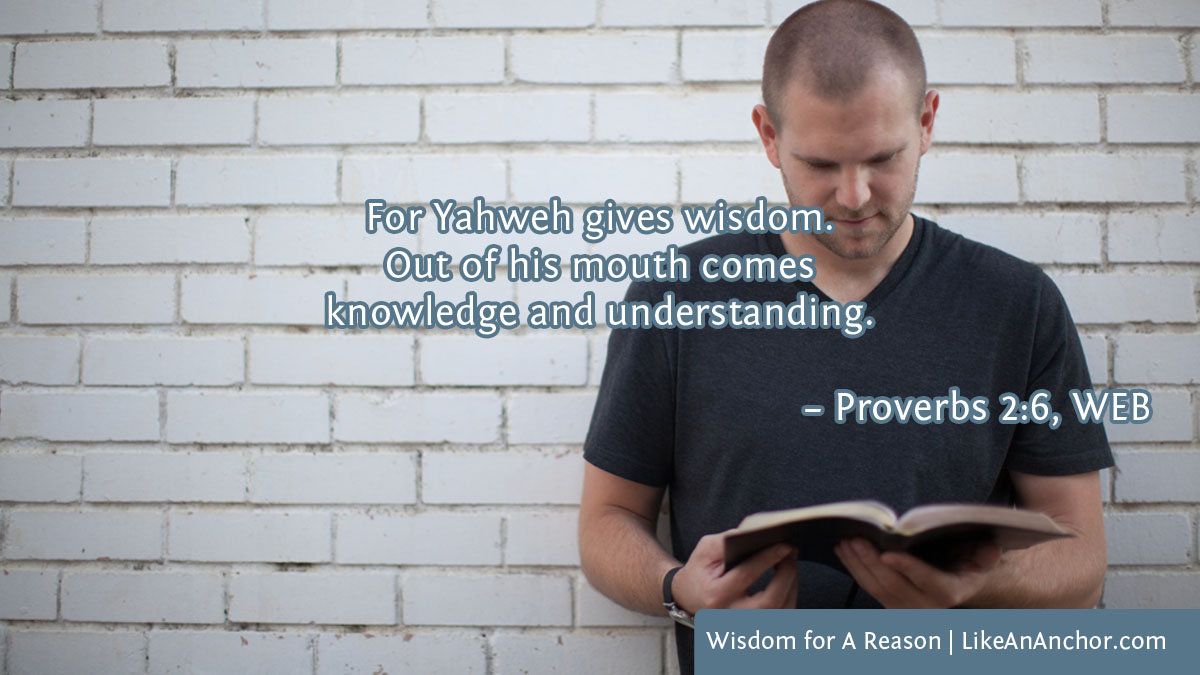
Image of a man reading a Bible overlaid with text from Proverbs 2:6, WEB version: "For Yahweh gives wisdom. Out of his mouth comes knowledge and understanding."
Image by Anggie from Lightstock

Justice, Judgement, and Governance

In the English language, judgement, government, and justice are separate things. We hope they’re connected, but we don’t see the judicial system or people who govern/rule as inseparably about justice. In Hebrew, though, it’s the same word. The root word shapat (which is used in 1 Kings 3:9, 28) means “to exercise [all] the processes of government” (Theological Wordbook of the Old Testament [TWOT], entry 2443). Ancient understanding didn’t really separate what we think of as different branches of government nor did they separate the law from the lawgiver: “the centering of law, rulership, government in a man was deeply ingrained” (TWOT 2443). This makes perfect sense when we think of God as the Lawgiver and Ruler. The Bible treats His Law as an extension of His character, and a good king of Israel was expected to act as God’s representative in upholding divine law.

The derivative word mishpat (used in 1 Kings 3:11, 28) has “at least thirteen related, but distinct, aspects of the central idea, which if to be rendered by a single English word with similar range of meaning ought by all means to be the word ‘justice’” (TWOT 2443c). These 13 meanings include “the act of deciding a case of litigation,” “a sentence or decision issuing from a magistrate’s court,” “an ordinance of law,” “one’s right under law,” and “sovereignty, the legal foundation of government in the sense of ultimate authority or right.” We get to see Solomon use his gift of wise judgement immediately, as the next thing recorded in this narrative is the story of the two mothers arguing over one living child. Both claim to be the baby’s mother and that a child who died belonged to the other. Solomon wisely figured out who the real mother was without even needing to conduct an investigation.

All Israel heard of the judgment (mishpat) which the king had judged (shaphat); and they feared the king, for they saw that the wisdom of God was in him to do justice (mishpat).

1 Kings 3:28, NET

Solomon’s wisdom wasn’t confined to judicial matters or government–God’s blessing exceeded Solomon’s initial request (1 Kings 4:229-34)–but that was the central reason he gave for requesting wisdom. It seems from the way that Solomon talked about his new responsibilities that he was worried he wouldn’t be able to govern as well as he ought, and he asked for supernatural help to discern and do justice. There was a purpose behind his request, and it was related to the role he was meant to fill in ruling and serving God’s people.
Image of a man reading the Bible overlaid with text from Micah 6:8, WEB version: "He has shown you, O man, what is good. What does Yahweh require of you, but to act justly, to love mercy, and to walk humbly with your God?"
Image by Matt Vasquez from Lightstock

Next-Level Justice and Love

As I pondered Solomon’s reason for asking God to give him wisdom, it made me think of what Paul told the Corinthians about wisdom and knowledge. In the opening part of 1 Corinthians, Paul made a distinction between wisdom as the world defines it and wisdom that God gives through His holy spirit. Earthly wisdom can get in the way of us following God–we get so impressed with what we know and how we wisely apply our knowledge that it’s hard for us to realize how much we need God and how little our own talents impress Him (Jer. 9:23-24; 1 Cor. 1:26-31). It took Solomon a long time to realize this, even with his wisdom being a gift from God (Ecc. 12:9-14).

The wisdom that Paul talked about is “not a wisdom of this age or of the rulers of this age, who are perishing. Instead we speak the wisdom of God, hidden in a mystery, that God determined before the ages for our glory” (1 Cor. 2:6-7, NET). It’s a different sort–or maybe a different level–of wisdom than Solomon had. This fits into a larger pattern in the New Testament of Jesus taking things from God’s Old Covenant interactions with people to a higher, deeper, more spiritual level.

We see good examples of this in the Sermon on the Mount, [where He mentions a law (e.g “You have heard that it was said, ‘Do not commit adultery’ [Matt. 5:27, NET]) and then shares the New Covenant application (e.g. “But I say to you that whoever looks at a woman to desire her has already committed adultery with her in his heart” [Matt. 5:28, NET]). He goes through this pattern several times, revealing that God expects more of us under the New Covenant because we’re to keep the spirit and intent of the law, not just the letter.

There is one law that seems like an outlier to this pattern. In the past, God’s law let you exact equal retribution for a crime (e.g. “An eye for an eye and a tooth for a tooth” (Ex. 21:24; Lev. 24:20; Matt. 5:38). Jesus doesn’t say to be more extreme with this law, but rather “do not resist the evildoer” (Matt. 5:39, NET). It might not seem like a logical escalation to us, but when God takes justice to the next level, it turns into mercy, long-suffering, peace, and love (Matt. 5:38-48).

Heading

Image of a woman reading the Bible, overlaid with blog's title text and the words, "When we ask God for wisdom and knowledge,  we should remember why He gives these sorts of gifts and know how He wants them to be used."
Image by Pearl from Lightstock

Wisdom by itself doesn’t do much for us. There has to be a purpose behind it, and it has to be the right kind of wisdom (i.e. “wise in what is good and innocent in what is evil” [Rom. 16:19, NET]). In 1 Corinthians, Paul discussed both wisdom and knowledge (which aren’t the same thing, but are connected). This church had several issues they needed to work through, including a mistaken idea that they had all the answers.

 With regard to food sacrificed to idols, we know that “we all have knowledge.” Knowledge puffs up, but love builds up. If someone thinks he knows something, he does not yet know to the degree that he needs to know.

1 Corinthians 8:1-2, NET

Having knowledge isn’t a problem in itself; we’re actually supposed to have some types of knowledge (1 Cor. 12:8; 14:6; 15:34). But no matter how much we know, we still have incomplete knowledge and a limited perspective compared to God. Also, not everyone has the same understanding, and there are times that acting on your knowledge–even if you’re right–can undermine someone else’s faith (1 Cor. 8:4-13). If you’re using your knowledge to increase your pride or hurt other people, then it’s worse than useless.

And if I have prophecy, and know all mysteries and all knowledge, and if I have all faith so that I can remove mountains, but do not have love, I am nothing. 

1 Corinthians 13:2, NET

Wisdom is often defined as using knowledge in the right way. I think there’s a connection here between Solomon’s wisdom to do justice and Paul’s teaching that knowledge is useless without love. Just like there was a reason behind the wisdom Solomon asked for, so there should be a driving factor behind our use of knowledge as well. Without love (a central aspect of God’s character and law [Rom. 13:10; Gal. 5:14; 1 John 4:8, 16]), intellectual gifts are pointless.

Solomon spent a lot of time in Ecclesiastes bemoaning how empty his life felt even with so much wisdom. He ultimately came to the conclusion that wisdom is definitely better than folly, but that the most important thing is to “Fear God, and keep his commandments; for this is the whole duty of man” (Ecc. 12:13, WEB). When we ask God for wisdom, knowledge, and understanding (which He will give us if we ask [James 1:5]), we should remember why He gives these sorts of gifts–so that we can follow His example and develop His character in us, including His love and justice.

He has told you, O man, what is good,
and what the Lord really wants from you:
He wants you to carry out justice, to love faithfulness,
and to live obediently before your God.

Micah 6:8, NET

Featured image by Pearl from Lightstock

Praise When You Just Don’t Understand

It’s pretty easy to praise when something good happens. You realize that God protected you from an accident, or that He made things line up just right to get a better job. Or you just feel happy and blessed and that bubbles out in praise.

But what about when things don’t make sense and you’re studying and trying to find answers in the Bible but they don’t seem to be there? Or when something bad is happening and you know that there are commands to be joyful even in trials but you just don’t feel happy? Or when something happens to a friend and you don’t know the full story, but you’re upset along with them? Maybe praise is the farthest thing from your mind and instead you just feel confused, angry, or betrayed.

Or what about the times when you take an objective look at your life, everything seems to be going well, but you still feel anxious or depressed? Sometimes the things we’re struggling with are inside our heads, and from the outside it looks like everything’s going great. How do you praise God in those moments, when you’re not sure why you feel terrible and when you might even feel guilty for struggling because God has blessed you so richly?

When we feel confusion, hurt, anger, or anything else that makes it hard to praise God we often also feel distant from Him. God didn’t go anywhere, so it’s up to us to reach out to Him and ask Him to help us feel His presence again. I touched on this topic years ago when I wrote about a breakup and MercyMe’s song “Even If” and also in another study about Lamentations 3. But those were more about hope and trust, and today I want to talk about praise when things don’t make sense to us.

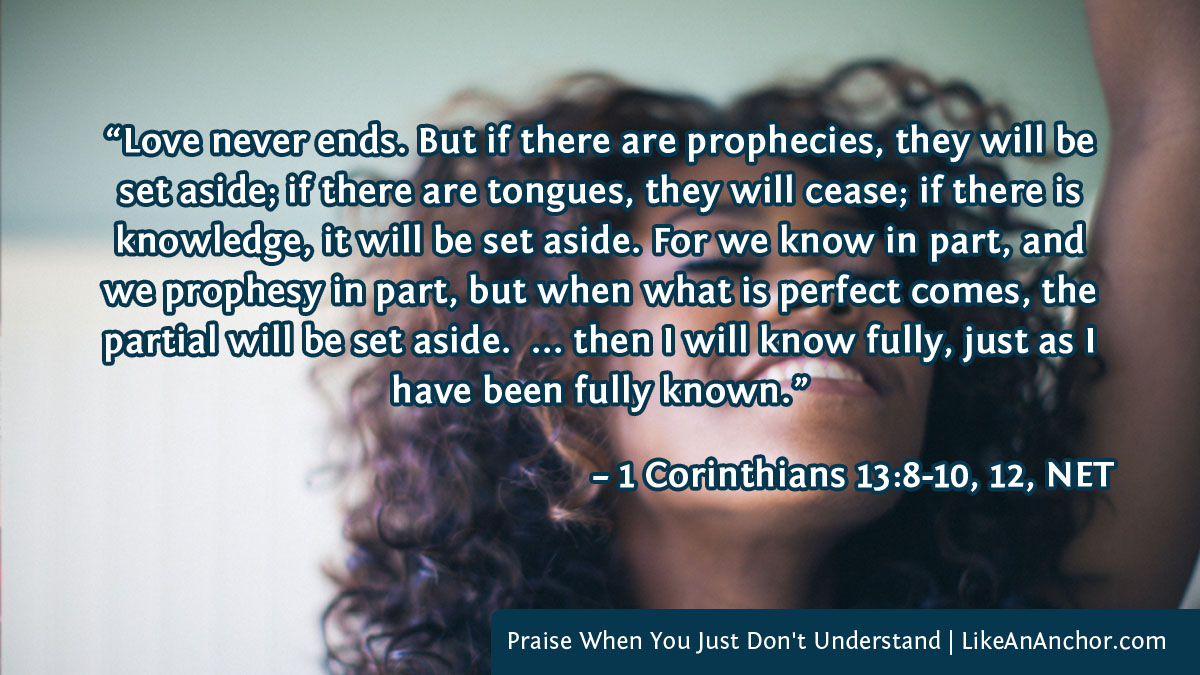
Image of a woman with her hand lifted in praise overlaid with text from 1 Cor. 13:8-10, 12, NET version: “Love never ends. But if there are prophecies, they will be set aside; if there are tongues, they will cease; if there is knowledge, it will be set aside. For we know in part, and we prophesy in part, but when what is perfect comes, the partial will be set aside.  ... then I will know fully, just as I have been fully known.”
Image by Pearl from Lightstock

Remember

Right now, I’m not in a season of my life where I feel super confused about what God is doing. Rather, I’m in a place where I can look back at times where I was confused and realize, “Oh, that’s what was going on.” For years, I’d been going through cycles of praying to God for a husband, going to Him for comfort with a broken heart, and asking if I should give up that dream because it didn’t seem like He was going to work things out for me to get married. And now here I am, getting married in just a few weeks and buying a house and talking about having kids. God didn’t work this out on the timeline I was expecting, but He worked it out better even than I expected; I still catch myself marveling at how good this relationship is and how happy I am with him.

It’s interesting looking back on how hopeless and confused I felt sometimes, knowing now how God was going to work things out. I do believe God allows us free will, and I’m not sure how much of this He had planned exactly, but it sure seems like He was working things out for me and my husband to be together. I want to remember this the next time I wonder what God is doing and why He hasn’t fixed things yet.

Then I thought, “I will appeal to this:
    the years of the right hand of the Most High.”
I will remember Yah’s deeds;
    for I will remember your wonders of old.
I will also meditate on all your work,
    and consider your doings.

Psalm 77:10-12, WEB

Over and over in the Bible, we’re admonished to remember. “Remember all Yahweh’s commandments, and do them,” “remember all the way which Yahweh your God has led you,” and that “your God redeemed you” (Num. 15:39; Deut. 8:2, 15:15 WEB). “Remember the words of the Lord Jesus,” “remember the former days, in which, after you were enlightened,” and “remember the words which were spoken before by the holy prophets and the commandment of us” (Acts 20:35; Heb. 10:32; 2 Pet. 3:2 WEB). Our memory of God’s goodness and faithfulness thus far gives us the hope needed to trust and praise Him when we’re in a season where we don’t know why He’s working the way He is.

Image of four people sitting around a table studying the Bible, overlaid with text from Psalm 78:4-7, WEB version: “We will not hide them from their children, telling to the generation to come the praises of Yahweh, his strength, and his wondrous deeds that he has done. ... that they might set their hope in God, and not forget God’s deeds, but keep his commandments”
Image by Ben White from Lightstock

We Don’t Know The Full Measure

I feel like a lot of times, we can trace our fears, anger, confusion, and frustrations back to not understanding what God is doing. Deep down, we might feel like it’d be a whole lot easier to trust Him if He’d just explain Himself clearly. But God didn’t design us to be all-knowing; I doubt our human minds could handle a fraction of the information we’d need to truly understand things. When we realize that, sometimes we can flip the feeling of frustration with not knowing everything over into awe of the God who does know everything.

But I will always hope,
    and will add to all of your praise.
My mouth will tell about your righteousness,
    and of your salvation all day,
    though I don’t know its full measure.

Psalm 71:14-15, WEB

Psalm 71 is a prayer for protection, asking God not to disappoint you when you run to Him for refuge. There are people in the psalmist’s life hinting that God has forsaken him, but he calls on God to prove them wrong. Verse 15 caught my eye (and gave me the idea for this study) because of the psalmist’s promise to speak of God’s righteousness and salvation even though they don’t fully understand it.

The topic of voicing truths about God when you don’t understand what He’s doing makes me think of Job. God described him as a righteous man at the beginning of the book, but Job still went through horrible trials and the people who should have comforted him instead wanted to diagnose his moral failings. Job and his friends all missed that there was something else going on in the background that they didn’t understand. In the end, Job didn’t get answers to the questions that he’d asked God. Instead, God showed up in person to tell him that he didn’t know the full measure of what was going on (see my post “The Central Question of Job: A Broader Perspective On Suffering“).

Much like Job, we might not always understand why tough things are happening. We might go back and forth trying to figure out possible reasons. Sometimes it might actually be because we did something wrong and we need a wake-up call to change (which is what Job’s friends thought was going on there). Sometimes we might be trying to force our own will on a situation where we need to let go and let God work it out in His timing. Sometimes bad things happen because we live in a fallen world that’s imperfect and is full of other imperfect people who hurt us, intentionally or accidently. And sometimes there might be something going on in the background that we’re ignorant of (which is what was actually happening in Job’s story). No matter what the root cause, it’s important to seek God during these times.

Your hands have made me and formed me.
    Give me understanding, that I may learn your commandments.
Those who fear you will see me and be glad,
    because I have put my hope in your word.
Yahweh, I know that your judgments are righteous,
    that in faithfulness you have afflicted me.
Please let your loving kindness be for my comfort,
    according to your word to your servant.

Psalm 119:73-76, WEB

We can echo this psalmist in praying for understanding so we can obey God’s commandments, hope in his word, and trust in his righteousness. But we also need to make peace with the fact that we won’t always understand everything. That can be challenging for those of us whose relationship with God is largely intellectual, but it’s a truth we need to acknowledge if we’re going to make it past our own egos and have a humble relationship with God.

Balancing Humility and Knowledge

Image of a silhouetted person lifting their hands to pray with the blog's title text and the words "How do we keep on praising and trusting God when we don’t understand what He’s doing?"
Image by Brittney Borowski from Lightstock

When Paul wrote to the Corinthian church, one of the things he addressed in his first letter was a debate they were having regarding whether it was okay to eat meat that had been sacrificed in an idol’s temple, then sold in the market. The reminder he gives his readers for that topic is a good one to keep in mind for other situations as well.

 With regard to food sacrificed to idols, we know that “we all have knowledge.” Knowledge puffs up, but love builds up. If someone thinks he knows something, he does not yet know to the degree that he needs to know.

1 Corinthians 8:1-2, NET

Because God is working with us, we have a certain amount of knowledge. We can even say with accuracy that we know more than most people in the world, at least about the things of God (Ps. 119:99). We certainly shouldn’t devalue the knowledge we have or give up on deepening our knowledge of God (for example, Paul tells us to worship and sing praises with our understanding as well as our spirits/hearts [1 Cor. 14:15]). But we still only “know in part” (1 Cor. 13:9, 12, NET). We need to let the understanding God has blessed us with remind us to be humble before Him.

We need to strike a healthy balance between humility and knowledge. It shouldn’t really be all that difficult; the more we really know about and understand God the more our relationship with Him should inspire true humility in us. And this isn’t just something Paul talked about. Peter’s letters also remind us that humility is vital before God and that He grants deep knowledge to His people.

And all of you, clothe yourselves with humility toward one another, because God opposes the proud but gives grace to the humble. And God will exalt you in due time, if you humble yourselves under his mighty hand by casting all your cares on him because he cares for you.

1 Peter 5:5-7, bolt italics a quote from Prov 3:34 

May grace and peace be lavished on you as you grow in the rich knowledge of God and of Jesus our Lord! I can pray this because his divine power has bestowed on us everything necessary for life and godliness through the rich knowledge of the one who called us by his own glory and excellence.

2 Peter 1:2-3, NET

It can be frustrating to feel like things aren’t going the way you hoped or planned. It can be equally frustrating to feel like you don’t know what’s going on or aren’t sure what you should do next. It might even make us angry (if you’re struggling with anger or have in the past, I recommend checking out this thought provoking Truth Be Told podcast episode). Through whatever it is we’re struggling with or that we’re questioning, we need to remember the big picture.

God is in control. He is trustworthy now and in the future, just like He’s been trustworthy since the beginning of time. It’s okay for us not to know the “full measure;.” We don’t really need all the answers now. Let’s do our best to balance our knowledge (and our desire for knowledge) with humility to obey and trust God while also hoping in His promises and praising Him with all our hearts and minds.


Featured image by Shaun Menary from Lightstock

But What if the Bible Doesn’t Seem to Make Sense?

Most of us want to think of ourselves as reasonable people. When need be, we can think logically and rationally about things and come to reasonable conclusions. We know at the least the basics of how to recognize fallacies in other people’s arguments and how to put our own thoughts together.

For those of us living in Western nations (and I’m guessing some other locations that have been influenced by Western ideas), the education we received in relation to logical reasoning is based in Grecian and Roman philosophies. This system of reasoning and logic laid the groundwork for our scientific method and our ideas about how to figure out if something makes sense.

When we apply our modern human reasoning to the Bible, sometimes there are things which seem odd to us. We might notice contradictions in the text. We might wonder why God would tell people to do certain things, or why He makes some of the choices He does. We might look at some of the connections New Testament writers make to the Old Testament and think their conclusions seem far-fetched. And when we look at the Bible and it doesn’t make sense, we might become frustrated with our own limitations or we could become skeptical of God’s word.

The first of those problems has a fairly simple answer: pray for wisdom and understanding. James says that if anyone asks for wisdom in faith, God will give it to them (James 1:5-6). Paul adds that if we’re off-the-mark in our views, God can reveal the truth to us (Phi. 3:14-16). When we’re in a relationship with God, He also gives us His holy spirit that Jesus said “will guide you into all truth” (John 16:13, WEB). When we’re frustrated with our own lack of knowledge or understanding, we can take those frustrations to God. He might not give us the exact answer we’re looking for right away, but He will always help those who keep asking and seeking (Luke 11:9-10).

It can also help to keep in mind the things that I’ll suggest people consider if they think God’s word doesn’t make sense. There’s a dangerous sort of arrogance in thinking there’s something wrong with God just because He doesn’t make sense to us. Similarly, there’s danger in dismissing God’s word because we’re not sure how to wrap our heads around it or we think it’s just a good book rather than His divine revelation. There’s a lot we could say on this subject, but for today’s post I want to focus on just two things we can think about if we’re struggling with the idea that things in the Bible don’t make sense.

Image of a girl reading the bible, with text from Romans 11:33 and 1 Corinthians 2:16, NET version.
Image by José Roberto Roquel from Lightstock

The Wrong System of Measurement

Suppose you come across a woodworking project, like a little birdhouse, at a resale shop. You like the way it looks so you take it home and plan to use it as a pattern for your next project. You get out your tape measure and start making notes. The roof is just shy of 7-7/8 inches long, and not quite 4-3/4 inches wide. You keep taking measurements and it gets more and more frustrating. Why didn’t the builder use nice, even, sensible numbers instead of all these not-quite-right fractions?

Then suppose you turn the tape measure around to the side with centimeters. Suddenly, the roof is exactly 20 by 12 cm. The problem wasn’t with the person making the birdhouse. The problem is you didn’t understand what system of measurement they used in the first place.

This is very similar to what happens when people approach the Bible with a cultural mindset different than the one the original writers use. The Bible is a text from the ancient Middle East. Even though we believe God is the ultimate author of the Bible, He still used people in that culture to write His word. When Jesus spoke to people of His day, He used examples and analogies they could understand. Those of us who are far removed from that original context (in terms of both time and cultural philosophies) often have a hard time figuring out the Bible. That’s not because there’s something wrong with the Bible or we’re incapable of understanding; it’s just that we need more contextualizing information.

For example, in Western culture we like having reliable rules and we think they ought to apply to everyone in the same way. If a rule is bent or broken for one person and not others, we call that “unfair” and complain about a lack of justice. If we see what looks like a rule in the Bible and then God does something different, we might think He’s unjust or that there’s some kind of hidden rule system that He’s unfairly keeping from us. But things are different in non-Western cultures where “rules apply except when the one in charge says otherwise. Westerners might consider this arbitrary; many non-Western Christians consider this grace (Richards & O’Brien, p. 174). That’s how Paul can (arguably) call Junia an apostle in Rom. 16:7 even though women don’t typically hold that office (p. 172).

That example comes from Misreading Scripture with Western Eyes–a book I highly recommend to anyone who wants to understand the Bible better. Reading the Bible with Rabbi Jesus is also a great help with that. These books are excellent “tools” for making sure you’re using the right system of measurement when interpreting God’s word. You might be able to find one or both of these books in your local library, and here are the Amazon links if you want to check them out:

God’s a Lot Smarter Than You

There’s another truth that we need to acknowledge if we want to work through parts of scripture that don’t make sense to us. God is smarter than us. And when someone is a lot smarter than you, plus they have a perfectly clear perspective on everything going on, sometimes you won’t be able to make sense of what they’re doing.

For some people, it’s easy to admit that they’re not the smartest person in the room. For others, our intellect can be a stumbling block that gets in the way of a close relationship with God. This latter one is something I can struggle with. I get prickly when someone insults my intelligence or implies that I don’t understand what I’m talking about. I rely heavily on my ability to research things thoroughly and find good answers. I preen inside when a professor complements my writing or calls me an “academic.”

However, an academic understanding of scripture isn’t how we have a relationship with God. Our spiritual temperament might lean more on logic, reason, and knowledge (as Gary Thomas discusses in “Sacred Pathways”), but intellect isn’t enough to have a relationship with God. We also need humility and love. We need to admit that no matter how much we study, we’re not going to learn everything about God because the depths of His knowledge are unfathomable. We need to humbly marvel at–and love–the God who is way smarter than us, and ask Him for help when we’re struggling to understand something in His word.

My brothers and sisters, consider it nothing but joy when you fall into all sorts of trials, because you know that the testing of your faith produces endurance. And let endurance have its perfect effect, so that you will be perfect and complete, not deficient in anything. But if anyone is deficient in wisdom, he should ask God, who gives to all generously and without reprimand, and it will be given to him. But he must ask in faith without doubting, for the one who doubts is like a wave of the sea, blown and tossed around by the wind. For that person must not suppose that he will receive anything from the Lord, since he is a double-minded individual, unstable in all his ways.

James 1:2-8, NET

Sometimes, the “testing of our faith” is an internal struggle rather than an external trial. We might wrestle with our own doubts, questions, or fears related to God’s word. We’re not abandoned during those struggles, though. Sometimes I think we worry if our trials are doubt-related then we don’t deserve to ask for God’s help, but the truth is that He’s is eager to help everyone seeking His kingdom to understand and know Him more fully. Even the tiniest spark of faith is enough for Him work with if only we’ll come to Him and say, “I believe; help my unbelief!” (Mark 9:24, WEB).

Shifting Our Focus

Image of a woman studying her Bible with the blog's title text and the words "We can eagerly seek knowledge of God while also humbly admitting that we don't yet know everything (and that's okay)."
Image by MarrCreative from Lightsock

There are still parts of the Bible that don’t quite make sense to me. But I think now I’ve reached a point where I trust that God knows what He’s doing even if I don’t understand it. I can also trust that someday He’ll help me understand those things, even if that “someday” doesn’t happen in this physical life.

I can also shift my focus off trying to make sense of everything and onto following Christ’s example. When Paul and Peter say we should have Christ’s mind, they aren’t focused on knowledge so much as on peaceful relationships (Rom. 15:5), God’s wisdom inside us (1 Cor. 2), service (Phil. 2:5-7), suffering, and freedom from sin (1 Pet. 4:1-2). There are far more important things to focus on than trying to make sense of everything in the Bible or put God into neat little categories. There is great value in knowing the Bible and understanding doctrine, but that’s all secondary to knowing God.

“Don’t let the wise man glory in his wisdom.
Don’t let the mighty man glory in his might.
Don’t let the rich man glory in his riches.
But let him who glories glory in this,
that he has understanding, and knows me,
that I am Yahweh who exercises loving kindness, justice, and righteousness in the earth,
for I delight in these things,” says Yahweh.

Jeremiah 9:23-24, WEB

Paul quotes these verses at the beginning of 1 Corinthians when he’s counseling his readers not to let disputes and pride get in the way of peaceful relationships in the church or following Christ. Even the smartest among us don’t have anything to boast of when we compare ourselves to the wisdom, goodness, and glory of God. With this shift in mindset, we can pursue a closer relationship with God and eagerly learn more about Him while also humbly admitting that we don’t yet know everything (and that’s okay).

Featured image by Matt Vasquez from Lightstock

Let Us Press On To Know The Lord

Are you settling for salvation?

This interesting phrase is one I’ve heard used by the Rabbi in my local Messianic congregation to describe those who accept Jesus as their savior and then don’t really pursue a deeper relationship with Him. Maybe they go to church most weeks and go through the motions of being a “good Christian,” but they don’t tap-in to the fullness and depth of their faith.

Shallow faith has been a problem throughout God’s history with His people. Evidently it will be a problem to the end, for Jesus questions if He’ll really “find faith on the earth” when He returns (Luke 18:8). But we want to be found faithful. I don’t think any Christian would say they don’t want to know Jesus better or strengthen their faith (and if they would we should pray for them!). So how do we get to deeper faith?

The Problem of Inconsistent Faith

For many of us, our faith waxes and wanes. We’re excited about God when we first meet Him and we turn to Him when things get bad, but the rest of the time it’s easy to become complacent. In a sense, we set Him on a shelf until we want/need Him.

Come! Let’s return to Yahweh; for he has torn us to pieces, and he will heal us; he has injured us, and he will bind up our wounds. … Let’s acknowledge Yahweh. Let’s press on to know Yahweh. As surely as the sun rises, Yahweh will appear. He will come to us like the rain, like the spring rain that waters the earth.” (Hosea 6:1, 3, WEB)

Hosea records these as Israel’s words when they turned back to God once again after a season of punishment. This was a cycle for them — they’d fall away from God, bad things would happen, they’d turn back to God, and then the whole thing would repeat. God forgave each time they repented, but He got tired of the cycle. Read more

Putting God in a Clay Pot: How Much Does the Lord Understand You?

Do you ever feel like God doesn’t really know what you’re going through? That He doesn’t get how hard it is to be human or that He expects too much of us?

I think this is an easy thought pattern to fall into. “My problem is something different,” we think. “Other people don’t understand, and maybe God doesn’t either. Sure Jesus was human but that was 2,000 years ago. Things have changed.”

Truth is, though, things haven’t changed that much. “There is no new thing under the sun” because human nature stays the same (Ecc. 1:9). And even if things have changed so much that being human is fundamentally different than it once was, God has still taken steps to make sure He understands us. Evidently connecting with us is very important to Him, because He’s done some pretty incredible things in order to get inside our perspectives and also to share His mind with us. Firstly, He made us. Secondly, He experienced human life by Jesus living as a human. Finally, He indwells His people today through His spirit.

Made

If you make something you understand it. You know all the ingredients in the cookies, you know the hours put into shaping clay into an urn, you know the measurements and materials required to machine that part. God understands us even better than that, for He created all the materials we’re formed from and then fashioned us in His own image.

Like a father has compassion on his children, so Yahweh has compassion on those who fear him. For he knows how we are made. He remembers that we are dust. (Psalm 103:13-14, WEB)

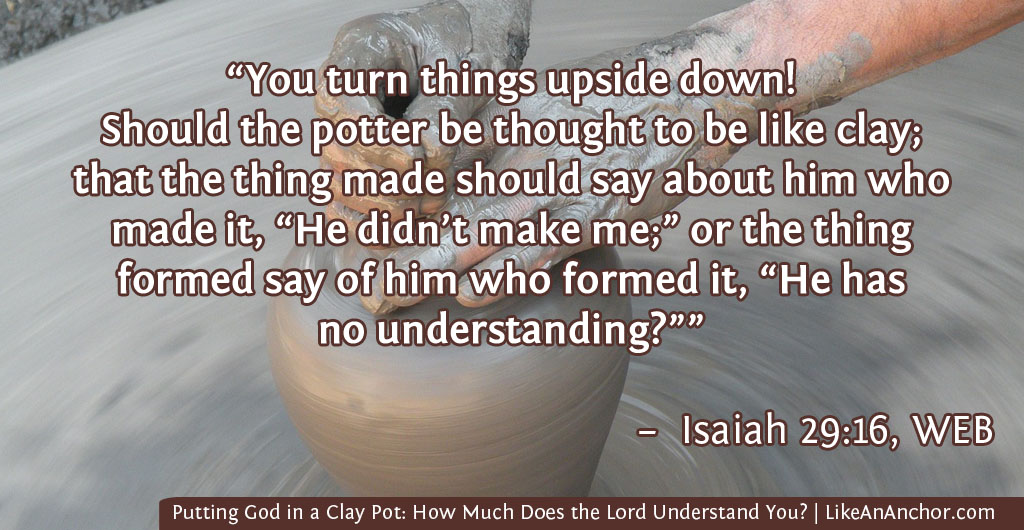
Other translations use the phrase “He knows our frame” (Hebrew word yetser, meaning form, framing, or purpose). God made us and knows all about us. We are something formed by him as if we were clay in the hands of a master potter (Is. 29:16 also uses the word yetser).

However, knowing how to make a clay pot isn’t the same as knowing what it’s like to be a clay pot. He could search us and know us more intimately than anyone else (see my favorite Psalm, number 139 for an example), but God in the Old Testament hadn’t yet lived as one of us.

Lived

They say if you want to understand someone you should walk a mile in their shoes. God did much more than that when the Son came to this earth as a man. He walked 33 years in our human form.

Who, existing in the form of God, didn’t consider equality with God a thing to be grasped, but emptied himself, taking the form of a servant, being made in the likeness of men. And being found in human form, he humbled himself, becoming obedient to the point of death, yes, the death of the cross. (Phil. 2:6-8, WEB)

Having created the form of man, God now inhabited it as the Word who took on the same form He created (John 1:1-4, 14). Both Father and Son were involved in creation (Eph. 3:9) and both were involved in the decision to send Jesus as the Messiah (John 5:36-37; 10:17-18). The God-family was in perfect agreement about how important it was for one of them to live and die as a human.

Since then the children have shared in flesh and blood, he also himself in the same way partook of the same, that through death he might bring to nothing him who had the power of death, that is, the devil … Therefore he was obligated in all things to be made like his brothers, that he might become a merciful and faithful high priest in things pertaining to God, to make atonement for the sins of the people. For in that he himself has suffered being tempted, he is able to help those who are tempted. (Heb. 2:14, 17-18, WEB)

This tells us that one of Jesus’ reasons for coming to this earth was to experience human life and so know first-hand what we are going through. This is an incredible sacrifice for God to make in order to understand you! It’s mind-boggling that one of the two all-powerful beings in the universe would choose to live like one of the clay pots He made all so He could save our lives and understand how to help each of us.

Indwelt

What Jesus did in coming to earth, living as human, and dying for us is amazing in itself. But He doesn’t stop there. He made us, then He lived like us, and now He lives inside us.

For we don’t preach ourselves, but Christ Jesus as Lord, and ourselves as your servants for Jesus’ sake, seeing it is God who said, “Light will shine out of darkness,” who has shone in our hearts to give the light of the knowledge of the glory of God in the face of Jesus Christ. But we have this treasure in clay vessels, that the exceeding greatness of the power may be of God, and not from ourselves. (2 Cor. 4:5-7, WEB)

Today, God is still putting His presence in clay pots (us) through His spirit. He has said, “I will dwell in them and walk in them. I will be their God and they will be my people” (2 Cor. 6:16, WEB). This is an intimate level of knowing that goes beyond how we are made or even what it’s like to be human (John 15:4; 17:22-23). Through the indwelling of His spirit, He knows what it is like to be us in the fullest way we could ever imagine.

So if you ever feel like maybe God doesn’t understand you, remember all the ways that He knows you. He made human kind, lived as a human, and now lives in each of us. No one (including yourself) will ever understand you as well as God does. And there’s a great comfort in that, “for we don’t have a high priest who can’t be touched with the feeling of our infirmities.” Our Lord and Savior knows what it’s like to be human and has deep sympathy for all of us (Heb. 4:14-16). Beyond that, He deeply sympathizes with each individual He’s in a relationship with because we dwell in Him and He in us through His spirit.

I know how hard it is when you’re struggling with loneliness, but when we have a relationship with God we never have to feel fundamentally alone or misunderstood. He’s gone to incredible lengths to have a deep, personal relationship with us. All we have to do is recognize that He’s there.

Featured image credit: JamesDeMers via Pixabay

Choose God (Lessons from Hosea, part two)

Last week, we began a study of Hosea, and covered the first three chapters. We looked at how Hosea’s marriage to a prostitute pictured God’s covenant with unfaithful Israel in the Old Testament, and how that serves as a warning to us. We need to learn from Israel’s example and not follow their pattern of repeatedly rejecting God, but rather hold fast to Him as He fulfills His promises to reestablish a marriage covenant with His people.

As we continue in Hosea, we see God addressing the reasons for Israel’s unfaithfulness. Everything that separated Israel from God was Israel’s fault.  God never let down His side of the bargain — Israel got into trouble because they walked away from Him. This holds true for the New Testament as well.

If we endure, we shall also reign with Him. If we deny Him, He also will deny us. If we are faithless, He remains faithful; He cannot deny Himself. (2 Tim 2:12-13)

God is always faithful to His promises, including His promise that sin will be punished. Like with Israel, it is still up to us to choose between life and death, blessings and cursing (Deut. 30:9).

Lack of Knowledge

Hear the word of the Lord, you children of Israel, for the Lord brings a charge against the inhabitants of the land: “There is no truth or mercy or knowledge of God in the land.” (Hos 4:1)

God gives three reasons for His “controversy” with Israel. They lacked truth, did not show mercy, and had no knowledge of Him. This resulted in “swearing and lying, killing and stealing and committing adultery” (Hos. 4:2). The farther they strayed from God, the more corrupt and destructive they became.

My people are destroyed for lack of knowledge. Because you have rejected knowledge, I also will reject you from being priest for Me; because you have forgotten the law of your God, I also will forget your children. (Hos 4:6)

This verse specifically refers to knowledge about God and His ways. The New Testament tells us that “the wisdom of this age” — knowledge that the world esteems — is coming to nothing (1 Cor. 2:6), but that “all the treasures of wisdom and knowledge” are hidden for us to find in the Father and Christ (Co. 2:2-3).

Chapters 4 and 5 cover punishments for Israel, and deal with prophecies of an Assyrian invasion and Judah’s alliances with Egypt and Syria. In chapter 6, the people say, “Come, and let us return to the Lord,” but they are not sincere (Hos. 6:1, 4).  Their sham repentance is not what God was looking for.

For I desire mercy and not sacrifice, and the knowledge of God more than burnt offerings. But like men they transgressed the covenant; there they dealt treacherously with Me. (Hos. 6:6-7)

God is all about relationship. He wants to know the people we’ll become when we learn to know Him. All the religious services and laws given to Israel weren’t the “point” of the Old Covenant. They were supposed to be an outward sign of an inward condition — a heart full of truth, mercy, and the knowledge of God.

Because of Unbelief

Israel’s lack of relationship with God was a result of choices they make to walk away from Him.

When I would have healed Israel, then the iniquity of Ephraim was uncovered, and the wickedness of Samaria. For they have committed fraud; a thief comes in; a band of robbers takes spoil outside. They do not consider in their hearts that I remember all their wickedness; now their own deeds have surrounded them; they are before My face. (Hos. 7:1-2)

Wickedness, lies, adulteries (Hos. 7:3-4) — their sins kept piling up until God could say of the people that “none among them calls upon Me” (Hos 7:7). The entire nation rejected the One who they had entered into a covenant with.

Woe to them, for they have fled from Me! Destruction to them, because they have transgressed against Me! Though I redeemed them, yet they have spoken lies against Me. They did not cry out to Me with their heart when they wailed upon their beds.
They assemble together for grain and new wine, they rebel against Me; though I disciplined and strengthened their arms, yet they devise evil against Me; they return, but not to the Most High; they are like a treacherous bow. Their princes shall fall by the sword for the cursings of their tongue.  (Hos. 7:13-16)

quotescover-JPG-96Israel did this continually in the Old Testament. Psalm 78 records that even though “their heart was not steadfast with Him, nor were they faithful in His covenant” that God was “full of compassion” and held back His anger many times (Ps. 78:37-38). He was grieved by their sins, because they would not let Him be their God. Though He acted as their Redeemer, Deliverer, and Rock, “again and again they tempted God, and limited the Holy One of Israel” (Ps. 78:35, 41-42). By not believing in Him, they rejected His good works in their lives.

This rejection of God continued into the New Testament as well. Matthew 13:58 records that Jesus “did not do many mighty works” in His hometown “because of their unbelief.” Mark’s account of this incident phrases it, “He could do no mighty work there, except that He laid His hands on a few sick people and healed them” (Mark 6:4-6). Where there was belief, simply touching the edge of Christ’s garments brought healing (Mark 5:27-29, 34). Where there was no faith, He was actually limited in how many miracles He could perform.

Make A Choice

Israel was given a choice whether or not to follow God and welcome His involvement in their lives. Many of them made the wrong choice, as Paul describes in Romans 11 when comparing God’s people to an olive tree where some of the natural branches were removed. In this analogy, Gentile New Testament Christians are wild olive branches grafted into the Rootstock. Once there, we also have a choice to make.

You will say then, “Branches were broken off that I might be grafted in.” Well said. Because of unbelief they were broken off, and you stand by faith. Do not be haughty, but fear. For if God did not spare the natural branches, He may not spare you either. Therefore consider the goodness and severity of God: on those who fell, severity; but toward you, goodness, if you continue in His goodness. Otherwise you also will be cut off.  And they also, if they do not continue in unbelief, will be grafted in, for God is able to graft them in again. (Rom. 11:19-23)

Like so many serious warnings in the Bible, this contains hope as well as caution. The Bible provides us with records of Israel rejecting God, being punished, and returning to Him again and again. God leaves as many doors open as possible for people to come back to Him, and He’s eager to “graft them in again” if they repent. These doors are open to us as well. But God still wants us to learn from Israel’s mistakes and choose not to leave Him at all, because even though He is a God of enormous mercy there is a point where we can go too far away to get back to Him.

For if we sin willfully after we have received the knowledge of the truth, there no longer remains a sacrifice for sins, but a certain fearful expectation of judgment, and fiery indignation which will devour the adversaries. Anyone who has rejected Moses’ law dies without mercy on the testimony of two or three witnesses. Of how much worse punishment, do you suppose, will he be thought worthy who has trampled the Son of God underfoot, counted the blood of the covenant by which he was sanctified a common thing, and insulted the Spirit of grace? (Heb. 10:26-29)

Like He did in Deuteronomy 30 with Israel, today God sets before His people a choice between life or death, blessings or cursing, and good or evil. He wants us — pleads with us — to choose life, blessings, and good, but the choice is still ours to make.