I’ve been rereading one of my favorite one-year devotional books, and I’d like to start today’s post by quoting part of one devotional entry.
God is holy, and we must conform to His holiness. This means restrictions on our behavior. But when the restraints become the essence of our faith, as they did for the Pharisees, we are far from the heart of God. … Faith is about following His character. That’s the whole point of obedience.
Chris Tiegreen, 365 Pocket Devotions, Day 49
It’s very easy for humans to go to extremes. On the one hand, you’ll meet Christians who build their lives around what they can and cannot do as if keeping the law perfectly can save them. On the other hand, you’ll meet Christians who say they don’t have to be obedient to God’s law because grace covers all that. The truth is somewhere in between. Obedience isn’t what saves us, but it is the right and proper response to receiving salvation. Having the right understanding of our relationship with God helps us have a right understanding of our relationship with His law.
Image by Matt Vasquez from Lightstock
Start With Love
There are certain things that God expects from people who follow Him. It is much like any healthy relationship. I expect people that I am friends with to generally treat me well and follow a basic standard of good conduct, and they expect the same from me. If one of us violated these unspoken “rules” of friendship, the friendship would dissolve or at the very least become more distant. Healthy relationships require things like regular communication, trustworthiness, reciprocity, a way to resolve conflicts, and mutual respect for the other’s needs, morals, and boundaries.
Our relationship with God works the same way, and He doesn’t leave us guessing about how the relationship works. He invites us into a covenant relationship with Him and lets us know exactly what He expects from us as well as what we can expect from Him. It’s actually pretty simple, and can be boiled down into just two commandments:
Jesus said to him, “‘Love the Lord your God with all your heart, with all your soul, and with all your mind.’ This is the first and greatest commandment. The second is like it: ‘Love your neighbor as yourself.’ All the law and the prophets depend on these two commandments.”
Matthew 22:37-40, NET
There are lots of other commands in scripture, of course (both Old and New Testament), but they are all just elaborations on these two expectations. At the most basic level, God’s restrictions on our behavior are all connected to making sure that we love Him and love the people around us in the right way. Remembering that helps us have the right perspective on obedience.
Owe no one anything, except to love one another, for the one who loves his neighbor has fulfilled the law. For the commandments, “Do not commit adultery, do not murder, do not steal, do not covet,” (and if there is any other commandment) are summed up in this, “Love your neighbor as yourself.” Love does no wrong to a neighbor. Therefore love is the fulfillment of the law.
Romans 13:8-10, NET
I like how Paul frames all the “do not” commandments as telling us how to love the way God does. A lot of times people describe God’s laws as restrictive or oppressive or outdated, but at the heart of it all is healthy relationships with God and with other people. He wants what is best for us, and He wants a personal relationship with us. His instructions reflect that truth.
Check Your Heart
Image by Pearl from Lightstock
God knows what our motives are. He looks inside our hearts and searches our minds to understand us even better than we understand ourselves (1 Sam. 16:7; Jer. 17:5-10). He knows if we’re flippantly disregarding His laws because we don’t care about what He says, and He also knows if we’re obeying from wrong motives.
“Not everyone who says to me, ‘Lord, Lord,’ will enter into the kingdom of heaven—only the one who does the will of my Father in heaven. On that day, many will say to me, ‘Lord, Lord, didn’t we prophesy in your name, and cast out demons in your name, and do many powerful deeds in your name?’ Then I will declare to them, ‘I never knew you. Go away from me, you lawbreakers!’”
Matthew 7:21-23, NET
This has got to be one of the most sobering passages in the entire Bible. Jesus warns us that calling Him Lord is not enough to get into the kingdom of heaven. Even doing wonderful things in His name isn’t enough. Only those who do the Father’s will and are known by Jesus Christ will be in His kingdom.
“I am the good shepherd. I know my own and my own know me—just as the Father knows me and I know the Father …
“My sheep listen to my voice, and I know them, and they follow me. I give them eternal life, and they will never perish; no one will snatch them from my hand. My Father, who has given them to me, is greater than all, and no one can snatch them from my Father’s hand.”
John 10:14-15, 27-29
Once again, it comes back to relationships. We must listen to Jesus and follow Him, “conforming to His holiness” and “following His character,” as Tiegreen puts it. So, how do you view the restrictions God places on our behavior?
As something you must do perfectly or else you’ll lose your salvation?
As something not worth bothering with?
As guides for how to live in close relationship with God and enjoy all the blessings that accompany adopting His character?
I don’t really like to think of God’s laws as “restrictions.” They do restrict my behavior, but I see them more as guides, guardrails, and insights into God’s character. We keep the law because we’re walking in the spirit; law-keeping is a side-effect of becoming like God. Christians today ought to obey God because we want to be like Him and follow Him faithfully, and His law tells us how to do that.
Over the past couple weeks, I’ve been pondering a topic that I’ve had such a difficult time writing about that I skipped one of my regular posting weeks and then picked another topic for my end of May post. It all started when my husband pointed out a Bible commentary that condemned Rahab for her lie even though it saved the lives of the two spies, and maintains there is never any acceptable reason for a lie (see Beyond Today Bible Commentary: Joshua 2). This stance comes down absolutely on the subject of sin and lies: lies are always a sin and never excusable under any circumstances. Then just a few days later, I read about Christians online sharing made up statistics and excusing it because the lie might encourage people to pray (see “Lying for Jesus: When Did Truth Become UnChristian?” by Sheila Wray Gregoire). This is a completely opposite view, one that approaches truth lackadaisically without any respect for the Bible’s teachings on truth and lies.
The Bible is very clear that lying is a sin and God hates it when people deal falsely. Framed in more positive wording, God’s people ought to follow the Truth and speak only truthful things. And yet we have that example of Rahab, where it seems that a good thing came from her lie, and also the example of the midwives who defied Pharaoh’s command to kill baby boys then concealed the truth, whom God rewarded for their actions. Does that mean they didn’t actually lie? Or that God is sometimes okay with lying? Or might there be some thing else going on, something that hits on a deeper topic of how we approach God’s rules and–more importantly–how God wants us to see His rules and understand His grace.
Image by MarrCreative from Lightstock
The Midwives In Egypt
Rahab is probably the most famous Biblical example of a lie that makes us question whether or not God approved of the deception. In that situation, though, the story does not explicitly state either way what God thought of the lie. It is probable that God did consider this a sin and that it would have been better to find another way to redirect the soldiers, but that because she did the best she could and because she was learning to fear the Lord, God extended grace. There’s one other story, though, where it’s harder for us to condemn the lie.
The king of Egypt spoke to the Hebrew midwives, of whom the name of the one was Shiphrah, and the name of the other Puah, and he said, “When you perform the duty of a midwife to the Hebrew women, and see them on the birth stool, if it is a son, then you shall kill him; but if it is a daughter, then she shall live.” But the midwives feared God, and didn’t do what the king of Egypt commanded them, but saved the baby boys alive. The king of Egypt called for the midwives, and said to them, “Why have you done this thing and saved the boys alive?”
The midwives said to Pharaoh, “Because the Hebrew women aren’t like the Egyptian women; for they are vigorous and give birth before the midwife comes to them.”
God dealt well with the midwives, and the people multiplied, and grew very mighty. Because the midwives feared God, he gave them families.
Exodus 1:15-21, WEB
Only one of the commentaries I looked at comes down on the view that this was a lie and dogmatically says, “Their disobedience in this was lawful, but their deception is evil” (Geneva Study Bible). Commentaries on this passage tend to hedge the midwives’ response by saying it “was probably true; but it was not the whole truth” (Ellicott’s Commentary for English Readers; see also Jamieson-Fausset-Brown Bible Commentary, Pulpit Commentary, and Matthew Poole’s Commentary). However, the commentaries’ justification for saying it’s a half truth smacks of racism or at least incomplete information (i.e. European writers in the 1800s saying Arabic women are reported to deliver babies easily). It’s also countered by the text itself saying the midwives, “didn’t do what the king of Egypt commanded them, but saved the baby boys alive,” which heavily implies that they were there for the births or at the very least could have obeyed the king if they so chose. If they were, in fact, present for the births then saying that the Hebrew women “give birth before the midwife comes to them” was not true. Yet despite this untruth, we are told very clearly, “God dealt well with the midwives” and “Because the midwives feared God, he gave them families.”
In this particular situation, it seems that the midwives had a choice between concealing the truth or participating in murder. I suppose they did have a third choice of telling the king that they disobeyed his command, but that would have also lead to death (and possibly not just for them). This sort of situation is rare, but it’s not unheard of. If someone’s life is in your hands and you’re talking to someone who wants to kill them, telling the whole truth could very easily mean you’ve betrayed someone to death (which is not looked on well in Matt. 24:10). It sounds almost heretical to type this, but it seems from this situation that there was at least one time when God was flexible with His command against lying. At the very least, He extended grace to cover the lie and it was neither condemned nor held against the midwives.
Image by Pearl from Lightstock
Is There Ever A Lesser Evil?
As I’m pondering the midwives’ situation, I wonder if the person who asked Jesus about the greatest commandment might have had similar questions as I do about what to do when you’re stuck in a situation where you can’t clearly see a good choice. If you’re in a situation like the midwives where you have to choose between obeying God’s commands to respect human authority, not commit murder, and to tell the truth, how do you decide which command is most important?
“Teacher, which commandment in the law is the greatest?” Jesus said to him, “‘Love the Lord your God with all your heart, with all your soul, and with all your mind.’ This is the first and greatest commandment. The second is like it: ‘Love your neighbor as yourself.’ All the law and the prophets depend on these two commandments.”
Matthew 22:36-40, NET
The Hebrew midwives never read this verse, but it might give us a clue to their thought process. We can’t obey human authority if they tell us to disobey God; God is a higher authority and we must love Him and follow Him will all our heart, soul, and mind. We cannot commit murder, firstly because God tells us not to but it is also completely incompatible with loving your neighbor as yourself. In the midwives’ situation, it seemed that telling the whole truth had to take a backseat to following the greatest commands. Could they have handled it in a more truthful way and still had a good outcome? Possibly, but whether it’s the case that they didn’t sin at all or they sinned in lying because they didn’t know what else to do, God still rewarded them for their actions. He has the right to extend grace in whatever situation He wants.
On a cosmic, eternal scale, there are not levels of severity to sin. If you keep every command except one, “you have become a violator of the law” and have “become guilty of all of it” (James 2:10, 11, NET; see James 2:8-13). The law gives us “the knowledge of sin” and ensures that “the whole world may be held accountable to God” by clearly showing how God defines sin (Rom. 3:19-20, NET). We’re all guilty in God’s eyes, no matter how “small” our sins might seem, and we all need Jesus’s sacrifice. Paul says that this truth helps show the righteousness and justice of God, who holds all accountable yet freely offers forgiveness and grace through Jesus Christ (Rom. 3:19-26).
No matter which of God’s laws you violate, “the payoff of sin is death” on an eternal timescale and you need “the gift of God [which] is eternal life in Christ Jesus our Lord” (Rom. 6:23, NET). But on an earthly level, we also know that some sins are less destructive than others and God’s laws for ancient Israel reflected that. Every sin would earn you an eternal death penalty (i.e. you can’t live forever unless you accept Jesus’s Christ’s sacrifice on your behalf) but not every sin earned you a physical death penalty when living in a nation ruled by God’s law. For example, murder was a death-penalty sin (Lev. 24:17; Num. 35:30-31) but theft required you pay back more than you stole (Ex. 22:1). If someone lied in a court of law, then the false witness was punished the same way “he had intended to do to the accused” (Deut. 19:19, NET; see Deut. 19:16-19). God didn’t order the same legal penalty for every sin; there was more nuance than that.
We should never think, “I can get away with breaking this one of God’s laws because it’s not a big deal,” but if we’re legitimately in a position where we have to choose between participating in murder or lying about something, I think the choice is clear. You would still need to repent of the lie, but God has a great deal of mercy for people, especially when they are not flagrantly defying Him because they think His laws don’t matter or that they can get away with it.
Maintain Careful Respect For God
Image by WhoisliketheLord Studio from Lightstock
Scripture is clear that God’s laws are very important and He acts justly at all times. We can rely on Him not to go around changing His laws willy-nilly. He has the sovereign right to deliver and enforce laws, and when we agree to live in relationship with Him, part of our covenant obligation is obedience. At the same time, one of the consistent things we know about His character is that He extends lots of mercy and grace to people who slip, and that He reserves the right to amend His plans in response to human behavior (e.g. withholding destruction from Nineveh after the city repented).
For lying in particular, we’re told in no uncertain terms that it originates with the devil and that those who live untruthful lives are abominable to God (Prov. 12:19, 22; John 8:44; 1 John 2:21). We can count on Him to cover that sin in some very specific circumstances, like for Rahab and the midwives, but we ought not take the grace that He shows to people who lied to save a life as license to lie for anything we think is a good cause. This is where those people we mentioned who spread false research even after knowing it was fabricated made a mistake.
Absolutely not! Let God be proven true, and every human being shown up as a liar, just as it is written: “so that you will be justifiedinyour words and will prevail when you are judged.”
But if our unrighteousness demonstrates the righteousness of God, what shall we say? The God who inflicts wrath is not unrighteous, is he? (I am speaking in human terms.)Absolutely not! For otherwise how could God judge the world? For if by my lie the truth of God enhances his glory, why am I still actually being judged as a sinner? And why not say, “Let us do evil so that good may come of it”?—as some who slander us allege that we say. (Their condemnation is deserved!)
Romans 3:4-8, NET (bold italics mark a quotation from Ps 51:4)
The Bible does not give us license to lie whenever we think we have a good reason. Here, Paul specifically addresses a situation where people thought to forward the gospel by lying, and shows that you are still a sinner if you violate God’s law thinking to do good. We need to obey God the way He tells us to. But it is also worth mentioning here if you lied for what you thought was a good reason, you can still realize your mistake and repent. God is always ready to respond to sincere human repentance with forgiveness and grace.
I almost didn’t share this post because it’s such a tricky thing to write about, but I think it’s good to have these types of conversations because they do come up in hypotheticals and sometimes in real-life. I have heard people say that they worry about being in a situation like Europeans who hid Jews during the Holocaust because they’re concerned that God would condemn them as sinners if they lied when asked, “Are there Jews hiding here?” I don’t think we need to worry about that so much. God is not up there waiting to pounce on us, watching for us to fail if we’re in an impossible situation and can’t think of a better way out.
To directly address the title of this post, “Is There Ever A Good Reason To Lie?” I think the answer is both no and yes. “No” in the sense that lying is always a sin, but “yes” in the sense that there are rare situations where you can’t see any other way to obey another of God’s commands (e.g. “love your neighbor as yourself”) than to conceal the truth. God always looks on our hearts, and there’s a big difference between lying because you can’t think of any other way to save a life (and then repenting of the lie) and lying because you’re too proud to admit your were wrong (especially if you then convince yourself you don’t need to repent).
In our lives as Christians, we’ve probably all thought at some point that we’d like to have more faith. We look at the heroes of faith in the Bible and read Hebrews 11, and we think it’d be nice to have faith like that. Jesus’s disciples had a similar desire.
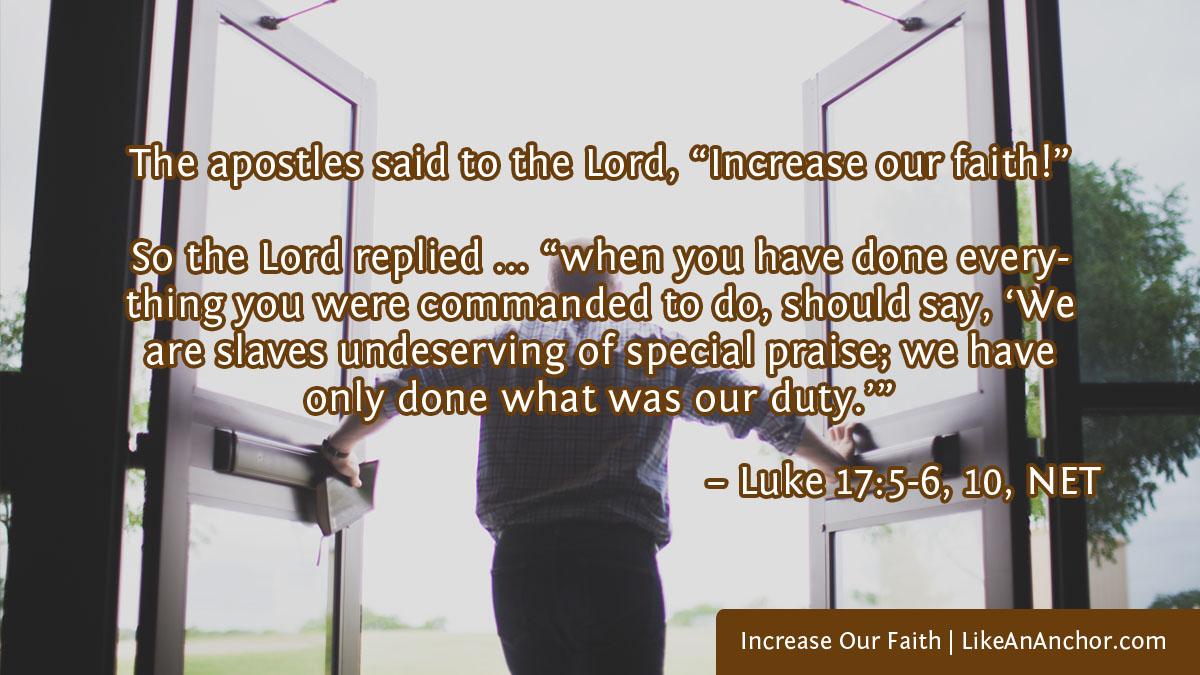
The apostles said to the Lord, “Increase our faith!”So the Lord replied, “If you had faith the size of a mustard seed, you could say to this black mulberry tree, ‘Be pulled out by the roots and planted in the sea,’ and it would obey you.”
Luke 17:5-6, NET
At first, it seems like Jesus didn’t give them a helpful answer. They asked for more faith, and He said if you had faith you could do this and this, but didn’t actually tell them how to get that faith. But then, as He so often did when teaching, He proceeded to tell them a story.
“Would any one of you say to your slave who comes in from the field after plowing or shepherding sheep, ‘Come at once and sit down for a meal’?Won’t the master instead say to him, ‘Get my dinner ready, and make yourself ready to serve me while I eat and drink. Then you may eat and drink’?He won’t thank the slave because he did what he was told, will he?So you too, when you have done everything you were commanded to do, should say, ‘We are slaves undeserving of special praise; we have only done what was our duty.’”
Luke 17:7-10, NET
The disciples asked for more faith, and Jesus gave this enigmatic response. First, He told them what they could do if they had faith. Then, he told them this story about the slave and the master. Finally, He gave them an instruction: “So you too, when you have done everything you were commanded to do, should say, ‘We are slaves undeserving of special praise; we have only done what was our duty.’” It’s this story and concluding instruction that serve as the answer to the disciples’ plea, “Increase our faith!”
Image by Pearl from Lightstock
Master and Slave
When we read the word “slave” with modern eyes, we become very uncomfortable. We think of involuntary subjugation and mistreatment. In many English translations, they use the word “servant” or “bondservant” to avoid using “slave.” However, “δοῦλος (doulos) … does not bear the connotation of a free individual serving another” (NET footnote on Matt. 8:9). “Bondservant” is a pretty good translation, since doulos “often indicates one who sells himself into slavery to another,” but it’s not a word that most modern English speakers are familiar with. That makes “slave” the best translation option even though our modern sense of what that means is a little different than what doulos meant in the ancient world.
It’s important that we understand doulos because the master-slave relationship is one that Jesus and New Testament writers frequently use to explain how God and His followers relate to each other. Jesus has multiple parables about the kingdom that compare us to slaves and He and/or His father to a master (Matt. 24:45-51; 25:14-30). While Jesus did say, “I no longer call you slaves … But I have called you friends” near the end of His human life (John 15:15), Paul, Timothy, James, Peter, and Jude all call themselves slaves of God the Father and Jesus Christ (Rom. 1:1; Phil. 1:1; Tit. 1:1; James 1:1; 2 Pet. 1:1; Jude 1:1). In the sense that Biblical writers use the word, we don’t have a choice about whether or not we’re slaves. All people either serve sin and the devil as their master, or serve righteousness and the one true God (Romans 6). We just get to choose whom we serve. With that in mind, let’s look at Jesus’s response to His disciples again.
“Would any one of you say to your slave who comes in from the field after plowing or shepherding sheep, ‘Come at once and sit down for a meal’?Won’t the master instead say to him, ‘Get my dinner ready, and make yourself ready to serve me while I eat and drink. Then you may eat and drink’?He won’t thank the slave because he did what he was told, will he?So you too, when you have done everything you were commanded to do, should say, ‘We are slaves undeserving of special praise; we have only done what was our duty.’”
Luke 17:7-10, NET
First, Jesus asked His listeners to put themselves in the master’s role. You wouldn’t think it was a remarkable thing, He points out, if your slave did as they were told and served you. Like the slave in this story, we have a master that we’re expected to serve. When we do everything God has commanded us to do, we shouldn’t think we’ve done something amazing. That’s just what’s expected of us. It is our duty to obey God in everything. And somehow, that is connected to faith.
Image by Prixel Creative from Lightstock
Doing What We Hear
Paul tells us that “faith comes from what is heard, and what is heard comes through the preached word of Christ” (Rom. 10:17, NET). As we talked about last week, a Jewish writer like Paul would have connected the idea of hearing to the action of doing. If you really hear or listen to something God says, then you’re going to act on what you hear. Faith follows from hearing God’s word and, as we talked about the week before last, that faith involves obedience to what God says.
When I read, “when you have done everything you were commanded to do, should say, ‘We are slaves undeserving of special praise; we have only done what was our duty’” I think of the difference Jesus drew between people who made a show of righteousness and people who lived genuinely righteous lives. Usually, this came up in relation to the Pharisees, who prided themselves on keeping God’s law to the letter and even adding more laws on top of it.
“Do not think that I have come to abolish the law or the prophets. I have not come to abolish these things but to fulfill them.I tell you the truth, until heaven and earth pass away not the smallest letter or stroke of a letter will pass from the law until everything takes place. So anyone who breaks one of the least of these commands and teaches others to do so will be called least in the kingdom of heaven, but whoever obeys them and teaches others to do so will be called great in the kingdom of heaven. For I tell you, unless your righteousness goes beyond that of the experts in the law and the Pharisees, you will never enter the kingdom of heaven!”
Matthew 5:17-20, NET
Clearly, the true righteousness Jesus talks about here has something to do with keeping the commands of God but it isn’t confined to just being an expert in the law or keeping that law as strictly as possible. In the rest of the Sermon on the Mount, Jesus continued talking about taking God’s law to the next level. Our righteousness has to go beyond the letter of the law to obeying God in the spirit and intent of His law. For example, it’s not enough to avoid murder; Jesus also expects us not to despise or condemn others (Matt. 5:21-22). It’s not enough to refrain from cheating on our spouses; we’re not even to lust after someone who doesn’t belong to us (Matt. 5:27-28). If we’re only keeping the letter of the law, then we are servants who have merely done our duty. If we want to be deserving of “special praise,” we need to demonstrate a higher degree of commitment to God than what He expected under the Old Covenant.
Now we have such confidence in God through Christ.Not that we are adequate in ourselves to consider anything as if it were coming from ourselves, but our adequacy is from God, who made us adequate to be servants of a new covenant not based on the letter but on the Spirit, for the letter kills, but the Spirit gives life.
2 Corinthians 2:4-6, NET
Paul explains “the letter kills, but the Spirit gives life” more fully in Romans, especially Romans 7-8. The law gives knowledge of sin, but it can’t save us from the death penalty that comes from breaking God’s law. We need Jesus’s sacrifice for that, and when we have a relationship with Him we’re “free from the law of sin and death” and under “the law of the life-giving Spirit in Christ Jesus” (Rom. 8:2, NET).
The Law That Gives Freedom
Image by Anggie from Lightstock
Many people think of God’s law as something restrictive, demanding, and confining. But when we’re in a New Covenant relationship with the Father and Jesus, the law becomes something else. It’s not so much that the law of God changed, but that our relationship with it changed.
But if you fulfill the royal law as expressed in this scripture, “You shall love your neighbor as yourself,” you are doing well. But if you show prejudice, you are committing sin and are convicted by the law as violators.For the one who obeys the whole law but fails in one point has become guilty of all of it.For he who said, “Do not commit adultery,” also said, “Do not murder.” Now if you do not commit adultery but do commit murder, you have become a violator of the law. Speak and act as those who will be judged by a law that gives freedom.For judgment is merciless for the one who has shown no mercy. But mercy triumphs over judgment.
While Paul often emphasized how we don’t rely on the law for salvation (even though we still owe God our loyalty and obedience), here, James emphasizes the continuing importance of God’s law. If we really love our neighbors as ourselves, then we’re keeping God’s whole law the way He intends us to (Rom. 13:8-10). But if we break one of the more detailed commands summed up by “love your neighbor as yourself” then we’re guilty of violating God’s law. He’s merciful, though, and the law is there for freedom not condemnation. It lets us know what kind of works we should produce when we have faith.
What good is it, my brothers and sisters, if someone claims to have faith but does not have works? Can this kind of faith save him? If a brother or sister is poorly clothed and lacks daily food, and one of you says to them, “Go in peace, keep warm and eat well,” but you do not give them what the body needs, what good is it? So also faith, if it does not have works, is dead being by itself. But someone will say, “You have faith and I have works.” Show me your faith without works and I will show you faith by my works. You believe that God is one; well and good. Even the demons believe that—and tremble with fear.
But would you like evidence, you empty fellow, that faith without works is useless?Was not Abraham our father justified by works when he offered Isaac his son on the altar? You see that his faith was working together with his works and his faith was perfected by works. And the scripture was fulfilled that says, “Now Abraham believed God and it was counted to him for righteousness,” and he was called God’s friend.You see that a person is justified by works and not by faith alone. And similarly, was not Rahab the prostitute also justified by works when she welcomed the messengers and sent them out by another way?For just as the body without the spirit is dead, so also faith without works is dead.
James 2:14-26, NET (bold italics mark a quotation from Gen. 15:6)
Belief that acknowledges God’s nature then does nothing based on that knowledge is the same kind of “faith” that the demons have. Faith that’s linked with righteousness takes action. Active faith does good works, not because works will save us but because our salvation links us with God the Father and Jesus Christ. A real relationship with them inspires change, growth, and goodness in us. As we follow Jesus’s example and obey God in the spirit of the law, not just doing our duty to obey in the letter of the law, our faith continues to grow.
The law God delivered to Israel at Mount Sinai included different types of commands. Efforts to sort them into categories aren’t usually all that helpful, but there are some general observations we can make. It’s clear from reading the Torah that not every command carries the same “weight,” if I can use that imperfect term. For example, some of these laws clearly categorize certain behavior as “sin.” These require repentance and animal sacrifice to cleanse (for example, refusing to act as a witness or swearing a rash oath [Lev. 5:1, 4-6] ). Some sins are serious enough they couldn’t be cleansed that way, and resulted in the perpetrator being cut off from the covenant congregation or even executed unless they were directly forgiven by God (murder, for example, Num. 35:15-34; 2 Sam. 12:7-14). (Note: all sins ultimately result in death without God’s intervention, and in that sense there aren’t “worse” or “better” sins [Rom. 3:23; 6:23; Jam. 2:8-11]).
There are other commands in the law that don’t necessarily involve sin. These regard things that result in a person being “unclean” until a certain time, at which point they might wash or offer a small sacrifice. This “uncleanness” is related to being common or unsanctified–the opposite of being holy and set apart for sacred use. It’s not something we talk about much anymore, but it was very important to God in the Old Testament. So what happened?
When we do talk about this concept, we often refer to it as “ritual uncleanness” to differentiate it from “sinful uncleanness.” I’ve been pondering this concept for years, and I finally want to share a formal Bible study post on the subject. Please just keep in mind as you read that this is a big topic, and the depth of God’s truth is something we could study our whole human lives without learning everything. I might get some things wrong or not explain things the best way (which is why I’ve been reluctant to write on the topic), but I think there’s value in sharing things we’re still learning about so that we can grow and learn together.
What Makes Someone “Unclean”?
First, I do need to point out that there isn’t always a clear-cut division between sin and uncleanness. For example, in Leviticus 5:1-6 it talks about four things that can make a person guilty: refusing to testify as a witness, touching an unclean animal, touching “the uncleanness of man,” and swearing a rash oath. All those things required confession of sin and a trespass offering. This indicates a connection between certain types of uncleanness and sin.
However, there are other things that make someone unclean which have a different outcome. For example, in Leviticus 11 God shares a list of clean and unclean animals. Only the clean animals may be eaten or offered to Him as a sacrifice. For the unclean animals, He says, “By these you will become unclean: whoever touches their carcass shall be unclean until the evening” (Lev. 11:25, WEB). There’s no mention of a sin offering, simply an uncleanness that expires at the end of the day. That sort of uncleanness doesn’t get you into trouble unless you then do something that God tells you not to do while unclean (such as eat of a holy offering [Lev. 7:19-21]).
If you were ritually unclean, you could not enter the holy places (tabernacle or temple) or touch any holy thing until you became clean again (Lev. 12:4; 22:1-6; 2 Chr. 23:18-19). That cleansing might happen at a certain time, or after washing in water, or after offering a sacrifice. Sometimes cleansing involved a combination of those things, as for lepers (Lev. 14) and those with a “discharge” (Lev. 15). The reason for this hyper-focus on ritual cleanliness was God’s holiness and presence among the people.
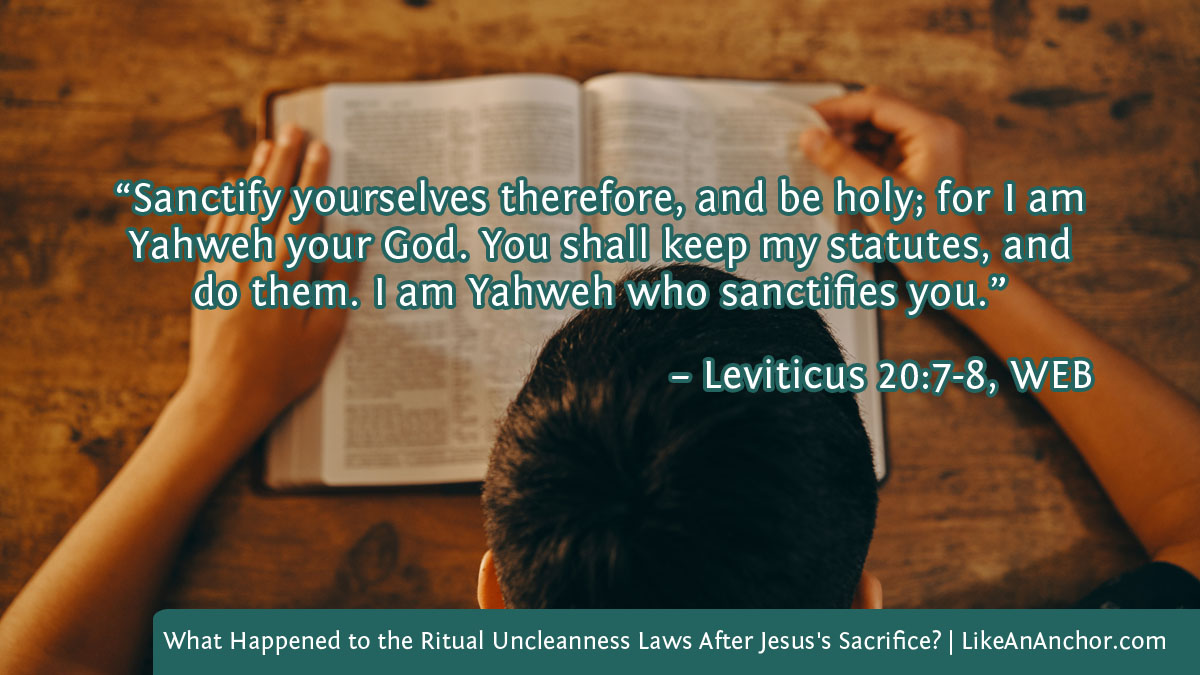
You shall not make yourselves abominable with any creeping thing that creeps. You shall not make yourselves unclean with them, that you should be defiled by them. For I am Yahweh your God. Sanctify yourselves therefore, and be holy; for I am holy. You shall not defile yourselves with any kind of creeping thing that moves on the earth. For I am Yahweh who brought you up out of the land of Egypt, to be your God. You shall therefore be holy, for I am holy.
Leviticus 11:43-45, WEB
You shall have a trowel among your weapons. It shall be, when you relieve yourself, you shall dig with it, and shall turn back and cover your excrement; for Yahweh your God walks in the middle of your camp, to deliver you, and to give up your enemies before you. Therefore your camp shall be holy, that he may not see an unclean thing in you, and turn away from you.
Deuteronomy 23:13-15, WEB
There is “a distinction between the holy and the common, and between the unclean and the clean” (Lev. 10:10, WEB). God is holy and clean, and there are things that are part of being human in a post-fall world that are unholy or unclean. Remember, holiness involves “set-apartness” for sacred use (H6944 qodesh, BDB definition). People and things aren’t holy unless God makes them that way, separating them to Himself.
Image by Matt Vasquez from Lightstock
Does God Care About Cleanness in the New Testament?
We’re not told exactly why touching certain animals, a woman being on her period, or a man having leprosy make someone “unclean” in the ceremonial sense. But we do know that up to the time of Jesus, these ritual cleanliness laws were enforced. In one case, “ten men who were lepers met” Jesus, but “stood at a distance” as they cried out, “Jesus, Master, have mercy on us!” (Luke 17:12, WEB). Jesus told them to go show themselves to the priest, as the Law instructed so they could be declared ceremonially clean after being cured of leprosy.
But there was something different about Jesus. He didn’t seem concerned with the fact that they were ritually unclean. He even touched some of the lepers He healed (Matt. 8:3) and He let a bleeding woman touch Him (Luke 8:43-48). He could cleanse someone in an instant, from sin or from ritual impurity.
Today, we don’t tell a woman on her period that she can’t come before God’s presence in prayer or go to church, or tell her husband that if he touches any surface she does that he’s similarly restricted. And we’re right to do so, but why is that? What changed from the Old to New Testament that the things making people ritually unclean no longer seem to matter to God when they mattered so much before?
The interesting thing is, cleanliness does still matter to God. In the Greek, we often see the word “holy” used to translate the word hagios, where the “fundamental idea is separation, consecration, devotion to the service of Deity, sharing in God’s purity” (G40, Zodhiates). The word is also sometimes translated “saint,” on the assumption that all of God’s people are holy (Rom. 1:7; 15:25-26; 1 Cor. 1:2; 3:17; Heb. 3:1). In 1 Corinthians 7:14, hagios is contrasted with the word koinos, common, defiled, or “Levitically unclean” (G2839, Thayer).
And if a woman has a husband who is not a believer and he is happy to live with her, she should not divorce him.For the unbelieving husband is sanctified because of the wife, and the unbelieving wife because of her husband. Otherwise your children are unclean, but now they are holy.
1 Corinthians 7:13-14, NET
Notice that things here work differently than they did in the Old Testament. Then, if one of the holy people interacted with an unclean thing they became temporarily unclean. Now, if one of the holy people is married to an unbeliever, “the believer is not defiled by the unbeliever” (G37, Zodhiates). Rather, the unbeliever is sanctified by their association with the believer so that the children might be holy to God. Something changed between the Old and New Testament/Covenant so people set apart as holy to God aren’t defiled by “common” things. In at least some cases, they can even sanctify someone who isn’t one of God’s holy people.
Image by Inbetween from Lightstock
What Changed With Jesus’s Sacrifice?
Of course, the big change between Old and New Covenant happened with Jesus’s sacrifice. That sacrifice provided a different type of cleansing than the one provided by the washings, sacrifices, and rituals of the Old Covenant.
For the law possesses a shadow of the good things to come but not the reality itself, and is therefore completely unable, by the same sacrifices offered continually, year after year, to perfect those who come to worship.For otherwise would they not have ceased to be offered, since the worshipers would have been purified once for all and so have no further consciousness of sin?But in those sacrifices there is a reminder of sins year after year. For it is impossible for the blood of bulls and goats to take away sins. …
Therefore, brothers and sisters, since we have confidence to enter the sanctuary by the blood of Jesus, by the fresh and living way that he inaugurated for us through the curtain, that is, through his flesh,and since we have a great priest over the house of God, let us draw near with a sincere heart in the assurance that faith brings, because we have had our hearts sprinkled clean from an evil conscience and our bodies washed in pure water.
Hebrews 10:1-4, 19-22, NET
Sacrifices couldn’t perfect or purify people. But Jesus can, and because of Him we can confidently enter the holy sanctuary. Remember, unclean things can’t come into God’s presence. But God’s not interested in leaving barriers between Him and His people anymore. Jesus’s death tore the veil in the physical temple separating the Holy of Holies from the rest of the temple, and now the whole body of believers is the holy temple of God. Also, we can now enter God’s presence directly through Jesus in prayer. When we’re living in Him, we don’t have to worry about being ritually unclean and if we become sinfully unclean, we can still come straight to God and seek forgiveness (Heb. 4:14-16; 1 John 2:1-6).
Blessed is the God and Father of our Lord Jesus Christ, who has blessed us with every spiritual blessing in the heavenly realms in Christ. For he chose us in Christ before the foundation of the world that we should be holy and blameless before him in love.He did this by predestining us to adoption as his legal heirs through Jesus Christ, according to the pleasure of his will— to the praise of the glory of his grace that he has freely bestowed on us in his dearly loved Son.In him we have redemption through his blood, the forgiveness of our offenses, according to the riches of his grace that he lavished on us in all wisdom and insight.
Ephesians 1:3-8, NET
And you were at one time strangers and enemies in your minds as expressed through your evil deeds, but now he has reconciled you by his physical body through death to present you holy, without blemish, and blameless before him— if indeed you remain in the faith, established and firm, without shifting from the hope of the gospel that you heard.
Colossians 1:21-23, NET
Jesus’s sacrifice is what washes us clean from all impurity, including ritual uncleanness and sinful unholiness. In both Ephesians and Colossians, Paul points out that the Father chose to make us holy–part of the saints–and did that through Jesus Christ. We are holy, blameless, blemish-free, and washed clean, and we’ll stay that way “if indeed we remain in the faith.”
Do We Have A Role In Keeping Clean?
Image by Jantanee from Lightstock
Because of Jesus’s sacrifice, we don’t have to worry about the things related to ritual uncleanness anymore. Jesus makes us pure, holy, and washed clean. But as mentioned previously, some uncleanness comes from sin rather than simply from association with common things. Sin is a serious thing; it separates people from God (Is. 59:1-2). God does not want separation between us, so He’s working to make us holy but we also still need to honor God’s laws, avoid the type of uncleanness that comes from sin, and repent as soon as we become aware that we’ve missed the mark (1 John 1:5-10; 2:1-6).
This I say therefore, and testify in the Lord, that you no longer walk as the rest of the Gentiles also walk, in the futility of their mind, being darkened in their understanding, alienated from the life of God because of the ignorance that is in them, because of the hardening of their hearts. They, having become callous, gave themselves up to lust, to work all uncleanness with greediness. But you didn’t learn Christ that way, if indeed you heard him, and were taught in him, even as truth is in Jesus: that you put away, as concerning your former way of life, the old man that grows corrupt after the lusts of deceit, and that you be renewed in the spirit of your mind,and put on the new man, who in the likeness of God has been created in righteousness and holiness of truth. …
Be therefore imitators of God, as beloved children. Walk in love, even as Christ also loved us and gave himself up for us, an offering and a sacrifice to God for a sweet-smelling fragrance. But sexual immorality, and all uncleanness or covetousness, let it not even be mentioned among you, as becomes saints; nor filthiness, nor foolish talking, nor jesting, which are not appropriate, but rather giving of thanks. Know this for sure, that no sexually immoral person, nor unclean person, nor covetous man, who is an idolater, has any inheritance in the Kingdom of Christ and God.
Ephesians 4:17-24; 5:1-5, WEB
Here, “uncleanness” is translated from akathartos (G169). It means “not cleansed, unclean” in a ceremonial or moral sense (Thayer). It is an antonym of katharizo (G2511), “to make clean” physically, morally, or “in a levitical sense” (Thayer). Just a little later in the letter to the Ephesians, Paul says that Christ sanctified (hagiazo [G37], to make holy) and cleansed (katharizo) the church “with the washing of the water by the word, so that he may present the church to himself as glorious—not having a stain or wrinkle, or any such blemish, but holy and blameless” (Eph. 5:25-27, NET).
In the past, ritual uncleanness meant someone following God could not enter the holy places or touch any holy thing. The Father and Jesus erased that distance between Them and Their people by making us holy things that aren’t defiled by the commonness of the world. They also washed away the sins that distance us from God. The sins They’ve already washed can’t come back, but that doesn’t mean that we should go wallow in the filthiness of sin because Jesus cleaned us up. We don’t need to worry about ritual uncleanness, but we do need to make sure if we participate in sin that we repent and come back to Him for spiritual renewal and assistance to grow and change.
People often criticize Christians who still value God’s law by saying things like, “You pick and choose which ones to follow” or “The law was done away with!” I’ve addressed the latter argument in other posts, and I think this study on ritual uncleanness vs. sinful uncleanness helps answer the first criticism. There are some rules in the Old Covenant that don’t apply anymore because they were legal codes for ancient Israel. There are others that we don’t need to follow anymore because we don’t need to worry about ritual uncleanness. Then there are others that are part of God’s Law (which is connected to, but not exactly the same as the Old Covenant) and which both pre-date the Old Covenant (for example, Noah new about clean and unclean meat animals [Gen. 7:2; 8:20]) and which continue into the New Covenant (for example, the two greatest commandments and all the others that depend on them [Mark 12:28-34; Rom. 13:8-10]). Basically, we know we’re not under the Old Covenant; we’re under the New Covenant and in that covenant God makes us holy and writes His law inside our hearts (Heb. 8:6-13; 10:8-18). We still study God’s law to understand what He’s written inside us and we follow His law to honor Him and because it helps teach us how to be like Him.
I want to start out today’s post with a verse that comes from King David’s advice to his son Solomon. One of the first things he said before passing on the kingship was, “You be strong therefore, and show yourself a man; and keep the instruction of Yahweh your God, to walk in his ways, to keep his statutes, his commandments, his ordinances, and his testimonies, according to that which is written in the law of Moses, that you may prosper in all that you do, and wherever you turn yourself” (1 Kings 2:2-3, WEB). Did you notice how many words David uses to refer to God’s instructions? He talks about statutes, commands, ordinances, testimonies, and law.
This isn’t the only place where multiple Hebrew words are used to describe God’s instructions, but I picked it because it includes most of them all in one verse. Another example comes from Nehemiah, where it talks about God giving ancient Israel “right ordinances and true laws, good statutes and commandments” (Neh. 9:13, WEB). For some time now, I’ve wondered why all those different words are used and what distinctions there are between them. I figured now is as good a time as any to actually study it.
Starting with A Dictionary
I decided to start by going to my favorite Hebrew dictionary, the Theological Wordbook of the Old Testament. I looked up the words used in those verses from 1 Kings and Nehemiah, as well as the Hebrew words for “word” and “charge” since they’re often used alongside them in other verses. The TWOT organizes words by root words and derivatives, so we’ll start with the roots and branch out from there to the derivatives used in the specific verses.
“word.” Root dabar, “to speak” (TWOT 399). The word dabar shows up in the Hebrew Bible more than 2500 times, and in the KJV translators used about 30 different English words for the noun (H1697) and 85 for the verb (H1696). Clearly, it’s not a simple word to translate. However, all “have some sense of thought processes, of communication, or of subjects or means of communication” (TWOT 399).For our purposes today, dabar can refer to words God speaks; it is, for example, used of the Ten Commandments as “words of the covenant” (Ex. 34:28. WEB).
“statutes.” Root haqaq, “primary meaning of cutting or engraving in stone,” though it also means “enacting a decree” or law (TWOT 728). The masculine noun form choqor hoq (H2706) appears in Nehemiah, and means “statue, custom, law, decree” and is frequently paired with the word for “keep,” stressing the importance of obeying God’s statutes (TWOT 728a). The feminine noun form chuqqahor huqqa (H2708) is used in 1 Kings, and is similar to the choq form, but is also used to talk about “perpetual statutes” such as the ordinances for holy days (TWOT 728b).
“law.” Root yara, “throw, cast, shoot” or “teach” (TWOT 910). The word for “law” is the derivative torah (H8451).Torah can be translated “law,” “instruction,” or “teaching” (TWOT 910d). Broadly, it means teaching in the sense of wise instruction (often directly from God). It also refers more specifically to God’s instructions, “statutes, ordinances, precepts, commandments, and testimonies” as well as His moral law which predates the giving of the law code as part of the covenant (TWOT 910d). In time, torah came to refer to the first five books of the Bible as well as God’s law.
“testimonies.” Root ud,to return, repent, or do over again, with various derivatives related to witnessing and testimony (TWOT 1576). The derivative eduth (H5715) is the one we’re looking at today. It specifically means “a warning testimony” (TWOT 1576f). Can be used as a synonym for law (as in Psalm 19 and 119) since “The law of God is his testimony because it is his own affirmation relative to his very person and purpose” and it is also “a warning sign to man” (TWOT 1576f). `
“commands.” Root sawa, “command” as a verb (TWOT 1887). The noun form for “commandments” is miswa or mitsvah(H4687). This word can refer to terms in a contract or instructions from a teacher, but most often it’s used for “the particular conditions of the covenant” God makes with humanity (TWOT 1887b). This is, for example, a word used of the Ten Commandments (Ex. 24:12).
“charge.” Root shamar, “keep, guard, observe, give heed” (TWOT 2414). The derivative mishmeret(H4931) doesn’t appear in any of the verses we’ve looked at so far, but it will in a few we’ll read next. It refers to something we keep as an obligation or something we do as a service (TWOT 2414g).
“ordinances” or “judgements.” Root shapat, to judge or “exercise the process of government” (TWOT 2443). We’ve looked at this word and its derivativemishpat (H4941) before. It’s a nuanced word, with “at least thirteen related, but distinct aspects” centered on the concept of justice (TWOT 2443c). For example, mishpat can mean “a case or litigation,” the judge’s ruling on that case, “an ordinance of law,” and/or justice as “rightness rooted in God’s character.”
As we can see in these brief word studies, there are some differences between the words although they mean similar things. A judgement, for example, is not exactly the same thing as a commandment. Most of the words used to talk about God’s instructions (statutes, testimonies, commands, etc.) fall under the umbrella of “law” or torah. You can tease out nuances between the words, like 119 Ministries does in their article, “Commandments, Statutes, Ordinances, and Judgments…What’s the Difference?” However, when they come from God, all these things are very similar in terms of how we’re expected to respond to them.
Of these words as a group, the TWOT writers say, “hoq occurs in sequence with other words for law: debarim (words), tora (law), mishpat (judgement), edut (testimony), and miswa (commandment). These words are used almost indiscriminately” and though some have tried to separate them into groups, such as using hoq and mishpat for two different categories of laws, “efforts to distinguish clearly between their connotations have not been entirely successful” (TWOT 728a). As GotQuestions.org says, the main point is “obedience to all that the Lord commands,” regardless of the word being used.
Image by Matt Vasquez from Lightstock
How These Words are Used
The words we looked at in the previous section occur hundreds, or in some cases thousands, of time in the Hebrew Bible. Clearly, we won’t be able to look at all those examples. We can, though, start looking at some of the verses that use more than one of these words together and see how they’re used and what we can learn about the response God expects from His people.
Yahweh appeared to him, and said, … “In your offspring all the nations of the earth will be blessed,because Abraham obeyed my voice, and kept my requirements (mishmereth), my commandments (mitsvah), my statutes (chuqqah), and my laws (torah).”
Genesis 26:2, 4-5, WEB
One of the things that often confuses people is the link between God’s law and the Old Covenant. Christians agree that we’re not under the Old Covenant–it has been replaced by a New Covenant based on better promises and ratified in Jesus Christ–but many Christians disagree on the role the law plays today. Some think that when the Old Covenant went away, the law went with it. But that’s not what Jesus or Paul taught and, as we see here in this verse about Abraham, God’s requirements, commandments, statutes, and laws pre-date the Old Covenant at Mount Sinai. You can see evidence of this elsewhere as well, such as God commanding Noah to “take seven pairs of every clean animal” on the ark but only one pair of unclean animals (Gen. 7:2, WEB). Clean and unclean meat laws are an example of God’s laws pre-dating the Sinai covenant by hundreds of years.
Now, Israel, listen to the statutes (choq) and to the ordinances (mishpat) which I teach you, to do them; that you may live, and go in and possess the land which Yahweh, the God of your fathers, gives you. You shall not add to the word (dabar) which I command you, neither shall you take away from it, that you may keep the commandments (mitsvah) of Yahweh your God which I command you. …Behold, I have taught you statutes (choq) and ordinances (mishpat), even as Yahweh my God commanded me, that you should do so in the middle of the land where you go in to possess it. Keep (shamar) therefore and do them; for this is your wisdom and your understanding in the sight of the peoples who shall hear all these statutes (choq) and say, “Surely this great nation is a wise and understanding people.” For what great nation is there that has a god so near to them as Yahweh our God is whenever we call on him? What great nation is there that has statutes (choq) and ordinances (mishpat) so righteous as all this law (torah) which I set before you today?
Deuteronomy 4:1-2, 5-8, WEB
The laws that God gave His people taught them how to follow Him and set themselves apart as His special people. We can still learn from them today because we’re also God’s people, though our context is not the same as that of ancient Israel. Some laws don’t apply to us directly (e.g. most of us don’t have to worry about what to do if your bull gores someone to death [Ex. 21:28-36]) but we can still learn wisdom from the principles behind the laws (e.g. God’s view on restitution and responsibility). Some laws still apply directly today, such as the Ten Commandments, which teach us more about how to fulfill the law in love (Rom. 13:8-10; Gal. 5:14).
Image by Pearl from Lightstock
Psalm 119
If you want to know how a godly person interacted with the Lord’s words, statutes, ordinances, testimonies, charge, judgements, and law, then read Psalm 119. This is the longest psalm in the Bible and the whole thing is a meditation on God’s law and the psalmist’s relationship with those instructions.
Blessed are those whose ways are blameless, who walk according to Yahweh’s law. Blessed are those who keep his statutes, who seek him with their whole heart. Yes, they do nothing wrong. They walk in his ways. You have commanded your precepts, that we should fully obey them. Oh that my ways were steadfast to obey your statutes! Then I wouldn’t be disappointed, when I consider all of your commandments. I will give thanks to you with uprightness of heart, when I learn your righteous judgments.
Psalm 119:1-7, WEB
Psalm 119 begins with this beautiful passage that puts me in mind of Romans 7-8. The Psalmist loves God’s law so much, but also recognizes that his ways are not steadfast enough to obey all God’s statutes. Similarly, Paul says “the law is holy, and the commandment is holy, righteous, and good” (Rom. 7:12, NET) but because he couldn’t obey it fully he needed Jesus’s sacrifice to set him free from the law. Now, he could serve God “in the new life of the Spirit and not under the old written code” (Rom 7:6, NET) while fulfilling “the righteous requirement of the law” by walking “according to the Spirit” instead of according to the flesh (Rom. 8:4, NET).
Like Paul and this psalmist, we can find delight in God’s law and learn from His instructions while also realizing we can’t perfectly obey God or justify ourselves. We need Jesus mediating forgiveness and making us right with God so we can serve Him in the spirit (which, in many ways, means taking the law to a higher, better level).
Do good to your servant. I will live and I will obey your word. Open my eyes, that I may see wondrous things out of your law. … My soul is consumed with longing for your ordinances at all times. … Indeed your statutes are my delight, and my counselors. … Let me understand the teaching of your precepts! Then I will meditate on your wondrous works. … I have chosen the way of truth. I have set your ordinances before me. I cling to your statutes, Yahweh. Don’t let me be disappointed. I run in the path of your commandments, for you have set my heart free.
Psalm 119:17-18, 20, 24, 27, 30-32 WEB
Have you ever thought about God’s instructions like this? I think a lot of times, we feel confused or frustrated when we read God’s laws, trying to figure them out. But the psalmist models a different approach. He asks God to teach him to understand the law, finds delight in the wonderous things of God’s law, and obeys because the Lord has set his heart free. There’s great comfort in knowing that God places guards around our lives to keep us safe and help us know how to follow Him with all our hearts, minds, and souls.
Yahweh, your word is settled in heaven forever. Your faithfulness is to all generations. You have established the earth, and it remains. Your laws remain to this day, for all things serve you. … How I love your law! It is my meditation all day.
Psalm 119:89-91, 97, WEB
I love the consistency and reliability of God. I don’t have to worry about Him changing His mind about His relationship with me or with His people as a whole. I don’t have to worry that He’ll say one thing a couple thousand years ago and then contradict Himself tomorrow. His plan of salvation, the way Jesus delivers us, and how we show our love by obeying Him doesn’t alter on a whim. We can count on Him not to break his New Covenant with us or to change the terms of relationship.
God’s law, word, statutes, ordinances, judgements, charges, and commands are good and they are good for us. We might not be able to figure out exactly what the differences are between those words or sort God’s instructions into neat categories, but that’s not the point of them. They’re a revelation of God’s character, guides for relating to Him and living in a way that honors Him, and a source of wisdom as we learn how to be more like Him.
Recently, I realized that The Bible Project, which I follow on YouTube, also has a podcast hosted by co-founders Tim Mackie and Jon Collins. I started listening to their Deuteronomy series, which is the end of their walk through the Torah (first five books of the Bible) that spanned all of 2022. It’s been fascinating. I’ve never sat down with the Torah and meditated on it the way they describe doing, though I have read those five books of the Bible several times over the years.
Then some Pharisees came to him in order to test him. They asked, “Is it lawful to divorce a wife for any cause?”He answered, “Have you not read that from the beginning the Creator madethem male and female,and said, ‘For this reason a man will leave his father and mother and will be united with his wife, and the two will become one flesh’?So they are no longer two, but one flesh. Therefore what God has joined together, let no one separate.”
They said to him, “Why then did Moses command us to give a certificate of dismissal and to divorce her?”Jesus said to them, “Moses permitted you to divorce your wives because of your hard hearts, but from the beginning it was not this way. Now I say to you that whoever divorces his wife, except for immorality, and marries another commits adultery.”
Matthew 19:3-9, NET (bold italics mark OT quotes)
In this podcast episode, Tim and Jon point out that Jesus went back to Genesis to reveal God’s original ideal for marriage. In this particular situation, the Law (given through Moses) isn’t representative of what God wanted from the beginning. It is God’s concession for hard-hearted people living in a fallen world. In other words, God intended marriage to be permanent but in a world where that doesn’t always happen He gave guidelines for divorce. Here, Jesus says infidelity is a justifiable reason for divorce. Later, Paul says that if a believer has an unbelieving spouse who wants a divorce the believer isn’t “bound” to stay married (1 Cor. 7:15). As the Bible Project points out, this hints that Jesus’s statement in Matthew 19 wasn’t taken as a full expression of His views on divorce and remarriage, but rather as the proper way to interpret the specific law in question from Deuteronomy.
My purpose today isn’t to examine divorce and remarriage as a topic, but to use this as a jumping off point for meditating on Jesus’s relationship with the Law. I did something similar in my post “What Happens When God Takes Justice to the Next Level?” In that post, we went through the Sermon on the Mount, where Jesus reveals that He came to fill up the Law to a spiritual level, not destroy it. For example, He said it’s not enough for His followers to obey the command “thou shalt not murder;” He also expects us not to despise or condemn other people (Matt. 5:21-22). That’s very similar to what He does in Matthew 19. It’s not enough to follow the instructions for divorce; Jesus said that, ideally, God doesn’t want divorce to happen at all (though there are some times it can/will).
If you read a Bible that calls attention to Old Testament quotes in the New Testament (NET, for example, puts direct OT quotes in bold italics and allusions to OT passages in italics) then you’ll see that Jesus quoted from the Old Testament extensively. The Blue Letter Bible’s website has a list of quotes and allusions, which you can click here to view. They list 258 quotes or allusions to the Hebrew scriptures in the four gospel accounts, including many from Psalms, Isaiah, and the Torah (especially Deuteronomy and Leviticus). To make things more manageable for today’s post, we’ll just focus on Matthew. This book contains 102 of the quotes and allusions noted by Blue Letter Bible, though not all are quotes from Jesus; many are Matthew linking Jesus’s life to Old Testament prophecies (which is a different, though fascinating, topic).
Image by Inbetween from Lightstock
Useful for Everyday Living
The first time Matthew records Jesus quoting the Old Testament is during the temptation in the wilderness. Here, Jesus goes into the wilderness for 40 days and nights after His baptism. Then, Satan shows up and tries three times to tempt Jesus into sin. Jesus counters each of these temptations with a quote from Deuteronomy (Matt. 4:1-11).
This account highlights and reveals a couple interesting things. First, Jesus had these verses memorized. There’s a good chance, given what we know of first-century Jewish education, he could have had the whole Torah memorized. Second, Jesus’s main counter for an attack by Satan was to quote God’s law. Clearly, He found value in memorizing and living by these verses.
Similarly, Jesus quoted Deuteronomy when He gave practical instructions for resolving a disagreement between brothers in the faith, and may also have been alluding to Leviticus (Matt. 18:15-20; Lev. 19:15-17; Deut. 19:15). He uses principles from the Laws God gave for interacting with other people and upholding justice to show how we should resolve disagreements as His followers.
Additionally, Jesus told a young man who asked Him about eternal life, “‘if you want to enter into life, keep the commandments.’ ‘Which ones?’”’ he asked. Jesus replied, ‘“’Do not murder, do not commit adultery, do not steal, do not give false testimony,honoryour father and mother, and love your neighbor as yourself‘” (Matt. 19:17-19, NET). There’s more to that story (Matt. 19:16-26), but for the topic we’re studying the main thing I want to point out is that Jesus taught familiar commandments from Exodus, Leviticus, and Deuteronomy as guides for heading toward eternal life. In short, He treated God’s laws from the Old Testament as something we should still follow that are useful for everyday life.
Back To God’s Intent
As I mentioned in the intro, Jesus quotes several Old Testament laws in the Sermon on the Mount. He does not say these laws are wrong or that we shouldn’t obey them. Rather, He counsels His listeners to pay attention to God’s intent behind the law and obey at a higher level. He expects more of us than simply keeping the Law. He expects us to become like God, who gave the law, and “be perfect, as your heavenly Father is perfect” (Matt. 5:48, NET). Later, He boils the Law down to the most important points.
And one of them, an expert in religious law, asked him a question to test him: “Teacher, which commandment in the law is the greatest?”Jesus said to him, “‘Lovethe Lord your God with all your heart, with all your soul, and with all your mind.’This is the first and greatest commandment. The second is like it: ‘Love your neighbor as yourself.’All the law and the prophets depend on these two commandments.”
Matthew 22:35-40, NET
Here, Jesus quotes from Deuteronomy 6:5 and Leviticus 19:18. Love is the essence, or fulfillment, of God’s law (Rom. 13:8-10; Gal. 5:14). The other commandments in the Law are details; instructions on how to love God and love your neighbor. And based on Jesus’s conversations about the Law, we really should be doing even better than simply obeying the letter of the law. We need to obey God in the spirit and intent behind the law.
Be Wary of Human Ideas
Image by Anggie from Lightstock
Now, thinking humanly, we might conclude that if Jesus wants us to keep the law even better, maybe we should put some extra guards around it. That’s a mistake people in Jesus’s day made, too, and He condemns the practice. People do not have the right to elevate human traditions to the level of doctrine, and they especially don’t have the right to replace something God commanded with anything else (Matt. 15:1-20).
Another error that Jesus pointed out was misinterpreting scriptures. One day the “Sadducees (who say there is no resurrection) came to him and asked him” about the levirate marriage law of Deuteronomy. He knew they really wanted to ask about the resurrection rather than that law, and He replied, “You are deceived, because you don’t know the scriptures or the power of God” and He quoted from Exodus to backup the truth of the resurrection (Matt. 22:23-33). In this case, human reasoning got in the way and these people tried to use one of the laws recorded by Moses to prove a point that law had nothing to do with.
When we read the psalms, especially Psalm 119, we see people meditating on God’s Law, loving His commandments, and praying for deeper understanding. We need to continue following that example. In many ways, obeying God is very simple: love Him and love your neighbor. But we’re not yet perfect; we aren’t yet fully “grown up” to be like Jesus Christ (Eph. 4:14-16). We are, however, being conformed to His image and having His mind formed in us (Rom. 8:28-29; 1 Cor. 2:15-16). We can study God’s law–and Jesus’s example of interacting with God’s law–to learn more about Him and our role as His followers.







![Image of several Bibles on a table as people study together, overlaid with text from Acts 10:14-15, 28, WEB version: But Peter said, “Not so, Lord; for I have never eaten
anything that is common or unclean.”
A voice came to him again the second time, “What God has cleansed, you must not call unclean.” ...
[Peter] said to them, “You yourselves know how it is an
unlawful thing for a man who is a Jew to join himself or come to one of another nation, but God has shown me that I shouldn’t call any man unholy or unclean.”](https://likeananchor.com/wp-content/uploads/2024/04/ritual-uncleanness-4.jpg)




 Like An Anchor