Is there anything we have to do in order to be a Christian? Some will tell you the answer is “no” — that salvation is a free gift and once you accept it you’re a Christian and there’s nothing else you need to do. Others will say “yes” — that you’re not a Christian unless you keep God’s commandments and follow Jesus Christ.
The truth is that God offers salvation freely, but you have to accept the gift on God’s terms. Those terms are called covenants — agreements that involve two parties binding themselves together with oaths. On the spiritual level, God initiates covenants, establishes the terms and promises, and binds Himself to the covenant oaths. These covenants are unfailing and sure, regardless of human action. We can choose whether or not to walk in covenant with God, but the covenant, and associated consequences for sin, stand whichever you decide.
Choose Covenant
“I make this covenant and this oath, not with you alone, but with him who stands here with us today before the Lord our God, as well as with him who is not here with us today,” Moses recorded in Deuteronomy 29:14-15. Not entering into covenant with God does not mean you’re getting out of consequences for sin — it means you’re choosing a path of death (Deut. 29:18-28). Read more →
There are a few verses in the New Testament that tell us we “are not under the law” (Rom. 6:15; Gal. 5:18). Though some use this as permission to act however you want so long as you’ve confessed Jesus, most Christians realize that God’s commandments are still in effect. Jesus did not come “to destroy the law or the prophets … but to fulfill” (Matt. 5:17, WEB), and Paul said his own writings “establish the law” rather than repeal it (Rom. 3:31, WEB).
So why do these passages tell us we’re not under the law? I’ve heard many explanations, and touched on some myself, but none of them really answered the question of why Paul would use this phrase. They focused more on trying to say “that’s not really what he meant” than on trying to figure out why Paul chose these words to argue his point. Recently, though, I came across the best analysis of the phrase “not under the law” that I’ve ever seen. It was just a short passage in a little book called Fill These Hearts: God, Sex, and the Universal Longing by Catholic writer Christopher West.
Image by Inbetween from Lightstock
Freed from Bondage to Sin
In Fill These Hearts, West writes about our desires, saying that we can either deny them and go on a “starvation diet,” indulge them in this life like “fast food,” or direct them toward God and partake in His “banquet gospel.” When addressing the idea of freedom in relation to desire, he says,
The Apostle Paul writes that those who “are led by the Spirit .. are not under the law” (Gal. 5:18). They’re free from the law — not free to break it (that’s license); they’re free to fulfill it because they don’t desire to break it. Christ didn’t come into this world to shove laws down our throats. He came into the world to align the desires of our hearts with the divine design so we would no longer need the laws
West, Fill These Hearts, p. 140
This isn’t just West’s own particularly theory; it’s a solid reading of the Biblical text. Basically, he’s just summarizing in modern English what Paul was explaining in Galatians 5 and putting the phrase “not under the law” in its proper context.
This verse in Galatians is preceded by a discussion of two covenants. The Old Covenant is described as one that “gives birth to bondage” (Gal. 4:24, NKJV). When the people broke that covenant, they bought a death penalty on themselves. Jesus paid the price of that broken covenant and freed us from sin with His sacrifice, then mediated and established the New Covenant (Heb. 8:6).
Stand firm therefore in the liberty by which Christ has made us free, and don’t be entangled again with a yoke of bondage
Galatians 5:1, WEB
Paul is telling us that if we go back to studiously keeping every aspect of the law as if that will save us “Christ will profit you nothing … You are alienated from Christ, you who desire to be justified by the law. You have fallen away from grace” (Gal. 5:2, 4, WEB). We can’t treat the Old Covenant as our way to salvation. That does not, however, grant license to sin.
For you were called to freedom, brothers and sisters; only do not use your freedom as an opportunity to indulge your flesh,but through love serve one another.For the whole law can be summed up in a single commandment, namely, “You must love your neighbor as yourself.”
Galatians 5:13-14, NET (bold italics mark a quotation from Lev 19:18)
“Love” in this verse is agapao–the divine, selfless love of God. When we start becoming love as God is love, we will keep His laws from the heart instead of by compulsion to an external system.
But I say, live by the Spirit and you will not carry out the desires of the flesh.For the flesh has desires that are opposed to the Spirit, and the Spirit has desires that are opposed to the flesh, for these are in opposition to each other, so that you cannot do what you want.But if you are led by the Spirit, you are not under the law.
Galatians 5:16-18, NET
That is, we’re no longer held in bondage to a cycle of sin and death. Christ pulled us out of that and set us on a path of walking in the Spirit. If you keep reading verses 19 through 21 you get a list of the “works of the flesh.” All these works are sins under the Old Covenant and under the New Covenant “those who practice such things will not inherit the kingdom of God!” (Gal. 5:21, NET). Someone walking in Jesus won’t act like this. They will shun things prohibited by God’s law because those things are anathema to God’s character. We get a list of God’s character traits and the “fruit” He’s looking for in our lives in verses 22 through 25.
Image by Pearl from Lightstock
Freed to to Fulfill the Law Through Love
The early chapters of Romans discuss this same subject with slightly different wording. First, Paul sets up a connection between sin and the law. He explains that “all have sinned” (Rom. 3:23), but we wouldn’t know that without the law to tell us about sin (Rom. 4:15; 5:13; 7:7). The law let us know we were enslaved to sin.
We know that our old man was crucified with him so that the body of sin would no longer dominate us, so that we would no longer be enslaved to sin. … So you too consider yourselves dead to sin, but alive to God in Christ Jesus. Therefore do not let sin reign in your mortal body so that you obey its desires.
Romans 6:6, 11-12, NET
When Jesus died, He paid the penalty for all sin, which was exposed by the law. When we accept Him, are baptized, and commit to walking in relationship with God, we also “die” in a figurative sense. We’re freed from sin. It’s not supposed to shackle us anymore, and we don’t have to obey its pulls.
For sin will not have dominion over you. For you are not under law, but under grace. What then? Shall we sin, because we are not under law, but under grace? May it never be!
Romans 6:14-15, WEB
Here’s Paul saying the same thing West was about freedom not being license to sin. Those who are “not under the law” still aren’t allowed to break the law. In fact, the more we become like God the less we’ll want to break His rules.
Image by Anggie from Lightstock
In Romans 7, Paul draws an analogy between being under Old Covenant law and a marriage. Marriages end when one of the married people dies (Rom. 7:1-3). The Old Covenant represented the first marriage between God and His people. That Covenant ended at Christ’s death and, through Him, we died to it as well.
So, my brothers and sisters, you also died to the law through the body of Christ, so that you could be joined to another, to the one who was raised from the dead, to bear fruit to God.
Romans 7:4, NET
Now, we are betrothed in marriage to Jesus Christ. We’re being transformed on the inside to become like Him and our heavenly Father. We’re not “under the law” because we’re becoming like the Lawgiver (Is. 33:22; Jas. 4:12; 1 Jn. 3:1-3). We’re marrying the One who fills the law to its fullest extent.
God is love. As we become like God we learn to “be love” as well, and that leads us toward fulfilling the law (Rom. 13:8-10). We’re not freed from the law so we can do whatever our fleshly nature urges, but rather so that we can live-out the fullest expression of God’s divine law by imitating His character. The law isn’t how we receive eternal life, but because we love God we still keep His law on our way to eternity.
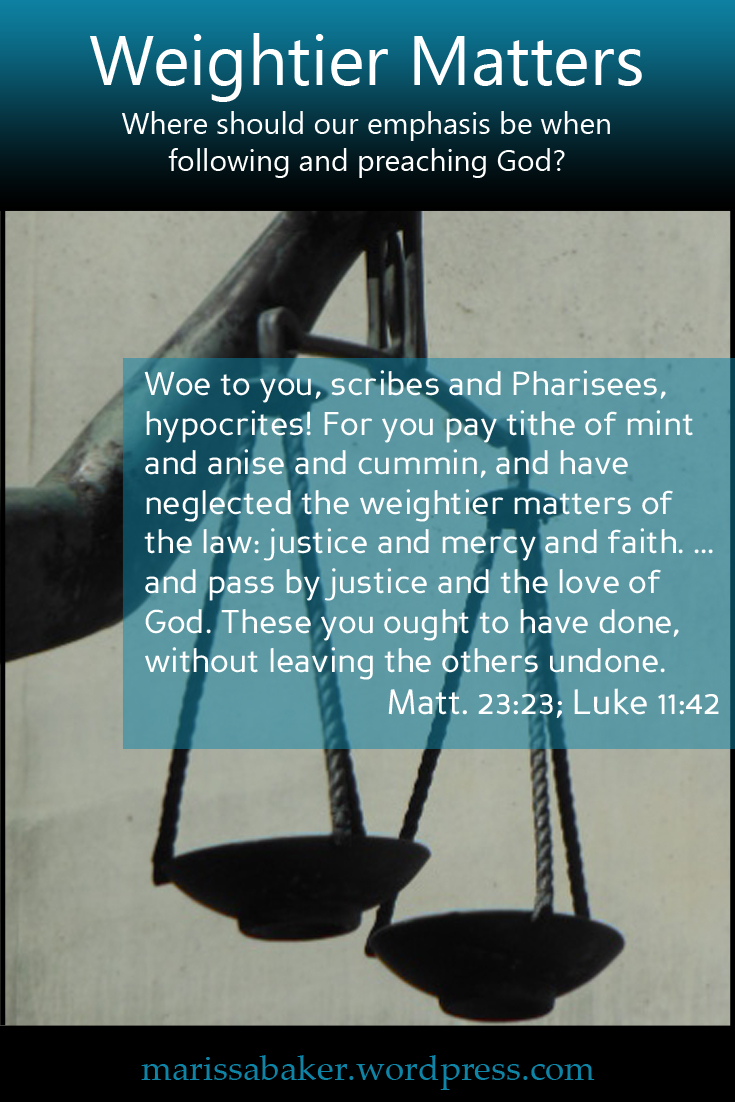
The scribes and Pharisees had a lot going for then. They were well-educated, well-respected, and held positions of authority in the community of believers. People thought they were important, and they were. Then this guy Jesus showed up and started condemning them for not following God correctly.
Can you imagine how this looked? Here are these men who’ve been the authority on worship tradition for years confronted by a young carpenter who just appeared out of nowhere. He didn’t even go to a good school! Worse, they know He’s right. But if they admit it, they lose their power.
A similar thing can happen in our churches today. When leadership is focused on maintaining church tradition, there’s a danger of developing a Pharisaical attitude. A certain amount of resistance to change is needed to keep from forsaking sound doctrine, but often church tradition isn’t rooted in the Bible at all and if that’s the case it’s fair-game for reexamination. We can also, as the Pharisees did, error in emphasizing certain doctrines to the neglect of others. Read more →
In Hebrews 3:1, the writer tells his “holy brethren, partakers of the heavenly calling” to “consider the Apostle and High Priest of our confession, Christ Jesus.” The word “consider” invites us to “observe fully” (Strong’s G2657) and “fix one’s eyes or mind upon” Jesus (Thayers). That’s what we did in last week’s post for His role as Apostle, and what I hope to do this week for His role as High Priest.
Changed Priesthood
Christ’s priesthood is “after the order of Melchizedek.” It’s a key point in Hebrews’ discussion of Christ as our High Priest, even though we know very little about Melchizedek from his 3-verse appearance in the Torah. Read more →
Last week we started a study about whether or not the commands and instructions given to Biblical Israel apply to us as Christians today. I answered with a qualified “yes” — we are spiritual Israel, which is not so much separate from physical Israel as it was the next step in God’s plan for His chosen nation. Now, the question becomes, “How many of the laws given to Israel apply under the New Covenant?”
I’ve grown up believing that the Ten Commandments, including Sabbath keeping, carry over into the New Covenant, along with the Lev. 23 Holy Days and the clean and unclean meats laws. I still believe that, but now I’m starting to wonder why we keep those things and not others like the command to put tassels on our garments (Num. 15:37-41) or blow shofars on Holy Days (Ps. 81:3-4). When I ask this question, I’m usually told that not everything from the Old Covenant applies, and when I ask how they know which ones to keep they say, “It’s our tradition.” In my mind, that’s not a good enough answer, so it’s time for some Bible Study.
A New Priesthood
If you read through the laws of the Old Testament, you find quite a lot about the Levitical priesthood. Some of these are described as “a statute forever to their generations on behalf of the children of Israel” (Ex. 27:21), yet it is evident that Christ’s priesthood supersedes that system. If the switch to the New Covenant changed that, how much else was changed?
For the priesthood being changed, of necessity there is also a change of the law. (Heb. 7:12)
But now He has obtained a more excellent ministry, inasmuch as He is also Mediator of a better covenant, which was established on better promises. (Heb. 8:6)
When it talks about a change of the law, I think we often imagine quite a disconnect between the Old and New Testament. We think of change as in something old being replaced by something completely new, but I think perhaps the change is more in how God’s laws apply.
For this is the covenant that I will make with the house of Israel after those days, says the Lord: I will put My laws in their mind and write them on their hearts; and I will be their God, and they shall be My people. (Heb. 8:10)
The Old Covenant was replaced with the New (Heb. 8:13), but God’s laws were not done away with. Even before the Old Covenant was instituted at Mount Sianai, God had laws in place. We can see this in Genesis 26:5, where God says, “Abraham obeyed My voice and kept My charge, My commandments, My statutes, and My laws.” Since God is unchanging, His standards for what He expects from us do not change either.
Jesus said, “till heaven and earth pass away, one jot or one tittle will by no means pass from the law till all is fulfilled” (Matt. 5:18) In the Greek, this means “filled to the fullest extent.” The laws were brought to a spiritual plane, much as physical Israel became spiritual Israel. You still keep the physical laws, but there is a spiritual aspect as well, and we are held accountable for what goes on inside us as much as for what we actually do (Matt. 5:17-30).
Updating The Law
The laws governing the Levitical priesthood are examples of parts of the Old Covenant that have already been filled to the fullest extent by Jesus Christ. We don’t have a physical priesthood any more because He is our High Priest forever. We don’t sacrifice animals any more because Christ’s sacrifice completely fulfilled all the Old Testament commands for blood sacrifices.
For Christ has not entered the holy places made with hands, which are copies of the true, but into heaven itself, now to appear in the presence of God for us; not that He should offer Himself often, as the high priest enters the Most Holy Place every year with blood of another — He then would have had to suffer often since the foundation of the world; but now, once at the end of the ages, He has appeared to put away sin by the sacrifice of Himself. (Heb. 9:24-26)
Without a physical priesthood or temple, many of the ceremonial laws no longer apply to spiritual Israel. Though we as the New Testament church can examine and learn from them and how they foreshadowed Christ’s role as priest and sacrifice, people in the church no longer serve as priests and we no longer sacrifice animals.
Similarly, there were civil laws given to govern the nation of Israel that are not in effect now because the church is scattered through other physical nations with their own laws. Many of the civil laws had a moral aspect, though, and this is updated for us to follow under the New Covenant. Take, for example, the law that said a man and woman who commit adultery must both be put to death (Lev. 20:10). The Pharisees brought Jesus just such a case, and Jesus told them, “He who is without sin among you, let him throw a stone at her first” (John 8:7). When all her accusers left, Jesus told the woman, “Neither do I condemn you; go and sin no more” (John 8:11).
Jesus didn’t say that she hadn’t committed a sin. He said that there was room for mercy and forgiveness even of sins that had formerly incurred a physical death penalty. For judicial matters, Christians are now under the laws of the countries we live in. For moral matters, God’s laws are applied to spirit and in truth with an emphasis on mercy. Is there a guy in your church shaking up with his step-mother? We don’t stone them as was the case in ancient Israel (Lev. 20:11), but we do make it clear that behavior like this is morally wrong and won’t be tolerated in the church (1 Cor. 5:1-13). If he repents, you have to welcome him back just like God welcomes us back into relationship with Him when we repent of our sins (2 Cor. 2:3-11).
There are also aspects of the Old Testament laws that we are specifically commanded to continue observing. This includes the weekly Sabbath (Heb. 4:9) and Passover (Luke 22:19-20). We infer from these specific commands, and from the fact that Jesus and His disciples observed the other Holy Days, that all those days are still commanded observances. Even more obvious is the fact that we should be keeping the Ten Commandments, which are succinctly comprehended in the two greatest commandments.
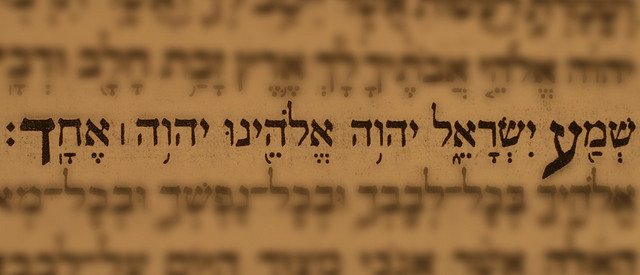
Jesus answered him, “The first of all the commandments is: ‘Hear, O Israel, the Lord our God, the Lord is one. And you shall love the Lord your God with all your heart, with all your soul, with all your mind, and with all your strength.’ This is the first commandment. And the second, like it, is this: ‘You shall love your neighbor as yourself.’ There is no other commandment greater than these.” (Mark 12:29-31)
God’s focus is on our hearts, and whether or not we choose to keep His commandments tells Him what our hearts are like. Jesus said, “If you love Me, keep My commandments” (John 14:15). The implication is that if we don’t keep His commandments, we are telling Jesus we don’t love Him. If our hearts are right, obedience to God naturally follows.
My feelings on the question, “What is applicable under the New Testament?” is that everything God didn’t specifically replace/update to a spiritual level (the priest hood, physical temples, civil laws) are probably still in effect. It’s up to us to seek out the spiritual reasons for these commands and find a way to physically keep them. There are still some I’m not sure about — like those tassels on the borders of our garments or what we’re supposed to do on New Moons — but I want to keep searching and learning. I want to worship God the way He tells me to, not the way I think sounds like a good idea.
People in the churches can’t seem to make up their minds about whether or not physical things are important. Here are a few examples that came to mind. They’re all specific to the church I grew up in, but I’m sure the basic idea can apply to other groups.
We say it’s better to have a printed Bible than just read off an electronic device because holding a physical book connects you to scripture more, but we think kissing a Torah scroll at a Messianic congregation is borderline idolatry.
We teach physical things from the Old Testament/Judaism like tassels on our garments and prayer shawls are done away with under the New Covenant, but heaven forbid a man stand up to speak without wearing a suit and tie.
We say it’s important to preach the gospel and do good works in the world, but many groups refuse to purchase or rent church buildings that we can put a sign out in front of, or to have any sort of physical presence in our communities.
What’s going on here? If the spiritual is all that matters, why do we hang on to certain physical aspects of faith? If the spiritual and physical both matter, which I believe is the case, why are we so contradictory in how we approach that truth?
What Are We?
Jesus told us, “God is Spirit, and those who worship Him must worship in spirit and truth” (John 4:24). That tells us, at least on a basic level, what God is. But what are we?
Now may the God of peace Himself sanctify you completely; and may your whole spirit, soul, and body be preserved blameless at the coming of our Lord Jesus Christ. (1 Thes 5:23)
In the Greek, the word translated “body” simply refers to our physical bodies, “soul” refers to the life-essence we have in common with animals, and “spirit” is the part of us that makes us human and which is able to communicate with God’s spirit.
The Spirit itself bears witness with our spirit that we are children of God (Rom. 8:16)
Now, in this human life, we have a natural body that contains a spirit. After Christ’s return when we are resurrected or changed, we shall be like God and have a spiritual body with a spirit. We are “sown a natural body,” and “raised a spiritual body” (1 Cor. 15:44).
The part of ourselves that is enduring is our spirits. When God “looks on the heart,” He is checking the state of our spirits. He is concerned most with the condition of the inner man. That does not, however, mean God doesn’t care about the part of us that’s physical.
Romans 7 Analysis
In Romans, Paul discusses how our spirits are related to keeping God’s law. He tells us that the law in the Old Testament was not enough by itself ot lead to eternal life. Rather, since everyone has sinned (Rom. 3:23) and the law gives knowledge of sin (Rom. 7:7), we end up dead as an indirect result of knowing the law.
But sin, taking opportunity by the commandment, produced in me all manner of evil desire. For apart from the law sin was dead. I was alive once without the law, but when the commandment came, sin revived and I died. And the commandment, which was to bring life, I found to bring death. (Rom. 7:8-10)
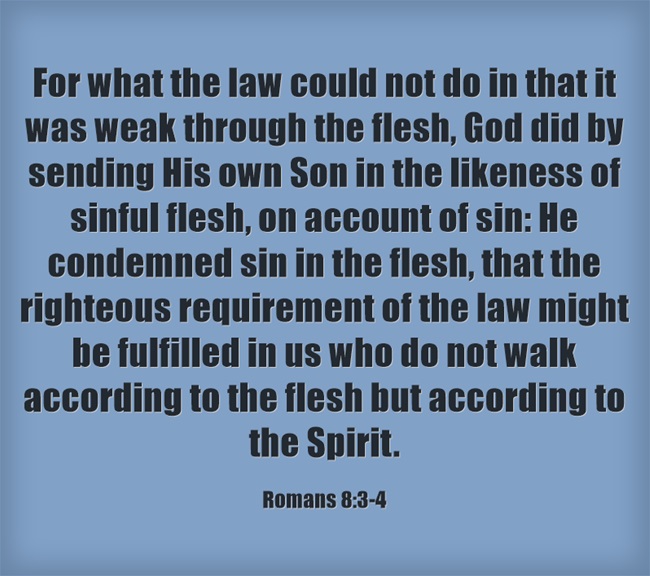
If we could keep the law perfectly, it would lead to life. But we can’t keep the law perfectly, and so we incur the death penalty for breaking God’s laws. That is how a law and commandment that is “holy and just and good” can result in our deaths (Rom. 7:12). That’s why we need Christ’s sacrifice to supply what was missing in the Old Covenant — a way for our sins to be removed and the penalty to be paid (Rom. 8:3-4).
For when we were in the flesh, the sinful passions which were aroused by the law were at work in our members to bear fruit to death. But now we have been delivered from the law, having died to what we were held by, so that we should serve in the newness of the Spirit and not in the oldness of the letter. (Rom. 7:5-6)
Serving in the spirit doesn’t mean we ignore the law, though. Even when we’ve been cleansed by Jesus and our spirits are in communication with God’s Spirit, we are still human and still capable of sin. To be righteous in the spirit, we have to obey God by rejecting sin on both a spiritual and a physical level (Rom. 6:14-23).
For we know that the law is spiritual, but I am carnal, sold under sin. For what I am doing, I do not understand. For what I will to do, that I do not practice; but what I hate, that I do. If, then, I do what I will not to do, I agree with the law that it is good. But now, it is no longer I who do it, but sin that dwells in me. (Rom. 7:14-17)
This isn’t Paul shirking responsibility for his actions. He’s telling us that, while his spirit recognizes and agrees with the law, his fleshly human nature is still slipping away from perfection. There’s a war going on between our spirits and our sinful desires.
For I delight in the law of God according to the inward man. But I see another law in my members, warring against the law of my mind, and bringing me into captivity to the law of sin which is in my members. O wretched man that I am! Who will deliver me from this body of death? I thank God—through Jesus Christ our Lord! So then, with the mind I myself serve the law of God, but with the flesh the law of sin. There is therefore now no condemnation to those who are in Christ Jesus, who do not walk according to the flesh, but according to the Spirit. For the law of the Spirit of life in Christ Jesus has made me free from the law of sin and death. (Rom. 7:22-8:2)
The only way we can win the war between our two natures is through Christ. His sacrifice removes our death penalty, His strength makes it possible for us to keep the law, and His grace covers us when we make mistakes. With His help, we can serve the law of God with our minds and spirits, and also keep the laws God gave us as a guide for how to behave as a physical being.
Some Concluding Thoughts
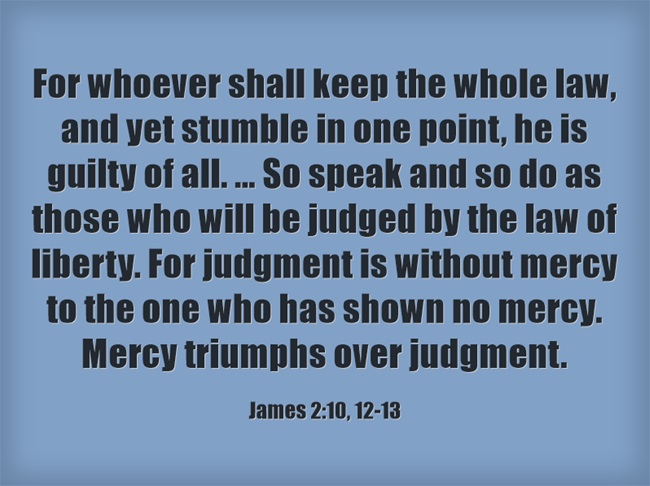
The New Covenant doesn’t take away from the laws and commandments — it adds an additional spiritual dimension (Matt. 5:17-30). What we choose to do physically is not less important now. We could say it’s actually more important, because it is indicative of the state of our hearts. We are already in trouble if we intend to sin in our minds — actually going through with it adds the sin of hurting others on top of the damage sin does to us on the inside. We will be judged by how well we keep the law, and we must take this seriously (James 2:8-13).
I don’t think we can separate the physical and the spiritual, nor should we. It is true that God is chiefly concerned with the state of our inner man, but if the inside is right then it will show on the outside. We need to support our spiritual lives with our physical selves by actively doing good and keeping the commandments. As humans, we still have physical bodies and even inside us we have human nature struggling with God’s spirit. Keeping God’s laws is a physical reminder of how important the spiritual is.
In the churches of God that I’ve grown up in, we teach that one of the reasons God still expects us to keep His annual Holy Days and weekly Sabbath is because humans tend to forget things without something to physically remind them on a regular basis. This general idea is also related to my praise and worship series, since I think that if we take physical expressions of praise out of our church services we’re refusing to involve part of who we are in our woship of God. To keep on track with God, we need something to do as well as something to think about.





 Like An Anchor