Revive Me, Lord

Two Sabbaths ago, my dad gave a message in our church group about personal revival, specifically on the topic of rekindling a waning interest in Bible study. I was feeling a bit down emotionally at the start of that following week, and I remembered he mentioned a Hebrew word often translated “revive” that I thought it might be encouraging to look at more closely. It turned into such an interesting study that I didn’t get this post finished for last week and skipped posting so I could spend two weeks studying and writing.

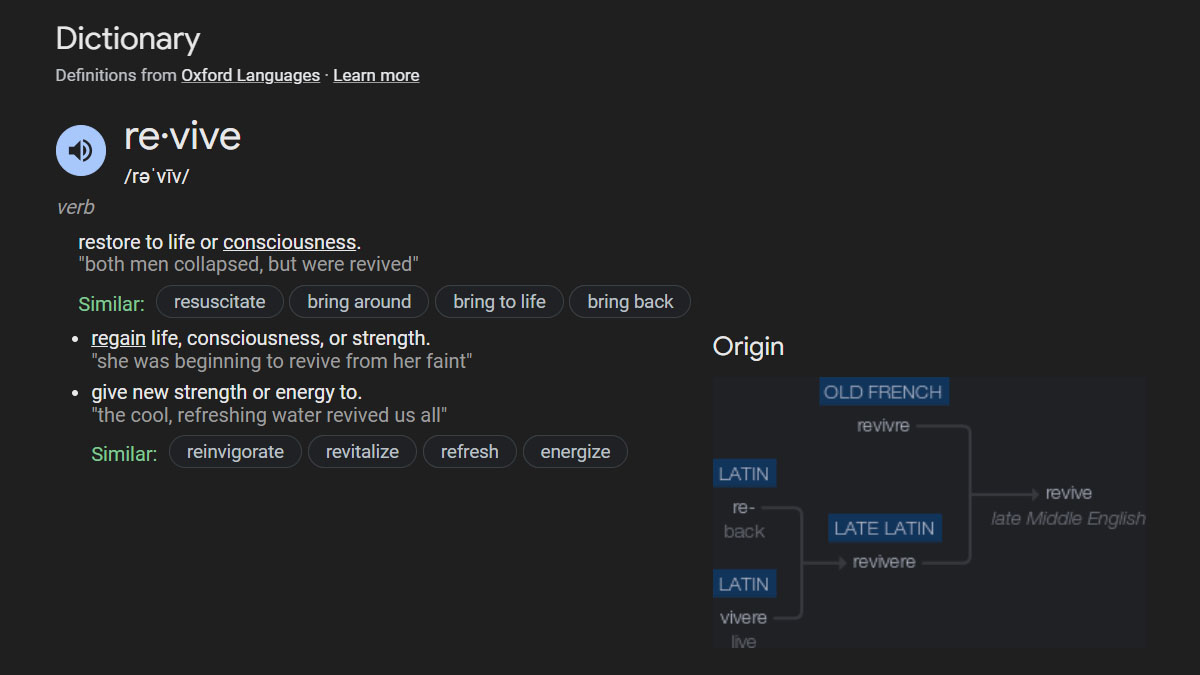
The Hebrew word in question is chayah or haya (depending on how you want to transliterate it into the English alphabet). It’s Strong’s number H2421 and entry 644 in the Theological Wordbook of the Old Testament (TWOT), where the authors devote nearly three full pages to haya and its derivatives. It’s a very important word in the Old Testament writings, with the root word appearing 270 times, and it’s translated as “live,” “alive,” “quicken,” “nourish,” “recover,” and “revive” (along with a few other less frequent phrases) in the King James Version. The closely related derivative chay (H2416) appears 498 times, and it’s most often translated “life” or something that is alive, e.g. “a living thing.” Today, let’s take a closer look at these words and see what we can learn.
“Life” In Hebrew

The TWOT says the root verb haya means “to live or have life” (in the simple Qal stem) or “giving or restoring life” (in the word’s two other verb stems) (p. 279). The “range of meaning” also includes “‘to preserve or sustain life’ or ‘to nourish’ … ‘or to restore to health, to heal, recover'” (p. 280). Key to understanding this word is that it is usually very concrete rather than an abstract idea.

“The OT speaks of life as the experience of life rather than as an abstract principle of vitality which may be distinguished from the body. This is because the OT view of the nature of man is holistic, that is, his function as body, mind, spirit is a unified whole spoken of in very concrete terms. Life is the ability to exercise all one’s vital power to the fullest; death is the opposite.”

R. Laird Harris, Gleason L. Archer, Jr., and Bruce K. Waltke; TWOT entry 644, p. 279

We might think this is a very different viewpoint from the New Testament, but that’s because we’ve been influenced by modern ideas about people being bodies with spirits or souls rather than unified wholes. The idea that humans have a soul that’s separate and immortal came into Christianity from Neoplatonic philosophy about 200-300 years after Christ’s human life (see “Rethinking Heaven: Capturing A Vision Of The Resurrection” and “Relational Faith: A Book Review and Theological Reflection“). We’re “spirit, soul, and body” (1 Thes. 5:23, WEB) as a unified whole, living our lives as human beings made in God’s image.

While chayah can have slightly “less concrete” meanings, such as living “by the words of God ‘not by bread alone’ (Deut 8:3; Ps 119:50, 93)” even these uses are grounded in “the biblical unity of man’s nature” and seem to refer to both physical “prosperity as the gift of obedience” and “the spiritual quality of life” (TWOT, p. 280). There are also hints in the Old Testament that chayah refers to the eternal, spiritual life God offers after death, not just the physical life that He gives us (Ps. 49:9; Prov. 12:28; 15:24; Dan. 12:2). The concreteness of the word ties in well with the Biblical teaching that there will be a bodily resurrection (i.e. we’ll be resurrected as spirit beings with spirit bodies, not something ghostly or disembodied).
Walking with God for Life

Since chayah is used so many times in the Bible, I thought I’d focus today’s study on the ways that it’s used in the Psalms (just to make things a little more manageable). I did this by looking up chayah (H2421) and chay (H2416) with the program eSword, which yielded 82 matches in the psalms (31 chayah, 51 chay). This includes several categories of verses, including ones describing God as “the living God” (Ps. 42:2; 84:2) and talking about us being in the “land of the living” (Ps. 27:13; 56:13; 142:5). I want to focus, though, on the ones that speak of how God impacts our lives (click for examples).

Surely goodness and loving kindness shall follow me all the days of my life,
    and I will dwell in Yahweh’s house forever.

Psalm 23:6, WEB

The much beloved Psalm 23 shows Yahweh’s involvement with David’s whole life (and ours as well). God is the shepherd who provides all our needs, restores our souls, guides us, guards us, and comforts us. Chay appears in the last verse, providing a conclusion to the short psalm. When we remember that the life represented by chay can involve nuances of preserving, sustaining, nourishing, and reviving, it deepens our understanding of the quality of life that God wants to give us.

In another section of scripture, Jesus said, “I have come so that they may have life, and may have it abundantly. I am the good shepherd” (John 10:10-11, NET). Obviously, the word chay doesn’t appear here because the New Testament was written in Greek rather than Hebrew, but I think we can see how the meaning is connected. God wants our lives to be good, not just abstractly but in a real, tangible way.

 I have set Yahweh always before me.
    Because he is at my right hand, I shall not be moved.
Therefore my heart is glad, and my tongue rejoices.
    My body shall also dwell in safety.
For you will not leave my soul in Sheol,
    neither will you allow your holy one to see corruption.
You will show me the path of life.
    In your presence is fullness of joy.
In your right hand there are pleasures forever more.

Psalm 16:8-11, WEB (footnote on v. 10: “Sheol is the place of the dead”)

As with Psalm 23, chay appears in the conclusion of Psalm 16 (also a psalm of David). Long after David’s death, the apostle Peter said that this Psalm is really “about the resurrection of the Christ, that he was neither abandoned to Hades, nor did his body experience decay” (Acts 2:31, NET [italics mark allusions to Psalm 16]). David was a prophet, and he knew he was writing about one of his descendants who would be the Messiah/Christ (Acts 2:22-33). A lot of this psalm also feels personal, though, and I suspect that we can read it on both levels: a messianic prophecy and an expression of David’s assurance that God will take care of him.

I’m not sure how much David understood about God’s ultimate plan to bring human beings into His family, but it is accurate that God won’t leave us in the grave forever. It’s also accurate to say that he shows us “the path of life” in multiple senses: the path to walk in order to have a good life here on this earth, and the path to eternal life with God forever.

Revival from God
I find it ironic that I’ve been struggling to focus on and finish this study, which was inspired by a message about reviving a waning interest in Bible study. For some reason, I’ve just had a very hard time for this post with going from reading Bible scriptures to knowing how to put them together and what to say about them.

In the Psalms, there are several times where chay or chayah are translated “revive” (as well as the more common “life” or “live”). It shows up a lot in Psalm 119. This whole psalm is like a love letter to God’s word; every single verse talks about God’s law, ordinances, statues, precepts, way, etc. Here, we learn that revival (chayah) is found in the words of God.

My soul is laid low in the dust.
    Revive me according to your word!

Psalm 119:25, WEB

I will never forget your precepts,
    for with them, you have revived me.

Psalm 119:93, WEB

Hear my voice according to your loving kindness.
    Revive me, Yahweh, according to your ordinances.

Psalm 119:149, WEB

It seems that the solution to my problem focusing on study is to persistently come back to God and His word even if it takes a while for things to come together and make sense. In fact, that’s the solution to all of our problems. It’s not like there’s anywhere else to go for answers. As Peter said when Jesus asked if the twelve wanted to go away after several other disciples decided not to listen to Him anymore, “Lord, to whom would we go? You have the words of eternal life” (John 6:68, NET).

We can physically survive without having a relationship with God, but we can’t have full, abundant, and eventually eternal life apart from Him. He doesn’t promise that we’ll never have tough times or difficult feelings, but He does promise life-giving revival in Him and His word if we come to Him during those challenges.


Featured image by Sasin Tipchai from Pixabay

Song Recommendation: “Mayim Chaim” by Zemer Levav

When God Breathes

There are a few verses that talk about God’s breath. In 2 Timothy 3:26, Paul makes a famous statement about scripture. He says, “Every scripture is inspired by God and useful for teaching, for reproof, correction, and for training in righteousness” (NET). Some translations use the more literal wording, “Every Scripture is God-breathed” (WEB). Another well-known verse describes God breathing life into Adam at creation, making him a living being.

The “God-breathed” translation of 2 Timothy 3:26 is what caught my eye to study this week, but there’s a lot more to this topic than I’d first realized. In both Greek and Hebrew, the words for breath are also connected to spirit and life. Amazing things happen when God breathes into something or breathes something out.

Life in the Word

In 2 Timothy 3:26, the Greek word translated “inspired by God” or “God-breathed” is theopneustos: theos (God) + pneo (breathe, blow). This is the only time that compound word is used in the Bible. Theos is, obviously, used frequently. Pneo is a verb that appears eight times, always in reference to literal wind blowing (Matt. 7:25, 27; Luke 12:55; John 3:8; 6:18; Acts 27:40; Rev. 7:1). In one of those verses, though, Jesus references wind to make a point about the spirit.

“Do not be amazed that I said to you, ‘You must all be born from above.’ The wind blows (pneo) wherever it will, and you hear the sound it makes, but do not know where it comes from and where it is going. So it is with everyone who is born of the Spirit (pneuma).”

John 3:7-8, NET

Pneo is the root word for pneuma, which is translated into English as “spirit” and appears 385 times in the New Testament. Usually, the word refers to God’s holy spirit or to the spirit in human beings, though it can also be translated “wind” or “breath.” If you’re like me, then this line of thought might have you thinking of a verse way back in Genesis.

The Lord God formed the man from the soil of the ground and breathed into his nostrils the breath of life, and the man became a living being.

Genesis 2:7, NET

This is another place where God breathed into something. In the first verse we looked at, He breathed out scriptures. In this verse, He’s breathing into man and turning him into a living being. This particular Hebrew phrase “breath of life” (nishmat khayyim) only appears here, but nishamah shows up in other places as well. This surprised me; I thought the only word for spirit/breath/wind was ruach (roughly equivalent to Greek pneuma) and the only word for soul/living thing/breathe was nephesh (roughly equivalent to Greek psuche). The Theological Wordbook of the Old Testament states that neshama “is frequently found in combination with ruah ‘spirit’ and seems synonymous with nepesh” (TWOT entry 1433a) (see Job 27:3; 33:4; Ecc. 12:7; Is 42:5; Dan. 5:23).

The Spirit (ruach) of God has made me,
    and the breath (neshamah) of the Almighty gives me life.

Job 33:4, NET

There is life in God’s breath. Interestingly, there’s also a strong connection between life and the God-breathed scriptures. In the Old Testament, God revealed that His words bring life to people (Deut. 8:3; 32:46-47; Prov. 4:4). Jesus even quoted one of those verses when resisting Satan’s temptation, saying, “Man does not live by bread alone, but by every word that comes from the mouth of God” (Matt. 4:4, NET). Other New Testament verses talk about the spirit and word as living, life-giving forces (John 6:63; Heb. 4:12; 1 Peter 1:23). There’s something special and uniquely powerful about God-breathed words and the life that God breathes into humanity.

Come To the Word

As I started pondering God-breathed words, another passage that I’ve been meaning to study came to mind. This passage doesn’t talk about breath specifically, but it does talk about the words that come out of God’s mouth.

“For my thoughts are not your thoughts,
    and your ways are not my ways,” says Yahweh.
“For as the heavens are higher than the earth,
    so are my ways higher than your ways,
    and my thoughts than your thoughts.
For as the rain comes down and the snow from the sky,
    and doesn’t return there, but waters the earth,
    and makes it grow and bud,
    and gives seed to the sower and bread to the eater;
so is my word that goes out of my mouth:
    it will not return to me void,
    but it will accomplish that which I please,
    and it will prosper in the thing I sent it to do.

Isaiah 55:8-11, WEB

I think this passage helps us see another connection between the two God-breathed verses (Gen. 2:7 with God breathing life into man and 2 Tim. 3:26 with Him breathing out scriptures). God has breathed out His words and breathed life into us; what happens when these two God-breathed things meet? In other words, when you (who have life because God breathed into humanity) encounter the words that God breathes out of His mouth, what happens?

God says that His word “will not return to me void, but it will accomplish that which I please, and it will prosper in the thing I sent it to do.” Another possible translation would be, “it accomplishes what I desire, and succeeds in what I commission it with” (NET footnote on Is. 55:11). God’s word will have the effect that He desires. But when His word comes to us, He doesn’t force us to do things against our will. If we don’t respond, His word can go prosper in someone else who’s more willing to listen. That’s what happened for the Jewish people who rejected Jesus as the Messiah (Acts 13:45-46; Rom. 11).

You people have never heard his voice nor seen his form at any time, nor do you have his word residing in you, because you do not believe the one whom he sent. You study the scriptures thoroughly because you think in them you possess eternal life, and it is these same scriptures that testify about me, but you are not willing to come to me so that you may have life.

John 5:37-40, NET

Scriptures by themselves don’t give full and abundant life. For that, we also need a relationship with the One who breathed the scriptures–with the Word of God (John 1:1-5, 14) who is also the Word of life (1 John 1:1) and “has the words of eternal life” (Jn. 6:68).

Scripture is God-breathed. Our physical lives are God-breathed. If we want eternal life, we need God to breathe into us again, making His words, spirit, and life part of us. And we need to respond to His work in us, making sure that His word doesn’t end up “void” in us because of our apathy, neglect, or hostility. By responding to God’s breathed-out words and the life He’s breathing into humanity in the right way, we strengthen our relationship with Him and participate in the redemptive, transforming work that He’s doing here on earth.


Featured image by Karl Egger from Pixabay

Great Changes Begin Great Stories

Think about your favorite novel, movie, or TV show. It probably begins with the main characters going about their ordinary lives. Bilbo Baggins lives peacefully in his hobbit hole (The Hobbit). Elizabeth Bennet is socializing with her sisters and putting up with a mother eager to marry her off (Pride and Prejudice). Luke Skywalker is moisture farming on Tatooine (Star Wars). A pastor is sailing with his family to a colony in the South Pacific (The Swiss Family Robinson).

Then Gandalf arrives with a party of dwarves. Mr. Bingley moves to Netherfield. Droids arrive carrying secret plans that must be delivered to the Rebellion. The ship crashes on an uncharted island. Something changes, acting as an inciting incident to push the main character out of their normal life and into the events of the story.

We’re currently living in a time of great change. People are talking about what the “new normal” will look like and speculating about how much things will change now that there’s Covid-19 in the world. There have been many other times of great change throughout history — pandemics, the industrial revolution, natural disasters, colonization by European powers, terrorist attacks, the falls of empires, the birth of Jesus Christ. Some are terrible, some depend on your point of view, and a very few are spectacularly good.

We have very little control over how the world changes. But we do have some control over if and how we change in response to those changes. In many ways, we get to decide whether the effects of this pandemic will be an inciting incident for personal growth, a speed bump as we continue on much the same as before, or something that derails our path.

Great Changes Begin Great Stories | LikeAnAnchor.com
Photo credit: RÜŞTÜ BOZKUŞ via Pixabay

We would not have had a story if Bilbo stayed home, Elizabeth refused to speak with Darcy a second time, Luke didn’t follow R2-D2 into the desert, or the Swiss family had been rescued after only a week on the island. Now, I’m not saying you should ignore social distancing guidelines and go running off on a grand adventure. For us today I’m talking more about an internal adventure and a commitment to positive change.

Some of the greatest journeys we can go on are those of self-discovery, and they’re often prompted by change. The biggest moments that stand-out in my mind as times that sparked personal growth were starting college, beginning a dating relationship with a man I’d been friends with for years, and then the breakup which ended that relationship. Maybe this pandemic will be another one for me, and for many other people.

Whether you’re stuck at home and have some extra time on your hands or not, the changes in the world around us can serve as a reminder to look inwards and evaluate ourselves. We might ask questions like, “What impact am I having on the people around me for good or ill?” or “How can I become a healthier individual mentally, emotionally, and physically?” or “What do I want the next part of my story to look like?”

We can’t control when quarantine restrictions lift, who gets sick, or most other things associate with this pandemic. But we can control how we respond to the changes that are happening in our lives and the world around us. Let’s commit to making sure the great changes we’re going through now spark great next chapters in the stories of our own lives.


If you’re looking for some ideas for where to start working on personal growth, I’ve finally found an Enneagram book that I like. It’s called The Road Back to You: An Enneagram Journey to Self-Discovery by Ian Morgan Cron and Suzanne Stabile (please note this is an affiliate link, which means if you click and make a purchase I’ll receive a small commission at no additional cost to you).



I haven’t quite finished it yet, but even just reading the introduction and chapter on my enneatype has given me some additional clarity on a couple issues I’ve been struggling with for a while. You might want to check this book out if you’ve been curious about the Enneagram or want some ideas for personal growth. I borrowed it from a digital library, so that might be an option for those who (like me) prefer to try out a book before buying it.


Featured image credit: js j via Pixabay

5 Tips for Dealing With Your Emotions in a Healthy Way Instead of Bottling Them Up

What do you do with your emotions? A lot of us bottle them up and pretend they don’t exist because we’ve grown up thinking it’s not okay to express problematic feelings like anger, or that strong people don’t cry, or that being too happy makes you look ridiculous. There are also people who swing to the opposite extreme and give all their emotions free reign, but that’s a different issue than the one we’re talking about in this article.

Emotions are a complicated subject. We all have them, but what are they really? And what’s the best way to deal with them? Those are questions typically answered by trial and error or by whatever messages regarding emotion we were targeted with as children. As such, we can make several mistakes when approaching emotions. We might see them as something that’s pesky and distracting rather than a core part of being human. We could make the mistake of thinking everyone has (or should have) the same emotional temperament as us. Or we might decide all emotions are negative and it’s better to hide our feelings than to process them.

As someone struggling with anxiety and depression, I often find myself stuck in negative emotions instead of working through them. In many cases, I also react to situations that could be positive in a negative way. But even people with great mental health can still struggle to process emotions effectively. And the more we bottle up emotions (particularly negative ones) without processing them, the greater the risk that we’ll reach a point where they’re released by something like a burst of out-of-place anger or by collapsing into tears for no apparent reason. So how do we avoid such problems and learn to process our emotions in a healthy way? Read more

What Does It Mean to Be the “Best Version” of Yourself? and How Can We Use That to Live More Authentically?

I once really puzzled someone by talking about being the best version of your true self. They wondered how there could be different versions of you. Aren’t you “yourself” all the time? What else could you be?

In some ways, this young man had an excellent point. For example, if you do something that hurts a friend and then say, “That wasn’t really me,” because it’s something your ideal self wouldn’t do that doesn’t make your friend feel better. That might not be how your idea self would act but you actually did the hurtful thing in real life.

Other people interact with each of us based on the assumption that what they see is the real version of you. They might also see your potential and encourage you toward it, but for them who you are right now is the only version of yourself that exists.

But there are also different roles we play based on context. And many of us struggle with feeling like there’s a true self we hide from the world and then a different self that we show other people. We might also think about an ideal self we don’t measure up to yet. So even though who you are right now is “yourself,” you might also feel like your true/best self isn’t who you’re living as right now.

What is a “best version” of you?

The idea that there’s a “best version” of you assumes there are several different versions. There’s the version of you that your parents, teachers, bosses, and other authority figures wanted you to be. There’s the version of you that fits in with the people you want to call friends. There’s the version of you that you don’t like very much when you look at yourself. There’s the version of you that makes you feel whole and authentic. I’m sure you could come up with others as well.

But are those really different versions of the real you? Or are you simply “you” and all those other “versions” are masks you wear or roles you choose to play?

This might just sound like nit-picking word choice, but there’s a difference between believing there are many versions of you and believing that you’re already your real self. If we go with the latter, being the best “version” of yourself isn’t about picking one of many versions that you want to be but rather about living authentically as the self you already are. Read more

Put on the Light: Choosing to Walk with God Instead of Darkness

One phrase I frequently pray is, “Thank you for bringing us from darkness into light.” It’s an incredible blessing that each believer partakes of. Without God the Father drawing us to His Son, the Light of the world, we wouldn’t even know the world around us is in darkness.

Do we really understand and value this light, though? And, equally important, do we live in the light now that we’ve been called to follow the Light?

It’s not a popular thing in today’s society to make distinctions between right and wrong, holy and profane, light and darkness. But that’s something we must do because it is something God does. We have to know the difference between light and darkness so that we can choose the light and live in relationship with God.

Confusing Light and Dark Hurts God

When we read the phrase “woe to those who ___” it seems like a scary, sobering pronouncement. It means great sorrow or distress, which is what comes on those who forsake God. Hebrew carries another shade of meaning as well. “Woe” is hoy (H1945), which is an exclamation like ah! alas! ha! O! In the sort of context we’re looking at today, we can read this word as a cry of grief and despair from God at seeing the evil His people are doing that’s leading them away from the light.

Woe to those who call evil good, and good evil; who put darkness for light, and light for darkness; who put bitter for sweet, and sweet for bitter! Woe to those who are wise in their own eyes, and prudent in their own sight! (Is. 5:20-21, WEB)

God has good reason to exclaim hoy! over these people, for He knows what happens to those who “have rejected the law of Yahweh of Armies, and despised the word of the Holy One of Israel” (Is. 5:24). Spoilers: it’s not pretty. Read more