Laid Hold Of By Christ

There is great depth to the entire Bible, but for me, Paul’s writings in particular are something I can come back to over and over again and keep discovering deeper meaning. I wrote about Philippians 3 nine years ago, and I want to go there again today to dig deeper into one particular phrase.

I strive to lay hold of that for which Christ Jesus also laid hold of me.

Philippians 3:12, NET

This is such an evocative phrase. Other possible translations include “I am apprehended of Christ Jesus” (KJV), “the Messiah Yeshua took hold of me” (CJB), “I have been taken possession of by Christ [Jesus]” (DARBY), “Christ grabbed hold of me for just this purpose” (CEB), and “Christ Jesus has made me his own” (ESV). There’s a forward-focus and intentionality here that makes me want to learn more about how and why Jesus laid hold of Paul and, likely, us as well.

Setting the Stage

Let’s start by putting this phrase in context. It’s in the letter that “Paul and Timothy” wrote “to all the saints in Christ Jesus who are in Philippi” (Phil. 1:1, NET). Paul was imprisoned at the time of the writing (Phil. 1:12-14), but it’s a very encouraging letter. It’s full of confidence, hope, and an exhortation to keep living faithful lives. Unlike some letters, Paul wasn’t focused on correcting a problem in this church. Rather, he urged them on to Godly living and unity in the church.

In the section we call chapter 3, Paul talked about his own walk in more detail than we often find. He summarized the earthly credentials that he could have been proud of (Phil. 3:3-6), then said he now regards them as “liabilities” and “dung” compared to the far higher value of knowing Jesus (Phil. 3:7-9).

My aim is to know him, to experience the power of his resurrection, to share in his sufferings, and to be like him in his death, and so, somehow, to attain to the resurrection from the dead.

Not that I have already attained this—that is, I have not already been perfected—but I strive to lay hold of that for which Christ Jesus also laid hold of me. Brothers and sisters, I do not consider myself to have attained this. Instead I am single-minded: Forgetting the things that are behind and reaching out for the things that are ahead, with this goal in mind, I strive toward the prize of the upward call of God in Christ Jesus. Therefore let those of us who are “perfect” embrace this point of view.

Philippians 3:10-15, NET

Here, Paul was talking about himself but then he expands it to others. All those who are “perfect” should embrace the same point of view he has about striving toward the goal and laying hold of the thing “for which Christ Jesus also laid hold of” us. Paul then continued with exhortation to imitate him and others who are faithfully living this way (Phil. 3:17). He concluded with more appeals to unity and more encouragement, urging his readers not to give up and to embrace the peace that God offers (Phil. 4:1-9). Even his appeal for support emphasizes contentment and mutual aid rather than his own pressing needs (Phil. 4:10-20).

Seize the Prize

The Greek word translated “lay hold of” is katalambano (G2638). Spiros Zodhiates lists three primary meanings: 1) “To lay hold of seize, with eagerness, suddenness,” 2) “In allusion to the public games, to obtain the prize with the idea of eager and strenuous exertion, to grasp, seize upon,” and 3) “Figuratively, to seize with the mind, to comprehend.” He links Phil. 3:12 with the second meaning. The word is used 15 times in the New Testament, and looking at some of the other uses can help us get some additional context for the meaning here in Philippians.

One thing we learn from looking at the other uses of katalambano is that it’s not an extremely specific word. Like the English words “take hold of,” the meaning depends a lot on context. Sometimes it’s a bad thing, as when a demon seizes a child (Mark 9:18), being caught in the act of adultery (John 8:3-4), or being overtaken by darkness (John 12:35, see also John 1:5 and 1 Thes. 5:4). Several times, it’s used in the sense of that third, figurative meaning that Zodhiates highlights (Acts 4:13; 10:34; 25:25; Eph. 3:18). The second meaning, the one we’re focusing on today, appears in three of Paul’s letters: Romans 9:30, 1 Corinthians 9:24, and Philippians 3:12-13. The one in 1 Corinthians is particularly relevant to our study today.

 Do you not know that all the runners in a stadium compete, but only one receives the prize? So run to win (katalambano). Each competitor must exercise self-control in everything. They do it to receive a perishable crown, but we an imperishable one.

So I do not run uncertainly or box like one who hits only air. Instead I subdue my body and make it my slave, so that after preaching to others I myself will not be disqualified.

1 Corinthians 9:24-27, NET

This is katalambano in the sense of obtaining or attaining (two words used in other English translations) a prize. When we’re looking at verses where Paul uses the word in this sense, there is an emphasis on continuing on toward a future goal. Jesus called us with purpose and set us on a path toward a prize that everyone can win if we continue striving for our imperishable crown. It’s not a prize that we’re competing against others to win, but one where we all compete together, striving to get ourselves and our brethren to fully grasp that prize.

Grasped For A Purpose

Yet, my brothers, I do not consider myself to have “arrived”, spiritually, nor do I consider myself already perfect. But I keep going on, grasping ever more firmly that purpose for which Christ grasped me. My brothers, I do not consider myself to have fully grasped it even now. But I do concentrate on this: I leave the past behind and with hands outstretched to whatever lies ahead I go straight for the goal—my reward the honour of being called by God in Christ.

Philippians 3:12-14, PHILLIPS

This version translates katalambano as “grasped” three times here in verses 12 and 13. The image of us grasping for eternal life (Phil. 3:11) like a runner racing toward a prize is a familiar one, but I think this is the only time that we have it paired with Jesus grasping on to us. That’s a really amazing thing to think about. He grabs us for the purpose of getting us to eternal life just as eagerly as we strive to grasp onto that prize.

“There are many dwelling places in my Father’s house. Otherwise, I would have told you, because I am going away to make ready a place for you. And if I go and make ready a place for you, I will come again and take you to be with me, so that where I am you may be too. …

 “Just as the Father has loved me, I have also loved you; remain in my love. … No one has greater love than this—that one lays down his life for his friends. You are my friends if you do what I command you.  … You did not choose me, but I chose you and appointed you to go and bear fruit”

John 14:2-3; 15:9,13-14, 16, NET

We can see Jesus’s focus on bringing more children into His Father’s family throughout His life, but perhaps it’s illustrated most clearly in the dialog during this final Passover with His disciples and the prayer that follows. Jesus doesn’t use the phrase “take hold of” here, but it’s a similar idea. He loves us so much He laid down His life for us, and He wants us to walk with Him in this life and finally join Him and His father in their kingdom. He wasn’t just talking about His disciples at the time, either; He makes clear in His prayer that we’re included as well.

 “I am not praying only on their behalf, but also on behalf of those who believe in me through their testimony, that they will all be one, just as you, Father, are in me and I am in you. … The glory you gave to me I have given to them, that they may be one just as we are one—I in them and you in me—that they may be completely one, so that the world will know that you sent me, and you have loved them just as you have loved me.

“Father, I want those you have given me to be with me where I am, so that they can see my glory that you gave me because you loved me before the creation of the world.”

John 17:20-24, NET

Jesus’s desire that those who belong to him will “be with me where I am” will be fully realized when we finally “lay hold of that for which Christ Jesus also laid hold of” us. He wants us to become part of His family and “attain to the resurrection from the dead” (Phil. 3:11, NET). God has grasped onto our lives for an eternal, life-giving reason. They want us to firmly take hold of that same vision for the future and keep moving forward with focus, hope, and commitment. “With this goal in mind,” we should imitate Paul and “strive toward the prize of the upward call of God in Christ Jesus” (Phil. 3:14, NET).


Featured image by Sasin Tipchai from Pixabay

Revive Me, Lord

Two Sabbaths ago, my dad gave a message in our church group about personal revival, specifically on the topic of rekindling a waning interest in Bible study. I was feeling a bit down emotionally at the start of that following week, and I remembered he mentioned a Hebrew word often translated “revive” that I thought it might be encouraging to look at more closely. It turned into such an interesting study that I didn’t get this post finished for last week and skipped posting so I could spend two weeks studying and writing.

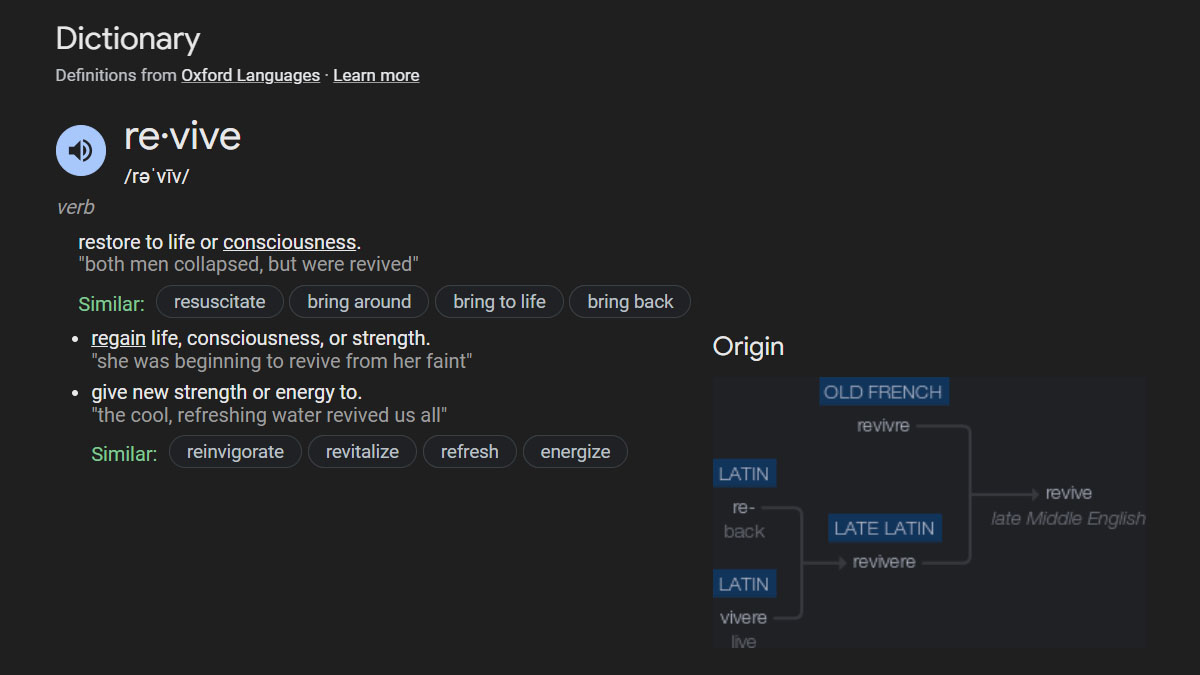
The Hebrew word in question is chayah or haya (depending on how you want to transliterate it into the English alphabet). It’s Strong’s number H2421 and entry 644 in the Theological Wordbook of the Old Testament (TWOT), where the authors devote nearly three full pages to haya and its derivatives. It’s a very important word in the Old Testament writings, with the root word appearing 270 times, and it’s translated as “live,” “alive,” “quicken,” “nourish,” “recover,” and “revive” (along with a few other less frequent phrases) in the King James Version. The closely related derivative chay (H2416) appears 498 times, and it’s most often translated “life” or something that is alive, e.g. “a living thing.” Today, let’s take a closer look at these words and see what we can learn.

“Life” In Hebrew

The TWOT says the root verb haya means “to live or have life” (in the simple Qal stem) or “giving or restoring life” (in the word’s two other verb stems) (p. 279). The “range of meaning” also includes “‘to preserve or sustain life’ or ‘to nourish’ … ‘or to restore to health, to heal, recover'” (p. 280). Key to understanding this word is that it is usually very concrete rather than an abstract idea.

“The OT speaks of life as the experience of life rather than as an abstract principle of vitality which may be distinguished from the body. This is because the OT view of the nature of man is holistic, that is, his function as body, mind, spirit is a unified whole spoken of in very concrete terms. Life is the ability to exercise all one’s vital power to the fullest; death is the opposite.”

R. Laird Harris, Gleason L. Archer, Jr., and Bruce K. Waltke; TWOT entry 644, p. 279

We might think this is a very different viewpoint from the New Testament, but that’s because we’ve been influenced by modern ideas about people being bodies with spirits or souls rather than unified wholes. The idea that humans have a soul that’s separate and immortal came into Christianity from Neoplatonic philosophy about 200-300 years after Christ’s human life (see “Rethinking Heaven: Capturing A Vision Of The Resurrection” and “Relational Faith: A Book Review and Theological Reflection“). We’re “spirit, soul, and body” (1 Thes. 5:23, WEB) as a unified whole, living our lives as human beings made in God’s image.

While chayah can have slightly “less concrete” meanings, such as living “by the words of God ‘not by bread alone’ (Deut 8:3; Ps 119:50, 93)” even these uses are grounded in “the biblical unity of man’s nature” and seem to refer to both physical “prosperity as the gift of obedience” and “the spiritual quality of life” (TWOT, p. 280). There are also hints in the Old Testament that chayah refers to the eternal, spiritual life God offers after death, not just the physical life that He gives us (Ps. 49:9; Prov. 12:28; 15:24; Dan. 12:2). The concreteness of the word ties in well with the Biblical teaching that there will be a bodily resurrection (i.e. we’ll be resurrected as spirit beings with spirit bodies, not something ghostly or disembodied).

Walking with God for Life

Since chayah is used so many times in the Bible, I thought I’d focus today’s study on the ways that it’s used in the Psalms (just to make things a little more manageable). I did this by looking up chayah (H2421) and chay (H2416) with the program eSword, which yielded 82 matches in the psalms (31 chayah, 51 chay). This includes several categories of verses, including ones describing God as “the living God” (Ps. 42:2; 84:2) and talking about us being in the “land of the living” (Ps. 27:13; 56:13; 142:5). I want to focus, though, on the ones that speak of how God impacts our lives (click for examples).

Surely goodness and loving kindness shall follow me all the days of my life,
    and I will dwell in Yahweh’s house forever.

Psalm 23:6, WEB

The much beloved Psalm 23 shows Yahweh’s involvement with David’s whole life (and ours as well). God is the shepherd who provides all our needs, restores our souls, guides us, guards us, and comforts us. Chay appears in the last verse, providing a conclusion to the short psalm. When we remember that the life represented by chay can involve nuances of preserving, sustaining, nourishing, and reviving, it deepens our understanding of the quality of life that God wants to give us.

In another section of scripture, Jesus said, “I have come so that they may have life, and may have it abundantly. I am the good shepherd” (John 10:10-11, NET). Obviously, the word chay doesn’t appear here because the New Testament was written in Greek rather than Hebrew, but I think we can see how the meaning is connected. God wants our lives to be good, not just abstractly but in a real, tangible way.

 I have set Yahweh always before me.
    Because he is at my right hand, I shall not be moved.
Therefore my heart is glad, and my tongue rejoices.
    My body shall also dwell in safety.
For you will not leave my soul in Sheol,
    neither will you allow your holy one to see corruption.
You will show me the path of life.
    In your presence is fullness of joy.
In your right hand there are pleasures forever more.

Psalm 16:8-11, WEB (footnote on v. 10: “Sheol is the place of the dead”)

As with Psalm 23, chay appears in the conclusion of Psalm 16 (also a psalm of David). Long after David’s death, the apostle Peter said that this Psalm is really “about the resurrection of the Christ, that he was neither abandoned to Hades, nor did his body experience decay” (Acts 2:31, NET [italics mark allusions to Psalm 16]). David was a prophet, and he knew he was writing about one of his descendants who would be the Messiah/Christ (Acts 2:22-33). A lot of this psalm also feels personal, though, and I suspect that we can read it on both levels: a messianic prophecy and an expression of David’s assurance that God will take care of him.

I’m not sure how much David understood about God’s ultimate plan to bring human beings into His family, but it is accurate that God won’t leave us in the grave forever. It’s also accurate to say that he shows us “the path of life” in multiple senses: the path to walk in order to have a good life here on this earth, and the path to eternal life with God forever.

Revival from God

I find it ironic that I’ve been struggling to focus on and finish this study, which was inspired by a message about reviving a waning interest in Bible study. For some reason, I’ve just had a very hard time for this post with going from reading Bible scriptures to knowing how to put them together and what to say about them.

In the Psalms, there are several times where chay or chayah are translated “revive” (as well as the more common “life” or “live”). It shows up a lot in Psalm 119. This whole psalm is like a love letter to God’s word; every single verse talks about God’s law, ordinances, statues, precepts, way, etc. Here, we learn that revival (chayah) is found in the words of God.

My soul is laid low in the dust.
    Revive me according to your word!

Psalm 119:25, WEB

I will never forget your precepts,
    for with them, you have revived me.

Psalm 119:93, WEB

Hear my voice according to your loving kindness.
    Revive me, Yahweh, according to your ordinances.

Psalm 119:149, WEB

It seems that the solution to my problem focusing on study is to persistently come back to God and His word even if it takes a while for things to come together and make sense. In fact, that’s the solution to all of our problems. It’s not like there’s anywhere else to go for answers. As Peter said when Jesus asked if the twelve wanted to go away after several other disciples decided not to listen to Him anymore, “Lord, to whom would we go? You have the words of eternal life” (John 6:68, NET).

We can physically survive without having a relationship with God, but we can’t have full, abundant, and eventually eternal life apart from Him. He doesn’t promise that we’ll never have tough times or difficult feelings, but He does promise life-giving revival in Him and His word if we come to Him during those challenges.


Featured image by Sasin Tipchai from Pixabay

Song Recommendation: “Mayim Chaim” by Zemer Levav

Even If You Don’t: Holding On To Hope In Dark Times

We know God can do anything. So how do you react when He doesn’t do something that you beg him to? When your loved one isn’t healed? When your heartbreak feels unbearable and then something else piles on top of that? When you just don’t know how to go on, yet you have to anyway?

I’ve been going through a rough patch emotionally, especially over the past few weeks but really for a few months now. And I feel like God has thrown me some songs as “lifelines” in this time. First it was “I Am Not Alone” by Kari Jobe and more recently it was “Even If” by MercyMe.

I know You’re able and I know You can
Save through the fire with Your mighty hand
But even if You don’t
My hope is You alone
I know the sorrow, and I know the hurt
Would all go away if You’d just say the word
But even if You don’t
My hope is You alone

I didn’t much want to sing this when it popped into my head. Actually, I couldn’t at first since all I remembered was the “But even if you don’t” line. But I looked the song up, grasping for some hope to anchor my soul, and after playing through it a few times I could breath and pray again. I’ll admit, though, that there was still a part of me crying out, “Why?” when I thought about Him choosing not to take away the sorrow and hurt. And it’s okay to do that. As my counselor said, God is big enough to handle it when His kids are frustrated with Him.

Hope is one of the key things that gets us through the times when we’re frustrated with God and don’t understand what He’s doing. And it’s something I don’t think we talk about enough. Paul tells us “faith, hope and love remain”  (1 Cor. 13:13, WEB). They’re all three virtues that aren’t going away, but we talk about faith and love a whole lot more than hope. Which is a shame, because hope is something that’s very much needed in this world. Read more

Which Criminal Are You?

When Jesus died, He hung on the cross between two criminals. In Greek, the word is kakourgos, a compound of evil+doer. This refers to someone who’s employment is practicing wrong things. While we might not have personally broken laws that would make us criminals in our societies, we have more in common with at least one of these two men than you might think.

Every human being has “sinned and come short of the glory of God” (Rom. 3:23, KJV). Because “sin is the transgression of the law,” this also makes us all law breakers (1 John 3:4, KJV). Like these criminals, we have practiced things that were not right. And when we recognize that fact, we also realize that “the compensation due sin is death, but the gift of God is eternal life in Christ Jesus our Lord” (Rom. 6:23, LEB). Like the criminals, we’re facing death and Jesus is there. But how do we respond to Him?

Which Criminal Are You? | marissabaker.wordpress.com
Photo credit: Dennis Hill via Flickr, CC BY

Pride v. Humility

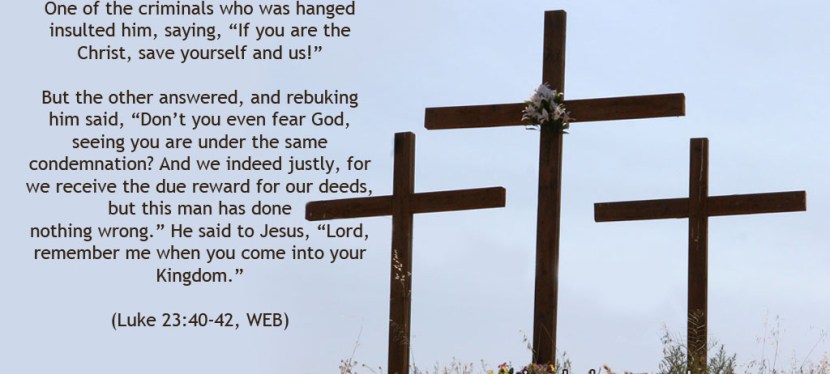
One of the criminals who was hanged insulted him, saying, “If you are the Christ, save yourself and us!” (Luke 23:39, WEB)

One criminal resented what was going on and attacked his fellow sufferer. Matthew Henry describes him as “hardened to the last.” Even his own agony “did not humble his proud spirit nor teach to give good language.”

In contrast, the other criminal was “softened at the last.” He acknowledges the justice of their punishment as “the due reward for our deeds” (Luke 32:41, WEB). He’s much more humble, willing to accept the consequences of his actions and admit their wrongness. This basic attitude difference sets the stage for other differences between these two men. Read more

Rethinking Hell: A Clearer View of God’s Judgement

One of the most uncomfortable aspects of modern Christianity is the idea of hell. The common notion is that those who aren’t following God (including those who reject Him and those who never knew Him) miss-out on their chance at salvation and are tormented forever in a burning place. Few want to talk about it, many have rejected it, but most don’t agree on an alternative. It’s something Christianity must address, though.

What happens after death for the people who are not followers of Jesus?

For believers, the question “What happens when we die?” has clear answers in scripture. We’re not sure exactly what life in God’s family will be like, but we know that we’ll either be resurrected from the dead (if we died before Jesus’s return) or transformed into spirit beings (if we’re still alive at His return). At that point, “we will be like him, because we will see him just as he is” (1 John 3:2, NET). For other people, things are a bit more ambiguous.

My purpose today isn’t to give a definitive answer, but rather to look at some different readings of scriptures talking about eternal judgement. There are some things we can say with a fairly high degree of certainty, but there are others that I just don’t know the answers to (and I’d rather acknowledge that than take a stance that I’m not reasonably confident lines up with God’s revealed word).

What is “hell”?

The word “hell” is used in the Bible, but not with the same connotation we have for it in English. Western ideas of hell come from Medieval imagery (think Dante’s Inferno). Most uses in the New Testament, though, are translated from the Greek word ghenna. When people of Jesus’s time heard this word they didn’t think of a burning place with a pitchfork-toting devil where eternal souls writhed in torment. They thought of Ghenna–a rubbish heap outside Jerusalem “where the filth and dead animals … were cast out and burned,” which is “a fit symbol of the wicked and their future destruction” (Thayer’s dictionary G1087).

Strong’s dictionary does describe ghenna as a place of “everlasting punishment,” but that imagery wasn’t originally in the Greek language. As we talked about last week, the Bible doesn’t teach humans have immortal souls. Immortality can only come to us as a gift of God, and unless He grants the gift of eternal life we won’t be around for everlasting anything, including torment.

Another word translated “hell” in English Bibles is hades (G86), which originally referred to the Greek god of the underworld but came to mean the grave in general. There’s also one other mention of “hell” in in the New Testament that’s translated from tartaroo (G5020), which was considered a place of eternal torment. The only time it’s used is in 2 Peter 2:4,where it talks about God casting “the angels who sinned … into hell” (NET). Other than that, when we look at what the Bible says about hell, we have to check each verse to see whether it’s talking about hades (the grave) or ghenna (a burning place of destruction).

While the Bible does speak of a burning lake of fire, it doesn’t talk about humans staying there nor going there instantly when they die. After people die, the prevailing Biblical description is that they’ve fallen asleep and are awaiting the resurrection (John 11:11-13; 1 Cor. 15:6, 18, 31; 1 Thes. 4:13-15; 5:10; 2 Pet. 3:4; Dan. 12:2and many others). Some people — the “firstfruits” that we discussed in last week’s post– will be raised from the dead to eternal life at Jesus Christ’s second coming. The rest of the dead stay asleep until a second resurrection.

Image of a woman reading the Bible overlaid with text from Rev. 1:17-18, NET version: “Do not be afraid! I am the first and the last, and the one who lives! I was dead, but look, now I am alive—forever and ever—and I hold the keys of death and of Hades!”
Image by MarrCreative from Lightstock

A Second Resurrection

We don’t actually get a whole lot of information about what happens after the first resurrection and the Millennial reign described in Revelation 20:1-6. We are told in the description of the first resurrection that “The rest of the dead did not come to life until the thousand years were finished” (Rev. 20:5, NET). Skipping to the end, we read this:

Then I saw a large white throne and the one who was seated on it; the earth and the heaven fled from his presence, and no place was found for them. And I saw the dead, the great and the small, standing before the throne. Then books were opened, and another book was opened—the book of life. So the dead were judged by what was written in the books, according to their deeds. The sea gave up the dead that were in it, and Death and Hades gave up the dead that were in them, and each one was judged according to his deeds. Then Death and Hades were thrown into the lake of fire. This is the second death—the lake of fire.  If anyone’s name was not found written in the book of life, that person was thrown into the lake of fire.

Revelation 20:11-15, NET

At this point in the future, “the devil who deceived them” has already been “thrown into the lake of fire and sulfur, where the beast and the false prophet are too, and they will be tormented there day and night forever and ever” (Rev. 20:10, NET). That’s the only mention of eternal torment, though. The people who follow the devil die in the “second death.” They’ll be consumed, burned-up like the rubbish thrown in ghenna.

Death as the punishment for sin fits with God’s warnings to humanity from the very beginning (Gen. 2:15-17; 3:2-3). God’s message is consistent throughout scripture. If you follow His way, then you will live. If you do not, then you are choosing death.

I call heaven and earth to witness against you today that I have set before you life and death, the blessing and the curse. Therefore choose life, that you may live, you and your descendants, to love Yahweh your God, to obey his voice, and to cling to him; for he is your life, and the length of your days.

Deuteronomy 30:19-20, WEB

This message continues through the old and new testaments. Sin leads to death, but following God results in life (Rom. 6:22-23; 8:5-7; 2 Cor. 2:15-16; 1 John 3:14). God doesn’t control or manipulate us with the threat of everlasting punishment. He sets two very simple choices before us: life forever with Him, or permanent death.

  • Note: you could argue my reading of everlasting punishment using verses like Matthew 25:41-46 and Mark 9:42-48. For Matthew 25, I would say that just because the fire is everlasting doesn’t mean the people cast in it stay alive, and that the phrase “everlasting punishment” can just as easily be read “punishment that is irreversible” (because they die in the second death, which fits with Rev. 20:15). For Mark 9, where “hell” is translated from ghenna, I really don’t know what the phrase “worm does not die” means. The Hebrew and Greek both refer to maggots/grubs such as would eat dead flesh, which doesn’t make much sense to me with either interpretation–if the people die, why don’t the worms? and if the people don’t die, why does it say “worm does not die” instead of something like “soul does not die”?
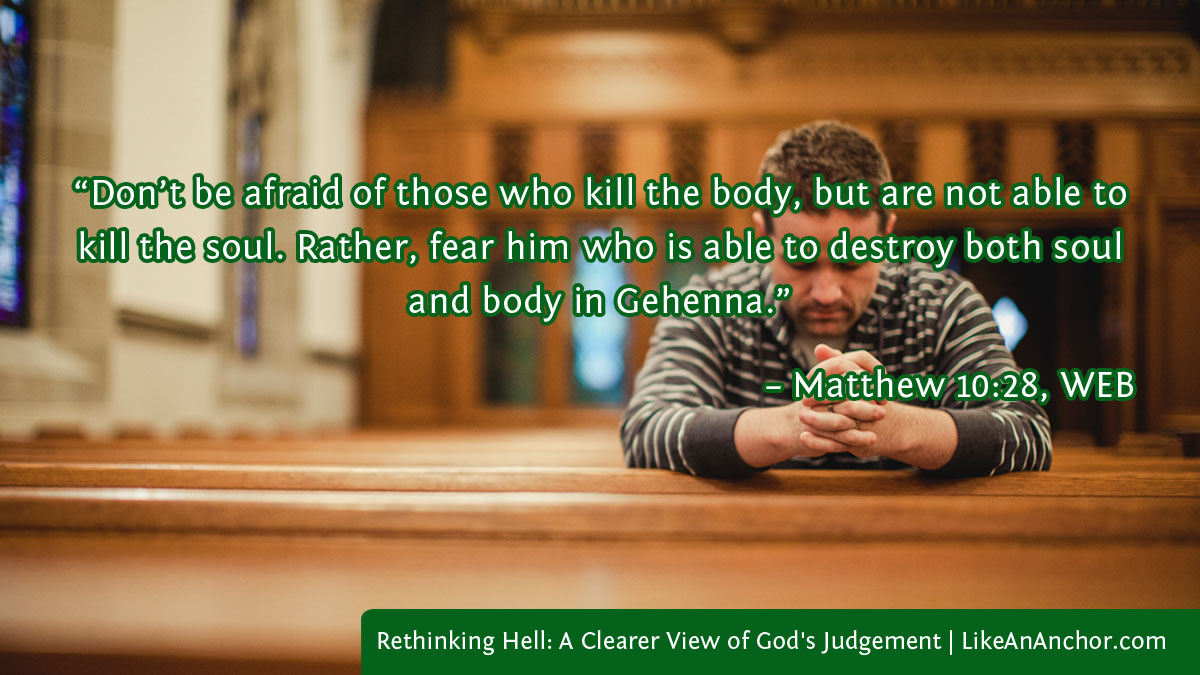
Image of a man praying overlaid with text from Matthew 10:28, WEB version: “Don’t be afraid of those who kill the body, but are not able to kill the soul. Rather, fear him who is able to destroy both soul and body in Gehenna.”
Image by Shaun Menary from Lightstock

Readings on Judgement

Last week I spent quite a bit of time talking about N.T. Wright’s teachings on the resurrection. He has comparatively little to say about hell, though. He goes through the Medieval hell symbolism and meaning of Gehenna (p. 177-178), mentions that while final judgement was accepted as part of God’s plan it wasn’t widely discussed in the epistles (p. 177), and covers different modern views on hell (p. 178). What he does state is that “God is utterly committed to set the world right in the end,” and that means there will be no people in His future world who worship “that which is not God as if it were” and who fail “fully to reflect the image of God” (p. 179).

God will condemn evil, and Wright thinks that those who reject God will “cease to bear the divine image at all” and continue to “exist in an ex-human state” (p. 182-183). That, however, ignores his own teaching that people do not inherently have immortal souls and doesn’t address what the Bible says about the lake of fire. I do, however, like the way Wright speaks of a “final condemnation for those who, by their idolatry, dehumanize themselves and drag others down with them” (p. 180). We know God doesn’t desire that any perish (1 Tim. 2:4; 2 Peter 3:9), but there will be people who end up in the lake of fire and this seems a good way of summing up their condition.

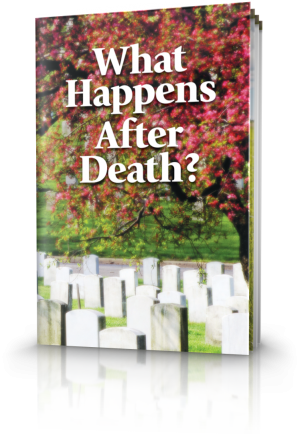
what-happens-after-death

The Churches of God that I’ve attended with most of my life venture into more specifics about the final judgement. Their main teachings are well represented in United Church of God’s booklet “What Happens After Death?” In brief, it goes like this: Those who are not the firstfruits will be resurrected to physical life after the Millennium and given a chance to understand God’s word. After a period of time (some say 100 years) they’ll be judged and the ones who’ve refused to repent will die in the lake of fire. The others will live on in God’s kingdom.

This teaching holds great hope, as well as relief for our worries about people who have not yet committed their lives to Jesus. It also relieves us of a sense of urgency to convert people before they die because we believe there’s a time in the future when they’ll be given the chance to know Him. If they aren’t saved in this life, they’ll have an opportunity to escape eternal death in the second resurrection.

There are a few things that this interpretation doesn’t explain, though. One thing that has to do more with implications than accuracy is that lack of urgency to convert people. We know that God is the one who chooses whether to call someone and open their eyes, and that those who do not choose Him now will have an opportunity in the second resurrection. But we should still care about sharing His word with people today. We’re supposed to be like God, and since He “wants all people to be saved and to come to a knowledge of the truth” that should be our desire as well (1 Tim. 2:4, NET).

The time frame of this judgment is also in question. Romans 2:1-16 indicates that all will be judged based on their actions in this life. It talks of God exercising abundant mercy towards those who didn’t know Him and yet lived good lives, but there’s also the promise of “wrath and anger to those who live in selfish ambition and do not obey the truth but follow unrighteousness” (Rom. 2:8, NET). Yet if people are judged as soon as the books are opened in Rev. 20:12, what about the babies, children, and others who never had a chance to do works by which they could be judged? God’s mercy, justice, and love seems to demand they be given a chance to know Him, which implies a time-gap between resurrection and judgement but that is not explicit in the scripture.

Consistent, Trustworthy God

I don’t have all the answers. What I do know is that, in the years after Jesus’s original apostle’s death, Christian religion generally adopted a terrifying version of God who tortures unbelievers in hell for all eternity. Even if we don’t understand everything about God’s final plan for those who don’t know Him now, it is time to recapture a vision of God that is more consistent with how He reveals Himself as One who is love, justice, and mercy.

His justice demands recompense for sin, but He also has no desire that anyone perish (or suffer forever) and He will be merciful to everyone. For some, this mercy involves granting salvation because they come to repentance and follow Him with a pure heart. For others, that mercy involves letting them die the final, second death because they can’t be allowed to continue in rebellion against Him. That’s a God we can trust, One Who will keep His promises to reward those who follow Him with life and those who persist in disobedient rebellion with death.

Another thing I think we can say for certain is that it’s best to follow God now if we have that option, not to wait for what seems like a second-chance in the future. The firstfruits do receive a greater reward. If you are faithful to God, He will be faithful to reward you according to His promises. That’s what the church should be teaching–not threatening people with “you’ll burn in hell” but rather encouraging them to pursue God and take hold of the “better promises” and the “better resurrection” that comes with following Him now (Heb. 8:6; 11:35, WEB).


Featured image by Anggie from Lightstock

Rethinking Heaven: Capturing A Vision Of The Resurrection

Christians and non-Christians alike typically assume that our religion teaches good Christians go to heaven when they die and bad people, or those who’ve never given their lives to Jesus, go to hell. As more and more Biblical scholars, Christian churches, and individual believers are realizing, though, this isn’t the most accurate picture of what the Bible teaches regarding life after death.

I grew up in churches that taught the resurrection. It’s straight out of the scriptures, but I hadn’t come across other churches teaching something similar until reading a book called Desiring the Kingdom by Catholic theologian James K.A. Smith. In this book, Smith made a comment about Christians not really going to heaven when they die and footnoted it with three book suggestions for further reading. I could only locate one book from that list in the library: Surprised by Hope by New Testament scholar and Anglican bishop N.T. Wright.

Wright’s powerful exegesis on the meaning of the resurrection is inspiring and some of the thoughtful, well-researched ways he diverged from my church’s traditional teachings made me realize there are alternative explanations for a few difficult scriptures that deserve a second look. I also admire his style. Instead of telling people “You’re wrong,” he says, “We’ve been misinformed, and here’s the more wonderful plan God has for us.” That’s what I want to focus on today. The deeper our understanding of what God is actually planning for us, the firmer our hope and faith becomes.

What Happens When We Die?

The idea that human beings have immortal souls does not come from the Bible, It traveled into Christian theology from Greek philosophy, specifically Plato (see “Plato’s Shadow” by Gary Petty for more details). The Bible teaches that God “alone possesses immortality” (1 Tim. 6:16, NET). Immortality is not something inherent to humans. We didn’t even have a chance at eternal life until Jesus Christ broke “the power of death and brought life and immortality to light through the gospel!” (2 Tim. 1:10, NET).

In Hebrew thought and New Testament theology, the soul refers “not to a disembodied entity hidden within the outer shell of a disposable body, but rather to what we would call the whole person or personality” (Wright, p. 28). In Hebrew, the word translated “soul” is nephesh (H5315). It refers to a living thing with breath (Thayer’s Dictionary).

 Yahweh God formed man from the dust of the ground, and breathed (naphach) into his nostrils the breath (neshamah) of life; and man became a living soul (nephesh).

Genesis 2:7, WEB

The New Testament does talk about different parts of a human. We have a body  — the soma , which is fleshy, physical, and “that which casts a shadow” (Thayer G4983). We have a soul — psuche , the vital force of life and personality (G5590). And we have a spirit — pneuma , the “rational spirit, the power by which the human being feels, thinks, decides” (Thayer G4151). The three can’t really be separated in any useful way, though; they all go together to make us human beings in the image of God.

Now may the God of peace himself make you completely holy and may your spirit (pneuma) and soul (psuche) and body (soma) be kept entirely blameless at the coming of our Lord Jesus Christ.

1 Thessalonians 5:23, NET

So, we are human bodies that God created from dust and breathed into, making us living beings with spirits that can communicate with His Spirit. Ecclesiastes says that, at death, “the dust returns to the earth as it was, and the spirit returns to God who gave it” (Ecc. 12:7, WEB). Wright believes that this spirit is conscious while awaiting the bodily resurrection, but I lean more toward my church’s traditional teaching that this isn’t the case.

While there are a couple verses hinting at the possibility of consciousness after death (Luke 16:19-31; Rev. 6:9-10), the bulk of scripture compares death to sleep (John 11:11-13; 1 Cor. 15:6, 18, 31; 1 Thes. 4:13-15; 5:10; 2 Pet. 3:4; Dan. 12:2; and many others). Furthermore, “in death there is no memory of you” (Ps. 6:5, WEB), “the dead don’t praise Yah” (Ps. 115:17, WEB), and ” the dead don’t know anything” (Ecc. 9:5, WEB). Two scriptures–one in a parable and one in Revelation– that aren’t necessarily clear/straightforward do not seem to be enough evidence to counter the many, many other scriptures describing the dead as unconscious and sleeping.

Image of a man reading the Bible overlaid with text from 1 Thes. 4:13-16, WEB version:  “But we don’t want you to be ignorant, brothers, concerning those who have fallen asleep, so that you don’t grieve like the rest, who have no hope. For if we believe that Jesus died and rose again, even so God will bring with him those who have fallen asleep in Jesus. ... The dead in Christ will rise first.”
Image by Matt Vasquez from Lightstock

For The Firstfruits

Eternal life is a gift God promises to those who follow Him now, in this life (we’ll save those who don’t for a follow-up post next week). The promises to believers are spelled out clearly in scripture, and nowhere more clearly than in 1 Corinthians 15. Here in the resurrection chapter, Paul reminded the Corinthians that he declared to them the gospel: “that Christ died for our sins according to the scriptures, and that he was buried, and that he was raised on the third day according to the scriptures, and that he appeared to” the apostles and hundreds of other believers (1 Cor. 15:3-5, NET). Jesus’s resurrection is central to the gospel message.

Paul then addressed a group of people who didn’t believe in the resurrection of the dead. He stated in no uncertain terms that if there is no resurrection the gospel is empty, and “if Christ has not been raised, your faith is useless; you are still in your sins. Furthermore, those who have fallen asleep in Christ have also perished” (1 Cor. 15:17-19, NET). There is no alternative. Either there’s a resurrection of the dead or we have no hope at all; physical death would be permanent.

Paul spent the next few verses talking about how and when we’ll be raised. N.T. Wright summed up the “how” by saying, “the risen Jesus is both the model for the Christian’ future body and the means by which it comes about” (p. 149). The “when” for the resurrection of faithful believers is Jesus Christ’s second coming (1 Thes. 4:13-18; 1 Cor. 15:23). This resurrection is for “the firstfruits”–a select group of people who actively, faithfully followed God during their physical lives. It’s not enough to verbally accept Jesus as your savior; we also have to live like Christians. And so the resurrection chapter also includes the injunction not to be deceived or corrupted, but rather “Sober up as you should, and stop sinning!” (1 Cor. 15:34. NET).

Image of a woman reading the Bible overlaid with text from 1 John 3:2-3, NET version:  “Dear friends, we are God’s children now, and what we will be has not yet been revealed. We know that whenever it is 
revealed we will be like him, because we will see him just as he is. And everyone who has this hope focused on him purifies himself, just as Jesus is pure.”
Image by Pearl from Lightstock

A Bodily Resurrection

Paul anticipated one question that many will have about the resurrection when he said, “But someone will say, ‘How are the dead raised? With what kind of body will they come?'” (1 Cor. 15:35, NET). It’s an understandable question, especially today given the confusion about what “soul” actually means. The short answer is given by John: “we will be like him, because we will see him just as he is.” (1 John 3:2, NET). When we’re resurrected, it will be to an existence like God’s.

Paul addresses this question in more depth. He likens our bodies now to “a bare seed” sown in a field with the expectation that it will grow into a mature, flourishing plant (1 Cor. 15:37, NET).We currently have a “natural body” that bears the image of the first human being that God breathed into and made a living being. Those who rise from the dead in the first resurrection will have a “spiritual body” that bears the image of Jesus Christ (1 Cor. 15:42-49).

 It is the same with the resurrection of the dead. What is sown is perishable, what is raised is imperishable. It is sown in dishonor, it is raised in glory; it is sown in weakness, it is raised in power; it is sown a natural body, it is raised a spiritual body. If there is a natural body, there is also a spiritual body.

1 Corinthians 15:42-44, NET

In Greek, the words “natural” and “spiritual” are psychikos and pneumatikos. Wright points out that “Greek adjectives ending in -ikos describe not the material out of which things are made but the power or energy that animates them” (p. 155, emphasis in original). We currently have a body animated by the human soul. We will have a body “animated by God’s pneuma, God’s breath of new life, the energizing power of God’s new creation” (p. 156).

When Jesus rose from the dead, people could touch Him (John 20:27) and eat with Him (John 21:9-13). He told them, “Look at my hands and my feet; it’s me! Touch me and see; a ghost does not have flesh and bones like you see I have” (Luke 24:39, NET). Though He could appear in the middle of a locked room or vanish from sight (Luke 24:30-31, 36), Jesus wasn’t a ghost or a disembodied spirit. His spiritual body was something more than His physical one.

We’re not waiting for an escape from the body, but rather “the redemption of our bodies” (Rom. 8:23, NET). We long “to put on our heavenly dwelling … because we do not want to be unclothed, but clothed, so that what is mortal may be swallowed up by life” (2 Cor. 5:1-5, NET). We’re not waiting to go to heaven when we die — we’re waiting for Christ to come down from heaven to raise His people from their sleep of death and transform us all to have a spiritual life and body like His (1 Cor. 15:51-58). And it doesn’t end there!

Blessed and holy is the one who takes part in the first resurrection. The second death has no power over them, but they will be priests of God and of Christ, and they will reign with him for a thousand years.

Revelation 20:6, NET

We don’t have a ton of information about what happens after the first resurrection, but God does sketch out the final stages of His plan for us. We know that for 1,000 years, those firstfruits who were resurrected from the dead or who were alive and transformed at Jesus’s second coming reign alongside Him in what we call the Millennium (most details about this come from the prophets and Revelation). After that, there will be a resurrection of the remaining dead, a final judgment, Satan’s total defeat, a new heaven and new earth, and God will come to dwell with humanity on earth (Rev. 20-22). It’s an incredible future that God has planned for His creation! Let’s not settle for any teaching that offers less than His glorious plan that He has revealed to us in scripture.


Featured image by Ruby-Rose from Lightstock

Song Recommendation: “With The Sound of Trumpets