In Sure And Certain Hope

A good friend of mine, named Kimberly, was in a fatal car accident Thursday morning. I know only a few details. She wasn’t feeling well, but drove to work any way — she wouldn’t have wanted to let her employer down by calling in sick unless she was too ill to stand. There was ice on the road, and she swerved. Someone in an oncoming car hit her (he was taken to the hospital and is expected to recover). She was killed instantly.

I had one of my regular posts all planned out, but I couldn’t write it. I couldn’t just pretend everything is normal. It’s not. This kind of accident could happen to anyone, but it didn’t. It happened to Kimberly.

Kimberly was a peacemaker who loved to help people, and she seemed to attract those who needed her. She often wondered why friends, acquaintances, and people she had never even met would seek her out to share their problems. I think I know at least part of the reason why. They knew she would listen to them. If you needed to talk, you could trust that Kimberly was listening. And once you were one of Kimberly’s friends, she wasn’t just content to listen and not do anything. She could recognize when people started rehashing grievances in an unhealthy way, and she would challenge you to change. If your life was falling apart, Kimberly would help you re-build it.

A picture of us as children. My sister, I, and Kimberly are in back. Kimberly's sister and my brother are in front.
A picture of us as children. My sister, I, and Kimberly are in back. Kimberly’s sister and my brother are in front.

I can’t really remember a time before I knew Kimberly. I know such a time existed because I vaguely remember her family moving to Ohio, but I don’t have distinct memories of a time before she was my friend. As I grew up, I lost touch with most of my childhood friends for various reasons, but not with Kimberly. If you had asked me just a few days ago who I would have as my bridesmaids in a hypothetical future wedding, Kimberly is one of only four girls who would have instantly come to mind.

In the past few years, mainly because of distance and college and work schedules, we did not see each other as much as I wish we had. I have a very fond memory of going to see Tangled with her and my sister, then eating lunch at Applebees. Why didn’t we do the same for Frozen? I’m sure we could have managed to find a day that would have worked, but everyone is so busy and we have all the time in the world, right?

She was 22 years old, and very close to graduating from college. Her degree would have been in computer science engineering. When she and my sister started talking about engineering, math, or science, I couldn’t follow even half the conversation. I’d just sit there wondering how two people could be so enthusiastic about discussing equations that would send most people into a panic if they were asked to solve it. She also wrote poetry, which I could never convince her to let me read.

There’s a phrase that keeps running through my mind: “in sure and certain hope of the resurrection into eternal life.” It’s from the funeral service in The Book of Common Prayer. I think I’ve probably heard it more in films than in real life, but for some reason that’s what keeps popping into my head.

earth to earth, ashes to ashes, dust to dust; in sure and certain hope of the Resurrection to eternal life, through our Lord Jesus Christ; who shall change our vile body, that it may be like unto his glorious body, according to the mighty working, whereby he is able to subdue all things to himself.

On Thursday night there were three passages of scripture I turned to: “…the Father of mercies and God of all comfort…” (2 Cor. 1:3-7); “…even so God will bring with Him those who sleep in Jesus…” (1 Thes. 4:13-18); “…now Christ is risen from the dead, and has become the firstfruits of those who have fallen asleep…”(1 Cor. 15:12-56). Paul says, “If in this life only we have hope in Christ, we are of all men most miserable” (1 Cor. 15:19, KJV). I would hate to try going through something like this without the hope and peace that God is ready to pour out in us — this is miserable enough as it is. For Kimberly, the next thing she knows will be a glorious resurrected life with God. For us still here, we hurt. And we miss her.

Please pray for Kimberly’s family — her father, mother, and younger sister, as well as aunts, uncles, cousins, and grandparents.

Of Kayaking and Love Languages

image from stock.xchng

In keeping with my decision to blog every day of the Feast of Tabernacles, I’m going to share a story from a previous Feast for today’s post. I originally wrote this account to read aloud in a creative non-fiction class in 2011. The only thing I’ve edited from that version is changing the guys’ names, and my sister asked for her name to be taken out.

It was so hot in Panama City Beach that my glasses would steam up stepping outside from the air conditioned hotel. My family was there two years ago, in the fall, meeting with a church group that had chosen Florida as the location to observe the week-long Feast of Tabernacles, one of our annual Holy Days. Just a couple days into the Feast, my sister and I met two brothers, Quentin and Declan. Somehow, in the course of our conversation, the idea of kayaking on a nearby lagoon came up. Not entirely comfortable going anywhere with two guys we’d hardly known more than an hour, I was trying to politely refuse when Quentin suggested our whole family come. Well, surely he couldn’t be that dangerous if he was willing to include our Dad, Mom, and younger brother, so my sister and I agreed to the plan and invited the two brothers to eat lunch with our family in the condominium.

Of course, something had to go wrong. Mommy sliced her finger open on a can of pineapple, not too seriously, but enough to keep her from kayaking. Since she was laid-up, Daddy and my brother also stayed behind and my sister and I set out with Quentin and Declan. We split the cost of kayak rentals, but still, (or so my mother informs me) it was my first “date” as well as my first time kayaking. As it turned out, I enjoyed the kayaking part a lot more than the “dating” part. Quentin and I shared one kayak, and Declan and my sister shared the other. Both brothers had quickly lost interest in my sister after learning she was under 18, and I learned later that Declan and my sister hardly spoke the whole kayaking venture. By the time we got back to the hotel, I was convinced that lagging conversation would have been preferable to mine and Quentin’s discussion.

The kayaking adventure began promisingly. We watched pelicans ungracefully plop into the ocean and laughed at terns diving like missiles honing in on fish in the water below. The water was so clear you could look through the ripples and see fish swimming through snaky sea-grass while crabs skittered along the sandy bottom. Occasionally, a fish would randomly leap from the water, as if it was so happy to be alive that simply swimming was no longer enough and it had to take flight.

We had stopped paddling for a moment to take in the scenery when Quentin suddenly asked, “Have you heard of the book The Five Love Languages?”

I drew out my “Yes…?” like a question, which he took as permission to reveal that his love language was “Quality Time.” Then, as if the conversation were not awkward enough already, he went on to explaining that he particularly liked time spent with someone in a natural setting.

You mean like a lagoon in Florida, alone with someone you met just THREE HOURS AGO? I thought while mumbling something non-committal. Picking up my paddle, I cut short the conversation by steering our kayak back towards my sister’s and Declan’s kayak, vowing there was no way I was going to tell Quentin one of my primary love languages was “Touch”.

Living With Style, Class, and Grace

Book cover: How to Be a Hepburn in a Hilton World: The Art of Living with Style, Class, and GraceI recently finished a delightful little book called How to Be a Hepburn in a Hilton World: The Art of Living with Style, Class, and Grass. It is written by a publicist for Warner Bros. Records named Jordan Christy. The basic idea behind the book is that in the years since Audrey Hepburn graced the silver screen, our culture has come to uphold standards of behavior that are simply unacceptable for smart girls to follow. This book sets out to show “modern ladies how they can be beautiful, intelligent, and fun while retaining values and morals.”

One of the most welcome things about this book is that it is not a Christian guide to modesty. I’m not saying those types of books can’t be helpful, but it was refreshing to find a book written for women who want to (or have to) work in a business setting instead of on an idylic homestead. It tells girls you can be modern as well as feminine, that you don’t have to wear ankle-length skirts to be modest, and that acting like a lady can be fun instead of restrictive. I think it would be a great book to give girls who feel like the commonly presented Christian ideals of womanhood are shutting them out (for the record, this does not include me, but does describe some of my close friends).

Just to be fair, there were some things I did not like about the book. In an effort (I assume) to keep the text relevant to modern readers, Christy uses many examples of actresses, characters, and reality shows. There were enough to become excessive (and I didn’t recognize most of them). Her writing style might also seem blunt and off-putting to some readers.

Best Quotes

Chapter 1: Keep Your Chin Up and Your Skirt Down

“If we want [guys’] undivided attention for a bout 2.4 seconds, we should keep wearing our glittery minis and doing the bend-and-snap. But if we want a real relationship with a real gentleman, we should just keep being our smart, classy, fabulous selves.” Or, for those who’ve never worn a mini skirt in their lives, don’t be tempted to compromise.

Chapter 2: Words, Words, Words

This chapter advised reading and increasing our vocabularies so we can become better conversationalists. She also covers knowing when to speak and when to keep silent, quoting George Eliot: “Blessed is the man who, having nothing to say, abstains from giving us wordy evidence of the fact.”

Chapter 3: Use Some Elbow Grease

“Unfortunately, that hard-work-doesn’t-hurt mentality appears to be in short supply these days. Why? It’s become painfully clear that our society just doesn’t support a sincere work ethic anymore.” Be that as it may, if you want to be a classy, respectable young woman, you have to be willing to work.

Chapter 4: Choose Your Friends Wisely

We need to find friends “who will help us kick our own vices, not just drag us down in the mire with them and theirs. If we’re struggling with self-image and potential eating-disorder thoughts … we need to find ourselves some normal, curvy friends who will take us to counseling and won’t care if we’re a size 2 or a 10.”

Chapter 5: Let Him Come Calling

“Regardless of the guy’s current status, bank account, background, or beliefs, if he’s interested, he will do the pursuing. There’s no need to interfere with the ways of nature! Doing so will only scare him off.” This is one chapter I had a little disagreement with. She doesn’t allow for anything in between completely-ignore-the-guy and obnoxiously-pester-him-with-text-messages-every-few-hours. If you’re already friends, shouldn’t you be allowed to Facebook or e-mail him once in a while to keep in touch?

Chapter 6: Dress to Impress

Two quotes this time: “While it may seem frivolous to some, our personal style does more talking than we ever could about ourselves — and we want to make sure it’s saying nice things!” “While it can be tempting to want to keep up with the current inseam trends, the respect we’ll receive from not exposing our chest region and upper thighs is worth so much more than the five-seconds stares we’d get from a bunch of ogling buffoons.”

Chapter 7: Less Is More

“Our society is undoubtedly of the flashier/louder/faster/stronger mentality, and for some reason makeup tends to fall into the same category, but it really should be placed indefinitely in the less-is-more category. … We need to realize makeup is a simply something to enhance certain features — not a daily necessity that needs to be applied from sunup to sundown.”

Chapter 8: Have Your Cake and Eat It Too

“You can healthfully and happily maintain your weight without taking any weird voodoo pills or sprinting a marathon on the treadmill every week. You simply need to find a steady balance between those leafy greens and that Sprinkles cupcake. Let’s become the new poster children for happy, healthy young women.”

Things You Should Know About INFJs

It might be terribly self-centered to devote an entire post to my Myers-Briggs personality type, but I’m going to do it anyway (think of it as a birthday present to myself). As the rarest personality type, we INFJs often feel misunderstood and alone. Most estimates say that less than 1-2% of the population have this type. That’s one reason discovering our label is so important to us (as I’ve written about before). It lets us know that we are not abnormal, flawed humans. We’re perfectly normal INFJs. This isn’t going to be the first list of it’s type. There’s a Top 10 Things Every INFJ Wants You To Know list and one titled How to love your INFJ? This last one is written mostly for romantic relationships, but it’s funny and true so I linked to it anyway. Though these two lists, and others like them, are excellent, I still wanted to add my voice to the mix. Which brings us to the first point:

Always daydreaming
image found on Pinterest
  • INFJ spend a lot of time thinking, and we like to share our thoughts. The problem is, we have a hard time putting them into words when we’re speaking, which can make us appear inarticulate or even unintelligent. That’s why so many of us become writers — it gives us the time we need to put our thoughts in order before we present them to other people. When we do talk with and listen to others, we crave depth and sincerity rather than small talk.
  • In keeping with all the time we spend inside our own minds, you’ll sometimes notice us staring off into space. There’s nothing wrong with me when I do this and there is certainly no need to wave your hand in front of my face, shout at, or poke me (you know who you are).
  • We really do need people. While some introverts can thrive in solitude for quite some time, INFJs love being around people. They might terrify us sometimes, and we do need alone time to recharge, but life without people makes us depressed. This doesn’t mean you’re likely to find us at parties, however. We prefer a few close friendships. And when we find those friendships, we want them to last forever and tend to work hard at being a good friend.
  • The flip side of this relationship thing is that it’s hard for us to make these deep friendships because we’re reluctant to share our true selves with others. It’s taken years for me to share bits of my inner world with my closest friends. In addition, INFJs have a horror of conflict, and will avoid it as long as possible even when something needs to be addressed in a relationship.
  • C.S. Lewis made for another world
    image found on Pinterest

    We’re often feel like we belong in other worlds. For me, this fits quite well into my Christian faith and my fantasy writing. For other INFJs, it can mean feeling disconnected from the physical to such an extent that they’ll forget to eat (something I’ve never struggled with).

  • INFJs tend to be romantic idealists. We do dream of finding true love, but I mean this in the sense given in the fourth Oxford English Dictionary definition. We are fascinated by what might be, what could be, and what should be. We want to bring order and peace to the world.

    4. Characterized or marked by, or invested with, a sense of romance (romance n. 5a); arising from, suggestive of, or appealing to, an idealized, fantastic, or sentimental view of life or reality …

  • INFJs are known in personality circles for being deeply intuitive. We just seem to know things without being able to explain them. This frustrates our more logical friends, but we find it very useful. It helps us see situations and arguments from both sides and appreciate different people’s perspectives even when we don’t agree with them. In spite of a strong sense of right and wrong and strict adherence to an inner value system, INFJs are very open minded and want to see the best in people.


If you’d like to know more about the INFJ personality type, check out my book The INFJ Handbook. I just updated it with a ton of new information and resources. You can purchase it in ebook or paperback by clicking this link.

Anxious For Nothing

There is something that I find comforting about realizing how well God knows us.

O LORD, Thou hast searched me, and known me. Thou knowest my downsitting and mine uprising, Thou understandest my thought afar off. Thou compassest my path and my lying down, and art acquainted with all my ways. For there is not a word in my tongue, but, lo, O LORD, Thou knowest it altogether. (Ps. 139:1-4)

If I take the wings of the morning, and dwell in the uttermost parts of the sea; Even there shall thy hand lead me, and thy right hand shall hold me.  Psa 139:9-10This is my favorite Psalm. Not only does it have one of the most fantastically poetic phrases in the Bible — “If I take the wings of the morning, and dwell in the uttermost parts of the sea” — it is also the prayer of a man who is in awe of his God and takes comfort in the close relationship they share. David put his complete trust in God, and shared all his worries, troubles, and fears with full confidence that God would hear and respond.

I cried unto the LORD with my voice; with my voice unto the LORD did I make my supplication. I poured out my complaint before Him; I shewed before Him my trouble. When my spirit was overwhelmed within me, then Thou knewest my path. (Ps. 142:1-3)

Throughout the Psalms, we can see examples of David bringing his anxiety before God, much as Peter admonishes us to do when he writes, “Humble yourselves therefore under the mighty hand of God, that He may exalt you in due time: casting all your care upon Him; for He careth for you” (1 Pet. 5:6-7). It is certainly not easy to let go of our worries, but that is what we are expected to do.

In the sermon on the mount, Jesus spends a large portion of chapter 6 admonishing His followers against earthly anxiety. He says to “lay up for yourselves treasures in heaven” instead of on earth and “take no thought for your life” (6:20, 25). Paul says much the same thing in Philippians:

Be careful for nothing; but in every thing by prayer and supplication with thanksgiving let your requests be made known unto God. And the peace of God, which passeth all understanding, shall keep your hearts and minds through Christ Jesus. (Php. 4:6-7)

The word translated “careful” is G3309 merimnao (μεριμνάω). Zodhiates says it means, “To care, be anxious, troubled, to take thought.” When we pray to God and draw near to Him, we do not have to be anxious about anything. Now, I can write this just fine, but I’ll be the first person to admit I’m not very good at letting go of my anxiety. I worry about my family and friends, being in groups of people,  my 15-year-old cat, how people will respond to my writings, and my future (which encompasses a whole sub-group of worries we won’t get into right now). I spend an inordinate amount time worrying, and usually things aren’t nearly as bad as I feared. In short, I am anxious about things that turn out to be nothing to worry about.

Just think how much time and energy we could save if we really believed that God will make “all things work together for good to them that love God, to them who are the called according to His purpose” (Rom. 8:28). This doesn’t mean we’ll never worry at all. But it should mean that we can let go of our anxieties more quickly and “let the peace of God rule in your hearts” (Col. 3:15).

Jeremiah 29:11-13

These verses from Jeremiah are some of my favorite encouraging passages in the Bible.

For I know the thoughts that I think toward you, saith the LORD, thoughts of peace, and not of evil, to give you an expected end. Then shall ye call upon Me, and ye shall go and pray unto Me, and I will hearken unto you. And ye shall seek Me, and find Me, when ye shall search for Me with all your heart. (Jer 29:11-13)

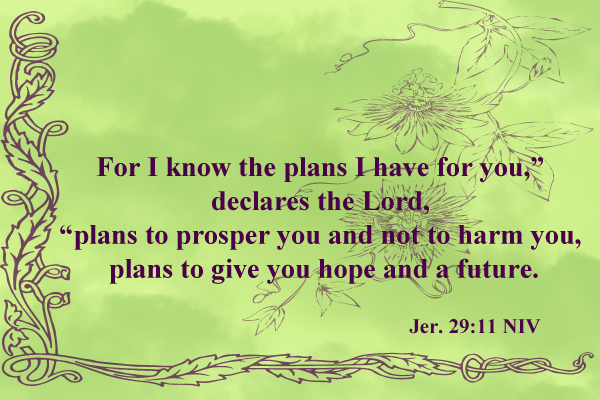
I don’t usually quote the NIV, but I do like the way it phrases verse eleven: “‘For I know the plans I have for you,’ declares the Lord, ‘plans to prosper you and not to harm you, plans to give you hope and a future.'” Even when we’re not sure what our own plans are for the future, we are assured that God has good things in store for us. He wants to see us succeed.

Since I graduated from college last year, my life hasn’t been going exactly like I planed. I’d intended to apply to several different grad schools and be back in school this fall, but for some reason I decided not to. Or rather, I didn’t decide exactly what to do and so nothing really got done.

I couldn’t (and still can’t) decide if I want to commit the next six years or so to an English Lit PhD program, try to get  a 3-4 year MFA in Creative Writing, or finally pursue my interest in type psychology. I’m not going to commit to or spend money on a program until I know which one I want. If I want any of them …

The other reason I find these verses in Jeremiah so encouraging are because of the promise that God will be there when we call on Him. He doesn’t hide from people who long for a relationship with Him.

For I will set mine eyes upon them for good, and I will bring them again to this land: and I will build them, and not pull them down; and I will plant them, and not pluck them up. And I will give them an heart to know Me, that I am the LORD: and they shall be My people, and I will be their God: for they shall return unto Me with their whole heart. (Jer. 24:6-7)

When we give our hearts to God, He promises that He will help us even — especially — when we don’t know what to do on our own. All-knowing, all-powerful, He is the ultimate source of strength and encouragement. And we can rest assured that He will make “all things work together for good to them that love God, to them who are the called according to His purpose” (Rom. 8:28).

Jeremiah 29:11