Unveiled

How many people do you really open up to? Even if you’re an “open book,” there are probably things you don’t share with everyone. There are secrets, aspects of our personality, and thoughts that we only show closest friends, family or a spouse. You may have parts of you hidden so deep no one sees them.

not sure who to credit; found on Pinterest

What about in your relationship with God? Even though He knows everything about us, we can still chose to hold things back from Him. We can tell Him to stay away, keeping Him at arms length and refusing to let go and surrender to His work in us.

Opening up and letting myself be seen is a challenge I face in human relationships, and in this fall holy day season I’ve been thinking about whether I try to do the same thing with God. I think that I’m more open with Him than with anyone else, but are there still things that I’m trying to hold back or hide?

Open To Me

Jesus is supposed to be our friend and lover. He wants to know you more thoroughly than anyone else ever will, but He wants you to chose that relationship. He won’t force Himself into your life, though He will knock.

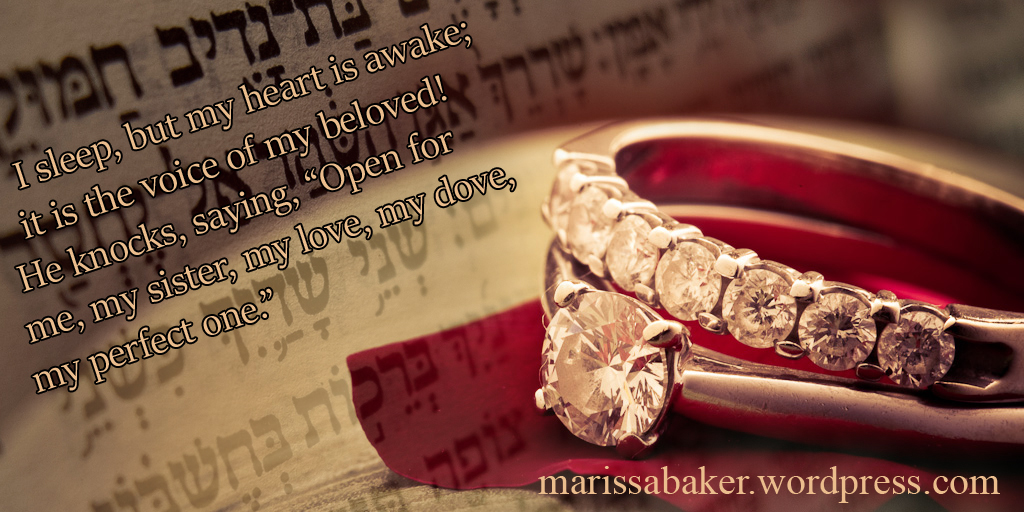
I sleep, but my heart is awake; it is the voice of my beloved! He knocks, saying, “Open for me, my sister, my love, my dove, my perfect one; for my head is covered with dew, my locks with the drops of the night.” (Song 5:2)

The woman in this part of the Song of Songs has “slumbered and slept,” and now Christ is outside asking to come in. “He sues for entrance who may demand it; he knocks who could easily knock the door down” (Matthew Henry’s Commentary). He doesn’t upbraid her for shutting Him out — He just wants her to let Him in. Have we also locked Him out? perhaps through carelessness if not deliberately?

she did not say, I will not open, but, How shall I? Note, Frivolous excuses are the language of prevailing slothfulness in religion; Christ calls to us to open to him, but we pretend we have no mind, or we have no strength, or we have no time (Matthew Henry)

Matthew Henry talks about this as “The slights which careless souls put upon Jesus Christ,” and which actually demonstrate “a great contempt” for their savior. When we ignore Jesus’ request to come into our lives, we reject His work in us.

Here, in the Song, the woman finally opens the door when she sees His hand at the door. Unfortunately, she waited too long for welcoming Christ in to be easy.

I opened for my beloved, but my beloved had turned away and was gone. My heart leaped up when he spoke. I sought him, but I could not find him; I called him, but he gave me no answer. The watchmen who went about the city found me. They struck me, they wounded me; the keepers of the walls took my veil away from me. (Song 5:6-7)

If we aren’t willing to open ourselves up to Christ when He knocks, He will be harder to find. If we don’t unveil ourselves to Him, we might find ourselves lost, alone and stripped of our covering pretenses before we find Him again. This can happen multiple times in a Christian’s life, just as this pattern is repeated in the Song (Song 3:1-4). Our lives are often a dance of drifting away and coming back to Christ.

Torn Veils

Unveiled | marissabaker.wordpress.comVeils keep us from fully experiencing God. The veil in the temple separated the Holy of Holies — where God’s spirit appeared — from the rest of the temple complex. Prior to Christ’s sacrifice, only the High Priest could enter, and only once a year (Heb. 9:1-8). The moment Jesus died, “the veil of the temple was torn in two from top to bottom” (Matt. 27:51). His death removed the most visible separation between God and His people.

There was another veil mentioned in the Old Testament that Paul talks about in the New. After Moses spoke to God, he shone so much with God’s reflected glory that Israel feared him. Moses wore a veil to hide his shining face before everyone but God (Ex. 34:29-35). Paul wrote about this veil in his second letter to Corinth.

But their minds were blinded. For until this day the same veil remains unlifted in the reading of the Old Testament, because the veil is taken away in Christ. But even to this day, when Moses is read, a veil lies on their heart. Nevertheless when one turns to the Lord, the veil is taken away. (2 Cor. 3:14-16)

Christ has torn away all the veils between the Lord and His people. The temple veil which tore at His death opened the way into His sanctuary, and when we turn our hearts to Him He takes away the veil shielding true understanding of the Torah.

But we all, with unveiled face, beholding as in a mirror the glory of the Lord, are being transformed into the same image from glory to glory, just as by the Spirit of the Lord. (2 Cor. 3:18)

We have to unveil our faces if we want to see His unvelied face. To know Him, we must want to be known. He took the first step — will we be equally open with Him?

Being Seen

Psalm 139 talks about God knowing us thoroughly — all our thoughts, every part of our personality. It also includes a very important line where David invites God into this deep, intimate relationship.

Search me, O God, and know my heart; try me, and know my anxieties; and see if there is any wicked way in me, and lead me in the way everlasting. (Ps. 139:23-24)

David’s willingness to be seen by God, and his request that God know him, are key to the sort of closeness described earlier in Psalm 139. Today, we can have that same sort of intimacy with our Lord if we let Him in.

Behold, I stand at the door and knock. If anyone hears My voice and opens the door, I will come in to him and dine with him, and he with Me. (Rev. 3:20)

Our Beloved is knocking on our doors, asking us to let Him in. Turn your face to Him, take off the barriers you’re putting up between you and Jesus. See, and be seen.
Unveiled | marissabaker.wordpress.com

Credits for photos used in blog images this week:

  • Veil” by Dan Thoburn, CC BY via Flickr
  • Red Drapery” by Sherrie Thai, CC BY via Flickr
  • Diamond Samples” by Seth Lemmons, CC BY via Flickr
  • Song 7:5” by Raffaele Esposito, CC BY via Flickr

Updated “God’s Love Story” E-Book

In honor of the fall Holy Days season, which we kicked-off yesterday with Yom Teruah (Feast of Trumpets), I’m re-releasing an updated version of my “God’s Love Story” booklet. It’s now available in multiple e-book formats through Smashwords and Amazon (the book is free on Smashwords, but Amazon doesn’t have that option when you’re setting up a new e-book).Updated "God's Love Story" E-Book by Marissa Baker

Throughout history, God calls out to His people asking one simple question, “Do you love Me?” Christianity isn’t a boring “let’s go to church and sit in a pew for an hour” sort of religion. It’s a romance with the creator of the universe; a “fairy tale” staring the Prince of Peace, Who laid down His life to rescue His bride from captivity to sin.

Click here to download “God’s Love Story” for free on Smashwords


Replacing Worry (Lessons from Zephaniah)

We live in the midst of a dangerous, confusing world, and it’s getting worse as we move ever closer to the time of Christ’s return.

And you will hear of wars and rumors of wars. See that you are not troubled; for all these things must come to pass, but the end is not yet. For nation will rise against nation, and kingdom against kingdom. And there will be famines, pestilences, and earthquakes in various places. All these are the beginning of sorrows. (Matt. 24:6-8)

Our first instinct when things get bad is to worry and panic. This is precisely what we’re told not to do. Easier said than done, though, isn’t it? Worry’s not something you can just turn off — you have to replace it with something else.

No Reason for Fear

Zephaniah prophesied during the reign of King Josiah, so things were going pretty well at the time for the nation of Judah. Even so, he warned about a time much like our own when things would start looking pretty bleak for God’s people. In the midst of these dark prophecies, though, Zephaniah’s book gives great reason for not giving in to fear.

In that day it shall be said to Jerusalem: “Do not fear; Zion, let not your hands be weak. The Lord your God in your midst, the Mighty One, will save; He will rejoice over you with gladness, He will quiet you with His love, He will rejoice over you with singing.”(Zeph. 3:16-17)

Replacing Worry | marissabaker.wordpress.comGod doesn’t just tell us not to have fear. He gives us assurances designed to make fear impossible. “Fear not” because God Himself is with you to save you. “Fear not” because of His steadfast love, which Paul says nothing can separate us from (Rom. 8:35-39). “Fear not” because the Lord delights in you (Deut. 10:15; Is. 62:4).

He Himself has said, “I will never leave you nor forsake you.” So we may boldly say: “The Lord is my helper; I will not fear. What can man do to me?” (Heb. 13:5-6)

I still struggle with removing fear on a practical level, but abstractly I know fear simply doesn’t make sense for a Christian. The God who created the universe personally guarantees that He won’t abandon you. I always find things I’m scared of less frightening if there’s a good friend beside me, and what better friend could we have to cling to for assurance and stability in times of fear than God Himself?

Live By Faith

We replace worry with faith by consistently turning to God.

Seek the Lord, all you meek of the earth, who have upheld His justice. Seek righteousness, seek humility. It may be that you will be hidden in the day of the Lord’s anger. (Zeph. 2:3)

Seeking after God and consistently following His commands is the best way to get close to Him, which is the best place to be in times of trouble. No matter what happens, our focus must stay on God as we live by faith.

Therefore you also be ready, for the Son of Man is coming at an hour you do not expect. (Matt. 24:44)

Living without fear doesn’t involve burying our heads in the sand and ignoring things that might make us afraid. Rather, it involves a watchful readiness while living in the faith and confidence of our Messiah.

Who then is a faithful and wise servant, whom his master made ruler over his household, to give them food in due season? Blessed is that servant whom his master, when he comes, will find so doing. (Matt. 24:45-46)

Replacing Worry | marissabaker.wordpress.comWhen we stand before Christ at the end of this earth or the end of our lives — whichever comes first — we want to be found “so doing.” Consistent growth and faithfulness will be rewarded.

But what if you’re lacking in faith, and still suffering from worry? Ask God for help. He won’t turn down a sincere plea for help, even if it’s help with our unbelief.

 But let him ask in faith, with no doubting, for he who doubts is like a wave of the sea driven and tossed by the wind. For let not that man suppose that he will receive anything from the Lord; he is a double-minded man, unstable in all his ways. (James 1:6-8)

Brethren, let us pray for stability in our walk with God — to be grounded so firmly on the Rock of Jesus Christ that we won’t be tossed about with fear. Wavering and worry go hand-in-hand, and we need God’s help to overcome that and “continue in the faith, grounded and steadfast” (Col. 1:23).

Behaviors, Boundaries and Bromance

Is what we consider appropriate behavior and boundaries as Christians based on the Bible, or on our culture?

Clearly, it’s a little of both. We avoid plain “thou shalt nots” (e.g. the culture says sex is great in many contexts; we teach sex is only appropriate in the type of marriage God set up in the garden of Eden), yet we tend to go with what’s culturally appropriate in how we interact with others (e.g. in Western churches we don’t “greet all the brethren with a holy kiss” though Paul and Peter both tell their readers to).

Part of this makes perfect sense. You don’t dress exactly like people did in Bible times because 1) you can’t find ankle-length robes for everyday wear in stores, 2) clothing designed for a Middle Eastern climate isn’t practical world-wide, and 3) these styles would be considered inappropriate or even immodest in some cultural contexts. So we apply the principle of dressing appropriately rather than trying to recreate Biblical fashion.

But what about other topics? How much should we go with what is culturally appropriate verses what is traditionally appropriate in Christian communities?

Brotherly Affection

marissabaker.wordpress.com

After my brother came back from teen camp, I learned that a pastor’s wife was concerned about the hand-holding, arms around shoulders, and hugging going on between the young men at camp. She was especially worried by the use of the term “bromance,” and how the teens’ behavior might be seen in light of the recent Supreme Court decision.

I understand why this upsets adults who have seen their culture change from “men don’t have feelings” to one that encourages male expression of emotion and accepts homosexuality (two things not necessarily related, except in this sort of discussion). I know why young men expressing affection for their guy friends scares middle aged and older adults. I’m just not sure God shares their fears.

Then he [Joseph] fell on his brother Benjamin’s neck and wept, and Benjamin wept on his neck. Moreover he kissed all his brothers and wept over them, and after that his brothers talked with him.(Gen 45:14-15)

Similar scenes play out when Esau and Jacob are reunited (Gen. 33:4), when Joseph sees his father again (Gen. 46:29), when the Prodigal son returns (Luke 15:20), and when Paul says good-bye to the Ephesians elders (Acts 20:36-37). Now, you might say they just got swept away in emotional reunions or partings and that this wasn’t common among friends and brothers, but what about this scene?

When Jesus had said these things, He was troubled in spirit, and testified and said, “Most assuredly, I say to you, one of you will betray Me.” Then the disciples looked at one another, perplexed about whom He spoke. Now there was leaning on Jesus’ bosom one of His disciples, whom Jesus loved. Simon Peter therefore motioned to him to ask who it was of whom He spoke. Then, leaning back on Jesus’ breast, he said to Him, “Lord, who is it?” (John 13:21-23)

Obviously Jesus wasn’t doing anything wrong — He never sinned! Yet if our young men in the church lean against each other at a supper table, we lecture them on the evils of “bromance.” We make a digression every time we teach on 1 Samuel 20 to explain that David and Jonathan weren’t gay and that there’s nothing wrong with close friendships between guys, but then we lecture young men who have close friends? Talk about mixed signals!

There are appropriate and inappropriate ways to interact with other people, but we can’t just make the blanket statement that the Bible forbids physical expressions of affection between two men (or two women, but “besties” aren’t my topic right now). I think we do our young people a grave disservice when we imply that there’s something unnatural about their friendships and make no effort to teach them how to express affection as men and as women. Just saying, “That’s bad, so don’t do it” isn’t going to work–touch is too important as a bonding mechanism among humans and there simply isn’t a Biblical basis for putting distance like that between friends.

Men and Women

All that being said about affection in friendships, there are stricter rules governing the interactions between men and women. I do think it is possible for men and women to be “just friends,” but the closer male and female friends get (physically or emotionally), the harder it is to keep the friendship casual. God created men and women to be attracted to each other–the very first human relationship was a romantic one (Gen. 2:18-24).

I find it interesting that in Genesis 20, when Abimelech takes Sarah away from Abraham thinking she is his sister, that God tells Abimelech in a dream, “I also withheld you from sinning against Me; therefore I did not let you touch her” (Gen 20:6). While this Hebrew word can euphemistically mean “to lie with a woman,” it’s not the typical word used for sex in the bible. Rather, it’s the word used to command Adam and Eve not to touch the forbidden fruit (Gen 3:3). For Abimelech, just touching another man’s wife would have been sin even though he did it in ignorance.

Flee sexual immorality. Every sin that a man does is outside the body, but he who commits sexual immorality sins against his own body. Or do you not know that your body is the temple of the Holy Spirit who is in you, whom you have from God, and you are not your own? For you were bought at a price; therefore glorify God in your body and in your spirit, which are God’s. (1 Cor. 6:18-20)

Though I appreciate the fact that we now live in a culture where I can give my guy friends a quick hug when I see them or put a hand on their shoulders in comfort, I wonder sometimes if we’ve reacted so strongly against the whole courtship idea of “never touch someone of the opposite sex” that boundary lines are becoming blurred.

More and more often at church events, I’m seeing guys and girls hanging on each other, sitting in each other’s laps and cuddling. Some of this is more than is even culturally acceptable among people who are “just friends,” and it confuses people when you try to explain you’re not in a romantic relationship (sometimes, it even confuses one of the two people involved in the friendship). I see no evidence that the Bible encourages or permits unrelated men and women to be as affectionate toward one another as they would be with their male or female friends.

Do not rebuke an older man, but exhort him as a father, younger men as brothers, older women as mothers, younger women as sisters, with all purity. (1 Tim. 5:1-2)

Notice that not only should we treat our brethren as family, but that we should do so “with all purity.” The woman in Song of Solomon wishes her beloved were seen by others as her brother so she could show him affection in public (Song. 8:1-2) — implying we can show our relatives a level of affection that would be inappropriate among friends and brethren (just as there are things you don’t do with your friends or siblings because they progress to a deeper level of intimacy only allowed in marriage).

Physical touch implies a certain level of intimacy, and different touches belong to different levels of closeness. I use this in my fiction writing all the time — a touch on the arm signals two people are comfortable with each other, an arm around the shoulder is a more intimate boundaries-invading touch that you don’t let just anyone do, hands on someone’s waist or lower back is even closer, and touching someone’s face is extraordinarily intimate (in writing romantic scenes, this often accompanies a kiss). We need to be aware of what our touch is communicating to people–both those we’re interacting with, and those observing us.

Judging What’s Right

In addition to the explicit and implied Biblical guidelines for interacting with same-sex and opposite-sex friends, there are a few other principles we need to consider.

Prove all things; hold fast that which is good. Abstain from all appearance of evil. (1 Thes. 5:21-22, KJV)

We’re not supposed to do things that appear evil or may be perceived as sin, even if we think it’s right and acceptable —  “do not let your good be spoken of as evil” (Rom. 14:16). Let’s say you’re a young person and you know in your heart that hugging and cuddling with your best friend is part of a pure, godly relationship. But what do you do if several people confront you about it, saying that it appears wrong and it’s causing other young people to stumble?

Therefore let us not judge one another anymore, but rather resolve this, not to put a stumbling block or a cause to fall in our brother’s way. (Rom. 14:13)

The freedom we feel knowing we did nothing immoral isn’t always enough. If it’s a question of whether or not to follow a clear command, then we always “ought to obey God rather than men” (Acts 5:29). But if it’s a case of something being permitted rather than commanded, we have to use our best judgement and think about how it impacts others.

There’s nothing “wrong” with a group of close male friends sharing hugs and acting closer than brothers. There’s nothing “wrong” with two female friends sharing a close, affectionate relationship. There’s nothing “wrong” with a woman greeting her brother in Christ with a chaste hug. But all these things can have a hurtful affect if we’re not careful. Just as a couple examples, how do our relaxed boundaries in female friendships affect women struggling with homosexual desires? how does a girl’s feeling that it’s okay to give her guy friends long hugs play with their emotions (or vice versa)? how do “bromances” affect the members of Christ’s body who are offended by the casual play on words?

It is good neither to eat meat nor drink wine nor do anything by which your brother stumbles or is offended or is made weak. Do you have faith? Have it to yourself before God. Happy is he who does not condemn himself in what he approves. But he who doubts is condemned if he eats, because he does not eat from faith; for whatever is not from faith is sin. (Rom. 14:21-23)

God is watching to see why we do what we do. He’s looking for faith, purity of heart, and a concern for how our actions affect other people. This might be as simple as young men avoiding the word “bromance,” two girls putting an arm around each other’s shoulders instead of sitting in each others laps, or guys and girls giving each other quick hugs instead of an embrace. Or it might require more thoughtfulness and self-examination about how your boundaries and behaviors are affecting other people, and yourself.

Update 9/22/2017: I don’t mean to imply that we must conform ourselves to other people’s standards. We are told to show consideration for our brethren and not do things with the intent that they stumble into sin, but our primary concern should be following God. So if we are going to do something that other Christians may consider unacceptable  we should be able to respectfully respond to them with Biblical evidence that we are behaving in a right and proper manner in God’s eyes. We don’t have to change just to make them happy but we should be able to support our actions from the Bible, just as we’d expect someone who asked us to change something to support their request from the Bible.

marissabaker.wordpress.com

Credits: Background picture for the images used in this post by Hernán Piñera, CC BY-SA via Flickr.

Save

Writing A “Husband List”

Every girl who wants to be married has dreamed about what he will be like. Many of us have written lists of the traits our ideal man will have. Over the years, we’ve also heard various views on writing husband lists. Some people say you should have a list, so you know what you’re looking for. Others say that having a list makes your focus too narrow and that you’re “limiting God.”

Writing A "Husband List"  | marissabaker.wordpress.com
bg image credit: Anonymous on Flickr

I had a nice long list when I was in my teens, then a short list of “must haves,” and now a more specific idea that’s not written down. Recently, though, a married friend encouraged me to write a new list to pray over. She had a list, and when she was in her 30s she met a man who fit every thing she’d been praying for (right down to the kind of car he drove) and married him 2 weeks after their first meeting (yes, you read that right. They’re still happily married and have two teenage kids). I know other girls who’ve been told their standards were “too high” yet found guys who matched everything on the list they were praying for, and there are also ladies like blogger Lucinda McDowell who prayed for 24 things in a husband, and God gave her 23. Writing a list doesn’t make you “too picky” — it means you have standards, and that’s a good thing.

So I started work on my new list. And I thought perhaps other girls might find it useful to read about how I decided what to include. There are articles out there offering lists of non-negotiables for you to base your list on, but even the essential qualities are going to look a bit different for everyone. For example, if you’re Christian, some form of “He’s a practicing believer” is probably at the top of your list, but what does “practicing believer” mean to you?

Just a quick note … guys can write “wife lists” too, and I suspect that much of what I talk about here might be useful for that as well. Since I’m a girl thinking about a future husband, though, that’s what I’m going to focus on for this post.

Free Writing

I’ll be honest — I actually didn’t start with this step, but I think now I should have. You want your list to reflect the things you feel like you “should want” as well as what you truly desire, and so there’s often a feeling of not being able to ask for “little thing” or mention appearance at all. But if we’re honest, things that might seem shallow at first glance are still there in the back of our minds, which means they do matter on some level. Starting with free writing gives us a chance to put those little dreams on paper without feeling bad about them.

Writing A "Husband List" | marissabaker.wordpress.comGrab a piece of paper and just start writing the first phrases and descriptions that pop into your head when you think about what kind of guy you would like to marry. Think about guys (real and fictional) you’ve had crushes on and list the things about them you found attractive. Think about guys you’ve dated and list things that you liked about them, and the opposite of the reason you broke up with him (i.e., if you’re boyfriend didn’t respect your boundaries, you might add “respects my boundaries”). Think about happily married couples you know and list things you want to see in your own marriage. Write down literally anything that you think of, no matter how unrealistic it sounds.

Now look back over your list. Circle anything that 1: doesn’t have to do with physical appearance and 2: you consider absolutely essential in a relationship. You’re looking for things that have to do with who he is as a person, like “loves God,” “good communicator,” and “we worship together.”

Next, look at the things you haven’t circled yet. Cross-out anything that you know is 1: not essential for you in a relationship (I crossed out “rich singing voice”), 2: only related to physical appearance (such as “taller than me), and/or 3: completely unrealistic. While you’re doing this, you might find that you can replace an unrealistic goal with a related realistic goal. For example, instead of “rich as Mr. Darcy” you might list, “able to provide financially for a family.” I would encourage you to pray about the things you want but know are unrealistic. Sometimes, we use unrealistic expectations to push other people away and shield ourselves from being vulnerable in relationships.

Now you have a sheet of paper with things crossed out, things circled, and a few things that are neither. For now, set this list aside.

Red, Yellow, Green

There’s a book called True Love Dates by Christian relationship counselor Debra Fileta that recommends writing three separate lists, and that’s where we’re going to start. Before you spend any more time writing down the things you want in a relationship, we’re going to write a list of things that are never okay.

“Stop” and “Slow”

The first thing you’re going to write is a Red list of traits that always mean “stop” when you notice them in a relationship. If a guy has any characteristic from your Red list, you do not pursue a relationship with him (no matter how many good traits he has). My Red list includes things like “does not believe in God/won’t respect my belief” and “refusal to communicate,” along with others like the examples Debra Fileta gives in her book:

  • Abusiveness (physical, verbal, emotional, or sexual)
  • Dangerous and uncontrolled temper or displays of aggression
  • Pattern of dishonesty or betrayal

The next step is writing a Yellow list. This is for things you’re not sure about and would need serious consideration and discussion before moving forward in a relationship. They give you pause, but don’t mean the relationship can’t work. A few on my list are “previously married” and “trouble handling money.” Here are more examples from True Love Dates:

  • Family of origin issues and problems
  • Unhealthy habits or behaviors
  • Lacks motivation, goals, and dreams

“Go” For It!

green light
credit: Raymond Brown

Now for the fun part — the Green list or “husband list” of things you want to have in your relationship. If Red means stop and Yellow means slow down and reevaluate, Green means you can feel good about going forward with a relationship. Here’s where we get to go back to the free writing exercise.

I sorted my list into four categories: “Personal Values,” “Family and Relationships,” “Makes Me Feel …” and “Personality.” The circled phrases from my free writing exercise ended up in the first three categories, and many of the phrases that were neither circled nor crossed out ended up in one of the last two categories (you might even list a couple of the ones you crossed-out if they are still important to you). I saw the “Personality” category as representing things I want, but some of which could be negotiable. Here’s a few specific items from each list, so you can see what I’m talking about without me sharing a copy of the whole thing:

  • Personal Values
    • follows God and Christ first
    • uses his gifts to serve in some way
    • demonstrates integrity, commitment, faithfulness
  • Family and Relationships
    • respects and helps set boundaries
    • wants children
    • hospitable; welcomes guests and visitors to our home
  • Makes Me Feel …
    • protected and cherished
    • listened to and understood
    • like I’m valuable and contributing to his life
  • Personality
    • slow to anger
    • good communicator
    • enjoys discussing ideas

Looking At Yourself

Now that you have your list, turn it back on yourself and ask if you have those qualities. Would the guy you’ve written about want to date, or marry, you? Some of this should match pretty easily — you wouldn’t list a guy who wants 6 kids if you didn’t want 6 kids.

Others might be harder. If you listed a man who spends time with God every day, will he want to marry you if you regularly forget to study? Or if you ask for a guy who will never cheat on you, are you prepared to be faithful to him? If you want an Ephesians 5 husband, will you be an Ephesians 5 wife?

I hope this post was helpful to you — writing the list that inspired it has certainly helped me. While we know that God knows exactly what we need without us telling Him, I think it is helpful for us to have something more to ask Him than “please give me a good husband.” You’re putting effort into pursuing a relationship by figuring out what it is you’re looking for. God bless you, my dear readers.

Delight yourself also in the Lord, and He shall give you the desires of your heart. (Ps. 37:4)


Avenging and Saving (Lessons from Obadiah)

Avenging and Saving | marissabaker.wordpress.comObadiah is the shortest book in the Old Testament, and so far the most difficult for me to write about. When I started reading through and studying the minor prophets, I figured I should be able to come up with at least one blog post on each, since “All Scripture is given by inspiration of God, and is profitable for doctrine, for reproof, for correction, for instruction in righteousness” (2 Tim. 3:16).

About 300 years ago, Matthew Henry’s verse-by-verse commentary covered Obadiah in humbling detail. Reading it made me marvel at the depth of his appreciation for God’s word (he wouldn’t have any trouble coming up with 3 or 4 posts on Obadiah). Where I saw a prophecy against Edom, he saw (among other things) a record of God’s motivation for vengeance, promises of a bright future for God’s people, and some warnings for us as well.

“Vengeance is Mine”

The “vision of Obadiah” is about what the Lord God has to say “concerning Edom,” and none of it’s good.

Though you ascend as high as the eagle, and though you set your nest among the stars, from there I will bring you down,” says the Lord. (Oba. 1:4)

All their allies will turn against them (verse 7), all their wisdom be destroyed (verse 8), and their warriors slaughtered (verse 9). Why such a strong condemnation from our loving God?

For violence against your brother Jacob, shame shall cover you, and you shall be cut off forever. (Oba. 1:10)

God does not look kindly on those who persecute the people He loves, or on those who betray and do violence against family on an individual or national scale. Matthew Henry has this to say:

that one single crime which is laid to their charge, as filling their measure and bringing this ruin upon them, that for which they here stand indicted, of which they are convicted, and for which they are condemned, is the injury they had done to the people of God …. Note, Injuries to men are affronts to God, the righteous God, that loveth righteousness and hateth wickedness; and, as the Judge of all the earth, he will give redress to those that suffer wrong and take vengeance on those that do wrong. (Matthew Henry, notes on Obadiah 1:10-16)

In Luke 18, Christ gives a parable about how even an unjust judge will seek justice on behalf of persistent petitioners. How much more will the just God “speedily” “avenge His own elect who cry out day and night to Him” (Luke 18:7-8)? Even with these reassurances, though, it can be hard to wait on God. If someone hurt us, we want to hurt them back (or at least see them get their just desserts), and we wonder why it seems like God is taking so long to fulfill His promises. I’m sure that’s how the Israelites felt when they were attacked by enemies then looted and captured by Edom after thinking they’d escaped (Oba. 1:12-14).

Beloved, do not avenge yourselves, but rather give place to wrath; for it is written, “Vengeance is Mine, I will repay,” says the Lord. (Rom. 12:19)

When we are struggling to believe that God is there for us, we can look to past examples of God’s deliverance and avenging role for comfort. He does not abandon, and He does not forget.

The righteous God will render both to nations and to particular persons according to their works; and the punishment is often made exactly to answer to the sin, and those that have abused others come to be themselves abused in like manner. The just and jealous God will find out a time and way to avenge the wrongs done to his people on those that have been injurious to them. (Matthew Henry, notes on Obadiah 1:10-16)

Be A Savior

Of course, this has a warning side as well: don’t be the person who God has to seek vengeance against. If we believe God will avenge His people, then we also should believe that there will be consequences if we go around hurting our brethren.

Millstone -- not something you'd want hung around your neck. Photo credit: Frerk Meyer, CC BY-SA
Millstone — not something you’d want hung around your neck. Photo credit:
Frerk Meyer, CC BY-SA

Whoever causes one of these little ones who believe in Me to sin, it would be better for him if a millstone were hung around his neck, and he were drowned in the depth of the sea. (Matt. 18:6)

This is a serious warning. Yet how many times are children scolded in churches for minor transgressions that really boil down to the fact that they’re not adults? How many new converts are made to feel insignificant, unwelcome and devalued because they don’t already know something about our church? How often do supposedly mature Christians squabble, back-bite and spread division?

 For all the law is fulfilled in one word, even in this: “You shall love your neighbor as yourself.” But if you bite and devour one another, beware lest you be consumed by one another! (Gal. 5:14-15)

Matthew Henry follows this principle of “being aware” when discussing the Edomites’ transgressions listed in Obadiah. When reading the things God told the Edomites they “should not” have done, Henry turns it around on us.

Note, In reflecting upon ourselves it is good to compare what we have done with what we should have done, our practice with the rule, that we may discover wherein we have done amiss, have done those things which we ought not to have done. We should not have been where we were at such a time, should not have been in such and such company, should not have said what we said, nor have taken the liberty that we took. Sin thus looked upon, in the glass of the commandment, will appear exceedingly sinful. (Matthew Henry, notes on Obadiah 1:10-16)

We want the whole “vengeance is Mine” thing to work on our behalf, but we dare not forget that it can be directed against us as well. If we love God, we will keep His commandments and need not fear Him, but we must always have a healthy respect for Him and His immutable laws.

 For we know Him who said, “Vengeance is Mine, I will repay,” says the Lord. And again, “The Lord will judge His people.” It is a fearful thing to fall into the hands of the living God. (Heb. 10:30-31)

We don’t often like to think of this side of God, but He can be really scary. Christ is the Lion of the tribe of Judah, not a housecat. That’s Someone you want fighting for you, not against you — and that’s what He wants as well.

Then saviors shall come to Mount Zion to judge the mountains of Esau, and the kingdom shall be the Lord’s. (Oba. 1:21)

The mountain of Zion shall be saved; on it saviours shall come, the preachers of the gospel, who are called saviours, because their business is to save themselves and those that hear them; and in this they are workers together with Christ, but to little purpose if he by his grace did not work together with them. (Matthew Henry, notes on Obadiah 1:17-21)

That’s what we want — to be saved and to have the privilege of serving alongside Christ to save others. Let’s not endanger that by seeking vengeance for ourselves, attacking our brethren, or drifting away from God’s laws. Rather, let’s trust in God and strive to work alongside Jesus to help others.