If We Are The Body

If we are the body, why is HIs love not showing? marissabaker.wordpress.comToday’s post is inspired by a Casting Crowns song called “If We Are The Body.” I’ll add a video of it at the end of this post, so you can listen to it if you’re not familiar with the song. It is basically a challenge to the Christian church — if we really are Christ’s body (and we know from verses like Colossians 1:18 that we are), why isn’t the church as a whole acting more like Jesus Christ?

Arms Reaching

♪ ♫ But if we are the body, Why aren’t His arms reaching?

Do we have the same kind of compassion that Christ showed? He wept over Jerusalem because His people rejected His attempts “to gather your children together, as a hen gathers her chicks under her wings” (Matt. 23:37; Luke 19:41-42). He was constantly reaching out to help, encourage, and teach people.

But when He saw the multitudes, He was moved with compassion for them, because they were weary and scattered, like sheep having no shepherd. (Matt. 9:36)

Each of us can bear witness to the compassion and mercy of God in our lives. Take just a moment to think about all the forgiveness He has shown you, all the times He picked you up out of hopelessness — and then look at the next chapter in Matthew.

When Jesus sent out His twelve disciples, He instructed them to do the same thing He was doing: “preach, saying, ‘The kingdom of heaven is at hand.’ Heal the sick, cleanse the lepers, raise the dead, cast out demons. Freely you have received, freely give” (Matt. 10:7-8). It’s this last sentence that I want to focus on. Are we giving compassion, forgiveness, and help to others as freely as Christ gives those things to us? Or are we holding ourselves back from reaching out to certain people?

Hands Healing

♪ ♫ Why aren’t His hands healing?

We often seem to gloss over the phrase “gifts of healing” when reading about spiritual gifts in the church. We say that since we don’t see people today performing the same kinds of miracles that were happening in Acts 3:1-10 and 5:12-16, that these gifts are not present in today’s church. Paul did not, however, indicated that there will be a time when certain gifts simply are not around.

But the manifestation of the Spirit is given to each one for the profit of all: for to one is given the word of wisdom through the Spirit, to another the word of knowledge through the same Spirit, to another faith by the same Spirit, to another gifts of healings by the same Spirit, (1 Cor 12:7-9)

If we are the body, why aren't His hands healing? marissabaker.wordpress.comThe word translated “healing” here is iama (G2386). It is much like our English word, and means a “cure, the result of the process of healing.”It is used in the gospels of Christ healing with a touch or by a “word of power.” Of the gifts in 1 Corinthians 12, Zodhiates points out that iama is always plural, and that the Lord gave “gifts or abilities to provide the means of various healings in His divine providence whether they be with or without medicine.”

I suspect that the gifts of healing can include a wide range of emotional, physical, mental, and spiritual healing. Some people have a gift for counseling others through emotional distress. Others with a gift for physical healing might practice a form of medicine. Those with a gift of faith can pray, trusting this promise:”the prayer of faith will save the sick, and the Lord will raise him up” (James 5:15).

There is no reason to assume the lack of showy miracles means there are no gifts of healing in the church. Not every person in the body of Christ will have a gift of healing (1 Cor. 12:28-30), but if those who have been given this gift are using it, then the overall body will have healing hands.

Words Teaching

♪ ♫ Why aren’t His words teaching?

The verse I most often see/hear people turn to in the context of the church’s responsibility to teach is at the end of Matthew. Jesus told His followers, “Go therefore and make disciples of all the nations … teaching them to observe all things that I have commanded you” (Matt. 28:19-20). Often, I think churches approach this verse one of two opposite and extreme directions. One is to adopt disciplining the nations as the chief and greatest occupation of the church. The other is to ignore it completely and say it’s not our place to “shove our religion down someone’s throat.”

As in many things, the balanced view is both rarer and a better goal. We cannot afford to ignore a clear instruction from Jesus Christ to teach, but if we adopt this as the one great commission of the church, we risk overlooking Christ’s instruction to “feed My sheep” — to care for and teach people who are already in the church. In Paul’s continuing discussion about spiritual gifts, he says,

Even so you, since you are zealous for spiritual gifts, let it be for the edification of the church that you seek to excel. (1 Cor. 14:12)

The reason to want spiritual gifts is so that we might build-up, teach, and help each other within the church. Then, when conditions inside the church are as they should be, God will bring in new believers.

But if all prophesy, and an unbeliever or an uninformed person comes in, he is convinced by all, he is convicted by all. And thus the secrets of his heart are revealed; and so, falling down on his face, he will worship God and report that God is truly among you. (1 Cor. 14:24-25)

How many of our church congregations would inspire this kind of reaction in someone who just walked through the door? TV shows, radio spots, websites, magazines, and booklets might help someone find a church group, but it’s the people who will inspire them to stay. If a new believer doesn’t see evidence that God is truly among us and hear His words being taught, they will keep looking for a church that actually acts like part of the body of Christ.

Feet Going

♪ ♫ And if we are the body, Why aren’t His feet going?
If we are the body, why aren't His feet going? marissabaker.wordpress.comWhen studying for this section, I was surprised to find how prominently feet figure in the Bible. The Lord “will not allow your foot to be moved” (Ps. 121.3), He delivers “my feet from falling” (Ps. 116:8), and His “word is a lamp unto my feet” (Ps. 119:105). The Israelites “feet did not swell” during all their years of wandering in the wilderness (Neh. 9:21). People sat at and anointed Jesus’ feet (Luke 7:38; 8:35; 10:39; John 12:3). Jesus washed the feet of His disciples (John 13:5-6). John the Baptist’s father prophesied that he would “guide our feet into the way of peace” (Luke 1:79).

Where our feet are going indicates the direction of our lives. Are our feet headed toward evil, such as “feet swift to shed blood” (Rom. 3:15)? Or are our feet beautiful like “the feet of those who preach the gospel of peace,” and shod with that same gospel as part of our spiritual armor (Rom. 10:15; Eph. 6:15)?

In Jeremiah, it says that “it is not in man who walks to direct his own steps” (Jer. 10:23). The only one who can direct our steps rightly is God, and He directs us to walk in the steps of Jesus.

For to this you were called, because Christ also suffered for us, leaving us an example, that you should follow His steps (1 Pet. 2:21)

The context here is that to endure “grief, suffering wrongfully,” is commendable before God because it gives us the opportunity to mimic Christ’s actions (1 Pet. 2:18-20). As His body, we must be willing to walk in His footsteps, wherever that might lead.

He who says he abides in Him ought himself also to walk just as He walked. (1 John 2:6)

Love Showing

♪ ♫ Why is His love not showing them there is a way? There is a way

Love — agape (G26) — is the key to relationships. It is called “a more excellent way” compared to gifts of leadership, prophecy, healing, and working miracles. Even “the best gifts” are of no value if separated from love (1 Cor. 12:28-13:3).

A new commandment I give to you, that you love one another; as I have loved you, that you also love one another. By this all will know that you are My disciples, if you have love for one another. (John 13:34-35)

Jesus said that love among the breathren is how the entire world will recognize us as His disciples. This builds right upon the idea of someone being able to walk into a gathering of the church and see “that God is truly among you” (1 Cor. 14:25). As the discussion continues, Jesus also connects love to the idea following in His footsteps.

This is My commandment, that you love one another as I have loved you. Greater love has no one than this, than to lay down one’s life for his friends. (John 15:12-13)

Like in 1 Peter 2, following Christ includes the very real possibility of suffering. Here, with the focus on love, it also includes the idea of voluntary sacrifice for the good of another person. That is the kind of attitude that the entire church is to have.

And if one member suffers, all the members suffer with it; or if one member is honored, all the members rejoice with it. Now you are the body of Christ, and members individually. (1 Cor. 12:26-27)

I am so blessed to regularly fellowship with a congregation like this. As we individually and collectively grow more and more like Jesus and learn to use our spiritual gifts “for the edifying of the body of Christ,” we will be better able to serve Him by serving other people (Eph. 4:12).

A Relationship Questionnaire

A Relationship "Questionnaire" by marissabaker.wordpress.com

I was talking with a friend some weekends ago about items we have on our “future husband” and “potential boyfriend” lists. We were saying how it would be nice if we could find out more easily whether or not a guy was someone we would like to date before we agreed to go out with him, and I suggested (half-jokingly) “I say we prepare a detailed questionnaire for potential boyfriends and ask for at least 3 character references.” The more we talked about it, the better the idea sounded. After all, when you apply for a job, you have to answer a whole series of questions and you’re expected to provide references that can attest to your good character. Relationships are more important, and hopefully more permanent, so why wouldn’t we give as much consideration to finding out whether or not someone is right for you and you are right for them?

On the other hand, I’ve talked to more than one girl who was approached by a guy who was clearly working his way through a list of questions as they talked. They felt like they could see him putting mental check-marks down as he covered each topic. Ew … that’s creepy! We certainly don’t want to end up like that.

Non-creepy Questions

As I continued to think about this idea, I realized it would be less helpful to run people through a “prefect person checklist” than to have some kind of guideline for clarifying what we need in a relationship. There are certain things I think of as non-negotiable, such as a having a relationship with God. If I don’t clarify what that means to me before I meet someone, though, I might find myself making excuses for a guy because I like him, even if his beliefs differ from mine on significant points.

Before our conversation about surveying boyfriends, I came across something titled “My Little Book of Whether Or Not He’s Worth It” by Brittany Baily. There is much to like about her points, particularly her emphasis on not settling for a guy who treats you with disrespect. But I feel this kind of guide misses two very important things: 1) it ignores the importance faith plays in a relationship, and 2) it focuses entirely on what I need/want in a relationship. For my list, I wanted to address the need to have God as the center of your relationship, as well as the fact that a relationship can’t be all about what you want — you also have to think of the other person’s needs and be the kind of person they are looking for.

I’ve presented my list in a questionnaire form, mostly because of the conversation which prompted this post. I would advise against actually passing them out to potential boyfriends or girlfriends (but if you do, be sure to let me know how it goes!). Think of it as a guide to learning important things about the person you are considering, or in, a relationship with. You might want to fill one out with the answers you think you would like a potential dating partner to fill-in, and then answer one for yourself. Would your ideal match like the way you filled out your survey? If you meet someone who would answer one of these questions differently than you think you would like, will you be irritated by that or learn to live with it?

Relationship Questionnaire

Spiritual

  • How would you describe your relationship with God? (you can’t expect someone to love you the way you deserve/need/want to be loved if they do not love God even more than they love you)
  • What do you consider a good amount of time to spend in prayer and study on a daily basis? (how much time they give to God is an indication of whether or not they are worth your time)
  • How important is fellowship with other believers to you? What influences your decisions about which church group(s) to attend?

Relational

  • What kind of boundaries (physical and emotional) would you want to set in a dating relationship?
  • How much time do you envision spending together in person, online, or on the phone while dating? Will you write letters and/or emails?
  • What would make you mistrust someone you were dating?
  • Why didn’t your previous relationships work out?
  • How do you handle money? Are you a spender? a saver? some other money personality?

Personal

  • Are you typically introverted or extroverted? would you be comfortable spending time with someone who is more introverted/extroverted than you are?
  • How do you express anger?
  • How do you handle conflict?
  • Do you know what your primary love language is?
  • Is there anything in your past that you wouldn’t want to tell someone you just started dating, but probably should before you get married?
  • What do you consider your positive characteristics?
  • What do you consider your negative characteristics?

Family

  • Do you want kids? How many? Would you consider adoption, and if so under what circumstances?
  • If you want kids, how would you like to educate them? Home school? Public school? Private school?
  • Would kids be encouraged to pursue higher education, if that’s what they want?
  • What do you consider appropriate discipline for young children? for teenagers?
  • Is it important to live near the extended family? Why or why not?
  • What kind of influence, if any, should our parents and family have over our relationship?
  • Are you closer to your mother or to your father? Why?

One Last Note

I hope you find these helpful. Feel free to add suggestions — I can continue to edit this based on feedback.

I also want to add that I talked about these questions with the friend who first gave me the idea, and requested feedback from a couple who has been happily married for almost 27 years — my parents. I’ve also been reading  about psychology, love, and relationships for years, and drew upon that information for some of these points.

Come To The Well

We were talking about The Woman at the Well last week, in the women’s book group at church (we’ve been reading Bad Girls of the Bible by Liz Curtis Higgs). One of the ladies in the group suggested that this meeting in John 4 between Christ and the woman at the well might be symbolically connected with Isaac, Jacob, and Moses all meeting their wives at a well. Does the woman here symbolize the Bride of Christ, and His invitation for us to drink from the well of eternal life?

The Living Water

On Jesus’ journey from Judea to Galilee in John 4, He stops to rest at Jacob’s well. A woman comes to the well and the Lord asks her for a drink. She wonders at this, since men did not normally talk to women and Jews had no dealings with Samaritans. A Jewish man certainly didn’t ask a Samaritan woman for a drink.

“Living Water” by Simon Dewey

Jesus answered and said to her, “If you knew the gift of God, and who it is who says to you, ‘Give Me a drink,’ you would have asked Him, and He would have given you living water.”

The woman said to Him, “Sir, You have nothing to draw with, and the well is deep. Where then do You get that living water? Are You greater than our father Jacob, who gave us the well, and drank from it himself, as well as his sons and his livestock?”

Jesus answered and said to her, “Whoever drinks of this water will thirst again, but whoever drinks of the water that I shall give him will never thirst. But the water that I shall give him will become in him a fountain of water springing up into everlasting life.” (John 4:10-14)

This comparison between the Lord and a fountain or well of living water is not confined to this passage in John’s gospel. (Ps. 36:9; Jer. 2:12-13, 17:13; John 6:35).

Behold, God is my salvation, I will trust and not be afraid; For Yah, the Lord, is my strength and song; He also has become my salvation. Therefore with joy you will draw water from the wells of salvation. (Is. 12:2-3)

An Ambassador

In Genesis 24, Abraham sends his servant to find a wife for Isaac. When the servant reaches his destination, he stops at a well and asks God to show him a sign.

“Rebekah At The Well” by Michael Deas

Behold, here I stand by the well of water, and the daughters of the men of the city are coming out to draw water. Now let it be that the young woman to whom I say, ‘Please let down your pitcher that I may drink,’ and she says, ‘Drink, and I will also give your camels a drink’—let her be the one You have appointed for Your servant Isaac. And by this I will know that You have shown kindness to my master.” (Gen. 24:13-14

God answered this prayer, and Rebekah not only drew water for this servant and his camels, but agreed to follow him into a different country and marry a man she had never met. Like Abraham’s servant, Jesus Christ is a messenger sent by a father who is seeking to add someone to His family. Abraham’s servant and Christ both ask the woman for a drink, and end up offering her something even more valuable than water in a desert.

A Bridegroom

For Jacob’s meeting with Rachel and Moses’s meeting with Zipporah, the woman is a shepherdess who comes to the well to draw water but is prevented by an obstacle. This obstacle is removed by the man, who then waters her flock.

“Jacob Encountering Rachel with her Father’s Herds” by Josef von Führich

Now while he was still speaking with them, Rachel came with her father’s sheep, for she was a shepherdess. And it came to pass, when Jacob saw Rachel the daughter of Laban his mother’s brother, and the sheep of Laban his mother’s brother, that Jacob went near and rolled the stone from the well’s mouth, and watered the flock of Laban his mother’s brother. (Gen. 29:9-10)

Now the priest of Midian had seven daughters. And they came and drew water, and they filled the troughs to water their father’s flock. Then the shepherds came and drove them away; but Moses stood up and helped them, and watered their flock. When they came to Reuel their father, he said, “How is it that you have come so soon today?” And they said, “An Egyptian delivered us from the hand of the shepherds, and he also drew enough water for us and watered the flock.” (Ex. 2:16-19)

Like Jacob and Moses met their wives at a well and provided water for her flock of sheep, so does the Good Shepherd Jesus Christ meet His church and offer her living water (John 10:11-16). He is a Bridegroom seeking His bride, and as a new believer this woman at the well became part of that group.

Becoming A Fountain

We have been given the same offer as the woman at the well. Come to the source of eternal life and drink freely of the living water. Become the Lamb’s bride.

For I am jealous for you with godly jealousy. For I have betrothed you to one husband, that I may present you as a chaste virgin to Christ. (2 Cor. 11:2)

This incredible offer is blessing enough, but on top of that we are offered the  chance to share this living water with others. “But the water that I shall give him will become in him a fountain of water springing up into everlasting life” (John 4:14). He wants us to become fountains as well (Song 4:12-15).

I don’t often listen to contemporary Christian music, but of late I’ve become quite attached to Casting Crowns’ music. This song, from their CD “Come To The Well” seems an appropriate way to end this post.

Watching Cinderella

Having watched Frozen last Tuesday (I shoveled the driveway so I could get to the theater) I’ve been in a Disney watching mood. Since my sister and I had been discussing Lucifer the cat’s role in Cinderella recently, I decided to start with that film.

Is this really the story of poor, misunderstood cat?

"Watching Cinderella" by marissabaker.wordpress.com. Is this really the story of a poor, misunderstod cat?The mice describe Lucify as “meany, sneaky, jump at you.” But if Lucifer the cat could talk, what would his version of this film look like? Cinderella wakes him up early every morning, orders him to “come,” and then shuts the door on his rump. Next, she takes Lucify down to a kitchen inhabited by a dog – a dog that mocks him and dreams of chasing and eating him. If he tries to defend himself by getting that horrible dog thrown out of the house, Cinderella berates him.

But Cinderella isn’t the only person in this house who torments the cat. Cinderella says, “It’s certainly not my idea to feed you first,” which shows that it’s his owner’s idea to wake him up early. She also decrees that “Lucifer gets his bath,” a bath clearly meant to punish Cinderella at the cat’s expense. And then the stepmother leads a music lesson for her off-tune daughters in the room Lucify has chosen for his nap. It would make anyone grumpy.

"Watching Cinderella" by marissabaker.wordpress.com. Is this really the story of a poor, misunderstod cat?On top of this, he is surrounded by a mouse infestation encouraged by the woman who drags him out of bed every morning. These mice must be gotten rid of – they are on the tables, in the serving trays, stealing trim from the sewing room, and have the entire house honeycombed with tunnels and secret doors — but when he catches one Cinderella takes his prize away and shakes him. These aren’t just any mice either – they attack him unprovoked in the middle of breakfast! They pluck out his whiskers, pull his tail, topple a broom on his head, trick him and snap a button in his face, pull on his eyelids, then one turns into a horse and attacks him. Finally the mice come after him with forks and fire, the birds gang up on him to drop pots and pans on his head, and they set the dog on him and he falls out of the tower (in the original uncut version, it is clear that this fall was fatal).

Not A Grimm Tale

Contrary to what you might read when people are contrasting Disney fairy tales with the “original Grimm version,” Disney’s Cinderella is not based on the version told by the Brothers Grimm, but rather on Charles Perrault’s “Cinderella, or The Little Glass Slipper” (as stated in the opening credits). This is the story where Cinderella sleeps in “the garret at the top of the house,” the one with a fairy godmother and magic pumpkin, and where the stepsisters’ feet don’t fit the glass slipper. It does depart from Perrault’s tale in a few aspects. For one thing, Cinderella’s father is absent from the story, but not necessarily dead, nor is Cinderella included in the invitation to the ball. She does not even ask to go, and says “That would not befit me at all” when her stepsisters teasingly ask if she would like to go to the ball. The ball lasts two days, and she leaves her slipper the second night. Her sister’s beg her forgiveness at the end, and she arranges marriages for them with “two great noblemen of the court.”

Grimm’s “Cinderella” is like Perrault’s concerning the main story (a girl is mistreated by her step-family, goes to a ball magically, leaves her shoe, and marries a prince), but there are significant differences. In this story, there is no fairy godmother – Cinderella’s father brings her a twig which she plants on her mother’s grave and it grows into a magical tree with a bird that lives in its branches and throws her “whatever she had requested.” That is where she gets the clothes for all three days of the ball. She does not loose her slipper because she is fleeing before the magic disappears – the prince coated the castle steps with pitch so she couldn’t run away so fast. The slipper that he gets as a result of this trick is made of gold. Both step sisters cut off parts of their feet to fit in the shoe, and the prince only notices the blood oozing out when they are halfway back to the castle. The Prince asks Cinderella’s father is he has any other daughters (he’s clearly alive in this version), and the man says, “No. There’s only little Cinderella, my dead wife’s daughter, who’s deformed, but she can’t possibly be the bride.” The prince demands to see her and marries her when the shoe fits. At the wedding, the stepsisters eyes get pecked out by birds.

Would the prince have married Cinderella if he didn’t have to chase her?

This isn’t so much a question inspired by re-watching Cinderella as it is something I’ve been wondering for a while now. Why does the prince pick Cinderella? Yes, I know it’s a fairy tale and he has to marry her for the happy ending, but it becomes an important question if you want to tell a story that fleshes out the prince’s character (my retelling makes them childhood friends to get around this problem). There’s even an entire song devoted to this question in the Rodgers and Hammerstein version: “Do I Love You Because You’re Beautiful?

In this Disney film, the prince appears for the first time 48 minutes into the story. We don’t hear their meeting – we just see him bow and kiss her hand (it evidently wasn’t much of an introduction. She doesn’t realize he’s the prince, and he doesn’t know her name). He doesn’t even have a line until singing “So This Is Love.” Between the palace, and the waltzing, and the walk in the garden it’s a pretty impressive first date. It doesn’t seem like quite enough to lead to matrimony, yet the Grand Duke says, “He won’t rest until he finds her. He’s determined to marry her.” Not that the Prince actually does any searching himself – the Grand Duke is the one who travels around trying on slippers.
In the written version they spend a little more time together and there’s a reason for the secrecy about her name. Perrault’s version has a two-day ball, and Cinderella talks with her stepsisters in her princess guise. She has to keep her name a secret so they won’t know her. In Grimm’s version, the ball lasts three days and she hides her identity because the prince is actually following her far enough each night to question her father about the elusive princess.

While they do spend a little more time together in the written stories, it still doesn’t seem like enough to base a marriage on. The prince can choose any woman in the kingdom to marry, but the one he goes after is the mysterious princess who presents an intriguing challenge. Would she have held his attention if it had been easy to win her hand? I doubt it.

Asking For Less Love

I’ve always thought that a land flowing with milk and honey sounded a little underwhelming. I like both, but surely there were better things (like chocolate or unicorns) that a perfect land could be filled with. But then a few weeks ago, the thought popped into my head that it wasn’t just milk and honey God was giving them, it was all the things which could be made using milk (dairy) and honey (sweetener). Ice cream, pasta sauce, pretty much every recipe on this blog. In itself, the milk and honey promise was deeper than I thought, and it was also symbolic of all the physical blessings God promised physical Israel for obedience (Deut. 28:1-14).

"Asking For Less Love" a blog post by marissabaker.wordpress.comI’m sure there were Israelites who said something like, Milk and honey? That’s it? “We remember the fish which we ate freely in Egypt, the cucumbers, the melons, the leeks, the onions, and the garlic,” those were much better (Num. 11:4). They did not understand that what God offered was infinitely better than what they used to have.

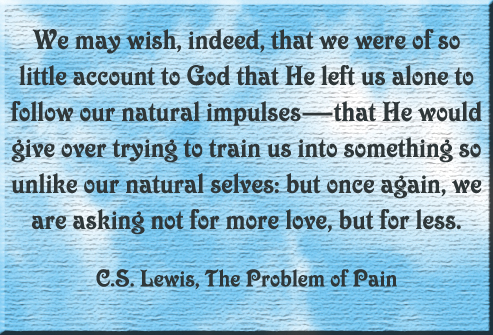
How many times do we devalue God’s promises, choosing instead to cling to things in this world because we do not realize just how much better the things God wants to give us are? In C.S. Lewis’ The Problem of Pain, he says that if we think we want less than God offers — wishing “God had designed us for a less glorious and less arduous destiny” — we are “asking not for more love, but for less.”

"Asking For Less Love" a blog post by marissabaker.wordpress.comSometimes we wish for things that are not good for us because we do not fully understand or value what we are being offered. God loves us too much to let us settle for a curse when He wants to give us a blessing. That’s why He keeps trying to bring us back to Him when we stray. Just look at how many times, in the midst of just punishments for sin, He begs Israel to come back to Him for their good (Hosea 11).

Free In Christ

I didn’t realize until I saw this post still in drafts that there wasn’t a Saturday post last week. Oops. Well, here it is now.

Then Jesus said to those Jews who believed Him, “If you abide in My word, you are My disciples indeed. And you shall know the truth, and the truth shall make you free …

“Most assuredly, I say to you, whoever commits sin is a slave of sin. And a slave does not abide in the house forever, but a son abides forever. Therefore if the Son makes you free, you shall be free indeed.” (John 8:31-32, 34-36)

What happens once we are made free from sin? Some people (especially those in Western cultures, I suspect) tend to think of freedom as license to do whatever they want. This is not what is meant by the freedom that we are given in Christ.

And having been set free from sin, you became slaves of righteousness. (Rom. 6:18)

The Bible reveals that we have only two options: service to sin or service to God. Though we are “not under law but under grace,” that does not give us license to disobey. Under the New Covenant, God’s commandments are still in effect, and He requires obedience from those who love Him (John 14:15, 21).

What then? Shall we sin because we are not under law but under grace? Certainly not! Do you not know that to whom you present yourselves slaves to obey, you are that one’s slaves whom you obey, whether of sin leading to death, or of obedience leading to righteousness? (Rom. 6:15-17)

"Free In Christ" marissabaker.wordpress.comThis does not mean we can earn eternal life by obedience — it is a free gift from God (Rom. 6:23). However, we can show by disobedient actions that we refuse to accept His gift. When we do that, it’s as if someone pulled us from a burning building and said, “Don’t go back in there,” and instead of obeying we marched right back inside because we thought the heat felt good.

Once we have been redeemed by Jesus Christ, we have to respond by walking not “according to the flesh, but according to the Spirit” (Rom. 8:1). We will surely slip and fall, but we have to stop willfully sinning and make a genuine effort to change and obey. The habit of our life has to become Christ-imitating instead of sinful.

For this is the will of God, that by doing good you may put to silence the ignorance of foolish men — as free, yet not using liberty as a cloak for vice, but as bondservants of God. (1 Pet. 2:15-16)