Slightly Bad Leah

As I mentioned last week, I recently finished reading Liz Curtis Higgs’ Bad Girls of the Bible series. Slightly Bad Girls, the last book, is a slightly different format than the first two. Higgs only covered five women’s stories — Sarah, Hagar, Rebecca, Rachel, and Leah — which allowed her to spend more time with their stories.  The fictional accounts span at least two chapters for each character, which allows a longer story-arch for each woman than in the two previous books.

Leah

Leah’s  story was the one I found most interesting. There is so much we don’t know about her. For example, we know Jacob was livid when he woke to find Leah in his bed instead of Rachel (Gen. 29:21-24), but we have no idea how Leah reacted to her father switching brides (or what Rachel’s opinion was for that matter).

I wonder what Leah was thinking. Was she so scared of her father that she didn’t dare disobey when he “brought her to Jacob” (Gen 29:23)? Did she want to get out of her father’s house so much she would have married anyone? Was she trying to steal Rachel’s husband? Perhaps she was in love with Jacob and hoped he would return that love once they were married (I don’t have much experience with relationships, but I’m pretty sure impersonating your unrequited-crush’s bride on their wedding night is not the best way to make him fall in love with you).

God’s Love

One of the most interesting verses in Leah’s story is this:

When the Lord saw that Leah was unloved … (Gen. 29:31)

Setting aside for the moment how terrible it was for Leah to be unloved, let’s think about how incredible God’s compassion was for her. He saw her and He  “listened to” her prayers (Gen.30:17). Isn’t it comforting to know that even when people who should love you don’t, God sees everything and cares deeply for our pain? It makes me think of my favorite Psalm.

O Lord, You have searched me and known me. You know my sitting down and my rising up; You understand my thought afar off. You comprehend my path and my lying down, and are acquainted with all my ways. (Ps. 139:1-3)

We serve a God who is powerful enough to do anything, and He chooses to let His attention and His compassion rest on us. For Leah, God’s care took the form of blessing her with children.

Leah’s Children

I hadn’t thought about it before, but Higgs points out that what Leah says when each of her sons was born reveal that she had a deeper faith in the God than we often give her credit for.

So Leah conceived and bore a son, and she called his name Reuben; for she said, “The Lord has surely looked on my affliction. Now therefore, my husband will love me.” Then she conceived again and bore a son, and said, “Because the Lord has heard that I am unloved, He has therefore given me this son also.” And she called his name Simeon. She conceived again and bore a son, and said, “Now this time my husband will become attached to me, because I have borne him three sons.” Therefore his name was called Levi. And she conceived again and bore a son, and said, “Now I will praise the Lord.” Therefore she called his name Judah. Then she stopped bearing. (Gen. 29:32-35)

Leah recognized that her sons were a gift from God, given to comfort her when He saw Jacob did not love her. She realized that she was heard and loved by God, and by the time she named her fourth child, Judah, she was able to offer praise to the Lord without even mentioning her hope that Jacob would learn to love her. (As an interesting side note, this is the first time the word “praise” appears in the King James translation.) I doubt Leah moved past her desire for her husband’s love, but perhaps she reached a point where her relationship with God gave her the peace needed to accept her life.

Not that I speak in regard to need, for I have learned in whatever state I am, to be content: I know how to be abased, and I know how to abound. Everywhere and in all things I have learned both to be full and to be hungry, both to abound and to suffer need. I can do all things through Christ who strengthens me. (Phil. 4:11-13)

Bad Girls of the Bible

I’ve been reading a series of three books by Liz Curtis Higgs titled Bad Girls of the Bible, Really Bad Girls of the Bible, and Slightly Bad Girls of the Bible. The first book was decided upon for a book club at church, and once I’d finished it I tracked down the other two from the library. Higgs’ writing style is a little more informal than I usually like (I found myself skipping some of her “Lizzie style” commentary), but I like the short fictionalized stories that begin each chapter and bring the woman’s story into a modern setting. I also appreciate spending an entire chapter discussing the Biblical accounts verse-by-verse, and sometimes even word-by-word, since I don’t always take the time I should to really think about the people in the Bible. I’ll talk about the first two books in the series now, but I have enough to say about Slightly Bad Girls that I think I’ll save it for another post.

Bad

Higgs’ reason for studying less-than-perfect women is that they can “show us how not to handle the challenges of life.” They can also be more relatable than women who seem perfect, and studying the weaknesses we share with women who stumbled can help us avoid pitfalls in our own lives.

The women discussed in this book are Eve, Potiphar’s Wife, Lot’s Wife, The Woman at the Well, Delilah, Sapphira, Rahab, Jezebel, Michal, and The Sinful Woman. I was really impressed with the fiction in this book. Eve becomes a sheltered rich girl, Delilah is a hairdresser, and Lot’s Wife a woman who refuses to leave her home near Mount Saint Helens. The fiction story for the Woman at the Well isn’t quite as well done, but it’s hard to come up with a modern fictionalized character to stand-in for Jesus so I think we’ll cut the author some slack.

Really Bad

I read these books slightly out of order, so this is the one I just finished. The title is a little misleading — it’s more like additional bad girls, rather than girls who are worse than those in the last book. Higgs describes the difference between the two books like this:
If the first Bad Girls of the Bible was all about grace, this second one is all about the sovereignty of God, the unstoppable power of God to accomplish his perfect will, no matter how much we mess up.

This book covers the Medium of En Dor, Jael, The Adulteress, Athaliah, Bathsheba, Herodias, Tamar, and The Bleeding Woman. What struck me most about this book was the Bleeding Woman’s story (from Matt. 9:20-22; Mark 5:25-34; Luke 8:43-48). This woman was bleeding for twelve years — that’s 4,380 days, plus a few extra for leap years. According to Levitical law, she was ceremonially unclean the entire time (Lev. 15:19-27). She couldn’t touch anyone, and probably had to live alone because everything she came in contact with became unclean. Can you imagine people not even wanting to be in the same house as you for twelve years? I like solitude as much as the next introvert, but that’s way too much alone-time.

When Jesus healed her, He took away not only her physical infirmity, but also her separation from other people. And He talked to her in public — not something teachers normally did with women, especially women who were still ceremonially unclean (Lev. 15:28-30). She is also the only woman in the Gospels who Jesus calls “daughter.” What an incredible story!

Reasons for Suffering

"Reasons for Suffering" marissabaker.wordpress.com
image from Stock.xchng

One of the best sermons we heard during the Feast of Tabernacles was titled “Why Will God Release Satan to Deceive the World Again?” (Sept. 24 sermon, link in Pacific COG archives). I could probably write half a dozen blog posts on different points he brought up, but for now I want to focus on just one. In the context of trying to see things from God’s point of view (such as understanding His decision to release Satan after the Millennium [Rev. 20:1-10]), the speaker brought up the subject of suffering. When we’re suffering, our automatic response is to want the suffering to end because we view it in a negative light, but God’s perspective can be very different.

Blessed Persecution

If we start reading the beatitudes, those who Christ calls blessed are not always in a condition we would consider a blessing. They are “poor in spirit” (Matt. 5:3), they mourn and weep (Matt. 5:4; Luke 6:21), they are hungry (Luke 6:21), they are hated (Luke 6: 22), and they are persecuted.

Blessed are those who are persecuted for righteousness’ sake, for theirs is the kingdom of heaven. Blessed are you when they revile and persecute you, and say all kinds of evil against you falsely for My sake. Rejoice and be exceedingly glad, for great is your reward in heaven, for so they persecuted the prophets who were before you. (Matt. 5:10-12)

I don’t know about you, but my first reaction when I’m feeling persecuted is not to “rejoice and be exceedingly glad” or to “leap for joy” (Luke 6:23). Yet we should be more like the apostles who, after they were beaten and commanded not to preach Jesus any more, “departed from the presence of the council, rejoicing that they were counted worthy to suffer shame for His name” and made themselves the target of more persecution by continuing to preach (Acts 5:40-42).

If we suffer with Him

The question, “Why would God allow suffering?” is frequently asked by those in the church and by those who have rejected belief in God. If He’s all powerful, we wonder, why would He allow such terrible things to happen? One answer, as pointed out in the sermon I’ve been referring to, is that God sees suffering in a different light than we do. Often, what we see as negative in this moment will ultimately be for our good. For example, in Romans 8, Paul writes that we will be glorified with Christ on the condition that we suffer as He suffered.

The Spirit itself beareth witness with our spirit, that we are the children of God: and if children, then heirs; heirs of God, and joint-heirs with Christ; if so be that we suffer with him, that we may be also glorified together. For I reckon that the sufferings of this present time are not worthy to be compared with the glory which shall be revealed in us. (Rom. 8:16-18, KJV)

This is certainly not the only scripture that talks of our glorious future as being conditional on present suffering. Here are a few more:

our light affliction, which is but for a moment, is working for us a far more exceeding and eternal weight of glory (2 Cor. 4:17)

if you should suffer for righteousness’ sake, you are blessed (1 Pet. 3:14)

But when you do good and suffer, if you take it patiently, this is commendable before God. For to this you were called, because Christ also suffered for us, leaving us an example, that you should follow His steps (1 Pet. 2:20-21)

Why is suffering so important?

Finding these scriptures and understanding that suffering is part of being a Christian is not hard. Accepting that there is a good reason for suffering in your life or in the lives of those you love is the hard part. And this is why I really appreciated this sermon message, because the speaker didn’t just tell people “suffering is good for you, be happy.” He pulled together an easy-to-understand analysis that moved logically from the proper reaction to suffering, to the reward for suffering, to the reason for suffering.

My brethren, count it all joy when you fall into various trials, knowing that the testing of your faith produces patience. But let patience have its perfect work, that you may be perfect and complete, lacking nothing. (James 1:2-4)

The reason for trials and testings and suffering is that it helps us learn to be like God. If we were dancing through life without a care in the world, we would forget how much we depend on God. If we never suffered for following Christ, we would have no sense of how much we owe Him for dying in our place. If we did not suffer the consequences of sin, we would never learn to hate sin as much as God does.

Of Kayaking and Love Languages

image from stock.xchng

In keeping with my decision to blog every day of the Feast of Tabernacles, I’m going to share a story from a previous Feast for today’s post. I originally wrote this account to read aloud in a creative non-fiction class in 2011. The only thing I’ve edited from that version is changing the guys’ names, and my sister asked for her name to be taken out.

It was so hot in Panama City Beach that my glasses would steam up stepping outside from the air conditioned hotel. My family was there two years ago, in the fall, meeting with a church group that had chosen Florida as the location to observe the week-long Feast of Tabernacles, one of our annual Holy Days. Just a couple days into the Feast, my sister and I met two brothers, Quentin and Declan. Somehow, in the course of our conversation, the idea of kayaking on a nearby lagoon came up. Not entirely comfortable going anywhere with two guys we’d hardly known more than an hour, I was trying to politely refuse when Quentin suggested our whole family come. Well, surely he couldn’t be that dangerous if he was willing to include our Dad, Mom, and younger brother, so my sister and I agreed to the plan and invited the two brothers to eat lunch with our family in the condominium.

Of course, something had to go wrong. Mommy sliced her finger open on a can of pineapple, not too seriously, but enough to keep her from kayaking. Since she was laid-up, Daddy and my brother also stayed behind and my sister and I set out with Quentin and Declan. We split the cost of kayak rentals, but still, (or so my mother informs me) it was my first “date” as well as my first time kayaking. As it turned out, I enjoyed the kayaking part a lot more than the “dating” part. Quentin and I shared one kayak, and Declan and my sister shared the other. Both brothers had quickly lost interest in my sister after learning she was under 18, and I learned later that Declan and my sister hardly spoke the whole kayaking venture. By the time we got back to the hotel, I was convinced that lagging conversation would have been preferable to mine and Quentin’s discussion.

The kayaking adventure began promisingly. We watched pelicans ungracefully plop into the ocean and laughed at terns diving like missiles honing in on fish in the water below. The water was so clear you could look through the ripples and see fish swimming through snaky sea-grass while crabs skittered along the sandy bottom. Occasionally, a fish would randomly leap from the water, as if it was so happy to be alive that simply swimming was no longer enough and it had to take flight.

We had stopped paddling for a moment to take in the scenery when Quentin suddenly asked, “Have you heard of the book The Five Love Languages?”

I drew out my “Yes…?” like a question, which he took as permission to reveal that his love language was “Quality Time.” Then, as if the conversation were not awkward enough already, he went on to explaining that he particularly liked time spent with someone in a natural setting.

You mean like a lagoon in Florida, alone with someone you met just THREE HOURS AGO? I thought while mumbling something non-committal. Picking up my paddle, I cut short the conversation by steering our kayak back towards my sister’s and Declan’s kayak, vowing there was no way I was going to tell Quentin one of my primary love languages was “Touch”.

“Because We Love The Brethren”

We had a lovely first day of the Feast yesterday. Our little group is live-streaming from Pacific Church of God, and the sermon yesterday was excellent. Mr. Railston’s main theme was using the Feast to make a positive difference in the lives of other people, instead of focusing on “what can I do for me this Feast?” Our focus should be on rejoicing with others and giving them reason to rejoice, not simply making ourselves happy.

There were two scriptures that particularly stood out to me. In a discussion of Matt. 22:35-40, Mr. Railston pointed out that the first great commandment, loving God, could be done in isolation. The second great commandment, to love your neighbor as yourself, must be fulfilled in the presence of other people. And here’s the second scripture:

We know that we have passed from death to life, because we love the brethren. He who does not love his brother abides in death. (1 John 3:14)

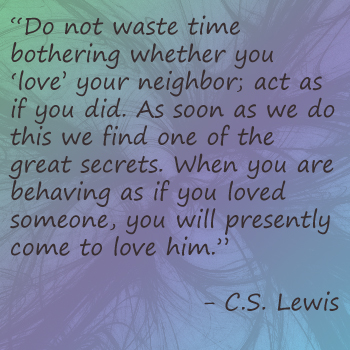
"Because We Love The Brethren" marissabaker.wordpress.comI’ve studied the subject of love in the Bible often, but I hadn’t thought much about the scripture in 1 John, or about the fact that we need to be around people to love them. It’s not that I really expected to love my brethren as a hermit — I just hadn’t thought of it in those words. I tend toward a more introspective approach to life, and my first reaction is to worry about changing myself and bringing “every thought into submission.” While it is important to be personally working toward perfection, I think my approach should probably be a little closer to C.S. Lewis’s councel to “not waste time bothering whether you ‘love’ your neighbor; act as if you did.” Sometimes action has to come before we feel like doing something or we think we’re perfectly ready.

God of Love, Old Testament

Love has always been an integral part of God’s relationship with His people. The commandments Christ called greatest (Mat. 22:37-39; Mar. 12:29-31) are contained in the the law delivered to Moses: “thou shalt love the LORD thy God with all thine heart, and with all thy soul, and with all thy might” and “thou shalt love thy neighbor as thyself” (Deu. 6:5; Lev. 19:5). In addition, the Old Testament conversation about love was not limited to instructions. God also declared His great love for His people.

For thou art an holy people unto the LORD thy God: the LORD thy God hath chosen thee to be a special people unto Himself, above all people that are upon the face of the earth. The LORD did not set His love upon you, nor choose you, because ye were more in number than any people; for ye were the fewest of all people: but because the LORD loved you, and because He would keep the oath which He had sworn unto your fathers, hath the LORD brought you out with a mighty hand, and redeemed you out of the house of bondmen, from the hand of Pharaoh king of Egypt. (Deut. 7:6-8)

In the Old Testament, God’s love is revealed in many ways. He shows His love by rescuing Israel from Egypt and defeating her enemies. His love is contained in the law, given to protect His people from the consequences of sin. Love is shown every time He chastises Israel for forsaking Him and in the way He offers forgiveness and welcomes them back when they repent. He also tells His people He loves them.

“I Love You,” says God

When I first started studying this subject, I was amazed to read how many declarations of love God makes for His chosen people. He calls Himself Israel’s husband, and even after they were unfaithful to Him, He promised to redeem His people from their sins and marry them again — a promise fulfilled when Jesus Christ established the New Covenant. He says, “I will allure her, and bring her into the wilderness, and speak comfortably unto her. … And it shall be at that day, saith the LORD, that thou shalt call Me Ishi [husband]; and shalt call Me no more Baali [master]” (Hos. 2:14,16).

And I will betroth thee unto Me for ever; yea, I will betroth thee unto Me in righteousness, and in judgment, and in loving kindness, and in mercies. I will even betroth thee unto Me in faithfulness: and thou shalt know the LORD. And it shall come to pass in that day, I will hear, saith the LORD, … and I will have mercy upon her that had not obtained mercy; and I will say to them which were not my people, Thou art my people; and they shall say, Thou art my God. (Hos 2:19-21, 23 KJV)

Can there be anything more beautiful than these promises? God is often accused of being unfairly harsh in His judgments, but how many human beings whose spouse was unfaithful would be as merciful towards them as the Lord is toward His unfaithful people?God of Love, Old Testament. marissabaker.wordpress.com

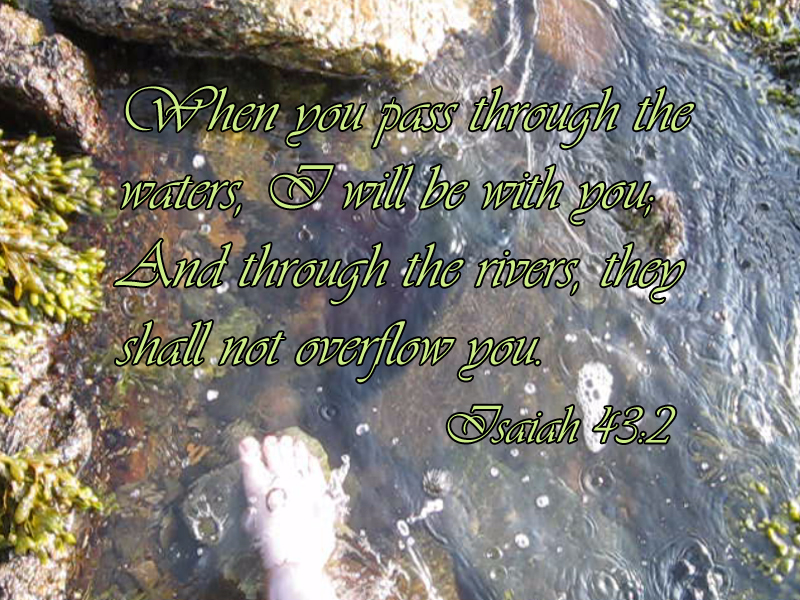
But now, thus says the Lord, who created you, O Jacob, and He who formed you, O Israel: “Fear not, for I have redeemed you; I have called you by your name; You are Mine. When you pass through the waters, I will be with you; and through the rivers, they shall not overflow you. When you walk through the fire, you shall not be burned, nor shall the flame scorch you. For I am the Lord your God, the Holy One of Israel, your Savior; I gave Egypt for your ransom, Ethiopia and Seba in your place. Since you were precious in My sight, You have been honored, and I have loved you; therefore I will give men for you, and people for your life. (Is. 43:1-4 NKJV)

This is one of my favorite passages from the Old Testament. It is so full of reassurance and love.

I was going to write a more complete concluding paragraph, but we have morning services today and I’m running out of time to get to choir practice. Happy Sabbath!