Is There Ever A Good Reason To Lie?

Over the past couple weeks, I’ve been pondering a topic that I’ve had such a difficult time writing about that I skipped one of my regular posting weeks and then picked another topic for my end of May post. It all started when my husband pointed out a Bible commentary that condemned Rahab for her lie even though it saved the lives of the two spies, and maintains there is never any acceptable reason for a lie (see Beyond Today Bible Commentary: Joshua 2). This stance comes down absolutely on the subject of sin and lies: lies are always a sin and never excusable under any circumstances. Then just a few days later, I read about Christians online sharing made up statistics and excusing it because the lie might encourage people to pray (see “Lying for Jesus: When Did Truth Become UnChristian?” by Sheila Wray Gregoire). This is a completely opposite view, one that approaches truth lackadaisically without any respect for the Bible’s teachings on truth and lies.

The Bible is very clear that lying is a sin and God hates it when people deal falsely. Framed in more positive wording, God’s people ought to follow the Truth and speak only truthful things. And yet we have that example of Rahab, where it seems that a good thing came from her lie, and also the example of the midwives who defied Pharaoh’s command to kill baby boys then concealed the truth, whom God rewarded for their actions. Does that mean they didn’t actually lie? Or that God is sometimes okay with lying? Or might there be some thing else going on, something that hits on a deeper topic of how we approach God’s rules and–more importantly–how God wants us to see His rules and understand His grace.
Image of a woman sitting at a table and studying the Bible overlaid with text from James 4:6-8, NET version: "But he gives greater grace. Therefore it says, “God opposes the proud, but he gives grace to the humble.” So submit to God. But resist the devil and he will flee from you. Draw near to God and he will draw near to you. Cleanse your hands, you sinners, and make your hearts pure, you double-minded."
Image by MarrCreative from Lightstock

The Midwives In Egypt

Rahab is probably the most famous Biblical example of a lie that makes us question whether or not God approved of the deception. In that situation, though, the story does not explicitly state either way what God thought of the lie. It is probable that God did consider this a sin and that it would have been better to find another way to redirect the soldiers, but that because she did the best she could and because she was learning to fear the Lord, God extended grace. There’s one other story, though, where it’s harder for us to condemn the lie.

The king of Egypt spoke to the Hebrew midwives, of whom the name of the one was Shiphrah, and the name of the other Puah, and he said, “When you perform the duty of a midwife to the Hebrew women, and see them on the birth stool, if it is a son, then you shall kill him; but if it is a daughter, then she shall live.” But the midwives feared God, and didn’t do what the king of Egypt commanded them, but saved the baby boys alive. The king of Egypt called for the midwives, and said to them, “Why have you done this thing and saved the boys alive?”

The midwives said to Pharaoh, “Because the Hebrew women aren’t like the Egyptian women; for they are vigorous and give birth before the midwife comes to them.”

God dealt well with the midwives, and the people multiplied, and grew very mighty. Because the midwives feared God, he gave them families.

Exodus 1:15-21, WEB

Only one of the commentaries I looked at comes down on the view that this was a lie and dogmatically says, “Their disobedience in this was lawful, but their deception is evil” (Geneva Study Bible). Commentaries on this passage tend to hedge the midwives’ response by saying it “was probably true; but it was not the whole truth” (Ellicott’s Commentary for English Readers; see also Jamieson-Fausset-Brown Bible Commentary, Pulpit Commentary, and Matthew Poole’s Commentary). However, the commentaries’ justification for saying it’s a half truth smacks of racism or at least incomplete information (i.e. European writers in the 1800s saying Arabic women are reported to deliver babies easily). It’s also countered by the text itself saying the midwives, “didn’t do what the king of Egypt commanded them, but saved the baby boys alive,” which heavily implies that they were there for the births or at the very least could have obeyed the king if they so chose. If they were, in fact, present for the births then saying that the Hebrew women “give birth before the midwife comes to them” was not true. Yet despite this untruth, we are told very clearly, “God dealt well with the midwives” and “Because the midwives feared God, he gave them families.”

In this particular situation, it seems that the midwives had a choice between concealing the truth or participating in murder. I suppose they did have a third choice of telling the king that they disobeyed his command, but that would have also lead to death (and possibly not just for them). This sort of situation is rare, but it’s not unheard of. If someone’s life is in your hands and you’re talking to someone who wants to kill them, telling the whole truth could very easily mean you’ve betrayed someone to death (which is not looked on well in Matt. 24:10). It sounds almost heretical to type this, but it seems from this situation that there was at least one time when God was flexible with His command against lying. At the very least, He extended grace to cover the lie and it was neither condemned nor held against the midwives.
Image of three women holding hands to pray overlaid with text from Zechariah 8:16-17, WEB version: "“These are the things that you shall do: speak every man the truth with his neighbor. Execute the 
judgment of truth and peace in your gates, and let none of you devise evil in your hearts against his neighbor, and love no false oath; for all these are things that I hate,” says Yahweh."
Image by Pearl from Lightstock

Is There Ever A Lesser Evil?

As I’m pondering the midwives’ situation, I wonder if the person who asked Jesus about the greatest commandment might have had similar questions as I do about what to do when you’re stuck in a situation where you can’t clearly see a good choice. If you’re in a situation like the midwives where you have to choose between obeying God’s commands to respect human authority, not commit murder, and to tell the truth, how do you decide which command is most important?

“Teacher, which commandment in the law is the greatest?” Jesus said to him, “‘Love the Lord your God with all your heart, with all your soul, and with all your mind.’ This is the first and greatest commandment. The second is like it: ‘Love your neighbor as yourself.’ All the law and the prophets depend on these two commandments.”

Matthew 22:36-40, NET

The Hebrew midwives never read this verse, but it might give us a clue to their thought process. We can’t obey human authority if they tell us to disobey God; God is a higher authority and we must love Him and follow Him will all our heart, soul, and mind. We cannot commit murder, firstly because God tells us not to but it is also completely incompatible with loving your neighbor as yourself. In the midwives’ situation, it seemed that telling the whole truth had to take a backseat to following the greatest commands. Could they have handled it in a more truthful way and still had a good outcome? Possibly, but whether it’s the case that they didn’t sin at all or they sinned in lying because they didn’t know what else to do, God still rewarded them for their actions. He has the right to extend grace in whatever situation He wants.

On a cosmic, eternal scale, there are not levels of severity to sin. If you keep every command except one, “you have become a violator of the law” and have “become guilty of all of it” (James 2:10, 11, NET; see James 2:8-13). The law gives us “the knowledge of sin” and ensures that “the whole world may be held accountable to God” by clearly showing how God defines sin (Rom. 3:19-20, NET). We’re all guilty in God’s eyes, no matter how “small” our sins might seem, and we all need Jesus’s sacrifice. Paul says that this truth helps show the righteousness and justice of God, who holds all accountable yet freely offers forgiveness and grace through Jesus Christ (Rom. 3:19-26).

No matter which of God’s laws you violate, “the payoff of sin is death” on an eternal timescale and you need “the gift of God [which] is eternal life in Christ Jesus our Lord” (Rom. 6:23, NET). But on an earthly level, we also know that some sins are less destructive than others and God’s laws for ancient Israel reflected that. Every sin would earn you an eternal death penalty (i.e. you can’t live forever unless you accept Jesus’s Christ’s sacrifice on your behalf) but not every sin earned you a physical death penalty when living in a nation ruled by God’s law. For example, murder was a death-penalty sin (Lev. 24:17; Num. 35:30-31) but theft required you pay back more than you stole (Ex. 22:1). If someone lied in a court of law, then the false witness was punished the same way “he had intended to do to the accused” (Deut. 19:19, NET; see Deut. 19:16-19). God didn’t order the same legal penalty for every sin; there was more nuance than that.

We should never think, “I can get away with breaking this one of God’s laws because it’s not a big deal,” but if we’re legitimately in a position where we have to choose between participating in murder or lying about something, I think the choice is clear. You would still need to repent of the lie, but God has a great deal of mercy for people, especially when they are not flagrantly defying Him because they think His laws don’t matter or that they can get away with it.

Maintain Careful Respect For God

Image of a man with his head bowed over an open Bible, overlaid with blog's title text and the words, " I think the answer is both no and yes. "No" in the sense that lying is always a sin, but "yes" in the sense that there are rare situations where you can't see any other way to obey another of God's commands (e.g. "love your neighbor as yourself") than to conceal the truth."
Image by WhoisliketheLord Studio from Lightstock

Scripture is clear that God’s laws are very important and He acts justly at all times. We can rely on Him not to go around changing His laws willy-nilly. He has the sovereign right to deliver and enforce laws, and when we agree to live in relationship with Him, part of our covenant obligation is obedience. At the same time, one of the consistent things we know about His character is that He extends lots of mercy and grace to people who slip, and that He reserves the right to amend His plans in response to human behavior (e.g. withholding destruction from Nineveh after the city repented).

For lying in particular, we’re told in no uncertain terms that it originates with the devil and that those who live untruthful lives are abominable to God (Prov. 12:19, 22; John 8:44; 1 John 2:21). We can count on Him to cover that sin in some very specific circumstances, like for Rahab and the midwives, but we ought not take the grace that He shows to people who lied to save a life as license to lie for anything we think is a good cause. This is where those people we mentioned who spread false research even after knowing it was fabricated made a mistake.

Absolutely not! Let God be proven true, and every human being shown up as a liar, just as it is written: “so that you will be justified in your words and will prevail when you are judged.”

But if our unrighteousness demonstrates the righteousness of God, what shall we say? The God who inflicts wrath is not unrighteous, is he? (I am speaking in human terms.) Absolutely not! For otherwise how could God judge the world? For if by my lie the truth of God enhances his glory, why am I still actually being judged as a sinner? And why not say, “Let us do evil so that good may come of it”?—as some who slander us allege that we say. (Their condemnation is deserved!)

Romans 3:4-8, NET (bold italics mark a quotation from Ps 51:4)

The Bible does not give us license to lie whenever we think we have a good reason. Here, Paul specifically addresses a situation where people thought to forward the gospel by lying, and shows that you are still a sinner if you violate God’s law thinking to do good. We need to obey God the way He tells us to. But it is also worth mentioning here if you lied for what you thought was a good reason, you can still realize your mistake and repent. God is always ready to respond to sincere human repentance with forgiveness and grace.

I almost didn’t share this post because it’s such a tricky thing to write about, but I think it’s good to have these types of conversations because they do come up in hypotheticals and sometimes in real-life. I have heard people say that they worry about being in a situation like Europeans who hid Jews during the Holocaust because they’re concerned that God would condemn them as sinners if they lied when asked, “Are there Jews hiding here?” I don’t think we need to worry about that so much. God is not up there waiting to pounce on us, watching for us to fail if we’re in an impossible situation and can’t think of a better way out.

To directly address the title of this post, “Is There Ever A Good Reason To Lie?” I think the answer is both no and yes. “No” in the sense that lying is always a sin, but “yes” in the sense that there are rare situations where you can’t see any other way to obey another of God’s commands (e.g. “love your neighbor as yourself”) than to conceal the truth. God always looks on our hearts, and there’s a big difference between lying because you can’t think of any other way to save a life (and then repenting of the lie) and lying because you’re too proud to admit your were wrong (especially if you then convince yourself you don’t need to repent).


Featured image by Ben White

Forgive Us Our Debts, as We Have Forgiven Our Debtors

Today’s post is our 5th on Jesus’s model prayer. If you need/want to catch up on the previous posts, here are the links: “Hallowed Be Your Name,” “May Your Kingdom Come,” “May Your Will Be Done On Earth As It Is In Heaven,” and “Give Us Today Our Daily Bread.” As mentioned in those posts, we find versions of Jesus’s model prayer in two gospels. We’ve been focusing on the one in Matthew, which is part of the Sermon on the Mount when He’s talking about good and bad examples for how to pray (Matt. 6:5-15). There’s also a near-identical one in Luke, where Jesus responds to a disciple’s request that Jesus teach them to pray (Luke 11:1-13).

So pray this way:
Our Father in heaven, may your name be honored,
may your kingdom come,
may your will be done on earth as it is in heaven.
Give us today our daily bread,
and forgive us our debts, as we ourselves have forgiven our debtors.
And do not lead us into temptation, but deliver us from the evil one

Matthew 6:9-13, NET

We can think of this prayer as a helpful outline for our own prayers. We’re not locked into repeating it word-for-word; He’s showing us the way to pray rather than giving us a specific prayer to recite (though there can be a time and place for that, too, just like we can read or sing psalms other people wrote at times when we can’t think of what to say or the psalms/prayers speak to our own situations). In this post, we’re looking at the second personal request that’s part of the model prayer: “forgive us our debts, as we ourselves have forgiven our debtors.”

Image of two people's clasped hands overlaid with text from Colossians 3:12-13, NET version: “Therefore, as the elect of God, holy and dearly loved, clothe yourselves with a heart of mercy, kindness, humility, gentleness, and patience, bearing with one another and forgiving one another, if someone happens to have a complaint against anyone else. Just as the Lord has forgiven you, so you also forgive others.”
Image by Jantanee from Lightstock

Forgiving Debts

“Forgive us our debts, as we ourselves have forgiven our debtors” is the only point in this prayer that Jesus explains in more detail. Right after wrapping up the outline, He adds this:

“For if you forgive others their sins, your heavenly Father will also forgive you. But if you do not forgive others, your Father will not forgive you your sins.”

Matthew 6:14-15, NET

There are two different Greek words used here, which is reflected in the English translations “debts” and “sins.” In the prayer, the word used is opheilema, which means “that which is owed” as “a debt” (Thayer’s Dictionary, entry G3783). It’s metaphorically used of sins. “Debtors” is the related word opheiletes, which as you might guess means the person who owes something to another (Thayer; G3781). This word for debtor is also used in Matthew 18, which we’ll be looking at in a moment.

“Sin” is translated from paraptoma, which means “to fall beside or near” or “a lapse or deviation from truth and uprightness” (Thayer; G3900). When it appears in the New Testament it’s translated with English words like “trespass,” “offense,” “fault,” or “sin.” Interestingly, this still isn’t the most commonly used Greek word for sin. That would be hamartia, which means “to miss the mark” or “that which is done wrong, sin, and offense, a violation of the divine law” (Thayer; G266). Harmartia is the word used for “sin” in the version of Jesus’s model prayer that Luke records (Luke 11:4).

Despite the different words, “forgive us our debts, as we ourselves have forgiven our debtors” is clearly connected with “forgive others their sins” so your Father will forgive you. Jesus uses parallel wording to make the connection, and the word for “forgive” is the same in both cases. It’s translated from aphiemi, which means “to let go, give up a debt, forgive, to remit” (Thayer; G863). When we sin, it’s like we owe God something because we messed up. When Jesus died, He paid the penalty in our place, remitting our debts. We need to understand this sin-debt analogy if we’re going to make sense of what’s going on in this part of the model prayer.

Image of a woman reading the Bible at a table, overlaid with text from James 2:12-14, NET version: “Speak and act as those who will be judged by a law that gives freedom. For judgment is merciless for the one who has shown no mercy. But mercy triumphs over judgment.”
Image by MarrCreative from Lightstock

The Necessity of Forgiveness

It might feel kind of weird to think that God’s forgiveness of us is conditional on our forgiveness of others. We like to think of His forgiveness and grace as something freely given that we don’t need to do anything in order to receive. But though we can’t do anything to earn His grace or forgiveness, there are some things we can do to reject them. Later in Jesus’s ministry, He shares a parable that sheds light on the connection between us forgiving others and us receiving forgiveness from God.

Then Peter came to him and said, “Lord, how many times must I forgive my brother who sins against me? As many as seven times?” Jesus said to him, “Not seven times, I tell you, but seventy-seven times!

“For this reason, the kingdom of heaven is like a king who wanted to settle accounts with his slaves. As he began settling his accounts, a man who owed 10,000 talents was brought to him. Because he was not able to repay it, the lord ordered him to be sold, along with his wife, children, and whatever he possessed, and repayment to be made. Then the slave threw himself to the ground before him, saying, ‘Be patient with me, and I will repay you everything.’ The lord had compassion on that slave and released him, and forgave him the debt. 

Matthew 18:21-27, NET

This is mercy. The man was an opheiletes, a debtor, who was incapable of repaying what he owed. Just one talent was “equal to 6,000 denarii. One denarius was the usual day’s wage for a worker” (NET footnote on Matt. 18:24). That means for a typical worker at the time, 10,000 talents was equal to 60,000,000 day’s wages, or about 164,384 years of work. A slave could never dream of repaying that, just like human beings can never do enough to make up for the sins we’ve committed against God (Rom. 3-6). As readers or listeners, we’re supposed to appreciate just what an incredible gift this lord gave the slave.

After he went out, that same slave found one of his fellow slaves who owed him 100 silver coins. So he grabbed him by the throat and started to choke him, saying, ‘Pay back what you owe me!’ Then his fellow slave threw himself down and begged him, ‘Be patient with me, and I will repay you.’ But he refused. Instead, he went out and threw him in prison until he repaid the debt. When his fellow slaves saw what had happened, they were very upset and went and told their lord everything that had taken place.  Then his lord called the first slave and said to him, ‘Evil slave! I forgave you all that debt because you begged me! Should you not have shown mercy to your fellow slave, just as I showed it to you?’ And in anger his lord turned him over to the prison guards to torture him until he repaid all he owed. So also my heavenly Father will do to you, if each of you does not forgive your brother from your heart.”

Matthew 18:28-35, NET

The fellow slave owed only 100 silver coins, or denarii, so about 3 months’ pay (NET footnote on Matt. 18:28). It’s a real debt, but compared to what the first slave owed the lord it’s a tiny sum. The difference between what the slave was forgiven and what he refused to forgive is enormous. We can see how ridiculous he’s being. But it’s just as ridiculous if we refuse to forgive another human being’s offenses against us after God has forgiven our offenses against Him.

It’s not just crazy for us to hold on to a tiny debt someone owes us when God has forgiven us a huge debt against Him. It’s dangerous. Jesus doesn’t leave room for ambiguity in interpreting this parable. The lord takes back His forgiveness, and Jesus says, “So also my heavenly Father will do to you, if each of you does not forgive your brother from your heart.” It’s exactly like He said after sharing the model prayer: “if you forgive others their sins, your heavenly Father will also forgive you. But if you do not forgive others, your Father will not forgive you your sins” (Matt. 6:14-15, NET). There’s an “if” in these verses, making forgiveness conditional. We need to show forgiveness if we want to receive forgiveness.

How To Let Go

Earlier, I said that aphiemi, the Greek word translated “forgive” means “to let go, give up a debt, forgive, to remit” (Thayer; G863). That’s the sense in which it usually applies to forgiveness. But it’s a complex word, and it can also mean “to send away,” “yield up,” “let alone, let be,” or “to leave, go away from one.” If we forgive, we stop holding on to the sins, offenses, debts, and trespasses of other people. We “let it alone,” send away our resentment, and walk away from what we might be owed. It’s much the same thing as our English definition of forgiveness.

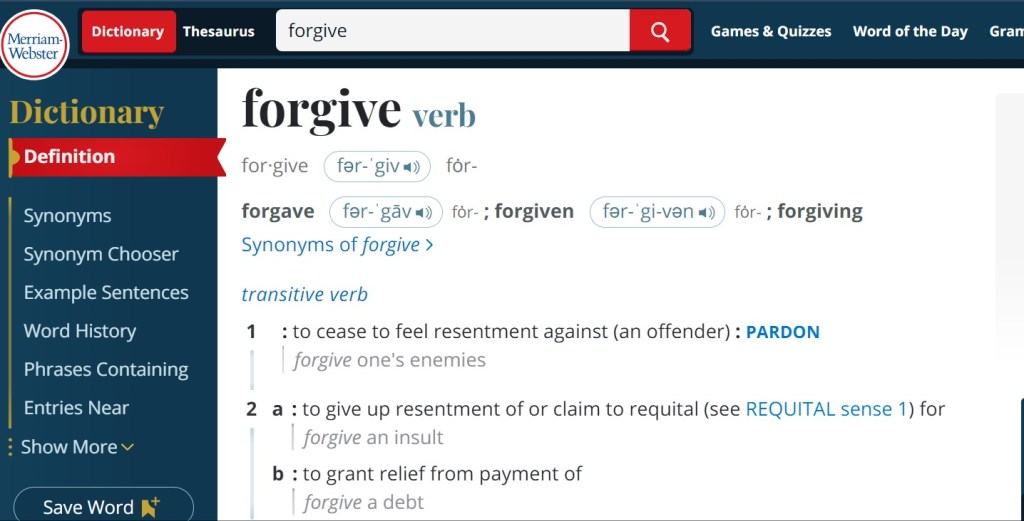
Screenshot of the definition of "forgive" in the Merriam-Webster dictionary. Definitions shown include " to cease to feel resentment against (an offender)," "to give up resentment of or claim to requital," and "to grant relief from payment of"

Notice that none of the things involved with forgiveness require the other person to take action. We can grant forgiveness–let go of resentment and yield any claim to payment owed us–without the other person asking for it. In fact, we should forgive as soon as possible regardless of the other person because we want God to respond positively when we ask Him to forgive us.

Image of a man praying in a church, overlaid with blog's title text and the words, "One of our main goals as Christians is to become like God. That involves learning to be loving, merciful, and forgiving just the same way that He is."
Image by Shaun Menary from Lightstock

One of the things I’ve struggled with related to forgiveness is how to tell if I’ve actually forgiven someone. Some things are relatively easy to forgive, and you might legitimately forget them when you release the debt. There are others, though, that can still color your perception of a person even if you don’t feel resentment or think they owe you something. In certain situations, that can be okay. It’s not always safe to reconcile or restore a relationship, but it’s always right to let go of resentment and the feeling that someone who hurt us owes us for something.

 “If your brother sins, go and show him his fault when the two of you are alone. If he listens to you, you have regained your brother. But if he does not listen, take one or two others with you, so that at the testimony of two or three witnesses every matter may be established. If he refuses to listen to them, tell it to the church. If he refuses to listen to the church, treat him like a Gentile or a tax collector.

Matthew 18:15-17, NET

This short formula for Christian reconciliation comes before Peter’s question about forgiveness and Jesus’s parable about the unforgiving slave. Ideally, we should reconcile if there’s an issue with a “brother” or “fellow believer.” The primary goal is reconciliation and restored relationship. But if that doesn’t work after repeated attempts, you don’t “associate with such a person” (NET footnote on Matt. 18:17). It’s our responsibility to try to reconcile, especially with a fellow believer, but regardless of how that goes we have an obligation to forgive and “live peaceably with all people” (Rom. 12:18, NET; see Rom. 12:16-21).

The conditionality of forgiveness from God should prompt us to extend forgiveness to others. But I don’t think He wants that to be the main reason why we forgive (just like the threat of punishment shouldn’t be the main reason we obey His laws). When we realize what a great debt God forgives us, we should want to forgive others. Similarly, as recipients of God’s great mercy, we should be eager to show mercy to others. Like forgiveness, there’s a reciprocity involved in mercy: “Blessed are the merciful, for they will be shown mercy” (Matt. 5:7, NET) and “For judgment is merciless for the one who has shown no mercy” (James 2:13, NET). One of our main goals as Christians is to become like God. That involves learning to be loving, merciful, and forgiving just the same way that He is. When we pray, “Forgive us our debts, as we ourselves have forgiven our debtors,” we acknowledge that we have an essential role to play in giving and receiving forgiveness.


Featured image by Pearl from Lightstock

Song Recommendation: “Mercy” by Casting Crowns

Mercy for the Unloved: A Story In Hosea, Peter, and Paul

I love reading the book of Hosea. It’s the sort of love story we might be very tempted to say must be fictional if we weren’t convinced of the Bible’s authenticity. It starts out like this:

When the Lord first spoke through Hosea, he said to him, “Go marry a prostitute who will bear illegitimate children conceived through prostitution, because the nation continually commits spiritual prostitution by turning away from the Lord.”

Hosea 1:2, NET

If this was the very first thing God said to you directly, you might privately wonder if it’s really Him. This just doesn’t sound like a good idea, though it’s an excellent illustration of how the nation of ancient Israel treated the Lord. Even the children’s names tell a story that continues all the way into the New Testament.

So Hosea married Gomer, the daughter of Diblaim. Then she conceived and gave birth to a son for him. Then the Lord said to Hosea, “Name him ‘Jezreel,’ because in a little while I will punish the dynasty of Jehu on account of the bloodshed in the valley of Jezreel, and I will put an end to the kingdom of Israel. At that time, I will destroy the military power of Israel in the valley of Jezreel.”

She conceived again and gave birth to a daughter. Then the Lord said to him, “Name her ‘No Pity’ (Lo-Ruhamah) because I will no longer have pity on the nation of Israel. For I will certainly not forgive their guilt. But I will have pity on the nation of Judah. I will deliver them by the Lord their God; I will not deliver them by the warrior’s bow, by sword, by military victory, by chariot horses, or by chariots.”

When she had weaned “No Pity” (Lo-Ruhamah), she conceived again and gave birth to another son. Then the Lord said: “Name him ‘Not My People’ (Lo-Ammi), because you are not my people and I am not your God.”

Hosea 1:3-9, NET

Continuing to read Hosea reveals a fascinating story. On one level, you have Hosea and Gomer’s love story (if you have trouble wrapping your mind around that or are just curious about imagining the feelings involved, I highly recommend the book Redeeming Love by Francine Rivers). On another level, you have God’s expression of great love for His own unfaithful bride, and what that reveals about His long-term plan. That second story carries into the New Testament as well; Peter and Paul both quote Hosea and reference the lesson from Gomer’s illegitimate children’s names to teach a lesson about how God is working today.

Image of a circle of people holding hands overlaid with text from Hosea 2:1, 23, WEB version: “Say to your brothers, ‘My people!’ and to your sisters, ‘My loved one!’ ... I will have mercy on her who had not obtained mercy; and I will tell those who were not my people, ‘You are my people;’ and they will say, ‘My God!’”
Image by Claudine Chaussé from Lightstock

My People! My Loved One!

Before jumping into the New Testament, lets look at what else God has to say about Lo-Ruhamah and Lo-Ammi in His message to Hosea. The first names He gives them aren’t the end of the story.

However, in the future the number of the people of Israel will be like the sand of the sea that can be neither measured nor numbered. Although it was said to them, “You are not my people,” it will be said to them, “You are children of the living God!” Then the people of Judah and the people of Israel will be gathered together. They will appoint for themselves one leader, and will flourish in the land. Certainly, the day of Jezreel will be great!

Then you will call your brother, “My People” (Ammi)! You will call your sister, “Pity” (Ruhamah)!

Hosea 1:10-2:1, NET

Even while asking Hosea to illustrate in heartbreaking detail how much unfaithful Israel hurt their Lord and Husband, God points to a time when He will reconcile with His people. The changes in the children’s names signify a change in the relationship between God and humanity.

“However, in the future I will allure her;
I will lead her back into the wilderness,
and speak tenderly to her.
From there I will give back her vineyards to her,
and turn the ‘Valley of Trouble’ into an ‘Opportunity for Hope.’
There she will sing as she did when she was young,
when she came up from the land of Egypt.
At that time,” declares the Lord,
“you will call, ‘My husband’;
you will never again call me, ‘My master.’
For I will remove the names of the Baal idols from your lips,
so that you will never again utter their names! ….

“I will commit myself to you forever;
I will commit myself to you in righteousness and justice,
in steadfast love and tender compassion.
I will commit myself to you in faithfulness;
then you will acknowledge the Lord.

Hosea 2:14-17, 19-20, NET

Isn’t this a beautiful picture? Not only does God change His people’s names so they are “My people,” “My loved one!” (Hos. 2:1, WEB). He also changes the land’s name so the “Valley of Trouble” turns “into an ‘Opportunity for Hope’” (Hos. 2:15, NET). Then He even changes the name they’ll know Him by, so “that you will call me ‘my husband,’ and no longer call me ‘my master’” (Hos. 2:16, WEB).

In Hebrew thought and language, “The concept of personal names … often included existence, character, and reputation” (Theological Wordbook of the Old Testament, entry 2406). When someone names a child or when God renames someone, it’s “often descriptive of the parent’s wishes or expectations for the personality that was to mature” (TWOT 2406). The name changes here are about changing who we are and how we relate to God. They reveal God’s heart. He wants us to be His beloved people and he wants a husband-wife relationship with us more than a master-servant one. These name changes are also Messianic–they point to something that Jesus did when He died for us.

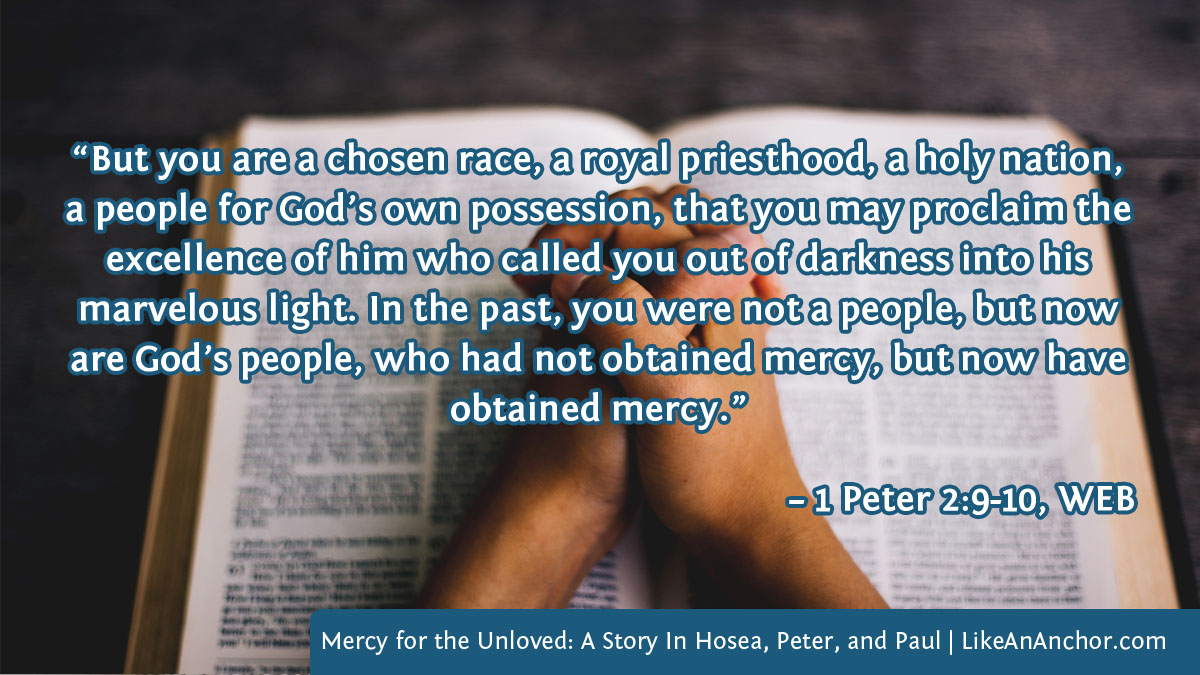
Image of hands clasped over a Bible overlaid with text from 1 Peter 2:9-10, WEB version: “But you are a chosen race, a royal priesthood, a holy nation, a people for God’s own possession, that you may proclaim the excellence of him who called you out of darkness into his marvelous light. In the past, you were not a people, but now are God’s people, who had not obtained mercy, but now have obtained mercy.”
Image by Jantanee from Lighstock

Peter and Paul on the People of God

Paul and Peter both quote Hosea’s book in their writings, specifically referencing the name changes for Lo-Ruhamah and Lo-Ammi. Let’s start with Peter, since reading the general epistles provides good background information for understanding Paul. For more on this epistle, see my post Crash-Course In Peter: Pre-Reqs for Paul, Part Two. Peter writes to Jewish and Gentile believers and connects both of them to a long history of faith. One of several scriptures he references to back up that point comes from Hosea.

So as you come to him, a living stone rejected by men but chosen and precious in God’s sight, you yourselves, as living stones, are built up as a spiritual house to be a holy priesthood and to offer spiritual sacrifices that are acceptable to God through Jesus Christ. For it says in scripture, “Look, I lay in Zion a stone, a chosen and precious cornerstone, and whoever believes in him will never be put to shame.” So you who believe see his value, but for those who do not believe, the stone that the builders rejected has become the cornerstone, and a stumbling-stone and a rock to trip over. They stumble because they disobey the word, as they were destined to do. But you are a chosen racea royal priesthooda holy nationa people of his own, so that you may proclaim the virtues of the one who called you out of darkness into his marvelous light. You once were not a people, but now you are God’s people. You were shown no mercy, but now you have received mercy.

1 Peter 2:4-10, NET (italics and bold in original)

The NET translation puts references to the Old Testament in italics and direct quotes in bold to make it easy to see which parts of the NT directly link back to OT scriptures. Here, Peter quotes or alludes to Is. 28:16, Ps. 118:22, Is. 8:14, Ex. 19:5-6; Is. 43:20-21; Mal. 3:17, and Hos. 1:6, 9; 2:23. Paul does a very similar thing in the book of Romans (I also wrote a Crash Course in Romans post, so you can check that out or read the whole letter if you want context to these statements).

 You will say to me then, “Why does he still find fault? For who has ever resisted his will?” But who indeed are you—a mere human being—to talk back to God? Does what is molded say to the molder, “Why have you made me like this?” Has the potter no right to make from the same lump of clay one vessel for special use and another for ordinary use? But what if God, willing to demonstrate his wrath and to make known his power, has endured with much patience the objects of wrath prepared for destruction? And what if he is willing to make known the wealth of his glory on the objects of mercy that he has prepared beforehand for glory—even us, whom he has called, not only from the Jews but also from the Gentiles? As he also says in Hosea:

I will call those who were not my people, ‘My people,’ and I will call her who was unloved, ‘My beloved.’”
And in the very place where it was said to them, ‘You are not my people,’
there they will be called ‘sons of the living God.’”

And Isaiah cries out on behalf of Israel, “Though the number of the children of Israel are as the sand of the seaonly the remnant will be saved for the Lord will execute his sentence on the earth completely and quickly.” Just as Isaiah predicted,

“If the Lord of Heaven’s Armies had not left us descendants,
we would have become like Sodom,
and we would have resembled Gomorrah.”

What shall we say then?—that the Gentiles who did not pursue righteousness obtained it, that is, a righteousness that is by faith, but Israel even though pursuing a law of righteousness did not attain it. Why not? Because they pursued it not by faith but (as if it were possible) by works. They stumbled over the stumbling stone, just as it is written,

Look, I am laying in Zion a stone that will cause people to stumble
and a rock that will make them fall,
yet the one who believes in him will not be put to shame.

Romans 9:19-33, NET (italics and bold in original)

Here, Paul quotes many of the same scripturas Peter did: Is. 29:16; 45:9; Hos 2:23; 1:10; Isa 10:22-23; 1:9; 28:16; 8:14. He’s also making a similar point. Not only did Jesus’s sacrifice redeem those who are physical descendants of Israel who believe in Him as the Messiah, but He is also making those who were once part of other nations His beloved people.

Hope for All God’s People

Image of two people's hands clasped together with the blog's title text and the words "In Hosea, God promised to take a people that were not His and on whom He no longer had pity and transform them into something new. Then, as Peter and Paul discuss, He followed-through on that promise when Jesus's sacrifice opened the way of life to all people."
Image by Jantanee from Lightstock

Much like in 1 Corinthians, where Paul expects his readers to connect quotes and allusions in that letter to the Feast of Unleavened Bread, Peter and Paul both assume their readers have an understanding of the Old Testament scriptures. Their Jewish readers would have heard the scriptures read at the synagogues their entire lives, and Gentile converts were expected to make a regular practice of listening to those as well (Acts 15:19-21). They would recognize these quotes. The most Biblically literate among them would also put the quotes in context, drawing on the original writer’s whole message when they interpreted Peter’s and Paul’s writings.

Christianity really isn’t a new religion that started after Jesus died–it was the next step in God’s plan that He’d been working on since before the beginning of our world. Peter and Paul reinforce this by quoting prophecies God gave in Hosea with fulfillment in the New Testament church. In Hosea, God promised to take a people that were not His and on whom He no longer had pity and transform them into something new. Then, as Peter and Paul discuss, He followed-through on that promise when Jesus’s sacrifice opened the way of life to all people. Those of a nation that had been chosen by God then rejected Him now had a chance to enter a covenant with Him again. Those who hadn’t been part of the family before are now welcomed in with open arms.

It’s an incredible message of hope. God follows through on His promises. He doesn’t leave those who are unloved and haven’t received mercy in that state. He calls them Beloved and pours out His mercy on them when they come to Him through Jesus Christ. Those promises are still in effect today. We can trust that God loves us this passionately; that He chooses us and claims us for His own special people. Just like He promised so long ago.


Featured image by Inbetween from Lightstock

Song Recommendation: “Out of Egypt” by Carolyn Hyde

God Chose You Even Knowing You’ll Mess Up

This Sabbath follows shortly after the Passover–a day when we remember Jesus’s death and His sacrifice for sins. He told us to keep that day “in remembrance of me” with the symbols of His new covenant. As we think about His sacrifice, we’re forced to consider the terrible price that justice for humanity’s sins–including our sins–demanded. Jesus died an excruciating death. He endured that with His eyes fixed on “the joy set out for him” because He knew that sacrifice was needed to grow His and His father’s family.

Recognizing the high price Jesus paid for us should humble us deeply and move us to genuine repentance. It should also boggle our minds with a realization of His overflowing love. God has been inviting people into His family for thousands of years even though He knew the cost of that welcome. Moreover, He still chooses us today knowing that even after we receive the gift of forgiveness we’ll mess up again. Thankfully, Jesus’s perfect sacrifice keeps covering those sins when we repent after making a mistake; He doesn’t need to be sacrifice again each time we slip-up (Hebrews 10:1-18). God chooses us and keeps showing us mercy even knowing we’ll mess up. This is a kind of love that people rarely offer to each other, but the Creator of all things gives it to us.

A History of Gracious Relationships

Long ago, God chose to form a covenant with Abraham and with his children. Those descendants grew into a nation called Israel, and God delivered them from Egypt on the first Passover. About 50 days later (very likely on the day of Pentecost), God made a covenant with them as well. About 40 years later, when Israel was finally ready to go into the promised land, God had this conversation with Moses:

“Behold, you shall sleep with your fathers. This people will rise up and play the prostitute after the strange gods of the land where they go to be among them, and will forsake me and break my covenant which I have made with them. Then my anger shall be kindled against them in that day, and I will forsake them, and I will hide my face from them, and they shall be devoured, and many evils and troubles shall come on them; so that they will say in that day, ‘Haven’t these evils come on us because our God is not among us?’ I will surely hide my face in that day for all the evil which they have done, in that they have turned to other gods.

“Now therefore write this song for yourselves, and teach it to the children of Israel. Put it in their mouths, that this song may be a witness for me against the children of Israel. For when I have brought them into the land which I swore to their fathers, flowing with milk and honey, and they have eaten and filled themselves, and grown fat, then they will turn to other gods, and serve them, and despise me, and break my covenant. It will happen, when many evils and troubles have come on them, that this song will testify before them as a witness; for it will not be forgotten out of the mouths of their descendants; for I know their ways and what they are doing today, before I have brought them into the land which I promised them.”

Deut. 31:16-21, WEB

God knew Israel wouldn’t be faithful, but He chose them anyway and told them to keep coming back to Him when (not if) they strayed from the right path. Similarly, He choses us knowing we’ll make mistakes and already planning to keep welcoming us each time we turn back to Him repentantly asking for forgiveness. When we begin this relationship with God He asks us for faithfulness, we promise to be faithful, and He accepts that promise even though he knows we’ll slip up and He’ll need to forgive us again.

Even at my best, my faithfulness involves falling, picking myself up (or Him picking me up), and then recommitting to walking with God. I’m encouraged looking at centuries of Bible history that records God’s grace-fueled relationships with people. There’s so much forgiveness available from God; so many calls in His word for people to keep coming back to Him. The whole process of us trying to be faithful to God is enabled by His faithfulness.

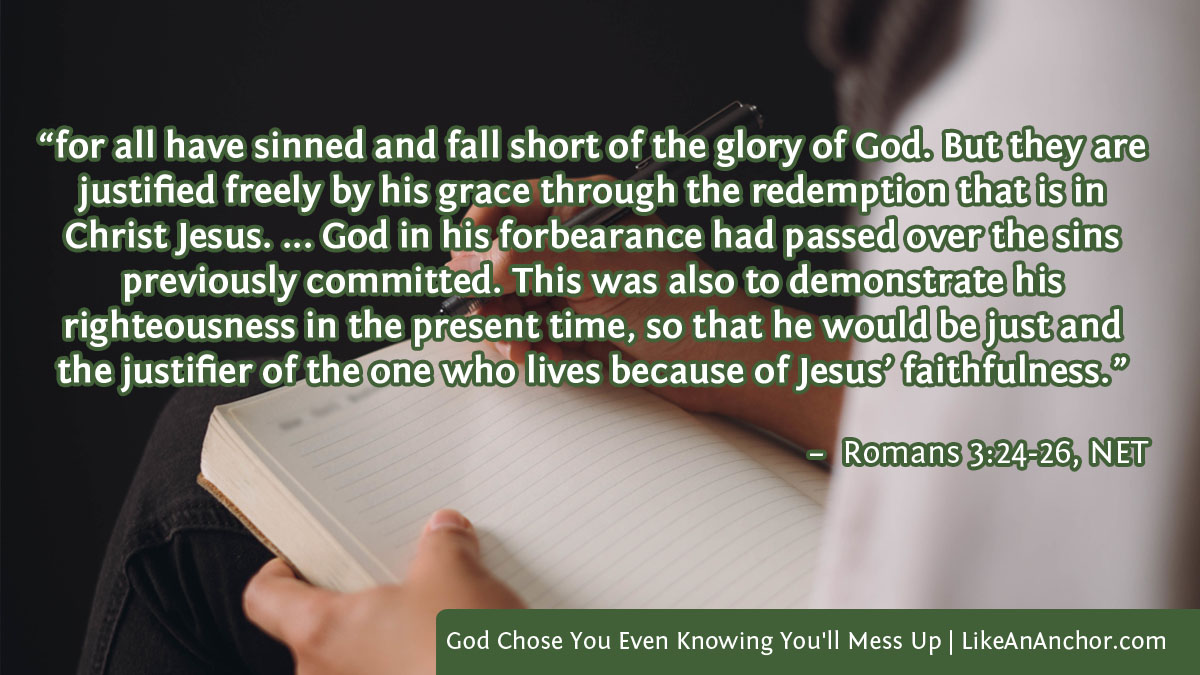
Image of a woman writing in a notebook, with text from Romans 3:24-26,  NET version: “for all have sinned and fall short of the glory of God. But they are justified freely by his grace through the redemption that is in Christ Jesus. ... God in his forbearance had passed over the sins previously committed. This was also to demonstrate his righteousness in the present time, so that he would be just and the justifier of the one who lives because of Jesus’ faithfulness.”
Image by Corey David Robinson from Lightstock

Saved Before We Were Good

Paul’s letter to Rome is one of the Bible books that I find most fascinating. There’s so much packed into this letter about our relationship with God and how His expectations for us work in the New Covenant. Paul spends quite a bit of time discussing the topic of God choosing us even though it’s still a battle for us to live in the spirit rather than in the flesh.

Therefore, since we have been declared righteous by faith, we have peace with God through our Lord Jesus Christ, through whom we have also obtained access into this grace in which we stand, and we rejoice in the hope of God’s glory. Not only this, but we also rejoice in sufferings, knowing that suffering produces endurance, and endurance, character, and character, hope. And hope does not disappoint, because the love of God has been poured out in our hearts through the Holy Spirit who was given to us.

For while we were still helpless, at the right time Christ died for the ungodly. (For rarely will anyone die for a righteous person, though for a good person perhaps someone might possibly dare to die.) But God demonstrates his own love for us, in that while we were still sinners, Christ died for us. Much more then, because we have now been declared righteous by his blood, we will be saved through him from God’s wrath. For if while we were enemies we were reconciled to God through the death of his Son, how much more, since we have been reconciled, will we be saved by his life? Not only this, but we also rejoice in God through our Lord Jesus Christ, through whom we have now received this reconciliation.

Romans 5:1-11, NET

God’s love is so amazing. No one could reasonably expect someone as perfect or as important as God to die for people like us. Most human beings would hesitate to die even for a good person, and we weren’t even good (Rom. 3:24-26). We are family, though, because God the Father decided He wants us to be His children. He claims us as His, justifies us even though we fall short of His glory, and gives us life through Jesus’s faithfulness.

Image of a smiling woman with her arm raised in worship with text from Lamentations 3:22-23, TLV version: “Because of the mercies of Adonai
    we will not be consumed,
    for His compassions never fail.
They are new every morning!
    Great is Your faithfulness.”
Image by Pearl from Lightstock

Mercies and Great Faithfulness

It’s incredible to think of how much God loves us and of the high price He was willing to pay to remove our sins and get us into His family. Knowing that God chose us despite our past sins and even though we aren’t perfect yet should both humble and inspire us.

It’s a strange sort of balance that we’re to have in our thinking. We’re supposed to be confident while acknowledging we have no power or strength on our own. We can fully embrace our importance to God, yet we must never become puffed up and self-important. We get to be heirs in God’s family alongside Jesus, but we must give thanks for God’s mercy and continue following His example rather than boasting about what He has given us.

Image of a man praying with the blog's title text and the words "Knowing that God chose us despite our past sins and even though we aren't perfect yet should both humble and inspire us."
Image by WhoisliketheLord Studio from Lightstock

So in the same way at the present time there is a remnant chosen by grace. And if it is by grace, it is no longer by works, otherwise grace would no longer be grace. What then? Israel failed to obtain what it was diligently seeking, but the elect obtained it. The rest were hardened …

But if you boast, remember that you do not support the root, but the root supports you. Then you will say, “The branches were broken off so that I could be grafted in.” Granted! They were broken off because of their unbelief, but you stand by faith. Do not be arrogant, but fear! For if God did not spare the natural branches, perhaps he will not spare you. Notice therefore the kindness and harshness of God—harshness toward those who have fallen, but God’s kindness toward you, provided you continue in his kindness; otherwise you also will be cut off. And even they—if they do not continue in their unbelief—will be grafted in, for God is able to graft them in again.

Romans 11:5-6, 18-21, NET

Here, Paul explains to his readers that even though many of the the peoples descended from ancient Israel turned their backs on God, He hasn’t given up on anyone. Rather, the Lord “has consigned all people to disobedience so that he may show mercy to them all” (Rom. 11:32, NET). This is a tricky verse, but I think it means that God chooses to treat people who ignore Him or who’ve broken covenants their ancestors made with Him as if they are ignorant and disobedient rather than unredeemably wicked. We’re accountable for what we know and what we do (see Rom. 2-3), but God still chooses mercy over judgment whenever He can (James 2:13).

As we embrace our godly identities more and more fully, we also become more and more like God. And the better we understand His holiness the more easily we see how far from being like Him we really are even as we get better at living His way of life. Alongside that comes an increased appreciation for the incredible gifts of His faithfulness, forgiveness, and mercy that keep guiding us back to Him when we miss the mark. God isn’t surprised that we aren’t perfect yet. He chose us anyway, and He keeps choosing us. We can take comfort in that, knowing that He’s just as invested (and often more so) in getting us into His kingdom as we are in being there.

Featured image by Shaun Menary from Lightstock

Song Recommendation: “Who Am I?” by Casting Crowns

God’s Parental Compassion

I started studying compassion this week and discovered something that seemed a bit odd at first. There are two main Hebrew words translated “compassion” in the Bible, and one of them is also translated “womb.” For example, these two verses use the exact same word:

even by the God of your father, who will help you,
by the Almighty, who will bless you,
with blessings of heaven above,
blessings of the deep that lies below,
blessings of the breasts, and of the womb (rachum).

Genesis 49:25, WEB

Yahweh, remember your tender mercies (rachum) and your loving kindness,
for they are from old times.

Psalm 25:6, WEB

To English speakers, “womb” and “compassion” are entirely different words. We might associate compassion with feminine traits, but other than that there’s not much connection. In Hebrew, though, this word describes love you feel deep in your guts. Racham (H7356), along with closely related words like raham (H7355) and rachum (H7349), are all part of the same word-family (Theological Wordbook of the Old Testament [TWOT] 2146). They refer “to deep love (usually of a ‘superior’ for and ‘inferior’).” It’s the sort of love/mercy/pity/compassion that people feel for each other because “they are human beings (Jer 50:42) and which is most easily prompted by small babies (Isa 13:18) or other helpless people” (TWOT).

Love for the Little Ones

Racham and related words are only rarely used “of men” (TWOT), though it does describe the type of love that a mother has for her children (1 Kings 3:26). Far more often, this word is used to describe how God feels, particularly as a parent toward people who owe their birth to Him (Is. 46:3-4). That’s all of humanity, really–He’s our Creator even if we’re not yet in a parent-child relationship with Him. He sees us as children who belong to Him.

“Can a woman forget her nursing child,
that she should not have compassion on the son of her womb?
Yes, these may forget,
yet I will not forget you!

Isaiah 49:15, WEB

God feels towards us the way a good mother feels towards her children. Even though God always presents Himself as male, women are also made in His image and many traits that we think of as “feminine” are traits of God. His love is perfect and far surpasses even the best parents.

Like a father has compassion on his children,
so Yahweh has compassion on those who fear him.

Psalm 103:13, WEB

Note that in this verse, the Psalmist specifies that “Yahweh has compassion on those who fear him.” It’s similar to how we’ve talked in the past about different types of love that God has for people. Though He has agape for everyone–benevolent love that always seeks good things/outcomes for the people loved– He only has phileo–familial affection based on shared interests–with those who’ve responded to His invitation to enter a relationship with Him (see “Not All God’s Love Is Unconditional: How To Become A Friend Of God”). We’re all little children in God’s eyes and, for those of us in relationship with Him, we’re recipients of a special, familial love that invovles reliable compassion and mercy.

Love that We Can Count On

One of the things that makes God’s love so precious is that we can count on it never to fail. His compassion and mercy aren’t going anywhere and we have abundant evidence in the Bible (and often from our own lives as well) that this is true. He even considers this character trait part of His name (Ex. 33:19; 34:6; Deut 4:31). One example of His rachum can be found in God holding Himself back from destroying ancient Israel no matter how many times they betrayed and forsook Him (Neh. 9:17-19, 27-31). There’s even more evidence in the Psalms, where the writers speak of God’s mercy, recall times when He had compassion on them, and ask for more mercy when they miss the mark (here’s a link to Psalms with rachem words).

It is because of Yahweh’s loving kindnesses that we are not consumed,
because his compassion doesn’t fail.
They are new every morning.
Great is your faithfulness.

Lamentations 3:22-23, WEB

This is still true for us today. Already, we’re the people Hosea prophesied of “who had not obtained mercy, but now have obtained mercy” (Hos. 2:23; 1 Pet. 2:9-10). And if we’re in distress, even if we’ve done something He tells us is wrong, we can count on Yahweh’s great mercies (2 Sam. 24:13-14; Ps. 51:1). That’s a promise backed-up by the sacrifice of Jesus Christ, who came to earth bringing the most incredible proof of our Father’s deep mercy and compassion (Luke 1.76-79; Eph. 2:4-6; Tit 3.4-7).

Just like a little child can trust in a good, responsible mother or father, so we can trust in God. In fact, we must be like little children if we want to inherit the Kingdom of Heaven (Matt. 8:2-4). The more we grow to see Him as our Father and ourselves as completely dependent on Him, the more easily His compassion and mercy flows toward us.

Featured image by Shaun Menary from Lightstock

Jesus: The Mercy Seat and Atonement Sacrifice

I love how dynamic the Bible is. Read a verse you’ve studied dozens of times, and suddenly a slightly different translation or an idea you had last month snaps into clarity and you see a deeper, fuller layer of God’s truth. I like to think that’s the holy spirit working, aligning our thoughts and ideas more closely with God so we can understand the things given to us by God.

The verse to most recently strike me in this way was the NET translation of Romans 3:25. I quoted it in last week’s post. Here, Paul says of Jesus that “God publicly displayed him at his death as the mercy seat accessible through faith.” In the KJV, this was translated as “whom God hath set forth to be a propitiation through faith in his blood.” Both translations are profound, but seeing that connection to the mercy seat (which is an accurate translation of G2435, hilasterion, and is also used in Heb. 9:5) made me think about the idea in this verse more deeply.

“Mercy seat” is one of those things in the New Testament that wouldn’t make any sense at all without context from the Old Testament. Reading either testament in isolation would mean you only get a partial picture of God’s story and plan. It’s all one book, and nowhere is that more visible than when looking at how key aspects of the Old Testament law and worship point straight to Jesus Christ.

Context for the Mercy Seat

The mercy seat was the top part of the ark of the covenant. It is the location where the incense and the blood of the yearly Yom Kippor (Day of Atonement) sacrifice were placed (Lev. 16:11-17) and the place that God’s presence appeared when He met with His people (Ex. 30:6; Num. 7:89). In the Old Testament, the NET uses the translation “atonement lid” for the Hebrew word kapporet to represent that this ornate “lid” for the ark of the covenant (Ex. 25:10-22) is the location where atonement is made and accepted (NET footnote). When there was a tabernacle or temple, the atonement lid/mercy seat was located inside the most holy place (also called the inner sanctuary or holy of holies). A heavy curtain or veil separated this inner sanctuary from view; only the high priest could enter and only once a year.

That background helps us understand what the New Testament writers tell us about Jesus’s death. When Matthew 27:51, Mark 15:38, and Luke 23:45 say “the temple curtain was torn in two” when Jesus died, they most likely mean the curtain that separated the holy of holies from the rest of the temple. Jesus’s death ripped open the separation between God and man. We’re not removed from the place where God appears or the location where atonement is made anymore. On their own, human beings had never been holy or pure enough to be in God’s presence, but now through the blood of Jesus which washes our sins away we can access the holiest places in the heavens.

One Sacrifice in the Heavenly Sanctuary

As we’ve seen, even though the Greek word translated “mercy seat” only shows up twice in the New Testament, the concept plays a much bigger role than it might seem at first. When Paul calls Jesus “the mercy seat accessible through faith,” it’s in the context of God’s righteousness (which “is attested by the law and the prophets”) being even more fully demonstrated in Jesus and the New Covenant than it was in the Old Covenant law (Rom. 3:19-26). There’s a “passing over” of sins that is connected with sacrifice, and the “mercy seat” is the “place or object” where that propitiation/atonement happens (Theological Wordbook of the Old Testament, entry 1023, kapportet).

The author of Hebrews expands on this sacrifice even more. As part of a lengthy discussion of Jesus’s priesthood (which takes up most of the book), this writer says one of the reasons that Jesus “shared in” our “humanity” was “so that he could become a merciful and faithful high priest in things relating to God, to make atonement for the sins of the people” (Heb. 2:14-17, NET). Remember, for Jewish readers (and probably non-Jewish converts in that society as well) the idea of atonement was linked to Yom Kippur and the sacrifice for that day where the high priest offered blood and incense at the mercy seat. Unlike the Old Covenant Levitical priests, Jesus “has no need” to offer daily or even yearly sacrifices (Heb. 7:23-28; 10:10-14). His New Covenant priesthood operates on a heavenly level.

For Christ did not enter a sanctuary made with hands—the representation of the true sanctuary—but into heaven itself, and he appears now in God’s presence for us. And he did not enter to offer himself again and again, the way the high priest enters the sanctuary year after year with blood that is not his own, for then he would have had to suffer again and again since the foundation of the world. But now he has appeared once for all at the consummation of the ages to put away sin by his sacrifice.

Hebrews 9:24-26, NET

The holy places, priesthood, worship, and sacrifices of the Old Covenant all pointed to this: Jesus the High Priest entering the heavenly sanctuary with His own blood to put away sin from all who will accept what He does on their behalf. The importance of Jesus’s sacrifice is something that all Christians, whatever their background or denomination, are intimately familiar with. The more we learn about the rich history of worship and covenants that frame His sacrifice, though, the more fully we can understand and appreciate what Jesus did. And it also deepens our understanding of what He is currently doing–His priesthood has no expiration date. He is still, right this very moment, acting as the “mercy seat” and High Priest in the heavenly temple whose atonement sacrifice removes all our sins by substituting Himself in our place.

Featured image by Pearl via Lightstock