This past Friday I did something I’ve never done before and which provided my father with much amusement. I danced at someone’s funeral. More precisely, it was at a memorial service for a man I didn’t really know. I’d seen him at church services, but we never spoke. His wife was on our dance team, though, and she asked us to open the service by dancing to Bo Ruach Elohim.
At first, I didn’t really feel much about this man’s death beyond a rather abstract sense of sympathy for those who loved him. But as soon as I was surrounded by those who were grieving, I started to feel it as well. Layering on top of that were the emotions I imagined other people I cared about feeling. I won’t go into any details, but some of the things this man’s wife and daughter mentioned when they spoke about him directly touched on struggles I know two other friends are going through. And my heart ached with/for them all.
INFJs are inherently sensitive to other people’s emotions. On top of that, many describe themselves as an HSP (Highly Sensitive Person) and/or empath. This trait, “empath,” isn’t simply a person who feels empathy. Here’s a description written by Jennifer Soldner, an empathic INFJ:
An empath is a person who feels exactly what others feel. This is not to be mistaken with sympathy, which is trying to understand what someone is going through, or even the very similar word empathy, which is actually just being familiar with what someone else is experiencing. An empath literally feels exactly what someone else feels, even if they have never experienced, nor can they relate in any way to what the other person is going through. (from The INFJ Empath Explained)
Talking about being an empath is kind of tricky. Going back to my opening story, suppose I told you that I didn’t start out having feelings of my own about this man’s death, but when I walked into a room of people grieving for him I felt grief. Someone who reads that and assumes I’m an empath would say it’s because I was picking up the other people’s energy waves and feeling their grief as if the emotion were my own. Someone who doesn’t think I’m an empath would say I’m mirroring the other people’s grief because I observe it and care about them, or that I’m projecting my ideas of what they are feeling and then responding to that. Read more →
We’ve all gotten lost in thought and stubbed our toes or run into something because we weren’t paying attention (or is that just me and my friends?). But for some of us, keeping track of what’s going on in the outer world is actually quite a challenge. People who are Sensing types in the Myers-Briggs system are naturally “wired” to interact with the real world of sensory information, but Intuitives are more concerned with abstract thought and possibility. It can be quite a strength, but it has its downsides as well (perhaps there’s a reason only 30% of the population is Intuitive).
When Sensing isn’t your preferred function (or, in the case of INxJs and ENxPs, isn’t even your second or third function), it can be easy to loose touch with the outer world. Dominant Intuitives may forget to eat or exercise when they’re distracted by non-sensory concerns. We might zone-out and miss important things going on in the outer world. Sometimes we even get hurt and can’t remember how (if I had a dollar for the bruises, cuts, and bumps I notice and wonder “How’d that get there?” …). Yet as challenging as it is, getting in touch with our inferior function, and even befriending it in some way, offers rich opportunities for growth and stability. Read more →
It always intrigues me how certain characters attract so much investment from viewers. Browsing Pinterest lately, it seems like Bucky is the new Loki — the Marvel fandom’s dark, mistreated character who just needs a hug because we love him soooooo much. In Bucky’s case, the reasons why we find his character compelling aren’t too hard to find. He’s a good man who was forced to do terrible things and is now constantly fighting a battle to be himself. Sebastian Stan’s portrayal allows audiences to glimpse Bucky’s human side under the soldier persona he wears and the assassin role he’s forced to adopt, and audiences are drawn in by a realistic, sensitive portrayal of a compelling character.
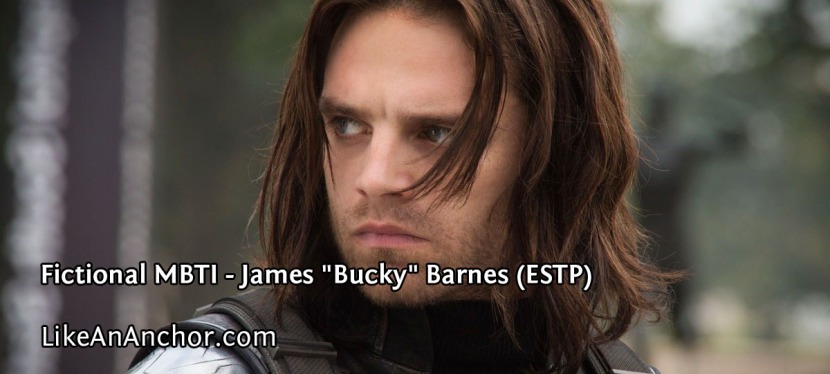
Most people type James “Bucky” Buchanan Barnes as an ESTP, and I’m inclined to agree with them. Operating under the assumption that MBTI type doesn’t change, when we see him as Bucky in Captain America: First Avenger he’s a healthy, stable version of his MBTI type. The version of Bucky we see later in Captain America: The Winter Soldier is a severely stressed and traumatized man of the same MBTI type. Bucky in Captain America: Civil War is still dealing with the fall-out of all he went through, but he’s more recognizable as an ESTP.
Typing Bucky Barnes
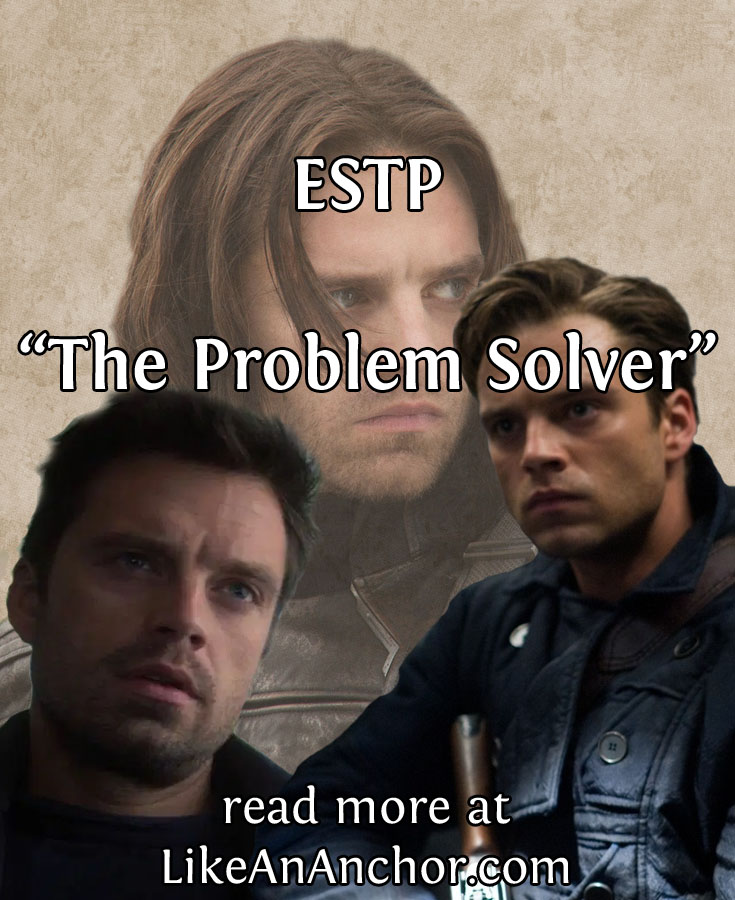
We only get about 13 minutes of footage with Bucky in the first Captain America film, but those scenes reveal a character in line with type descriptions of ESTPs as people characterized by decisive action, contagious energy, and enjoyment of being in the moment. They are “thrillseekers who are at their best when putting out fires, whether literal or metaphorical. … They assess situations quickly and move adeptly to respond to immediate problems with practical solutions” (Truity.com description). David Keirsey writes that ESTPs (whom he nick-names Promoters) “live with a theatrical flourish which makes even the most routine events seem exciting. … Promoters demand new activities and new challenges. Bold and daring at heart, and ever-optimistic that things will go their way, Promoters will take tremendous risks to get what they want, and seem exhilarated by walking close to the edge of disaster.” Other nicknames for ESTPs include “problem solver” and “realist.”
ESTPs lead with a mental process called Extroverted Sensing, or “Sensation.” This process “can get into the action in the moment. Think of it as ‘real-time kinetic’” (from Personality Hacker). It’s a fun-loving function that delights in sensory experiences, such as Bucky spending his last night in New York dancing with girls he probably doesn’t care whether or not he ever sees again. On that same night, he and Steve are talking about Steve’s inability to enlist and he says, “I don’t see what the problem is. You’re about to be the last eligible man in New York.” He’s trying to make Steve feel better with joking and doesn’t really ‘get’ the duty-fulfilling and self-sacrificing aspect of Steve’s character. It’s not a deeply ingrained aspect of his personality type (like it is for ISFJ Steve), though in practice he still does his duty and sacrifices himself because he’s a loyal friend and a good man.
We also see Bucky demonstrate sensory skills in more serious situations. Even post-experimentation and groggy when escaping Redscull’s prison, Bucky could walk across that metal girder with coordination, balance, and no hints of fear other than a healthy caution. As a Howling Commando, we see him as a sniper (which requires skills that come naturally to SP types) and making split-second sensory decisions with ease in the final train fight.
ESTP types support their Sensation function secondary with Introverted Thinking (or “Accuracy”) and then tertiary Extroverted Feeling (or “Harmony”). These mental processes describe how ESTPs, like Bucky, make decisions. First he’s using impersonal criteria to evaluate information and make decisions that are motivated by his own understanding of how the world works. Extroverted Feeling gives ESTPs an insight into other people that they stereotypicaly use to be charming and get people to do what they want. When he tries to ask Peggy to dance, he’s clearly not used to being ignored in favor of his friend (or any other guy). ESTPs are not primarily an emotional sort of people, though. In an early scene, Bucky had just had an argument with his best friend and turns that emotionally invested side of himself ‘off’ to take the girls dancing and enjoy himself.
The Winter Soldier
Once Hydra turns Bucky into the Winter Soldier, it’s difficult to use any scenes to get a clear picture of his personality type. In Captain America: The Winter Soldier we see a few glimpses of the real Bucky trying to get out, but not really anything to help with typing him. In Civil War, however, his own mind is starting to reassert itself and we can talk about his personality type in that film.
When ESTPs are stressed, one of the most common things they experience is internal confusion. They feel out of control, forget details, and become paranoid. Their inferior, or 3-year-old, function is Introverted Intuition (also called “Perspectives”). It’s a mental process that speculates on things that cannot be known, which is great for creativity and insight if you’re using it as a driver process but not so good if it’s an underdeveloped function that comes out when you’re stressed. Most ESTPs snap out of what Naomi Quenk calls a “Grip experience” (where stress causes your inferior function to assert itself) fairly quickly, but “Chronic grip behavior can lead the individual and others to believe that he or she is typically negative, pessimistic, and worried about both the present and the future” (Was That Really Me? p.180). Add to that all the torture and brainwashing used to turn Bucky into the Winter Soldier, and you have the Bucky who’s fighting alongside Cap in Civil War.
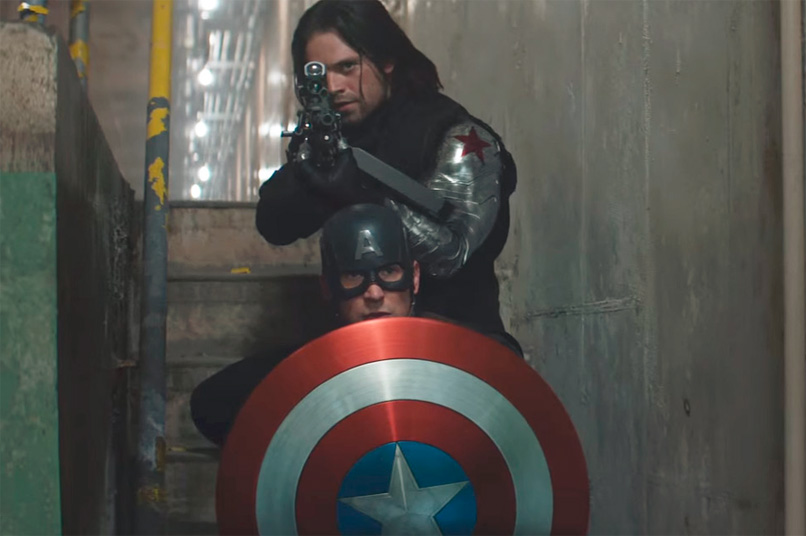
Here, we see a man who is not only fighting physical battles (and with extraordinary skill now that super-soldier enhancements have been added to his natural sensory abilities), but who is also fighting a mental battle. As extroverts, ESTPs tend to focus more on the external. Bucky’s experiences have turned him inward, making him more serious and forcing him to develop his Introverted Thinking side. Though type theory holds that your base personality doesn’t change, Bucky is in many ways a different person than the one we see in The First Avenger. He’s burdened with the weight of what he’s done and his friend Steve is now his only real connection with another human being.
In some ways, Bucky’s joking remark from the first Captain America movie “I’m turning into you” has come true. He’s become much more introspective and aware of the weight of his actions. Yet he’s also still thoroughly himself. We have a scene where he and Cap are reminiscing about fun times they had and a girl Bucky tried to impress, and he’s really Bucky against instead of the Winter Soldier. The fun-loving young ESTP is still in there, just buried deeply under the weight of all he’s been though.
In The First Avenger, we see Bucky fighting to protect his best friend and giving his life for his country. Now in Civil War, he trusts his best friend to help him through and gives up his freedom by going into cryostasis so he’s can’t be used to hurt others. Bucky’s decision to enter cryostasis at the end of the movie is also an intensely individualistic move that’s characteristic of SP types. If he can’t guarantee he can control himself, then at least he can make sure no one else can take control of him either.
If you enjoyed this post, check out my other MCU typings:
Congratulations on the procurement your new INFJ!* INFJs are highly sought after in the personality type collecting world given their extremely rare nature. INFJ spotting is a very difficult hobby, requiring forays into the deepest recesses of bookstores, yoga studios, and the internet. Keeping an INFJ in your life once you’ve found one can be even more of a challenge.
INFJs are widely considered one of the most amiable and empathetic personalities. Their minds offer a good balance of emotion and logic that helps them relate to most types of people, and they highly value commitment and relationships. As introverts, though, they have limited social energy and they don’t maintain relationships with most of the people they meet. Once you’ve found an INFJ, taking your acquaintance to the level or friendship, or relationship, isn’t simple. That is, unless you have this user guide.
Overview of the INFJ
The INFJ is a strange sort of creature, often compared to unicorns. Their uniqueness is a result of two things: the way their brains/personalities are hardwired and the rarity of their personality type. What’s perfectly normal for an INFJ seems unusual among humanity as a whole because so few people function this way. Understanding your INFJ’s basic functions is the first step towards successful interaction with the INFJ.
My mother refuses to take a Myers-Briggs test and won’t answer any questions if I try to type her. I do have my suspicions about her four-letters, but this actually isn’t the topic of my post today. One of my mom’s reasons for not learning her type is that she doesn’t want put into a box. While I do find MBTI a useful tool, I also realize it contains stereotypes that can be limiting. People are so much more nuanced than a type description. We can (and should) love them, understand them, and value their “personality type” in a way that doesn’t have anything to do with Myers-Briggs theory.
I’m not exaggerating when I say I have an incredible mother. Here’s just one example: she has this super-human ability to get angry so rarely that her wrath might as well be nonexistent. This is an invaluable gift in any situation but considering she lives with three Extroverted Feelers (an ENFJ, an INFJ and ISFJ) who tend to get stressed-out and emotionally vent (which then triggers the other Extroverted Feelers in the house) it’s a wonder she hasn’t killed us yet. Instead, she’s a peacemaker and a willing sounding-board for all the emotions we’re not quite sure what to do with. I don’t need to know her four-letter type to appreciate that.
My mother’s personality is patience, kindness, and peace. She’s one of the most truly godly women I’ve ever known. Thought it’s a little surreal to have someone who knew her when she was my age recognize me as her daughter, I can’t think of many higher compliments than being compared to her. They say girls turn into their mothers as they grow older, and that’s perfectly okay with me. I love you, Mommy.
It’s strange that a personality type for which “homemaker” is one of the top recommended career options has such a difficult time finding love. While not true of all INFJs, many of us are romantics in every sense of the word. We’re idealists who still believe in soul-mates. We’re eager to dive deep into relationships and prioritize the people closest to us. We’re among the MBTI types least likely to cheat in a romantic relationship.
But we also shy away from any type of deep relationship if we don’t feel completely safe. Our idealism means we often have unrealistic expectations for our (potential) romantic partners. The soul-mate type of understanding we crave is hard to find. And so here I am, turning 27 this year having been on 4 dates since I was 19 (all with guys I chose not to go out with a second time) and yet still wanting to be in a relationships (almost) just as much as ever.
So what’s a single INFJ to do? It sounds cliche, but I agree with Amelia Brown on Introvert, Dear that it’s important to focus on “the relationship you have with yourself.” If you’re not comfortable with yourself, you’re never going to be happy, regardless of whether or not you’re in a relationship with someone else. Also, if you haven’t taken ownership of your life, your choices, and your struggles then you’re going to have a harder time cultivating the sort of strong, lasting relationship INFJs crave. Read more →








 Like An Anchor