Fictional MBTI – Anakin Skywalker/Darth Vader (ENTJ)

Note: an updated version of this post can be found on my Star Wars Personalities blog (click here).

Fictional MBTI - Anakin Skywalker/Darth Vader (ENTJ) | marissabaker.wordpress.comLike many with even a hint of interest in film and/or science-fiction, I’m eagerly awaiting Star Wars Episode 7. In anticipation of its release, I’ve been re-watching all the movies, branching out into the animated series and some of the in-cannon books, and working on a new Myers-Briggs Star Wars chart.

While trying to type Anakin Skywalker, I discovered I’d started writing a blog post within a blog post. And so, rather than waiting until December to start blogging about my Star Wars obsession, I decided to give Anakin his own post. Read more

Finding Your Real Myers-Briggs® Type

It’s so easy to take a pseudo-Myers-Briggs® test on the internet. You can click through a quick quiz, get your result and think, “Wow, I guess that does sound like me.” A few weeks later, you might stumble across another short quiz and take it again. Maybe you get a different answer and the description still sounds like you. Now you’re wondering whether this whole Myers-Briggs thing is all it’s cracked up to be, and if it is, then why were your results different?

This is one of the reasons Myers-Briggs tests have come under fire from critics who don’t really understand how the Myers-Briggs Type Indicator (MBTI®) is supposed to work. They look at the short little quizzes with generic feel-good results, and say it’s too simple and unreliable. But if you dive into the theory behind Meyers-Briggs, and especially cognitive functions (click here for an introduction to type functions), you start to realize how helpful the MBTI can be as a tool for understanding yourself and other people.

One of the principles of Myers-Briggs theory is that people only have one type, which stays consistent throughout their lives. You grow and develop within your type, but you don’t change from an INFP to an ENFJ to an ISTP or any other combination of letters. So with that in mind, how can you find your true type with so many conflicting results floating around?Finding Your Real Myers-Briggs® Type | LikeAnAnchor.com

Take A Good Test

Disclaimer: some of the links in this post are affiliate links. This means that, at no additional cost to you, I will receive a commission if you click on the link and make a purchase on that website.

If you can’t take the official MBTI, there are a few decent substitutes out there on the internet. My favorite by far is Personality Hacker’s Genius Style test.* They ask for an e-mail address, but it is free. One of my favorite bloggers, Susan Storm, also recently released a test. You can click here to take that.

Similar Mind’s Jungian test is another I’ve recommended (note from May 2017: recent changes to the test questions may skew results. You might want to try HumanMetrics instead). Some people really like the test from 16Personalities, but it’s not my favorite. These tests all give you a series of questions which are designed to learn what cognitive functions you use, then give you a four-letter test result.

I’d recommend starting with the Personality Hacker test, and then taking one or both of the other tests to compare results. Try not to read the full results of one test before you take the others — you want to take each one as unbiased as you can. If they all give you the same result, that’s a pretty good indication you’ve found your personality type. If they’re different, though, it’s time to start reading.

Compare Results

Now that you have one or more personality type results, start reading descriptions of your potential personality type(s). Here are some excellent resources:

Read the descriptions for each of your type results. Even if you only got one result, it’s a good idea to look at similar types that use some of the same cognitive functions. Here are a few guidelines for which other types to look up based on your test results.

If you test as an …

  • Introvert, read about the type which is opposite you on the J/P scale. The J/P preference describes how we interact with the outer word through our extroverted function, so an IJ type actually leads with a perceiving process and an IP type leads with a judging process. This can affect test results.
  • EJ, take a look at the type opposite you on the S/N scale. The tests found that you lead with an extroverted judging/decision making process, but might not have accurately found your introverted secondary process.
  • EP, take a look at the type opposite you on the F/T scale. The tests found that you lead with an extroverted perceiving/learning process, but might not have accurately found your introverted secondary process.
  • SFJ or NFJ, read results from ENFJ, INFJ, ISFJ, and ESFJ. These types all use Extroverted Feeling, and can often be mistaken for each other. Shy ESFJs and ENFJs can be mis-typed as introverts, and outgoing ISFJs and INFJs can be mis-typed as extroverts.
  • NT types, read the type opposite you on the E/I preference. ENT- types, especially ENTJs, are among the most “introverted extroverts” and might mis-type.

Think About Stress

Most tests look at your primary and secondary function — the driver and co-pilot processes that lead in our personality. This makes sense, since other functions are less well developed and we don’t use them as much unless we’re stressed. When we’re trying  to discover our true type is, though, how we react under stress is a good indication of which type matches us best.

Good type descriptions will also talk about the inferior function. An excellent book on this topic is Was That Really Me? How Everyday Stress Brings Out Our Hidden Personality* by Naomi Quenk.

Keep In Mind …

No personality test result is going to be a 100% perfect match. You’re looking for the one that fits you best. You will find elements of other descriptions that sound like you, but there should be one that fits better than the others. Pay close attention to descriptions of how your type uses cognitive functions. Descriptions of INFJ and INFP types, for example, sound similar but they lead with very different mental processes.

Good luck on your journey of self discovery! There’s a plethora of resources out there that can help you, including type-based Facebook groups and forums where you can talk with people of different types to see how they think. And if there’s anything I can help with, just ask!

*indicates affiliate links

Featured image credit: StockSnap via Pixabayy

Save

The Myth of the Good Little INFJ

Last week, I stumbled across an article on Pinterest talking about female INFJs. Well, technically it was about INFj in the Socionics system, which is a bit different than the MBTI type and may include INFPs as well, but for purposes of this article we’ll just talk about INFJ types. The original article, written in 2011 by someone identified only as Beskova, paints a portrait of the INFJ type that is beautiful on the surface but doesn’t quite manage to reach their heart. It’s part of a disturbing trend in portrayals of INFJs, though this is the most extreme example I’ve seen.

Like many people who treat the INFJ type as quasi-mythical, this writer describes INFJs as flawless, naive, pure and submissive. They even describe a typical INFJ appearance: “Women of this type are very feminine and are delicate, modest and even shy. … They have a very ephemeral body, and sometimes lightly stooped posture.”

Reading on, it seems the INFJ has no faults. They never gossip or argue, meet adversity with mild gentleness, focus on humanitarian efforts, fit into any job, and submit themselves selflessly to helping the people in their lives. In short, the article says, “When a female INFj becomes your wife, know that in your home there lives a quiet angel” who “makes for one of the most obedient wives.”

The Myth of the Good Little INFJ | marissabaker.wordpress.com
photo credit: Cameron Nordholm

The biggest problem with this portrait of an INFJ isn’t just that it’s untrue; it’s the fact that INFJ women may try to fit into this mold if they end up in a relationship with someone who expects “their” INFJ to act like this. One thing that’s become clear in the months I’ve been reading things INFJs share online is that we’re one of the types most vulnerable to getting involved in unhealthy relationships with narcissists. And INFJ descriptions that make us out to be perfectly submissive and obedient aren’t helping discourage interest from unhealthy people.

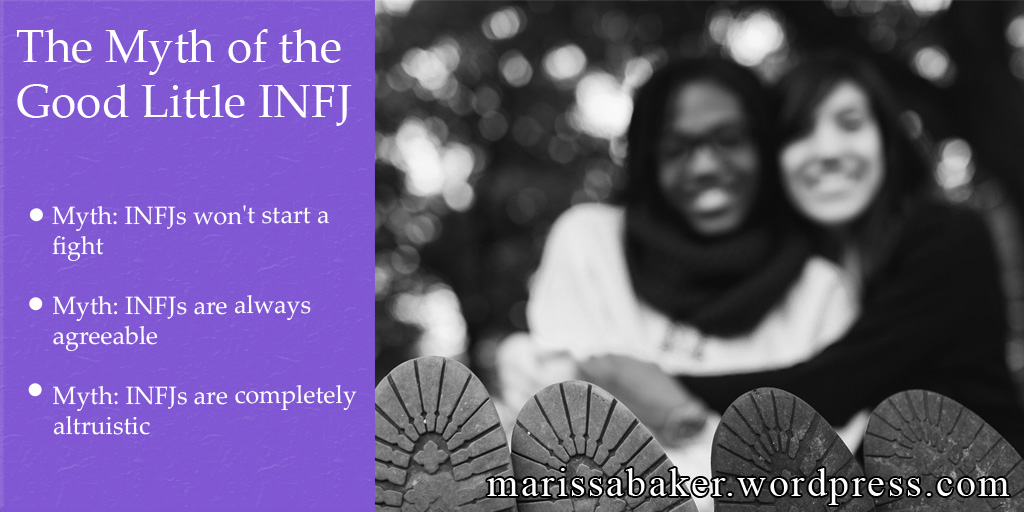
Myth: INFJs won’t start a fight

It’s true that INFJs are one of the most conflict-avoidant types. Until a person does something the INFJ can’t live with, we’ll often just nod and smile at most conversations and suggestions. This happens with casual acquaintances when we don’t want to wast energy on conflict, and in closer relationships when we don’t want to deal with the emotional fall-out of conflict unless there’s a very good reason. I talk about this at greater length in my INFJ Handbook.

But if you think INFJs can’t get angry or won’t take a stand when things aren’t as they should be, think again. INFJs tend to draw a line in their minds, and once it’s crossed we’ll make sure we let you know. Once we get started, we’ll probably tack on a list of every other way you’ve ever let us down as well. The closer we are to you, the better we’ll know how to tear you apart (note: we’re not proud of this fact, and many INFJs work hard at controlling their anger). The best way to avoid this in a relationship is to keep open lines of communication, which is the number one thing many INFJs are looking for in a relationship. INFJs prefer to keep our emotions out in the open, and if we feel safe and heard then there’s no need to bottle up our feelings until we explode.

Myth: INFJs are always agreeable

In this socionics article, the writer talks about how INFJ women often need/want other people to make decisions for them. They write, “If you are her husband take responsibility for making major decisions in development of your family and she will with pleasure obey you.” Now, I’ll be honest — sometimes I do want people to make decisions for me. But if an INFJ is consistently told she can’t be trusted with important decisions and is left out of the planning process, then she’s going to stop trusting you.

The other party might not even notice an INFJ doesn’t agree with him if he’s expecting her to be what the article says: “friendly and dutiful, never quarrel nor ask much for themselves.” We place a high value on trust and communication in relationships, and assuming we agree with you instead of really asking us what we think is a good way to experience the INFJ door slam.

The Myth of the Good Little INFJ | marissabaker.wordpress.comA tip for people who know INFJs: If we don’t actually agree with you, or simply don’t care, we’ll typically make non-committal sounds, nod our heads, and avoid eye contact. If pressured to commit to something we don’t want to do or think, but won’t openly disagree with, we’ll try to push it off to an unspecified future date. When an INFJ actually agrees with you, we’ll make eye contact, our face will light-up, and we’ll say things like “Oh, yes” instead of just nodding. Usually, we’ll also be able to explain why we agree with you in specific terms.

Myth: INFJs are completely altruistic

One last quote from the socionics article: “watch that her emotional resources aren’t spent on her girlfriends, who inadvertently will use your wife as a psychotherapist. She will never refuse them herself, of course. Out of compassion. Therefore, it will be best if you take the matter into your own hands and limit the flow of those desiring to obtain psychotherapeutic sessions and useful advice from her.” Excuse me! What gives someone else the right to limit an INFJ’s contact with her friends? That’s the sort of controlling behavior that’s a huge red-flag in any relationship.

In addition to being incapable of taking care of herself, INFJ wives are apparently so dutiful they’ll do all the housework without any complaint even though they hate cleaning and cooking. For the record, this INFJ loves cooking and the housework doesn’t always get done in a reasonable amount of time. Also, one reason INFJs will avoid conflict and try to help people is because of how it affects us. Sometimes I do what people ask just because I don’t want to stay awake for three hours that night re-hashing every word of the resulting argument. It’s a self-protecting mechanism. That’s not to say INFJs don’t care about people — we do, deeply, and we will support our friends and family whenever possible. It’s a good thing. We can stretch ourselves too thin at times, but INFJs value their introvert time and don’t usually need someone to step in an control their lives to keep them from burning out. We’re not that altruistic.

In conclusion …

I may have dispelled some of the “mystic unicorn” aura surrounding INFJs, but perhaps that’s a good thing. Our rarity doesn’t make us better than other types, and type portraits that make us out to be something ephemeral and idyllic really aren’t helpful. As my siblings (and no doubt other people who INFJs have let into their lives) can testify, we’re not perfect.


If you’d like to know more about the INFJ personality type, check out my book The INFJ Handbook. I just updated it with a ton of new information and resources. You can purchase it in ebook or paperback by clicking this link.

A Faith For Me

A couple weeks ago, Personality Hacker released a podcast about personality types and religions. They spent much of their time talking about faith traditions in the United States and how different personality types gravitate towards different religious expressions. As an example, they talk about the personalities attracted by Baptist and Presbyterian faiths. FP types are more likely to gravitate toward the Baptist faith, which values “personal faith expression.” Since Presbyterians are “more organized as a collective” with “codified belief systems,” that tends to attract FJ and TJ types. TP types are the most likely to leave a religion, and don’t fall neatly into either of these example categories.

It’s a fascinating topic, though at first it seems rather obvious. Of course different personality types are attracted to different types of religions. Someone who isn’t comfortable without outward displays isn’t going to join a Pentecostal group. Someone who hates rules and ritual won’t become Catholic. At Personality Hacker, they boiled it down to a question of whether or not your faith encourages and allows you to use the dominant aspect of your personality.

“If your driver process is not being respected, honored or allowed to manifest … you will eventually leave” — Antonia Dodge

ESFJs and ENFJs lead with Extroverted Feeling, and they’ll leave a faith tradition that doesn’t encourage harmony among the members. INTPs and ISTPs lead with Introverted Thinking, and they’ll leave a faith that doesn’t make rational sense. And so different types gravitate towards different religions, or move away from religion, when they aren’t allowed to be themselves.

A Faith For Me | marissabaker.wordpress.com

Let’s switch gears for a minute. One of the core aspects of Christianity is the belief that we’re right and everyone else is wrong. That’s overly simplistic, but if you’re a worshiper of the Christian God, then you also have to believe that He’s the only true God. Even the demons know this (James 2:19). There are other things that people worship as a god, but the Bible is very clear that 1) Christians shouldn’t run after other gods and 2) those “gods” aren’t on anything like the same level as our God.

You shall worship no other god, for the Lord, whose name is Jealous, is a jealous God (Ex. 34:14)

Know this day, and consider it in your heart, that the Lord Himself is God in heaven above and on the earth beneath; there is no other (Deut. 4:39)

This might be the least talked about truth in Christianity. We don’t want to offend non-Christians and we’re not sure how to handle doctrinal conflicts with other Christian groups. So we talk about finding the religion that “works for you,” or a “faith tradition that expresses who you are.” If really pushed to admit it, though, I think most Christians will say they believe their particular brand of Christianity is more right than the others.

Jesus Christ isn’t the Head of many different churches, though. He’s the head of one true Church which is composed of His called-out people scattered throughout many different groups. There are many groups out there who claim to be part of this one true church, but are they? What does a true church look like?

A Faith For Me | marissabaker.wordpress.com

As I think about the topic of personality types in religion, I’ve reached a sobering conclusion. If your brand of Christianity is driving a certain personality type away, there’s something wrong with it. We tend to assume that if people are leaving church there’s a problem with them, and in some cases that may be. However, if all INTPs and INTJs (or any other personality types) are leaving that means this particular church is failing to engage a group of God’s children.

God created all personality types, and He wouldn’t command a worship style that excludes some of His children. Any religion claiming to be true worship of the one true God must have room for all personalities, just as it has to include both men and women. God wouldn’t give people a personality type that isn’t compatible with worshiping Him, so if certain types are driven away because they are not “respected, honored or allowed to” use their gifts, then there must be something wrong with how we humans are constructing our churches.

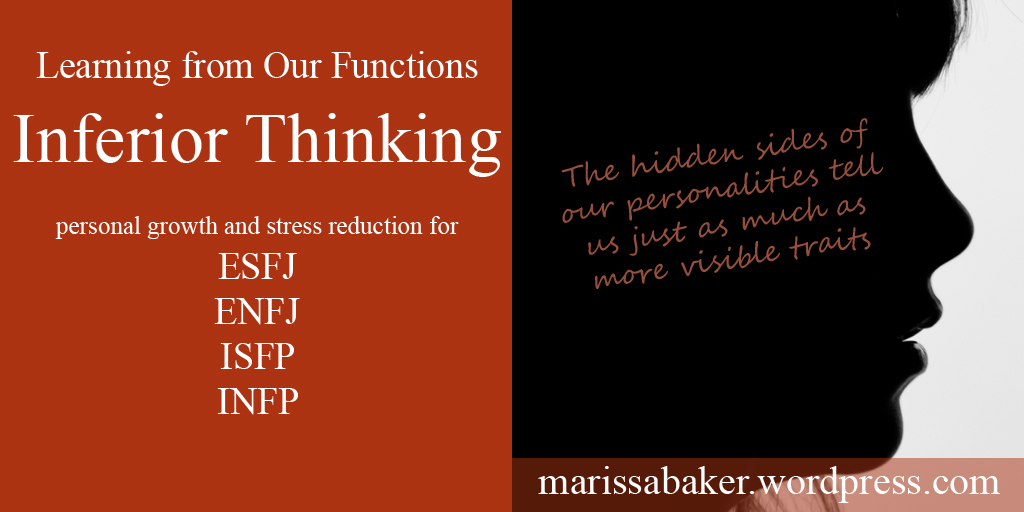
Learning from Our Stress Function – Inferior Thinking

Disclaimer: some of the links in this post are affiliate links. This means that, at no additional cost to you, I will receive a commission if you click on the link and make a purchase on that website.

When we’re talking about someone’s personality type in the Myers-Briggs system, we usually talk about their primary and secondary functions (also called mental processes). An ISFP, for example, leads with a process called Introverted Feeling (a judging/decision making function), which is supported with Extroverted Sensing (a perceiving/learning function). An ENFJ, on the other hand, leads with Extroverted Feeling, supported by Introverted Intuition. Using Personality Hacker’s car model,* we can compare our primary function to an adult driving a car, and the secondary function to a second adult navigating in the passenger seat.

Each type also has a tertiary function (the opposite of their secondary function), and an inferior function (the opposite of their primary function). These are less well developed. In the car model, our tertiary function is like a 10-year-old sitting behind the co-pilot, and the inferior function is like a 3-year-old sitting behind the driver. The processes you use most readily are the ones typically visible, and they define your personality as others usually see it. Our less developed functions play a significant role as well, though. Today, we’ll be looking at types which use Thinking as an inferior function.

Learning from Our Stress Function - Inferior Thinking | marissabaker.wordpress.com

Everyday Life

Inferior functions often show up in the type of hobbies people choose. INFPs and ISFPs, for example, may enjoy strategy games or something like crossword puzzles to engage their Thinking side. More than other types, though, dominant Feeling types often choose careers that tap-into less dominant functions (Was That Really Me?* Quenk 149). An ENFJ might use their thinking and intuitive sides to work with computers, or an ISFP could work in engine repair using their sensing and thinking sides. In this case, they’d be using their dominant function in hobbies and play, and their less-developed functions at work. ENFJs, ESFJs, ISFPs, and INFPs in this type of situation often retreat into nature or opt for a more social activity to relax.

Characteristics of Inferior Thinking

ESFJs and ENFJs use dominant Extroverted Feeling, which makes Introverted Thinking their inferior function. It’s their least developed function, and has different characteristics than the Introverted Thinking used by types like ISTPs and INTPs. Naomi Quenk says inferior Introverted Thinking displays the following traits (I’ve put the traits of dominant Ti in parenthesis):

  • Excessive criticism (Impersonal criticism)
  • Convoluted logic (Logical analysis)
  • Compulsive search for truth (Search for accuracy and truth)

ISFPs and INFPs also lead with a feeling function, in this case Introverted Feeling. This makes Extroverted Thinking their stress function, and it looks different than the Thinking used by ENTJ and ESTJ types. Here are the traits Quenk associates with inferior Extroverted Thinking (and their counterparts in Te-dominant types).

  • Judgements of incompetence (Competence)
  • Aggressive criticism (Truth and accuracy)
  • Precipitous action (Decisive action)

Stress Reactions

Inferior Thinking types are sensitive about how other people perceive their intellect. They’re very careful when handling facts and can become irritated or defensive if people question their competence (or if they feel someone might question them). When stressed, they’re quick to point out other peoples’ errors and judge them as incompetent, often aloud. Normally, dominant Feeling types value peace and harmony, but when stressed they are much quicker to voice their criticisms.

They can also turn this “excessive” or “aggressive” criticism inward. I have several good friends who are ExFJ types, and they are very hard on themselves whenever something goes wrong or pulls them into depression. It’s very frustrating to outside observers because it’s almost impossible to talk them out of self-criticism. When working out of their stressed function, Feeling types, especially ESFJs and ENFJs, often insist on solving problems alone and fall into a pattern of “convoluted logic” (Quenk 154). One ENFJ that Naomi Quenk interviewed talked about coming up with a plan to break her leg in an accident so she wouldn’t have to participate in a sporting event that had her stressed out (she didn’t actually go through with it).

Stressed Feeling types often feel compelled to take some kind of action to correct a problem and regain control. The introverts, whose stress function is extroverted, usually try for outward action without thinking it through (Quenk 108). Extroverts, with their inferior introverted function, are more likely to take internal action and seek out books or lectures they think might help (Quenk 155).

Getting Out of Stress

All Feeling types benefit from alone time away from everyday routine to process stressful situations. Introverted types especially say that their “grip experience” needs “to expire on its own” (Quenk 115). They need time to process what’s going on without other people trying to interfere too soon. Some INFPs and ISFPs, especially women, want to talk eventually but not right away.

ESFJs and ENFJs do need alone time, but they also need someone to bounce ideas off of much more than the introverted types. They need a friend who is willing to listen without criticism, take them seriously, remind them of their good qualities, and reassure them that they’re a good person (Quenk 163). Many Extroverted Feelers also appreciate someone taking the time to involve them in a low-pressure social activity.

Learning From the Inferior

For many people, the side of their personality that’s related to the inferior function stays a mystery throughout their lives. Type theorists say that most people who successfully incorporate their inferior function do so around middle age, but you can start working on it sooner. Isabel Meyer suggested that every type can, and should, exercise all their functions on a regular basis when making decisions. Dominant Feeling excels in weighing how much you care about different options, takes into account others’ well-being, and seeks the most authentic and harmonious solution. Making a conscious effort to incorporate Thinking adds a level of impersonal analysis that helps when working with facts and making long-term plans (Meyers, Gifts Differing*, 197).

Naomi Quenk says that ENFJs and ESFJs who successfully incorporate their inferior functions learn to take better care of themselves rather than always putting others first. They’ll often dig into their inner lives more fully and give themselves permission to explore interests they’d pushed aside when younger — like one ENFJ who left a successful law practice to become a minister (Quenk 165). The introverted types also become more comfortable with themselves, and more confident when making decisions. Incorporating their inferior Thinking helps INFPs and ISFPs cope with their own shortcomings and relax (Quenk 117, 118). It also helps both types learn to deal with outside criticism effectively.

Learning from Our Stress Function - Inferior Thinking | marissabaker.wordpress.com

credits for pictures used in blog images:

*indicates affiliate links

Learning from Our Stress Function – Inferior Feeling

Disclaimer: some of the links in this post are affiliate links. This means that, at no additional cost to you, I will receive a commission if you click on the link and make a purchase on that website.

If we’re describing someone’s personality type in the Myers-Briggs system, we usually talk about their primary and secondary “functions” (also called mental processes). An ISTP, for example, leads with a process called Introverted Thinking (a judging/decision making function), which is supported with Extroverted Sensing (a perceiving/learning function). An ENTJ, on the other hand, leads with Extroverted Thinking, supported by Introverted Intuition. Using Personality Hacker’s car model,* we can compare our primary function to an adult driving a car, and the secondary function to a second adult navigating in the passenger seat.

Each type also has a tertiary function (the opposite of their secondary function), and an inferior function (the opposite of their primary function). These are less well developed. In the car model, our tertiary function is like a 10-year-old sitting behind the co-pilot, and the inferior function is like a 3-year-old sitting behind the driver. The processes you use most readily are the ones typically visible, and they define your personality as others usually see it. Our less developed functions play a significant role as well, though. Today, we’ll be looking at types which use Feeling as an inferior function.

Learning from Our Stress Function - Inferior Feeling | marissabaker.wordpress.com

Everyday Life

As with other types, ISTPs, INTPs, ESTJs, and ENTJs do use their inferior function in everyday life.  They use Thinking for most decision-making, but Feeling still shows up in several ways. For Extroverted types, it often influences the causes they champion and/or is connected with their religion. Their Feeling function helps them connect with the human community and drives them to contribute in a way that meshes with their sense of authentic self.

Introverted Thinking types are often (unfairly, I might add) stereotyped as areligious, coldly analytical and unconcerned with other people’s feelings. They can come across that way, but they really do have a feeling side. ISTPs and INTPs can be deeply spiritual and they value their friendships just as much as dominant Feelers do (though they often have fewer close friends and aren’t as comfortable expressing emotion).

Characteristics of Inferior Feeling

ESTJs and ENTJs use dominant Extroverted Thinking, which makes Introverted Feeling their inferior function. It’s their least developed function, and has different characteristics than the Introverted Feeling used by types like ISFPs and INFPs. In her book Was That Really Me?* Naomi Quenk says inferior Introverted Feeling displays the following traits (I’ve put the traits of dominant Fi in parenthesis):

  • Hypersensitivity to inner states (Inner harmony)
  • Outbursts of emotion (Economy of emotional expression)
  • Fear of feeling (Acceptance of feeling as nonlogical)

ISTPs and INTPs also lead with a thinking function, in this case Introverted Thinking. This makes Extroverted Feeling their stress function, and it looks different than the Feeling used by ENFJ and ESFJ types. Here are the traits Quenk associates with inferior Extroverted Feeling (and their counterparts in Fe-dominant types).

  • Logic emphasized to an extreme (Comfortable inattention to logic)
  • Hypersensitivity to relationships (Sensitivity to other’s wellfare)
  • Emotionalism (Sharing of emotions)

Stress Reactions

When stressed out, both introverted and extroverted types which use inferior Feeling are hypersensitive to anything having to do with understanding their own or other people’s emotions. They often misinterpret other people’s intentions, seeing them as overly critical and judgmental. They might become distressed, anxious and annoyed, but this won’t be readily apparent from the outside (Quenk p. 130).

Because Thinking types are often uncomfortable expressing their feelings, they still struggle to maintain an appearance of control when stressed-out. To make up for being unsure how to express what they’re struggling with, stressed Thinkers may excessively focus on logic to counteract feelings of uncertainty and being overwhelmed. From the outside, they start to look short tempered and unreasonable.

When pushed far enough (either by an external stressor or something going on inside their minds), Thinkers may blurt out their own feelings in a way that seems totally out of character. ESTJs and ENTJs, especially women, often say that losing control and crying in public or lashing out in anger is typical of their “grip experiences” (Quenk p. 84). For some INTPs and ISTPs, an “intense expression of emotion” can actually help them deal with stress and be the push they need to back to normal (p. 140).

Getting Out of Stress

Both the introverted and extroverted thinkers need plenty of alone time to process their feelings when dealing with stress. This is particularly important for ISTPs, INTPs and ENTJs (one of the most “introverted extroverts”). Whether or not they want to talk about it with a friend varies from person to person. One thing that’s consistent, though, is that they don’t want someone trying to fix things for them or pressure them to open up. Other people are most helpful if they can act as a low-pressure sounding board.

Naomi Quent reports that ESTJs and ENTJs experience “very few or quite minor eruptions of their inferior function” compared to other types (p.92). Often, finding a distraction through entertainment or a change of scenery is enough to bring them out of their stress function. Physical activity, a change of scenery, and “light problem solving … such as reading a mystery novel” can also help INTPs and ISTPs (p.140).

Learning From the Inferior

For many people, the side of their personality that’s related to their inferior function stays a mystery throughout their lives. Type theorists say that most people who successfully incorporate their inferior function typically do so around middle age. However, Isabel Meyer suggested that every type exercise all their functions on a regular basis when making decisions. Dominant Thinking excels at impersonal analysis, predicting cause and effect, and considering the cost involved in any decision. Incorporating Feeling adds a people-oriented level that checks decisions against your personal values and take into consideration the good other people (Meyers, Gifts Differing*, 197).

According to Naomi Quenk, ESTJs and ENTJs who successfully use their Introverted Feeling learn to value relationships highly. They (occasionally) loosen their high standards and cut themselves and others a little slack (p. 94-95). Much the same thing can happen for INTPs and ISTPs, who become increasingly sensitive “to the nuances of important relationships” and learn to express and accept their emotions more readily (p. 141-142).
Learning from Our Stress Function - Inferior Feeling | marissabaker.wordpress.com

credits for pictures used in blog images:

*indicates affiliate links