Why Fiction Matters: Can Reading Make You A Better Person?

Most people who I spend lots of time with are readers. We tend to gravitate toward each other, I suppose, drawn together in part by a mutual love of books. But I also encounter quite a few people who wonder what’s the point of all this reading, especially if it’s fiction. “Do you really want to write/read a book full of lies?” one might ask. Or another may say, “Why bother reading stories? It’s just escapism.”

We all need a bit of escape from reality now and then, and I’d say fiction is one of the healthiest ways to do that. And, as many writers have pointed out, these books full of “lies” are actually one of the most effective vehicles for truth-telling. Those are both excellent reasons to read and write stories, but for today’s post I want to focus on another reason that numerous studies have been looking at since 2013. Reading fiction can actually make you a better person.

Why Fiction Matters: Can Reading Make You A Better Person? | LikeAnAnchor.com
Photo credit: Free-Photos via Pixabay

Theory of Mind and Fiction

Back in 2013, a study in the journal Science by David Kidd and Emmanuele Castano suggested that reading “literary” short stories immediately improved participants’ scores on the Reading the Mind in the Eyes Test (RMET). This test asks people to look at photographs of actors’ eyes and select one of four states of mind the picture conveys. It’s designed to measure “theory of mind,” which is the ability to attribute mental states to yourself and to others, as well as recognize others have distinct beliefs, desires, intentions, etc. from your own.

The media tends to embellish their reports on scientific studies, so it’s no surprise many popular news outlets said this study proved fiction can increase your empathy. That’s not exactly what the study measured, though, and a subsequent study in 2016 failed to replicate the original’s results. The new study did, however, find that “People who were lifelong readers of fiction … had significantly higher scores on the RMET.” Read more

“A Reluctant Bride” Book Review

Several years ago, while I was in college, I stopped reading Christian fiction. The more I learned about writing and literature, the less impressed I was with the inspirational market. I felt the books were poorly written and too preachy. I don’t like shoe-horned themes or author agendas shoved in my face even when the author and I share a faith.

Then a few years ago, I gave it another chance after a review of Francine Rivers’ book Redeeming Love* caught my eye. That book was so good it convinced me to give the Christian fiction market another try. And I’m glad I did, or I wouldn’t be writing about the book that’s the subject of today’s post.
  • please note that links in this post marked with an * are affiliate links, which means that at no additional cost to you, I’ll receive a small commission if you click on the link and make a purchase.

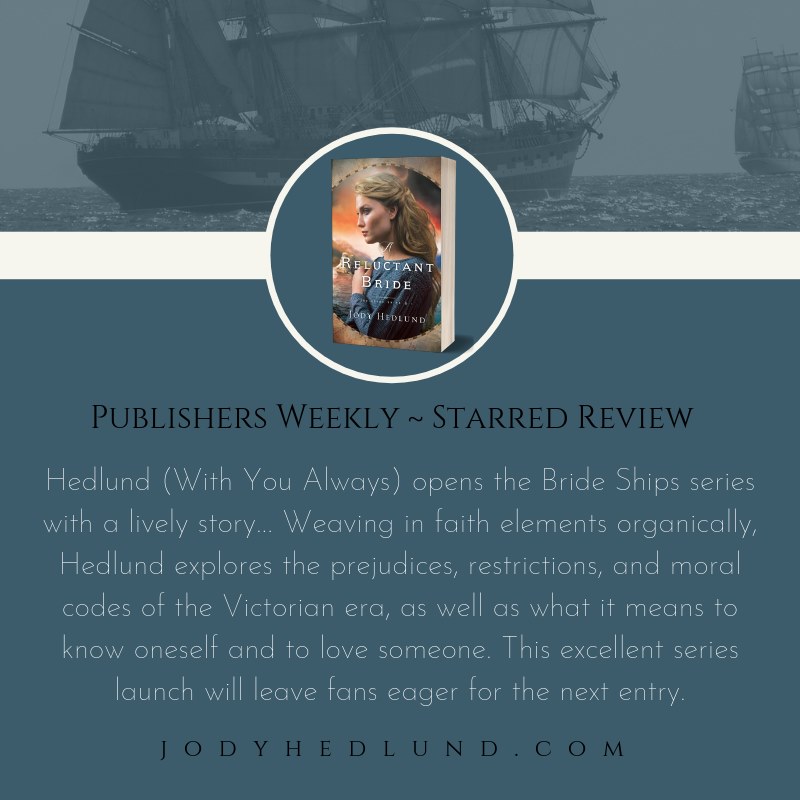
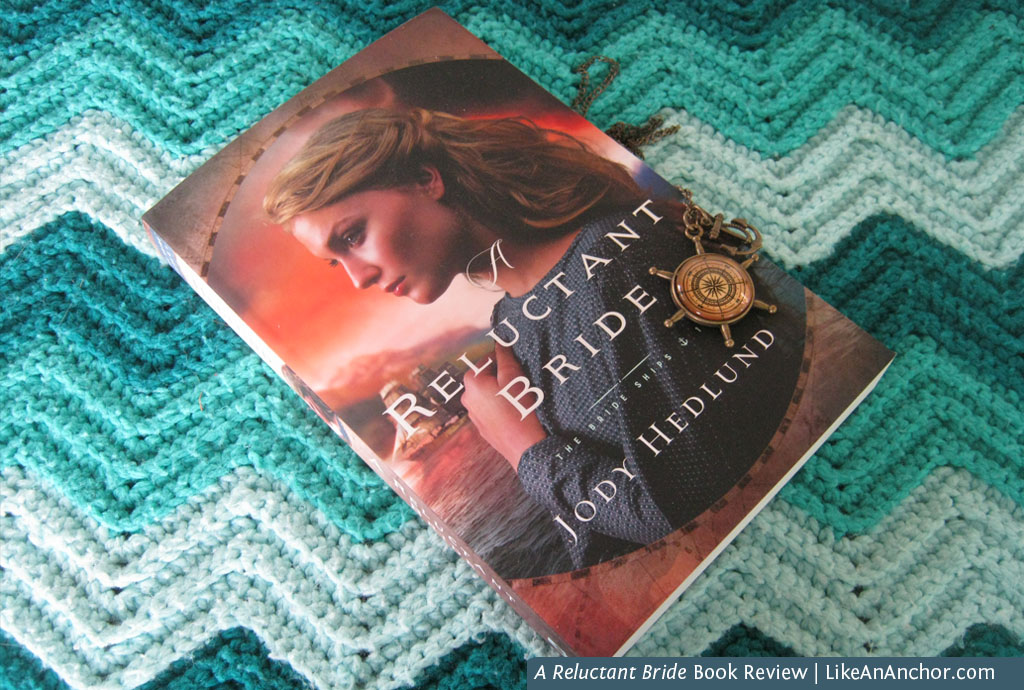
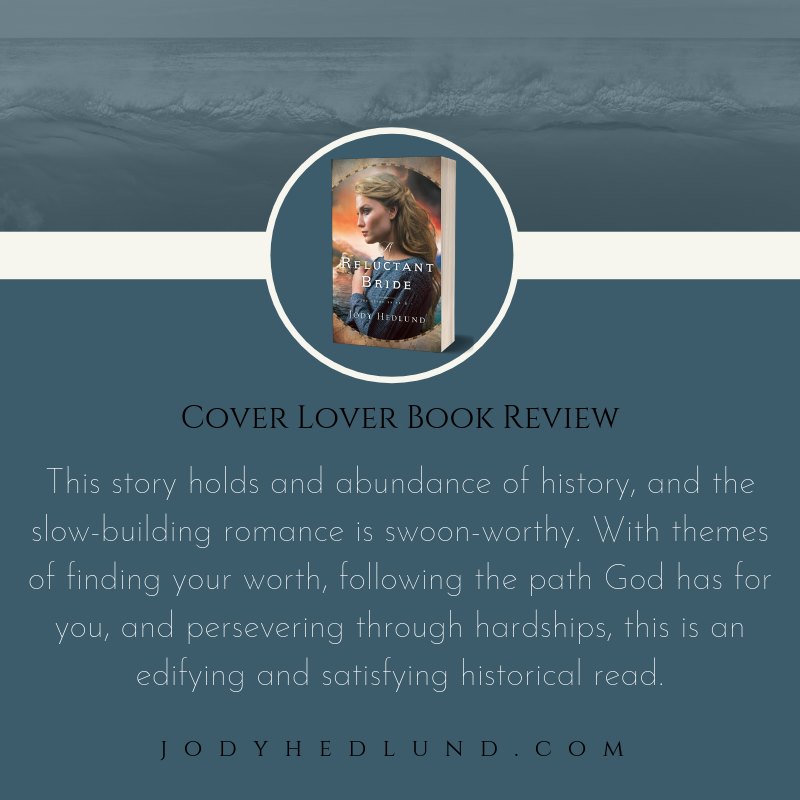
Jody Hedlund’s A Reluctant Bride kicks off her new Bride Ships series series with a heartwarming slow-burn romance. This historical fiction novel, set in the Victorian era, follows the story of Mercy Wilkins. Mercy — a compassionate, selfless young woman who grew up in one of the poorest areas of London — follows her sister’s advice to immigrate to Vancouver with a group promising jobs. It’s only after she’s on board the ship that she learns the women sailing with the Columbia Mission Society will be offered jobs only temporarily. This is a bride ship, and those traveling on-board will be expected to marry once they arrive — something Mercy has no intention of ever doing.

As one would expect from this type of story, there’s a man on board this ship with the potential to change Mercy’s mind. Lord Joseph Colville is heir to one of the noble families of England. Since the death of his parents and brother, he’s been delegating his political and social responsibilities to his aunt and focusing on his passion for medicine. He’s the doctor aboard the bride ship and fully intends to continue traveling for a few more years before settling down. But when Mercy becomes his assistant, they both start thinking that maybe marriage wouldn’t be so bad. Unfortunately, he’s supposed to marry someone from his station and she’s supposed to marry one of the men waiting in British Columbia.

I’ll not spoil anything about the ending for you, since I hope some of you will decide to read this for yourselves. But I will say I loved the characters. The faith elements weave through the story naturally and the plot kept me turning pages eager to see how events played out.

I always appreciate when historical fiction engages with the characters’ time period in a believable fashion. Lord Colville’s choice to work as a doctor and romance a poor working-class girl is an unusual one. However, it’s handled in a way that seems fairly realistic — including the reactions of people around them and Joseph’s and Mercy’s own recognition of the challenges they face. Parts of their romance remind me of Jane Austen’s Pride and Prejudice,* which is one of my favorite books.

I’d never had the chance to read and promote a book pre-release before, so I was very excited when Jody Hedlund opened up applications to her Reader Room group, and even more excited when I became part of the release crew for A Reluctant Bride. I love her YA medieval romance series,* and I wasn’t surprised to enjoy this book as well.

A Reluctant Bride will be out on June 4th. You can click these links to order it and to learn more about Jody Hedlund’s work. (A note for those  who, like me, enjoy print books: you won’t be disappointed with this one. The cover is absolutely beautiful, the paperback feels amazing, and pictures can’t do it justice.)

"A Reluctant Bride" Book Review | LikeAnAnchor.com

The Awakening and This Side of Paradise

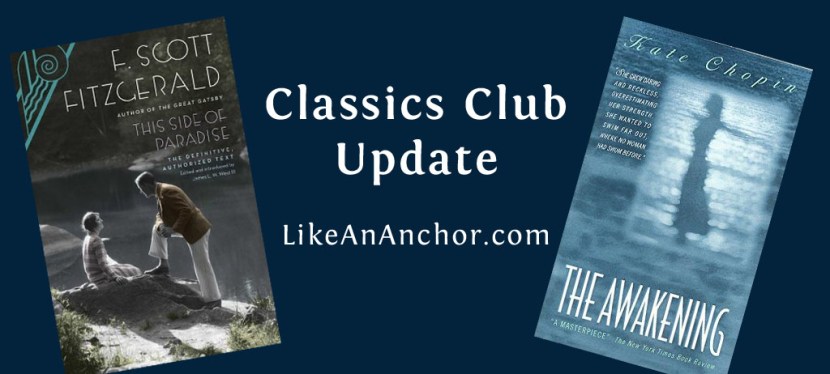
I’ve been trying to get caught-up on my reading for my Classics Club book list that I started almost 5 years ago. This also involves blogging about the books I’m reading in the hope that we can spread our love for classic literature all over the internet. Interestingly, the last two books I read have some similar themes and it made sense to group them together. Which is good, since book reviews aren’t the main focus of this blog.

This Side Of Paradise

This Side of Paradise was F. Scott Fitsgerald’s debut novel (published in 1920). Its publication famously helped Fitzgerald gain Zelda Sayre’s hand in marriage because he was convinced he could win her back if he became a published novelist. It must have worked, since they married just 8 days after the novel’s first printing. The initial print run of 3,000 copies sold out in three days. Read more

A Tale of Two Saviors

Do you ever wish someone loved you enough to die for you?

Not that you’d actually want them to die, of course. But you’d just like to know that someone cared enough about you that they would give up their life to keep you safe and well.

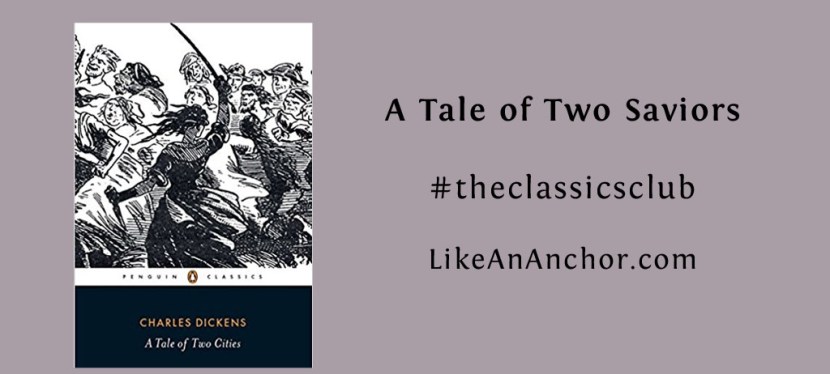
I was thinking about that last week while reading A Tale of Two Cities. I’d planned on reading two of Charles Dickens’s books that I’d never read before for my Classics Club list, but ended up swapping out Bleak House for re-reading A Tale of Two Cities. I liked it so well when I read it 12 or 13 years ago in high school that I wanted to see if it still captured my interested.

I think it’s safe to say this book is just as powerful now as it was back then, considering the last few chapters left me in tears. I love books that are so real, so well written that they can make me cry and let me tell you there were plenty of that by the last sentence. Read more

Ostriches, 200-year-old Fanfiction, and The Swiss Family Robinson

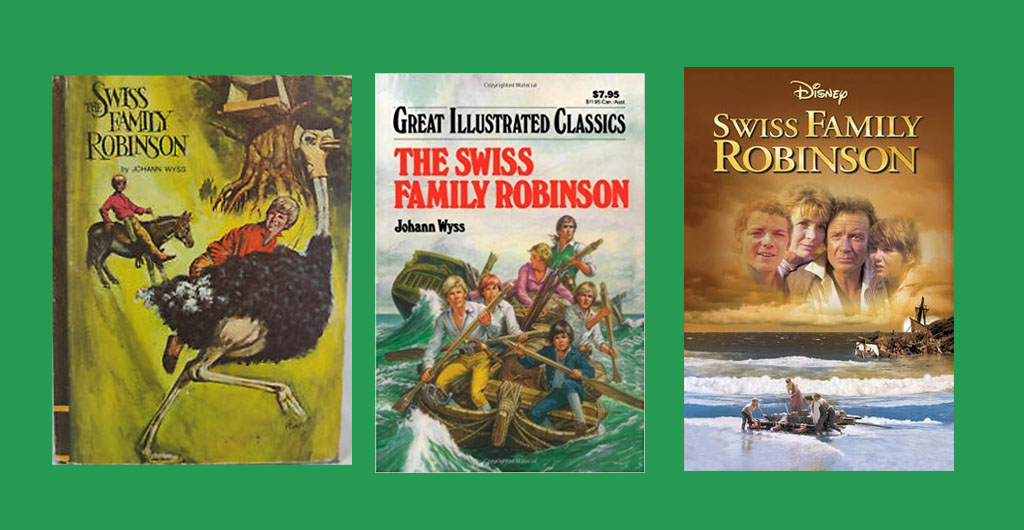
There’s a good chance that if I mention The Swiss Family Robinson you know what I’m talking about. This story of a castaway family has enchanted readers since its first publication in 1812. Even if you haven’t read a version, there’s a good chance you’ve seen or at least heard of one of the film adaptations.

I don’t remember if I first came across this story as a Great Illustrated Classics book or through the 1960 Disney film. I’m sure one led quickly to the other. Shortly after that, I found a more “grown-up” version of the book in my favorite book store. It was a 1968 edition that was about 12 tall by 8 inches wide, and the margins were filled with illustrations of animals and explanatory notes. I read it so much the book literally fell apart.Ostriches, 200-year-old Fanfiction, and TheSwiss Family Robinson | LikeAnAnchor.com

The Great Fanfic Conspiracy

When I started looking for a replacement copy, I realized this book was originally written in German and that there was more than one English version to choose from. This led to a startling revelation.

I had never read The Swiss Family Robinson. Read more

Seeing Unicorns For What They Really Are

I realized after my last Classics Club post that I’m bad at writing book reviews. I’d intended to just write a short “this is what the books are like, this is what I thought” post for Elizabeth Gaskell’s novels but it turned into an essay on what makes a strong female character and the state of modern feminism. I think I’ll give up on book reviews. Apparently I can only write thoughtful, rambling essays.

That’s not a bad thing though, right? These are classics, after all. People have been writing reviews of them for decades or centuries. If you want to find out about the plot you can go on Goodreads. I’d much rather talk about the ideas prompted by these great books. And I think you might rather read about that, too.

NOTE: this post contains spoilers but not enough, I think, to ruin the book for you

Disclaimer: some of the links in this post are affiliate links. This means that, at no additional cost to you, I will receive a commission if you click on the link and make a purchase on that website. Affiliate links are marked with *

A Perfect Fantasy Book

I feel like The Last Unicorn by Peter S. Beagle* should have been a re-read for me, but this was the first time I’d read it. You’d think as much as I love unicorns and fantasy novels I’d have picked this one up earlier. Especially considering how much everyone loves it. Even the guy who wrote the best fantasy book I’ve ever read says, “The Last Unicorn is the best book I have ever read. You need to read it. If you’ve already read it, you need to read it again” (Patrick Rothfuss, author of The Name of the Wind*).

On the surface, The Last Unicorn seems like a pretty simple book. A unicorn overhears two men say there aren’t any unicorns left in the world. Worried that she might be the last one, she goes out searching for other unicorns and meets with the sort of adventures you’d expect in a fantasy novel. There’s a wizard, a merry band of outlaws, a wise woman, a curse, a wicked king, and heroic prince, a talking cat, and a beautiful princess. But there’s so much more than that, too.

How People See You

There’s a lot going on in this relatively short book, so I’m just going to focus on one theme that I found particularly interesting. When the unicorn first sets out on her search, I expected that problems would arise when people spotted a unicorn walking down the road. But all they see is a white mare. The unicorn is puzzled.

“I suppose I could understand if men had simply forgotten unicorns, or if they had changed so that they hated unicorns and tried to kill them when they saw them. But not to see them at all, to look at them and see something else — what do they look like to one another, then? What do trees look like to them, or houses, or real horses, or their own children?”(p. 11).

Read more