You know you’re a writer when one of the first things you think after a breakup is, “I could turn this into a blog post.”
It’s taken me about three months to get to the point where I felt I could write the post I wanted to — an article sharing tips for other INFJs going through heartbreak. I was quite certain I would get through this heartbreak eventually, but I wasn’t going to write this post until I felt like I had some good things to share with you.
When INFJs finally let someone in (not an easy thing for us to do), we tend to become very attached to them. We “map” them into our inner world so being with them is almost as relaxing/energizing as being alone. We rearrange our lives to make room for them. We start to consider their needs, wants, and desires as equally (or even more) important as our own. So when a relationship like that ends (whether it’s dating, marriage, or even a close friendship) it leaves a huge hole in our lives.
In some ways, of course, that’s true for everyone who really cares about someone and then loses that relationship. Today, though, I’m just focusing on one personality type. We INFJs don’t let many people in, and losing a close relationship often feels like being cut lose from an anchor. Especially if we still care about the person deeply (rather than in the case of an emotionless door slam). Read more →
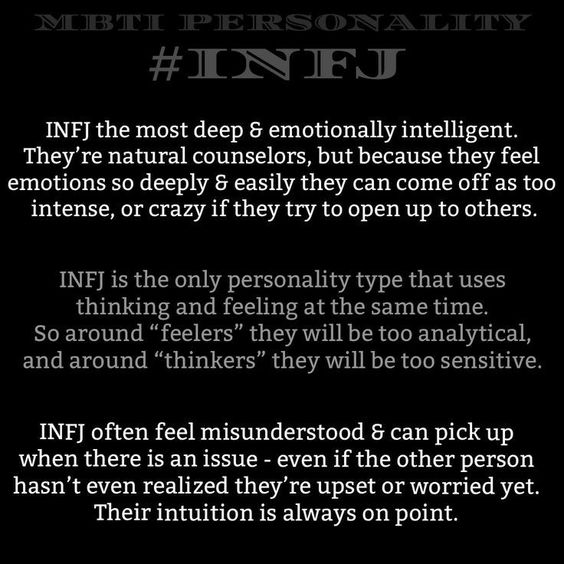
It’s nearly impossible to study Myers-Briggs® types on the Internet without coming across several articles about the incredibly rare and nearly magical INFJ type. I’m an INFJ myself, and I’ve seen us described as the world’s prophets and shamans with deep spiritual insights. We’re called natural empaths with unfailingly accurate telepathy. We appear so deep you’ll never plumb the depths of their souls. We’re even seen as the ideal type–the one everyone else mis-types as because they wish they were this special. And the more people describe INFJs as perfect and other worldly, the more ridiculous the claims about INFJ super-powers becomes. For example, I’ve actually seen such ridiculous claims like these made in INFJ memes and blog posts:
If you’re laughing out loud at the craziness of this, you’re not alone. The tendency to portray INFJs as something akin to a demigod or goddess doesn’t sit well with most healthy INFJs, and yet these sorts of stereotypes are still around. On the one hand, you have certain INFJs and want-to-be INFJs embracing the idea that they’re better/special and using it to look down on other types (something that can be damaging to us as well as to others). And on the other hand, you have non-INFJs buying-in to the otherworldly stereotype and reacting to it in ways that aren’t good for the INFJs (such as when certain people “hunt” INFJs for a relationship, a disturbing thing that I’ve written about in another post).
How Did This Happen?
The simple fact that INFJs are the rarest personality type is going to make us feel and appear different than other people. That’s where this whole thing started–with acknowledging and explaining why INFJs aren’t like the other 98-99% of the population. So far so good. But soon, it started turning into an idea that “different” equals “better.”
INFJs process incoming information with a mental function called Introverted Intuition (Ni). INTJs also lead with this process, and they’re the second-rarest type. That means only 3-7% of the population has this as their preferred mental process (it’s the co-pilot for ENFJ and ENTJ, and they’re pretty rare too). Ni is a perceiving process that’s inward focused, tied to personal perspectives, highly interested in patterns, and is concerned with things that can’t be directly experienced.
It’s not too hard to see how this process could be seen as mystical, or even magical (as side-note, I actually like the nickname “The Mystic” for INFJs as much or more than “The Counselor,” since it focuses on our dominant function instead of our co-pilot). Introverted Intuition doesn’t “make sense” to most people, even the INFJs and INTJs who use it all the time. Pattern-recognition related to things you can’t directly experience is hard to explain. And if we stop trying to explain how this works, then some variation on “it’s magic” seems like a good enough stand-in.
The impression of INFJs as empaths and mind-readers comes from how Ni relates to their co-pilot process, Extroverted Feeling (Fe). Fe picks up on other people’s feelings and makes decisions based on meeting the needs of the whole group. When you couple a keen interest in other people and an ability to pick up their emotions with Ni pattern recognition, INFJs can be insanely good at predicting behavior. And so we became known as the telepathic mind-readers of the Myers-Briggs® community (even though other types use this process as well).
Perpetuating The Unicorn Stereotype
The fact that the quasi-mythical, somewhat deified image has become a stereotype for INFJs is party our fault. Many INFJs grew up feeling like outsiders who never fit in. We’re carrying around deep emotional scars and we’re longing for someone to look at us and say, “Your weirdness makes you wonderful and valuable.” And we find that in the personality type community. Here are a couple examples:
The INFJ has been called “The Mystic,” “The Counselor,” and “Empath”. They are described as original, gentle, caring, and highly intuitive. The quality of extrasensory perception, or ESP, is often attributed to them. People who have known INFJs for years continue to be surprised when yet another layer of their complex personality is revealed. (Ann Holm, “The Mysterious INFJ”)
If we hearken back to humanity’s tribal days, we would likely find only a few INs in a given tribe. At that time, they would have assumed roles such as sage, healer, Shaman or prophet—anything that capitalized on their powers of insight and intuition. Indeed, their rare and unusual gifts would have made INs a precious commodity. (Dr. A.J. Drent, “Why INFJ, INFP, INTJ, & INTP Types Struggle in Modern Life”)
While there are some INFJ haters out there, most of what you’ll find about INFJs on the internet is positive and supportive. In fact, the descriptions are so good at inviting you to identify with this type that non-INFJs are very likely to mis-type when reading about different types online. In at least one little niche of the world, INFJs are in vogue for the first time in their lives. On the one hand, this is a good thing–we do need to understand that there’s nothing wrong with our personalities and that we have amazing strengths. On the other hand, though, we also need to be aware that we’re not a special category of human that’s more valuable, impressive, intelligent, etc. than other people who aren’t INFJs.
The Dark Side of Special Snowflakes
As I mentioned in the opening for this post, there are a couple dangers to letting the mythical unicorn INFJ persona run around unchecked. On the one hand, it can build resentment towards INFJs or make them targets for unwanted attention. I’ve seen a few nasty, aggressive posts attacking INFJs for thinking they’re so special. But for now, let’s set aside how the mythical stereotype hurts people’s perceptions of INFJs and look at how it can lead INFJs to develop wrong ideas about ourselves and damage our relationships with other people.
After writing my “Myths About Sensing Types” post, a reader on Facebook commented that quite a bit of the Sensor-hate online comes from INFJs, who write a large percentage of the personality type content online. Since Sensors make up 70% of the population, that means most of the (very real) emotional wounds that INFJs carry around and feel so deeply came from Sensors. And so we may look down from our “I’m the most insightful personality type around” pedestal and turn Sensing types into villains, or at the very least a type that Intuitives like us cannot get along with.
It’s not just around Sensing types that this sort of thinking can become a problem. We also read that we’re too intelligent for the Feelers and too emotional for the Thinkers, which further alienates us from the other types. Depending on how an individual INFJ responds to the message that they’re special and different, they can become a terror in typology as they wield their 1% status to prove that we’re better than everyone else. Alternately, it might make an INFJ feel even more isolated and alone than they did before now that they’re sure they don’t fit in with other Feelers, or the Thinkers, or Sensors. If we’re to believe our special snowflake status makes it impossible for others to understand us, that leaves a depressingly small pool of people we can build relationships with.
Embracing Differences Without Becoming A Snob
In describing INFJs, it’s important to make sure we do so the same way we describe other types. INFJs are special and different, but we’re no more special and different than everyone else. We need to make sure we talk about and value the unique traits of each type, and show both INFJs and all the non-INFJs balanced, insightful, and helpful portraits of their types online. At the same time, we also need to remember that everyone individual is more than the mental hard-wiring that we call a Myers-Briggs® type.
As INFJs, we need to guard against the temptation to see ourselves as better because we’re more rare or because that’s what we read online. We also have to be careful not to resent or put down other types because they’re not like us or because someone of that type hurt us in the past (I know I have to be careful of that when I meet people with the same personality type as an ex-boyfriend). This shouldn’t really be a difficult thing to do, since as INFJs it’s usually easy for us to see things from other people’s perspectives. Most of us know what it’s like to be misunderstood, misinterpreted, and unfairly judged. Let’s commit to not doing that to other people.
It’s also important to point out that while INFJs aren’t perfect (we’ve all got a bit of a dark side to us), most of us don’t default to thinking we’re better than everyone else. It’s when we’re unhealthy, hurt, and/or stressed that we become adversarial or snobbish towards other people. A healthy INFJ is going to recognize that these tendencies are not ideal and work against them (or perhaps not even have a problem with this at all).
Personality type systems are meant to give us insight into how our minds work. That insight should empower us to understand and embrace our differences while also celebrating the uniqueness of others. It’s okay to enjoy what makes your type unique and, in the case of INFJs, rare as well. It’s even okay to embrace certain aspects of the mystic persona, if that fits your personality in a healthy way. But we should never use our INFJ-ness as an excuse to put-down other people or make ourselves look better than them.
As an INFJ, you’re good at picking up on other people’s emotions. And when you pick up on what other people feel you also start to get a good feel for their expectations. For some of us, that seems like a good thing. We know what’s expected of us in different social settings and from different friend groups. We understand who we need to be so we can fit in.
But is that really a good thing for us? Does being able to fit in help an INFJ?
We call it the chameleon effect when an INFJ leverages their unique combination of mental processes to blend in with different groups of people. Chameleon INFJs might even appear as if they’re a different personality type in different situations because they’re automatically shifting toward being extroverted around the extroverts, logical around the thinkers, and interested in the real world around the sensors.
Blending in feels like an advantage at times. That’s why we do it. Fitting in feels safe. It seems like a way to protect ourselves from negative attention. But in reality, using our gifts in this way doesn’t just protect us from bad things. It also blocks us from really being seen and appreciated as ourselves. Read more →
I have issues with trust. I knew this to a certain extent, but being in a relationship has brought it to the forefront of my attention. My boyfriend wants to build the kind of trust that I’ve always wanted in a relationship, which is fantastic. But it’s harder to get there than I was expecting and that’s frustrating for both of us. I probably feel safer with him than anyone else who I haven’t known a minimum of 10 years and yet I still feel nervous opening up to him and being “me” around him.
As I mentioned a few weeks ago, I love Brené Brown’s TED talks. Since writing that post, I’ve read her book The Gifts of Imperfection and I’m halfway through Daring Greatly. Since I’ve been confronting some deep-seated fear issues as well as this trust thing, they’ve been really good books for me. They’re tough, though. For example, she has a list of 10 things that “Wholehearted” people who believe in their worthiness do. I’ve only got one down pretty good and maybe half of two others. And that’s even though all 10 points on the list are things that, in theory, I agree are good and which I’ve considered worth pursuing for quite some time.
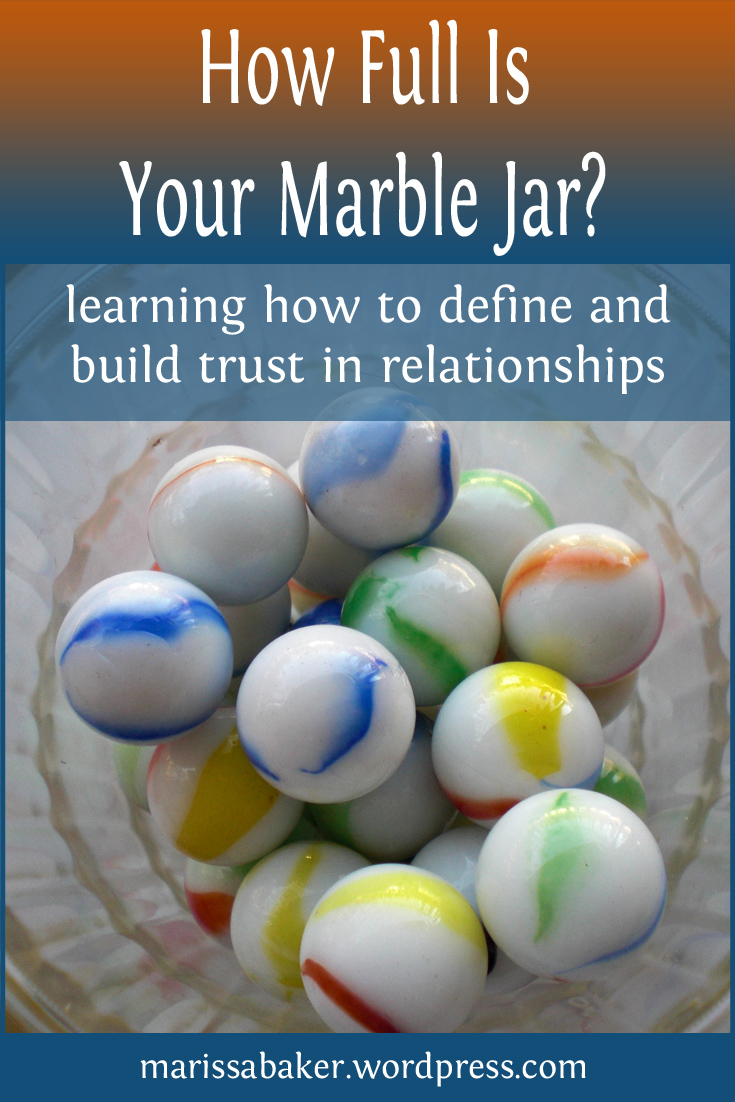
Earlier this year, Brené Brown gave a talk called “The Anatomy of Trust.” In this talk, she tells a story that she also relates in Daring Greatly about her daughter experiencing a betrayal of trust at school. You can click here to read the full story or just watch the video below, but in short summary the situation got so bad that the teacher took marbles out of the Marble Jar (marbles go in when the kids are making good choices and come out if they’re breaking rules, acting out, etc.). Read more →
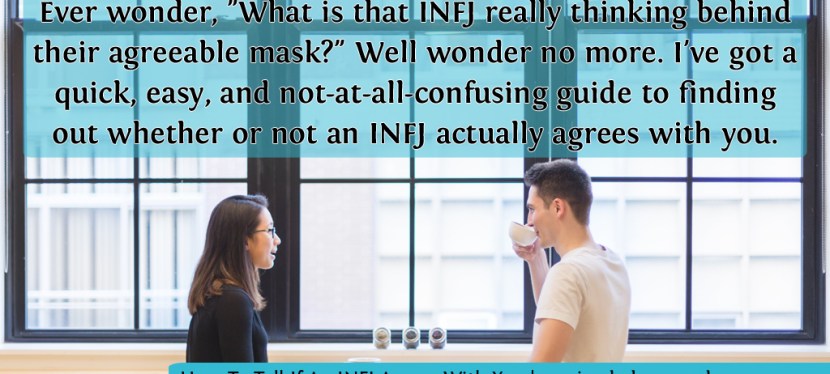
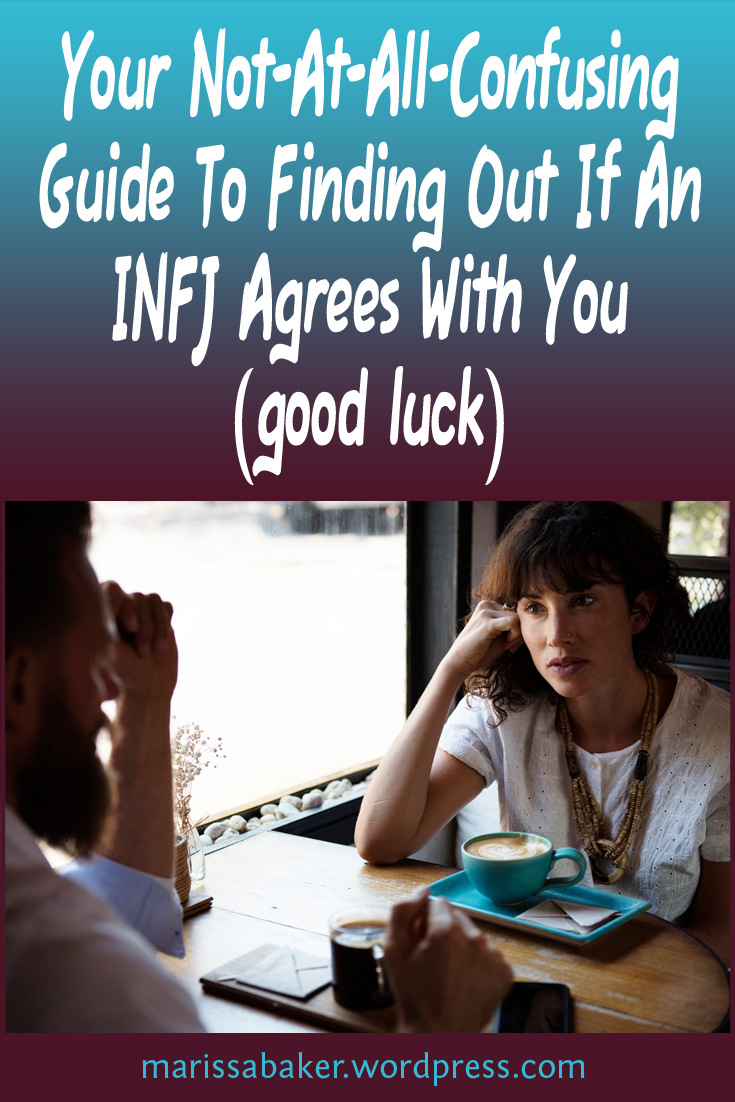
Think INFJs are hard to figure out? Have you found yourself puzzled by an INFJ’s contradictory words and behavior? Well there’s no need to worry any more. I’ve got your quick, easy, and not-at-all-confusing guide to finding out if an INFJ agrees with you. No more will those mysterious unicorns of the personality type world confuse you in conversation. No longer will their confrontation-avoidance leave you wondering whether an INFJ actually agrees with what you’re saying or is simply making you think they do so you won’t get upset with them.
Nodding mostly means we’re listening to you, so this could really go either way. Cross-check with other signs.
Eye Contact
Making eye contact typically means the INFJ agrees with you. Not making eye contact could mean one of three things: they disagree with you, they don’t care, or they agree with you but don’t want to admit it.
Non-Committal Sounds
An INFJ who’s making sounds like “um-hum” while glancing away looking for an escape doesn’t agree with you. But if they’re making the same sound with eye-contact while leaning toward you and smiling, then you’re good. Probably. Read more →
A few weeks ago a fellow INFJ named Bo Miller contacted me and asked if he could interview me on his new podcast. After picking my jaw up off the floor and texting my boyfriend to share that I was equal parts terrified and excited, Bo and I started a conversation that led to this interview. Our conversation focused on how INFJs can understand and learn to use their Extroverted Feeling and Introverted Thinking functions.
I already shared this link on my Facebook page, but in addition to the podcast I have a special treat for you all today as well. Bo is a Certified Myers-Briggs practitioner and the creator of iSpeakPeople.com as well as The INFJ Personality Show. He recently published The INFJ Personality Guide and would love to give you a free copy. I haven’t read it yet myself, but from my conversations with him I’m pretty well convinced it’s going to be really good. I hope you’ll grab a copy and check out his website. Here’s more info:
In The INFJ Personality guide, you’ll discover…
• Your greatest strengths
• Your weaknesses
• Why the rest of the world thinks differently than you
• Why you’re so good at discerning people’s thoughts, motivations, and feelings
• How to set better boundaries
• How to cultivate healthy relationships
• What to do when you get down or depressed
• Career advice
• How to manage your thoughts
• How to make your creative ideas, insights, and visions a reality
• How to communicate more effectively with other personality types
• How to handle criticism without getting your feelings hurt
The guide is divided into three sections:
• INFJ preferences
• INFJ functions
• How to develop your personality and reach your potential




 Like An Anchor