Relational Faith: A Book Review and Theological Reflection

I was so happy to receive a comment from Brent Schmidt on my blog post about his book Relational Grace: The Reciprocal and Binding Covenant of Charis (2015) offering me the opportunity to read his new book Relational Faith: The Transformation and Restoration of Pistis as Knowledge, Trust, Confidence, and Covenantal Faithfulness (2023). I really enjoyed the book on grace, and I was eager to read this follow-up work on faith.

You could read Relational Faith on its own, but it builds on Relational Grace and is best read as a continuation of that study. The basic argument of this new book is, “A universal doctrinal apostasy regarding faith occurred, necessitating a restoration of relational, covenantal faith” (p. 233). Much like Schmidt explained with charis/grace, the original meaning of pistis is vastly different from most mainstream Christian ideas of faith. Studying the context for how these Greek words were used when the New Testament was written helps us understand how grace and faith work today. God’s character is unchanging and the way He relates to us–including what He expects of those in relationship with Him–also didn’t change just because theologians over the years came up with different interpretations and ideas.

I don’t remember if I’ve mentioned this here before, but if I could have constructed a perfect-for-me class to take as part of my Masters in Rhetoric and Writing program, it would have focused on the Apostle Paul’s use of classical and Jewish rhetorical strategies. Schmidt holds a PhD in classics, and reading this book I felt like I was getting much of what I’d want from that hypothetical class. Schmidt opens the introduction with the words, “Context is key if we are to understand the essential Christian doctrine of faith as taught by the Apostle Paul” (p. 1). Amen, sir. Also, pistis is the same word used for “persuasion” in Aristotle’s rhetoric, and Schmidt spends a good deal of time on classical rhetoricians’ use of the word.

In short, this book could have been written for me even though Schmidt and I have some significantly different theological views/backgrounds (a bit more on that at the end). Overall, I found this an excellent scholarly work situating pistis firmly in its ancient context for both Jewish and Gentile Christians in the first-century. It also contains a detailed history of the changes in doctrinal understandings of faith over the years, with comparisons between different interpretations of faith from a variety of theologians. I didn’t find this book quite as engaging as Relational Grace, but it was well worth reading.

Image of two people with hands lifted in worship overlaid with text from Hebrews 11:1, WEB version:  “Now faith is assurance of things hoped for, proof of things not seen.”
Image by Temi Coker from Lightstock

Contextualizing Pistis

One of Schmidt’s basic premises is that we can better understand how Biblical writers use a Greek word by looking at how Classical writers earlier and around the same time used that word. This may seem an odd idea to us who live in a world where it’s considered normal and proper to separate religion from things like philosophy and science. There wasn’t such a separation in ancient times, though (Schmidt, p. 3). And while Biblical writers did give some words new/deeper Christian spiritual meanings, extrabiblical writings provide invaluable clues for understanding how people used these words at the time Paul and others were writing.

Schmidt’s etymological history of pistis and related words reveals that they can mean “faithfulness, steadfastness, and trustworthiness because of the underlying expressions of loyalty between parties in covenant relationships” (p. 11). He also places the word’s use in the context of classical Greek writers and Roman writers using the equivalent Latin word fides. He even looked into how pagan conceptions of the Pistis and Fides as goddesses influenced contemporary uses of the word. It’s a thorough scholarly investigation.

Additionally, Schmidt writes, “in the first century, pistis implied active loyalty, trust, hope, knowledge, and persuasion in the patron-client relationship or within the new covenant brought about through Christ’s Atonement” (p. 11). Faith in this sense is an active thing that’s connected with reciprocal relationships. When we’re in covenant with God, He is faithful to us and we must be faithful to Him. This is a concept that would have been very familiar to both Greek and Jewish audiences (Schmidt, p. 12-16). Also, Greek and Roman audiences were very familiar with the patron-client relationships that had pistis at the center. Whatever their religious background, first-century audiences would have thought of faith in a reciprocal relational context.

Jewish audiences in particular knew that faithfulness was key to covenants with God. In Hebrew, the basic root word for faith is aman (H539 in Strong’s). At the core, it means “firmness or certainty” (Theological Wordbook of the Old Testament, entry 116). Related words in this family include amen (verily, truly), emun (faithfulness, trusting), emuna (firmness, fidelity), and emet (truth). Schmidt points out that, like the Greek pistis, these Hebrew concepts were “knowledge-based, relational, and covenantal” (p. 37). And when Jewish writers wrote in Greek, they translated aman words into Greek as pistis (Schmidt 38). For example, when Paul quotes Habackuck 2:4, “the righteous will live by his faith (emunah),” he says, “the righteous shall live by faith (pistis)” (Rom. 1:17, WEB).

Image of a woman studying the Bible, overlaid with text from Deuteronomy 7:9, NET version:  “So realize that the Lord your God is the true God, the faithful God who keeps covenant faithfully with those who love him and keep his commandments, to a thousand generations”
Image by MarrCreative from Lightstock

Tracking Changes in Descriptions of Faith

Neoplatonists and Augustine

Have I talked on this blog before about the Neoplatonists? I don’t think I have, but they keep coming up in books I read that trace how Christianity changed after the first century. This school of thought (along with other trends, including anti-Jewish sentiments) heavily influenced shifts such as the change from keeping the Sabbath on Saturday to gathering on Sunday and adding the idea of an immortal soul (whereas in the Bible, God ” alone possesses immortality” until He grants it to people in His family [1 Tim. 6:16; 1 John 3:1-3]). And apparently, it’s also connected to the change from thinking of faith as intimately connected to covenant to an expression of belief in accepted Christian doctrines.

  • Side note: if you’re interested in exploring this idea more, I recommend Plato’s Shadow: The Hellenizing of Christianity by Gary Petty. It’s a good introduction/overview of the topic. (Please note this is an affiliate link, which means I’ll receive a small commission if you click on the link and make a purchase.)

While tracing the ways Christian conceptions of faith changed after the first century, Schmidt writes, “Neoplatonist faith (pistis) embraced the intelligible and pure through contemplation and also embraced emotional assurances that the soul was immortal by identifying with an abstract divine” (p. 116). Here’s where we start getting the idea of faith as something abstract, mystical, or requiring only passive acknowledgement. This is happening during the late Classical period (starting around 200 AD), and heavily influences Christianity of the Middle Ages. In contrast, “Ancient readers understood that faith obligated them to demonstrate their faithfulness actively” (p. 130).

The major shifts in conceptions of faith solidified around the 5th century. Schmidt comes down hard on Augustine for that, and rightly so I think based on other examinations I’ve read of Augustine’s work and the readings I’ve done of excerpts from his own texts (we covered him in my classical rhetoric class). Augustine introduced doctrinal concepts such as original sin and predestination, and defined faith as something God gave those He determined would be His people. Though an influential theologian, Augustine contradicted long-established Christian teachings in some of his doctrines, including the way he spoke about faith as something passively received from God, an emotion, and/or acknowledgment of a belief system (Schmidt, Chapter 9). In short, “Augustine’s model of faith fit very poorly with any Hellenistic notions of pistis because first-century pistis was ‘neither a body of beliefs nor a function of the heart or mind, but a relationship which creates community” (Schmidt, p. 167, quoting scholar Teresa Morgan).

I find it very interesting that the shift to seeing faith as a mystical thing granted to you by God, which helps you accept mysteries unknowable, coincides with the shift in popularly accepted Christian doctrine toward describing God’s nature as a Trinity (the Council of Nicae and the Council of Constantinople both happened in the 4th century). If you’re going to describe God as an unknowable three-in-one deity rather than as a family where the Father and Son make covenants with and know people individually, then it’s hard to define faith as a patron-client relationship that believers have with the Father modeled after the relationship the Father has with the Son. (For more on why I don’t think “trinity” is the best way to describe the nature of God, see my post “What Does It Mean For Each of Us That God Is A Family?“)

Medieval to Modern Theologians

Schmidt spends the next few chapters tracing Catholic and then Protestant teachings about faith through the Medieval, Renaissance, Enlightenment, and early Modern periods. William Tyndale stands out as a theologian working to balance the ideas of “salvation by faith alone” and the clear Biblical instructions for faith to result in good works (Schmidt, pp. 185-88). Heinrich Bullinger, John Locke, and Dietrich Bonhoeffer are also highlighted as rare examples of theologians hearkening back to the active, covenantal context of pistis. Overall, though, the meaning of faith shifted away from ancient conceptions of pistis as faithfulness in covenant and focused more on passive, mystical experiences. Debates at this time often centered on how/if good works were linked with faith and whether or not there was any human free will involved.

There still isn’t a clear consensus in modern Christianity about how to define faith. There are, however, influential theological movements hearkening back toward an ancient understanding of pistis. In Chapter 13, Schmidt explores one of the reasons why I wasn’t all that surprised by what I read in this book about covenants and faith. C.S. Lewis (my favorite Christian writer) taught that faith necessarily involves action. The modern theological movement known as The New Perspective on Paul (including authors I’ve read and enjoyed like N. T. Wright and others I’m familiar with including E.P. Sanders and James Dunn) teach that Paul must be read through a first-century Jewish lens. They also point out that mistakes in reading Paul’s writings and over-reliance on Medieval theologians have led to distorted ideas of faith.

A Few Last Thoughts
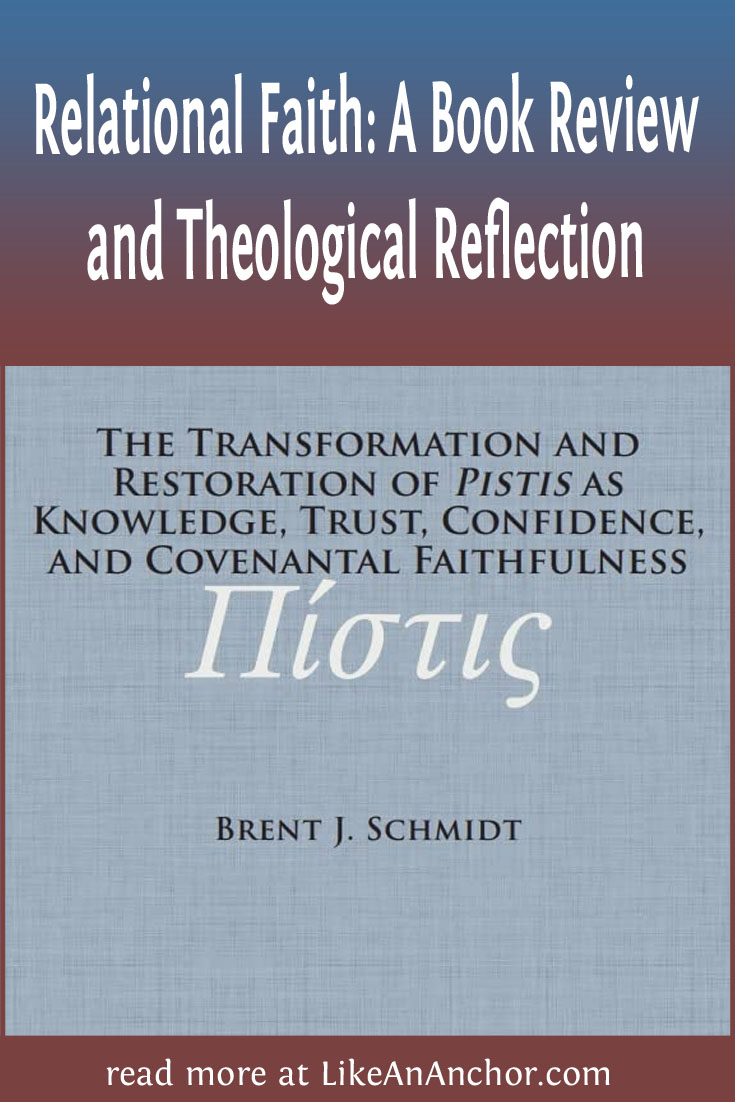
Image of the Relational Faith book cover overlaid with the blog post's title text.
Features cover image for Relational Faith

As someone who’s been part of a 7th-day Sabbath-keeping Church of God group her whole life and who also has a Messianic Jewish background, the core arguments of Relational Faith weren’t surprising to me. Similarly, when I first came across the New Perspective on Paul, it didn’t seem revolutionary to read Paul as a Jewish writer who sees covenants as central to Christianity. That’s simply how I think of Christianity.

I will admit, though, that reading Relational Faith challenged me to think more deeply about how I talk about faith. For example, I will use the phrase “my faith” to mean “the doctrines I believe in and the experience of feeling sure that God exists.” A first-century Christian, though, saw faith more as something you do than something you have. If they talked about “my faith,” they’d likely mean “my faithfulness to the covenant God makes with me, as well as the obedient actions associated with honoring that covenant.” Reading this book made me want to be more intentional and careful about how I conceptualize and speak of my relationship with God to ensure it aligns with His word.

Even with confusion about what faith really means and ongoing theological debates, I would argue that the original meaning of faith has not been entirely lost even in “mainstream” Christianity. Yes, there are plenty of songs and teachings that reduce faith to some internal sensation or belief, but there’s also Josh Wilson singing, “Faith is Not a Feeling,” Christianity.com pointing out that faith is often synonymous with obedience, and Baker’s Evangelical Dictionary of Biblical Theology connecting faith with covenants that bridge Old and New Testaments. There isn’t a simple “this group is all wrong, while this group is all right” answer.

Finally, as I mentioned in the beginning, Schmidt and I have some different theological views. I try to practice the first-century version of Christianity I read about in the New Testament as closely as possible (if you want to label me, “Messianic” or “Sabbath-keeper” works pretty well). Schmidt is a member of the Church of Jesus Christ of Latter Day Saints. Most of the focus of his book is on areas where he overlaps with other Christians (i.e. interpreting the New Testament in light of the writers’ use of classical Greek language), but the last two chapters are devoted to the concept of “faith” in the Book of Mormon and other Latter Day Saints’ writings. While I find this aspect of his beliefs rather puzzling, please read this more as an observation than a criticism–those chapters didn’t interest me much, but readers are free to do with them as they will.


Relational Faith was published on March 21, 2023. It is available on Amazon as a Kindle ebook or paperback book (please note this is an affiliate link, which means I’ll receive a small commission if you click on the link and make a purchase).


Featured image by Claudine Chaussé

Relational Investment In The New Covenant

It’s amazing how much you notice the reciprocal nature of God’s relationships with people once you start looking for it. I noticed this when I first read Brent Schmidt’s book Relational Grace, and I’m noticing it even more now that I’m reading his follow-up book, Relational Faith. In both these books, Schmidt explains the context for the Greek words charis (grace) and pistis (faith) are relational and reciprocal; they were connected to patron-client relationships, where a more powerful patron creates a covenant relationship with a client who owes them ongoing loyalty in response to their faithfulness and gracious gifts.

Schmidt writes, “in the first century, pistis implied active loyalty, trust, hope, knowledge, and persuasion in the patron-client relationship or within the new covenant brought about through Christ’s Atonement” (Relational Faith, p. 11). Similarly, everyone knew “receiving charis implied entering into reciprocal covenantal relationships” (Relational Grace, p. 63).

So, I’ve been thinking about faith as active trust and the centrality of reciprocal relationship as we went into the Passover this past week. I also took my Tree of Life translation as the Bible I’d be following along with during the Passover service. And I noticed some interesting things. For one, this Messianic translation uses “trust” instead of the more typical “belief” when translating John 14:1. Second (and this is what we’ll focus on today), the words of the New Covenant in John 13-17 have a lot of reciprocal language.

The Importance of Doing Loyal Things

For purposes of this discussion, I’m using “reciprocal” in the sense of “reciprocity.” Merriam-Webster’s dictionary defines it as “mutual dependence, action, or influence” and ” a mutual exchange of privileges” (Reciprocity). This dictionary also points out that “Reciprocal and mutual share a good deal of meaning; the former may be defined as ‘shared, felt, or shown by both sides,’ and the latter as ‘shared in common'” (Reciprocal). So when we look at this idea in the Bible, we’re looking at places where God says, “Because I do ___, you respond like ___” or where His followers say something like, “It is right for us to do ___, because the Lord has graciously done ___.”

At Jesus’s last Passover on earth with His disciples, He instituted New Covenant symbols and traditions, including the foot washing. During the evening meal, Jesus got up and washed His disciples feet. Then, He told them to reciprocate by doing the same thing for other people.

 If I then, your Lord and Teacher, have washed your feet, you too ought to wash one another’s feet.  For I have given you an example—you should do just as I have done for you. I tell you the solemn truth, the slave is not greater than his master, nor is the one who is sent as a messenger greater than the one who sent him. If you understand these things, you will be blessed if you do them.

John 13:14-17, NET

The proper response to Jesus serving you is to go out and serve others. Then, when you understand and do the things He teaches, you’ll receive blessings. In sharp contrast stands Judas, who responded to His Master’s selfless service with betrayal. You might remember I’ve also been reading The Heliand, a Saxon retelling of the gospel account in the style of epic poetry like Beowulf. In this version, the disciples are cast as warrior-companions who owe fealty to their thane, the great king Jesus the Healer. Though we feel Judas’s betrayal deeply in modern translations, I think the Saxons might have understood even more deeply what it meant to a first-century Jewish, Greek, and Roman audience to break faith with someone who you’d bound yourself to in a covenant that should have been faithful and reciprocal.

Image of Bibles on a table overlaid with text from John 14:21, 23,  NET version:  “One who has my commandments and keeps them, that person is one who loves me. One who loves me will be loved by my Father, and I will love him, and will reveal myself to him. ... If a man loves me, he will keep my word. My Father will love him, and we will come to him, and make our home with him.”
Image by Inbetween from Lightstock

More Reciprocal Instructions

In my church we often refer to the passage of scripture in John 13-17 as the words of the New Covenant. I encourage you to read through that section of scripture and look at how many times the “if you do this, I will do this” or “because I do this, you should do this” pattern repeats. I’ll just quote one of those passages here:

“You are clean already because of the word that I have spoken to you. Remain in me, and I will remain in you. Just as the branch cannot bear fruit by itself, unless it remains in the vine, so neither can you unless you remain in me.

“I am the vine; you are the branches. The one who remains in me—and I in him—bears much fruit, because apart from me you can accomplish nothing. If anyone does not remain in me, he is thrown out like a branch, and dries up; and such branches are gathered up and thrown into the fire, and are burned up. If you remain in me and my words remain in you, ask whatever you want, and it will be done for you. My Father is honored by this, that you bear much fruit and show that you are my disciples.

 “Just as the Father has loved me, I have also loved you; remain in my love. If you obey my commandments, you will remain in my love, just as I have obeyed my Father’s commandments and remain in his love. I have told you these things so that my joy may be in you, and your joy may be complete.  My commandment is this—to love one another just as I have loved you. No one has greater love than this—that one lays down his life for his friends. You are my friends if you do what I command you.

John 15:3-14, NET

If we live in Jesus, He and His Father will live in us. Because they live in us, we’ll bear much fruit. When we bear fruit, it honors God. And so on. The New Covenant is a reciprocal relationship. Like any healthy relationship, there’s trust and reliance on each other to do things that build up the relationship. And as the far more powerful party in the covenant, God gives far more than we do. In John 13-17, Jesus promises to send the gift of the Holy Spirit. He assures those who are loyal to Him that His Father will hear and respond to their prayers. And the main thing He asks from us in return is love, loyalty and obedience. Over and over we read, “if you love me, keep my commandments,” including the one to love each other (John 13:34-35; 14:15, 21, 23; 15:17).

It’s really amazing to think about. God wants to have a real relationship with us. And not one that’s easily ended when someone decides it’s hard or not what they expected or they don’t “feel like it” anymore. He’s invested in us for the longest-term possible–eternity. He wants us to grow and thrive in this relationship, learning to be like Him since we’re becoming part of His family.

A Real, Mutually Invested Relationship

Image of two people holding hands with the blog's title text and the words  "God wants a real, lasting covenant relationship with us where the trust and investment go both ways."
Image by Jantanee from Lightstock

Now this is eternal life—that they know you, the only true God, and Jesus Christ whom you sent.

John 17:3, NET

Our eternal potential hinges on a meaningful, real, covenantal relationship with God the Father and Jesus the Messiah. We can learn more about the type of relationship they want to have with us by looking at the relationship they share.

Everything I have belongs to you, and everything you have belongs to me, and I have been glorified by them. I am no longer in the world, but they are in the world, and I am coming to you. Holy Father, keep them safe in your name that you have given me, so that they may be one just as we are one.

John 17:10-11, NET

We belong to God, and He gives us to Jesus, and Jesus leaves us safe with God, and they work together so we can be one as they are one. There’s a beautiful, seamless unity in their relationship and they want to welcome us into that oneness as well (John 17). It’s such an astonishing proposition that the apostle John was still marveling at it decades later.

See how glorious a love the Father has given us, that we should be called God’s children—and so we are! The reason the world does not know us is that it did not know Him. Loved ones, now we are God’s children; and it has not yet been revealed what we will be. But we do know that when it’s revealed, we shall be like Him, because we will see Him just as He is. Everyone who has this hope in Him purifies himself, just as He is pure.

1 John 3:1-3, TLV

There are expectations connected to this covenant relationship, but they’re expectations that naturally flow from the type of connection we share with God our Father and Jesus our adopted elder brother and betrothed Husband. For example, I expect that my parents will continue loving me as their daughter; they expect I won’t do things to dishonor them or purposefully disgrace the family. My fiancé and I each expect the other to remain faithful to and invest in our relationship now and after we’re married. It’s very similar in our relationship with God–the trust and investment go both ways.

We know God the Father and Jesus Christ are invested in their relationships with people. They’ve “got skin in the game”–they made us in their own image, poured their time and energy into us, and Jesus even died for us. He talked about that at Passover, too: “No one has greater love than this—that one lays down his life for his friends. You are my friends if you do what I command you” (John 15:13-14, NET). John brings this up again in his epistles as well, saying, “We have come to know love by this: that Jesus laid down his life for us; thus we ought to lay down our lives for our fellow Christians” (1 John 3:16, NET). There’s even a reciprocal aspect to Jesus’s sacrifice; we can’t pay Him back for such a gift, but there is a proper response we’re supposed to have when we recognize the love that motivated His sacrifice.


Featured image by Claudine Chaussé from Lightstock

Learning More About Covenant Grace

There’s a fascinating relationship between God’s grace and the covenants He makes with people. Until the 5th century (when theologians brought Neo-Platonic philosophy into their interpretation of scriptures), Greek and Roman literature and early Judeo-Christian writings saw charis (grace) as something both relational and reciprocal (Schmidt, p. 201-202). The idea of “grace” as a free gift that God is obligated to give without having any expectations of the recipients was not originally part of the Greek language or of Christianity. Rather, there was a fuller, richer meaning to charis that Jesus, Paul, and other Bible writers used.

I’ve been reading a book on this topic by Brent J. Schmidt, who holds a PhD in classics, called Relational Grace: The Reciprocal and Binding Covenant of Charis (2015). His scholarship on the original meaning of charis is fascinating, but even without that background we can still see that grace comes with expectations. For example, Jesus said the one who “endures to the end will be saved” (Matt. 10:22, WEB) and that “unless your righteousness exceeds that of the scribes and Pharisees, there is no way you will enter the kingdom of heaven” (Matt. 5:20, WEB). We’re saved by God’s grace, and then He expects us to act in a certain way (with His power supporting us, of course).

The Bible talks about Christian conversion as a process and tells us that relationships with God require continued faithfulness. Yet the popular definition of grace in many modern churches still says grace is unmerited favor that God gives without expectation of anything in return. Trying to make these two ideas fit together is confusing, and it’s a problem first-century Christians didn’t have to deal with because they had a different definition for grace.

Ancient Understandings of Charis

Several centuries before Christ’s first coming and until at least the 4th century after, charis was understood as something that involved obligation and reciprocity (Schmidt, ch. 2 and 3). This meaning infused Greek, Roman, Jewish, and later Christian society to the point that everyone knew “receiving charis implied entering into reciprocal covenantal relationships” (p. 63).

Jews knew about covenantal relationships from the Bible. Every commandment was a covenant with God. Several stories, including Joseph, Moses, and David, associate the concepts of grace and mercy with covenants. Greek-speaking Jews lived in a culture that depended heavily on reciprocal relationships and understood what charis meant. When Paul taught them using the words charis, they would have understood that by accepting God’s grace they were making covenantal obligations.

Brent Schmidt, Relational Grace, p. 64

When Jesus Christ came to earth, one of the things that He did was establish a New Covenant on better promises and with a different sort of sacrifice. The Old Covenant was “completely unable … to perfect those who come to worship” (Heb 10:1, NET). In contrast, Jesus took away sin completely, giving us an incredible gift for us that we could never deserve nor repay. When we accept this “charis,” we enter a covenant with Him and His Father.

For by one offering he has perfected for all time those who are made holy. And the Holy Spirit also witnesses to us, for after saying, “This is the covenant that I will establish with them after those days, says the Lord. I will put my laws on their hearts and I will inscribe them on their minds,” then he says, “Their sins and their lawless deeds I will remember no longer.” Now where there is forgiveness of these, there is no longer any offering for sin.

Hebrews 10:14-16, NET (OT quotes bolded in this translation)

Grace is so closely connected with covenants that treating “the blood of the covenant ” as “an unholy thing” means someone has “insulted the Spirit of grace” (Heb. 10:29). Covenants and laws don’t vanish after Christ’s sacrifice–they move to a heart and spirit level. We can see this in Jesus’s Sermon on the Mount, where He talks about the deeper, spiritual, enduring applications of God’s law. Paul also talks about this shift from flesh-level to spirit-level in detail when he’s talking about law and covenants.

Grace in Paul’s Letter to the Romans

Shifting our definition of grace to align with the one Paul and his audience would have used gives us a better idea of how to properly interpret Paul’s letters. One of the best places to see that is in Romans 6. Here, Paul talks about how we are “not under law but under grace” (v. 14, NET). This verse and others like it are often read out of context, but if you read the surrounding text the reciprocal and obligatory aspects of charis are easy to see. This is a very long quote, but I think it’s important to look at the whole thing to get enough context to understand Paul’s words.

Therefore do not let sin reign in your mortal body so that you obey its desires, and do not present your members to sin as instruments to be used for unrighteousness, but present yourselves to God as those who are alive from the dead and your members to God as instruments to be used for righteousness. For sin will have no mastery over you, because you are not under law but under grace.

What then? Shall we sin because we are not under law but under grace? Absolutely not! Do you not know that if you present yourselves as obedient slaves, you are slaves of the one you obey, either of sin resulting in death, or obedience resulting in righteousness? But thanks be to God that though you were slaves to sin, you obeyed from the heart that pattern of teaching you were entrusted to, and having been freed from sin, you became enslaved to righteousness. (I am speaking in human terms because of the weakness of your flesh.) For just as you once presented your members as slaves to impurity and lawlessness leading to more lawlessness, so now present your members as slaves to righteousness leading to sanctification. For when you were slaves of sin, you were free with regard to righteousness.

So what benefit did you then reap from those things that you are now ashamed of? For the end of those things is death. But now, freed from sin and enslaved to God, you have your benefit leading to sanctification, and the end is eternal life. For the payoff of sin is death, but the gift of God is eternal life in Christ Jesus our Lord.

Romans 6:12-23, NET

Many translations use the word “servant” instead of “slave,” but doulos is best translated either as “bondservant” or “slave.” Being bound to serve the Lord in this way was seen as an “honor and a privilege” in the Jewish mindset (NET footnote on Rom. 1:1). It’s a very different sort of thing than slavery in the modern sense. In fact, at the time Paul was writing, the “asymmetrical social relationships between patron and client and between master and salve were founded on the reciprocal notion of charis” (Schmidt, p. 95). When Paul talks of slavery, he’s talking about us being obligated to God for His gifts and bound in a covenant with Him that has expectations.

Living by God’s Spirit

When Jesus healed a man in Bethesda who’d been sick for 38 years, He told the man, “Behold you are made well. Sin no more, so that nothing worse happens to you” (John 5:1-14, WEB). It’s similar to what He told the woman caught in adultery (a story that’s not in the earliest manuscripts but is traditionally included with John’s gospel): “Neither do I condemn you. Go your way. From now on, sin no more” (John 8:11, WEB). In one case, Jesus provided physical healing and in the other He freed her from being condemned to death. After giving these gifts, He told both people that they should respond by doing something specific: stop living a life of sin.

There is therefore now no condemnation for those who are in Christ Jesus. For the law of the life-giving Spirit in Christ Jesus has set you free from the law of sin and death. For God achieved what the law could not do because it was weakened through the flesh. By sending his own Son in the likeness of sinful flesh and concerning sin, he condemned sin in the flesh, so that the righteous requirement of the law may be fulfilled in us, who do not walk according to the flesh but according to the Spirit.

Romans 8:1-4, NET

The Father and Son have given us incredible gifts. They’ve saved us from sin, adopted us into their family “with full rights of inheritance” (NET footnote on 8:15), and offer continued forgiveness so long as we do our best to follow Them and repent when we miss the mark. In response, “we are under obligation” to live a life lead by God’s spirit (Rom 8:12-14, NET). Being in a reciprocal covenant of grace is not about earning salvation or trying to pay back an impossible debt. It’s about having the right response of thankfulness to the incredible things God has done for us by welcoming us into His family. The more we can learn about that, the deeper relationship we can have with Him.

Featured image by José Roberto Roquel via Lightstock