Be Of The Same Mind: God’s Intention For Peace In His Church

If God says He hates something, is it a thing we should be doing in the church? Of course not! Those who love God do things that are pleasing in His sight (1 John 3:22). We don’t always do that perfectly, but it’s supposed to be our goal. And when we miss the mark, we repent and change and try again.

One of the things the Lord hates and considers an abomination is “he who sows discord among brothers” (Prov. 6:19, all scriptures in this post are WEB version). In Hebrew, “sow” is shalach (H7971), and it means to send out or shoot forth, as in a growing plant putting out leaves. God hates it when someone plants and spreads strife or contention (medan, H4090) among those who are metaphorical or literal family (ach, H251).

So what does it say about us as a church body when there are divisions, disagreements, and rifts in our relationships and beliefs? In some cases, we can disagree on things that are open to interpretation and still fellowship peaceably, which is the right thing to do (Rom. 14). But all too often, when people in the churches disagree they start attacking or ignoring each other rather than working through their issues, resolving doctrinal conflicts, and seeking peace and unity as God intends.

Be Of The Same Mind: God's Intention For Peace In His Church | marissabaker.wordpress.com
Photo credit: Shaun

Menary via Lightstock

Strife Does Not Come From God

The greatest commandments are to love God with all your heart, mind, soul, and strength and to love your neighbor as yourself. In contrast, strife is stirred up by hatred, not love (Prov. 10:12). And the people who spread strife are called perverse, lovers of disobedience, greedy, and angry (Prov. 16:28; 17:19; 28:25; 29:22). Those aren’t the sort of things God wants to see when He looks at the people in His chruch.

Now the deeds of the flesh are obvious, which are … hatred, strife, jealousies, outbursts of anger, rivalries, divisions, heresies, envy … of which I forewarn you, even as I also forewarned you, that those who practice such things will not inherit God’s Kingdom. (Gal. 5:19-21)

More than half the things in this “works of the flesh” list have to do with discord and disunity. In contrast, the fruit of the Spirit is things like “love, joy, peace, patience, kindness, goodness, faith, gentleness, and self-control” (Gal. 5:22-23). Those are the things that stop arguments before they even start.

This Goes Beyond Not Fighting

Scriptures make it quite clear that God puts a high value on peace. Though He warns us that following Him will set people against you (Matt. 10:34-36; John 15:18-21), that sort of strife should only happen between you and the world. There’s supposed to be peace in the church among God’s people.

So then, let us follow after things which make for peace, and things by which we may build one another up. (Rom. 14:19)

On your part, you’re supposed to do what you can to live peacefully with everyone you meet (Rom. 12:18; Heb. 12:14). This is especially important in the church, where it’s an attainable goal because all the believers are supposed to be working toward peace (1 Thes. 5;13). God intends for there to be unity in His church. Read more
How Much Have You Grown In A Year?

As we approach the Passover season, it’s traditionally a time of reflection and self-examination. It’s good to have moments like that where we consider what God has to say about our lives, the areas where we need to repent, and different ways we can continue to grow and change.

At my Messianic congregation, they’ve shared that certain rabbis teach that if you are still in the same place you were a year ago you have backslid. We can’t maintain a sort of “status quo” in our walk of faith. Either we’re moving toward God or we’re moving away. There’s no place for complacency in a Christian life.

God expects growth. That doesn’t mean we need to be constantly on-edge and second guessing if we’re “good enough,” though. He doesn’t expect us to already be perfect, but He does expect us to keep going that direction. Such growth involves becoming more like God in every aspect of our lives. The more we grow, the more His character, desires, priorities, etc. are reflected in our own lives.

How Much Have You Grown In A Year? | marissabaker.wordpress.com
Photo credit: Pearl via Lightstock

In Touch With The Great  Commandments

What are the most important things to focus on as we try to grow as Christians and learn more about God? You’ll hear various answers. Some say preach the gospel, citing the great commission as our primary goal. Others devote themselves to good works. Some study prophecy. I like to point to the passage where Jesus identified the greatest commandments.

Jesus answered, “The greatest is, ‘Hear, Israel, the Lord our God, the Lord is one: you shall love the Lord your God with all your heart, and with all your soul, and with all your mind, and with all your strength.’ This is the first commandment. The second is like this, ‘You shall love your neighbor as yourself.’ There is no other commandment greater than these.” (Mark 12:29-31, WEB)

We can all tell how important these commands are from the way Jesus describes them. But I think we too often see them just as a starting place when they should be a continuing focus. We should never stop learning how to love God and our neighbors.

In Jesus’ letter to the Ephesian church, He said, “I have this against you, that you left your first love” (Rev. 2:4, WEB). We’re not told exactly what that first love is, but since the first commandment is to love the Lord your God I don’t think it’s too much of a stretch to say the Ephesians’ problem was related to losing touch with the greatest commandments. Read more

A Story of Battle And Victory

Once upon a time, a great King and Prince decided to they didn’t want to be alone anymore. There were other beings in their realm, but none like them. No one else to share their love and unity with, at least not in the way they longed for. So they came up with a plan. They created a beautiful garden and from the earth they molded living, breathing people patterned after their own image. They wanted these people to be their companions, but not as servants or slaves, and that meant the people had to be given free will. They would need the opportunity to choose the King and Prince just as the King and Prince chose to want them.

But there was an evil force at work. One of the other beings, prideful and jealous of the King, led a revolt and became the Adversary. And as Adversary, he made it his goal to thwart the King’s plan, including the great plan to grow his family. The Adversary was not powerful enough to destroy the King. But he knew if he could kill these new people who the King wanted to become his children he would have his revenge.

When tempted by the Adversary, the King’s new creation fell into his lie. They chose a path that led away from the king their Father and the Prince their brother. And that choice changed the battle field between the King and Prince and the Adversary. Now they fought over the fate of the King’s children.

The King and Prince weren’t caught off-guard by the Adversary, though. They already had a plan, but it seemed a strange sort of plan for going into battle. Rather than using force to get the King’s children back they used love. The Prince came as a suitor asking for his adopted sister’s hand in marriage. And some of the people made a covenant with him, but there was still a death penalty hanging over their heads. The Adversary had talked them all into breaking the King’s law and someone had to pay the price justice demanded. So that’s what the Prince did, leaving his kingdom and making himself vulnerable on the battlefield.

The Adversary threw everything he had against the Prince, but he didn’t win. The Prince conquered the Adversary personally and then gave his own life to pay the penalty hanging over his beloved’s head. In doing so he sealed the ultimate victory. The Adversary keeps fighting though, trying to destroy as many people as he can before his time is up.

But even though the Adversary is still doing damage in the world, the King is holding off on the final battle. He wants to get as many people as possible on his side because he knows if they don’t accept the victory he and the Prince already won that they’ll take part in the Adversary’s defeat. And his goal all along was to make every single person part of His family. He’s not giving up on reaching as many of them as he can. So he keeps calling people to join in following the Prince as the Adversary keeps trying to yank them away.

A Story of Battle And Victory | marissabaker.wordpress.com
Photo credit: Ruby-Rose via Lightstock

Called To Fight

That is the situation we’re called into today when we begin a walk as Christians. Our Prince, brother, and rescuing lover Jesus has achieved victory. But His people here on earth are still fighting the Adversary Satan, waiting for the final battle to end all this. Read more

Praying At All Times

We’ve spent the last nine weeks looking at the famous Armor of God passage in Ephesians. There are six pieces of armor named there: the Girdle of Truth, the Breastplate of Righteousness, the Footwear of the Gospel, the Shield of Faith, the Helmet of Salvation, and the Sword of the Spirit. Those six character traits and spiritual items are where most lists stop, since they’re the ones compared to physical pieces of armor. But there’s a seventh item on the list.

with all prayer and supplication praying at all times in the Spirit, and to this end being alert with all perseverance and supplication for all the saints (Eph. 6:18, LEB)

All the armor must be put on and used with prayer. In this context, we can see prayer either as the connective tissue buckling the other armor on us or as a necessity before and when using the armor (or both). Whether you count prayer as a piece of armor or not, it’s clear that praying is essential when going into a battle we want God to fight for and with us.

Praying At All Times | marissabaker.wordpress.com
Photo credit: Ben White via StockSnap

Prayer Before Battle

As with the six pieces of armor listed earlier, we have examples of prayer being used in physical battles as well as spiritual ones. People of God have always recognized that even when facing physical enemies there’s a more important spiritual side to the battle. And it’s the Lord of Hosts who determines the outcome.

Three righteous kings left us records of their prayers before battle. Asa prayed when facing “an army of a thousand thousands” (2 Chr. 14:9-12), Jehoshaphat when facing “a great multitude” of Moabites and Ammonites (2 Chr. 20:1-29), and Hezekiah when threatened by a powerful Assyrian army (Is. 37:8-38).

In all three cases, God answered with a powerful victory. “Yahweh defeated the Cushites before Asa” and his army (2 Chr. 14:12, LEB). The Lord sent Jehoshaphat and his men armored into battle, but did all the fighting Himself (2 Chr. 20:16-29). And Hezekiah woke up one morning to find his enemy struck dead outside (Is. 37:36-37). Clearly, prayer is an effective battle strategy for those following God and fighting against His enemies. Read more

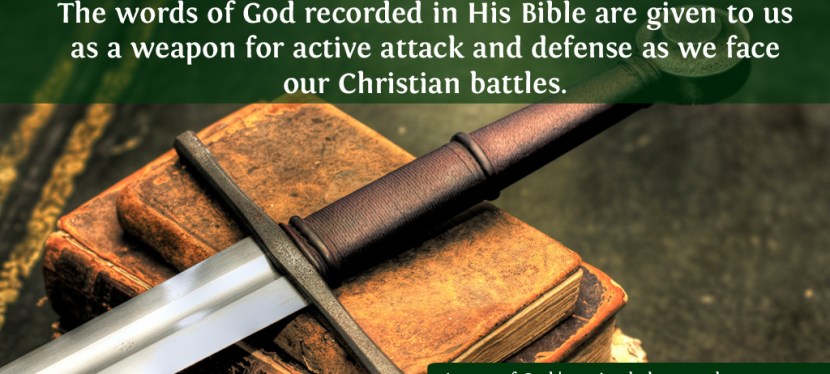
Sword Of The Spirit

Thus far, the armor of God we’ve been studying has all been defensive. The girdle, breastplate, footwear, shield, and helmet all protect us. They’re essential in battle, but they’re not something we can use to attack and (with the exception of the shield) they’re not actively defensive either. This next piece of armor, though, is a weapon.

receive … the sword of the Spirit, which is the word of God (Eph. 6:17, LEB)

Paul tells us exactly what we’re given as the only weapon included in this Armor of God. It’s called the Sword of the Spirit and it is the Word of God. Now it’s up to us to learn how to use the word as a sword.

Sword Of The Spirit | marissabaker.wordpress.com
Photo credit: Paul Kitchener via Flickr

Avoiding Word Confusion

There are two words in Greek for “word,” and we have to start by defining them if we want to avoid confusion. Just looking at the English, we would connect Eph. 6:17 with Heb. 4:12, which says, “the word of God is living and active, and sharper than any two-edged sword, piercing even to the dividing of soul and spirit” (WEB). But these versus aren’t talking about the same thing.

In Hebrews, it’s talking about the logos (G3056). This word refers to a spoken word of intelligence, and it’s what’s used as a name for Jesus in John 1:1, 14. Reading on in Hebrews makes it clear that He’s being talked about in this passage as well (Heb. 4:13-16).

In Ephesians, on the other hand, the word is rhema (G4487). It refers to the spoken or written sayings of God, but isn’t used as a title for the speaker. So in Hebrews, the Word as a sword refers to Jesus cutting into people’s spirits and knowing them deeply. Ephesians is talking about wielding the word, or scriptures, of God as a weapon. Read more

Footwear Of The Gospel

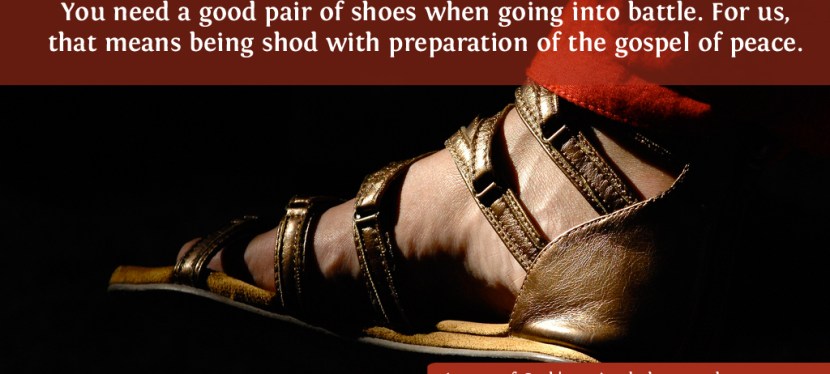
If you’re going into battle, you’re going to need a good pair of shoes. That’s probably not something most of us think about, but what soldiers wear on their feet helps determine how far they can travel in a day and what type of terrain they can fight on. In fact, a good argument can be made that one of the Roman army’s key strengths was improved footwear. Perhaps that’s part of what Paul was thinking about when he wrote this phrase to describe the third piece in the armor of God:

and binding shoes under your feet with the preparation of the good news of peace (Eph. 6:15, LEB)

This piece of armor is related to preparation, the gospel, and peace. It’s a curious combination, especially considering the girdle of truth and breastplate of righteousness have pretty straightforward descriptions. I wasn’t even quite sure what to title this post. Shoes of peace? Prepared footwear? Sandals for preparing good news of peace? I settled on the title you see up there since similar scriptures in Isaiah and Nahum place the focus on carrying good news. Let’s take a look at those.

Footwear Of The Gospel | marissabaker.wordpress.com
Photo credit: DVIDSHUB, CC BY via Flickr

Carrying God’s Words

How beautiful on the mountains are the feet of him who brings good news, who publishes peace, who brings good news, who proclaims salvation, who says to Zion, “Your God reigns!” (Is. 52:7, WEB)

Nahum borrows this phrase in 1:15 and Paul uses it to support his teaching that “faith comes by hearing and hearing by the word of God” (Rom. 10:17, WEB). People must call on the name of the Lord to be saved, but before that they must believe on him and to do that they need to hear about Him. For that to happen, there must be a preacher sent to carry the good news of peace (Rom. 10:13-15). Read more