Does My Personal Example Matter?

I’m borrowing the title for this post from a sermon I heard last month. The speaker said “Does my personal example matter?” was a question Google didn’t have an answer for, and he was right — searching this phrase only turns up results on “personal matters” and “personal opinions.” Searching for “Why is it important to set a good example?”, though, turns up some interesting results. On the first page, you’ll see articles on parents setting a good example for children, leading by example in the workplace, and the importance of role models. Clearly, there are those who believe your personal example does matter.
Does My Personal Example Matter?  | marissabaker.wordpress.com

Most of the articles I saw connected setting an example with leadership. Indeed, this is inherent to the English definition of the word “example” (as found on Merriam-Webster.com):

: a person or way of behaving that is seen as a model that should be followed

: one that serves as a pattern to be imitated or not to be imitated

: one that is representative of all of a group or type

In the Greek, we have several words translated “example,” but they build a similar picture to our English idea. Tupos (G5179) means a print, prototype, pattern or model. Hupogrammos (G5261) is something that’s written down so it can be copied. Hupodeigma (G5262) refers to an example, pattern, or representative of a type. Deigma (G1164) means an example, specimen, or sample.

A Model To Follow

As Christians, we’re called both to follow an example and to be an example.

For to this you were called, because Christ also suffered for us, leaving us an example, that you should follow His steps (1 Pet. 2:21)

This verse is the only time hupogrammos is used in scripture. The word comes from hupo (before/under) and grapho (to write). It paints a picture of a teacher writing out letters and phrases for a student to copy. In effect, Peter is telling us to study and “trace over” the lines of Christ’s life exactly.

We can also learn from the examples of our fellow believers. James tells us to “take the prophets, who spoke in the name of the Lord, as an example of suffering and patience,” and mentions Job as a specific example (James 5:10-11). These and others, like the people in the faith chapter, are positive examples modeling Godly life.

Other examples show us what not to do. Israel’s history was “written for our admonition” and “these things became our examples, to the intent that we should not lust after evil things as they also lusted” (1 Cor. 10:11, 6). Ananias and  Sapphira are another example of how we ought not to act. Such examples serve as a model of what happens when we stray from God.

Jesus Christ is the key to knowing which examples to follow. Paul writes, “Imitate me, just as I also imitate Christ” (1 Cor. 11:1). We need to know the example of Christ, follow Him, and check our role models against the pattern He set. Only then will be be able to tell which examples are worth imitating.

Being An Example

I mentioned earlier that setting a good example is connected with being a leader. Everyone in the church has leadership and ministerial responsibilities, though to different extents and in different roles. We’re all part of “a royal priesthood, a holy nation, His own special people, that you may proclaim the praises of Him who called you” (1 Pet. 2:9). Part of this calling involves Jesus Christ making “us kings and priests to His God and Father” (Rev. 1:6). Those are roles of responsibility, roles that people look to for an example.

As we follow the Lord, we can inspire and reach others by our examples, as the Thessalonians did. Paul wrote to them, saying, “you became examples to all in Macedonia and Achaia who believe. For from you the word of the Lord has sounded forth,” and not just locally. Their faith in God “has gone out, so that we do not need to say anything” (1 Thes. 1:7-8). Their example was more effective at preaching than words.
Does My Personal Example Matter?  | marissabaker.wordpress.com

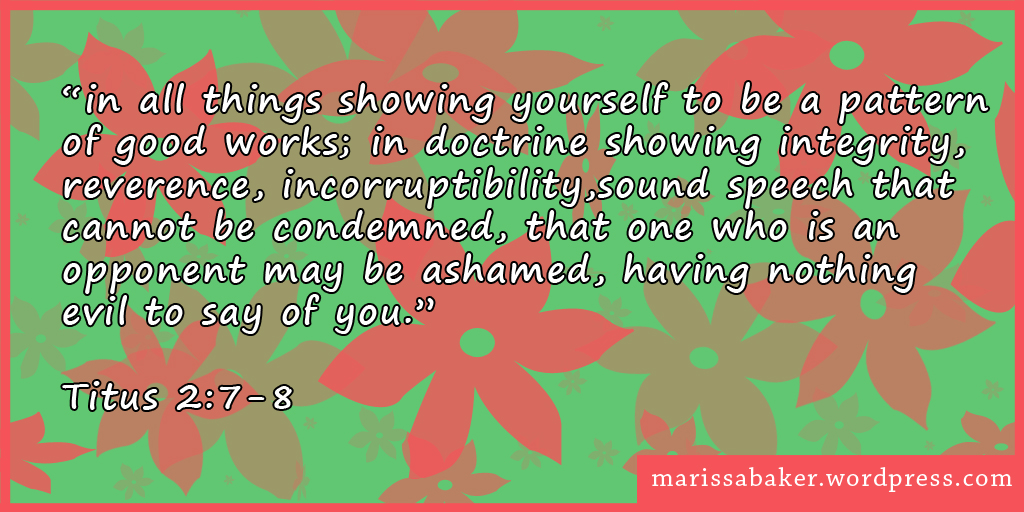
Indeed, we teach by what we do equally (if no more) effectively than by what we say. Writing to a young minister, Paul told him to teach “sound doctrine,” yes, but also to lead by example — “showing yourself to be a pattern of good works; in doctrine showing integrity, reverence, incorruptibility” (Tit. 2:1, 7).

Shepherd the flock of God which is among you, serving as overseers, not by compulsion but willingly, not for dishonest gain but eagerly; nor as being lords over those entrusted to you, but being examples to the flock (1 Pet. 5:2-3)

Representatives

In addition to patterning an example for other believers, we’re also supposed to be examples of what a Christ-follower looks like.

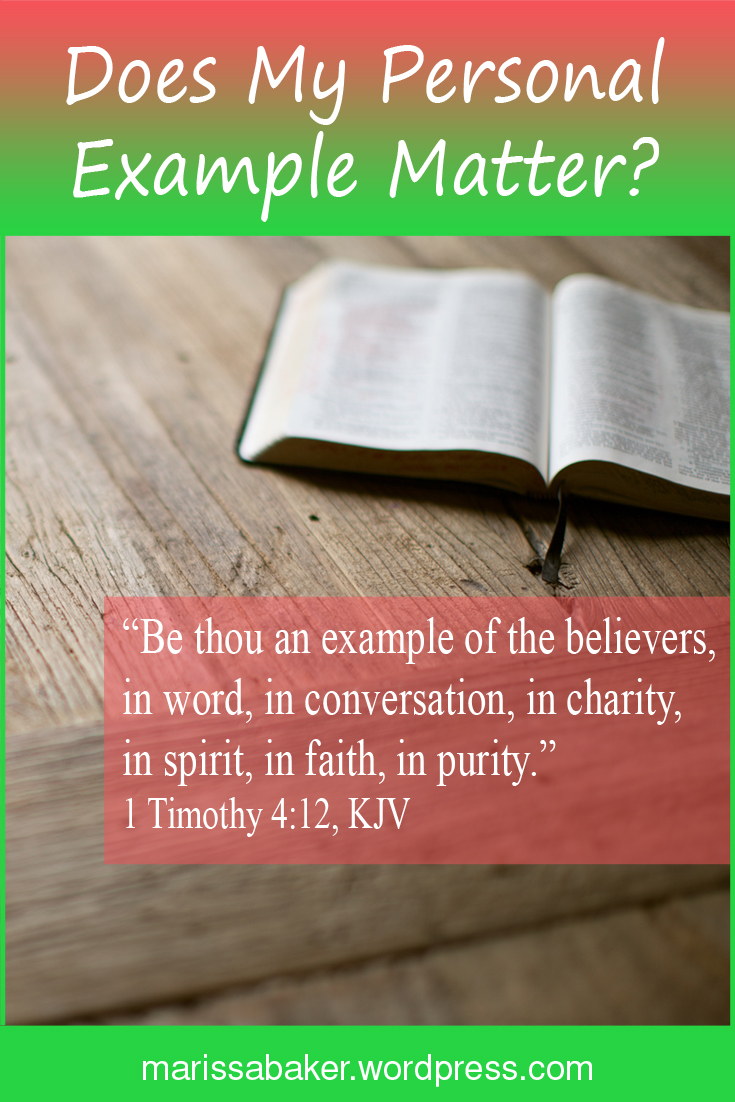
Let no man despise thy youth; but be thou an example of the believers, in word, in conversation, in charity, in spirit, in faith, in purity. (1 Tim. 4:12, KJV)

No matter our age, ability, gift, or role in the church, we can serve as a representative of the Christian type. We are “the epistle of Christ … written not with ink, but with the Spirit of the living God; not in tables of stone, but in fleshy tables of the heart.” (2 Cor. 3:3). We can be seen, “known and read of all men” (2 Cor. 3:2). Indeed, as some have said, you may be the only Bible some people ever read.

Our example doesn’t just “matter.” It’s powerful. We have the amazing opportunity, and responsibility, to show the world how God’s people are supposed to live — to be Christ’s body as we model His love for our brethren and for everyone on the planet.

Download God's Love Story at https://www.smashwords.com/books/view/577523


Loving Christ’s Body

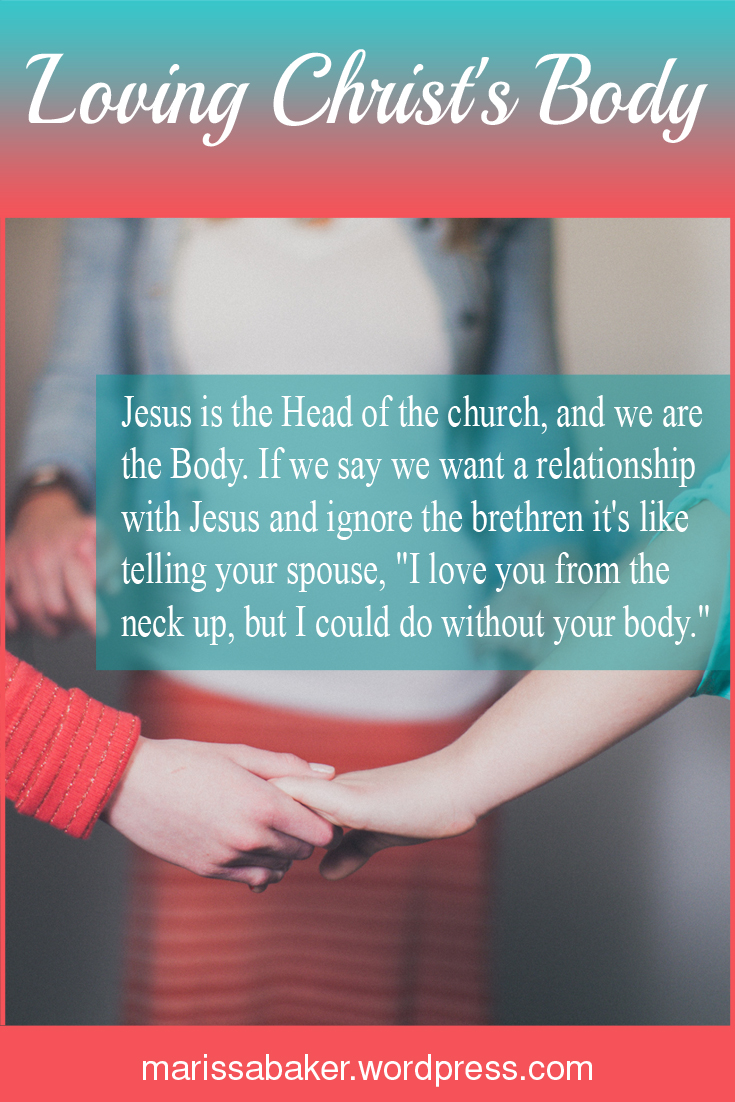
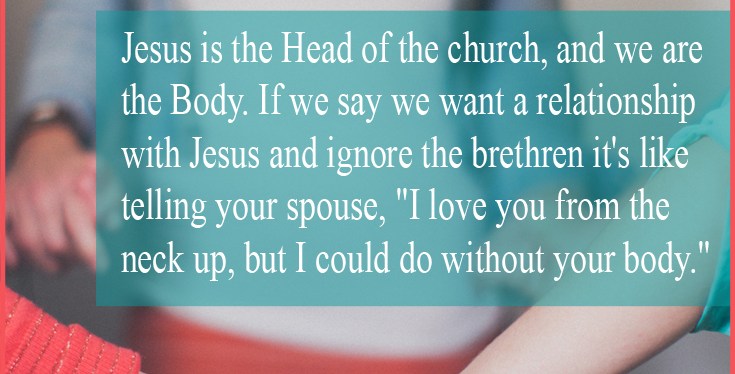
Not too long ago, I heard an analogy on a Christian radio station that stuck with me. It was a pastor trying to convince listeners they need a church to fellowship with. He said that since the church is Jesus Christ’s body and He is the Head, if we say we want a relationship with Jesus and ignore the brethren it’s like telling your spouse, “I love you from the neck up, but I could do without your body.”

Loving Christ's Body | marissabaker.wordpress.com

Vital Commandments

This analogy is not an exaggeration. John’s writings make very clear the high value Jesus puts on love among believers. If we can’t love our brethren, we’re actually incapable of loving God. Read more

Seeking The Lord

What should your heart be set on once you give your life to the Lord? Is it keeping the commandments? going to church? an active prayer life? acts of service? Those are all good things, but they should be a side-effect of our primary focus. In other words, they’ll happen because we want to keep the Law, fellowship with other believers, pray, and serve when our hearts are in the right place.

Seeking The Lord | marissabaker.wordpress.com
picture credit: “Pearls” by FergieFam007, CC BY-SA via Flickr

In Christopher West’s book Fill these Hearts, he quotes mid-twentieth century artist and writer Caryll Houselander as saying, “If instead of using the expression ‘spiritual life’ we used ‘the seeking,’ we should set out from the beginning and go on to the end with a clearer idea of what our life with God will be on this earth” (56). Our conversion isn’t a static state. It’s a continuous search for closeness with God. Read more

Courage To Feel

I recently finished reading, and then immediately re-reading, Fill These Hearts by Christopher West. It’s a powerful rebuttal to the lie that Christianity is a joyless religion of laws and suppressed desires. West touches on many points regarding marriage and the plan of God that I hit in my book God’s Love Story, a subject you know is dear to my heart. I could probably write half a dozen posts inspired by Fill These Hearts (I already quoted from it in last week’s post), but here’s the part I want to focus on today:

Christianity is the religion of desire — the religion that redeems eros — and its saints are the ones who have had the courage to feel the abyss of longing in their souls and in their bodies and to open … all their desires for love and union to the Love and Union that alone can satisfy. … the saints have learned to open eros (their yearning for love) to Eros (God’s passionate love for them).” (p. 39)

Seeing God’s love described as Eros might make you a little uncomfortable at first (it had that effect on me). Eros is the Greek word for passionate or sexual love. This word doesn’t even appear in scripture, although erotic love is alluded to. The word we usually associate with God’s love — and rightly so — is agape. Read more

What Does “Not Under The Law” Mean?

There are a few verses in the New Testament that tell us we “are not under the law” (Rom. 6:15; Gal. 5:18). Though some use this as permission to act however you want so long as you’ve confessed Jesus, most Christians realize that God’s commandments are still in effect. Jesus did not come “to destroy the law or the prophets … but to fulfill” (Matt. 5:17, WEB), and Paul said his own writings “establish the law” rather than repeal it (Rom. 3:31, WEB).

So why do these passages tell us we’re not under the law? I’ve heard many explanations, and touched on some myself, but none of them really answered the question of why Paul would use this phrase. They focused more on trying to say “that’s not really what he meant” than on trying to figure out why Paul chose these words to argue his point. Recently, though, I came across the best analysis of the phrase “not under the law” that I’ve ever seen. It was just a short passage in a little book called Fill These Hearts: God, Sex, and the Universal Longing by Catholic writer Christopher West.

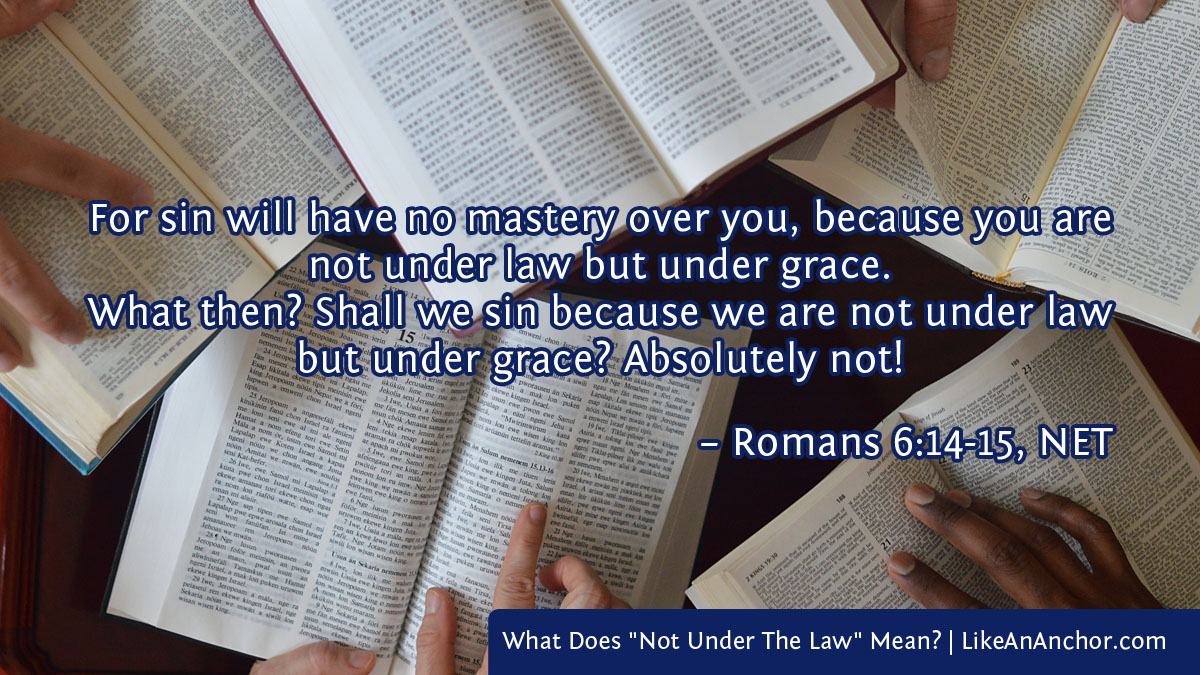
Image of five bibles on a table, with hands touching the pages overlaid with text from Rom. 6:14-15, NET version: "For sin will have no mastery over you, because you are not under law but under grace. What then? Shall we sin because we are not under law but under grace? Absolutely not!"
Image by Inbetween from Lightstock

Freed from Bondage to Sin

In Fill These Hearts, West writes about our desires, saying that we can either deny them and go on a “starvation diet,” indulge them in this life like “fast food,” or direct them toward God and partake in His “banquet gospel.” When addressing the idea of freedom in relation to desire, he says,

The Apostle Paul writes that those who “are led by the Spirit .. are not under the law” (Gal. 5:18). They’re free from the law — not free to break it (that’s license); they’re free to fulfill it because they don’t desire to break it. Christ didn’t come into this world to shove laws down our throats. He came into the world to align the desires of our hearts with the divine design so we would no longer need the laws

West, Fill These Hearts, p. 140

This isn’t just West’s own particularly theory; it’s a solid reading of the Biblical text. Basically, he’s just summarizing in modern English what Paul was explaining in Galatians 5 and putting the phrase “not under the law” in its proper context.

This verse in Galatians is preceded by a discussion of two covenants. The Old Covenant is described as one that “gives birth to bondage” (Gal. 4:24, NKJV). When the people broke that covenant, they bought a death penalty on themselves. Jesus paid the price of that broken covenant and freed us from sin with His sacrifice, then mediated and established the New Covenant (Heb. 8:6).

Stand firm therefore in the liberty by which Christ has made us free, and don’t be entangled again with a yoke of bondage

Galatians 5:1, WEB

Paul is telling us that if we go back to studiously keeping every aspect of the law as if that will save us “Christ will profit you nothing … You are alienated from Christ, you who desire to be justified by the law. You have fallen away from grace” (Gal. 5:2, 4, WEB). We can’t treat the Old Covenant as our way to salvation. That does not, however, grant license to sin.

 For you were called to freedom, brothers and sisters; only do not use your freedom as an opportunity to indulge your flesh,but through love serve one another. For the whole law can be summed up in a single commandment, namely, “You must love your neighbor as yourself.”

Galatians 5:13-14, NET (bold italics mark a quotation from Lev 19:18)

“Love” in this verse is agapao–the divine, selfless love of God. When we start becoming love as God is love, we will keep His laws from the heart instead of by compulsion to an external system.

 But I say, live by the Spirit and you will not carry out the desires of the flesh. For the flesh has desires that are opposed to the Spirit, and the Spirit has desires that are opposed to the flesh, for these are in opposition to each other, so that you cannot do what you want. But if you are led by the Spirit, you are not under the law.

Galatians 5:16-18, NET

That is, we’re no longer held in bondage to a cycle of sin and death. Christ pulled us out of that and set us on a path of walking in the Spirit. If you keep reading verses 19 through 21 you get a list of the “works of the flesh.” All these works are sins under the Old Covenant and under the New Covenant “those who practice such things will not inherit the kingdom of God!” (Gal. 5:21, NET). Someone walking in Jesus won’t act like this. They will shun things prohibited by God’s law because those things are anathema to God’s character. We get a list of God’s character traits and the “fruit” He’s looking for in our lives in verses 22 through 25.

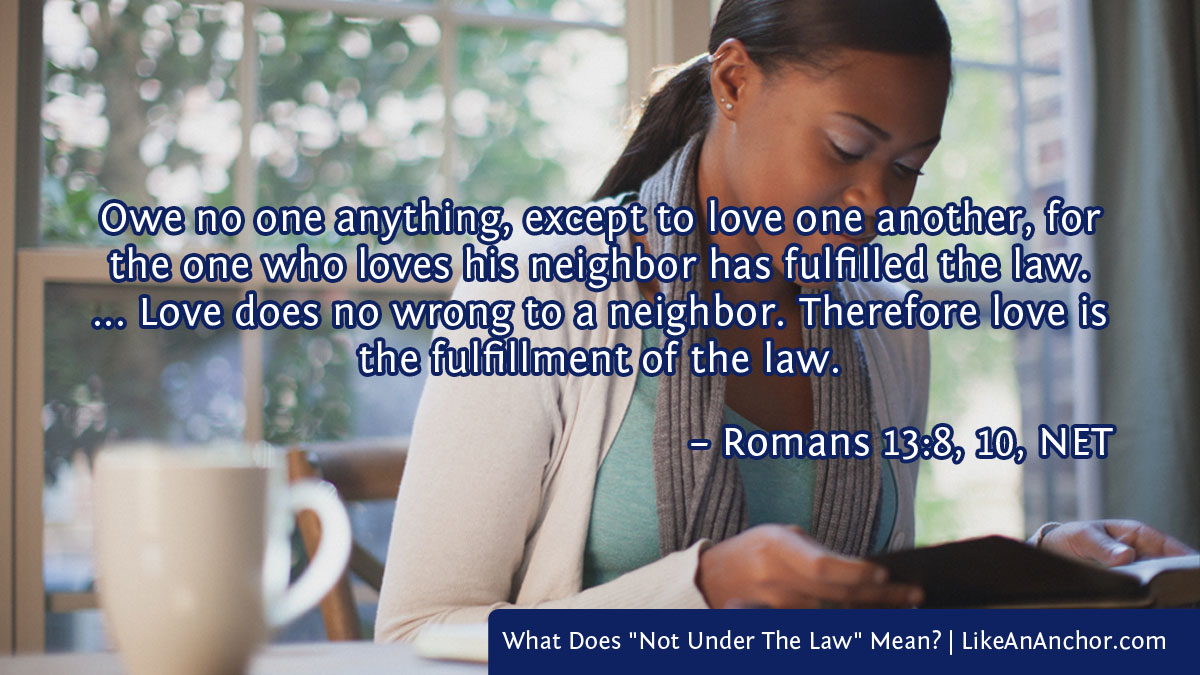
Image of a woman reading the Bible overlaid with text from Rom. 13:89, 10, NET version: "Owe no one anything, except to love one another, for the one who loves his neighbor has fulfilled the law. ... Love does no wrong to a neighbor. Therefore love is the fulfillment of the law."
Image by Pearl from Lightstock

Freed to to Fulfill the Law Through Love

The early chapters of Romans discuss this same subject with slightly different wording. First, Paul sets up a connection between sin and the law. He explains that “all have sinned” (Rom. 3:23), but we wouldn’t know that without the law to tell us about sin (Rom. 4:15; 5:13; 7:7). The law let us know we were enslaved to sin.

We know that our old man was crucified with him so that the body of sin would no longer dominate us, so that we would no longer be enslaved to sin. … So you too consider yourselves dead to sin, but alive to God in Christ Jesus. Therefore do not let sin reign in your mortal body so that you obey its desires.

Romans 6:6, 11-12, NET

When Jesus died, He paid the penalty for all sin, which was exposed by the law. When we accept Him, are baptized, and commit to walking in relationship with God, we also “die” in a figurative sense. We’re freed from sin. It’s not supposed to shackle us anymore, and we don’t have to obey its pulls.

For sin will not have dominion over you. For you are not under law, but under grace. What then? Shall we sin, because we are not under law, but under grace? May it never be!

Romans 6:14-15, WEB

Here’s Paul saying the same thing West was about freedom not being license to sin. Those who are “not under the law” still aren’t allowed to break the law. In fact, the more we become like God the less we’ll want to break His rules.

Image of a man in the woods reading the Bible, overlaid with blog's title text and the words, "We're not freed from the law so we can do whatever our fleshly nature urges, but rather so that we can live-out the fullest expression of God's divine law by imitating His character"
Image by Anggie from Lightstock

In Romans 7, Paul draws an analogy between being under Old Covenant law and a marriage. Marriages end when one of the married people dies (Rom. 7:1-3). The Old Covenant represented the first marriage between God and His people. That Covenant ended at Christ’s death and, through Him, we died to it as well.

So, my brothers and sisters, you also died to the law through the body of Christ, so that you could be joined to another, to the one who was raised from the dead, to bear fruit to God.

Romans 7:4, NET

Now, we are betrothed in marriage to Jesus Christ. We’re being transformed on the inside to become like Him and our heavenly Father. We’re not “under the law” because we’re becoming like the Lawgiver (Is. 33:22; Jas. 4:12; 1 Jn. 3:1-3). We’re marrying the One who fills the law to its fullest extent.

God is love. As we become like God we learn to “be love” as well, and that leads us toward fulfilling the law (Rom. 13:8-10). We’re not freed from the law so we can do whatever our fleshly nature urges, but rather so that we can live-out the fullest expression of God’s divine law by imitating His character. The law isn’t how we receive eternal life, but because we love God we still keep His law on our way to eternity.


Featured image by Chris Mainland from Lightstock

Bridging The Gap

In the beginning Adam and Eve had a face-to-face relationship with God. They they sinned, creating a gap between them and their creator that was renewed each time a human broke God’s law. God was still there, but we kept moving farther and farther away.

Behold, the Lord’s hand is not shortened, that it cannot save; nor His ear heavy, that it cannot hear. But your iniquities have separated you from your God; and your sins have hidden His face from you, so that He will not hear. (Is. 59:1-2)

Throughout the time period covered by the Old Testament books, it appears few people had a relationship with God. In every case, that relationship existed because God stepped across the gap and initiated the relationship. He called Abraham, Isaac and Jacob into covenant with Him. He spoke to Moses out of the burning bush. He chose David as king over Israel. He called the prophets individually.

Today, God also has to take the first steps in any relationship we have with Him. Jesus said, “No one comes to the Father except through Me” (John 14:6) and also, “No one can come to Me unless the Father who sent Me draws him” (John 6:44). To have a relationship with Yeshua we must be called by the Father, and to know the Father we have to go through Yeshua.

Bridging the Gap | marissabaker.wordpress.com

Several months ago, there was a handout at my Messianic congregation with a “Thought Of The Week” printed on the back talking about just this topic. It started out discussing Jacob’s ladder, then human attempts to bridge the gap between God and man by building things like towers. Such attempts are futile, but

The same might be said of all our religious impulses. The stars are always beyond our reach. God is far distant. Man’s best attempts to bridge the gap fail. … If we are to ascend to God, we must ascend upon a ladder that He Himself has extended to us from above.”

We can’t do anything that will make us worthy of God’s attention. All our “religious impulses” — going to church every week, singing worship songs, preaching, or even doing works like healings — aren’t going to make Jesus let us into the kingdom (Matt. 7:22-23). The only thing we can do is respond when God extends us a way to know Him.

For all have sinned and fall short of the glory of God, being justified freely by His grace through the redemption that is in Christ Jesus, whom God set forth as a propitiation by His blood, through faith, to demonstrate His righteousness, because in His forbearance God had passed over the sins that were previously committed (Rom. 3:23-25)

Jesus is the ladder “extended to us from above” by God the Father. He “came down from heaven” (John 6:38) to pay the price for our sins and “draw all men to” Himself (John 12:32). Because we could not reach Him, he came to us.

The Hebrew word for “bless” also means to kneel. No matter how many good works we climb up on or how hard we stretch toward heaven, we won’t reach God. Yet He blessed us by kneeling down to our level and welcoming us into a relationship through Jesus Christ.

 Therefore, having been justified by faith, we have peace with God through our Lord Jesus Christ, through whom also we have access by faith into this grace in which we stand, and rejoice in hope of the glory of God. (Rom. 5:1-2)

Because of what Jesus has done and is doing, we can reach God. Through Him, we “have access by one Spirit to the Father” (Eph. 2:18). We can come to Them with absolute confidence that They love us and want a relationship with us. They’ve proved that time and again throughout history by making covenants with people, building friendships with men like Abraham (Jas. 2:23), pleading with Their loved ones to come back, kneeling down to die in our place, and now living and walking with us.

Seeing then that we have a great High Priest who has passed through the heavens, Jesus the Son of God, let us hold fast our confession. For we do not have a High Priest who cannot sympathize with our weaknesses, but was in all points tempted as we are, yet without sin. Let us therefore come boldly to the throne of grace, that we may obtain mercy and find grace to help in time of need. (Heb. 4:14-16)

Jesus bridged the gap once and for all with His sacrifice that “perfected forever those who are being sanctified” (Heb. 10:14). He gave us access to God and “boldness to enter the Holiest” by making us holy (Heb. 10:19-22). “Now we are children of God” (1 John 3:2), and we can come to Him just as a child who knows their loving Father always has time to pick them up and listen to their concerns.