Myers-Briggs Types and Grief

 LMAP, CC-BY, via flickr
credit: LMAP, CC-BY, via flickr

I started writing this post nearly a year ago, after losing a dear friend, but I couldn’t finish it then. While I was grieving and watching the people around me grieve, I started wondering if the ways individuals respond to grief might be influenced by personality type. Once I started thinking about it, I was surprised that it wasn’t something I’d already read about in my personality studies.

People experience grief in such different ways that it would make sense for someone to try and find commonalities between how each personality type deals with grief. Maybe then we could come up with a self-help method for the grieving process more individualized than the inadequate and outdated 5 stages of grief model.

A few Google searchers later, I’d found plenty of forum topics where people who shared personality types were getting together to compare notes on how they deal with grief. I also found the following on the official Myers-Briggs website:

There have been many books written about personality type and grief, and it is perhaps one of the most profound uses of type. Understanding one’s personality type helps a person recognize why certain expressions of grief are better suited to his or her personal journey through this difficult process.

Unfortunately, they are neglected to give any more information about the “many books.” I’ve only been able to find Recovery from Loss: A Personalized Guide to the Grieving Process by Lewis Tagliaferre and Gary L. Harbaugh and Understanding Grief Types: Working with the Individual Nature of Bereavement by Lisa Prosser-Dodds (which had not yet been released).

Survey of Available Information

Recovery from Loss is specifically written for people who are grieving the loss of a spouse. It proposes a 20-step model for dealing with grief, and does address the role of personality type. However, the authors’ ideas are drawn from general knowledge of how different types respond to stressful situations rather than on actual research. They suggest this would be a profitable study, but do not undertake such a study themselves.

For such a study, I found a The Relationship Between Grief and Personality — A Quantitative Study by Lisa Prosser-Dodds, who presented this study of 239 individuals’ responses to grief as part of her PhD (I’m assuming it was also the starting point for her soon-coming book). Her study asks, ” Is there a difference in grief response between groups with differing MBTI personality types?” According to her, previous explorations of the MBTI’s role in grief are very few. She mentions four:

  1. a 1990 study of 51 bereaved mothers that said, “Extroverts reported higher levels of coping resources and focused on Social, Cognitive, Emotional and Spiritual resources.” The sample group mainly consisted of Extroverts and Feelers.
  2. a 1999 study of 14 people who had lost a spouse. This study “found differences in styles of grieving between varying personality types” but not “a significant use of inferior function,” which we would expect to show up in times of stress.
  3. the 1990 book Recovery From Loss, which I’ve alredy mentioned. Prosser-Dodds thinks their 20-step recovery model is presented “at a level of intellectual requirement that most grievers might become unable to digest,” and notes their observations are “not grounded in empirical data.”
  4. the 1994 book Voices of Loss, compiling first-hand accounts of grief and loss (not necessarily due to death) from various personality types. It is also “not based upon empirical data.”

 What We Can Learn

If you’re interested in reading part of Prosser-Dodd’s study, her summary of results begins on page 68 of this PDF document. The aspect of her findings that I found most surprising was that “When the dominant function aspect of the personality was compared, none of the results showed significant differences. All six subscales and the total scale scores failed to support the hypothesis.” Given Naomi Quenk’s writings on the role of inferior functions in times of stress, this is quite shocking. I would have assumed eruptions of the shadow played a key role in grief, but our dominant function might actually have more to do with how we grieve than our inferior functions.

Instead, “the results that showed the most significant differences were with the predictor variable functional pairs (NT, ST, NF and SF).” This probably wouldn’t have surprised Isabel Myers, since that is the method she used to divide personality types into four groups: “ST- Practical and Matter of Fact Types,” “SF – Sympathetic and Friendly Types,” “NF – Enthusiastic and Insightful Types,” and “NT – Logical and Ingenious Types.”

NF Types

Prosser-Dodd found that NF types had “higher levels of despair, disorganization and detachment” in their grief response, as wells as “slightly less personal growth.” NF type tend to feel things deeply in general, so it is hardly surprising that our grief response involves high levels of emotion. They are, however, better able than thinking types to find meaning in the tragedy of loss and regain balance in relation to the world.

NT Types

Intuitive Thinkers scored lowest on all aspects measured by the Integration of Stressful Life Events Scale. This measures the ability to make meaning out of a loss and to find one’s footing in the world while recovering. Prosser-Dodd said that considering NT types as “as the logical and strategic types, it would follow they might struggle with a comprehension of the loss in general and perhaps find it difficult to regain their footing in world following a loss.”

SF and ST Types

On the scales of despair, disorganization, and detachment the ST and SF types scored in between the NF and NT types, with SF types just a bit higher than ST types. Interestingly, ST types were the most likely to use a loss for personal growth. SFs scored higher than STs in being able to find their footing in the world and make meaning out of a loss (they’re better at this than NF types, as well).

God’s Friends

Disney explains Greek words for love, by Blair a.k.a. GraphiteDoll

When we talk about love in the bible, the word we’re usually discussing is agape. It’s one of several Greek words for love, and is typically described as “godly” or “unconditional” love. There’s also storge (family love), eros (romantic love), and phileo (friendly love).

Agape is an amazing kind of love. It’s the one spoken of in 1 Corinthians 13 and the word used in the phrase “God is love. ” Most times when the word “love” appears in the New Testament, it is translated from a form of agape.

But the other kinds of love are amazing as well, and I think we can overlook the importance of phileo in our fixation with agape (storge and eros are not found in scripture).

Friend of God

Philos (G5384) is the root word for a whole family of words having to do with love. It’s basic meaning is “friend” — someone who is dear, a beloved companion. The derivative phileo is the form more often translated “love.” It means “to have affection for someone.” Zodhiates notes that it is rarely used of man’s love toward God, but is used of the disciples’ love for Jesus. Both agape and phileo are used of God’s love toward man. Simply put, phileo involves adopting someone’s interests as yours.

the Father Himself loves you, because you have loved Me, and have believed that I came forth from God. (John 16:27)

Disney explains Greek words for love, by Blair a.k.a. GraphiteDoll

By using the word phileo in this passage instead of agape, Christ is telling us that God feels affection for us. He is fond of those who love His Son, and He has shared interests with us.

A chapter earlier, Jesus tells His disciples, “You are My friends if you do whatever I command you” (John 15:14). That word is philos. The disciples would have known about the connection between these two words, and I suspect what Christ was telling them was that they could be friends with the Father as well as with Him, just as Abraham was.

And the Scripture was fulfilled which says, “Abraham believed God, and it was accounted to him for righteousness.” And he was called the friend of God. (James 2:23)

James tells us that Abraham was called God’s friend after “he offered Isaac his son on the altar.” That situation was an example of works and faith going together in a way that perfected Abraham’s faith (James 2:21-22). At that point, Abraham had faithfully demonstrated for years that his interests were in line with God’s plan.

Abraham is not the only person in the Bible who God treated as a friend. We’re told “the Lord spoke to Moses face to face, as a man speaks to his friend” (Ex. 33:11). God called David “a man after My own heart, who will do all My will” (Acts 13:22). As their interests lined up with God’s and they moved in the direction God was leading, they became His friends. Christ’s friendship with His disciples followed much the same pattern, and that is the kind of relationship we are now offered with God the Father and with Jesus Christ.

Necessity of Brotherly Kindness

In most places where we are instructed by God to love other people, the word is agape or agapao. But there are a few places where a form of phileo is used instead.

Be kindly affectionate to one another with brotherly love, in honor giving preference to one another (Rom. 12:10)

Believers are to have this kind of love for one another. If the church is unified in Christ, then the members will share the same goals and interests, because they are also His goals and interests. The brethren will be friendly to one another, and love each other like friends who are closer than family.

 But also for this very reason, giving all diligence, add to your faith virtue, to virtue knowledge, to knowledge self-control, to self-control perseverance, to perseverance godliness, to godliness brotherly kindness, and to brotherly kindness love. For if these things are yours and abound, you will be neither barren nor unfruitful in the knowledge of our Lord Jesus Christ. (2 Pet. 1:5-8)

Disney explains Greek words for love, by Blair a.k.a. GraphiteDoll

Both “brotherly kindness” and agape are necessary for us to become the opposite of barren and unfruitful. We must set our hearts on right things, and focus on being friends of God rather than of the world, for whoever “wants to be a friend of the world makes himself an enemy of God” (James 4:4).

The necessity for a friendly kind of love between brethren is made plain not only by verses discussing phileo between believers, but also by verses like Philippians 2:1-4 and Ephesians 4:1-7 that talk about how we should be like-minded and care for one another. Other instructions for us to have phileo hearken back to our discussion about being friends with God. Turns out, having this kind of affection for our Creator is not optional.

If anyone does not love the Lord Jesus Christ, let him be accursed. O Lord, come! (1 Cor. 16:22)

The King James reads, “If any man love not the Lord Jesus Christ, let him be Anathema Maranatha.” The word anathema (G331) means something accursed, or given up to destruction. It does not “denote punishment intended as disciple but being given over or devoted to divine condemnation” (Zodhiates). Maran-atha (G3134) is an Aramaic word which literally means “our Lord has come.” Taken together, it tells us that someone who does not love, phileo, Jesus Christ will be judged at the Lord’s coming, and probably not in the way they were hoping (Matt. 7:21-23). It could probably be translated, “If anyone does not love the Lord Jesus Christ, let him be set aside for condemnation when the Lord returns.”

Add Agape

As vital as phileo is in our relationship with the God-family, it is not enough by itself. We must have phileo, but we must also add agape, as we saw in 2 Peter 1:5-8.

Probably one of the most discussed passages where both phileo and agape are used is in John 21. Here, we find a conversation between Jesus and Peter, after Peter had seen the resurrected Lord and then went back to fishing. In the following quote, I’ve replaced the English word “love” with the Greek word it’s translated from, so you can see which one is used when.

So when they had eaten breakfast, Jesus said to Simon Peter, “Simon, son of Jonah, do you agapao Me more than these?” He said to Him, “Yes, Lord; You know that I phileo You.” He said to him, “Feed My lambs.”

He said to him again a second time, “Simon, son of Jonah, do you agapao Me?” He said to Him, “Yes, Lord; You know that I phileo You.” He said to him, “Tend My sheep.”

He said to him the third time, “Simon, son of Jonah, do you phileo Me?” Peter was grieved because He said to him the third time, “Do you phileo Me?” And he said to Him, “Lord, You know all things; You know that I phileo You.” Jesus said to him, “Feed My sheep. (John 21:15-17)

Disney explains Greek words for love, by Blair a.k.a. GraphiteDoll

Usually, when I hear people talk about this verse, it’s in the context of agapao being a much higher form of love than phileo. They say Peter just wasn’t quite able to measure up to that kind of love — that he kept falling short of what Christ was asking. From Peter’s perspective, though, I don’t think that was the case. He responded to Christ’s question about agapao by saying, “Yes.” Perhaps what he meant when he added phileo was, “Of course I have agape love for you. You know that — I love you like a brother. We’re friends.”

And yet, Peter had denied Jesus three times just a few days ago (John 18:15-18, 25-27). I think Peter initially thought phileo was a better kind of love because of how much it involves emotions, but phileo needs agape added to it. Agape is the kind of love that keeps loving when feelings are gone or when they are crowded out by fear. Peter did learn this lesson, for it’s in his epistle that we are told to add agapao to our brotherly kindness.

We need to learn similar lessons today. Our love for God and our fellow believers does need an element of emotion and feeling — we need to be friends with them. Our love also needs to be stable and unconditional — we need to act with love even when we don’t feel in love. Both are needed to maintain a friendship with God.

Heartbreak and Vulnerability

This week, I was reading someone’s comments on a young lady’s question about her increasingly physical relationship with her boyfriend when I ran into a phrase that always makes me twitch. The commenter suggested breaking up with the boyfriend immediately, then said, “Do not get attached to any boy until you are ready to have a serious relationship.”

Now, that might be good advice in this specific case (since the girl was 16 and had only been dating the guy for 3 months). But in Christian circles, the idea of not getting attached to anyone until you’re ready to get married has been painted with a wide brush across a whole range of situations. It’s often treated as a sure solution to avoiding heartbreak and keeping yourself “pure” for God.

Concerning Conduct

I first heard this advice in courtship circles, where young people are advised to avoid developing feelings for someone of the opposite sex and just be friends until they reach a point where they want to get married. Then, in theory, you can start courting one of these friends and explore the possibility of marriage with them. If you develop feelings for someone before you’re in a position where you could get married to them, then you’re doing something wrong.

Struggle then against yourself as you would struggle against an enemy. Refuse to listen to a wish, to dwell even upon a possibility, that opens to your present idea of happiness. All that in the future may be realized probably hangs upon this conflict. … I only require from you what depends upon yourself, a steady and courageous warfare against the two dangerous undermines of your peace and of your fame, imprudence and impatience.

If not for the slightly out-dated language, you might think I quoted this from a courtship book written within in the past ten years or so. Actually, this quote is from the novel Camilla, first published in 1796 by Frances Burney. It’s part of the letter a pastor writes to his daughter, and is based on 18th century conduct books. Camilla’s father urges her not to let the man she is attracted to learn of her affection, because as a woman it is her duty to “retire to be chosen” by a man rather than seek out a man she loves. It doesn’t turn out quite like he planned, though, since Edgar is waiting for a sign that Camilla has feelings for him before he confesses his attraction to her. They spend much of the 913 pages of this novel miserable because neither one thinks they can properly and decently give the other a hint about how they feel.

On Heartbreak

There are oodles and oodles of songs and stories about heartbreak. Two people fall in love (or at least become quite attached to each other), have a relationship, then the relationship ends and one or both people end up with “broken hearts.” One thing this model presupposes is that you have to be in a relationship in order to get your heart broken. I don’t think that is the case. You can experience the feeling of heartbreak without actually having been in a relationship with someone.

This is one of the things the courtship movement got right — if you let yourself get attached to someone, there’s always the chance that they can hurt you, even if it’s simply by not returning your feelings. Courtship phrased this as “giving away pieces of your heart,” and said the reason it’s a bad idea is because then you don’t have as much heart left to give the person you actually do marry (which is really a ridiculous idea when you think about it; it’s not like we’re born with a set amount of love that we have to dole out sparingly, but problems with the courtship movement is a topic for another day).

I’ve never been in a romantic relationship, but even so I feel like my heart’s been broken a few times. It’s largely my own fault, too — I let myself get pretty close (emotionally) to a few guys I liked, and nothing came of the relationships. But would I have been better if I’d tried to keep myself from feeling anything at all, as Camilla’s father suggests? I really don’t think so.

On Vulnerability

Being open to the possibility of heartache is a prerequisite for entering any kind of relationship. The people who know us best and who we are closest to are those who are most capable of loving us, but they are also the people who could most easily hurt us. If we want to gather people around us to love and be loved by us, we have to take risks. We have to have the strength to be vulnerable.

To love someone fiercely, to believe in something with your whole heart, to celebrate a fleeting moment in time, to fully engage in a life that doesn’t come with guarantees – these are risks that involve vulnerability and often pain. But, I’m learning that recognizing and leaning into the discomfort of vulnerability teaches us how to live with joy, gratitude and grace.” ― Brené Brown, from “The Gifts of Imperfection”

A Hypothesis on Heartbreak | marissabaker.wordpress.comNow, we should exercise a certain amount of caution when letting people get close to us. Some people simply cannot be trusted with your heart, but you usually don’t know who these people are until you start to get to know them. The key is to be vulnerable in stages. Don’t pour out all your thoughts, emotions, and self into someone you just met. You do, however, need to start connecting to people authentically if you want to develop relationships. Locking everyone out might keep them from breaking your heart, but you’ll end up lonely if you try that and loneliness can feel an awful lot like heartbreak.

Brene Brown has a great TED talk about this subject. She says that the people who have “a strong sense of love and belonging” see vulnerability as fundamental. They share a willingness “to say ‘I love you’ first, the willingness to do something where there are no guarantees … to invest in a relationship that may or may not work out.” It’s not easy, and it’s not guaranteed to keep you safe, but I think it is better to risk getting close to people than fighting your human desire for connection “as you would struggle against an enemy.”

Are We On Fire for God?

Last Shabbat, the Rabbi in my local Messianic congregation gave a message on zeal. One of the last things he said in the message was, “Christ is not coming back for a bride who has no fire.” We want to much to be the kind of people Christ will be looking for at His return, so if this is the case we do well to take heed, and learn what it means to be on fire, or have fire, for the Lord.

What is Zeal?

The Hebrew words translated “zeal” and “zealous” are qana (H7065), qanna (H7067), and qin’a (H7068). They can all be translated “jealous” as well. Both qana and qin’a can be used in a good or a bad sense, but qanna is exclusively used as a title or attribute of God. Exodus 34:14 even says the Lord’s “name is Jealous.”

In the positive connotations, these words express a strong emotion one person has for another person, or on behalf of someone else. It is “an intense furor, passion, and emotion that is greater than a person’s wrath or anger” (Baker and Carpenter’s WordStudy Dictionary of the Old Testament). Zeal is one of the strongest emotions there is.

When God tells us He is a “jealous God,” He is saying that He does not tolerate any competition for our adoration (Ex. 20:5; Deut. 4:24; Josh 24:19). In all three of these verses, the context is talking about the evils of being unfaithful to the Lord by worshiping idols and turning away to other religions. God has invested His strongest emotions and passions in us, and He expects us to be “on fire” for Him in return.

They have provoked Me to jealousy by what is not God; they have moved Me to anger by their foolish idols. But I will provoke them to jealousy by those who are not a nation; I will move them to anger by a foolish nation. (Deut. 32:21)

Are We On Fire for God? | marissabaker.wordpress.comGod won’t accept a stagnant, lackluster reaction to Him from His people. A half-hearted worship is thoroughly distasteful to Him.

I know your works, that you are neither cold nor hot. I could wish you were cold or hot. So then, because you are lukewarm, and neither cold nor hot, I will vomit you out of My mouth. … As many as I love, I rebuke and chasten. Therefore be zealous and repent. (Rev. 3:15-16, 19)

The Greek words for “zeal” and “zealous” are zelos (G2205), zeloo (G2206), and zelotes (G2207). Like the Hebrew, these can have a positive or negative meaning. We actually discussed the negative side of zeloo last week, in connection with 1 Corinthians 13:4.

I think perhaps the best example of how this trait can be good or bad is the apostle Paul. Before his conversion, he persecuted Christ’s church out of zeal for the Jewish faith (Phil. 3:6). But after his encounter with Jesus on the road to Damascus, he turned that zeal to preaching the true gospel.

In the Greek, zelos is derived form the word zeo (G2204), which means to be hot, either in the sense of fervency or actual warmth, so all the zeal-words carry this idea of heat. Focusing on the positive sides of the definitions, Zodhiates says, “zelos signifies the honorable emulation with the consequent imitation of that which presents itself to the mind’s eye as excellent.” When zeal sees good, it strives to become good. The next word, zeloo, means to be filled with zeal, jealousy, or love. Zelotes refers to a person who is “zealous for or eagerly desirous of something.”

Zealous Love

We just mentioned the relationship between zeal and love in defining the word zeloo. It seems fitting, then, to focus on that next. If God did not love His people so much, He would not be so jealous of our affection. Our God is described as “a consuming fire, a jealous God” (Deut. 4:24). How could we expect His love to lack zeal? He does not passively love us from some cold, aloof position. His love is active, and emotional.

 So the angel who spoke with me said to me, “Proclaim, saying, ‘Thus says the Lord of hosts: “I am zealous for Jerusalem and for Zion with great zeal. …” ‘Therefore thus says the Lord: “I am returning to Jerusalem with mercy; My house shall be built in it,” says the Lord of hosts, “And a surveyor’s line shall be stretched out over Jerusalem.”’ (Zech. 1:14, 16)

Notice that in connection with His zeal for His people, the Lord says, “My house shall be built.” This is not the only place where the Lord demonstrates a zeal for His house.

Now the Passover of the Jews was at hand, and Jesus went up to Jerusalem. And He found in the temple those who sold oxen and sheep and doves, and the money changers doing business. When He had made a whip of cords, He drove them all out of the temple, with the sheep and the oxen, and poured out the changers’ money and overturned the tables. And He said to those who sold doves, “Take these things away! Do not make My Father’s house a house of merchandise!” Then His disciples remembered that it was written, “Zeal for Your house has eaten Me up.” (John 2:13-17)

The people Christ threw out of the temple were making a mockery of worship. They had turned God’s house into a place of business. From what I’ve heard, they had probably set up a system where people had to purchase a sacrificial animal from them before going into the temple, rather than bringing a sacrifice of their own. The sellers were putting themselves in a position where the people had to deal with them before they could approach God, and Jesus did not approve. It  was unacceptable in the physical temple, and such things are unacceptable in God’s church today.

Do you not know that you are the temple of God and that the Spirit of God dwells in you? If anyone defiles the temple of God, God will destroy him. For the temple of God is holy, which temple you are. (1 Cor. 3:16-17)

Sounds a lot like what we just read in the gospel of John, doesn’t it? We are “members of the household of God” (Eph. 2:19), and Jesus has the same zeal for us today that He had for His Father’s house back then. He won’t tolerate impure worship practices, or those who try to get between Him and His church. He wants a bride whose heart is fully His, and who is eager for Him to come back and claim her.

What Will He Find In Us?

For I am jealous for you with godly jealousy. For I have betrothed you to one husband, that I may present you as a chaste virgin to Christ. But I fear, lest somehow, as the serpent deceived Eve by his craftiness, so your minds may be corrupted from the simplicity that is in Christ. (2 Cor. 11:2-3)

It is possible to let our love for and commitment to Christ wane, and we must be on guard against such a thing. Paul was filled with zeal about the church not loosing their commitment to Christ. In a very real way, he was zealous for His Father’s house. We should also be zealous about guarding our hearts and keeping them fixed on Christ, and on helping our brethren toward a passionate relationship with God as well.

Nevertheless I have this against you, that you have left your first love. (Rev. 2:4)

This is part of the letter to the church of Ephesus in Revelation 2. Christ commends this church for their works, labor, patience, and their diligence to root-out evil. But even with all those good things, He says that if they do not “repent and do the first works” He will “remove your lampstand from its place” (Rev. 2:1-7). Just like in 1 Corinthians 13 where gifts, knowledge, and other spectacular things are described as nothing without love, so is the faith and works of this church empty without their first passion for following God.

When we talk about this Greek word for love, agape (G26), we often bring out that agape doesn’t necessarily involve the emotions we typically think of as love. Thus the command “love your enemies” is more about active goodwill toward them than having “warm fuzzy feelings” about those who hate you. But this is the word used to say “God is love,” and we’ve seen that God’s love toward His people does contain strong emotions. Agape can, and in relation to God should, involve strong feelings. To truly love God, we need to learn to reciprocate the kind of love He has toward us.

And you shall love the Lord your God with all your heart, with all your soul, with all your mind, and with all your strength.” This is the first commandment. (Mark 12:30)

Are We On Fire for God? | marissabaker.wordpress.comJesus gave the perfect example of what it looks like to love God this way. On His last Passover, Jesus said His obedience to the Father’s commandments demonstrated to the world that He loves the Father (John 14:31). He tells us, “As the Father loved Me, I also have loved you; abide in My love. If you keep My commandments, you will abide in My love, just as I have kept My Father’s commandments and abide in His love” (John 15:9-10).

I think this willing obedience and sacrifice prompted by love is what Jesus was referring to when He told the Ephesian church to “do the first works.” Recapture the zeal you felt when you first started serving God. The relationship Christ modeled with the Father was close, personal, and sustained by frequent communication. He was perfectly obedient to His Father’s will, and was willing to give up His life because He loved God and He loved His friends (John 15:13-15). Now, He looks for us to have that kind of love for Him, for our Father, and for our brethren.

And it shall be, in that day,” says the Lord, “That you will call Me ‘My Husband,’ and no longer call Me ‘My Master’ …. I will betroth you to Me forever; yes, I will betroth you to Me in righteousness and justice, in lovingkindness and mercy; I will betroth you to Me in faithfulness, and you shall know the Lord.” (Hos. 2:16, 19-20)

How can we respond to this Being with anything other than a zealous love? Our Savior “gave Himself for us, that He might redeem us from every lawless deed and purify for Himself His own special people, zealous for good works” (Tit. 2:14). He wants His bride to be zealous about the things He cares about, to be faithful to Him because we owe Him our lives, and to love Him as He loves us.

 Nevertheless, when the Son of Man comes, will He really find faith on the earth?” (Luke 18:8)

It is so sad after all Christ has done for us, given to us, and offered us in the future that He has to ask this question: “When I come back, is anyone who loves Me going to be waiting?”

When we see Jesus in the future, will He find faith in us? If we could talk to Him now about the state of our faith today, would He tells us “you are not far from the kingdom of God,” as He did to the man who recognized loving God and his neighbor was the key to religion (Mark 12:32-34)? or would He say, as He did to the church in Sardis, “be watchful, and strengthen the things which remain, that are ready to die, for I have not found your works perfect before God” (Rev. 3:2)?

Some Thoughts on Feminism and Modesty

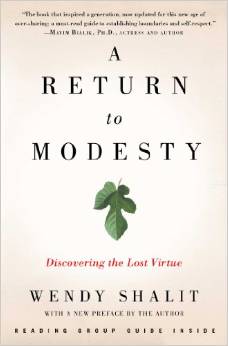
Amazon.com: A Return to Modesty

I mentioned a couple weeks ago that I recently read a book called A Return to Modesty: Discovering the Lost Virtue by Wendy Shalit. One of the first things she tackles in this book is the “polarized debate about sex,” particularly between the conservatives and the feminists.

She challenges conservatives to “take the claims of feminists seriously,” because you can dismiss however many studies and stories you like as “exaggeration” but the fact remains that “a lot of young women are very unhappy …. I want conservatives to really listen to these women, to stop saying boys will be boys, and to take what these women are saying seriously.”

To the feminists, Shalit writes, “I want to invite them to consider whether the cause of all this unhappiness might be something other than the patriarchy.” We’ve gotten rid of that just about as much as possible, and things have gotten worse rather than better. Perhaps men aren’t the enemy.

This book was published in 1999. That was almost 16 years ago, and we are still dealing with the exact same issues. On the one side, we see conservative Rush Limbaugh respond to a street harassment video by describing it as not a big deal because the men were just being polite. On the other side, there are still rants about patriarchy on Jezebel.com (language/content warning).

But just a little over two months ago Emma Watson, British actress and UN Women Goodwill Ambassador, gave a speech about feminism where her vision for gender equality sounded remarkably similar to ideas Wendy Shalit arrives at while defending the power of modesty. Are we starting to find common ground, and is there hope for a peaceful resolution to “the war between the sexes”?

A Trip to the 18th Century

It might seem odd to take a 3-century detour when talking about issues in modern culture. But when I started reading Francis Burney’s novels Cecelia (1782) and Camilla (1796) as part of an independent study my junior year of college, I was struck by how the gender issues facing those heroines were so remarkably like what women in my church regularly complain about. Where are the “real men?” we ask, looking around and seeing adult men who act like overgrown boys and have little interest in committing to marriage. We typically blame feminism, for telling boys that it was wrong to be “masculine” and to stop oppressing girls by taking care of them.

Portrait of Francis Burney by her relative Edward Burney

A contemporary of Burney, Mary Wollstonecraft wrote a book called A Vindication of the Rights of Women (1792), which is often considered one of the first feminist writings. When you actually read her book, however, it becomes clear that she is arguing for arguing for a reexamination, not a dismissal, of the traditional roles between men and women. She believes men and women are equal in God’s eyes, but that argument doesn’t mean they don’t both have distinct roles to fill.

Both these writers were responding to a moment called “sentimentality,” which encouraged men to indulge their emotions and abandon their traditional roles of protectors and providers. The result was something like what we see today — when men are no longer encouraged to protect or respect women, more and more women are victimized. That’s where we made our mistake, both in the 18th and the 20th/21st centuries. We thought men would treat women better if we told them to stop being manly, when in fact the opposite is true.

HeForShe

When Emma Watson introduced her talk about gender equality and the #HeForShe campaign, she first addressed issues people have with the word “feminism.”

the more I spoke about feminism, the more I realized that fighting for women’s rights has too often become synonymous with man-hating. If there is one thing I know for certain, it is that this has to stop. For the record, feminism by definition is the belief that men and women should have equal rights and opportunities. It is the theory of political, economic and social equality of the sexes.

One of the key points of Watson’s speech is that both men and women must be working together if we are ever to achieve a gender equality that benefits and protects both men and women.

How can we effect change in the world when only half of it is invited or feel welcome to participate in the conversation? Men, I would like to take this opportunity to extend your formal invitation. Gender equality is your issue, too. Because to date, I’ve seen my father’s role as a parent being valued less by society, despite my need of his presence as a child, as much as my mother’s. I’ve seen young men suffering from mental illness, unable to ask for help for fear it would make them less of a man. …

If men don’t have to be aggressive in order to be accepted, women won’t feel compelled to be submissive. If men don’t have to control, women won’t have to be controlled. Both men and women should feel free to be sensitive. Both men and women should feel free to be strong.

When we turn issues of gender into a “battle of the sexes” instead of a friendly discussion or a cause to work on together, both men and women lose the battle. You can’t build peaceful relations on a foundation of strife.

Courteous Men

Wendy Shalit discusses essentially the same issue, though she comes from the perspective of restoring part of the traditional gender roles (I suspect Burney and Wollstonecraft would both approve). Rather than pushing for an increasingly “nonsexist” approach to raising boys (in this example), she argues for “a good dose of sexist upbringing: how to relate as a man to a woman.”

Today we want to pretend there are no differences between the sexes …. We try to cure them of what is distinctive instead of cherishing these differences and directing them towards each other in a meaningful way. We can never succeed in curing men and women of being men and women, however, and so these differences emerge anyway — only when they do, the emerge in their crudest, most untutored form (p.153).

Frontispiece to ‘The English Gentleman and English Gentlewoman’ by Richard Braithwaite, 1641

She also goes back to a previous century to illustrate her arguments, all the way to 1630 and 1631 — the years Richard Brathwait’s The English Gentleman and The English Gentlewoman were published. Shalit’s reading of these texts is that  there was a “link between male obligation and female modesty” where men attained “perfection” by treating women with respect (p.99-102). In this century, men were not compelled to respect women by an outside authority — they were taught that this  was the only way for real men to behave.

The argument from external authority labels a man as evil if he date-rapes or sexually harasses a woman. From the standpoint of modesty, he is behaving abominably, but more crucially, he is really missing the whole point. He hasn’t understood what it means to be a man (p.104).

The feminists who see patriarchy as oppressive balk at this idea, but Shalit assures them, “I doubt that if men are taught to relate courteously to women, women would be suddenly thrown out of all the professions, as some contend. Maybe, on the contrary, it would be much easier for the sexes to work together.” Isn’t this, at its core, what Emma Watson’s brand of feminism is asking for? men and women who can work together toward common goals with mutual respect. Isn’t that something we all want?

How Should We View Other Church Groups?

How Should We View Other Church Groups? | marissabaker.wordpress.comWe all know there are divisions in the church today. There are large groups, small groups, corporate churches, independent churches, and then factions and rivalries inside and among many of them. I think we can all agree this is not an ideal situation — that Christ’s intention is for us to be “at one.” Often we think the way to achieve that unity is for “all those people out there” to just “come to their senses and join my church.”

But what if there isn’t anything wrong with “them”? What if they are already in God’s church, and the problems lie with us picking and choosing a “my church” to stick with? Take the churches of my faith background as an example. There are literally hundreds of different groups that are all keeping the 7th Day Sabbath and God’s Holy Days of Leviticus 23, and each of them considers that a defining “thing” about our particular variety of Christianity. Yet there are still people, especially in the larger or more exclusive groups, who think if you aren’t keeping the Sabbath with their church is doesn’t really count. And then we tell ourselves we’re better than “mainstream Christianity”!

Other Sheep

There was a similar problem in the New Testament church, with divisions between Jewish and Gentile believers. Up until Acts 10, the disciples assumed only Jews were being called to know Jesus Christ. Then, God showed very clearly that He was opening up the chance for salvation to everyone.

There was a certain man in Caesarea called Cornelius, a centurion of what was called the Italian Regiment, a devout man and one who feared God with all his household, who gave alms generously to the people, and prayed to God always. (Acts 10:1-2)

This man was already serving the God of Israel, but the Jews wouldn’t have had anything to do with him. Unless there were other Gentile believers around, he didn’t have anyone to fellowship with except his family. Some of us have probably been there, without a local group to fellowship with or feeling like we’re unwelcome in the ones that are there. In Cornelius’s case, God took care of this problem by sending him a vision telling him to send for Peter, and then God told Peter to go (Acts 10:3-27).

Then he [Peter] said to them, “You know how unlawful it is for a Jewish man to keep company with or go to one of another nation. But God has shown me that I should not call any man common or unclean. (Acts 10:28)

Then Peter opened his mouth and said: “In truth I perceive that God shows no partiality. But in every nation whoever fears Him and works righteousness is accepted by Him. (Acts 10:34-35)

And just to clear up any lingering doubts in the minds of Peter’s Jewish companions, God gave Cornelius and his family the Holy Spirit before they were even baptized.

While Peter was still speaking these words, the Holy Spirit fell upon all those who heard the word. And those of the circumcision who believed were astonished, as many as came with Peter, because the gift of the Holy Spirit had been poured out on the Gentiles also. (Acts 10:44-45)

They really shouldn’t have been so surprised. Christ’s ministry on earth was to “the lost sheep of the house of Israel” (Matt. 15:24), but He still spoke with a Samaritan woman in John 4, healed a Gentile woman’s daughter in Matthew 15, and had this to say in John 10:

And other sheep I have which are not of this fold; them also I must bring, and they will hear My voice; and there will be one flock and one shepherd. (John 10:16)

From the very beginning of the New Testament church, Jesus made it clear that He wasn’t going to work with just one group or one type of people. He had bigger plans.

Church Squabbles

Several things happened in the aftermath of Cornelius’s conversion. First, Peter had to defend his choice to even talk with a Gentile. Once the whole story was known, though, there wasn’t much to say.

When they heard these things they became silent; and they glorified God, saying, “Then God has also granted to the Gentiles repentance to life.” (Acts 11:18)

That wasn’t the end of the squabbling, however, because church culture started becoming an issue. The way I see it, the whole circumcision debate that became such an issue in the early church boiled down to a group of people who thought everyone else had to worship God the exact same way they did. They didn’t want the Gentiles bringing in any of their culture or ideas about how to worship, and they certainly didn’t want anyone to “get away with” anything.

And certain men came down from Judea and taught the brethren, “Unless you are circumcised according to the custom of Moses, you cannot be saved.” Therefore, when Paul and Barnabas had no small dissension and dispute with them, they determined that Paul and Barnabas and certain others of them should go up to Jerusalem, to the apostles and elders, about this question. (Acts 15:1-2)

There’s quite a discussion about this question in the rest of Acts 15. The basic decision was to lay no unnecessary burden on the new converts. Precisely why physical, male circumcision is unnecessary under the New Covenant is something addressed in Paul’s epistles (1 Cor. 7:18-19). My point is that this question was a big deal to some people, and it caused division, dissension, and dispute in the church. Yet the consensus upon examining the issue was that it wasn’t really anything to get worked up about either way. There were far more important things to focus on, like the keeping of God’s commandments and developing a relationship with Him.

So far we’ve seen church culture/background divisions and doctrinal divisions in the New Testament church. They also struggled with another sort of division that we face today, regarding which human teacher you follow.

Now I plead with you, brethren, by the name of our Lord Jesus Christ, that you all speak the same thing, and that there be no divisions among you, but that you be perfectly joined together in the same mind and in the same judgment. For it has been declared to me concerning you, my brethren, by those of Chloe’s household, that there are contentions among you. Now I say this, that each of you says, “I am of Paul,” or “I am of Apollos,” or “I am of Cephas,” or “I am of Christ.” Is Christ divided? Was Paul crucified for you? Or were you baptized in the name of Paul? (1 Cor. 1:10-13)

Paul would no doubt have much the same thing to tell us today — that we should stop squabbling about who we follow or what group we’re in and be unified in Christ. The message is not to convert everyone to your faction and then get along. It’s to be unified right now — to be peaceful with the people you’re currently squabbling with both inside and outside “your” group. There are Biblical guidelines for resolving conflict (Matt. 18:15-17; 1 Cor. 6:1-11), and none of them involve starting a new church group because you can’t agree on when the barley in Jerusalem is ripe, or excommunicating a family because they want to keep the land Sabbath on their farm (true stories).

Made One

We have different ways of dividing ourselves now other than Jews vs. Gentiles or circumcision vs. uncircumcision, but the principles laid-out for how these groups were to interact give us guidelines for how the churches of God should look today.

For there is no distinction between Jew and Greek, for the same Lord over all is rich to all who call upon Him. (Rom. 10:12)

There is no difference — how strange that must have seemed to them! As strange as telling a former Catholic and a former Baptist who meet in the same group now that there was never any difference between them in God’s eyes; as strange as telling a Sabbath keeper with a Worldwide Church of God background that there’s no difference between them and a Messianic believer.

Therefore remember that you, once Gentiles in the flesh — who are called Uncircumcision by what is called the Circumcision made in the flesh by hands — that at that time you were without Christ, being aliens from the commonwealth of Israel and strangers from the covenants of promise, having no hope and without God in the world. But now in Christ Jesus you who once were far off have been brought near by the blood of Christ. For He Himself is our peace, who has made both one, and has broken down the middle wall of separation (Eph. 2:11-14)

There used to be dividing lines, but no longer — they are all done away in Christ.

For through Him we both have access by one Spirit to the Father. Now, therefore, you are no longer strangers and foreigners, but fellow citizens with the saints and members of the household of God, having been built on the foundation of the apostles and prophets, Jesus Christ Himself being the chief cornerstone, in whom the whole building, being fitted together, grows into a holy temple in the Lord, in whom you also are being built together for a dwelling place of God in the Spirit. (Eph. 2:18-22)

There aren’t multiple groups in God’s eyes. Every person He has called into His family is part of the temple He is building. He doesn’t expect everyone in His family to look or act exactly alike, so why should we?

For as the body is one and has many members, but all the members of that one body, being many, are one body, so also is Christ. For by one Spirit we were all baptized into one body—whether Jews or Greeks, whether slaves or free—and have all been made to drink into one Spirit.  For in fact the body is not one member but many.

How Should We View Other Church Groups? | marissabaker.wordpress.comIf the foot should say, “Because I am not a hand, I am not of the body,” is it therefore not of the body?And if the ear should say, “Because I am not an eye, I am not of the body,” is it therefore not of the body? If the whole body were an eye, where would be the hearing? If the whole were hearing, where would be the smelling? But now God has set the members, each one of them, in the body just as He pleased. And if they were all one member, where would the body be?

But now indeed there are many members, yet one body. And the eye cannot say to the hand, “I have no need of you”; nor again the head to the feet, “I have no need of you.” No, much rather, those members of the body which seem to be weaker are necessary. And those members of the body which we think to be less honorable, on these we bestow greater honor; and our unpresentable parts have greater modesty, but our presentable parts have no need. But God composed the body, having given greater honor to that part which lacks it, that there should be no schism in the body, but that the members should have the same care for one another. (1 Cor. 12:12-25)

And there you have it — God is working with a wide variety of people who are filling different roles as He sees fit. When we decide a certain person, or type of person, doesn’t have a place in our church group, that’s like saying our bodies would be just fine without an eye or a foot.

Say, “Come”

God knows what He’s doing. He doesn’t make a habit of calling people to follow Him unless He has a plan for working with them. It is not our place to decide who God is and is not working with, or who He should call. How arrogant is it for us to assume we can decide which people God takes an interest in?

Who are you to judge another’s servant? To his own master he stands or falls.  …

But why do you judge your brother? Or why do you show contempt for your brother? For we shall all stand before the judgment seat of Christ. … So then each of us shall give account of himself to God. Therefore let us not judge one another anymore, but rather resolve this, not to put a stumbling block or a cause to fall in our brother’s way. (Rom. 14:4, 10, 12-13)

There are times in the church when we have to make judgements concerning right and wrong. Sometimes the fruits seen in a person’s life call for them being excluded from fellowship until they return to God’s way of life, but those incidents should be rare and very carefully considered (Matt. 18:15-17; 1 Cor. 5:1-13). As a general rule, the actions we need to be most concerned about are our own. God isn’t going to have people in His family who can’t get along with each other and who refuse to work with certain people. His plan is for the whole world to repent and be saved (John 3:16-17). If you’re excluding people from God’s family, even just in your own mind, then your thoughts are not in line with His.

At the end of the book of Revelation there is a beautiful picture of the future where “a pure river of water of life” flows out “from the throne of God and of the Lamb.” A tree of life grows by this river, and the “leaves of the tree were for the healing of the nations” who will see God’s face and live in His light (Rev. 22:1-5). In this future, what do we see the Lamb’s wife — the church — doing?

And the Spirit and the bride say, “Come!” And let him who hears say, “Come!” And let him who thirsts come. Whoever desires, let him take the water of life freely. (Rev. 22:17)

We’re welcoming anyone who wants to come, inviting them to freely partake of what God is offering. We aren’t picking and choosing who’s allowed in — we’re inviting everyone to come and learn. This is something we have to start learning how to do now. I think sometimes we expect all this will be easy when we’re spirit beings, but if that was a magic cure-all for bad attitudes, Lucifer wouldn’t have fallen (Is. 14:12-21; Ezk. 28:11-19). It is imperative that we learn how to relate to one another now, for if we cannot be faithful and obedient on a physical level in a command so important as “love thy neighbor as thyself,” why would God entrust us with true riches? (Matt. 22:36-40; Luke 16:10-12).