The Old Testament often describes God as “slow to anger.” A more literal translation of the Hebrew is actually “long-nosed,” which makes no sense in English. But it’s a picture of a person who takes a long time to reach the point where they’re so angry that their nostrils flare and the air whooshes through their nose like a bull about to charge.
The phrases “slow to anger” and“long-suffering,” are both translated from two Hebrew words — “long” and “breath/passion/heat/anger.” The Greek equivalent is typically translated “patience” or “long-suffering.” It’s not about never getting angry, but about having control over when that happens and not flying off into a rage.
Anger is not inherently sinful. God gets angry, and Paul also tells us we can be angry without sinning (Eph. 4:26). But God doesn’t get angry quickly or without good cause, and we shouldn’t either. So how can we become “slower to anger” and “longer suffering”?
Quick Anger Fuels Strife
I think the dividing line between anger that is and is not sinful can be found in the effect that it has. Jesus throwing those who were exploiting believers out of the temple? Righteous anger. Me getting so upset at someone that I say something nasty which leads to conflict? Sinful anger.
God hates arrogance, wicked schemes, and discord. So if your anger is causing these (or anything else He hates), then it is leading to sin. There are several Proverbs addressing this. Here are a few: Read more →
Many Christians have a complicated relationship with the Song of Solomon, or Song of Songs as it’s also called. They skip it when reading through the whole Bible, ignore it in study, and struggle to explain what it’s doing in scripture. Even the idea that the Song is an allegory for the love between God and His people and/or Christ and the church (the dominant interpretation for thousands of years) has been largely abandoned by modern Bible scholars.
In Jewish tradition, the Song is associated with Passover (Pesach) and is read at this time of year. Some say this is just because the song references the spring season. But other rabbis describe this book as the “holy of holies” in the canon of scripture. They accept as a matter of fact that “Israel, in it’s covenant with God made on Mt. Sinai, was married to God” and the people owed Him their “absolute fidelity” (quotes from “Why Do We Sing the Song of Songs on Passover?” by Benjamin Edidin Scolnic).
This assumption explains why the prophets speak so often of Israel’s unfaithfulness to God as marital infidelity. In reference to Hosea, Gerson Cohen said this was “because his Israelite mind had been taught from childhood to think of the relationship between God and Israel in terms of marital fidelity, in terms of love” (quote from “The Song of Songs and the Jewish Religious Mentality”). The Song of Songs might be the most explicitly romantic book in the Bible, but it’s certainly not the only time romantic imagery is used to teach us something about the relationship between God and His people. The Apostle Paul (also a Jewish rabbi) even said after giving instruction to human husbands and wives that “this mystery is great, but I am speaking with reference to Christ and the church” (Eph. 5:32, LEB).
Covenants and Romance
So what does all this have to do with Passover? For some writers, the Song actually functions as a midrashon Exodus — a commentary in the form of a poetic, figurative retelling of the Exodus story. With this interpretation, “the Song of Songs, according to the rabbis, is a text which describes the very events that Pesah celebrates and commemorates.” You can read more about this viewpoint in Scolnic’s paper (click here).
Even without turning to Jewish midrash, though, we can find connections between God’s romance of Israel and the Exodus story. Take, for example, one of my favorite passages from Hosea: Read more →
Have you ever felt like your spirit is crushed and your heart broken? Like you’ve been pounded into dust or smashed to smithereens?
Those are the definitions for the Hebrew words shabar (H7665, broken) and dakka (H1793, crushed). I bring them up because I want to talk about this verse from Psalms:
Yahweh is near to those who have a broken heart, and saves those who have a crushed spirit. (Psalm 34:18, WEB)
When you’re ground down like dust and broken into pieces, God is there beside you. We often want Him to prevent or remove bad things but it seems that in most cases His preference is to walk with us through hardship rather than stop it from ever happening. We are promised deliverance, but in His timing, not ours.
The righteous cry, and Yahweh hears, and delivers them out of all their troubles. Yahweh is near to those who have a broken heart, and saves those who have a crushed spirit. Many are the afflictions of the righteous, but Yahweh delivers him out of them all. (Psalm 34:17-19, WEB)
It’s clear from this psalm that righteousness doesn’t exempt us from bad situations. In fact, “many are the afflictions of the righteous” and they have to cry to Yahweh for deliverance. That holds true for believers throughout the ages.
I endured those persecutions. The Lord delivered me out of them all. Yes, and all who desire to live godly in Christ Jesus will suffer persecution. (2 Tim. 3:11-12, WEB)
Let’s take a trip back to the early 1st century. It’s a few days before Passover and the Jews are heading to Jerusalem for the Feast. As they travel, they sing the songs of ascent like they do every year. On this particular year, though, there’s an extra level of excitement. A man named Yeshua (Jesus) arrived on the scene a few years ago and many think he could be the Messiah. He’s even riding into Jerusalem on a donkey’s colt, as Zechariah said the Messiah would.
“Hoshiya-na! Baruch haba B’Shem Adonai!” they call. Save us now! Blessed is He who comes in the name of the Lord!
As Yeshua rides in, the people spread their garments in the way. They also cut palm branches as if they were here for the Feast of Tabernacles instead of the Passover and the Feast of Unleavened Bread. They’re expecting the Messiah to kick the Romans out, redeem Israel, and restore the kingdom. They’re hoping for the fulfillment of Tabernacles — the Messiah, son of David, ruling in power and might.
Instead, this Yeshua turns his donkey toward the temple. Once there, he “drove out all of those who sold and bought in the temple, and overthrew the money changers’ tables and the seats of those who sold the doves.” Instead of driving the pagans out of Jerusalem, he drove corruption out of God’s house, saying, “My house shall be called a house of prayer,’ but you have made it a den of robbers!” Read more →
In 1 Corinthians, Paul makes several references to leavening and to Passover. For many readers today, these references mean very little because so many Christian churches have left the roots of their faith, which Paul was referencing here. In order to really understand key passages of 1 Corinthians, we need to understand Passover and the Feast of Unleavened Bread.
I know some (perhaps quite a few) of you are Christians who don’t keep Passover, but I hope you’ll still keep reading today’s post. I think you’ll find it interesting and maybe it’ll give you something new to think about and study.
Passover Background
The Passover story begins in Exodus 12. We’re nearing the end of the plagues of Egypt, and the Lord is telling Moses what the Israelite must do to avoid the final plague — the death of the first born. In the first month of the year, on the evening that begins the 14th day (Hebrew days begin at sunset), Israel was to kill a young male lamb, paint the door posts of their houses with its blood, then roast the lamb whole and eat it with unleavened bread and bitter herbs (Ex. 12:1-13).
This day shall be to you for a memorial, and you shall keep it a feast to Yahweh: throughout your generations you shall keep it a feast by an ordinance forever. (Ex. 12:14, WEB)
The Lord goes on to describe a festival of unleavened bread (matzah) that follows the Passover. For seven days, no leavening (hametz) is permitted in anyone’s house and whoever eats leavened food will be cut off from God’s people (Ex. 12:15-20). Later instructions in Leviticus clarify the timing of all this, stating that Passover is on the 14th and Unleavened Bread begins with a holy convocation on the 15th, then ends with another holy convocation on the seventh day (Lev. 23:4-8). The two holy days are Sabbaths of rest where you are not to work, much like the weekly Sabbath.
The New Covenant Passover
Moving into the New Testament, the gospels make careful note of Passovers that Jesus kept during his ministry. The first is recorded in John 2:13-23. The second is skimmed over, though Luke 6:1 probably references the last day of Unleavened Bread. John 6:4 mentions the third Passover, and Christ’s final Passover is recorded in detail by all four gospels because that was the day He died.
He said to them, “I have earnestly desired to eat this Passover with you before I suffer, for I tell you, I will no longer by any means eat of it until it is fulfilled in God’s Kingdom.” (Luke 22:15-16, WEB)
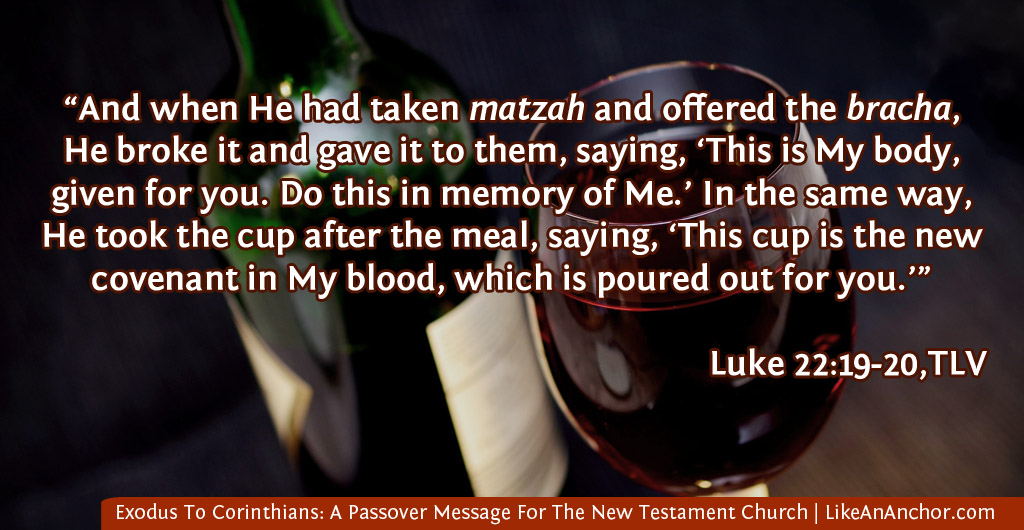
He then proceeded to institute new Passover symbols for New Covenant believers. Jesus will not partake of the Passover again until the kingdom of God comes in the future, but He tells us to do so in memory of Him (Luke 22:17-20).
For I received from the Lord that which also I delivered to you, that the Lord Jesus on the night in which he was betrayed took bread. When he had given thanks, he broke it, and said, “Take, eat. This is my body, which is broken for you. Do this in memory of me.” In the same way he also took the cup, after supper, saying, “This cup is the new covenant in my blood. Do this, as often as you drink, in memory of me.” (1 Cor. 11:23-25, WEB)
The passage we just read from 1 Corinthians 11 is part of the most obvious Passover reference in this letter. Paul goes on to share instructions on how we’re supposed to prepare for Passover, as well as warnings about the dangers of not keeping Passover the correct way. Read more →
Lamentations is a depressing little book, at least on first glance. It’s composed of 5 poems of mourning that were once part of the book of Jeremiah, but were then isolated so they’d be easier to read in public. Traditionally, the Jewish people read Lamentations each year on Tish B’av, a fast day commemorating the destructions of the temple in 586 BC and 70 AD.
The first poem speaks of sorrow, weeping, misery, and desolation that has come upon Israel. Jeremiah describes the Lord as righteous for bringing such punishment to those who rebelled. The second poem is about the Lord fighting against Israel as an enemy. As a result, there is weeping, misery, and no comfort.
The fourth poem recounts more horrors that happened because of Israel’s sin. It talks about persecutions and punishment brought on them by the anger of the Lord. The fifth poem cries out to God to remember His people, recounting the punishments they’ve already suffered for their iniquities. It ends by talking about God forgetting and rejecting Israel, begging Him not to do so forever.
We now know that God answered this last prayer. He didn’t forget His people or cast them off forever. In fact, God the Father sent God the Son to die in our place and redeem us. The Word became flesh and brought about reconciliation between God and man as our Passover sacrifice.
Even without this perspective, though, Jeremiah was able to have a surprisingly hopeful outlook in the midst of incredibly difficult situations. In the third poem, nestled right in the middle of Lamentations, we find a determination to continue believing in the Lord’s goodness no matter what comes. That’s an outlook we would all do well to imitate. Read more →




 Like An Anchor