What should your heart be set on once you give your life to the Lord? Is it keeping the commandments? going to church? an active prayer life? acts of service? Those are all good things, but they should be a side-effect of our primary focus. In other words, they’ll happen because we want to keep the Law, fellowship with other believers, pray, and serve when our hearts are in the right place.
In Christopher West’s book Fill these Hearts, he quotes mid-twentieth century artist and writer Caryll Houselander as saying, “If instead of using the expression ‘spiritual life’ we used ‘the seeking,’ we should set out from the beginning and go on to the end with a clearer idea of what our life with God will be on this earth” (56). Our conversion isn’t a static state. It’s a continuous search for closeness with God. Read more →
Before Daredevil premiered on Netflix in April of last year, the closest Marvel’s Cinematic Universe came to portraying a superhero of faith was Captain America’s line, “There’s only one God, ma’am, and I’m pretty sure he doesn’t dress like that” in The Avengers three years earlier. As much as I like and admire Steve Rogers as a character, however, I’m not sure I’d describe him as a man of faith. Certainly he’s a moral man who believes in God, but his faith doesn’t play a major role that we can see on-screen.
Matt Murdock (played by Charlie Cox), on the other hand, is a character defined by his faith. The way he’s portrayed in the Netflix series leaves no doubt that Matt is a staunch Catholic and that his faith influences every decision he makes. The religious elements don’t make Daredevil any less violent (this is not a show for children or squeamish adults), but the series’ engagement with religious themes does make it one of the most intriguing things on screen right now.
It’s rare to see a character portrayed as unabashedly Christian in today’s culture, at least outside of films produced by a faith-based group such as Sherwood Pictures. It’s even rarer to see a man of faith cast as the hero of a gritty drama. Yet Matt Murdock is a practicing Catholic who proclaims his belief on-screen, as well as a seriously impressive superhero.
Quick note: I’ll be honest, I don’t know all that much about Catholicism. I’ve known Catholics and counted several my friends, read a few books written by Catholic authors (both fiction and non-fiction), and encountered some facts about Catholicism in studying British history, but I wouldn’t really consider myself knowledgeable on the subject. If you’re reading this as a Catholic and I say something stupid, please correct me with love in the comments 🙂
Quicker note: this article contains spoilers for both seasons of Daredevil. Spoilers for Season 2 will be clearly noted.
To Kill, or Not To Kill
Everything about Matt’s choices is influenced by his Catholicism. He won’t kill because he firmly believes it is morally wrong. That is explored strongly in the first season, when we learn Matt refuses to kill his enemies and tries his best to prevent others, including his allies, from killing as well. It’s back again in the second season when
SPOILER WARNING
we learn in flashbacks that Matt’s college romance with Electra ended after she asked him to kill the man who murdered his father. A few episodes later, we find out that she has a mission to pull Matt away from the faith that was, in part,why he’s not still fighting alongside Stick. It didn’t work. Matt wasn’t a perfect enough Christian to say no to premarital sex or to leave Electra when she was stealing cars and breaking into people’s houses, but his faith runs too deep for the possibility of murder to not act as a wake-up call.
(end spoilers)
Unlike Batman, who doesn’t (typically) kill because it’s part of his crime-fighting code, Daredevil doesn’t kill because it’s part of his faith. The only way he would consider breaking the law of God that prohibits murder is if he thinks sacrificing his soul would save enough people to make it worthwhile. That’s why he considers killing Wilson Fisk near the end of Season 1. “I know my soul is damned if I take his life,” Matthew says, “But if I stand idle” people “will suffer and die.”
Daredevil S1, E9
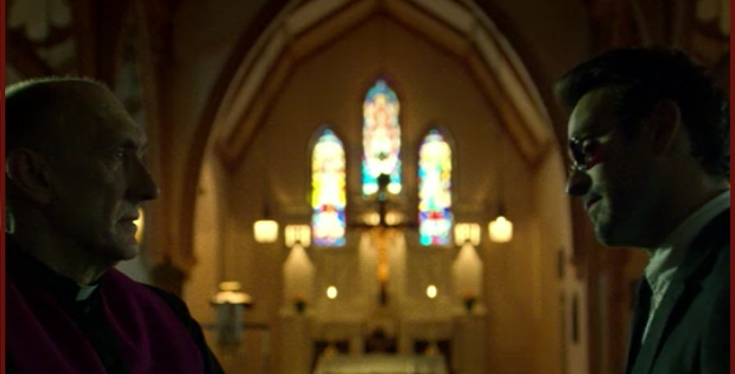
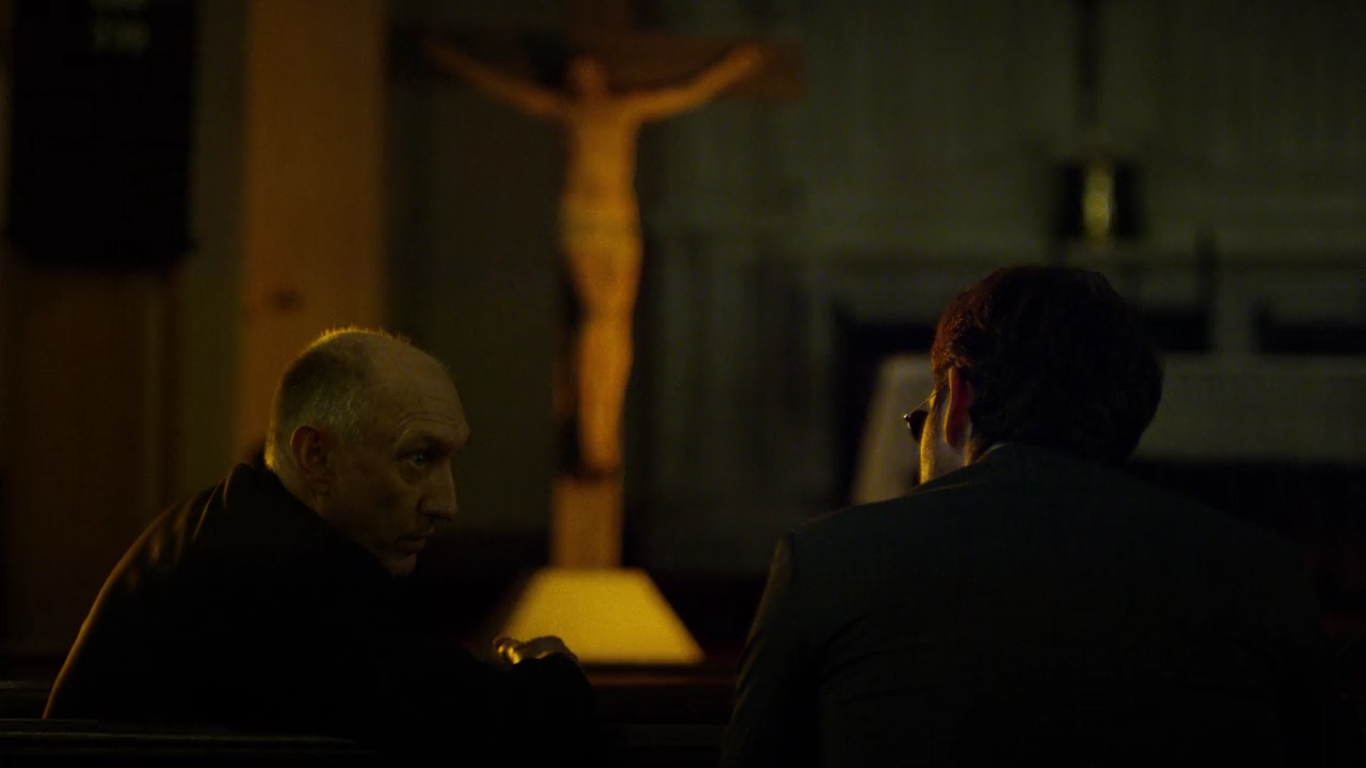
For most action heroes, there wouldn’t even be a question of what to do — you just go out and kill the bad guys. Matt, however, cares about what taking another person’s life says about him. He doesn’t take this question to his bartender or girlfriend though (as an equally introspective but less religious character might). He takes it to his faith in the form of his priest, Father Lantom, who reminds him, “There is a wide gulf between inaction and murder, Matthew. Another man’s evil does not make you good. … the question you have to ask yourself is are you struggling with the fact that you don’t want to kill this man, but have to? Or that you don’t have to kill him, but want to?”
A Question of Motive
In the same conversation where Father Lantom talks with Matt about whether or not Matt should kill Fisk, he also says, “Few things are absolute, Matthew. Even Lucifer was once an angel. It’s why judgment and vengeance… are best left to God. Especially when murder is not in your heart.” When Matt asks how Lantom can know what’s in his heart, the priest responds, “You’re here, aren’t you?” The fact that Matt wrestles with how his faith fits into his mission to fight for justice is one thing that proves he’s a good man. Our motivations matter.
Matt works as a lawyer by day trying to right wrongs within the system, then goes out at night as Daredevil trying to bring justice to the people who were overlooked by the law. In the first episode of Season 2, Matt tells Foggy that the woman they helped as lawyers by recommending a battered women’s shelter would have been murdered by her husband before her escape if Daredevil hadn’t put the man in a hospital. Daredevil goes around fixing the problems that Matt Murdock can’t.
An article that appeared on Slade.com last year said Netflix’s Daredevil understands that Matt’s religion is “essential to his identity … which is what makes the show work.” The article continues, “Murdock’s brutal justice is more than his way of taking personal responsibility for the sins of others; it’s his way of atoning for his own. Murdock’s real superpower, and also his biggest foe, is his Catholicism” (from “Daredevil’s Greatest Superpower Is His Catholicism“). Matt’s religion is what drives him to fight for justice, yet it’s also what makes him question himself at every turn.
Guilt and Redemption
Throughout his crusade, Matt punishes himself as much as the people he’s after. In “Daredevil, Catholicism, and the Marvel Moral Universe,” Leah Schnelbach connects this with “mortification of the flesh.”While Matt Murdock does qualify as a powered-person in the MCU, his powers don’t give him fast healing or make him invincible. To fight evil, “He has to keep getting hit, keep getting wounded. Over the course of the show, we see this process–old wounds reopen, cuts heal slowly, bruises linger, and each fight seems more labored. … The point is that he keeps going anyway” (click here to read the full article). Matt’s only partly joking when he responds to Claire describing him as “blind vigilante who … can take an unbelievable amount of punishment without one damn complaint” by saying, “The last part’s the Catholicism.”
Daredevil S2, E10
Mortification of the flesh is a concept very much tied to penance in the Catholic version of Christianity. It’s referenced even more clearly into Daredevil in Season 2, again by Claire (mild spoiler warning). Matt’s beating himself up (metaphorically, this time) for not saving a group of people soon enough. She suggest he take off his “hair shirt” and “start thinking about climbing down off that cross of yours and spending some time with us normal people for a change.” The idea of Matt martyring himself is a theme throughout both seasons.
MAJOR SPOILER WARNING
One of the aspects of Season 2 I found most interesting was the association of Matt with Jesus Christ. He’s not portrayed as a “Christ-figure” per say, but there’s more going on here than just Claire’s overt reference to Matt crucifying himself. Much like I argued when talking about Luke and Vader in Star Wars, we can compare Matt’s insistence that redemption is possible for Electra to God “not wishing that any should perish, but that all should come to repentance” (2 Pet. 3:9, ASV). While Matt is willing to die for her, what’s more poignant is that he’s willing to sacrifice himself by living for her.
I struggled with this scene in the final episode. Why would Matt give up everything he’s working for in Hell’s Kitchen to run away with such a morally dark character as Electra? Upon further reflection, I realized he didn’t intend to abandon his faith by offering to take this action. While being with Electra does bring out the “devil” side of him, he’s not offering to run off with Electra just so he can be free of responsibility or guilt. He wants to do this because of his stated reason — that she “gets” the part of him that no one else understands — and because of the redemption theme running through this season. He has to believe Electra can be good and he’ll give up his own life to help make that possible.
(end spoilers)
Matt’s not a perfect Christian or a perfect Catholic. Some might even question whether or not he qualifies as a “good man” after putting so many people (criminals, yes, but still people) in the hospital. Where do we draw the line? and what is the responsibility of a moral man confronted with evils that he can fight, but isn’t sure at what cost? Those are the sort of questions that Marvel’s Daredevil offers for our consideration. It’s not interested in a sanitized version of Christianity that focuses on faultless people living lives of bliss and, quite frankly, I’m not either. And neither’s the Bible, if the struggles of David, Peter, Paul and so many others are any indication. God never tells us our walk with Him will be without wrestling. It’s how we respond to the crises of faith — the moments where we wonder if all this is worth it — that count.
I recently finished reading, and then immediately re-reading, Fill These Hearts by Christopher West. It’s a powerful rebuttal to the lie that Christianity is a joyless religion of laws and suppressed desires. West touches on many points regarding marriage and the plan of God that I hit in my book God’s Love Story, a subject you know is dear to my heart. I could probably write half a dozen posts inspired by Fill These Hearts (I already quoted from it in last week’s post), but here’s the part I want to focus on today:
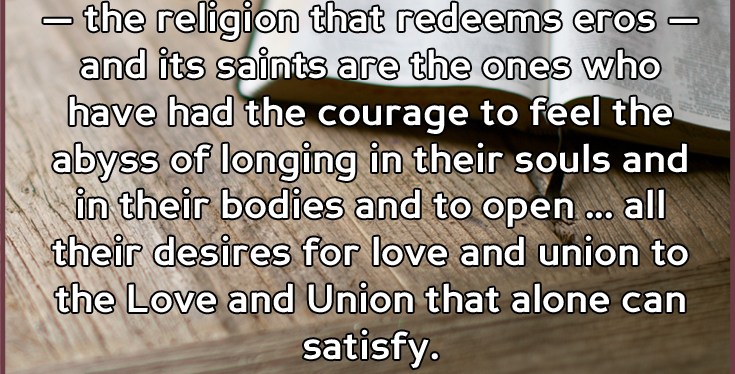
Christianity is the religion of desire — the religion that redeemseros — and its saints are the ones who have had the courage to feel the abyss of longing in their souls and in their bodies and to open … all their desires for love and union to the Love and Union that alone can satisfy. … the saints have learned to open eros (their yearning for love) to Eros (God’s passionate love for them).” (p. 39)
Seeing God’s love described as Eros might make you a little uncomfortable at first (it had that effect on me). Eros is the Greek word for passionate or sexual love. This word doesn’t even appear in scripture, although erotic love is alluded to. The word we usually associate with God’s love — and rightly so — is agape.Read more →
There are a few verses in the New Testament that tell us we “are not under the law” (Rom. 6:15; Gal. 5:18). Though some use this as permission to act however you want so long as you’ve confessed Jesus, most Christians realize that God’s commandments are still in effect. Jesus did not come “to destroy the law or the prophets … but to fulfill” (Matt. 5:17, WEB), and Paul said his own writings “establish the law” rather than repeal it (Rom. 3:31, WEB).
So why do these passages tell us we’re not under the law? I’ve heard many explanations, and touched on some myself, but none of them really answered the question of why Paul would use this phrase. They focused more on trying to say “that’s not really what he meant” than on trying to figure out why Paul chose these words to argue his point. Recently, though, I came across the best analysis of the phrase “not under the law” that I’ve ever seen. It was just a short passage in a little book called Fill These Hearts: God, Sex, and the Universal Longing by Catholic writer Christopher West.
Image by Inbetween from Lightstock
Freed from Bondage to Sin
In Fill These Hearts, West writes about our desires, saying that we can either deny them and go on a “starvation diet,” indulge them in this life like “fast food,” or direct them toward God and partake in His “banquet gospel.” When addressing the idea of freedom in relation to desire, he says,
The Apostle Paul writes that those who “are led by the Spirit .. are not under the law” (Gal. 5:18). They’re free from the law — not free to break it (that’s license); they’re free to fulfill it because they don’t desire to break it. Christ didn’t come into this world to shove laws down our throats. He came into the world to align the desires of our hearts with the divine design so we would no longer need the laws
West, Fill These Hearts, p. 140
This isn’t just West’s own particularly theory; it’s a solid reading of the Biblical text. Basically, he’s just summarizing in modern English what Paul was explaining in Galatians 5 and putting the phrase “not under the law” in its proper context.
This verse in Galatians is preceded by a discussion of two covenants. The Old Covenant is described as one that “gives birth to bondage” (Gal. 4:24, NKJV). When the people broke that covenant, they bought a death penalty on themselves. Jesus paid the price of that broken covenant and freed us from sin with His sacrifice, then mediated and established the New Covenant (Heb. 8:6).
Stand firm therefore in the liberty by which Christ has made us free, and don’t be entangled again with a yoke of bondage
Galatians 5:1, WEB
Paul is telling us that if we go back to studiously keeping every aspect of the law as if that will save us “Christ will profit you nothing … You are alienated from Christ, you who desire to be justified by the law. You have fallen away from grace” (Gal. 5:2, 4, WEB). We can’t treat the Old Covenant as our way to salvation. That does not, however, grant license to sin.
For you were called to freedom, brothers and sisters; only do not use your freedom as an opportunity to indulge your flesh,but through love serve one another.For the whole law can be summed up in a single commandment, namely, “You must love your neighbor as yourself.”
Galatians 5:13-14, NET (bold italics mark a quotation from Lev 19:18)
“Love” in this verse is agapao–the divine, selfless love of God. When we start becoming love as God is love, we will keep His laws from the heart instead of by compulsion to an external system.
But I say, live by the Spirit and you will not carry out the desires of the flesh.For the flesh has desires that are opposed to the Spirit, and the Spirit has desires that are opposed to the flesh, for these are in opposition to each other, so that you cannot do what you want.But if you are led by the Spirit, you are not under the law.
Galatians 5:16-18, NET
That is, we’re no longer held in bondage to a cycle of sin and death. Christ pulled us out of that and set us on a path of walking in the Spirit. If you keep reading verses 19 through 21 you get a list of the “works of the flesh.” All these works are sins under the Old Covenant and under the New Covenant “those who practice such things will not inherit the kingdom of God!” (Gal. 5:21, NET). Someone walking in Jesus won’t act like this. They will shun things prohibited by God’s law because those things are anathema to God’s character. We get a list of God’s character traits and the “fruit” He’s looking for in our lives in verses 22 through 25.
Image by Pearl from Lightstock
Freed to to Fulfill the Law Through Love
The early chapters of Romans discuss this same subject with slightly different wording. First, Paul sets up a connection between sin and the law. He explains that “all have sinned” (Rom. 3:23), but we wouldn’t know that without the law to tell us about sin (Rom. 4:15; 5:13; 7:7). The law let us know we were enslaved to sin.
We know that our old man was crucified with him so that the body of sin would no longer dominate us, so that we would no longer be enslaved to sin. … So you too consider yourselves dead to sin, but alive to God in Christ Jesus. Therefore do not let sin reign in your mortal body so that you obey its desires.
Romans 6:6, 11-12, NET
When Jesus died, He paid the penalty for all sin, which was exposed by the law. When we accept Him, are baptized, and commit to walking in relationship with God, we also “die” in a figurative sense. We’re freed from sin. It’s not supposed to shackle us anymore, and we don’t have to obey its pulls.
For sin will not have dominion over you. For you are not under law, but under grace. What then? Shall we sin, because we are not under law, but under grace? May it never be!
Romans 6:14-15, WEB
Here’s Paul saying the same thing West was about freedom not being license to sin. Those who are “not under the law” still aren’t allowed to break the law. In fact, the more we become like God the less we’ll want to break His rules.
Image by Anggie from Lightstock
In Romans 7, Paul draws an analogy between being under Old Covenant law and a marriage. Marriages end when one of the married people dies (Rom. 7:1-3). The Old Covenant represented the first marriage between God and His people. That Covenant ended at Christ’s death and, through Him, we died to it as well.
So, my brothers and sisters, you also died to the law through the body of Christ, so that you could be joined to another, to the one who was raised from the dead, to bear fruit to God.
Romans 7:4, NET
Now, we are betrothed in marriage to Jesus Christ. We’re being transformed on the inside to become like Him and our heavenly Father. We’re not “under the law” because we’re becoming like the Lawgiver (Is. 33:22; Jas. 4:12; 1 Jn. 3:1-3). We’re marrying the One who fills the law to its fullest extent.
God is love. As we become like God we learn to “be love” as well, and that leads us toward fulfilling the law (Rom. 13:8-10). We’re not freed from the law so we can do whatever our fleshly nature urges, but rather so that we can live-out the fullest expression of God’s divine law by imitating His character. The law isn’t how we receive eternal life, but because we love God we still keep His law on our way to eternity.
The directness of the inquiry did, I admit, take me rather by surprise. “It’s rather a hard thing to explain in a few words, sir,” I said. “But I suspect it comes down to not removing one’s clothing in public.” (Kazuo Ishiguro, The Remains of the Day)
This quote comes from a delightful little book about a British butler looking back on his life. Much of his reminisces center around this idea of dignity. He connects dignity with “a butler’s ability not to abandon the professional being he inhabits.” A butler who cannot do this is “like a man who will, at the slightest provocation, tear off his suit and shirt and run around screaming.” In short, a good butler keeps himself covered in the role he is committed to no matter how trying the circumstances.
I would probably not have connected this with the Bible if not for a message I heard on the same day I was taking The Remains of the Day back to the library. The Rabbi at my local Messianic congregation taught on the priestly garments and how we choose to “cover” ourselves with either good or bad actions, words, and character traits. Read more →
In the beginning Adam and Eve had a face-to-face relationship with God. They they sinned, creating a gap between them and their creator that was renewed each time a human broke God’s law. God was still there, but we kept moving farther and farther away.
Behold, the Lord’s hand is not shortened, that it cannot save; nor His ear heavy, that it cannot hear. But your iniquities have separated you from your God; and your sins have hidden His face from you, so that He will not hear. (Is. 59:1-2)
Throughout the time period covered by the Old Testament books, it appears few people had a relationship with God. In every case, that relationship existed because God stepped across the gap and initiated the relationship. He called Abraham, Isaac and Jacob into covenant with Him. He spoke to Moses out of the burning bush. He chose David as king over Israel. He called the prophets individually.
Today, God also has to take the first steps in any relationship we have with Him. Jesus said, “No one comes to the Father except through Me” (John 14:6) and also, “No one can come to Me unless the Father who sent Me draws him” (John 6:44). To have a relationship with Yeshua we must be called by the Father, and to know the Father we have to go through Yeshua.
Several months ago, there was a handout at my Messianic congregation with a “Thought Of The Week” printed on the back talking about just this topic. It started out discussing Jacob’s ladder, then human attempts to bridge the gap between God and man by building things like towers. Such attempts are futile, but
The same might be said of all our religious impulses. The stars are always beyond our reach. God is far distant. Man’s best attempts to bridge the gap fail. … If we are to ascend to God, we must ascend upon a ladder that He Himself has extended to us from above.”
We can’t do anything that will make us worthy of God’s attention. All our “religious impulses” — going to church every week, singing worship songs, preaching, or even doing works like healings — aren’t going to make Jesus let us into the kingdom (Matt. 7:22-23). The only thing we can do is respond when God extends us a way to know Him.
For all have sinned and fall short of the glory of God, being justified freely by His grace through the redemption that is in Christ Jesus, whom God set forth as a propitiation by His blood, through faith, to demonstrate His righteousness, because in His forbearance God had passed over the sins that were previously committed (Rom. 3:23-25)
Jesus is the ladder “extended to us from above” by God the Father. He “came down from heaven” (John 6:38) to pay the price for our sins and “draw all men to” Himself (John 12:32). Because we could not reach Him, he came to us.
The Hebrew word for “bless” also means to kneel. No matter how many good works we climb up on or how hard we stretch toward heaven, we won’t reach God. Yet He blessed us by kneeling down to our level and welcoming us into a relationship through Jesus Christ.
Therefore, having been justified by faith, we have peace with God through our Lord Jesus Christ, through whom also we have access by faith into this grace in which we stand, and rejoice in hope of the glory of God. (Rom. 5:1-2)
Because of what Jesus has done and is doing, we can reach God. Through Him, we “have access by one Spirit to the Father” (Eph. 2:18). We can come to Them with absolute confidence that They love us and want a relationship with us. They’ve proved that time and again throughout history by making covenants with people, building friendships with men like Abraham (Jas. 2:23), pleading with Their loved ones to come back, kneeling down to die in our place, and now living and walking with us.
Seeing then that we have a great High Priest who has passed through the heavens, Jesus the Son of God, let us hold fast our confession. For we do not have a High Priest who cannot sympathize with our weaknesses, but was in all points tempted as we are, yet without sin. Let us therefore come boldly to the throne of grace, that we may obtain mercy and find grace to help in time of need. (Heb. 4:14-16)
Jesus bridged the gap once and for all with His sacrifice that “perfected forever those who are being sanctified” (Heb. 10:14). He gave us access to God and “boldness to enter the Holiest” by making us holy (Heb. 10:19-22). “Now we are children of God” (1 John 3:2), and we can come to Him just as a child who knows their loving Father always has time to pick them up and listen to their concerns.






 Like An Anchor