
A Time To Return

If I asked you to define “repent” or “repentance,” what would you say?

We know it’s the thing you’re supposed to do when you’ve sinned and you’re coming to God asking for forgiveness. But is it just saying you’re sorry?

In English, “repent” means to express regret and remorse. While the Hebrew and Greek words translated “repent” in the Bible include that aspect of regret, the Biblical concept goes a step farther. Biblical repentance involves change. This change is a movement; an alteration in the direction of your heart and your life. The word image contained in both Hebrew and Greek is to turn away from sin and to turn toward God.

Unpopular Repentance

According to Oxford Languages (via Google), “repent” means “feel or express sincere regret or remorse about one’s wrongdoing or sin.” It came into Middle English “from Old French repentir, from re- (expressing intensive force) + pentir (based on Latin paenitere ‘cause to repent’).” There’s also something interesting going on with Google’s tracking for how often this word was used in English-language books between 1800 and 2019.
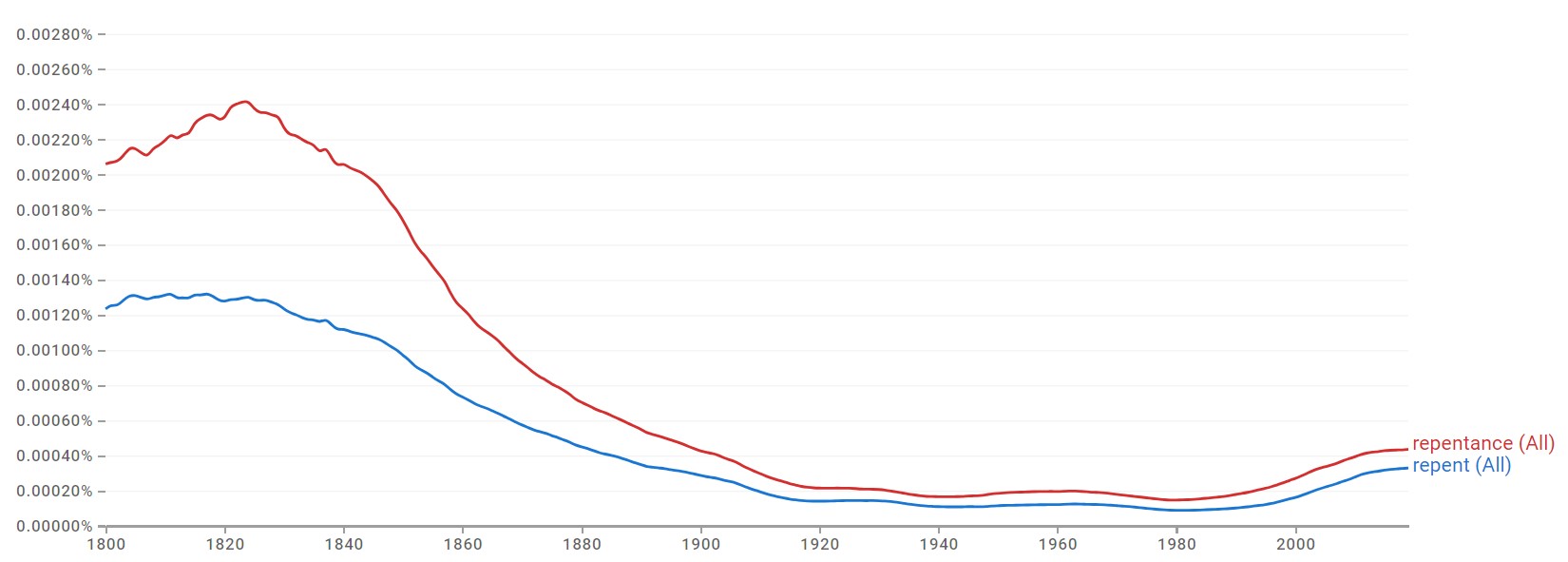
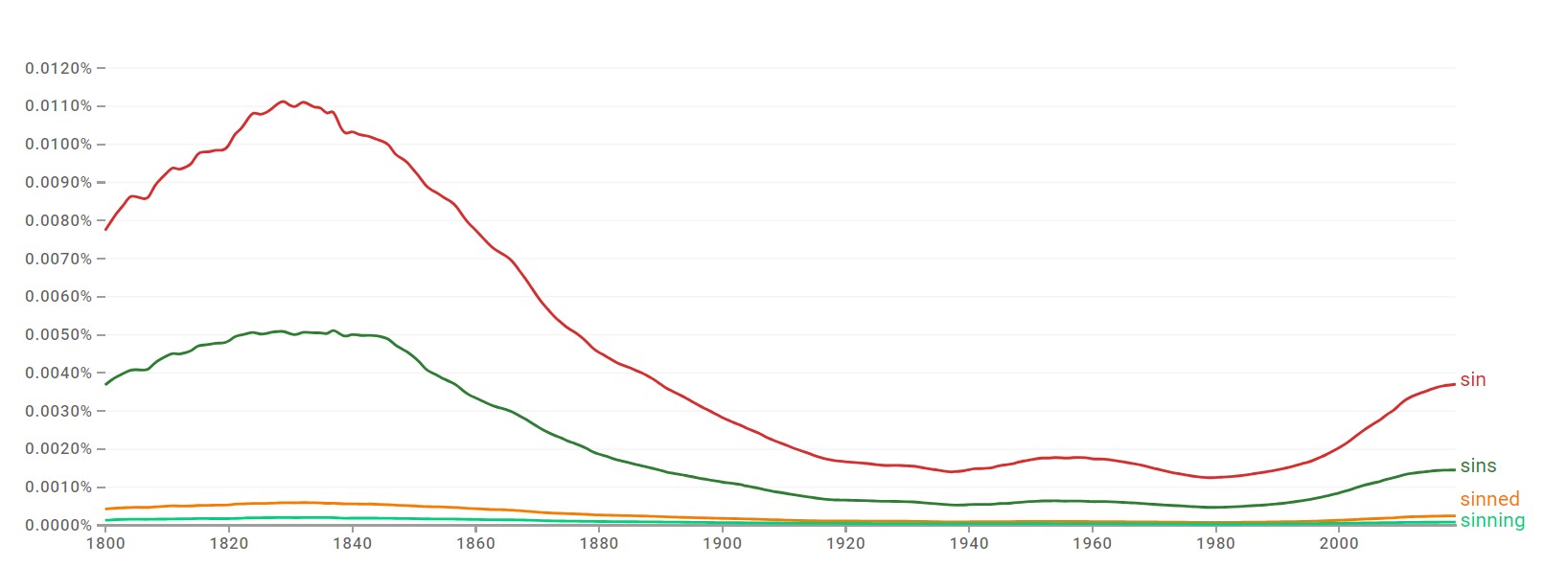
Evidently, repentance is not a popular idea (though I am intrigued by the recent uptick in usage after that slump in the 1900s). I don’t really think it will surprise any of us that “repent” and “repentance” are used less now than they were in the early 1800s. Repentance is something you need to do after you sin, and sin isn’t something we like to think about either. The more moral relativism takes hold in our society, the less people are willing to acknowledge sin is even a real thing since sin is the transgression of (God’s) absolute laws. The chart for “sin” in English language books looks very similar to the one for repentance.
But what about us today? If we’re sincerely following Jesus and love Him, He says we’ll obey His commandments. Commandments are contained in the law of God (Matt. 22:36, 40). The law and commandments are “holy, righteous, and good” (Rom. 7:12), and it is how God lets people know what sin is (Rom. 7:7-8). John says, “Sin is lawlessness” (1 John 3:4, WEB) or “the transgression of the law” (KJV). Paul further adds that “all have sinned” (Rom. 3:23). When Jesus came to this earth, one of His stated purposes was to call “sinners to repentance” (Luke 5:32), and it’s a message His disciples continued to preach (Acts 2:38; 3:19).

Putting all that together, we see that every human being is guilty of sin. Jesus can fix that problem, though. When sinners repent and follow Him, He takes away their sins (John 1:29; 1 John 3:5). Even after that, though, we still have a responsibility to keep His commandments because we love Him. And if we sin, then we need to repent again.

Returning and Changing

In Greek, one word translated “repent” is metanoeo (G3340). It includes the “regret or sorrow” aspect that is captured by the English word “repent,” but it also involves another step. The root words are meta (G3326: to be among or amidst, or to move toward that position) and noeo (G3539: “to exercise the mind, think, comprehend”) (Zodhiates entry G3340). Metanoeo is distinct from regret (metamelomai [G3338]) and includes “a true change of heart toward God” (Zodhiates). Thayer defines metanoeo as “to change one’s mind for better, heartily to amend with abhorrence of one’s past sins” (Thayer entry G3340). There’s a sense of turning around involved, as if when we sin we are walking away from God and when we repent we turn around and go toward Him again.

There’s another word for repentance in the New Testament as well. Zodhiates writes, “Metanoeo presents repentance in its negative aspect as a change of mind or turning from sin while epistrepho presents it in its positive aspect as turning to God” (Zodhiates entry G3340). He also notes that both of these words “derive their moral content … from Jewish and Christian thought, since nothing analogous to the biblical concept of repentance and conversion was known to the Greeks.” To understand what metanoeo and epistrepho (G1994) meant to early Christians, we need to look back at the Hebrew words expressing the same concepts.

Once again, we have two words that can be translated into English as “repent.” One of those, nacham (H5162) is typically only used of God “repenting” in the sense of “relenting or changing,” like He did when he delayed Nineveh’s destruction in response to their repentance (Theological Wordbook of the Old Testament [TWOT] entry 1344). In that story of Nineveh, we also see the Hebrew word more commonly used for human repentance, shub (H7725).

Jonah began to enter into the city a day’s journey, and he cried out, and said, “In forty days, Nineveh will be overthrown!”

The people of Nineveh believed God; and they proclaimed a fast, and put on sackcloth, from their greatest even to their least. The news reached the king of Nineveh, and he arose from his throne, and took off his royal robe, covered himself with sackcloth, and sat in ashes. He made a proclamation and published through Nineveh by the decree of the king and his nobles, saying, “Let neither man nor animal, herd nor flock, taste anything; let them not feed, nor drink water; but let them be covered with sackcloth, both man and animal, and let them cry mightily to God. Yes, let them turn (shub) everyone from his evil way, and from the violence that is in his hands. Who knows whether God will not turn (shub) and relent (nacham), and turn (shub) away from his fierce anger, so that we might not perish?”

God saw their works, that they turned (shub) from their evil way. God relented (nacham) of the disaster which he said he would do to them, and he didn’t do it.

Jonah 3:4-10, WEB

The basic meaning of shub is to turn or return. It is a Hebrew verb used frequently; “over 1050 times” in the Old Testament. While the Hebrew writers use many word pictures to describe repentance, all “are subsumed and summarized by this one verb shub. For better than any other verb is combines in itself the two requisites of repentance: to turn from evil and to turn to the good” (TWOT 2340). Like the Greek words that would later represent the same concept, Hebrew notions of repentance include both regret and turning away from sin and turning toward God. There’s always a sense of change; the verb shub is so connected with turning and change that it is even used of physical movement and coming back to a people or location (TWOT 2340).

The word shub is particularly important in it’s relation to “the covenant community’s return to God,” and one scholar concludes “there are a total of 164 uses of shub in a covenantal context” (TWOT 2340). Covenants are the way that God makes formal relationships with people; if we’re truly following God then we have made a covenant commitment to Him. Under the terms of a covenant, both parties involved have rights and responsibilities. In relation to repentance, both God and humanity have a role to play. The person repenting goes “beyond contrition and sorrow to a conscious decision of turning to God,” God freely extends His sovereign mercy, and then we continue in a commitment that involves “repudiation of all sin and affirmation of God’s total will or one’s life” (TWOT 2340). That concept is found in the Old Covenant, and is reinforced in the New Covenant (Acts 3:19; 26:17-20; 1 Thes. 1:9).

Trumpet Blasts As A Call to Return

In last week’s post, I talked about observing the Day of Trumpets (Yom Teruah). It is one of God’s special holy days, which He commands His covenant people to keep. It is a Sabbath day of complete rest, a day God calls His people to gather together, and “a memorial announced by loud horn blasts” (Lev. 23:24, WEB); “it is a day of blowing trumpets for you” (Num. 29:1, WEB). We traditionally say that in the New Covenant, the Day of Trumpets pictures the second coming of Jesus Christ, which will be heralded by trumpet blasts (1 Thes. 4:15-18).

We can also see the trumpet blasts as a call to alert us today of the need to return to God. In Jewish tradition, the Sabbath day that falls between Day of Trumpets and Day of Atonement (Yom Kippur) is called Shabbat Shuvah, the Sabbath of Return. As we just learned, shuvah/shub is the Hebrew word for repentance. As we move from Day of Trumpets to Day of Atonement, repentance should be on our minds.

Blow the trumpet in Zion,
    and sound an alarm in my holy mountain!
Let all the inhabitants of the land tremble,
    for the day of Yahweh comes,
    for it is close at hand:
A day of darkness and gloominess,
    a day of clouds and thick darkness.
As the dawn spreading on the mountains,
    a great and strong people;
    there has never been the like,
    neither will there be any more after them,
    even to the years of many generations.

Joel 2:1-2, WEB

As Joel warns, the time before Jesu’s return (the day of Yahweh, or day of the Lord) will be a dark time for the world as a whole. The world is getting worse and worse as His return draws nearer, and Revelation reveals it’s only going to get even worse (like during the soundings of the seven trumpets given to angels; Rev. 8-11). When contemplating the coming of this day, Peter asks a pertinent question: “since all these things will be destroyed like this, what kind of people ought you to be in holy living and godliness?” (2 Pet. 3:11, WEB). He answers by saying that since we look for Jesus’s return, we should “be diligent to be found in peace, without defect and blameless in his sight” and “grow in the grace and knowledge of our Lord and Savior Jesus Christ” (2 Pet. 3:14, 18 WEB). Joel records a similar warning to turn back to following God faithfully.

Yahweh thunders his voice before his army;
    for his forces are very great;
    for he is strong who obeys his command;
    for the day of Yahweh is great and very awesome,
    and who can endure it?
“Yet even now,” says Yahweh, “turn to me with all your heart,
    and with fasting, and with weeping, and with mourning.”
Tear your heart, and not your garments,
    and turn to Yahweh, your God;
    for he is gracious and merciful,
    slow to anger, and abundant in loving kindness,
    and relents from sending calamity.
Who knows? He may turn and relent,
    and leave a blessing behind him,
    even a meal offering and a drink offering to Yahweh, your God.
Blow the trumpet in Zion!
    Sanctify a fast.
    Call a solemn assembly.
Gather the people.
    Sanctify the assembly.

Joel 2:11-16, WEB
Image of four people walking into a church building with the blog's title text and the words "As we're reminded of Jesus's approaching return, God calls us to repentance; to turn away from our own way of doing things and turn toward Him."
Image by Pearl from Lightstock

This year, we will observe the Day of Atonement on September 25, 2023. This is a solemn holy day when God commands us to rest completely and “afflict your souls” (traditionally understood to mean fasting). Reading Joel, I can’t help but notice that the trumpet blasts warning that the Messiah’s return is coming closer and closer also call us to fast and repent. God and the prophet Joel call out to readers, saying, “turn (shub) to Yahweh, your God!”

All of us are getting closer every day either to the end of our lives or to Jesus Christ’s return. One way or another, we have a limited time here on this earth. Keeping the Day of Trumpets and Day of Atonement remind us of that. They also remind us of the wonderful things the Messiah has done and is doing for His people. Because of Jesus’s atoning sacrifice, God graciously removes our sins when we repent, turning our lives around and (re)committing to following Him faithfully. We need that reminder of His awesome mercy, of our total dependence on Him, and of His promise to return and set things on this earth right.


Featured image by Pearl from Lightstock

Our God Delights In Helping Us Succeed

There can be great peace and security in having a relationship with God. That’s something He wants us to enjoy. But if you’re struggling, feeling as if you may never measure up to God’s standards, serenity is likely the last thing you feel. It might even be discouraging to see other Christians seem so confident when you’re secretly unsure if you’ll make it through the week as a good and godly person.

One of the most comforting truths revealed in the Bible is that God wants us to succeed. His “mercy triumphs over judgement,” which in Greek means that mercy “boasts against, exalts over” judgement “in victory” (Jas 2:13, NET). When He looks at us, He hopes to see us doing well and He wants to support our growth far more than He wants to pass judgement on us. And when we slip-up or stray off the “straight and narrow” path, He’s eagerly looking for us to come back. God wants as many people as possible to be in His family, and He’s deeply committed to making that happen.

The Compassionate Father

You’re likely familiar with the parable of the prodigal son. In some translations, it’s labeled The Parable of the Compassionate, or Forgiving, Father. This name shifts our focus as we read this parable to notice the father’s role. In this parable, a man’s younger son demanded his share of the inheritance, then went off and “squandered his wealth with a wild lifestyle” (Luke 15:13, NET). Once he’d lost everything and was living destitute, barely scraping by feeding pigs, he realized he’d be better off going home even if his father only let him be a servant rather than acknowledged again as a son.

So he got up and went to his father. But while he was still a long way from home his father saw him, and his heart went out to him; he ran and hugged his son and kissed him. … the father said to his slaves, ‘Hurry! Bring the best robe, and put it on him! Put a ring on his finger and sandals on his feet! Bring the fattened calf and kill it! Let us eat and celebrate, because this son of mine was dead, and is alive again—he was lost and is found!’ So they began to celebrate.

Luke 15: 20, 22-24, NET

This father’s joy is the same joy God and all the hosts of heaven feel when a sinner repents (Luke 15:7, 10). God has felt this joy over us; we’ve all sinned (Rom. 3:23) and we’ve all had to repent many times. We count on God’s mercy to say, “Yes, I forgive you” every time we come to Him repentant and committed to doing better.

Image by Free-Photos from Pixabay

Wanting Us To Choose Life

God sincerely “desires all people to be saved and come to full knowledge of the truth” (1 Tim. 2:4, WEB). He does not wish “that any should perish, but that all should come to repentance” (2 Pet. 3:9, WEB). His goal is salvation and truth for, and repentance from, everyone (with that last one connected to our acceptance of the first two). We need to opt-in to grace; God doesn’t give people eternal life unless we take Him up on His offer. But He very much wants us to accept His gift and He’s invested in our success.

“But if the wicked person turns from all the sin he has committed and observes all my statutes and does what is just and right, he will surely live; he will not die. None of the sins he has committed will be held against him; because of the righteousness he has done, he will live. Do I actually delight in the death of the wicked,” declares the Sovereign Lord? “Do I not prefer that he turn from his wicked conduct and live?”

Ezekiel 18:21-23, NET

We might sometimes think God seems strict or unfair, but the reality is that His whole focus is on making things turn out well for His people (Rom. 8:28). He says to people He’s working with, “I have plans to prosper you, not to harm you. I have plans to give you a future filled with hope” (Jer. 29:11, NET). That group He’s working with can include any of us; people from all sorts of backgrounds, personalities, and experiences. Through Jesus’s sacrifice, God has opened up the opportunity to live in covenant with Him to anyone who hears His voice and responds.

Invested In and Delighted With Us

God delights in people who do their best to follow Him, not in people who are already “perfect.” Which is good for us, since we’re all still quite a ways off from attaining perfection even though we’re headed that direction. What’s important to God is that we stay on the journey toward being more and more like Him.

So then, my dear friends, just as you have always obeyed, not only in my presence but even more in my absence, continue working out your salvation with awe and reverence, for the one bringing forth in you both the desire and the effort—for the sake of his good pleasure—is God.

Philippians 2:12-13, NET

There are so many verses saying God delights in His people. Ps. 149:4; Prov. 11:20; 12:22; Is. 62:4-5; Jer. 32:40-41; Zeph. 3:17 are just a sample that point out He specifically delights in those who keep covenant with Him; who love and obey Him. Doing these things leads to delight for us as well (Ps. 16:11; 21:1; 37:4; 112:1; 119:16, 24, 35, 47, 77, 143, 174; 149:2; Is. 29:19). The more we delight in God and His laws, the more He delights in us. And when we do sin–since, as Paul said, it’s a struggle to do good all the time even when you delight in God’s law (Rom. 7:14-25)–then God delights in our repentance; our choice to run home to our compassionate Father.

Featured image by SnapwireSnaps from Pixabay

Examining Ourselves by Examining God

Every year before Passover, Christian and Messianic Jewish believers who follow Jesus’s instruction to keep this day “in remembrance of me” also follow Paul’s instruction to examine ourselves. Before we eat the unleavened bread and drink the wine as Jesus did “on the night in which he was betrayed,” we must examine ourselves. It’s a serious matter, for “the one who eats and drinks in an unworthy way eats and drinks judgment to himself if he doesn’t discern the Lord’s body” (1 Cor. 11:23-31. WEB).

As I ponder the question of self-examination today, about 4 weeks before Passover, I’m struck by something Job says near the end of the book bearing his name. After all his trials, all the discussions with his friends, and all of God’s replies, Job says,

I had heard of you by the hearing of the ear,
but now my eye has seen you.
Therefore I despise myself,
and I repent in dust and ashes!”

Job 42:5-6, NET

It’s easy to look at ourselves and think we’re doing okay unless something comes along to shake up that self-perception. Job thought he was a righteous man. He was even right about that, as God points out when He describes Job as “a blameless and upright man” at the beginning of the story (Job 1:8, NET). But Job still had room for improvement, and the more he learned about God the more fully he realized how much he still had to learn. The better we can see God, the less impressive we are to ourselves.

Heading Toward His Perfection

It is important to regularly “put yourselves to the test to see if you are in the faith; examine yourselves!” (2 Cor. 13:5, NET). We can’t accurately evaluate ourselves, though, unless we understand the standard we’re measuring ourselves by. In other words, if we don’t have some idea of what we are supposed to be we don’t know how well we’re doing.

See what sort of love the Father has given to us: that we should be called God’s children—and indeed we are! For this reason the world does not know us: because it did not know him. Dear friends, we are God’s children now, and what we will be has not yet been revealed. We know that whenever it is revealed we will be like him, because we will see him just as he is. And everyone who has this hope focused on him purifies himself, just as Jesus is pure.

1 John 3:1-3, NET

God is calling us into His family and we are His children right now. We’re also growing and changing, becoming more and more like Him. At least, that’s what should be happening. And if we’re going to examine ourselves to see how much progress we’re making on becoming like God, we need to know what it means to be like Him. We won’t achieve perfection in this life, but we should be heading there. And if we want to know what perfection looks like, we just need to look to God for an example of how we’re supposed to be.

Glimpsing His Unsearchable Riches

I keep talking about the need to see and understand God as if that’s something we could actually do as human beings. While we are invited to know Him in an increasingly familiar way, part of knowing Him involves realizing that our minds can’t warp themselves around His fullness. His thoughts are not like our thoughts (Is. 55:8-9) and “the riches both of wisdom and the knowledge of God” are so deep we’ll never plumb them all (Rom. 11:33).

I find this an encouraging realization. We’re never going to hit a point where there’s nothing left to work on, no way to grow, or nothing more to learn. The more we follow God, the more we get to engage with Him in a dynamic, growing relationship.

But just as it is written, “Things that no eye has seen, or ear heard, or mind imagined, are the things God has prepared for those who love him.” God has revealed these to us by the Spirit. For the Spirit searches all things, even the deep things of God.

1 Corinthians 2:9-10, NET

By God’s spirit inside us, we get an increasingly clear picture of what it means to be like God. We even get to put on “the mind of Christ” (1 Cor. 2:6-16). The better we know Him, the better we understand who we are meant to be and what we are supposed to do on the way toward being that person. That’s why I say that if we want to examine ourselves, we need to “examine” God. Self-examination is vital, but that process isn’t all about us even though the word “self” is in there. It’s about becoming like God.

To Fix Ourselves or to Be Like God

Putting on God’s nature often goes against our ingrained impulses. We are so used to reacting in certain ways (like anger if someone shouts at us, or spite if we’re ill treated) that trying to fix our human nature might seem impossible. And it is if we try to do that on our own. Thankfully, we’re not on our own and we don’t have to start from scratch.

“We have two options: we can try to reform the sinful human nature, or we can ask God for His nature. The former approach has never in history proven successful. Our only remaining option is to ask God.”

Chris Tiegreen, 365 Pocket Devotions, Day 78

Trying to make ourselves like God without putting on His nature is a futile endeavor. We need a more drastic change than just trying to be good or nice people. It reminds me of a C.S. Lewis quote, where he talks about the need to transform rather than just improve. Using the sort of agricultural analogy Jesus was so fond of in His parables, Lewis says,

“If I am a field that contains nothing but grass-seed, I cannot produce wheat. Cutting the grass may keep it short: but I shall still produce grass and no wheat. If I want to produce wheat, the change must go deeper than the surface. I must be ploughed up and re-sown.”

C.S. Lewis, Mere Christianity, book IV chapter 8

Returning to the topic of self-examination, the goal of that is not to fix ourselves by our own efforts. It’s to look for evidence of Jesus Christ in us (2 Cor. 13:5). It’s to identify areas where we’re not yet like God and ask Him to change us. The focus should be on God–who He is and who He wants us to be in Him–as much (or even more) than on ourselves.

The more we learn about God and seek to know Him, the more clearly we see ourselves. When we turn away from the Lord, our minds can deceive us into thinking we’re something different than we are. But when we turn to the Lord, who can “probe into people’s minds” and “examine people’s hearts,” we can then see ourselves as He sees us (Jer. 17:5-10, NET). We may, like Job, abhor what we see and need to repent, but there are blessings that follow something like that because God responds so positively to sincere repentance. When we look at ourselves in light of God’s goodness and realize we still aren’t perfect, it leads to humility. And when we take that humble attitude to God and ask Him to share His mind and nature with us, He will respond to our self-examination by transforming us.

Featured image by Inbetween via Lightstock

Don’t Be Something Jesus Would Throw Out Of His Father’s Temple

Let’s take a trip back to the early 1st century. It’s a few days before Passover and the Jews are heading to Jerusalem for the Feast. As they travel, they sing the songs of ascent like they do every year. On this particular year, though, there’s an extra level of excitement. A man named Yeshua (Jesus) arrived on the scene a few years ago and many think he could be the Messiah. He’s even riding into Jerusalem on a donkey’s colt, as Zechariah said the Messiah would.

Hoshiya-na! Baruch haba B’Shem Adonai!” they call. Save us now! Blessed is He who comes in the name of the Lord!

As Yeshua rides in, the people spread their garments in the way. They also cut palm branches as if they were here for the Feast of Tabernacles instead of the Passover and the Feast of Unleavened Bread. They’re expecting the Messiah to kick the Romans out, redeem Israel, and restore the kingdom. They’re hoping for the fulfillment of Tabernacles — the Messiah, son of David, ruling in power and might.

Instead, this Yeshua turns his donkey toward the temple. Once there, he “drove out all of those who sold and bought in the temple, and overthrew the money changers’ tables and the seats of those who sold the doves.” Instead of driving the pagans out of Jerusalem, he drove corruption out of God’s house, saying, “My house shall be called a house of prayer,’ but you have made it a den of robbers!” Read more

Mercies That Don’t Run Out

How many times can God forgive you? I think sometimes we might feel there’s a limit, or that God gets tired of “dealing with” us. We might even think that someday He could just give up on us if we can’t get ourselves straightened out fast enough. But what does the Bible say?

It is because of Yahweh’s loving kindnesses that we are not consumed, because his compassion doesn’t fail. They are new every morning; great is your faithfulness. Yahweh is my portion, says my soul; therefore will I hope in him. (Lam. 3:22-24, WEB)

This doesn’t mean God winks at sin or thinks it’s not a big deal. “The compensation due sin is death,” and without His mercies we would be finished (Rom. 6:23, LEB). But the mercies don’t run out. Each morning we have a chance to walk with Him, repenting of past wrongs, letting Him work in our lives to make us like Him, and trusting in his loving kindness, compassion, and faithfulness to lead us into a hopeful future.

God Doesn’t Remove His Mercies

Our sins can separate us from God if we refuse to  turn from them (Is. 59:2). When we choose to do things in a way that doesn’t line up with God’s way of life, we’re walking away from him. It’s unfaithful, like a wife cheating on her husband. But, unlike many human spouses who’ve been cheated on, God keeps asking us to come back. Read more

Forgiven The Most

Who responded to Jesus best when He walked on this earth? It wasn’t the religious leaders or the pious folk or the wealthy and powerful. It was the ordinary people, the sinners and the outcasts of society. But why is that? The Christian message carries good news for all people. What made some receive it joyfully and others want to kill Jesus?

click to read article, "Forgiven The Most" | marissabaker.wordpress.com
Photo credit: Skitter Photo via StockSnap

How Big Is Your Debt?

There’s a story in Luke 7 that might shed some light on this. One of the Pharisees, a man named Simon, invited Jesus over for dinner. A woman known in her city as “a sinner” followed them and started crying on Jesus’ feet. She washed His feet with her tears, wiped them with her hair, kissed them, and anointed them with oil.

The Pharisee’s mind instantly went to a place of judgement. If Jesus were a prophet, he thought, then He would know what sort of woman this was and stop her from touching Him. Jesus wasn’t too impressed with that line of thought, so He told this story:

There was a certain creditor which had two debtors: the one owed five hundred pence, and the other fifty. And when they had nothing to pay, he frankly forgave them both. Tell me therefore, which of them will love him most?” Simon answered and said, I suppose that he, to whom he forgave most.” And he said unto him, “Thou hast rightly judged.” (Luke 7:41-43, KJV)

Jesus went on to list the ways this woman demonstrated her love for him (which, incidentally, highlighted Simon’s deficiencies in hospitality). He finished His conversation with Simon by saying, “Her sins, which are many, are forgiven; for she loved much: but to whom little is forgiven, the same loveth little” (Luke 7:47, KJV).

One reason the sinners responded so well to Jesus is that they knew they needed what He offered. The people who viewed themselves as righteous thought they were good enough already and found His call to repentance offensive. Read more