The Action Words of Faith

The other day as I was reading through Hebrews 11, I noticed the faith chapter follows a pattern: “By faith [name] [action].” Each time the writer mentions a hero of faith, they following it by saying what it was this person did by faith.

As we’ve been studying here on this blog for the past three weeks, faith is linked with the actions we take (see “The Obedience of Faith,” “Be Careful How You Listen,” and “Increase Our Faith“). I thought it might be fitting to follow these posts up with one that’s more concrete; one that moves past discussing faith in action as a concept to looking at the actions that people of faith really did. Hebrews 11 isn’t an exhaustive list, but it is a great place to start.

We Understand

 By faith we understand that the worlds were set in order at God’s command, so that the visible has its origin in the invisible.

Hebrews 11:3, NET

I’ve never before stopped to think about the fact that the faith chapter starts with us. We think of this as a list of heroes of the faith, but the very first people mentioned is “we”–the author and all the readers. None of us were there at the creation of the world. The understanding we have to worship God as Creator is something we do by faith.

Abel Offered

  By faith Abel offered God a greater sacrifice than Cain, and through his faith he was commended as righteous, because God commended him for his offerings. And through his faith he still speaks, though he is dead.

Hebrews 11:4, NET

Abel’s faith prompted him to give an offering to God. If we do this today it’s usually money, but in the Old Testament God’s followers gave physical offerings. In Genesis, we read, “Abel brought some of the firstborn of his flock and of its fat. Yahweh respected Abel and his offering” (Gen. 4:4, WEB). Something about Abel’s offering and the way he presented it pleased God and led to Him commending Abel’s righteousness. We’ll see this connection between action, faith, and righteousness repeated with Abraham as well.

Enoch Pleased God

 By faith Enoch was taken up so that he did not see death, and he was not to be found because God took him up. For before his removal he had been commended as having pleased God. Now without faith it is impossible to please him, for the one who approaches God must believe that he exists and that he rewards those who seek him. 

Hebrews 11:5-6, NET

Enoch is the one break in our “By faith [name] [action]” pattern. Here, “Enoch was taken” by God–it’s God doing the action, not Enoch. The lines that follow, though show that Enoch was doing something to please God. We’re not sure exactly what all was involved in that, but it is linked with “believe” (translated from pisteuo, the verb/action word form of pistis, which is faith as a noun/thing/concept).

Noah Constructed, Condemned, and Inherited

 By faith Noah, when he was warned about things not yet seen, with reverent regard constructed an ark for the deliverance of his family. Through faith he condemned the world and became an heir of the righteousness that comes by faith.

Hebrews 11:7, NET

I still think about a study I published in 2016 “Grace To Build An Ark.” The first time we see “grace” in the Bible, it’s when God decided to spare Noah and his family from the flood. Like the grace we receive, Noah couldn’t have enacted this salvation on his own, but once he received grace he took action. He built an ark, and here we learn that he did that “by faith.”

We’re also told that through faith Noah “condemned the world.” The word translated “condemned” is katakrino, “to give judgement against” (G2632, Thayer’s Dictionary). Noah wasn’t the one who decided the world was “worthy of punishment” (Thayer), but the actions he took by faith highlighted that he was the only one alive who would be obedient to God and drew a sharp contrast between him and the sinful world.

Noah also “became an heir of the righteousness that comes by faith.” In Romans, Paul talked extensively about how “faith was credited to Abraham as righteousness” (Rom. 4), but this points out that it happened for Noah as well. It’s really an amazing thing to say about someone in the Old Testament, when many people who knew about God were “pursuing a law of righteousness” yet fell short of “righteousness that is by faith” (Rom. 9:30-31, NET, see Rom 9:30-10:13). Noah’s example provides further support for one of Paul’s main arguments in Romans: that God has always worked with people who pursued righteousness through faith and obeyed God from the heart rather than simply by rote obedience to the letter of the law.

Abraham Obeyed, Went Out, Lived, Looked Forward, Procreated, and Offered

 By faith Abraham obeyed when he was called to go out to a place he would later receive as an inheritance, and he went out without understanding where he was going. By faith he lived as a foreigner in the promised land as though it were a foreign country, living in tents with Isaac and Jacob, who were fellow heirs of the same promise.  For he was looking forward to the city with firm foundations, whose architect and builder is God. By faith, even though Sarah herself was barren and he was too old, he received the ability to procreate, because he regarded the one who had given the promise to be trustworthy. So in fact children were fathered by one man—and this one as good as dead—like the number of stars in the sky and like the innumerable grains of sand on the seashore. …

By faith Abraham, when he was tested, offered up Isaac. He had received the promises, yet he was ready to offer up his only son. God had told him, “Through Isaac descendants will carry on your name,” and he reasoned that God could even raise him from the dead, and in a sense he received him back from there.

Hebrews 11:8-12, 17-18 NET (bold italics mark a quotation from Gen 21:12)

Abraham is known as the father of the faithful, and for good reason (Rom. 4:12, 16). His whole life is characterized by faithful action in obedience to God and based on trust in God. Most of the other action words used in this section of Hebrews 11 hinge on that first word: “obeyed.” It was in obedience to God that he left his homeland and “lived as a foreigner” in the land God promised to his descendants. He was obeying when he “offered up Isaac.” We also see a lot of trust in Abraham’s life–trust that God would raise up Isaac if he died, trust when looking forward to a heavenly city, and trust that God would give him a child. For Abraham, as for all of us, faith is an action that involves trusting God, staying loyal to Him, and obeying Him.

Image of a smiling woman with her arm raised in praise overlaid with text from Heb. 11:6, NET version: “Now without faith it is impossible to please him, for the one who approaches God must believe that he exists and that he rewards those who seek him.”
Image by Pearl from Lightstock

Isaac and Jacob Blessed

By faith also Isaac blessed Jacob and Esau concerning the future. By faith Jacob, as he was dying, blessed each of the sons of Joseph and worshiped as he leaned on his staff.

Hebrews 11:20-21, NET (bold italics mark a quotation from Gen 47:31)

When we think of blessing today, we usually think of it as something God does for us (e.g. “God blessed us with protection during the storm”) or that we do for God (e.g. “Bless the Lord, O my soul”). In the Bible, though, there’s a third type of blessing as well. People can bless other people. It’s part prophecy, part asking God to bless them. To bless someone like this, you have to have faith in God–faith that He’s guiding the words of your blessing and faith that He’ll carry it out.

Joseph Mentioned and Instructed

 By faith Joseph, at the end of his life, mentioned the exodus of the sons of Israel and gave instructions about his burial.

Hebrews 11:22, NET

This is another example of faith that includes trusting God about the future. Joseph’s only guarantee that Israel would leave Egypt is that God told Him about it (Gen. 50:24-26). He trusted God’s word so much that he made plans for the Exodus that would happen long after his death, instructing his brothers to pass down this command all the way to Moses (Ex. 13:19).

Moses’s Parents Hid

By faith, when Moses was born, his parents hid him for three months, because they saw the child was beautiful and they were not afraid of the king’s edict. 

Hebrews 11:23, NET

We often think of hiding as something we do because of fear, but that’s the opposite of what’s happening here. Moses’s parents hid him to keep him safe from the murderous pharaoh. My baby is almost 3 months old now, and I can’t imagine how much faith it took for his mother to overcome her fears, put her little baby into a basket in the river, and hope that he’d be safe (Ex. 1:22-2:3).

Moses Refused, Chose, Suffered, Left, Persevered, and Kept

By faith, when he grew up, Moses refused to be called the son of Pharaoh’s daughter, choosing rather to be ill-treated with the people of God than to enjoy sin’s fleeting pleasure. He regarded abuse suffered for Christ to be greater wealth than the treasures of Egypt, for his eyes were fixed on the reward. By faith he left Egypt without fearing the king’s anger, for he persevered as though he could see the one who is invisible. By faith he kept the Passover and the sprinkling of the blood, so that the one who destroyed the firstborn would not touch them.

Hebrews 11:24-28, NET

Movies like The Ten Commandments and Prince of Egypt make it seem like Moses didn’t know about his Israelite heritage until shocked by the revelation as an adult, but this passage in Hebrews indicates he knew for a while. He didn’t stumble into the knowledge or run away because he was scarred. He chose, by faith, to align himself with the people of God even though that meant suffering.

All of the faithful actions recorded here for Moses hinge on looking to the future and relying on God. He chose God over Egypt–long-term good over “fleeting pleasure” and treasures in heaven over earthly wealth. He trusted in God to pass the last plague over Israel if they obeyed His instructions, and though it isn’t mentioned here, we know Moses and generations of Israelites to follow continued keeping the Passover as they looked forward to the Messiah.

People of Israel Crossed Red Sea and Watched Jericho Fall

By faith they crossed the Red Sea as if on dry ground, but when the Egyptians tried it, they were swallowed up. By faith the walls of Jericho fell after the people marched around them for seven days. 

Hebrews 11:29-30, NET

The people of ancient Israel are often seen as a cautionary tale–an example of disobedience that we’re to learn from and not imitate (1 Cor. 10:1-12). But there were times that they acted in faith, and we can look to those times as positive examples. They were scared at the Red Sea, but when God parted the waters they fled through this supernatural way of escape by faith. They weren’t the most formidable army in the world, but Joshua didn’t hesitate to lead them into the promised land and trust God to provide the victory. Once again, we see that actions of faith are linked with trusting God.

Rahab Escaped

 By faith Rahab the prostitute escaped the destruction of the disobedient, because she welcomed the spies in peace.

Hebrews 11:31, NET

Rahab didn’t know anything about the God of Israel except what she’d heard about the things He’d done through and for His people (Josh. 2:8-13). That was enough, though, for her to say, “Yahweh your God, he is God in heaven above, and on earth beneath” (Josh. 2:11, WEB), and to act based on faith in Him. You don’t need to know everything about who God is and what He expects from you to begin a life of faith.

Summary of Other Faithful Actions
Image of a man sitting at a table with a Bible in front of him and his head bowed in prayer, overlaid with blog's title text and the words, "Hebrews 11 records actions that people did “by faith” and teaches us about things we can do if we have faith."
Image by WhoisliketheLord Studio from Lightstock

And what more shall I say? For time will fail me if I tell of Gideon, Barak, Samson, Jephthah, of David and Samuel and the prophets.  Through faith they conquered kingdoms, administered justice, gained what was promised, shut the mouths of lions, quenched raging fire, escaped the edge of the sword, gained strength in weakness, became mighty in battle, put foreign armies to flight, and women received back their dead raised to life. But others were tortured, not accepting release, to obtain resurrection to a better life. And others experienced mocking and flogging, and even chains and imprisonment. They were stoned, sawed apart, murdered with the sword; they went about in sheepskins and goatskins; they were destitute, afflicted, ill-treated (the world was not worthy of them); they wandered in deserts and mountains and caves and openings in the earth. And these all were commended for their faith, yet they did not receive what was promised. For God had provided something better for us, so that they would be made perfect together with us.

Hebrews 11:21-40, NET

The actions of faith often seem exciting and heroic when we look back on them. At the time, though, I imagine they were often harrowing for people. The verses in Hebrews tell us people like Moses and his parents acted without fear, but there was still uncertainty. They trusted God, but they didn’t know the outcome when they started out.

Sometimes, the actions we take by faith lead to things like conquering kingdoms, attaining the promises, escaping from lions, and raising the dead. Other times, these actions lead to God’s people being tortured, mocked, imprisoned, and homeless. No matter what the outcome, the point of this chapter is that we can trust God when we act in faith. In the grand scheme of things, He always works things out for good. Sometimes that’s obvious in this life, but whether we see a good outcome here or not, the ultimate fulfillment of God’s promises will happen in His kingdom.

These all died in faith without receiving the things promised, but they saw them in the distance and welcomed them and acknowledged that they were strangers and foreigners on the earth. For those who speak in such a way make it clear that they are seeking a homeland. In fact, if they had been thinking of the land that they had left, they would have had opportunity to return. But as it is, they aspire to a better land, that is, a heavenly one. Therefore, God is not ashamed to be called their God, for he has prepared a city for them. 

Hebrews 11:13-16, NET

Every single person mentioned here in the faith chapter is still waiting to receive all that God promised them. They’ll be resurrected at the same time as the New Covenant believers are at Jesus’s return (see “Rethinking Heaven: Capturing A Vision of the Resurrection“). The faith chapter begins by including us (“by faith we understand”) and it ends with us as well (“they would be made perfect together with us”). When we remain faithful to God–demonstrated by the actions of faith that we take in obedience to Him–we’ll inherit the promises right alongside all the faithful people who’ve followed God over thousands of years.


Featured image by Pearl from Lightstock

How Do We Learn From God’s Judgements?

As I wrote last week’s post about “Seeking and Learning Righteousness,” I kept mentioning the connection between learning righteousness and paying attention to God’s judgements. The key scripture we looked at in that post reads, “Yes, with my spirit within me I will seek you earnestly; for when your judgments are in the earth, the inhabitants of the world learn righteousness” (Is. 26:9, WEB). 

It’s clear from this and other verses we looked at last week that we can learn righteousness from God’s judgements. But how? That was a question I thought of while writing, but didn’t really have the time to address. To answer this, we first need to understand what Isaiah means by God’s judgements.

More than Simply “Judgements”

The word translated “judgement” in Isaiah 26:9 is the Hebrew mishpat (H4941). Common translations include “judgement, justice, ordinance” (Brown-Driver-Briggs). This word is not confined to what we think of as the judicial function of government. The root word shapat means “to exercise [all] the processes of government” (Theological Wordbook of the Old Testament [TWOT], entry 2443). Furthermore, ancient understanding didn’t really separate the law from the lawgiver–“the centering of law, rulership, government in a man was deeply ingrained” (TWOT 2443). This makes perfect sense when we think of God as the Lawgiver and Ruler. The Bible treats His Law as an extension of His character.

For mishpat specifically, there are “at least thirteen related, but distinct, aspects of the central idea, which if to be rendered by a single English word with similar range of meaning ought by all means to be the word ‘justice'” (TWOT 2443c). These 13 meanings include “the act of deciding a case of litigation,” “a sentence or decision issuing from a magistrate’s court,” “an ordinance of law,” and “one’s right under law,” among others.” One other key meaning is “sovereignty, the legal foundation of government in the sense of ultimate authority or right.” People today expect this to be centered in laws and governing documents, but in scripture “The mishpat is God’s” (TWOT 2443c; Deut. 1:17). He has all authority, and when He exercises judgement/justice He does so as head of everything (not just a single branch of government).

When we speak of learning from God’s mishpat, that includes learning from His sovereign authority, His ordinances of law, and His just legislative rulings. Mishpat appears 421 times in the Old Testament so obviously we can’t look at every verse right now, but we can look at some examples of how God expected people to interact with His mishpat.

  • God chose to share His plans about Sodom and Gomorrah with Abraham before it happened because “I have known him, to the end that he may command his children and his household after him, that they may keep the way of Yahweh, to do righteousness and justice (mishpat)” (Gen. 18:19, WEB). One of the reasons the Lord trusted Abraham is because he kept Yahweh’s mishpat and would teach the people under his care to do so as well.
  • The laws/rules/ordinances/commands revealed to Moses at Mount Sinai are called mishpat: “Moses came and told the people all Yahweh’s words, and all the ordinances(mishpat); and all the people answered with one voice, and said, ‘All the words which Yahweh has spoken will we do'” (Ex. 24:3, WEB). (See also Lev. 18:4-5; 20:22; 25:18; 26:46).
  • The people of Israel had to keep all the Lord’s mishpat if they wanted to inherit the promises He made. They were warned not to add to or take away from God’s commands, nor to forget them. They also had a responsibility to pass on the mishpat to their children, as Abraham did to his. If they kept the mishpat, God would give them great blessings (Deut. 4:1-14; 5:1-22, 31-33; 7:12-13; 11:1; 26:16-19).
  • David, whom God described as “a man after my heart, who will do all my will” (Acts 13:22, WEB), said, “I have kept Yahweh’s ways, and have not wickedly departed from my God. For all his ordinances (mishpat) were before me. As for his statutes, I didn’t depart from them” (2 Sam 22:22-23, WEB).
  • We often say Solomon asked God for wisdom, but the specific wording when God responds is, “Because you … have asked for yourself understanding to discern justice (mishpat); behold, I have done according to your word. Behold, I have given you a wise and understanding heart” (1 Kings 3:11-12, WEB).
  • Judgement came on ancient Israel because they forsook God and stopped keeping His judgements/ordinances (1 Kings 11:31-33; Neh. 1:4-7; 9:28-29; Ezk. 5:5-8; 11:10-12; 20:11-24; Dan. 9:4-5). Notice that not keeping God’s mishpat is a sin and is linked with forsaking God Himself.
Image of a man watching a sunset overlaid with text from Deut. 11:1, WEB version:  “you shall love Yahweh your God, and keep his instructions, his statutes, his ordinances, and his commandments, always.”
Image by Aaron Kitzo from Lightstock

Lessons from Ancient Israel’s Relationship With God

I want to spend a little more time looking at ancient Israel’s relationship with God’s mishpat. When God instituted the Sinai Covenant with Israel, it was like a marriage ceremony. The laws and ordinances that He delivered are like the marriage vows that couples make. Both God and the people bound themselves together in a formal relationship–a covenant–and agreed to live by His mishpat (Ex. 24:3). As co-inheritors with Jesus Christ of the covenants God made with His people in the past, His mishpat are still relevant for us today and we can learn from the ways that God’s people in the past related to Him and His justice/ordinances.

There’s a passage in Ezekiel where God summarizes His relationship with the people of Israel thus far, and He pays particular attention to how they related to His mishpat. Ezekiel records that “some of the elders of Israel came to inquire of Yahweh,” and Yahweh responded by telling Ezekiel, “Cause them to know the abominations of their fathers” (Ezk. 20:1, 4, WEB). As we read the history of Israel from the Lord’s perspective, keep in mind that He uses the word “abominations” to describe what the people did. The actions they took against Him and His mishpat were very serious.

“So I caused them to go out of the land of Egypt, and brought them into the wilderness. I gave them my statutes, and showed them my ordinances (mishpat), which if a man does, he will live in them. Moreover also I gave them my Sabbaths, to be a sign between me and them, that they might know that I am Yahweh who sanctifies them.

“But the house of Israel rebelled against me in the wilderness. They didn’t walk in my statutes, and they rejected my ordinances (mishpat), which if a man keeps, he shall live in them. They greatly profaned my Sabbaths. Then I said I would pour out my wrath on them in the wilderness, to consume them. But I worked for my name’s sake, that it should not be profaned in the sight of the nations, in whose sight I brought them out.  Moreover also I swore to them in the wilderness, that I would not bring them into the land which I had given them, flowing with milk and honey, which is the glory of all lands;  because they rejected my ordinances (mishpat), and didn’t walk in my statutes, and profaned my Sabbaths; for their heart went after their idols. Nevertheless my eye spared them, and I didn’t destroy them. I didn’t make a full end of them in the wilderness. I said to their children in the wilderness, ‘Don’t walk in the statutes of your fathers. Don’t observe their ordinances (mishpat) or defile yourselves with their idols.  I am Yahweh your God. Walk in my statutes, keep my ordinances (mishpat), and do them.  Make my Sabbaths holy. They shall be a sign between me and you, that you may know that I am Yahweh your God.'”

“But the children rebelled against me. They didn’t walk in my statutes, and didn’t keep my ordinances (mishpat) to do them, which if a man does, he shall live in them. They profaned my Sabbaths. Then I said I would pour out my wrath on them, to accomplish my anger against them in the wilderness. Nevertheless I withdrew my hand, and worked for my name’s sake, that it should not be profaned in the sight of the nations, in whose sight I brought them out. Moreover I swore to them in the wilderness, that I would scatter them among the nations, and disperse them through the countries; because they had not executed my ordinances (mishpat), but had rejected my statutes, and had profaned my Sabbaths, and their eyes were after their fathers’ idols.”

Ezekiel 20:10-24, WEB

This tragic story is not just ancient history. Paul told New Covenant Christians in Corinth, “These things happened to them as examples and were written for our instruction, on whom the ends of the ages have come. So let the one who thinks he is standing be careful that he does not fall” (1 Cor. 10:11-12, NET). We need to learn from the lessons of Israel’s history in the Old Testament so that we don’t make the same mistakes, such as rejecting the mishpat of our God. Then and today, God wants people who have a relationship with Him to live in and walk in His justice/ordinances/judgements. We’re supposed to become holy as He is holy, and doing what He tells us to is part of that process.

Image of two women reading Bibles overlaid with text from 1 Peter 1:13-15, WEB version:  "“Be sober, and set your hope fully on the grace that will be brought to you at the revelation of Jesus Christ—as children of obedience, not conforming yourselves according to your former lusts as in your ignorance, but just as he who called you is holy, you yourselves also be holy in all of your behavior”
Image by Shaun Menary from Lightstock

Trained in Righteousness Today

Talking about the ordinances of God from the Old Testament makes some modern Christians uncomfortable. This is due to misinformation about how New Covenant believers relate to God’s laws. For example, Paul is often misread as doing away with God’s law. He preempted that reading by asking and answering a question: “Do we then nullify the law through faith? May it never be! No, we establish the law” (Rom. 3:31, WEB). This sentiment echoes something Jesus Himself said.

“Do not think that I have come to abolish the law or the prophets. I have not come to abolish these things but to fulfill them. I tell you the truth, until heaven and earth pass away not the smallest letter or stroke of a letter will pass from the law until everything takes place. So anyone who breaks one of the least of these commands and teaches others to do so will be called least in the kingdom of heaven, but whoever obeys them and teaches others to do so will be called great in the kingdom of heaven. For I tell you, unless your righteousness goes beyond that of the experts in the law and the Pharisees, you will never enter the kingdom of heaven!”

Matthew 5:17-20, NET

The scribes, or “experts in the law,” and Pharisees were a group of people that Jesus called out for putting on a righteous show while neglecting the true spiritual meaning of God’s laws and leaving “justice, mercy, and faith” undone (Matt. 23). Jesus wants His people to follow His words faithfully from the heart, not to put on a righteous show. Aligning ourselves with Jesus is how we become truly righteous.

That’s how the mishpat of God help us learn righteousness. The Law is an expression of God’s character, and keeping it aligns people with Him. Paul compared the Law to a “tutor to bring us to Christ, that we might be justified by faith” (Gal. 3:24, WEB). Even today, the mishpat of God (which we’re to keep on a spiritual and literal level as New Covenant believers with the law written in our hearts) point us to our Savior and help us learn righteousness.

You, however, must continue in the things you have learned and are confident about. You know who taught you and how from infancy you have known the holy writings, which are able to give you wisdom for salvation through faith in Christ Jesus. Every scripture is inspired by God and useful for teaching, for reproof, for correction, and for training in righteousness, that the person dedicated to God may be capable and equipped for every good work.

2 Timothy 3:14-17, NET

When Paul wrote these words to Timothy, the “holy writings” and “scripture” he refered to are what we now call the Old Testament. Over and over in those scriptures, we learn that righteousness and justice are something that God loves and that those who love Him will keep His mishpat (Deut. 11:1; 30:16; Ps. 33:5; 37:28). God pleads with His people to walk in and follow His mishpat and practice righteousness because that’s the way to life (Lev. 18:5; Neh. 9:29; Ezk. 18:9). Then, just as today, God “wants all people to be saved and to come to a knowledge of the truth” (1 Tim. 2:4, NET; see also 2 Pet. 3:9 and Ezk. 18; 33).

There are no human beings who can claim to be perfectly righteous on their own, “for all have sinned” (Rom. 3:10, 23, WEB). It is Jesus Christ’s act of righteousness that makes it possible for us to really become righteous (Rom. 5:17-18). Now that He has called us, we are obligated to obey God our Savior as servants of righteousness (Rom. 6:12-23). We’re not justified by our own righteousness, but having been justified by Jesus we must choose to live according to His righteousness. God’s mishpat train us in how to do that.

Called To Holiness

Image of a man praying with the blog's title text and the words "Scriptures say we can learn righteousness from God's 
judgements.  How?"
Image by WhoisliketheLord Studio from Lightstock

Like Timothy, we need God’s word “for teaching, for reproof, for correction, and for training in righteousness” so that we who are “dedicated to God may be capable and equipped for every good work” (2 Tim. 3:16-17, NET). God has called us for a purpose, which involves becoming part of His family. We’re literally supposed to become like Him. This is a process that won’t be completed until Jesus Christ’s return.

When Paul tells his readers they are “called to be saints,” the word translated “saints” literally means a holy thing/people (Rom. 1:7; G40 hagios). Peter expands on this idea when he says we must be “obedient children” who, “like the Holy One who called you, become holy yourselves in all of your conduct, for it is written, ‘You shall be holy, because I am holy‘” (1 Peter 1:15-16, NET [bold italics a quote from  Lev 19:2]). God expects holiness and righteous conduct from those He calls into a relationship with Him.

The simplest way to put this is that we’re to follow Jesus’s holy and righteous example (Acts 3:14; 1 Cor. 11:1; Eph. 5:1-2). Expand on it a little more, and you get the two greatest commandments–love God and love your neighbor (Mark 12:28-34; Rom. 13:8-10). For more detailed instructions on how to be holy and righteous, we go to the Lord’s words, laws, ordinances, and teachings (those mishpat we’ve been talking about). God’s word shows us what people who are becoming holy do and do not do. As we obey His commands out of love for Jesus and the Father, we are training in righteousness and becoming holy like He is holy.


Featured image by Matt Vasquez from Lightstock

Lessons from The Kings of Judah

One thing I find fascinating when reading the Old Testament is thinking about how the ancient kings of Israel and Judah did at childrearing. I’m guessing they weren’t all that involved with raising their children given their other kingly responsibilities (and perhaps cultural expectations as well). Still, if we didn’t know the story we probably wouldn’t expect David, the “man after God’s own heart” to have children who end up in a situation where one rapes his half-sister, gets murdered by her brother, and then that brother rebels against David and sleeps with his concubines (2 Sam. 13-18). David’s son Solomon was a great king, but then Solomon’s son Rehoboam listens to bad advisors, messes everything up, and the kingdom splits into Israel and Judah (2 Chr. 10).

Reading the books of Kings and Chronicles, it often seems like the kings of Judah bounce back and forth from good, to bad, to okay, to really bad, to almost righteous with no real pattern. It just seems random, or perhaps it would be more accurate to say it’s deeply individual. We just don’t know that much about the kings and what influenced them to act the way they did. I suspect a closer look, though, will reveal some interesting things we can learn. This is going to be a pretty long post, mapping out the kings of Judah after Rehoboam through the fall of Judah. The first three sections of this post walk through the kings in order, then in the last section of the post I’ll share my thoughts looking back on this study (you can skim until then if you’re short on time).

Abijam to Athaliah

The scripture helpfully records summaries for each of the kings, giving us an overview of their deeds and character before (sometimes) filling in extra details. Before we dive into those summaries, here’s a link to a timeline of all the kings that should help with keeping all these names straight. Let’s start with Rehoboam’s son, along with the two kings after him.

Abijam began to reign over Judah. He reigned three years in Jerusalem. His mother’s name was Maacah the daughter of Abishalom. He walked in all the sins of his father, which he had done before him; and his heart was not perfect with Yahweh his God, as the heart of David his father. …

Abijam slept with his fathers, and they buried him in David’s city; and Asa his son reigned in his place. … He reigned forty-one years in Jerusalem. … Asa did that which was right in Yahweh’s eyes, as David his father did. He put away the sodomites out of the land, and removed all the idols that his fathers had made. … But the high places were not taken away. Nevertheless the heart of Asa was perfect with Yahweh all his days. …

Asa slept with his fathers, and was buried with his fathers in his father David’s city; and Jehoshaphat his son reigned in his place. … Jehoshaphat was thirty-five years old when he began to reign; and he reigned twenty-five years in Jerusalem. His mother’s name was Azubah the daughter of Shilhi. He walked in all the way of Asa his father. He didn’t turn away from it, doing that which was right in Yahweh’s eyes. However the high places were not taken away. The people still sacrificed and burned incense on the high places. 

1 Kings 15:1-3, 8-12, 4, 24; 22:42-43, WEB
  • note: bold words added throughout to help keep track of names when a new ruler takes over.

Here, we have a son (Abijam) who walked in all the sins of his father (Rehoboam), followed by a king (Asa) who refused to follow his father’s bad example. Then, that king’s son (Jehoshaphat) followed his father’s example of righteousness. The scriptures actually say their hearts were “perfect with Yahweh” (in Asa’s case) and they did “what was right in Yahweh’s eyes” (in Jehoshaphat’s case)–high praise indeed. Then the next king went back the other direction.

Jehoram the son of Jehoshaphat king of Judah began to reign. He was thirty-two years old when he began to reign. He reigned eight years in Jerusalem. He walked in the way of the kings of Israel, as did Ahab’s house; for he married Ahab’s daughter. He did that which was evil in Yahweh’s sight. However Yahweh would not destroy Judah, for David his servant’s sake, as he promised him to give to him a lamp for his children always. …

Jehoram slept with his fathers, and was buried with his fathers in David’s city; and Ahaziah his son reigned in his place. … Ahaziah was twenty-two years old when he began to reign; and he reigned one year in Jerusalem. His mother’s name was Athaliah the daughter of Omri king of Israel. He walked in the way of Ahab’s house, and did that which was evil in Yahweh’s sight, as did Ahab’s house; for he was the son-in-law of Ahab’s house.

2 Kings 8:16-19, 24, 26-27, WEB

In case you’re getting a bit lost with all the names, this is talking about the daughter of King Ahab of Israel whose wife was the infamous Queen Jezebel. They were so bad that scripture says, “there was no one like Ahab, who sold himself to do that which was evil in Yahweh’s sight, whom Jezebel his wife stirred up” (1 Kings 21:25, WEB). Here, scripture does give us hints as to why this king went bad–he brought evil influences into his life.

Ahaziah dies in the same uprising that takes out Jezebel and her son Jehu. When his mother Athaliah heard it, she slaughtered all but one of her grandchildren and took Judah’s throne for herself (2 Kings 9-11). Out of the six rulers of Judah from Abijam to Athaliah, only two made an effort to walk with God.

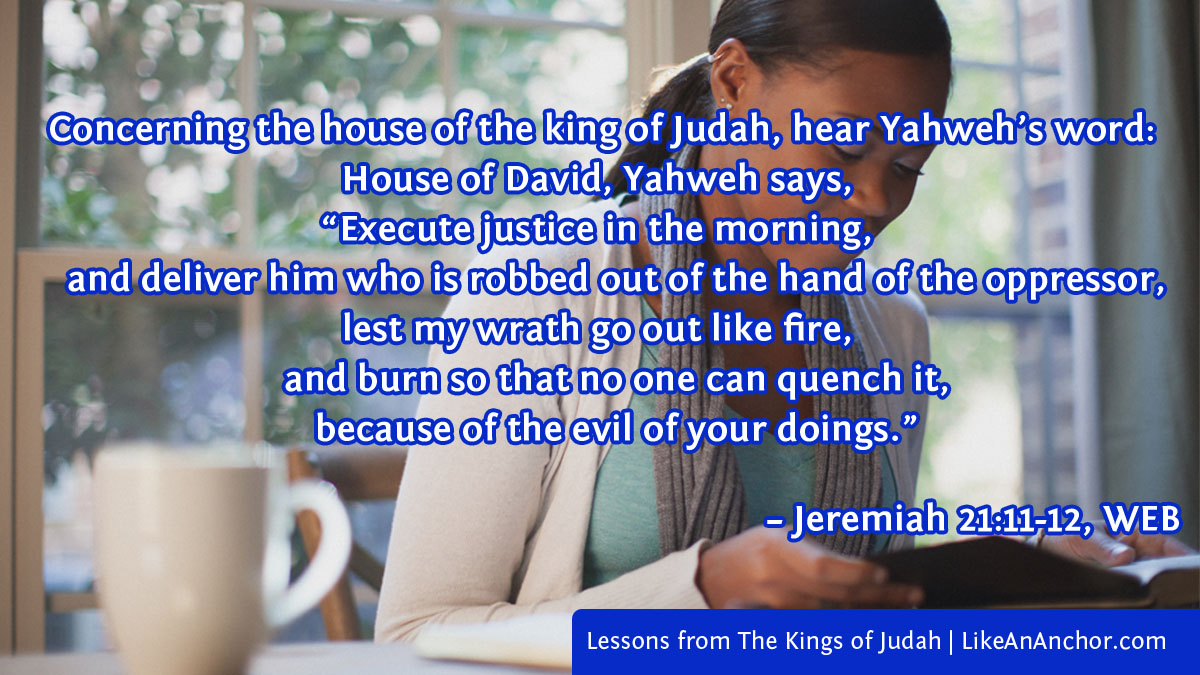
Image of a woman reading a Bible, overlaid with Jer. 21:11-12, WEB version: “Concerning the house of the king of Judah, hear Yahweh’s word: 12 House of David, Yahweh says,

‘Execute justice in the morning,
    and deliver him who is robbed out of the hand of the oppressor,
lest my wrath go out like fire,
    and burn so that no one can quench it,
    because of the evil of your doings.
Image by Pearl from Lightstock

Joash to Ahaz

Athaliah only ruled for six years before the people who’d rescued her one surviving grandson put him on the throne. This new child-king is called Joash or  Jehoash. He spent his childhood living in Yahweh’s temple, presumably raised by his uncle, Jehoiada the priest, and the aunt Jehoshabeath who’d saved his life (2 Chr. 22:11-12).

Jehoash was seven years old when he began to reign.

Jehoash … reigned forty years in Jerusalem. His mother’s name was Zibiah of Beersheba. Jehoash did that which was right in Yahweh’s eyes all his days in which Jehoiada the priest instructed him. However the high places were not taken away. The people still sacrificed and burned incense in the high places.

2 Kings 11:27-12:3, WEB

There’s an interesting qualifier here. Jehoash did what “was right in Yahweh’s eyes,” but only in the days when “Jehoiada the priest instructed him.” After that, things go terribly wrong. We learn the details about that by moving from 2 Kings to 2 Chronicles, where he’s called King Joash.

Now after the death of Jehoiada, the princes of Judah came, and bowed down to the king. Then the king listened to them. They abandoned the house of Yahweh, the God of their fathers, and served the Asherah poles and the idols …

The Spirit of God came on Zechariah the son of Jehoiada the priest; and he stood above the people, and said to them, “God says, ‘Why do you disobey Yahweh’s commandments, so that you can’t prosper? Because you have forsaken Yahweh, he has also forsaken you.’”

They conspired against him, and stoned him with stones at the commandment of the king in the court of Yahweh’s house. …

[Joash’s] own servants conspired against him for the blood of the sons of Jehoiada the priest, and killed him on his bed, and he died. They buried him in David’s city, but they didn’t bury him in the tombs of the kings.

2 Chronicles 24:17-18, 20-21, 25, WEB

Joash, who started out so well, wasn’t even buried with the kings of Judah. He’s one of the few kings whose childhood we know about; he was raised by a God-fearing uncle and most likely aunt as well. Then the moment the people influencing him change, Joash’s character changed as well. It’s a sobering lesson in being careful about those you trust as influences, as well as a lesson in having your own convictions and sticking to them. It makes you wonder how much of Joash’s flip-flopping between good and bad examples influenced the kings after him.

Amaziah was twenty-five years old when he began to reign, and he reigned twenty-nine years in Jerusalem. His mother’s name was Jehoaddan, of Jerusalem. He did that which was right in Yahweh’s eyes, but not with a perfect heart. Now when the kingdom was established to him, he killed his servants who had killed his father the king. But he didn’t put their children to death, but did according to that which is written in the law in the book of Moses …

Now from the time that Amaziah turned away from following Yahweh, they made a conspiracy against him in Jerusalem. He fled to Lachish, but they sent after him to Lachish, and killed him there. They brought him on horses, and buried him with his fathers in the City of Judah.

2 Chr. 25:1-4, 27-28 WEB

Amaziah did a little better than his father, but he didn’t say “perfect” with God. His son follows the same pattern once he brings ruling Judah. He starts out okay, but then he goes kind a crazy.

All the people of Judah took Uzziah, who was sixteen years old, and made him king in the place of his father Amaziah. … he reigned fifty-two years in Jerusalem. His mother’s name was Jechiliah, of Jerusalem. He did that which was right in Yahweh’s eyes, according to all that his father Amaziah had done. He set himself to seek God in the days of Zechariah, who had understanding in the vision of God; and as long as he sought Yahweh, God made him prosper. …

But when he was strong, his heart was lifted up, so that he did corruptly, and he trespassed against Yahweh his God; for he went into Yahweh’s temple to burn incense on the altar of incense. … He had a censer in his hand to burn incense, and while he was angry with the priests, the leprosy broke out on his forehead before the priests in Yahweh’s house, beside the altar of incense. … Uzziah the king was a leper to the day of his death, and lived in a separate house, being a leper; for he was cut off from Yahweh’s house. Jotham his son was over the king’s house, judging the people of the land.

2 Chr. 26: 1, 3-5, 16, 19, 21, WEB

Uzziah does not have other people to blame for influencing him in the wrong direction (though he does go off the right path after “the days of Zechariah,” so it seems he was better when he had a strong, positive influence in his life). He just let his success get the better of him, gave into pride, and thought he needed to act as a priest as well as a king. For his corruption, Uzziah becomes a leper and his son rules in his place (that’s why you’ll see them overlapping in a timeline of all the kings).

Jotham was twenty-five years old when he began to reign, and he reigned sixteen years in Jerusalem. His mother’s name was Jerushah the daughter of Zadok. He did that which was right in Yahweh’s eyes, according to all that his father Uzziah had done. However he didn’t enter into Yahweh’s temple. The people still acted corruptly. … Jotham became mighty, because he ordered his ways before Yahweh his God. … Jotham slept with his fathers, and they buried him in David’s city; and Ahaz his son reigned in his place.

Ahaz was twenty years old when he began to reign, and he reigned sixteen years in Jerusalem. He didn’t do that which was right in Yahweh’s eyes, like David his father, but he walked in the ways of the kings of Israel, and also made molten images for the Baals. Moreover he burned incense in the valley of the son of Hinnom, and burned his children in the fire, according to the abominations of the nations whom Yahweh cast out before the children of Israel. He sacrificed and burned incense in the high places, and on the hills, and under every green tree.

2 Chr. 27:1-2, 6, 9; 28:1-4, WEB

It seemed for a while that the kings were getting better. Uzziah was impious, but he didn’t forsake Yahweh like his father Amaziah. Then Jotham stayed with doing what “was right in Yahweh’s eyes,” even though the people he ruled over were corrupt. Then all of the sudden, his son Ahaz starts putting up idols and sacrificing children (a sin that so horrified God He hadn’t even imagined people should do it).

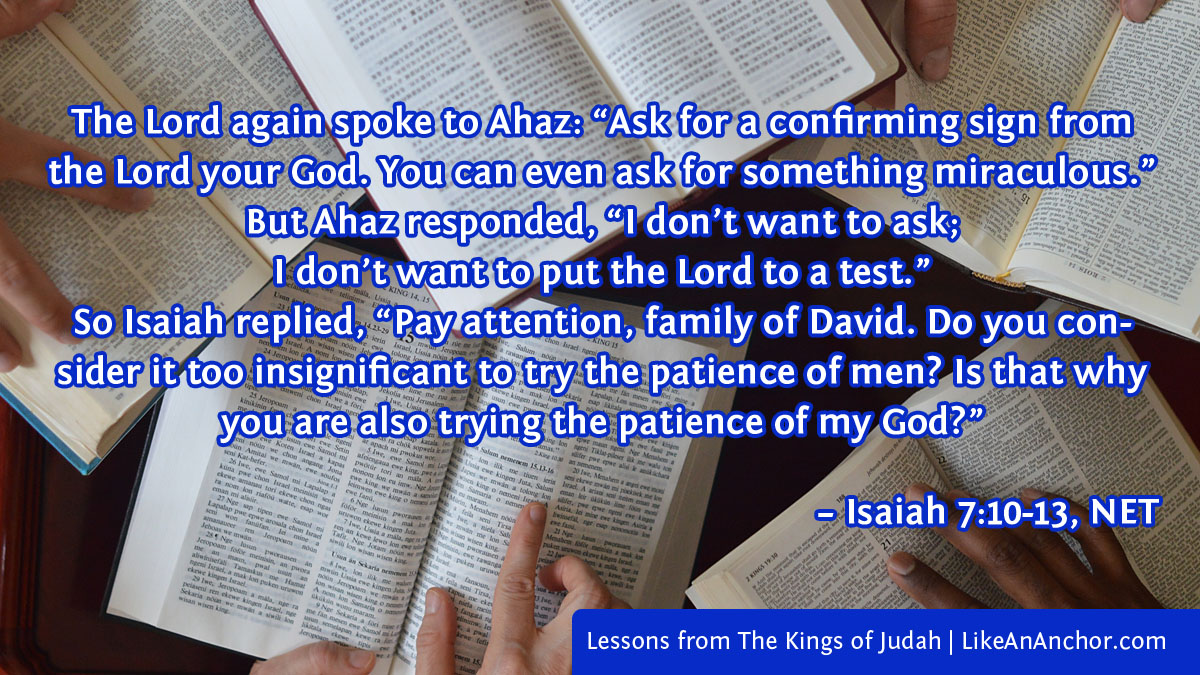
Image of five Bibles on a table with hands pointing to scriptures, overlaid with Isaiah 7:10:13, NET version: The Lord again spoke to Ahaz: “Ask for a confirming sign from the Lord your God. You can even ask for something miraculous.”
But Ahaz responded, “I don’t want to ask; 
I don’t want to put the Lord to a test.”
So Isaiah replied, “Pay attention, family of David. Do you consider it too insignificant to try the patience of men? Is that why you are also trying the patience of my God?”
Image by Inbetween from Lightstock

Hezekiah to Zedekiah

I told you this would be a long post 🙂 We’re now at one of the greatest kings of Judah, famous for his religious reforms and the detail the Bible gives us about events during his reign.

Hezekiah began to reign when he was twenty-five years old, and he reigned twenty-nine years in Jerusalem. His mother’s name was Abijah, the daughter of Zechariah. He did that which was right in Yahweh’s eyes, according to all that David his father had done. In the first year of his reign, in the first month, he opened the doors of Yahweh’s house, and repaired them. He brought in the priests and the Levites, and gathered them together into the wide place on the east, and said to them … “Now it is in my heart to make a covenant with Yahweh, the God of Israel, that his fierce anger may turn away from us.”

2 Chronicles 29:1-5, 10, WEB

We have a lot of details about Hezekiah’s reign; probably more than any other king besides David and Solomon (2 Kin. 18-20; 2 Chr. 29-32; Is. 36-39). None of those details tell us about his life before he was king, but by the age of 25 when he assumed the throne he was passionate about following God faithfully and he stayed that way until his death. He also surrounded himself with good influences, including the prophet Isaiah. Unfortunately, it seems he didn’t have much influence on his own 12-year-old son.

Manasseh was twelve years old when he began to reign, and he reigned fifty-five years in Jerusalem. He did that which was evil in Yahweh’s sight, after the abominations of the nations whom Yahweh cast out before the children of Israel. For he built again the high places which Hezekiah his father had broken down; and he raised up altars for the Baals, made Asheroth, and worshiped all the army of the sky, and served them. …  He also made his children to pass through the fire in the valley of the son of Hinnom. He practiced sorcery, divination, and witchcraft, and dealt with those who had familiar spirits and with wizards. He did much evil in Yahweh’s sight, to provoke him to anger. … Manasseh seduced the inhabitants of Jerusalem, so that they did more evil than did the nations whom Yahweh destroyed before the children of Israel. …

Therefore Yahweh brought on them the captains of the army of the king of Assyria, who took Manasseh in chains, bound him with fetters, and carried him to Babylon. When he was in distress, he begged Yahweh his God, and humbled himself greatly before the God of his fathers. He prayed to him; and he was entreated by him, and heard his supplication, and brought him again to Jerusalem into his kingdom. Then Manasseh knew that Yahweh was God.

2 Chronicles 33:1-3, 6, 9, 11-13, WEB

It’s a rollercoaster now. From one of the most righteous kings (Hezekiah), to a wicked child-sacrificing king who then did a 180° turn of repentance (Manasseh), to a brief yet very wicked king (Amon), then back to a righteous king (Josiah).

So Manasseh slept with his fathers, and they buried him in his own house; and Amon his son reigned in his place.

Amon was twenty-two years old when he began to reign; and he reigned two years in Jerusalem. He did that which was evil in Yahweh’s sight, as did Manasseh his father; and Amon sacrificed to all the engraved images which Manasseh his father had made, and served them. He didn’t humble himself before Yahweh, as Manasseh his father had humbled himself; but this same Amon trespassed more and more. His servants conspired against him, and put him to death in his own house. But the people of the land killed all those who had conspired against king Amon; and the people of the land made Josiah his son king in his place.

Josiah was eight years old when he began to reign, and he reigned thirty-one years in Jerusalem. He did that which was right in Yahweh’s eyes, and walked in the ways of David his father, and didn’t turn away to the right hand or to the left. For in the eighth year of his reign, while he was yet young, he began to seek after the God of David his father; and in the twelfth year he began to purge Judah and Jerusalem from the high places, the Asherah poles, the engraved images, and the molten images. …  All his days they didn’t depart from following Yahweh, the God of their fathers.

2 Chronicles 33:20-25; 34:1-3, 33 WEB

Josiah was the last really good king of Judah. Joahaz his son only reigned three months before he’s taken captive to Egypt and his evil brother Jehoiakim takes over. He reigned 11 years before being taken captive into Babylon. Jehoiachin his son reigned wickedly for just three months before the Babylonians took him as well and set up his brother Zedekiah. Zedekiah did evil, refused to “humble himself before Jeremiah the prophet speaking from Yahweh’s mouth,” rebelled against Babylon, and Jerusalem was destroyed (2 Chr. 36). Thus ends the reign of the Judean kings.

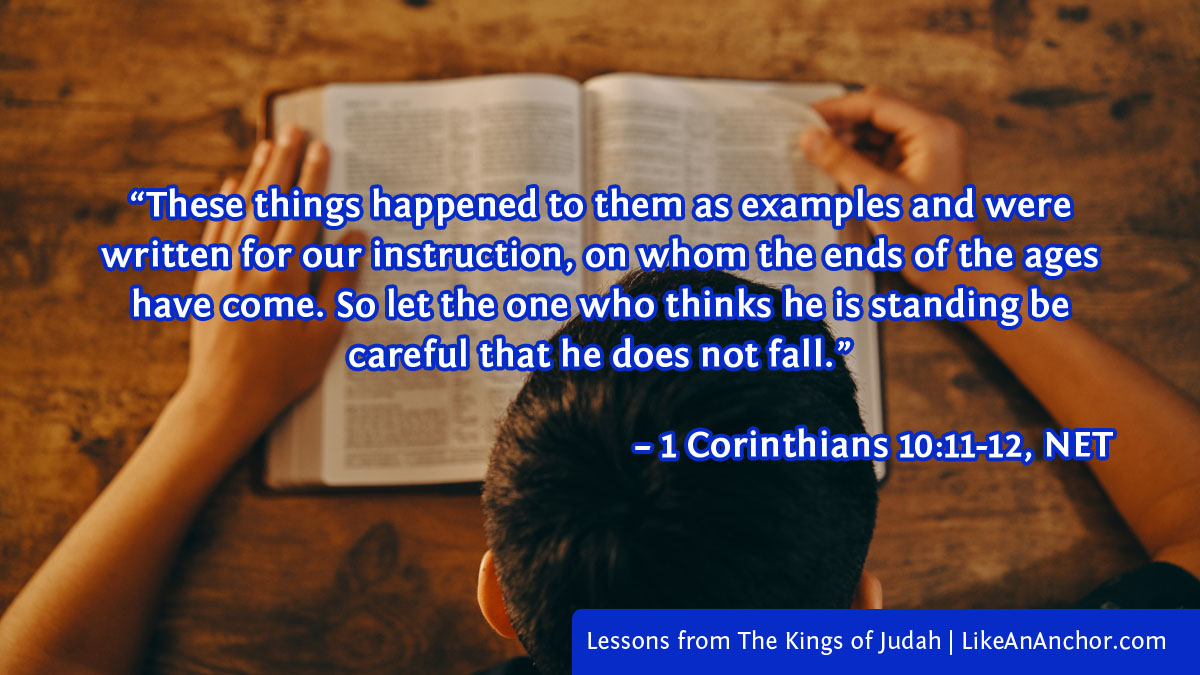
Image of a man reading a Bible overlaid with 1 Cor. 10:11-12, NET Version: “These things happened to them as examples and were written for our instruction, on whom the ends of the ages have come. So let the one who thinks he is standing be careful that he does not fall.”
Image by Matt Vasquez from Lightstock

Summary of Judah’s Kings

  • David—righteous with a perfect heart
  • Solomon—righteous, but not perfect with God in the end
  • Rehoboam—evil
    • Listened to bad advisors
  • Asa—righteous with a perfect heart
  • Jehoshaphat—righteous with a perfect heart
  • Jehoram—evil
  • Ahaziah—evil
    • Welcomed evil influences into his life
  • Athaliah—evil
  • Jehoash—righteous for a while, then turned wicked
    • Faithful only while he had good influences
  • Amaziah—righteous, but not perfect hearted
  • Uzziah—righteous at first, but disobeyed God later
    • Faithful only while he had good influences
  • Jotham—righteous
  • Ahaz—evil
  • Hezekiah—righteous with a perfect heart
    • surrounded himself with good influences
  • Manasseh—evil, but repented and changed
  • Amon—evil
  • Josiah—righteous
    • surrounded himself with good influences
  • Joahaz—evil
  • Jehoiakim—evil
  • Jehoiachin—evil
  • Zedekiah–evil

Lessons from the Kings

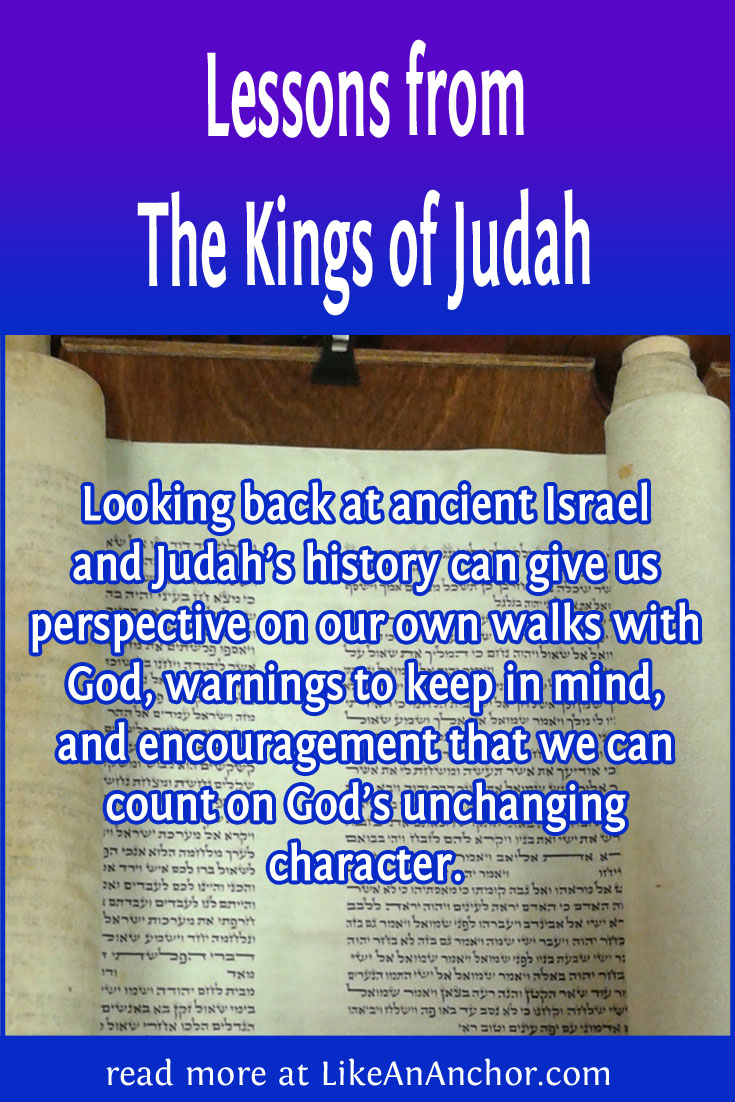
Image of a scroll written in Hebrew overlaid with the blog post's title and the words, "Looking back at ancient Israel and Judah’s history can give us perspective on our own walks with God, warnings to keep in mind, and encouragement that we can count on God’s unchanging character."

Alright, now that we’ve gone through a 3,000-word history lesson, what next? (I honestly didn’t intend for it to be that long; it just happened :lol:) One of the few patterns I did notice is probably obvious to you too based on how I’ve written about the kings–some of the really bad ones had evil influences, several that went from good to bad changed after a good influence died, and the good ones surrounded themselves with positive influences. It’s not all that shocking–we’ve all heard adages like “evil company corrupts good behavior.” We know the people around us influence how we live and act.

And yet, the influences don’t tell the whole story. Manasseh did some of the most horrible things any king of Judah ever tried, and yet he sincerely repented based not on the influence of another person but on a distress-prompted, character-redefining revelation that Yahweh is God. We see Asa, Jehoshapat, and Jotham all described as righteous with God and we’re not told anything about their influences. Some of the perfect-hearted kings came to power right after a father who was thoroughly wicked in God’s eyes, and some of the most evil kings rule right after seeing their righteous father lead the country.

It feels almost anti-climactic to go through that whole study and say it comes down to an individual issue of the heart. And yet, I also find this encouraging. The most famous kings are the ones that reformed all of Judah and brought the nation back into covenant with God, but Jehoshaphat and Jotham are still commended for doing what “was right in Yahweh’s eyes” even though they didn’t reform the entire country. Their individual faithfulness mattered a great deal to God, and it’s the same for us as well.

We also see real-life examples of the point God makes about himself in Ezekiel 18 and 33–He interacts with people according to the way their actions reveal their character. God says He delights when the wicked “return from his way, and live” (Ezk. 18:21, WEB), and we see that when He accepts Manasseh’s repentance even after he commits abominable sins like child sacrifice. God also says, “The righteousness of the righteous will not deliver him in the day of his disobedience” (Ezk. 33:12,WEB), and we see this as well when kings who started out doing well are labeled as unrighteous because they did not stay faithful to God all their lives.

Looking back at ancient Israel’s history can give us perspective on our own walks with God (1 Cor. 10:1-13). We learn from the examples of the past how to follow God with perfect hearts. We also see warnings about how not to live, and learn we need to avoid evil influences and take personal responsibility for obeying and following God. We can also take encouragement seeing that God’s character is unchanging–He still interacts with us in both righteousness and mercy.


Featured scroll images are photos taken by me.

Isaiah Study: The Lord’s Desire for Justice

Since starting a university master’s program two years ago, I’ve participated in several diversity trainings and class assignments that prompted us to evaluate our core values. One thing I realized is that while a buzz-word like “equity” just makes me feel tired since I’ve heard it so much, the idea of “justice” stirs a deep desire for things in the world to be right. I think many of us (perhaps even most of us) want fairness and justice. We feel there’s a way things should be, and we’re irritated when that isn’t the case. We hate injustice, especially if it’s directed at us but often if we see it happening to others as well.

In Mere Christianity, C.S. Lewis proposes that our sense of right and wrong is a clue pointing to God’s existence and revealing His nature. Even in our modern age of moral relativism, people still have some idea of how the world “should” be (though different groups often dramatically disagree about what that looks like). Many of us still have in mind “some kind of Law or Rule of fair play or decent behaviour or morality or whatever you like to call it” (Lewis) that hints at a larger ideal to strive toward. Lewis expands on this recognition of a need for justice when he talks about his time as an atheist.

My argument against God was that the universe seemed so cruel and unjust. But how had I got this idea of just and unjust? A man does not call a line crooked unless he has some idea of a straight line. What was I comparing this universe with when I called it unjust? If the whole show was bad and senseless from A to Z, so to speak, why did I, who was supposed to be part of the show, find myself in such violent reaction against it? …

Of course I could have given up my idea of justice by saying it was nothing but a private idea of my own. But if I did that, then my argument against God collapsed too— for the argument depended on saying that the world was really unjust, not simply that it did not happen to please my private fancies. Thus in the very act of trying to prove that God did not exist—in other words, that the whole of reality was senseless—I found I was forced to assume that one part of reality—namely my idea of justice—was full of sense

C.S. Lewis, Mere Christianity, Chapter 1

Lewis maintains that knowledge of justice points to the existence of a God who embodies justice, and the Bible supports that. Scripture reveals that God is deeply concerned with justice and that it’s one of His driving motivations. This shows up clearly in Isaiah 40-66, the passage of scripture we’ve been studying over the past couple months. These last 27 chapters of Isaiah record a message from God where He speaks candidly about His desires, motivations, and plans. If you go back and read the very first post, you’ll see I made a list of key themes from this section of scripture to study more extensively. One of those themes was that “God is motivated by justice.”

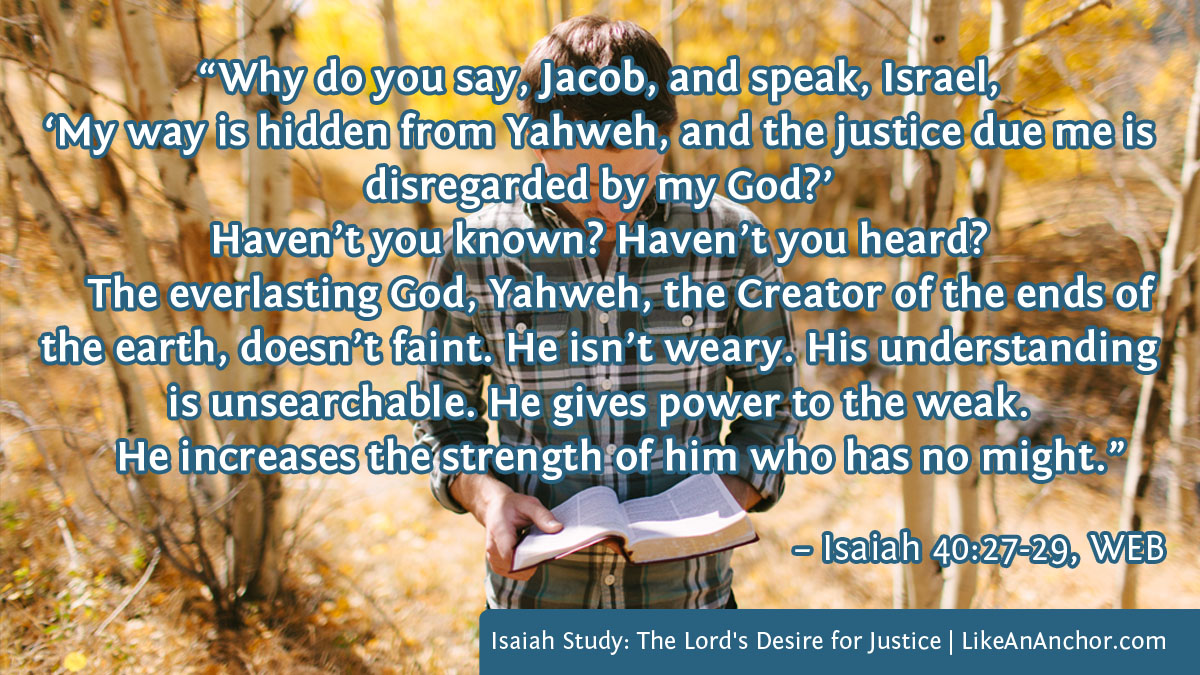
Image of an oasis in a desert overlaid with text from Isaiah 40:27-29, WEB: "“Why do you say, Jacob, and speak, Israel, ‘My way is hidden from Yahweh, and the justice due me is disregarded by my God?’ Haven’t you known? Haven’t you heard? The everlasting God, Yahweh, the Creator of the ends of the earth, doesn’t faint. He isn’t weary. His understanding is unsearchable. He gives power to the weak. He increases the strength of him who has no might.”
Image by HarveyMade from Lightstock

Justice, Righteousness, and Judgement

“Justice” is a complex word when we’re working with Hebrew to English translations. In the King James Version, “justice” appears 5 times in this section of Isaiah and it’s translated from tsedeq (H6664 and H6664); a word that WEB translates “righteousness.” In the WEB translation, “justice” is used 14 times and it’s translated from mishpat (H4941), which the KJV translates as “judgment.” So we have two Hebrew words here, and three different English translations. That’s not really surprising if you’ve compared Old Testament translations or studied Hebrew even a little bit. Hebrew has a smaller pool of available words than English, and relies on context and word pictures to paint pictures that we might use half a dozen English words to express.

When I’m trying to understand the nuances of a Hebrew word, I like to look it up in the Theological Wordbook of the Old Testament (TWOT). This resource says the root word for tsedeq “basically connotes conformity to an ethical or moral standard” (entry 1879). It has to do with justice and “rightness,” and it’s connected to righteously living in accordance with God’s law. It’s also closely connected with God. He is righteous and just, and so His commands are as well. The TWOT says there’s a “forensic” and legal aspect to tsedeq. When people break His commands, God is righteous to punish them for it. He is also righteous when He provides “salvation as vindication,” acting to clear our names in a legal sense.

Mishpat and its root shapat (TWOT entry 2443) are concerned with “the process of government.” While shapat is often translated “judge,” it really includes all the functions of a proper government–not just what we think of as the “judicial branch.” It’s also closely connected with a ruler; the law and the one giving the law aren’t separated the way we do today. God’s role as ruler, judge, and lawgiver are all connected. When we see mishpat translated “justice,” that’s the best word available in English to represent a concept with “at least thirteen related, but distinct, aspects of the central idea” related to judicial government, authority, and legislation (TWOT entry 2443c). In connection with God, justice involves “the just claims of God. God, who is Lord, can demand and He does demand” (Koehler, qtd. in TWOT). God wants things to be right in the world, and He’s the one who tells us what right, just, and correct looks like.

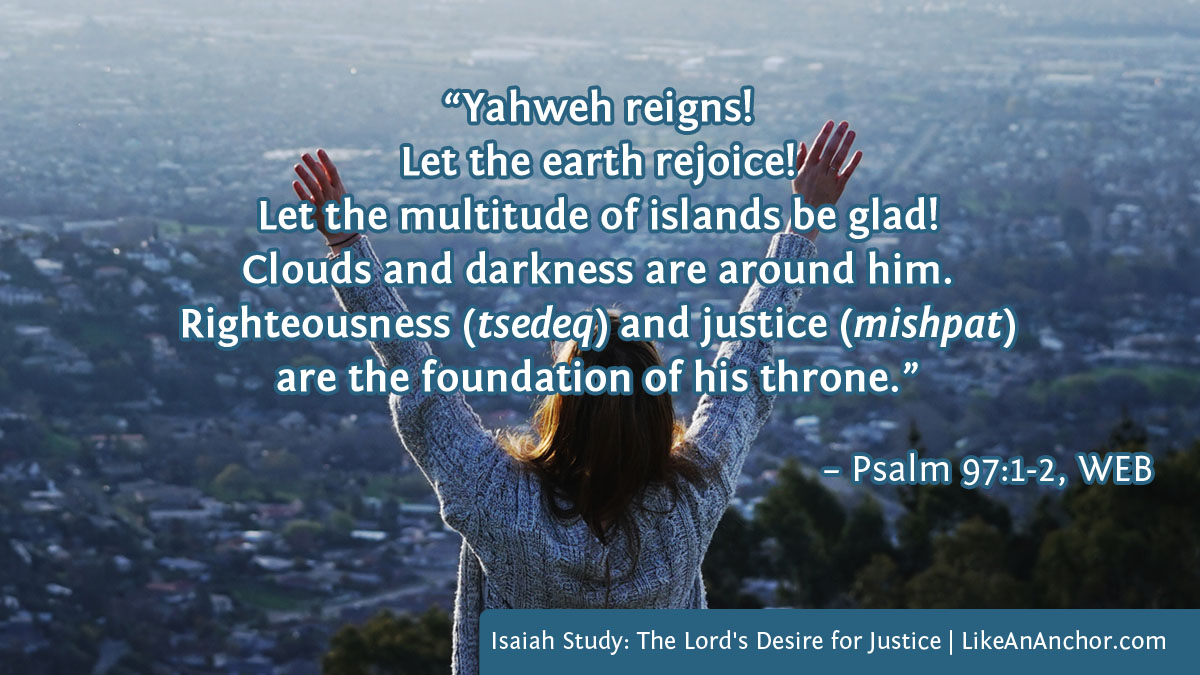
Image of a woman with her arms raised in worship overlaid with text from Psalm 987:1-2, WEB translation: "Yahweh reigns! Let the earth rejoice! Let the multitude of islands be glad! Clouds and darkness are around him. Righteousness (tsedeq) and justice (mishpat) are the foundation of his throne."
Image by Ruby-Rose from Lightstock

The Justice-Bringing Messiah

That was a long introduction, but it gives us a lot to think about in regards to justice. While justice does involve our ideas of fairness and what’s right, it’s also more than that. In the Bible, real justice is connected to God’s character, authority, and laws. It’s also a central concept in this section if Isaiah, and it underlies all the other topics we’ve discussed so far. “God is Incomparable and Irreplaceable,” and His justice is a key part of His character. There is “Joy in the Sabbath Covenant With God” in part because His sense of rightness involves rewards for acting justly and walking with Him. When we are “Looking Toward the Messiah,” we see that a big part of Jesus’s role in both His comings involves satisfying God’s justice. God’s activity in “Doing A New Thing” involves bringing justice to all the nations in the future. Finally, “The Contrast Between Righteousness and Wickedness” that God describes involves how each group does or does not align with His justice.

We can see how integral this idea of justice is from the very beginning of the message in Isaiah 40-66. This section of scripture opens with God saying that He has punished sins and now He will pardon them. It says God is a ruler brining reward and recompense to His kingdom. No one can compare to Him; other so-called rulers are nothing (Is. 40:1, 10-26). Even in the verses where mishpat and tsedeq aren’t used directly, we can clearly see themes of authority, law, righteousness, and justice. With those aspects of God’s character in mind, how can people possibly say, “My way is hidden from Yahweh, and the justice due me is disregarded by my God?” (Is. 40:27, WEB).

In reality, the “justice due” to us isn’t something we should want because “all have sinned” and “the compensation due sin is death.” However, “the gift of God is eternal life in Christ Jesus our Lord” (Rom. 3:23; 6:23, LEB). When we looked at the Servant Song prophecies a few weeks ago, we only briefly touched on the role of the Messiah in bringing justice but it’s an important part of Jesus’s mission. Just look at how many times justice is mentioned in this first Servant Song.

 “Behold, my servant, whom I uphold,
    my chosen, in whom my soul delights:
    I have put my Spirit on him.
    He will bring justice to the nations.
He will not shout,
    nor raise his voice,
    nor cause it to be heard in the street.
He won’t break a bruised reed.
    He won’t quench a dimly burning wick.
    He will faithfully bring justice.
He will not fail nor be discouraged,
    until he has set justice in the earth,
    and the islands wait for his law.”

Isaiah 42:1-4 WEB

This is one of the Servant Songs quoted in the New Testament; Matthew references it when showing his readers how Jesus’s actions on earth link back to prophecies from the Old Testament (Matt. 12:15-21). Jesus’s actions in healing and helping people demonstrated His commitment to justice. He also highlights justice as one of ” the weightier matters of the law” when talking with the Pharisees (Matt. 23:23).

Image of a woman studying her Bible overlaid with text from Matt. 12:17-18, 20, NET translation: This fulfilled what was spoken by the prophet Isaiah: “Here is my servant whom I have chosen, the one I love, in whom I take great delight. I will put my Spirit on him, and he will proclaim justice to the nations. ...
He will not break a bruised reed or 
extinguish a smoldering wick,
until he brings justice to victory.”
Image by Pearl from Lightstock

God’s Love for Justice

We see further evidence of God’s love for justice in another prophecy that’s sandwiched between the Servant Songs in Isaiah 50:4-11 and Isaiah 52:13– 53:12

“Listen to me, you who follow after righteousness,
    you who seek Yahweh. …

“Listen to me, my people;
    and hear me, my nation,
for a law will go out from me,
    and I will establish my justice for a light to the peoples.
My righteousness is near.
    My salvation has gone out,
    and my arms will judge the peoples. …
my salvation will be forever,
    and my righteousness will not be abolished.”

Isaiah 51:1, 4-6, WEB
Image of a woman's hand turning pages in a Bible with the blog's title text and the words "God’s desire for justice drives Him on to  accomplish 
salvation and share His righteousness with the world. "
Image by Delanie from Lightstock

Notice how close the connection is between justice, righteousness, salvation, and God’s law. God loves justice, as He says very clearly near the end of Isaiah: “For I, Yahweh, love justice” (Is. 61:8, WEB). When we love the God of Justice, we’ll also want to practice justice. Without justice, we don’t have a relationship with God.

Behold, Yahweh’s hand is not shortened, that it can’t save;
    nor his ear dull, that it can’t hear.
But your iniquities have separated you and your God,
    and your sins have hidden his face from you,
    so that he will not hear. …

They don’t know the way of peace;
    and there is no justice in their ways.
They have made crooked paths for themselves;
    whoever goes in them doesn’t know peace.
Therefore justice is far from us,
    and righteousness doesn’t overtake us.
We look for light, but see darkness;
    for brightness, but we walk in obscurity. …

Yahweh saw it,
    and it displeased him that there was no justice.
He saw that there was no man,
    and wondered that there was no intercessor.
Therefore his own arm brought salvation to him;
    and his righteousness sustained him.
He put on righteousness as a breastplate,
    and a helmet of salvation on his head.

Isaiah 59: 1-2, 8-9, 15-17, WEB

You might want to take some time and read all of Isiah 53 here; it’s got a lot to say about how upset God is when there’s no justice and how motivated He is to fix that problem. He wants the people He’s in a relationship with to “Maintain justice and do what is right” (Is. 56:1-2). He also wants His people to receive justice–to have Him as their good and righteous ruler acting with authority to make justice happen. His desire for justice drives Him on to accomplish salvation and share His righteousness with the world. We benefit every day from God’s desire for justice and His love of righteousness.

Featured image by Inbetween from Lightstock

Isaiah Study: The Contrast Between Righteousness and Wickedness

If you’ve been following this blog for the past month and a half, you know we’ve been studying Isaiah 40-66. After six weeks, you might think we’re starting to run out of material, but that’s not the case. I feel like we’re only about halfway through mining the rich treasure trove of the last 27 chapters of Isaiah. This section of the book is an extended dialog where God speaks about redemption and reconciliation, but that isn’t the only thing He talks about.

In the first post for this study, I made a list of key themes that I want to study more extensively in this section of scripture. The list included (among other things) a sharp contrast between prosperity for the righteous and no prosperity for the wicked. This is also connected to another theme that runs through this section of scripture: the importance of obedience. Since God’s nature and character are unchanging (Mal. 3:6; Heb. 13:8), we can conclude that He cares just as much about this topic today as He did thousands of years ago when He talked with Isaiah. Therefore, reading these words and figuring out what message He had for His people then can also help us learn what He wants to say to us today.

Outcomes for the Righteous and Wicked

In Isaiah 40-66, there are several passages showing a sharp contrast between two groups of people. On the one hand, you have the righteous people who listen to God, treat Him with respect, and follow His commandments. On the other hand you have the people who disregard God’s words, spurn Him and profane His ways, and disobey His commands. God discusses the outcomes of these two groups in clear-cut language.

This is what the Lord, your Protector, says,
the Holy One of Israel:
“I am the Lord your God,
who teaches you how to succeed,
who leads you in the way you should go.
If only you had obeyed my commandments,
prosperity would have flowed to you like a river,
deliverance would have come to you like the waves of the sea.” …

“There will be no prosperity for the wicked,” says the Lord.

Isaiah 48:17-18, 22, NET

I’m sure this message put Isaiah’s readers in mind of the blessings and cursing section of Deuteronomy. Near the end of that book, Moses reminded the people of Israel about the blessings God promised for faithfulness to His covenant and the curses that would come upon them if they disobeyed (Deut. 28-30). Isaiah’s original readers were in the position Moses talked about when he said, “When you have experienced all these things, both the blessings and the curses I have set before you, you will reflect upon them in all the nations where the Lord your God has banished you” (Deut. 30:1, NET). Now, the people of Isaiah’s day had an opportunity to turn back to God, receive deliverance, and inherit the prosperity that comes with obeying God’s commands.

The curses that God lays out in Deuteronomy and the statement in Isaiah that “There will be no prosperity for the wicked” are straightforward facts. It’s not a threat so much as it is a revelation about how the world designed by God works. If you do things that align with God’s righteous character, your life will turn out better than if you live wickedly. Sometimes, this rule is difficult for us to see evidence of. It often looks like people who disobey God have all the good things while righteous people are beset by trails.

We’re not the first people to wonder why there seems to be so much evidence contradicting this rule of “prosperity for the righteous/no prosperity for the wicked.” David, Asaph, and Jeremiah all said they saw evildoers prospering, and they wrested with how those observations might relate to God’s promises. All three concluded that the answer is found by looking at the end result of people’s lives (Pss. 37; 73; Jer. 12). No mater how prosperous the wicked seem, they often lead bitter and violent lives and–unless they repent and change (Ezek. 18)–they will be cut off from God in the end.

Similarly, David, Asaph, Jeremiah, and many other people throughout history wondered why righteous people struggle when God said they will prosper. Here again, we need to consider the end result. Even when following God, there will still be ups and downs in your life. Things might even seem downright terrible (just look what happened to some of the people in the faith chapter), but ultimately God works all things out for good in the lives of those He calls into His family (Rom. 8:28). Even during the midst of trials, the righteous can have peace that transcends outward circumstances. Interestingly, the word translated “prosperity” in Isaiah 48 is shalom, which is more typically translated “peace” and also means “wholeness.” The righteous get a sense of “wholeness” that comes from being in relationship with God. The wicked, having rejected God, do not.

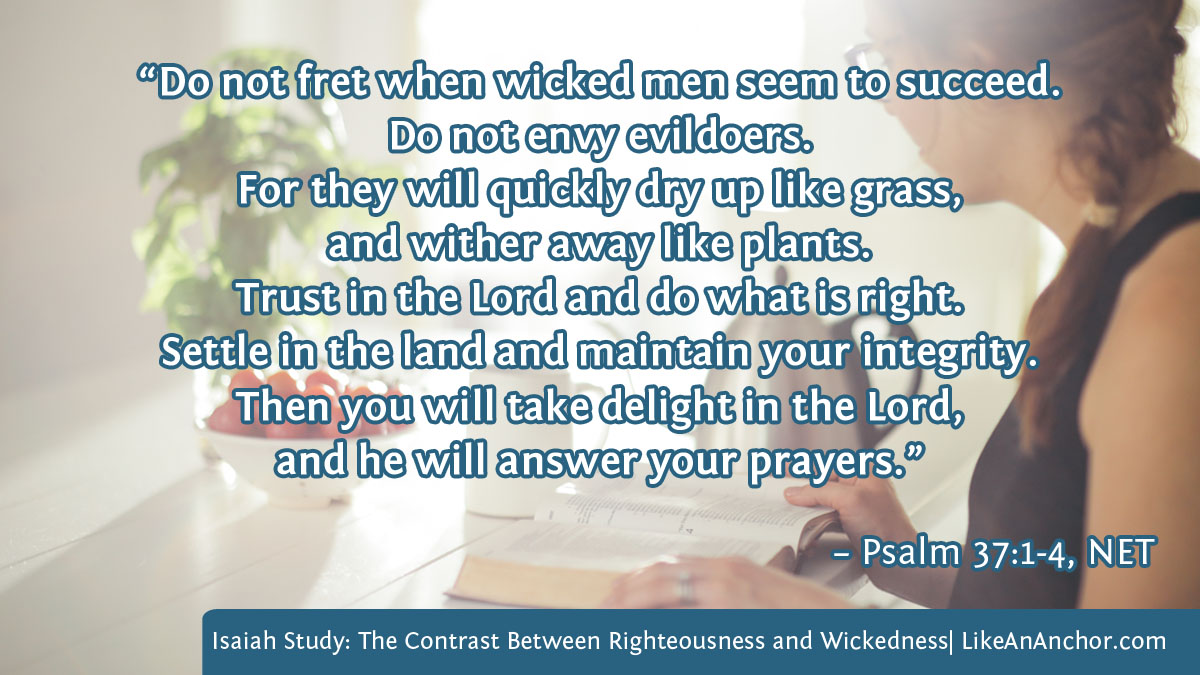
Image of a woman studying her Bible overlaid with text from Psalm 37:1-4, NET version: "“Do not fret when wicked men seem to succeed. Do not envy evildoers. For they will quickly dry up like grass,
and wither away like plants. Trust in the Lord and do what is right. Settle in the land and maintain your integrity. Then you will take delight in the Lord, and he will answer your prayers.”
Image by MarrCreative from Lightstock

The Importance of Obedience

God wants us to follow Him with genuine hearts–hearts on which the New Covenant is written. This covenant is not engraved on stone tablets like the kind Moses carried down from Mount Sinai, but on “tablets of human hearts” (2 Cor. 3:1-3; Heb. 8:7-10). Our hearts. And when our hearts are following God, that results in obedience from the inside-out. We’ll walk in His ways because we’re being transformed by His spirit. Just as in Isaiah’s day, God is looking for obedience that shows our hearts are in the right place.

This is what the Lord says,
“Promote justice! Do what is right!
For I am ready to deliver you;
I am ready to vindicate you openly.
The people who do this will be blessed,
the people who commit themselves to obedience,
who observe the Sabbath and do not defile it,
who refrain from doing anything that is wrong.”

Isaiah 56:1-2, NET

As we discussed in the post about Sabbath-keeping in Isaiah 40-66, we find an abundance of joy and blessings when we walk in covenant with God and do the things He commands. There’s a special relationship between God and the people who sincerely follow Him. Even though He loves everyone with a selfless, beneficent desire for their good, His familial/friendship love is reserved for those who commit to living in relationship with Him.

For the high and lofty One who inhabits eternity,
whose name is Holy, says:
“I dwell in the high and holy place, with him also who is of a contrite and humble spirit,
to revive the spirit of the humble,
and to revive the heart of the contrite.” …
“I create the fruit of the lips:
Peace, peace, to him who is far off and to him who is near,”
says Yahweh; “and I will heal them.”
But the wicked are like the troubled sea;
for it can’t rest and its waters cast up mire and mud.
“There is no peace,” says my God,
“for the wicked.”

Isaiah 57:15, 19-21, WEB

As in the verses we looked at earlier, God reveals a sharp contrast between the wicked and righteous. One prospers, one does not. One is full of peace, the other has none. Having peace/wholeness and experiencing blessings is a natural state for those who walk in relationship with God. Even if their circumstances aren’t great right now, they know things will work out for good in the end and their relationship with God can give them a supernatural peace.

In contrast, the wicked don’t enjoy the peace and prosperity that comes with being in relationship with God. They’re not necessarily stuck in that state, though. God is always eager for people to reconcile with Him and if they do, God promises, “None of his transgressions that he has committed will be remembered against him” (Ezek. 18:22, WEB). There’s always the opportunity for us to move from one category to the other (Ezek. 18; 33).

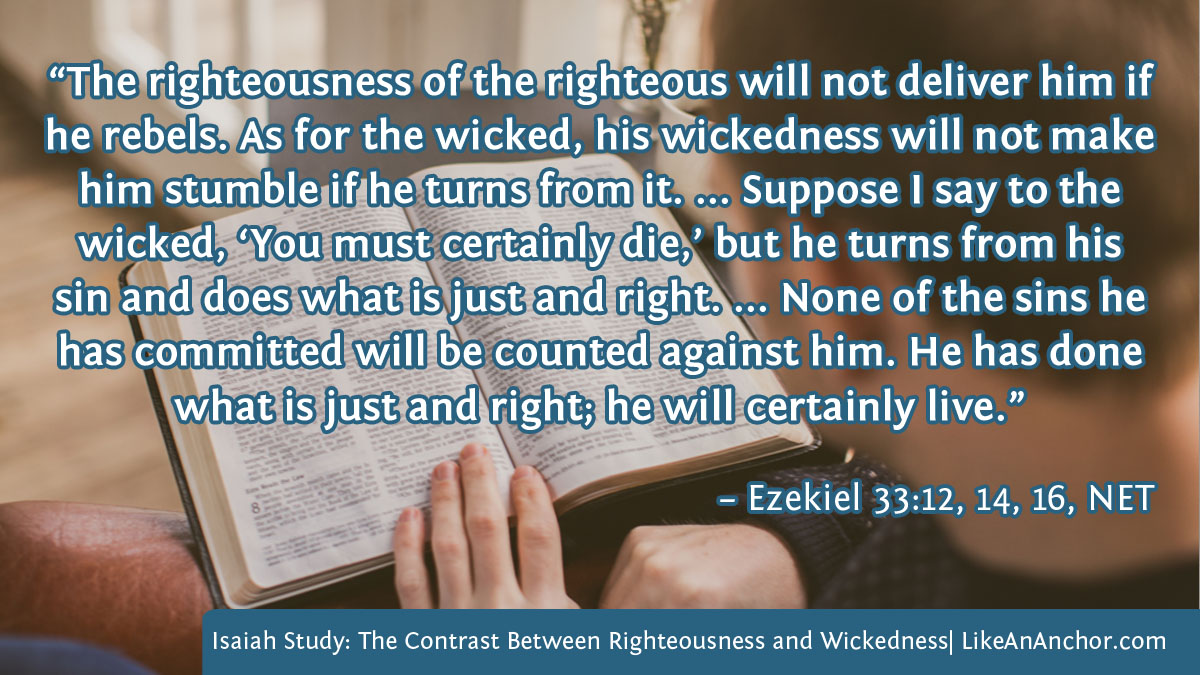
Image of a man studying his Bible overlaid with text from Ezekiel 33:12-16, NET version: “The righteousness of the righteous will not deliver him if he rebels. As for the wicked, his wickedness will not make him stumble if he turns from it. ... Suppose I say to the wicked, ‘You must certainly die,’ but he turns from his sin and does what is just and right. ... None of the sins he has committed will be counted against him. He has done what is just and right; he will certainly live.”
Image by Anggie from Lightstock

Hoping and Praying for Good Outcomes

The sharp contrast between long-term outcomes for the righteous and wicked might seem harsh. But as I mentioned before, what God lays out here and in other passages throughout the Bible is simply a revelation about how His world works. He designed and created the universe, and He has the “inside scoop” on how to live in a way that results in a good outcome. We can either listen to Him or reject His counsel. Either way, we’ll reap the consequences (good or bad) that He tells us about beforehand.

“But you who forsake Yahweh,
    who forget my holy mountain,
    who prepare a table for Fortune,
    and who fill up mixed wine to Destiny;
I will destine you to the sword,
    and you will all bow down to the slaughter;
because when I called, you didn’t answer.
    When I spoke, you didn’t listen;
but you did that which was evil in my eyes,
    and chose that in which I didn’t delight.”

Therefore the Lord Yahweh says,
    “Behold, my servants will eat,
    but you will be hungry;
behold, my servants will drink,
    but you will be thirsty.
Behold, my servants will rejoice,
    but you will be disappointed;
Behold, my servants will sing for joy of heart,
    but you will cry for sorrow of heart,
    and will wail for anguish of spirit.”

Isaiah 65:11-14, WEB
Image of a man praying with the blog's title text and the words " In Isaiah 40-66, God draws a sharp contrast between the outcomes for those who live righteous and wicked lives. One enjoys peace and prosperity, the other does not unless they repent and change."
Image by Shaun Menary from Lightstock

These aren’t the sort of feel-good, reassuring verses that we like to spend our time reading. If it just said, “My servants will eat, drink, rejoice, and sing for joy of heart,” then we might spend a lot more time reading Isaiah 65. But it also contains information about what will happen to those who forsake God, ignore His voice, and do things He calls evil. And those verses give us pause, as they should.

When we read these hard verses, it’s an opportunity to take a look at ourselves. If we see ourselves in any of those descriptions, then we can repent and recommit to following God with our whole hearts. He is always eager to hear sincere repentance and grant forgiveness. He also offers us help through His own indwelling Spirit, His words written in our hearts, and His energetic working inside us to accomplish salvation (John 14:16-7, 26; Phil. 2:12-13). We’re not left alone on this journey. Jesus and the Father work in us, and apply their righteousness to us (Jer. 23:6; 2 Cor. 5:21; 1 Pet. 2:24).

These verses might also make us think about others and grieve because we don’t want these terrible things to happen to anyone. That is also a godly response. God “desires all people to be saved and come to full knowledge of the truth” (1 Tim. 2:4, WEB). He is “not wishing that anyone should perish, but that all should come to repentance” (2 Peter 3:9, WEB). When we wish that people wouldn’t need to go through such terrible things, it’s a desire God shares. And even though we can’t make people come to God–He’s the one who opens eyes and draws hearts to Him (John 6:44; 14:6)–we can share our hope with people around us and pray for others to come to know God (1 Peter 3:15-16; 1 Tim 2:1-4).

We can also take comfort from scriptures like these in Isaiah. When we’re walking with God, we are among those blessed by His favor. These good, comforting, and encouraging words are for us. He teaches us how to succeed. He sends deliverance over us like ocean waves. He vindicates us, revives us, heals us, and gives us peace. He fills us with joy. There is a “day of vengeance of our God” proclaimed in this section of Isaiah, but it is also “the year of Yahweh’s favor,” filled with comfort, provision, and joy for the Lord’s people who faithfully follow Him (Is. 61).

Featured image by Inbetween from Lightstock

Song Recommendation: This Is The Year (Isaiah 61) by Deborah Kline-Iantorno & Vince Iantorno

“Who Is the One Who Will Condemn?”

Sometimes, I’ll come across something during Bible study that makes me sit up and think, “Oh! That’s what that means.”

I suspect this is one of the ways God keeps me humble; by reminding me that I haven’t figured anything out yet, even things that in hindsight seem obvious. It’s also one of the ways He keeps me interested in Bible study; I’m not very motivated to keep studying something after I’ve figured everything out, and thankfully that doesn’t happen when you’re studying scripture.

So, Romans 8:34 typically reads something like this: “Who is he who condemns? It is Christ who died, yes rather, who was raised from the dead, who is at the right hand of God, who also makes intercession for us” (WEB).

One thing I’ve learned studying Greek and French (the two languages other than English I’ve spent the most time with) is that sentence structures don’t always translate well from other languages into English. Word orders are different in many cases, and sometimes you need to add or rearrange things to get the same intention in English as there was in Greek. Figuring out how to do that is complicated by the passage of time. If we have a harder time guessing what Paul meant here because we can’t talk with him or anyone else who used this particular Greek; they all died centuries ago.

That’s a long, rambling introduction to saying that this particular sentence structure kinda makes it seem like Christ is the answer to the question, “Who is he who condemns?” We know from context that Paul is not saying Jesus condemns us; he’s saying the opposite. It still seems odd the way it’s setup in English, but I just read over it and didn’t really think about why it looks odd and if there might be a translation that would make more sense to me.

Image of a Bible laying on a deck in the sunset, with text from Romans 8:34-35, 38-39, NET version: “Who is the one who will condemn? Christ is the one who died (and more than that, he was raised), who is at the right hand of God, and who also is interceding for us. Who will separate us from the love of Christ? ... I am convinced that neither death, nor life, nor angels, nor heavenly rulers, nor things that are present, nor things to come, nor powers, nor height, nor depth, nor anything else in creation will be able to separate us from the love of God in Christ Jesus our Lord.”
Image by Lamppost Collective from Lightstock

Setting Up A Contrast

I started reading the NET Bible a few years ago, and I’m still finding translation choices that make me notice verses in a slightly new way. It’s one of the best translations I’ve found for balancing a desire to stay as close to the original languages as you can with transferring the sense of the original into English. I particularly like reading the New Testament in this translation. For Romans 8:34, the NET translators make it extra clear that Paul is setting up a contrast here rather than saying that Christ is the one who condemns.

What then shall we say about these things? If God is for us, who can be against us? Indeed, he who did not spare his own Son, but gave him up for us all—how will he not also, along with him, freely give us all things? Who will bring any charge against God’s elect? It is God who justifies. Who is the one who will condemn? Christ is the one who died (and more than that, he was raised), who is at the right hand of God, and who also is interceding for us.

Romans 8:31-34, NET

In other words, verse 34 continues the exact same pattern as the previous sentences. Do you think anyone can stand up against us or charge us with wrong doing? Don’t worry–God is for us and He’s the one who justifies His people. Do you worry about people who might condemn us? No need–Jesus Christ died for us and He’s interceding on our behalf with God, so we’ve got nothing to worry about. With Jesus mediating for us, not even the “the one called the devil and Satan … the accuser of our brothers and sisters” can condemn us (Rev. 12:9-10, NET).

Image of a woman looking up at the sky, with text from 1 John 3:19-22, NET version: "And by this we will know that we are of the truth and will convince our conscience in his presence, that if our conscience condemns us, that God is greater than our conscience and knows all things. Dear friends, if our conscience does not 
condemn us, we have confidence in the presence of God, and whatever we ask we receive from him, because we keep his commandments and do the things that are pleasing to him."
Image by Brightside Creative from Lightstock

No Condemnation

Paul addressed the topic of condemnation earlier in this same letter as well, just a page or so farther back in our Bibles. It’s part of a point he’s been building up to through the whole letter of Romans about how we relate to God’s law in the New Covenant.

There is therefore now no condemnation for those who are in Christ Jesus. For the law of the life-giving Spirit in Christ Jesus has set you free from the law of sin and death. For God achieved what the law could not do because it was weakened through the flesh. By sending his own Son in the likeness of sinful flesh and concerning sin, he condemned sin in the flesh, so that the righteous requirement of the law may be fulfilled in us, who do not walk according to the flesh but according to the Spirit.

Romans 8:1-4, NET

Paul is not contradicting Jesus’s statement that He did not “come to abolish the law or the prophets.” Rather, Paul is clarifying what Jesus meant when He said, “I have not come to abolish these things but to fulfill them. … whoever obeys them and teaches others to do so will be called great in the kingdom of heaven” (Matt. 5:17-20, NET). Jesus removes the condemnation that the Law placed on us as sinners by taking our sin away and paying the penalty for it Himself. Now, we’re free to keep God’s law by living in the Spirit, fulfilling the righteous requirements of the law as God’s grace covers our mistakes.

Image of a man reading a Bible, with text from Romans 5:17-18, NET version: "For if, by the transgression of the one man, death reigned through the one, how much more will those who receive the abundance of grace and of the gift of righteousness reign in life through the one, Jesus Christ!
Consequently, just as condemnation for all people came through one transgression, so too through the one righteous act came righteousness leading to life for all people.”
Image by Matt Vasquez from Lightstock

Salvation and Belief

There’s a delicate balance in how we understand God’s grace. I think we often error toward one extreme or another. On the one hand, we might make the mistake of thinking grace means we don’t have to obey God’s law and He’ll just give us salvation no matter what we do. On the other hand, we might stray too close to an idea of “salvation by works” and think our actions play a bigger role in salvation than they really do. The truth is something much more amazing.

Image of  a woman reading a Bible with the blog's title text and the words "We can live lives of righteousness with confidence, knowing all we need to do if we make a mistake is repent. There is no condemnation when we have Jesus interceding for us."
Image by Pearl from Lightstock

For this is the way God loved the world: He gave his one and only Son, so that everyone who believes in him will not perish but have eternal life. For God did not send his Son into the world to condemn the world, but that the world should be saved through him. The one who believes in him is not condemned. The one who does not believe has been condemned already, because he has not believed in the name of the one and only Son of God.

John 3:16-18, NET

God offers us salvation that we had nothing to do with; we cannot save ourselves. In return, He asks for life-changing belief. There’s a reciprocal aspect to grace. It’s part of a covenant agreement God offers us and if we accept this covenant we also accept our role as lovers of God who want to become like Him and follow His commands.

When we enter a relationship with God, we can trust that He is all-in with His commitment as well. He’s already demonstrated this in a spectacular way with Jesus dying for our sins. Moreover, He continues to demonstrate it today with Jesus acting as our mediator and advocate “who is at the right hand of God, and who also is interceding for us” (Rom. 8:34, NET). We can live lives of righteousness with confidence, knowing that if we make a mistake all we have to do is repent and ask forgiveness. There’s no condemnation for us when we have Jesus interceding for us.

Featured image by Aaron Kitzo from Lightstock

Song Recommendation: “Our God” by Chris Tomlin