Seeking God’s Righteousness

I’ve been reading a book called Reclaiming Our Forgotten Heritage by Curty Landry and one of his comments about what we’re supposed to “seek first” caught my eye. This book is about how understanding the Jewish roots of Christianity can transform your faith. It’s amazing to me how much we can miss when we read the Bible in English with a Western cultural mindset. And it’s equally amazing how much it can deepen our understanding of God and His ways to dive-in to the roots of our faith.

One of the things Landry talks about is how our interpretation of words and stories in the Bible can change based on whether we approach them through a Western philosophical lens or a first-century Jewish one. An example is how we see the word “righteousness” in Matthew 6:33.

When we read “seek first the kingdom of God and His righteousness,” we in the Western world tend to think this means we have to be righteous in the sense of being a “law-abiding citizen” of heaven. But a Jewish person listening to Jesus would have thought of the Hebrew concept of tzedakah, which changes how you interpret this verse. Let’s take a look at that.

Righteousness in Hebrew

Tzedakah is about justice, righteousness, and truthfulness (Brown, Driver, Briggs lexicon, entry H6666). It’s associated with God’s fairness and is also tied to acts of charity and giving. At my Messianic congregation, this word is written on the box where we put tithes and offerings because tzedakah is so closely connected with righteous giving.

In her article “God’s Kind of Righteousness,” Lois Tverberg points out that “tzedakah means more than just legal correctness – it refers to covenantal faithfulness, often resulting in rescuing those in distress and showing mercy to sinners.” It’s quite a bit different than what most of us think of when we think “righteousness,” but it’s very much in line with God’s character.

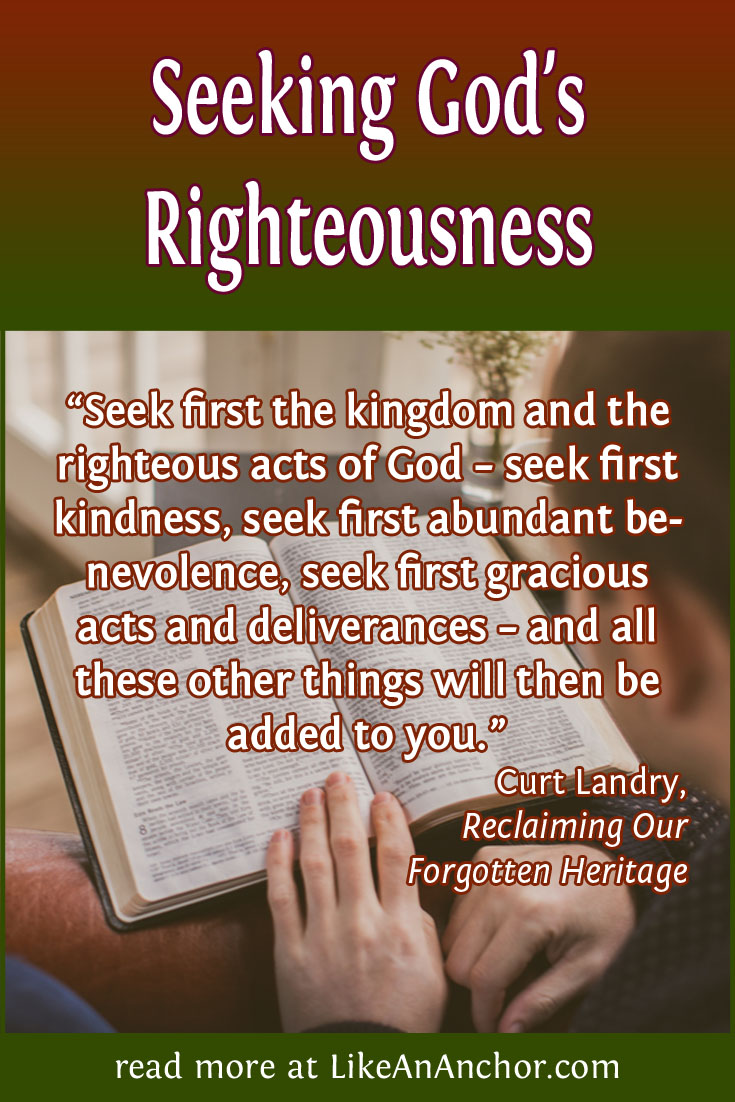
From this Jewish perspective, then, one would better read Matthew 6:33 in this way: “Seek first the kingdom and the righteous acts of God – seek first kindness, seek first abundant benevolence, seek first gracious acts and deliverances – and all these other things will then be added to you.” Read in this way, Matthew 6:33 requires a daily walk of faith that still challenges me to this day. (Landry, p. 134).

Seeking God's Righteousness | LikeAnAnchor.com
Photo credit: Pearl via Lightstock

Doing and Believing

It might not sit well with many American Christians that we need to do what is right in addition to believing what is right. Or, depending on exactly what you believe, it might be challenging to know that our obedience has to go beyond legal correctness. But as a deeper look into tzedakah demonstrates, true faith involves ongoing growth and change as we become more and more like God. Nothing we can do will save us — “by grace you have been saved through faith, and that not of yourselves; it is the gift of God” (Eph. 2:8, all scriptures from the WEB translation). But after we’re saved, we do take certain actions in accordance with God’s ways — “faith, if it has no works, is dead in itself” (James 2:17).

He has shown you, O man, what is good. What does Yahweh require of you, but to act justly, to love mercy, and to walk humbly with your God? (Micah 6:8)

Jesus called justice, mercy, and faith “the weightier matters of the law” (Matt. 23:23). These are things which must not be left undone by God’s people. And though righteousness isn’t on this list, it is closely associated with mercy and justice (see Ps. 33;5; 889:14; Is. 16:5; Hos. 2:19). We’re supposed to become like God and since righteousness is part of His character it should be part of ours as well.
Yahweh, Our Righteousness

Our God loves righteousness (Ps. 11:7; 33:5). He even reveals it as one of His names which He puts on His people — Yahweh Tsidqenu, the Lord our Righteousness (Jer. 23:6; 33:16). In the Matthew 6:33 verse we opened with, Jesus doesn’t say “seek to be righteous” or that we should seek righteousness in general. He’s very specific. We are to seek God’s righteousness.

Yahweh says, “Don’t let the wise man glory in his wisdom. Don’t let the mighty man glory in his might. Don’t let the rich man glory in his riches. But let him who glories glory in this, that he has understanding, and knows me, that I am Yahweh who exercises loving kindness, justice, and righteousness in the earth, for I delight in these things,” says Yahweh. (Jer. 9:23-24)

Knowing God involves understanding that He exercises and loves righteousness. If we want to be righteous as He is, we need to come to Him. He will reveal His righteousness when we follow His ways and keep seeking Him, as Jesus told us to in Matthew 6:33 (Is. 54:17; 56:1; 61:10).

Pursue His Righteousness
Seeking God's Righteousness | LikeAnAnchor.com
Photo credit: Anggie via Lightstock

Returning to the idea that righteousness involves more than just law-based obedience, Jesus taught “that unless your righteousness exceeds that of the scribes and Pharisees, there is no way you will enter into the Kingdom of Heaven” (Matt. 5:20). He said this during the same sermon where He told us, “seek first God’s Kingdom and his righteousness.” Seeking righteousness is a foundational part of our faith, and yet the most scrupulously obedient religious elite of Jesus’ day didn’t practice God’s righteousness in a way that pleased Him. There is more to it than simply following rules.

We aren’t saved based on how well we measure up to God’s just laws. Jesus Christ died for us “so grace might reign through righteousness to eternal life” (Rom. 5:21). As we talked about earlier, God’s type of righteousness has to do with His kindness and benevolence — righteous acts that spring from His righteous character. His righteousness toward us isn’t about legal justification based on us already being perfect, but rather about bringing us into a right state with Him and empowering us to follow His example of righteous doing (Rom. 3:21-31).

Through Christ, we have “become the righteousness of God” (2 Cor. 5:21). We’re to be “filled with the fruits of righteousness, which are through Jesus Christ, to the glory and praise of God” (Phil. 1:11). Righteousness isn’t just passively applied, though. We must “follow after righteousness” (1 Tim. 6:11; 2 Tim. 2:22) and seek God’s “instruction in righteousness” from scripture (2 Tim. 3:16; Heb. 5:13). To quote Curt Landry again, seeking first God’s kingdom and His righteousness “requires a daily walk of faith” that challenges each of us today.

Featured image credit: Pearl via Lightstock

Breastplate of Righteousness

When we’re going into spiritual warfare, we need spiritual armor. As we talked about in last week’s post on the Girdle of Truth, God is the one who gives us this armor. He doesn’t invite us to do battle and then leave us defenseless.

take up the full armor of God, in order that you may be able to resist in the evil day, and having done everything, to stand. Stand therefore, girding your waist with truth, and putting on the breastplate of righteousness. (Eph. 6:13-14, LEB)

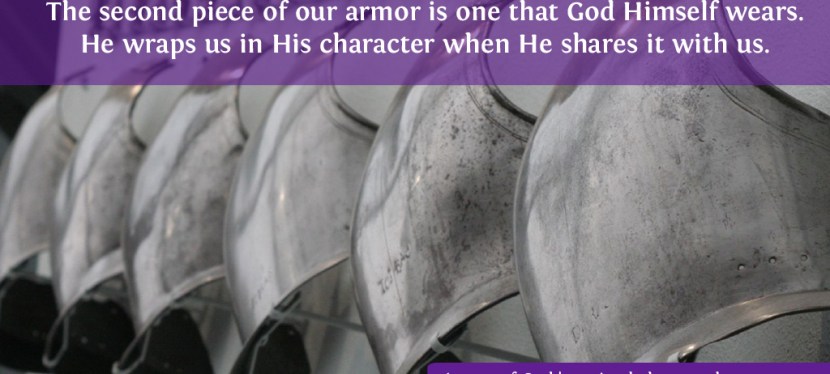
The second piece of our armor is a breastplate of righteousness. In a physical soldier’s armor, this is the part of the armor that protects the front and back of the torso. It’s keeping your spine, internal organs, and especially your heart and lungs safe.

Breastplate of Righteousness | marissabaker.wordpress.com
Photo credit: Thomas Quine, CC BY via Flickr

Keeping Your Heart

For us, righteousness serves much the same protective function. In a broad sense, the word dikaiosune (G1343) means being in a “condition acceptable to God.” It also refers to “the doctrine concerning the way in which man may attain a state approved by God” (Thayer’s Dictionary). Righteousness involves the condition of your heart and state of your character.

Oh that there were such a heart in them, that they would fear me, and keep all my commandments always, that it might be well with them, and with their children forever! (Deut. 5:29, WEB)

God has always been interested in wining His people’s hearts. That desire is at the core of Him asking us to follow Him in righteousness, which is why Jesus didn’t destroy the Law when He came. Rather, He revealed the full expression and intent behind God’s law — that we might develop His character and become like Him (Matt. 5:17-20, 48).

Armor God Wears

Speaking of becoming like God, the Breastplate of Righteousness is a piece of armor that He actually wears.

He put on righteousness as a breastplate, and a helmet of salvation on his head. He put on garments of vengeance for clothing, and was clad with zeal as a mantle. (Is. 59:17, WEB)

The breastplate we’re talking about isn’t just something God gives us to wear. It’s also something that He wears Himself. This is truly armor of God what He’s sharing with us. Read more

Should You Do What You Think Is Right?

“Always let your conscience be your guide.”

“Follow your heart.”

“Trust yourself.”

Those are the kinds of self-affirming advice we often hear. The basic argument is that most of us are pretty good people and if we listen really closely to our inner guiding light, then we’ll make good decisions.

But as Christians, we’re not supposed to do what’s right in our own minds. We’re supposed to do what God thinks is right. To some, this might just seem like a subtle shift in semantics. Of course what I think is right and God thinks is right are the same thing. Aren’t they?’

Not necessarily. While the holy spirit is transforming us to “have the mind of Christ,” we’re not all the way there yet. That’s one reason why it’s so important to spend time studying scripture — to make sure we know how God thinks and line-up with Him.Should You Do What You Think Is Right? | marissabaker.wordpress.com

What God Has To Say About Your Heart

When God made the choice to destroy everyone but Noah and his family in a flood, He did so after seeing “that every imagination of the thoughts of man’s heart was continually only evil” (Gen. 6:5, WEB). Even though we are made in God’s image, every single person has sinned and we’re corrupted by the fallen world we live in. And yet even in this state, human’s tend to trust that they know what’s right. But we’re often very wrong.

Yahweh says: Cursed is the man who trusts in man, and makes flesh his arm, and whose heart departs from Yahweh. … The heart is deceitful above all things, and it is exceedingly corrupt: who can know it? I, Yahweh, search the mind, I try the heart, even to give every man according to his ways, according to the fruit of his doings. (Jer. 17:5, 9-10, WEB)

Human being can’t trust their hearts. You might get some things right, but you can’t even really know yourself unless you ask God to share His perspective on you. But that verse in Jeremiah is addressed to the person who’s heart departs from the Lord. What about once you are in relationship with God and making Him the one your trust? What does that do to your heart? Read more

Are We Living A Performance Or Living For God?

I’d meant to just write one post about the Sermon on the Mount. Now here we are three weeks later with a third post on this study. And the first two only got through chapter five! I’m marveling at how much depth there is in such a familiar passage of scripture.

In the first part of this sermon, Jesus focuses on what God expects from those He’s in a relationship with. And it’s not always something that makes sense to human beings. The Beatitudes cover actions and character traits that don’t seem particularly positive from a human perspective, yet Jesus describes them as “blessed.” Then He starts talking about how law-keeping will change under the New Covenant. Walking in the spirit raises the bar higher, aiming for being like God rather than just living by the letter of His law. We end up keeping the law as we live in the spirit. And Jesus sticks with this theme of God’s expectations verses man’s ideas as He continues the sermon.

Are We Living A Performance Or Living For God? | marissabaker.wordpress.com
Photo credit: Ruby-Rose via Lightstock

Righteous Play-Acting

Jesus tells His hearers not to “do merciful deeds,” pray, or fast “as the hypocrites do” (Matt. 6:1-18, WEB). Those things are good — even essential — but they need to come from the right heart. The word hupokrites (G5273) means a stage actor or player who assumes a character’s role. So if you call someone who’s not on stage a hupokrites, you’re accusing them of playing a role in their lives. These people are living a performance, pretending to follow God while having other motives.

Hypocrites pretend to follow God so they can show-off to other people. But if we do that, Jesus warns “you have no reward from your Father who is in heaven” (Matt 6:1, WEB). The hypocrites do things for human praise and when they get it “they have received their reward” (Matt. 6:2, 5, 16, WEB). If your only motive is impressing people, then that’s all you’ll get out of your righteous play-acting. Read more

Keeping The Law On The Way To Eternity

If you’re a Christian, it’s a good bet you’ve read and/or heard the Sermon on the Mount more than once. And if you’re like me, you probably think you’re pretty familiar with this straight-forward message Jesus delivered during His time here on earth. But in a sermon a few weeks back, the speaker said something that prompted me to take a deeper look.

I hadn’t thought before about what a radical message this must have seemed when first preached. Matthew even tells us people who heard Jesus were “astonished at his doctrine” (Matt. 7:28, KJV). Throughout Jesus’ words, a message is woven that tells us our human way of looking at things is wrong. Something that makes no sense to us might be exactly what God is looking for, and the things we’d consider reasonable might not be what He wants at all. This sermon is about showing us a new way of thinking and living.

Questions Of Law

Following the Beatitudes (which we talked about last week), Jesus described people who follow Him as salt and light. All the attributes listed earlier are meant to be visible in His people, showing the world good works that will cause them to “glorify your Father who is in heaven” (Mat. 5:16, WEB). Jesus then made a statement about how His teachings relate to the Old Testament Law and Prophets. People often like to take Paul out of context and say Christians today have nothing to do with the Law, but that’s not what Jesus (or Paul, for that matter) taught.

Don’t think that I came to destroy the law or the prophets. I didn’t come to destroy, but to fulfill. For most certainly, I tell you, until heaven and earth pass away, not even one smallest letter or one tiny pen stroke shall in any way pass away from the law, until all things are accomplished.

Matthew 5:17-18, WEB

The Greek word translated “fulfill” here means to fill to the fullest extent (G4137, pleroo). In other words, Christ’s coming crammed the law full of its intended meaning. Thayer’s dictionary says the word means “to cause God’s will (as made known in the law) to be obeyed as it should be and God’s promises (given through the prophets) to receive fulfillment.”

Whoever, therefore, shall break one of these least commandments, and teach others to do so, shall be called least in the Kingdom of Heaven; but whoever shall do and teach them shall be called great in the Kingdom of Heaven. For I tell you that unless your righteousness exceeds that of the scribes and Pharisees, there is no way you will enter into the Kingdom of Heaven.

Matthew 5:19-20, WEB

Clearly, Jesus still intends His followers to keep the commandments. Not only that, He tells them they have to do it better than the most legalistic religious leaders of their day. How on earth were they supposed to do that? And how are we supposed to do that today?

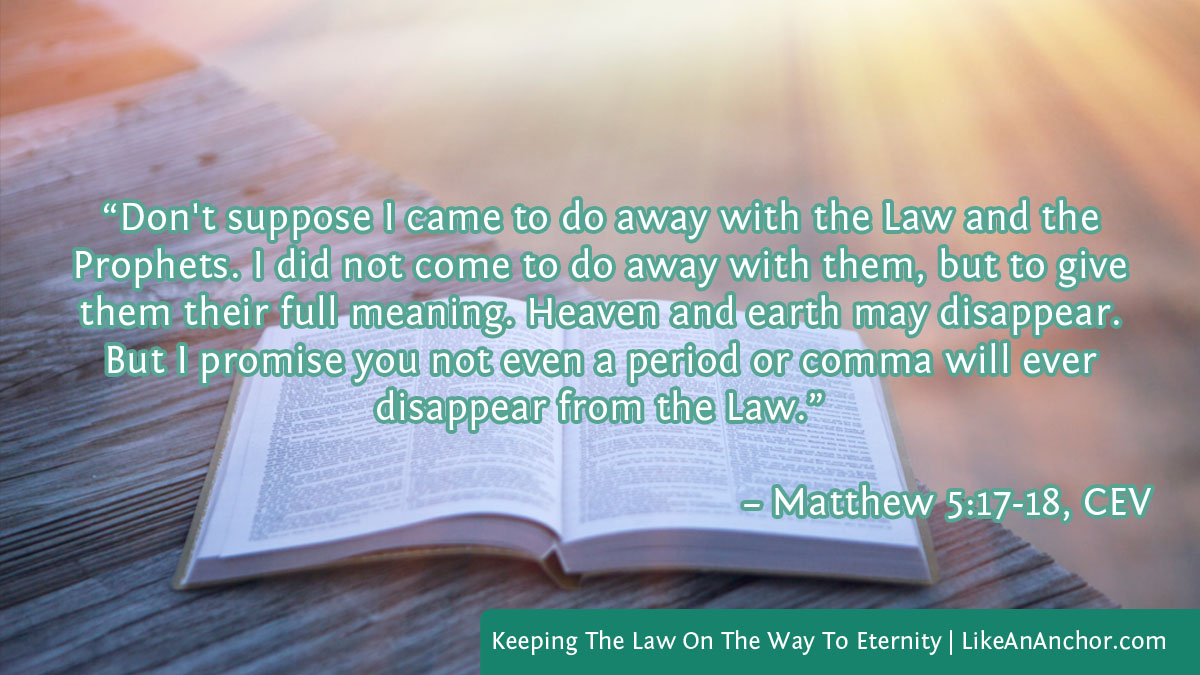
Image of an open Bible overlaid with text from Mat. 5:17-18, CEV version: “Don't suppose I came to do away with the Law and the Prophets. I did not come to do away with them, but to give them their full meaning. Heaven and earth may disappear. But I promise you not even a period or comma will ever disappear from the Law.”
Image by Lamppost Collective from Lightstock

Letter v. Spirit

Jesus explains how to keep the commandments in a fulfilled manner by contrasting the way things had been done with the way He wants them done. We might think of it as the letter of the law contrasted with God’s spirit and intent behind the law. Or better yet, we can say Jesus is clarifying God’s purpose for the Law. For example:

You have heard that it was said to the ancient ones, ‘You shall not murder;’ and ‘Whoever murders will be in danger of the judgment.’ But I tell you, that everyone who is angry with his brother without a cause will be in danger of the judgment; and whoever says to his brother, ‘Raca!’ will be in danger of the council; and whoever says, ‘You fool!’ will be in danger of the fire of Gehenna.

Matthew 5:21-22, WEB

It’s not enough to obey the law that says not to kill someone. Sin starts in the heart and that’s where God looks. He cares if you get to the point where you want to murder a person, not just if you actually violate the command “thou shalt not murder.” He even cares before you get to that point; if you’re unreasonably angry with someone or despise them as an empty headed fool, that’s enough to put you under judgement.

This pattern continued as Jesus kept teaching. Lusting after someone counts as adultery in your heart (Matt. 5:27-28). Divorce shouldn’t be done nearly so often (Matt. 5:31-32). Straightforward communication is better than swearing oaths (Matt. 5:33-37). We’re not to follow the human impulse to retaliate, even though it was allowed under the law (Matt. 5:38-42). We need to love our enemies if we want to be God’s children (Matt. 5:43-48). In many ways, God expects more of New Covenant believers, not less.

Going Beyond Law-Keeping

Image of a woman reading the Bible, overlaid with blog's title text and the words, "Christians obey God not because we're under bondage to the law, but because we're becoming like Him. Law-keeping is a side-effect of who we are."
Image by Pearl from Lightstock

Jesus’s expectations for His people go beyond the Law. The goals of living in the spirit reach higher than living by a strict code, though the spirit and letter both come from God and are connected. If we’re living in the spirit we are keeping the law on the way to becoming like God. Paul discussed this in Galatians, where he said, “walk by the Spirit, and you won’t fulfill the lust of the flesh” (Gal. 5:16, WEB).

Continuing in Galatians, Paul said, “if you are led by the Spirit, you are not under the law.” But right after saying that, he listed sinful things that spirit-led believers don’t do and says “those who practice such things will not inherit God’s Kingdom” (Gal. 5:18-21, WEB). He’s telling us that if we do things that break God’s laws, we won’t be in His kingdom even though the Law isn’t what saves us (Jesus does that).

We should keep the law because we’re walking in the spirit. It’s a side-effect of becoming like God. And so Christians today obey God, but they do it because they’re becoming like and following Him, not because they’re trying to make themselves righteous by their own power. It’s something we do on the way to eternity even though it’s not the method by which we get there.

Therefore you shall be perfect, just as your Father in heaven is perfect.

Matthew 5:48, WEB

Featured image by Matt Vasquez from Lightstock

Save

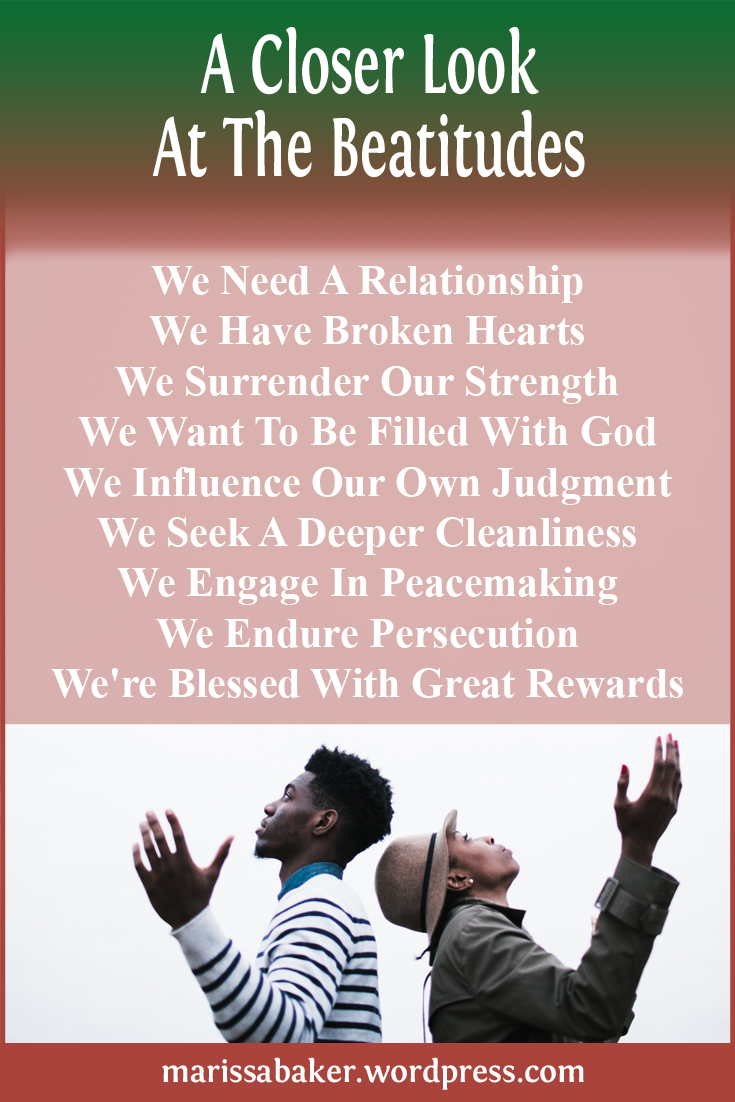
A Closer Look At The Beatitudes

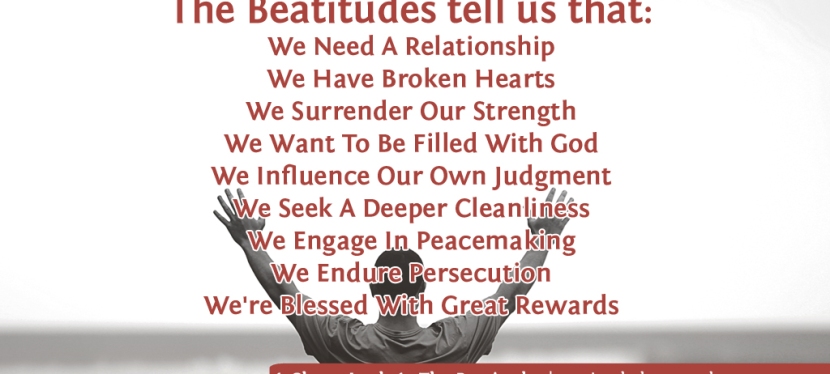
When Jesus delivered the Sermon on the Mount, He began at what we now call the Beatitudes. He says, “Blessed are” the sort of people who probably don’t feel all that blessed — those who are poor, mourning, meek, hungry and thirsty for righteousness, merciful, pure in heart, peacemakers, persecuted, and reviled. We don’t like being poor, or in grief, or humble enough to put others first, or attacked by the people around us. It’s hard work being a peacemaker, or showing mercy, or staying pure of heart, or constantly yearning to get closer to God’s righteousness.

It’s interesting that two of the beatitudes mention righteousness: “Blessed are they which do hunger and thirst after righteousness” and “Blessed are they which are persecuted for righteousness’ sake” (Matt. 5:6, 10, KJV). This word refers to “the condition acceptable to God” and/or “the doctrine concerning the way which man may attain a state of approval by God” (Thayer’s G1343, dikaiosune). It relates to our state of being and the way we live. In fact, when you think about it, all the beatitudes relate to something we do and/or become as we follow God.

A Closer Look At The Beatitudes | marissabaker.wordpress.com
Photo credit: Temi Coker via Lightstock

We Need A Relationship

Blessed are the poor in spirit: for theirs is the kingdom of heaven. (Matt. 5:3, KJV)

There’s more than one word that could be translated from Greek as “poor.” This one means “reduced to beggary” and “lacking anything” (Thayer’s G4434, ptochos). When we’re like that in our spirits, we’re really in a place to recognize how much we need a relationship with the Father and Jesus. We become the sort of person the Lord is talking about when He says, “to this man will I look, even to he who is poor and of a contrite spirit, and who trembles at my word” (Is. 66:2, WEB).

We Have Broken Hearts

Blessed are they that mourn: for they shall be comforted. (Matt. 5:4, KJV)

We all experience grief. The death of a parent, child, or dear friend. The loss of a hope held close to our hearts. The decay of a relationship. Betrayal from a friend. And even in the midst of that mourning, we’re blessed because God promises comfort (John 14:16-18; 2 Cor. 1:3-7). He can respond to our tears as powerfully as He did for David in the situation recorded in Psalm 6. Read more