Did you know that there are certain days in the Bible that God calls holy? One of these holy times happens every 7 days and we call it the weekly Sabbath. The other 7 holy days happen at set times in the spring, early summer, and fall.
If you’re reading this when it was posted, the fall holy days ended a couple weeks ago and the spring ones won’t start again for 6 months. This in-between time seems to me like the perfect opportunity for those of us who do keep the holy days to reflect on their meaning, along with how and why we keep them. And if you’ve never observed God’s holy days before, I hope you’ll find value in learning about them and maybe even join us in keeping them.
All the holy days are outlined in Leviticus 23, and then expounded on in other passages as well. In this chapter they’re all called “set feasts” (mo’ed) and “holy convocations (miqra). This identifies them as appointments that God has set at specific times for specific reasons. We talked about these Hebrew words, and others that describe God’s holy days, in last week’s post (click here to read it).
Sabbath
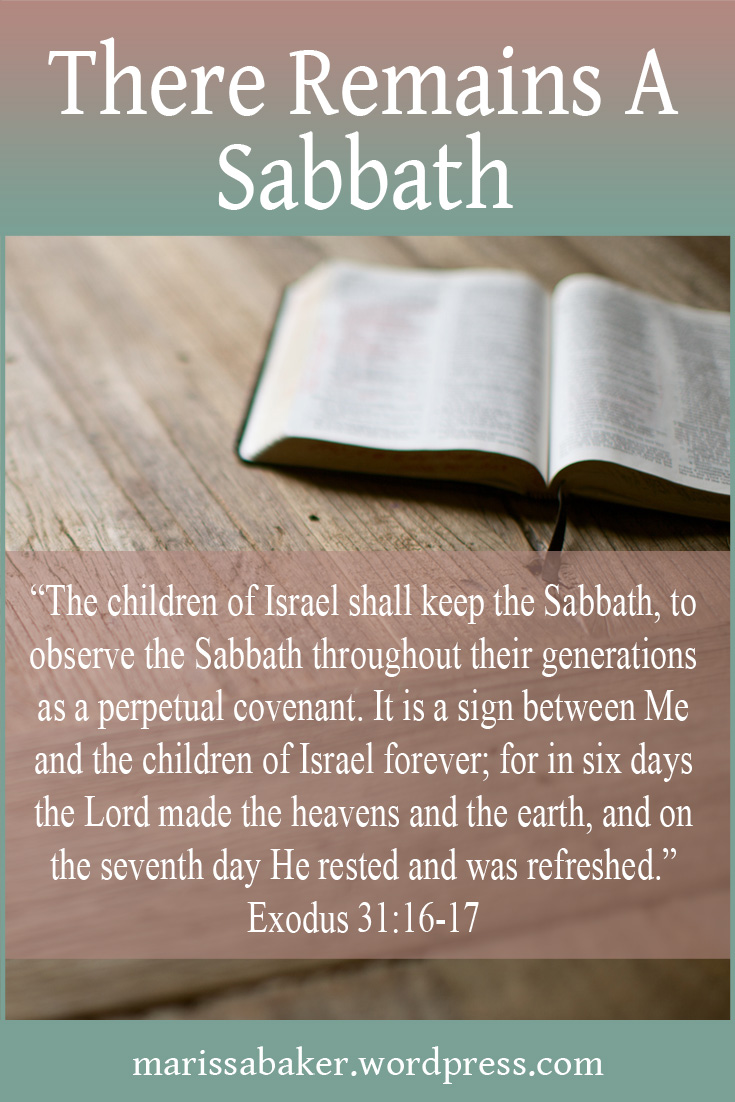
“The children of Israel shall keep the Sabbath, to observe the Sabbath throughout their generations, for a perpetual covenant. It is a sign between me and the children of Israel forever; for in six days Yahweh made heaven and earth, and on the seventh day he rested, and was refreshed.”
Exodus 31:16-7, WEB
As spiritual Israel (Rom. 9:6-8; Gal. 3:29; Eph. 2:12-13), this is part of God’s eternal law that is transferred to us (see post “Inheriting Covenants“). The author of Hebrews talks about this topic from 3:7 to 4:9 and concludes, “There remains therefore a Sabbath rest for the people of God.” The Greek word sabbatismos literally means “keeping Sabbath” (G4520, Thayer’s dictionary).
The Sabbath (which happens every week from sunset on Friday until sunset on Saturday) is a time when we stop doing work and other things that clutter our weeks and enter God’s rest. It’s a time to gather with other believers in God’s presence, to learn from Him, and take on His delights as our own. The Sabbath reminds us of His plan, purpose, and presence, and let’s us practice His rest.
Further study: “Delighting In The Sabbath” by Brian Shaw and Isaiah Study: Joy in the Sabbath Covenant With God
Passover
When the hour had come, he [Jesus] sat down with the twelve apostles. He said to them, “I have earnestly desired to eat this Passover with you before I suffer.”
Luke 22:14-15, WEB
The Passover (Pesach in Hebrew) observance was instituted in Exodus 12, and Israel was told they should keep it and the Feast of Unleavened Bread that followed “throughtout your generations by an ordinance forever” (Ex. 12:14, WEB). Jesus changed/added to (depending on your interpretation) the symbols associated with Passover, but still told his followers to continue keeping it “in remembrance of me” (Luke 22:19; 1 Cor. 11:23-26).
For New Covenant believers, Passover reminds us of God’s deliverance and Jesus’ sacrifice. Drinking the wine and eating the bread symbolize our commitment to and participation in the New Covenant. Passover also lets us “proclaim the Lord’s death until he comes” (1 Cor. 11:26, WEB). It is a way for us to keep in mind of, and remind others, that Jesus died for our sins and that He will return.
Further study: “Passover Questions: Am I Ready To Hear What God Says?” and “Why I’m Keeping Passover On Nisan 14“
Feast of Unleavened Bread
Purge out the old yeast, that you may be a new lump, even as you are unleavened. For indeed Christ, our Passover, has been sacrificed in our place. Therefore let us keep the feast, not with old yeast, neither with the yeast of malice and wickedness, but with the unleavened bread of sincerity and truth.
1 Corinthians 5:7-8, WEB
Beginning the day after the Passover, the Feast of Unleavened Bread (Chag HaMatzot) lasts for 7 days. The first and last days are both holy convocations and days when we do no work. For all 7 days, we eat nothing with leavening in it and we eat unleavened bread (Lev. 23:6-8; Ex. 23:15).
As we can see in this quote from Paul’s letter, the early New Testament church was still keeping this Feast. They were doing so in the spirit as well as the letter, recognizing that there’s a purpose behind the symbolism of putting leaven out and taking in unleavened things. These days are a yearly reminder to keep putting off sin and putting on Christ’s nature.
Further study: “Rhythms of Worship” and “Exodus To Corinthians: A Passover Message For The New Testament Church“
Feast of Weeks
Now when the day of Pentecost had come, they were all with one accord in one place.
Acts 2:1, WEB
On the Sunday after Passover, ancient Israel performed a ceremony called Firstfruits or Wavesheaf (Lev. 23:9-14). From that day, you count seven Sabbaths plus one day to get 50 days, then o-bserve the Feast of Weeks (better known today as Pentecost or, in Hebrew, Shavuʿoth).
Pentecost is a fascinating holy day. It’s connected with the story of Ruth and our role as firstfruits in God’s harvest. It’s the day Jesus and His Father gave the precious gift of their Holy Spirit to the church. It’s also the only single day called by the Hebrew word a chag (the other holy days designated “Feasts” are the 7-day long Unleavened Bread and Tabernacles). There’s a great deal of significance in this day, and it’s there for us today as well as for earlier believers.
Further study: “Firstfruits from the Rejects” and “The Bridegroom’s Pledge“
Day of Trumpets
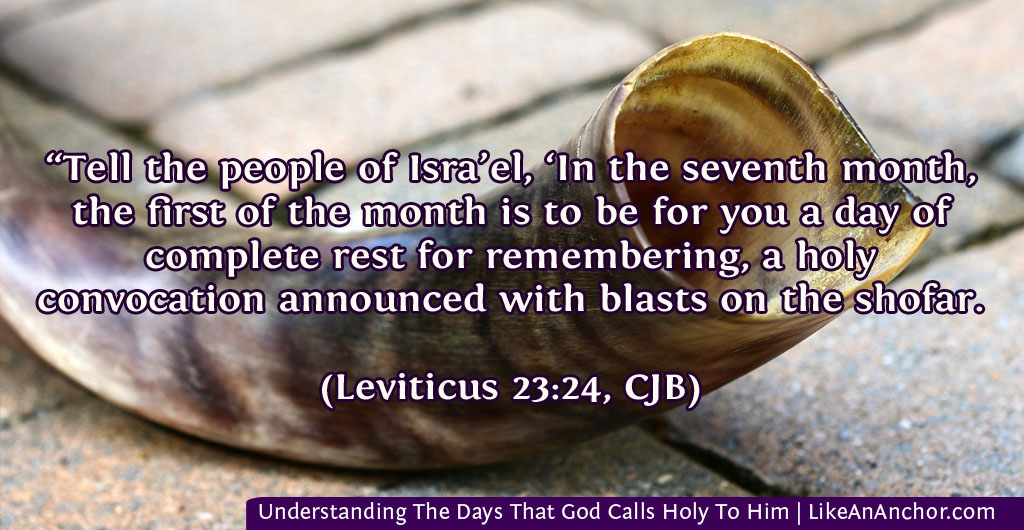
Speak to the children of Israel, saying, “In the seventh month, on the first day of the month, shall be a solemn rest to you, a memorial of blowing of trumpets, a holy convocation.”
Leviticus 23:24, WEB
There’s not nearly as much information in scripture about the Day of Trumpets/Shouting (Yom Teruah) as for the other holy days, but that doesn’t mean it’s any less important. Many believers (and I think rightly so) see it as the holy day which points to Christ’s return because of the connection with trumpet blasts (1 Thes. 4:16; Rev. 11:15). It’s one of the “shadows” speaking to us of Christ’s reality (Col. 2:16-17).
Further study: “Preparing For The Bridegroom To Come Back” and “With The Sound of Trumpets“
Day of Atonement
Yahweh spoke to Moses, saying, “On the tenth day of this seventh month is the day of atonement: it shall be a holy convocation to you, and you shall afflict yourselves; and you shall offer an offering made by fire to Yahweh. … It shall be a Sabbath of solemn rest for you, and you shall deny yourselves. In the ninth day of the month at evening, from evening to evening, you shall keep your Sabbath.”
Leviticus 23:26-27, 32, WEB
The Jews consider the Day of Atonement (Yom Kippur) as the most solemn and holy time of the year. It was the only day a human being could enter the Holy of Holies inside the temple, and even then only the high priest. There was also a ceremony of two goats — one killed for the sins of the people as a picture of Jesus Christ and the other banished as picture of what will happen to Satan (Lev. 16; Heb. 2:17; Rev. 20:1-3).
Today, Atonement reminds us of Christ’s sacrifice, looks forward to a time when Satan is removed from the picture, and invites us to think deeply about our High Priest Jesus Christ. It’s also the only specific day we’re commanded to fast, which in itself has a whole host of spiritual benefits. Exactly how to “fast” is debated, but most people I know (including me) believe it’s a fast of no food or drink for 24 hours. This holy day is briefly mentioned in the New Testament (Acts 27:9).
Further study: “Clean Temples For Yom Kippur” and “Fasting“
Feast of Tabernacles
And then every survivor from all those nations coming against Jerusalem will go up year after year to worship the king, Yahweh of hosts, and celebrate the Feast of Booths.
Zechariah 14:16, LEB
The Feast of Tabernacles or Booths (Sukkot) is a week-long feast with an 8th day, the Last Great Day, on the end (Lev. 23:33-36; 39-44). It was a Feast that Jesus kept (John 7:1-10; 37-39), and this prophecy in Zechariah shows it will still be celebrated in the future. It’s a time when we’re told to stay in temporary shelters. Most people I know celebrate this Feast by traveling to a “Feast site” hosted by a church group, staying in a hotel (a place we live temporarily) or camping in a tent (a temporarily set-up shelter), and attending daily church services.
This Feast is a season of great rejoicing, followed on the 8th day by a solemn observance called an atsarah (click here to go to last week’s post on Hebrew words associated with the holy days). Tabernacles reminds us that we’re strangers and pilgrims on this temporary earth, but that a time is coming when God will establish His kingdom here and all people will live in His peace.
Further study: “Tabernacles and Temples” and “Do You Value The Gifts From Your Bridegroom?“
Conclusion
This is a long post, but it’s just the briefest overview of the days God calls holy to Him. These days offer a weekly (in the Sabbath) and yearly (in the annual Feasts) rehearsal of God’s plan. He invites — and commands — us to keep these days with Him on His set appointed times because they matter.
“You shall keep my Sabbaths, and have reverence for my sanctuary. I am Yahweh.”
Leviticus 26:2, WEB
We keep His Sabbaths because He is Yahweh — the eternal Lord and the only true God. These days mean something to God, and therefore should mean something to His children. The Sabbaths and Feasts are appointments that God has set at specific times for His people to gather together for specific reasons. God places a high value on these days, calling them “holy” or set-apart for Him. As His children, we should value these days as well.
Free resource! Click here to download a chart summarizing these holy days, including the Hebrew words used for each, when and how they were observed, and New Covenant applications:
Featured image credit: tihanyitom via Pixabay

 Like An Anchor