Can We Lose Our Salvation?

The notion that we could lose our salvation is not a popular one among Christians. It is far more comfortable to believe that God will welcome us back with open arms no matter what we do. And yes, we do see that God rejoices over repentant sinners (Luke 15:4-7) and welcomes back prodigal children (Luke 15:11-32). We have all sinned and we’ve all been “justified freely by His grace through the redemption that is in Christ Jesus” (Rom. 3:24).

But where sin abounded, grace abounded much more, so that as sin reigned in death, even so grace might reign through righteousness to eternal life through Jesus Christ our Lord. What shall we say then? Shall we continue in sin that grace may abound? Certainly not! How shall we who died to sin live any longer in it? (Rom. 5:20-6:2)

Though we are not suddenly incapable of sin once we receive grace, the direction of our lives must be moving away from sin. God’s love covers a multitude of slips and stumbles on our walk with Him, but our hearts must change so we can learn to practice righteousness instead of sinfulness. We could talk about this in theory indefinitely, but let’s go to an example instead.

A Lost Kingdom

We all know about King David, the “man after God’s own heart” who was so faithful that God promised to establish his kingdom forever (1 Kings 9:5), even including him in the genealogy of Messiah (Matt. 1:1). David is an example to a man who sinned, sincerely repented, and received grace so he could continue to walk with God. He was even forgiven for what we think of as Really Big Sins, like committing adultery and then murdering the woman’s husband.

But before David, there was a king who did not measure up. Saul was offered the same promise made to David — that his kingdom would be established forever. He could have been in the line of Messiah. He could have been David, but he lost that opportunity.

And Samuel said to Saul, “You have done foolishly. You have not kept the commandment of the Lord your God, which He commanded you. For now the Lord would have established your kingdom over Israel forever. But now your kingdom shall not continue. The Lord has sought for Himself a man after His own heart, and the Lord has commanded him to be commander over His people, because you have not kept what the Lord commanded you.” (1 Sam. 13:13-14)

This happened after Saul’s first sin at Gilgal, when he stepped out of line by offering a sacrifice that could only be offered by a priest. On the surface, that doesn’t look as serious as David’s sins, but at it’s core there was a much bigger issue. Saul’s heart was not obedient, and he didn’t change. In fact, he just kept getting worse.

Can We Lose Our Salvation? | marissabaker.wordpress.comSaul’s second sin at Gilgal was also one of direct disobedience. He was ordered to “utterly destroy” Amalek, but he thought it would be a good idea to spare the king of Amalek’s life and save some of the best livestock. Compounding sin upon sin, Saul insisted that he had “performed the commandment of the Lord” (1 Sam. 15:13). When he was confronted about his disobedience, he kept back-peddling and blaming everyone but himself, insisting he was actually doing what was right because he intended to sacrifice the livestock to God. This is in stark contrast with David’s attitude after being confronted with his sins (2 Sam. 12:7-14; Ps. 51:1-19).

So Samuel said, “When you were little in your own eyes, were you not head of the tribes of Israel? And did not the Lord anoint you king over Israel? Now the Lord sent you on a mission, and said, ‘Go, and utterly destroy the sinners, the Amalekites, and fight against them until they are consumed.’ Why then did you not obey the voice of the Lord? Why did you swoop down on the spoil, and do evil in the sight of the Lord?”

So Samuel said: “Has the Lord as great delight in burnt offerings and sacrifices, as in obeying the voice of the Lord? Behold, to obey is better than sacrifice, and to heed than the fat of rams. For rebellion is as the sin of witchcraft, and stubbornness is as iniquity and idolatry. Because you have rejected the word of the Lord, He also has rejected you from being king.” (1 Sam. 15:17-23)

Saul was rejected because he thought he had a better idea for how to conduct himself than God did. He rejected the leadership of God, and so God said, “I greatly regret that I have set up Saul as king, for he has turned back from following Me, and has not performed My commandments” (1 Sam. 15:11).

Could that happen to us? could we do something that would make God “regret” choosing us? Are there things we read about in the Bible and rebel against, thinking we could come up with something better than what God commands? How about some of these (just as an example to give us something to think about):

“I Never Knew You”

Jesus told us that if we love Him, we will keep His commandments (John 14:15). The love comes first — what God is chiefly concerned with is having a relationship with us, like He had with David. But obedience is also essential, and that is something Saul lacked.

 Let us hold fast the confession of our hope without wavering, for He who promised is faithful. And let us consider one another in order to stir up love and good works, not forsaking the assembling of ourselves together, as is the manner of some, but exhorting one another, and so much the more as you see the Day approaching. (Heb. 10:23-25)

This is one reason why fellowship and friendship with other believers is so important. We help keep each other on-track and encourage each other to never give up. God gives us these people to help save us.

For if we sin willfully after we have received the knowledge of the truth, there no longer remains a sacrifice for sins, but a certain fearful expectation of judgment, and fiery indignation which will devour the adversaries. Anyone who has rejected Moses’ law dies without mercy on the testimony of two or three witnesses. Of how much worse punishment, do you suppose, will he be thought worthy who has trampled the Son of God underfoot, counted the blood of the covenant by which he was sanctified a common thing, and insulted the Spirit of grace? (Heb. 10:26-29)

Brethren, these are scary scriptures. It’s talking about turning our backs on and actually despising what God has offered us. This is doubly scary when we read Matthew 7:21-23, where Christ says that there will be people who thought they were being faithful but were really “practicing lawlessness.” To them, He will say, “I never knew you; depart from Me.”

Never Let Go

The good news is that this doesn’t have to happen. God is committed to pursuing a real, life-giving relationship with each one of us. He doesn’t just sit around twiddling His thumbs waiting for people to wander towards Him. He is constantly working to develop real relationships that save lives.

The Lord is not slack concerning His promise, as some count slackness, but is longsuffering toward us, not willing that any should perish but that all should come to repentance. (2 Pet. 3:9)

God gives us every opportunity to come to Him. We are precious in His sight, and He is pursuing our hearts in the greatest romance ever told (Is. 43:1-7). If we do lose our salvation, it will be because we turned away from Him and walked away, not because He gave up on us.

Therefore do not cast away your confidence, which has great reward. For you have need of endurance, so that after you have done the will of God, you may receive the promise: “For yet a little while, and He who is coming will come and will not tarry. Now the just shall live by faith; but if anyone draws back, My soul has no pleasure in him.” But we are not of those who draw back to perdition, but of those who believe to the saving of the soul. (Heb. 10:35-39)

Can We Lose Our Salvation? | marissabaker.wordpress.comThese are the verses which follow the warning in Hebrews about rejecting Christ’s sacrifice. It’s like the writer is telling us, “Look, you need to know how serious it is to turn away from God. Let that scare you — it should. Now that you know how bad it is to reject the Lord, don’t do it! We’re not that kind of people. We are the ones who can and will continue in the faith with God. Take courage, because the Creator of the whole universe is on your side and He wants you to succeed.”


Unchanging Laws

Tallitot (prayer shawls) by  Robert Couse-Baker, CC BY via Flickr
Tallitot (prayer shawls) by Robert Couse-Baker, CC BY via Flickr

Last week we started a study about whether or not the commands and instructions given to Biblical Israel apply to us as Christians today. I answered with a qualified “yes” — we are spiritual Israel, which is not so much separate from physical Israel as it was the next step in God’s plan for His chosen nation. Now, the question becomes, “How many of the laws given to Israel apply under the New Covenant?”

I’ve grown up believing that the Ten Commandments, including Sabbath keeping, carry over into the New Covenant, along with the Lev. 23 Holy Days and the clean and unclean meats laws. I still believe that, but now I’m starting to wonder why we keep those things and not others like the command to put tassels on our garments (Num. 15:37-41) or blow shofars on Holy Days (Ps. 81:3-4). When I ask this question, I’m usually told that not everything from the Old Covenant applies, and when I ask how they know which ones to keep they say, “It’s our tradition.” In my mind, that’s not a good enough answer, so it’s time for some Bible Study.

A New Priesthood

If you read through the laws of the Old Testament, you find quite a lot about the Levitical priesthood. Some of these are described as “a statute forever to their generations on behalf of the children of Israel” (Ex. 27:21), yet it is evident that Christ’s priesthood supersedes that system. If the switch to the New Covenant changed that, how much else was changed?

 For the priesthood being changed, of necessity there is also a change of the law. (Heb. 7:12)

But now He has obtained a more excellent ministry, inasmuch as He is also Mediator of a better covenant, which was established on better promises. (Heb. 8:6)

When it talks about a change of the law, I think we often imagine quite a disconnect between the Old and New Testament. We think of change as in something old being replaced by something completely new, but I think perhaps the change is more in how God’s laws apply.

For this is the covenant that I will make with the house of Israel after those days, says the Lord: I will put My laws in their mind and write them on their hearts; and I will be their God, and they shall be My people. (Heb. 8:10)

The Old Covenant was replaced with the New (Heb. 8:13), but God’s laws were not done away with. Even before the Old Covenant was instituted at Mount Sianai, God had laws in place. We can see this in Genesis 26:5, where God says, “Abraham obeyed My voice and kept My charge, My commandments, My statutes, and My laws.” Since God is unchanging, His standards for what He expects from us do not change either.

Jesus said, “till heaven and earth pass away, one jot or one tittle will by no means pass from the law till all is fulfilled” (Matt. 5:18) In the Greek, this means “filled to the fullest extent.” The laws were brought to a spiritual plane, much as physical Israel became spiritual Israel. You still keep the physical laws, but there is a spiritual aspect as well, and we are held accountable for what goes on inside us as much as for what we actually do (Matt. 5:17-30).

Updating The Law

The laws governing the Levitical priesthood are examples of parts of the Old Covenant that have already been filled to the fullest extent by Jesus Christ. We don’t have a physical priesthood any more because He is our High Priest forever. We don’t sacrifice animals any more because Christ’s sacrifice completely fulfilled all the Old Testament commands for blood sacrifices.

For Christ has not entered the holy places made with hands, which are copies of the true, but into heaven itself, now to appear in the presence of God for us; not that He should offer Himself often, as the high priest enters the Most Holy Place every year with blood of another — He then would have had to suffer often since the foundation of the world; but now, once at the end of the ages, He has appeared to put away sin by the sacrifice of Himself. (Heb. 9:24-26)

Without a physical priesthood or temple, many of the ceremonial laws no longer apply to spiritual Israel. Though we as the New Testament church can examine and learn from them and how they foreshadowed Christ’s role as priest and sacrifice, people in the church no longer serve as priests and we no longer sacrifice animals.

Similarly, there were civil laws given to govern the nation of Israel that are not in effect now because the church is scattered through other physical nations with their own laws. Many of the civil laws had a moral aspect, though, and this is updated for us to follow under the New Covenant. Take, for example, the law that said a man and woman who commit adultery must both be put to death (Lev. 20:10). The Pharisees brought Jesus just such a case, and Jesus told them, “He who is without sin among you, let him throw a stone at her first” (John 8:7). When all her accusers left, Jesus told the woman, “Neither do I condemn you; go and sin no more” (John 8:11).

Jesus didn’t say that she hadn’t committed a sin. He said that there was room for mercy and forgiveness even of sins that had formerly incurred a physical death penalty. For judicial matters, Christians are now under the laws of the countries we live in. For moral matters, God’s laws are applied to spirit and in truth with an emphasis on mercy. Is there a guy in your church shaking up with his step-mother? We don’t stone them as was the case in ancient Israel (Lev. 20:11), but we do make it clear that behavior like this is morally wrong and won’t be tolerated in the church (1 Cor. 5:1-13). If he repents, you have to welcome him back just like God welcomes us back into relationship with Him when we repent of our sins (2 Cor. 2:3-11).

"Shema Israel" by  Yaniv Ben-Arie, CC BY-SA, via Flickr
“Shema Israel” by Yaniv Ben-Arie, CC BY-SA, via Flickr

There are also aspects of the Old Testament laws that we are specifically commanded to continue observing. This includes the weekly Sabbath (Heb. 4:9) and Passover (Luke 22:19-20). We infer from these specific commands, and from the fact that Jesus and His disciples observed the other Holy Days, that all those days are still commanded observances. Even more obvious is the fact that we should be keeping the Ten Commandments, which are succinctly comprehended in the two greatest commandments.

Jesus answered him, “The first of all the commandments is: ‘Hear, O Israel, the Lord our God, the Lord is one. And you shall love the Lord your God with all your heart, with all your soul, with all your mind, and with all your strength.’ This is the first commandment. And the second, like it, is this: ‘You shall love your neighbor as yourself.’ There is no other commandment greater than these.” (Mark 12:29-31)

God’s focus is on our hearts, and whether or not we choose to keep His commandments tells Him what our hearts are like. Jesus said, “If you love Me, keep My commandments” (John 14:15). The implication is that if we don’t keep His commandments, we are telling Jesus we don’t love Him. If our hearts are right, obedience to God naturally follows.

My feelings on the question, “What is applicable under the New Testament?” is that everything God didn’t specifically replace/update to a spiritual level (the priest hood, physical temples, civil laws) are probably still in effect. It’s up to us to seek out the spiritual reasons for these commands and find a way to physically keep them. There are still some I’m not sure about — like those tassels on the borders of our garments or what we’re supposed to do on New Moons — but I want to keep searching and learning. I want to worship God the way He tells me to, not the way I think sounds like a good idea.

The Scarlet Letter

I’ve never been a big fan of classic American literature (unless it was written by Mark Twain). I don’t really have fond memories of any of the American lit I had to read in high school fondly, and in college the only ones I remember enjoying were Puddin’ Head Wilson by Mark Twain, The Great Gatsby by F. Scott Fitzgerald, and House Behind the Cedars by Charles Chestnut (and they still didn’t intrigue me like the British literature).

So when I agreed to teach my homeschooled younger brother’s high school literature class, I had quite a bit of extra reading to do in preparation for American lit this year. This is the main reason there’s a collection of Edgar Allen Poe on my Classics Club Book list, and why I’m re-reading Tom Sawyer. I also added a few other works by American authors, just because I felt like I “should” read them.

Reading The Scarlet Letter

Case in point: Nathaniel Hawthorn’s The Scarlet Letter. This is one of the books that I didn’t read in high school because my mother hated that she was made to read it (this is the same reason I didn’t read any of Shakespeare’s tragedies until college). Certainly can’t fault her for that, since it doesn’t look like this book’s going to fit in my American literature course either (also, I’m just rebellious enough to feel like I don’t have to teach all the “inevitable” high school texts). I’m glad I finally read it, though, if for no other reason than to enjoy passages like this:

Amongst any other population, or at a later period in the history of New England, the grim rigidity that petrified the bearded physiognomies of these good people would have augured some awful business in hand. It could have betokened nothing short of the anticipated execution of some noted culprit, on whom the sentence of a legal tribunal had but confirmed the verdict of public sentiment. But, in that early severity of the Puritan character, an inference of this kind could not so indubitably be drawn.

Bearded physiognomies augur awful business — don’t they sound like the kind of people you’d want for your next-door neighbors?

Or how about this lovely description of the women, also from Chapter 2 where the town is assembled outside the jail awaiting Hester Prynne’s public disgrace for committing adultery:

Lillian Gish as Hester Prynne in The Scarlet Letter (1926)

It was a circumstance to be noted, on the summer morning when our story begins its course, that the women, of whom there were several in the crowd, appeared to take a peculiar interest in whatever penal infliction might be expected to ensue. The age had not so much refinement, that any sense of impropriety restrained the wearers of petticoat and farthingale from stepping forth into the public ways, and wedging their not unsubstantial persons, if occasion were, into the throng nearest to the scaffold at an execution. Morally, as well as materially, there was a coarser fibre in those wives and maidens of old English birth and breeding, than in their fair descendants, separated from them by a series of six or seven generations; for, throughout that chain of ancestry, every successive mother had transmitted to her child a fainter bloom, a more delicate and briefer beauty, and a slighter physical frame, if not a character of less force and solidity, than her own. The women, who were now standing about the prison-door, stood within less than half a century of the period when the man-like Elizabeth had been the not altogether unsuitable representative of the sex. They were her countrywomen; and the beef and ale of their native land, with a moral diet not a whit more refined, entered largely into their composition. The bright morning sun, therefore, shone on broad shoulders and well-developed busts, and on round and ruddy cheeks, that had ripened in the far-off island, and had hardly yet grown paler or thinner in the atmosphere of New England. There was, moreover, a boldness and rotundity of speech among these matrons, as most of them seemed to be, that would startle us at the present day, whether in respect to its purport or its volume of tone.

Isn’t this a flattering portrayal? (in case you were wondering, this is the best passage to read aloud to your younger siblings). In all seriousness, I did enjoy the way Hawthorne uses the English language. His humor is subtle, and so dry it’s almost impossible to laugh-out-loud, but it is in there if you’re paying enough attention not to over look it. In most of his character descriptions, like these women outside the jail, I get the impression of him raising is eyebrow and looking down his nose as he tells you about these poor “primitives.”

“A” is for Adultery

While a tight plot, command of language, and good writing are all things I look for in a novel, what always stands out most are the characters. Perhaps the most interesting character in this novel is Hester’s precocious little daughter, Pearl, whose keen intelligence and disregard for conventional behavior more than once leave Hester suspecting the child’s nature is part of her punishment for committing adultery. Just like she stands out in the town because Hester dresses her in bright colors (including scarlet, since Pearl is the embodiment of Hester’s scarlet letter), so she stands out as a bright spot in a novel that can otherwise be rather grim.

Speaking of Hester’s crime, I’ve heard Christian homeschoolers suggest that we shouldn’t teach books like The Scarlet Letter or The Great Gatsby since they deal with the concept of adultery. You can’t fault these books for “inappropriate scenes” (well, perhaps Gatsby depending on what age your teaching, but I think it’s age-appropriate by high school). It’s the subject matter in general which people find objectionable. But ignoring the fact that people sin certainly doesn’t make sin go away, and books like The Scarlet Letter force us to think about a subject like adultery and how we respond to that. There’s no question in the minds of Hester Prynne and Rev. Arthur Dimmesdale that what they did was wrong, and they spend most of the book miserable as a result of their actions. This is not a book that promotes adultery.

But it’s also not a book that lets you sit back and comfortably judge Hester. Her wronged husband is the most loathsome character in the book, and his reaction to his wife’s adultery is even more destructive than her initial “fall.” The townspeople aren’t easily let off the hook, either, and it is Hester — not her accusers or judges — who emerges as the strongest character. She is the one in the town who gives the most selflessly of her time and meager resources, and she is the only character whose mind escapes from the confines of Hawthorne’s depiction of Puritan thought. She’s far more than simply the woman wearing the scarlet letter, and because her sins are out in the open, she has a chance at the forgiveness and peace that so completely eludes Dimmesdale and her husband.

It is my opinion that Arthur Dimmesdale is one of the most unimpressive men in fiction. What sort of man lets the woman he supposedly loves bear public humiliation and raise their child alone, all while living in the same town? He’s so spineless that, at risk of sounding indelicate, I wondered exactly where he found enough passion or gumption to engage in an illicit love affair. He tells himself that he must keep the secret of his relationship with Hester so that he can continue serving God — for if the truth were known he would lose credibility as a minister. He’s so tormented by guilt that he beats himself and is making a half-hearted attempt at starving to death, but though he assures his parishioners that he’s a greater sinner than all of them, he knows this only makes him seem more devout in their eyes. There is nothing in him that I can admire.


Click here to get a copy of The Scarlet Letter. Please note that this is an affiliate link. This means that, at no additional cost to you, I will receive a commission if you click on the link and make a purchase.


Choose God (Lessons from Hosea, part two)

Last week, we began a study of Hosea, and covered the first three chapters. We looked at how Hosea’s marriage to a prostitute pictured God’s covenant with unfaithful Israel in the Old Testament, and how that serves as a warning to us. We need to learn from Israel’s example and not follow their pattern of repeatedly rejecting God, but rather hold fast to Him as He fulfills His promises to reestablish a marriage covenant with His people.

As we continue in Hosea, we see God addressing the reasons for Israel’s unfaithfulness. Everything that separated Israel from God was Israel’s fault.  God never let down His side of the bargain — Israel got into trouble because they walked away from Him. This holds true for the New Testament as well.

If we endure, we shall also reign with Him. If we deny Him, He also will deny us. If we are faithless, He remains faithful; He cannot deny Himself. (2 Tim 2:12-13)

God is always faithful to His promises, including His promise that sin will be punished. Like with Israel, it is still up to us to choose between life and death, blessings and cursing (Deut. 30:9).

Lack of Knowledge

Hear the word of the Lord, you children of Israel, for the Lord brings a charge against the inhabitants of the land: “There is no truth or mercy or knowledge of God in the land.” (Hos 4:1)

God gives three reasons for His “controversy” with Israel. They lacked truth, did not show mercy, and had no knowledge of Him. This resulted in “swearing and lying, killing and stealing and committing adultery” (Hos. 4:2). The farther they strayed from God, the more corrupt and destructive they became.

My people are destroyed for lack of knowledge. Because you have rejected knowledge, I also will reject you from being priest for Me; because you have forgotten the law of your God, I also will forget your children. (Hos 4:6)

This verse specifically refers to knowledge about God and His ways. The New Testament tells us that “the wisdom of this age” — knowledge that the world esteems — is coming to nothing (1 Cor. 2:6), but that “all the treasures of wisdom and knowledge” are hidden for us to find in the Father and Christ (Co. 2:2-3).

Chapters 4 and 5 cover punishments for Israel, and deal with prophecies of an Assyrian invasion and Judah’s alliances with Egypt and Syria. In chapter 6, the people say, “Come, and let us return to the Lord,” but they are not sincere (Hos. 6:1, 4).  Their sham repentance is not what God was looking for.

For I desire mercy and not sacrifice, and the knowledge of God more than burnt offerings. But like men they transgressed the covenant; there they dealt treacherously with Me. (Hos. 6:6-7)

God is all about relationship. He wants to know the people we’ll become when we learn to know Him. All the religious services and laws given to Israel weren’t the “point” of the Old Covenant. They were supposed to be an outward sign of an inward condition — a heart full of truth, mercy, and the knowledge of God.

Because of Unbelief

Israel’s lack of relationship with God was a result of choices they make to walk away from Him.

When I would have healed Israel, then the iniquity of Ephraim was uncovered, and the wickedness of Samaria. For they have committed fraud; a thief comes in; a band of robbers takes spoil outside. They do not consider in their hearts that I remember all their wickedness; now their own deeds have surrounded them; they are before My face. (Hos. 7:1-2)

Wickedness, lies, adulteries (Hos. 7:3-4) — their sins kept piling up until God could say of the people that “none among them calls upon Me” (Hos 7:7). The entire nation rejected the One who they had entered into a covenant with.

Woe to them, for they have fled from Me! Destruction to them, because they have transgressed against Me! Though I redeemed them, yet they have spoken lies against Me. They did not cry out to Me with their heart when they wailed upon their beds.
They assemble together for grain and new wine, they rebel against Me; though I disciplined and strengthened their arms, yet they devise evil against Me; they return, but not to the Most High; they are like a treacherous bow. Their princes shall fall by the sword for the cursings of their tongue.  (Hos. 7:13-16)

quotescover-JPG-96Israel did this continually in the Old Testament. Psalm 78 records that even though “their heart was not steadfast with Him, nor were they faithful in His covenant” that God was “full of compassion” and held back His anger many times (Ps. 78:37-38). He was grieved by their sins, because they would not let Him be their God. Though He acted as their Redeemer, Deliverer, and Rock, “again and again they tempted God, and limited the Holy One of Israel” (Ps. 78:35, 41-42). By not believing in Him, they rejected His good works in their lives.

This rejection of God continued into the New Testament as well. Matthew 13:58 records that Jesus “did not do many mighty works” in His hometown “because of their unbelief.” Mark’s account of this incident phrases it, “He could do no mighty work there, except that He laid His hands on a few sick people and healed them” (Mark 6:4-6). Where there was belief, simply touching the edge of Christ’s garments brought healing (Mark 5:27-29, 34). Where there was no faith, He was actually limited in how many miracles He could perform.

Make A Choice

Israel was given a choice whether or not to follow God and welcome His involvement in their lives. Many of them made the wrong choice, as Paul describes in Romans 11 when comparing God’s people to an olive tree where some of the natural branches were removed. In this analogy, Gentile New Testament Christians are wild olive branches grafted into the Rootstock. Once there, we also have a choice to make.

You will say then, “Branches were broken off that I might be grafted in.” Well said. Because of unbelief they were broken off, and you stand by faith. Do not be haughty, but fear. For if God did not spare the natural branches, He may not spare you either. Therefore consider the goodness and severity of God: on those who fell, severity; but toward you, goodness, if you continue in His goodness. Otherwise you also will be cut off.  And they also, if they do not continue in unbelief, will be grafted in, for God is able to graft them in again. (Rom. 11:19-23)

Like so many serious warnings in the Bible, this contains hope as well as caution. The Bible provides us with records of Israel rejecting God, being punished, and returning to Him again and again. God leaves as many doors open as possible for people to come back to Him, and He’s eager to “graft them in again” if they repent. These doors are open to us as well. But God still wants us to learn from Israel’s mistakes and choose not to leave Him at all, because even though He is a God of enormous mercy there is a point where we can go too far away to get back to Him.

For if we sin willfully after we have received the knowledge of the truth, there no longer remains a sacrifice for sins, but a certain fearful expectation of judgment, and fiery indignation which will devour the adversaries. Anyone who has rejected Moses’ law dies without mercy on the testimony of two or three witnesses. Of how much worse punishment, do you suppose, will he be thought worthy who has trampled the Son of God underfoot, counted the blood of the covenant by which he was sanctified a common thing, and insulted the Spirit of grace? (Heb. 10:26-29)

Like He did in Deuteronomy 30 with Israel, today God sets before His people a choice between life or death, blessings or cursing, and good or evil. He wants us — pleads with us — to choose life, blessings, and good, but the choice is still ours to make.

How Should We Think of Sin?

I wonder why it is that people tend to go to extremes in so many things. It’s almost impossible to be neutral or moderate on anything from politics to how you feel about a TV show without someone telling you that you have to have a decided opinion one way or another. This spills over into how we approach morality as well — we either go along with the culture and adopt an “anything goes” mentality, or we dig our heels in and don’t approve of anything.

Now, most Christians I know are actually a lot more balanced than either of these views, but there is a very real danger of going to either extreme. We can become too tolerant about something like the fact that cohabiting couples are the norm in pop culture, and just accept this trend in society  even though we know what God says about sexual immorality. People tend to go to extremes over the issue of homosexuality as well, either supporting it wholeheartedly or placing it high on their “most horrible disgusting sin ever” scale.

But is either view how God wants us to respond to sin? This is an enormous topic, and I might very well be biting off more than I can chew, as the saying goes. But it’s something I felt like I should study and share, so here it goes.

Sin in the Church

Let’s start with a very foundational principle of scripture: “all have sinned and fall short of the glory of God” (Rom. 3:23). There’s no “my sin is better than your sin,” because all of us have committed sins that could only be removed by the sacrifice of Jesus Christ. It can’t really get “worse” on the sinning scale than requiring God Himself to die to remove your death penalty.

But, again with our tendency to go to extremes, we might take this fact and become too accepting of sin in our lives and in the lives of others. After all, we’re no better or worse than anyone else, so let’s just all live and let live, right? That’s what the Corinthians did, and Paul wasn’t too happy about it.

It is actually reported that there is sexual immorality among you, and such sexual immorality as is not even named among the Gentiles—that a man has his father’s wife! And you are puffed up, and have not rather mourned, that he who has done this deed might be taken away from among you. … Your glorying is not good. Do you not know that a little leaven leavens the whole lump? (1 Cor. 5:1-2, 6)

They thought tolerance was a good thing. Paul said to get this sinful man out of the church.

I wrote to you in my epistle not to keep company with sexually immoral people. Yet I certainly did not mean with the sexually immoral people of this world, or with the covetous, or extortioners, or idolaters, since then you would need to go out of the world. But now I have written to you not to keep company with anyone named a brother, who is sexually immoral, or covetous, or an idolater, or a reviler, or a drunkard, or an extortioner—not even to eat with such a person. For what have I to do with judging those also who are outside? Do you not judge those who are inside? But those who are outside God judges. Therefore “put away from yourselves the evil person.” (1 Cor. 5:9-13)

The issue here is that we cannot approve of someone who knowingly practices sin while professing to follow Christ. The people outside the church who commit sin are still sinning, but it is not our place to make judgements about them. The people inside the church should know better, though, and so should we.

Woe to those who call evil good, and good evil; who put darkness for light, and light for darkness; who put bitter for sweet, and sweet for bitter! (Is. 5:20)

Christians are not immune to sin, but there is a difference between a Christian who sins, recognizes it, repents, and stops sinning and a Christian who knowingly practices a sinful lifestyle. The latter reflects badly on the One we profess to follow, Jesus Christ, Who said, “If you love Me, keep My commandments” (John 14:15). Paul tells us this type of person who practices sin should be put out of the church until they repent and stop sinning (which did happen in this case, as we can read in 2 Cor. 2:5-11).

A Chance to Be Good

Paul instructed us to exercise good judgement within the church, but not to judge those who are outside it. So what should our attitude be towards those who commit sin while not following Christ?

In answering any question of this sort, the first thing we should look at is the example of Jesus Christ. He was God in the flesh, and the way He responded to a situation shows us how God wants us to respond in similar situations.

And the Pharisees and scribes complained, saying, “This Man receives sinners and eats with them.”

So He spoke this parable to them, saying: “What man of you, having a hundred sheep, if he loses one of them, does not leave the ninety-nine in the wilderness, and go after the one which is lost until he finds it? And when he has found it, he lays it on his shoulders, rejoicing. And when he comes home, he calls together his friends and neighbors, saying to them, ‘Rejoice with me, for I have found my sheep which was lost!’ I say to you that likewise there will be more joy in heaven over one sinner who repents than over ninety-nine just persons who need no repentance.” (Luke 15:2-7)

How Should We Think of Sin? | marissabaker.wordpress.comThe scribes and Pharisees had a very “holier-than-thou” attitude toward sinners. They despised Jesus for eating with people who were not considered righteous and rebuked Him for letting them touch Him (Luke 7:37-39). We get the sense that if a Pharisee encountered someone they thought of as a sinner, they would have either had nothing to do with them or been harsh in their condemnation of how horribly sinful this person was. But that’s not how Christ handled things.

When “the scribes and Pharisees brought to Him a woman caught in adultery,” Christ’s response was to write on the ground and then say, “He who is without sin among you, let him throw a stone at her first.” They all left one by one, and when there was no one left to accuse her Jesus said, “Neither do I condemn you; go and sin no more” (John 8:1-11). He did not condone her sin by telling her she could go off and continue committing adultery, but neither did He condemn her as a person.

Now it happened, as Jesus sat at the table in the house, that behold, many tax collectors and sinners came and sat down with Him and His disciples. And when the Pharisees saw it, they said to His disciples, “Why does your Teacher eat with tax collectors and sinners?”

When Jesus heard that, He said to them, “Those who are well have no need of a physician, but those who are sick. But go and learn what this means: ‘I desire mercy and not sacrifice.’ For I did not come to call the righteous, but sinners, to repentance.” (Matt. 9:10-13)

We’re not supposed to be okay with sin or say that it is good, but the key to what our response should be is mercy and love. That is how Christ called people to repentance — not by telling them they were evil, but by offering them a chance to be good.

Making Judgements

The goal of Christ’s interactions with sinful people was that all should come to repentance. The goal of our interactions with sinful people (so, really everyone we come in contact with) should be to point them to Christ by modeling His attitude of love, mercy, and gentle correction when necessary.

Judge not, that you be not judged. For with what judgment you judge, you will be judged; and with the measure you use, it will be measured back to you. And why do you look at the speck in your brother’s eye, but do not consider the plank in your own eye? (Matt. 7:1-3)

We saw how harshly the Pharisees judged other people, and we can see how severely they were judged in return by reading Matthew chapter 23. It serves as a warning to us not to judge others from a self-righteous attitude. We do have to make judgements about right and wrong as relates to our own conduct and in situations like Paul was talking about in 1 Corinthians, but we need not be harsh and condemning. In fact, that attitude can be dangerous.

Therefore you are inexcusable, O man, whoever you are who judge, for in whatever you judge another you condemn yourself; for you who judge practice the same things. (Rom. 2:1)

The context of this verse (Rom. 1:18-2:16) discusses some of what we think of as the very worst sins. That might make us think this warning doesn’t apply to us, until we read James.

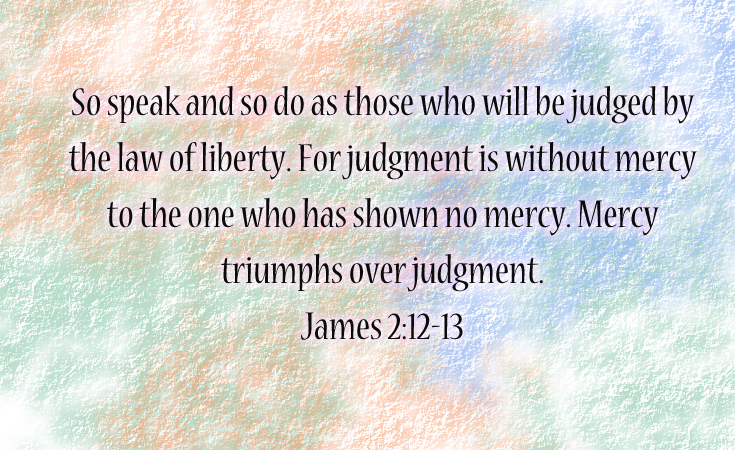
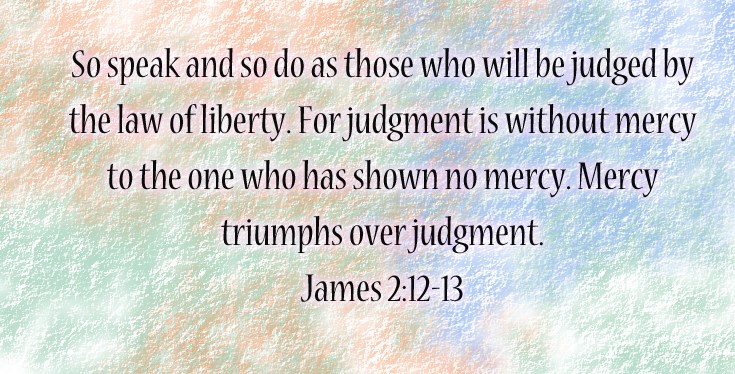
For whoever shall keep the whole law, and yet stumble in one point, he is guilty of all. For He who said, “Do not commit adultery,” also said, “Do not murder.” Now if you do not commit adultery, but you do murder, you have become a transgressor of the law. So speak and so do as those who will be judged by the law of liberty. For judgment is without mercy to the one who has shown no mercy. Mercy triumphs over judgment. (James 2:10-13)

I’ve heard it said that we can’t judge other people for sinning differently than us, and I think that’s true. We all have weaknesses, and we’re not supposed to decide that they are better weaknesses than someone else, even if they’re less visible (like, a tendency to lie can be less visible than a tendency towards promiscuity) or seem like they’re “not hurting anyone.”How Should We Think of Sin? | marissabaker.wordpress.com

We’ve now made a full circle in our discussion, and are back to the topic of “all have sinned.” I said earlier that all sins are equally bad, because all sins require Jesus Christ’s death to pay the penalty on our behalf. I want to add something to that, though, because I’ve never felt satisfied with such a black-and-white view of sin. It’s obvious that there’s a difference between petty theft and murder, for instance. Both are against God’s laws, both are sins, and both can only be washed clean by Christ’s blood. But one is far more damaging to society and other people.

We can see God acknowledging this in the Old Testament laws, where some sins incurred a physical death penalty and some did not. In the New Testament, we see similar distinctions. A thief is told to “steal no longer,” but rather work “with his hands what is good, that he may have something to give him who has need” (Eph. 4:28). In contrast, those who commit sexual transgressions are warned, “he who commits sexual immorality sins against his own body” and defiles the temple of God (1 Cor. 6:18-20). Both are sinful, but one causes more damage than the other.

As we consider the topic of sin inside and outside the church, let’s keep our focus on following Christ’s example of showing mercy while faithfully revealing God’s laws in our words and actions. We must not “approve of those who practice” sin (Rom. 1:32), but we also must not hate other people or follow the scribes and Pharisees’ example of harsh judgement.

Forgetting God

I was reading Hosea early this week when two phrases jumped out at me from this verse:

My people are destroyed for lack of knowledge. Because you have rejected knowledge, I also will reject you from being priest for Me; because you have forgotten the law of your God, I also will forget your children. (Hos. 4:6)

The phrases were “rejected knowledge” and “thou hast forgotten the law of God.” I also accidentally loaded an NIV translation which renders the word “forgotten” as “ignored.” I’m not sure which translation I like better — forgetting makes me think of gradually letting something slip your mind because you don’t think about it, while ignoring sounds more like a conscious choice. Either way, it is a dangerous thing to do with God’s law.

Hear the word of the Lord, you children of Israel, for the Lord brings a charge against the inhabitants of the land: “There is no truth or mercy or knowledge of God in the land.” (Hos. 4:1)

Destruction comes upon those who reject knowledge of God, and who forget God’s law. It is so very important that we continue to grow in knowledge of God and keep His commandments.

Knowledge of God

According to my study Bible, the Hebrew word translated “knowledge” is H1847 dha’ath. it refers to knowledge gained through the senses, and is the opposite of “folly.” Meanings include knowledge, insight, intelligence, understanding, and wisdom. “Knowledge of God,” Zodhiates writes, “describes the proper relationship between God and a man who truly obeys Him.”

"Forgetting God" by marissabaker.wordpress.comAnd this is eternal life, that they may know You, the only true God, and Jesus Christ whom You have sent. (John 17:3)

Jesus answered and said to him, “If anyone loves Me, he will keep My word; and My Father will love him, and We will come to him and make Our home with him. (John 14:23)

Knowledge of God increases as we grow into a closer relationship with Him. They are inseparably connected. If we reject knowledge of God, we reject a relationship with Him. As pointed out in the definition of dha’ath, a relationship with Him is dependent on keeping His laws. God cannot be in fellowship with a person who is walking contrary to Him.

And after all this, if you do not obey Me, but walk contrary to Me,then I also will walk contrary to you in fury; and I, even I, will chastise you seven times for your sins. (Lev. 26:27-28)

Do Not Forget

Take heed to yourselves, lest you forget the covenant of the Lord your God which He made with you, and make for yourselves a carved image in the form of anything which the Lord your God has forbidden you. (Deut. 4:23)

The Israelites were commanded, multiple times, to remember all God had done for them, and to teach their children His laws “That they may set their hope in God, and not forget the works of God, but keep His commandments” (Ps. 78:7). But “they forgot God their Savior,” and did not teach His laws to their children (Ps. 106:21). This set up generational cycles of forsaking God, punishment, repentance and forgiveness, and then forgetting God again.

Can a virgin forget her ornaments, or a bride her attire? Yet My people have forgotten Me days without number. (Jer. 2:32)

"Forgetting God" by marissabaker.wordpress.comCan you feel God’s heartbreak in this verse? His presence is what made His people beautiful and His grace clothed them in dignity, yet they cast Him away (Ezk. 16:8-14). It’s as unthinkable as a bride forgetting to put on her wedding dress before walking down the aisle, but it happened over and over again.

In Psalm 50, God addresses the wicked who “hate instruction” and  “cast My words behind you,” asking them “What right have you to declare My statutes, or take My covenant in your mouth?” (Ps. 50:16, 17). These people were thieves, adulterers, liars, slanderers, and evil supporters of others who committed sin (Ps. 50:18-20). Though they knew God’s law, they thought He would overlook their sins — an error He corrects.

These things you have done, and I kept silent; you thought that I was altogether like you; but I will rebuke you, and set them in order before your eyes. “Now consider this, you who forget God, lest I tear you in pieces, and there be none to deliver: whoever offers praise glorifies Me; and to him who orders his conduct aright I will show the salvation of God.” (Ps. 50:21-23)

As this last verse hints, there is an antidote to forgetting God. On the night of His betrayal, Jesus promised His disciples that He would send them the Holy Spirit, which would “teach you all things, and bring to your remembrance all things that I said to you” (John 14:26). Keeping God’s commandments puts us into a right relationship with Him, and gives us access to aid through the Holy Spirit.

The Law of God

To recap (since this has become a long post), God says in Hosea 4:6, “because you have forgotten the law of your God, I also will forget your children.” Keeping God’s law close to our hearts and minds, holding it in remembrance, is key to knowing Him and maintaining a lasting relationship.

The law of the Lord is perfect, converting the soul; the testimony of the Lord is sure, making wise the simple; the statutes of the Lord are right, rejoicing the heart; the commandment of the Lord is pure, enlightening the eyes; the fear of the Lord is clean, enduring forever; the judgments of the Lord are true and righteous altogether. More to be desired are they than gold, yea, than much fine gold; sweeter also than honey and the honeycomb. Moreover by them Your servant is warned, and in keeping them there is great reward. (Ps. 19:7-11)

"Forgetting God" by marissabaker.wordpress.comThis is why it makes no sense to say Jesus Christ did away with the law under the New Covenant. Keeping the commandments is how we show God and Jesus that we love Them (John 14:15, 21, 23; 15:10, 14). We can’t pick-and-choose which parts of the commandments we want to obey, either: “All Scripture is given by inspiration of God, and is profitable for doctrine, for reproof, for correction, for instruction in righteousness, that the man of God may be complete, thoroughly equipped for every good work” (2 Tim. 3:16-17).

“Do not think that I came to destroy the Law or the Prophets. I did not come to destroy but to fulfill. For assuredly, I say to you, till heaven and earth pass away, one jot or one tittle will by no means pass from the law till all is fulfilled. Whoever therefore breaks one of the least of these commandments, and teaches men so, shall be called least in the kingdom of heaven; but whoever does and teaches them, he shall be called great in the kingdom of heaven.” (Matt. 5:17-19)

Jesus warns that breaking “the least of these commandments” will make us “least in the kingdom of heaven.” Other scriptures reveal that a pattern of sin will block us from the kingdom all together (Gal. 5:19-21). Forgetting and rejecting God by turning our backs on keeping His laws is like asking Him to forget about and reject us. But, thankfully for us, the flip-side of this is that showing our love for God by obeying Him puts us into a personal relationship with Him that has incredible, lasting rewards.

He who has My commandments and keeps them, it is he who loves Me. And he who loves Me will be loved by My Father, and I will love him and manifest Myself to him. … If anyone loves Me, he will keep My word; and My Father will love him, and We will come to him and make Our home with him. (John 14:21, 23)