Lessons From My Nervous Cat

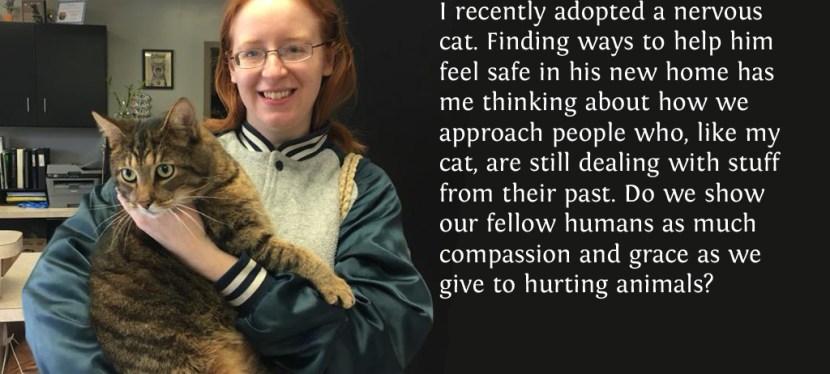
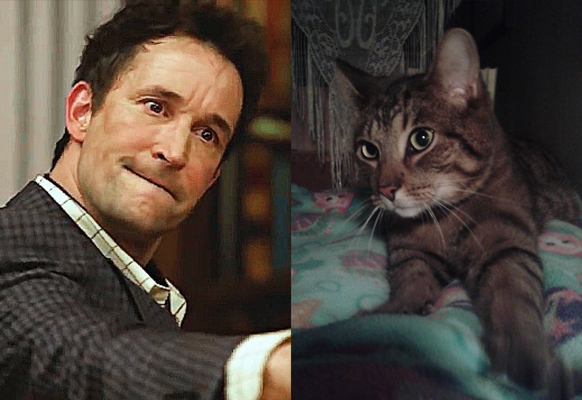
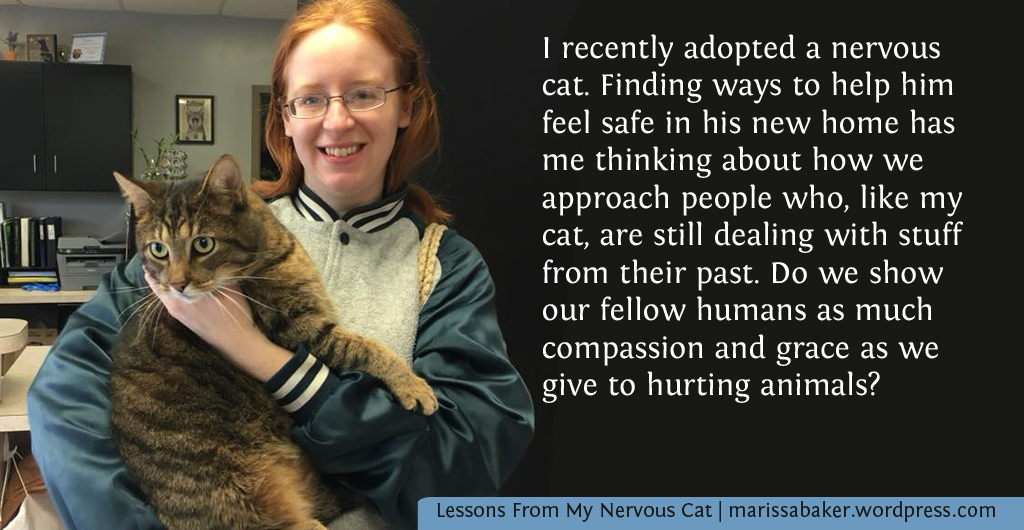
Meet Flynn. He’s 2 years old, weighs 15 pounds, and lost his previous home (not sure of the exact circumstances). I brought him home from a local humane society a couple weeks ago. I’d asked them if they had a sweet, cuddly cat that would do well in a single-cat home. They recommended Dorito (I’d originally planned to keep his name, but he doesn’t respond to it at all and it just didn’t “feel right” to me. Hence the name change, after Flynn Carsen from The Librarians).
Lessons From My Nervous Cat | marissabaker.wordpress.com
Flynn Carsen and Flynn the Cat

My new kitty cried for the entire car ride home. Once I released him from the cat carrier he promptly hid under the couch for the next six hours. Poor little thing’s been through a lot. But we’re starting to settle in and get used to each other. And after two weeks together I’ve learned that

  • He loves meat and will beg in the kitchen for beef, poultry, and fish
  • Catnip mice are his favorite thing. He just lays on the floor while hugging and chewing on them
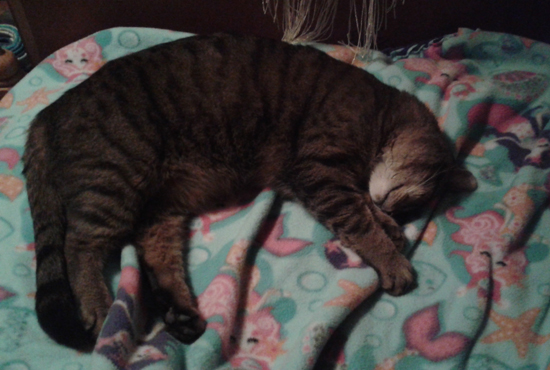
  • My fleece mermaid blanket must have a texture he likes, since he danced around with a look of wonder on his face the first time he touched it. It’s our favorite blanket
  • His purr is furniture-rattling in volume and intensity
  • He likes sleeping with people. Usually he picks my bed and spends the night curled up near my feet or legs

But I’ve also learned some other things:

  • He’s terrified of people in motion. If you stand up or walk into a room his eyes get big and he runs away
  • If you reach out toward him he flinches, like he expects you to hit him. But he’s sweet and affectionate if you’re sitting down and he comes up to you
  • He doesn’t like being picked up
  • The slightest noise is enough to make him startle awake, leap in the air, and/or flee the room
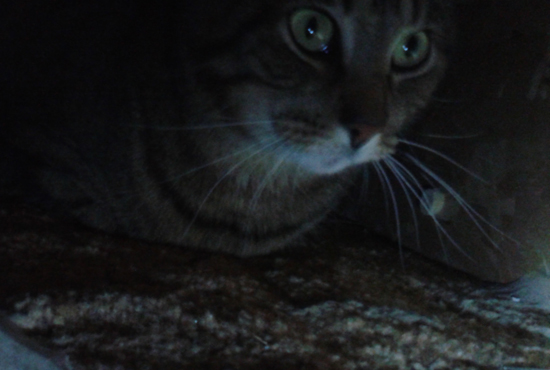
  • He spends most of the day hiding, only coming out to spend time with us in the morning and evenings
Lessons From My Nervous Cat | marissabaker.wordpress.com
hiding under the bed

I don’t know what happened in Flynn’s past as Dorito. Being a storyteller, I have a completely theoretical narrative that goes like this: Dorito’s owner was a sweet, elderly person who was confined to a wheelchair. They fed Dorito in the kitchen, invited him to sleep in the bed, and showered him with love. But this person had a caretaker that came in during the days and wasn’t kind to the cat. So Dorito learned that people walking toward him meant he’d be kicked or grabbed or chased out of the room. And then when their elderly person passed away, Dorito was dumped off at the Humane Society.

Of course I have no idea if that’s anywhere near the truth. What I do know is that I’ve adopted a very nervous cat. He startles at the slightest noise. He flinches if you touch him. He doesn’t do “normal cat” things like lay around all day and nap (at least not out in the open). And he’s taking a very long time to relax around us, especially my 6′ 3″ younger brother.

After a few days of this, someone in my family described Flynn as a “useless cat” because he won’t cuddle. And then someone asked if I could return a defective cat. I was behind the couch at this point trying to convince Flynn to come out and raised my voice just enough to say, “He’s scared and he needs our love and understanding!” After that the (mostly) joking suggestions that Flynn wasn’t the cat we were looking for stopped. He also started becoming more friendly, which helped with that.
Lessons From My Nervous Cat | marissabaker.wordpress.com
Flynn’s favorite blanket

I don’t know what in Flynn’s past made him so scared. But I know that right now he’s easily startled, worried, and only wants touched on his terms. So I decided to love him where he’s at and work with him. It’s not going to help if I lecture him, saying he’s got it so good now that he should just suck it up and move forward with his life. He needs patience. He needs someone not to push his boundaries because that will only prove we can’t be trusted not to go too far. He needs someone there for him when he does want held and petted.

And then I started thinking, isn’t that what hurting people need too? Love, understanding, acceptance, and someone to be there for them on their terms. But how many times do we meet someone who’s going through something we don’t understand and yet we treat them as if they’re “lesser than” because they’re still showing signs of their past trauma? Why are we so much more willing to extend grace and compassion to a nervous cat than to an anxious, depressed, or hurting human?

Then I had another realization. The way I’m treating my cat is the way I want to be treated when I’m anxious, nervous, or on the edge of panic. I want patience, understanding, and someone who will ask what I need instead of pushing me to just get over it. And it’s also the way I should treat myself (I’ve recently started seeing a counselor to get help working through my anxiety and she was delighted with this realization). We must give ourselves the same compassion, love, and permission to be ourselves that we long for from other people and should extend to others who are going through similar things.

So that’s what I’ve been learning from my nervous cat. I think he’s turning out to be a pretty good teacher.
Lessons From My Nervous Cat | marissabaker.wordpress.com

An Open Letter to Socially Timid Highly Sensitive People

I’m so excited to share with you my first article published on Introvert, Dear. Read an excerpt below, then follow the “Read More” link for the full article.

Dear fellow highly sensitive person,

Like many of you, I didn’t know I was a highly sensitive person (HSP) for a long while. I just knew I was “different.” For me, this was particularly marked in social situations. Other people went shopping together to unwind, but I felt tense in brightly lit malls bombarded by flashing advertisements, milling crowds, and heavy perfumes. My friends didn’t wince at dances when the music was turned up, they danced harder. My classmates in college seemed like they could relax and focus, while I noticed the flickering lights, the quality of air, the spot on the professor’s shirt, the scratch of pencils on paper.

Sound familiar? If you were like me, you were sure this wasn’t normal—but you weren’t sure what to do about it. I couldn’t understand why it was so hard to get over my shyness and start acting like other people. I had discovered my Myers-Briggs personality type was INFJ when I was preparing to graduate high school as a homeschooler, but it wasn’t until I was floundering through the social landscape of college that I started really researching it. I began at the library, desperately digging through books, looking for ways to cope with my introversion. …. Read More

Walking by Faith (and next e-book announcement)

I just got back yesterday from an incredible  service-themed Young Adult weekend. It didn’t start out all that well for me, though. The day before I left I started feeling nervous (which is normal for me going into social events) but then by the time I left on Friday I had a shaking-crying-hyperventilating panic attack (which is becoming less and less normal/frequent for me).

I was really caught off-guard by this. I knew several people there — not just as acquaintances, but as friends — and I’d been eagerly looking forward to this event for weeks. I chalked it up to my too-active imagination combined with uncertainty about Friday evening’s schedule, breathed deep, prayed, turned Fallout Boy up, and started driving …

… and hit heavy traffic and rain (my two least favorite things to drive in). That left me running 20 late to met the people I was supposed to be car pooling with to the house I didn’t have an address for. Thankfully, one of the people I was meeting is also one of only 2 out of 100+ people at the weekend with my phone number, and he texted me the address. I proceeded to enter said address in my GPS and it took me to a house with no cars in the driveway.

It is either a testament to my stupidity or my faith that I walked up and rang the doorbell. Turns out, my friend accidentally sent me to another church member’s home (whose name I recognized, though I’d never met them) and they fed me cheese, gave me the correct address, and sent me on my way. Oddly, that’s when I felt a sense of peace for the first time all day. I was late, I was temporarily lost and yet God showed me that these worries coming true weren’t anything He couldn’t handle.

Walking by Faith | marissabaker.wordpress.com
photo credit: Dan4th Nicholas, CC BY via Flickr

Saturday brought a great round of seminars and an excellent sermon on foot washing and Passover. Nothing to worry about, until game night happened. I’m sure I’m in the minority judging by how many people said they had a wonderful time, but any sort of game that involves doing something in front of other people or in a group or on a team makes me intensely uncomfortable, especially if you add competition. The first two games were mixers where you asked someone a question and their name. I literally remember nothing from meeting people this way (does it even count as a “meeting” then?). Next was that game where you tie a balloon to your ankle and try to keep it from getting popped while popping everyone else’s balloon. I could have kissed whoever it was that popped my balloon the moment the game started.

That’s the last game I “played” (I stepped on my own balloon when they started round two) and I thoroughly enjoyed the rest of my evening talking with two other people who saw no appeal in participating. Give me a deep conversation with someone over competitive and/or rambunctious games any day. Now that’s how to meet new people. (Side-track back to the topic of social anxiety: game night continued throughout my conversations and there was a Bag of Doom from which they were drawing names to participate in a novelty challenge which you had to do while standing in the center of a room surrounded by 80-something people watching you. Can anyone say “introvert’s worst nightmare”?)

I think one of the biggest lessons I learned this weekend was that my fears were either 1) groundless or 2) didn’t have the power to hold me back. The fact that I had a panic attack before leaving turned into a blessing because it gave me the choice between either canceling my plans or praying through it and trusting God. I chose the later, and I kept encountering situations that could make me feel nervous and which reminded me to stay in prayer all weekend. Every single one of the things I was worried about worked out for the best, and the only part of that I can take credit for is that I took the step to go to the weekend and start a few conversations. The rest was all God.

This brings us in a very round-about way back to the topic of the weekend — service. Specifically, “Unlocking Your Desire To Serve.” As many of you know, I consider this blog a sort of ministry and it’s been growing in ways that amaze me and make me want to do more. One of the big things that holds me back is my own fears, including my fear of panicking when it’s important that I talk with people about my faith. So for me, blending this weekend’s focus on service with a need to rely on God for help working through my anxiety was a powerful experience.

  • If you gave up reading that long rambling post and started scrolling, here’s the e-book announcement:

Something I haven’t shared with many people is that in my local Messianic congregation I’ve been receiving words, prayers, and hints from brethren for the last several months along the lines of “God’s going to do something big in/with your life soon.” I even finally have a hint as to what that might involve after I came back from services a few weeks ago with a title for an e-book in my head which I promptly sat down and outlined. I’ve barely worked on it since, but this weekend was exactly what I needed to reconfirm that God wants me to be sharing my gifts through writing and that He’s more than capable of overcoming deficiencies on my part.

My first step is officially announcing the project here on this blog. The working title is “Rise Up, My Love” and the focus will be on reigniting the church’s passion for God (so, basically this blog in book form). I’m not committing to a release-date quite yet (it would be lovely to have it out by Sukkot/Feast of Tabernacles this fall, but I think a full year might be more realistic judging by how long it took to write The INFJ Handbook). I’ll keep you posted on details.


INFJ Overthinking -­ When Our Beautiful Mind Turns Against Us

This is a guest post by John Lindholm, a writer for the Introvert Spring INFJ forum.

INFJs like to look in. Sometimes this habit works against us. Our mind is a busy freeway of thoughts that steer our car off the happy highway. Certain circumstances are particularly disorienting. Our mind twists, turns, and reverses these situations so much that they no longer match up to reality. Here are a few you might recognize:

Small Talk, Big Mistake

INFJ Overthinking -­ When Our Beautiful Mind Turns Against Us, guest post by John Lindholm | marissabaker.wordpress.com
photo credit: “Thinking RFID” Jacob Bøtter

It is no secret that introverts would rather eat a brick sideways than engage in small talk. But I’ve only been offered that choice twice in my life, so the chit chat is unavoidable even to the ghosty­ist INFJ.

It’s even worse when we think our conversation partner is more successful, better looking, or more interesting than we are. When this happens, the chatter milk can sour in an instant.

It starts with rotten self-­talk like, “why am I such a loser compared to him?” Or, “why can’t I just relax and talk like she can?” Or even, “why do I suck at life?” Then the pulverized mind of the INFJ has to throw a few words together to continue the conversation. Not good.

One time, I ran into somebody I hadn’t seen for well over a year. He started with, “I haven’t seen you for a while, so I just wanted to say hi.”

I volleyed, “Yeah, so how have you been?” Not a bad start, but the meter on my coherence tank plummeted as the palaver continued.

When he tried to end things with, “Ok so, I just wanted to say hi,” I again replied, “Yeah, so how have you been?”

Realizing I had repeated myself, I answered my own question. “Good, good, yes right?” It was ridiculous, so I excused myself and retreated to the restroom.

It Will Be All Better When…

For the INFJ, successes that should be celebrated and lead to happiness and further growth can actually lead to frustration, sadness, and even depression. This has a lot to do with “I’ll start my diet on Monday” self­-promising. We tell ourselves,

“Once I get through this social-­event­-stuffed weekend, everything will be perfect.”

“As soon as school ends, I’ll get back to writing my book.”

“I’ll be so happy after I lose these ten pounds.”

This kind of thinking ensures that we’re never where we are. We’re not here, we’re in our head. We’re so busy thinking about what would make us happy that we miss out on the present moment. Since no amount of achievement will evict us from our brain, we’re better off focusing on how to make our head a happier place.

There’s Only One Side: Mine

We INFJs will brood, contemplate, deliberate and ruminate the DNA right out of an idea. Other folks might have an opinion, a passing notion, or even a half­-baked solution. But if they don’t agree with us, they’re wrong.

Or so we think.

We’re awesome at dissecting an issue, but have a hard time accepting opposing points of view. It’s hard for us to trust that others have as much going on between the ears as we do (they probably don’t, but that’s beside the point).

And heaven forbid that people want to speak about a problem without also brainstorming for a solution. I mean, what’s the point in highlighting a fault if we don’t want to fix it, right?

Your Turn…

I’d like to hear from the rest of you INFJs, and from those who love them. What other ways do INFJs overthink or misunderstand social situations? Please share below.

Author Bio: John Lindholm is a middle school math teacher and a writer for the Introvert Spring INFJ Forum (which you are welcome to join). He enjoys writing fiction as well as articles and other pieces about introversion. Check him out at InwardFacingWriters.com.


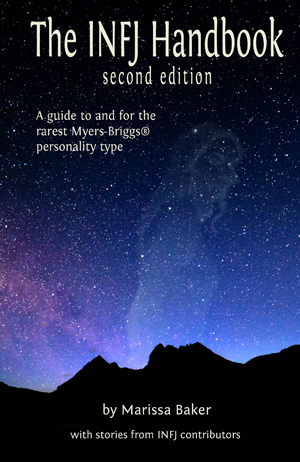
If you’d like to know more about the INFJ personality type, check out my book The INFJ Handbook. I just updated it with a ton of new information and resources. You can purchase it in ebook or paperback by clicking this link.

Dancing the Night Away

12233525_10153726823613234_114218666_n
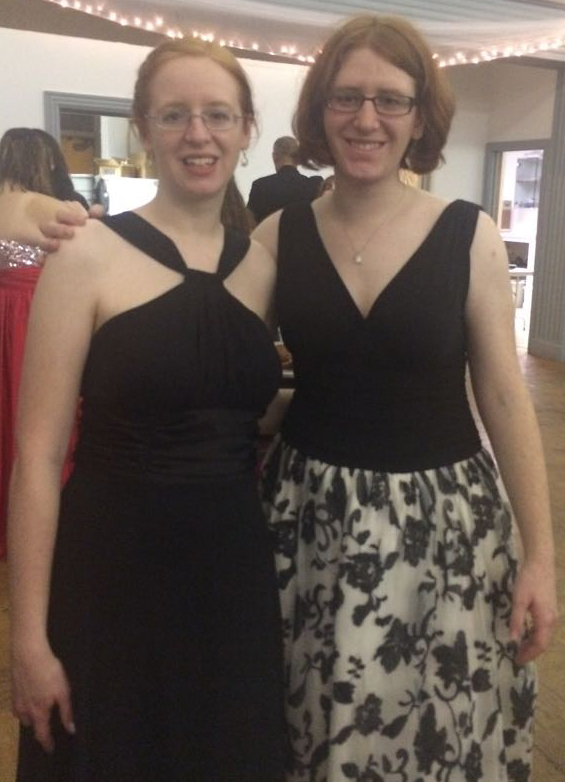
me and my sister

This post will be a bit random. I’m writing on Sunday, after a few hours sleep following a dance we got back from just before 3:00 in the morning. And that was after staying up past midnight the evening before talking about Myers-Briggs with someone who just learned he’s an INFJ. Dancing and typology being two of my favorite things, I’m happy. Add the fact that many of my good friends were at the dance, and I’m delighted.

On the topic to typing people, sometimes people online ask me, “How do you find out the personality types of so many people?” It’s really not all that difficult to bring up in conversation. When people ask what are your hobbies/interests or how you spend your time, I often bring up this blog and/or mention psychology. Then I just ask people if they’re taken a Myers-Briggs test. People love to talk about themselves, so it’s not usually all that hard from there. If they’re a good enough friend and haven’t taken the test yet, just point them to Personality Hacker. If you’re really ambitious, guess their personality once they have the result but before they tell you (the reaction is great if you’re right).

Taking this in a different direction, I think I’ve hit a personal growth milestone. My shyness/social anxiety really only showed up once last night. Once! And a week ago I raised my hand and said something in church (this is accepted/encouraged at my Messianic congregation, but I haven’t done anything like that in the 3 years since I graduated college and there wasn’t mandatory class participation). I think I’m actually starting to conquer a fear that’s been a part of me for so long. For INFJs, this sort of personal growth usually involves tapping into your secondary function, Extroverted Feeling, and I feel like I’m doing that with more consistency and confidence. The dance was a a great place to realize this, since it’s a setting which could have made me intensely uncomfortable a few years ago.

What about you? have you attended any events or had any experiences lately that highlighted some area where you’ve grown as a person?

Shy Introverts

Last week, when I wrote about reasons to homeschool introverts, I touched on the difference between “shy” and “introverted.” I said that shyness and introversion are often confused, but introversion is an inherited preference for how you recharge (alone, rather than with other people), while shyness is a fear response. We talked about how introverted children can become shy and insecure if they are told there’s something wrong with their preference for introversion, which reinforces a low self-confidence and increases feelings of shyness.

But looking at shyness this way doesn’t give a complete picture. It still assumes shyness is “bad,” while in reality the more mild forms of shyness might simply be traits of an introverted temperament. Also, for those of us who are both shy and introverted, being told that shyness and introversion aren’t the same thing is not very helpful. I agree with people who argue that introversion needs to be understood rather than overcome — introverts shouldn’t feet guilty for not being extroverts. But I’ve read articles that set out to prove introverts should be accepted just the way they are, and then turn around and start criticizing shy people for their fears and anxiety in social situations. It’s not very encouraging to be told that your introversion is okay, but you need to “get over” your shyness.

Is Shy Really So Bad?

While researching for this post, I cam across “A Quiet Rant About Introversion and Shyness” by Barbara Markway. Like this writer, I’m both an introvert and a highly sensitive person (HSP).  We’re also both shy, though not as “painfully shy” as we once were. Like her , I worry that we risk hurting shy introverts when we focus the conversation about shyness and introversion on the idea that introverts are not shy. Because some of us actually are.

Shyness is not necessarily a bad thing. It’s just viewed as bad in current American culture. Other cultures see shyness as a sign of modesty, and treat it as a virtue (Asian cultures are typically used as an example). So for those of us who are shy, quiet, and introverted, know that there’s not necessarily something “wrong” with you. Extreme shyness becomes a problem when your fear gets in the way of you choosing to move forward with things you want to do, but a little shyness  can be a positive trait depending on how you look at it.

“the shy and the introverted, for all their differences, have in common something profound. Neither type is perceived by society as alpha, and this gives both types the vision to see how alpha status is overrated, and how our reverence for it blinds us to things that are good and smart and wise.” — Susan Cain

Shyness vs. Social Anxiety

Social anxiety is where “shyness” becomes problematic. Both shyness and social anxiety disorder are motivated by a fear of social situations, but social anxiety is more of a phobia-level fear. It’s often accompanied by a physical response (nausea, sweating, heart racing), and a person with social anxiety disorder might not appear shy all the time. It’s much more complex than simply an exaggerated form of shyness, as illustrated in the essay “Social anxiety is not the same as excessive shyness” by Chris Alaimo. I recommend clicking over there and reading what he wrote if you’re interested in this topic.

“Many people are a little bit shy. If you’re shy, you might be somewhat uncomfortable in situations such as going to a party where you don’t know anyone, but you do it. You give yourself a push, you go to the party, after a while you relax and talk to people. The social phobic person, at the prospect of the same party, would be overwhelmed by such anxiety that [he or she] would have a physical reaction — perhaps nausea, sweating, heart racing, dizziness — and would avoid it if at all possible. It’s a matter of degree.” Rudolf Hoehn-Saric, MD, head of the Anxiety Disorders Clinic at Johns Hopkins University School of Medicine (as quoted on WebMD).

I actually didn’t know about this distinction until someone asked what the difference was and I did some research. Now, I’m not sure anymore whether I qualify as shy or socially anxious. Using the above example, I do experience the the heart-racing, nausea, and panic-attack reaction to going to an event, but I usually go anyway (often because a family member pushes me out of the house. Literally, sometimes). So do I have mild social anxiety, or extreme occasional shyness? I suppose it doesn’t really matter, since WebMD says the typical treatment is anti-depressants and I’m not going to do that for something that’s not having a more drastic impact on my life.

I think it’s something worth thinking about, though, for people who are very shy. One of the reasons I like type psychology is because when you know yourself, you are better able to plan for and cope with your weaknesses, as well as utilize your strengths. Along the same lines, wven if you don’t plan on seeking medical help for shyness or social anxiety, knowing there’s a name for what you’re dealing with can help make it seem more manageable, and it helps you track down information like Must-Have Coping Strategies for Social Anxiety.