One of the phrases that I’ve been praying a lot over the past year since my baby was born is, “We’re in your hands, Lord, and that’s a good place to be.” It’s not a phrase that’s found in scripture, but the idea is Biblical. I’ve found that it serves as a good reminder to help me find calm amid anxieties and refocus on God’s goodness, faithfulness, and promises.
Today’s post is going to be quite a bit different than usual. As I was praying about this topic earlier in the week and planning how to write about it, I started writing song lyrics instead of an article. I haven’t tried songwriting since high school, and I rarely write poetry, so it caught me off-guard. A while ago, I’d prayed that God would help me write songs (the reason why is a long story we don’t need to get into now), but I’d assumed the answer was “no.” Apparently, though, it was, “not yet” and suddenly I have one completed hymn and two others drafted.
I’m not a musician (though I do have some musical training, I focused mainly on voice), and I didn’t write the tunes for these pieces. The one I’m sharing today is set to the traditional Irish tune “Slane,” which you might know as “Be Thou My Vision.” I love these old traditional melodies, and since they’re in the public domain I can freely use them and add my own lyrics.
Hold Me In Your Hands
Hold me in your hands as long as I live; Nothing else matches the comfort you give. With you, Lord, beside me my eyes finally see Dwelling with you is the best place to be.
When I am sinking in life’s stormy waves, You stretch your hand out and surely do save. You say “Have no fear” and slowly I learn We can rest easy where you are concerned.
God of all comfort you still hold us all. When we’re in your hands then we’ll never fall. Uphold your people with your righteous hand, In your great power we surely will stand.
Lyrics by Marissa Martin. Set to the traditional Irish tune “Slane” (“Be Thou My Vision”)
Here’s a really good piano version of “Be Thou My Vision.” The pianist plays four verses and I only have three, but you can see what the music sounds like and maybe sing along with my lyrics. I’m releasing my lyrics under a Creative Commons license (CC BY-SA) and the music is already public domain, so if you want to use them for something you don’t have to worry about copyright restrictions. The sheet music is at the end of this post.
Scripture References
I reference quite a few scriptural phrases in my song, but there were three verses in particular that I was thinking about as I wrote these lyrics:
So do not fear, for I am with you; do not be dismayed, for I am your God. I will strengthen you and help you; I will uphold you with my righteous right hand.
Isaiah 41:10, NET
But when he saw the wind, he was afraid and, beginning to sink, cried out, “Lord, save me!”
Immediately Jesus reached out his hand and caught him. “You of little faith,” he said, “why did you doubt?”
Matthew 14:30-31, NET
Blessed is the God and Father of our Lord Jesus Christ, the Father of mercies and God of all comfort, who comforts us in all our troubles so that we may be able to comfort those experiencing any trouble with the comfort with which we ourselves are comforted by God.
2 Corinthians 1:3-4, NET
One of the many reasons that I love music is because it makes things easier to remember. I want my daughter to learn phonics, so we listen to “Sing the Alphabet.” I want to strengthen my French speaking and listening skills, so I listen to French music. And when I want to memorize scripture and/or scriptural truths, it’s a whole lot easier for me to do that when it’s set to music.
One of the things I worried about when I shared this list was that 22 out of 30 were from Psalms. Typically, I like to draw from all over the Bible but for this one, most of the on-topic verses were in Psalms (not surprising, considering what we’re studying). I worried it might start to seem monotonous to write out verses from psalms over and over each day that basically all read as “sing praise to God.” But there’s a lot more variation in those verses than it seems when writing them in English. As I wrote these scriptures throughout February, I also wrote down the Hebrew words translated “sing,” “praise,” and occasionally “thanks.” It’s just two or three words in English, but in Hebrew there’s zamar, zamiyr, zimral, shur, shiyr, yadah, halel, tehillah, tephillah, ranan, renanah, todah,anah, and shaback.
I find the wide variety of Hebrew words that surround the concept of praise and song fascinating, particularly since Hebrew has a far smaller pool of words than English. There are “about eight thousand words” in the Hebrew language, in contrast to “one hundred thousand or more in our language” (Reading the Bible with Rabbi Jesus: How a Jewish Perspective Can Transform Your Understanding, Lois Tverberg, p. 61). Given that vast difference between the two languages, you’d expect that English would be the one with tons of words that are synonymous with praise (it does to a certain extent, but you don’t often see words like commend, compliment, extol, applaud, etc. used in English scripture). Praise must be extremely important to the Hebrew people for them to devote so many of their words to this concept.
To help illustrate this point, let’s look at a concept that the English language places a high value on: the legal system and government. There are a ton of different words for government, branches of government, and the systems of government. But Hebrew doesn’t have words for separating the legislative, executive, and judicial functions of government. They combine everything into one word shapat/mishpat, which Bible translators often render as “justice.” It’s a reflection of a culture where all that authority is centered in God and the king as His representative on earth. In contrast, English reflects a culture where government functions are divided up among different people and conceptualized differently.
It’s similar with praise. In English, we think of praise and worship together and mostly associate it with singing Christian music. We might also include praise in the sense of thanking or acknowledging God for good things that He has done. But praise in Old Testament Hebrew culture is much more varied and vital a concept, and that’s reflected in the number of words the language uses to denote specific types of praise.
Even if you know nothing about Hebrew, you probably know this word because of our English “hallelujah” (literally, praise Yah[weh]). The root word halal (H1984) appears 165 times in the Old Testament. It can mean to shine, boast, or even “act like a madman” (Brown, Driver, Briggs [BDB]) but most often it means praise. Basically, it “connotes being sincerely and deeply thankful for and/or satisfied in lauding” something or someone (Theological Wordbook of the Old Testament [TWOT], entry 500). One noun form, tehilla (H8416), also appears fairly often in the Old Testament (57 times). It “represents the results of halal as well as divine acts which merit that activity” (TWOT 500c). Tehilla can also be linked specifically to a “song or hymn of praise” (BDB, H8416).
Praise (halal) Yah! Praise Yahweh from the heavens! Praise him in the heights! …
let them praise (halal) Yahweh’s name, for his name alone is exalted. His glory is above the earth and the heavens. He has lifted up the horn of his people, the praise (tehilla) of all his saints, even of the children of Israel, a people near to him. Praise (halal) Yah!
Psalm 148:1, 13-14, WEB
Typically in the Bible, halal is used to praise and glorify God. It’s linked with joy, speaking, singing, dancing, and intelligent expression. Interestingly, “most of these occurrences are plural … [showing] that the praise of Jehovah was especially, though by no means uniquely … congregational” (TWOT 500). We can and should praise when we’re alone, but praise is something that’s expected when God’s people gather together. That’s why so many churches sing songs that glorify God as part of their formal services.
Praise (halal) Yah! Praise God in his sanctuary! Praise him in his heavens for his acts of power! Praise him for his mighty acts! Praise him according to his excellent greatness! Praise him with the sounding of the trumpet! Praise him with harp and lyre! Praise him with tambourine and dancing! Praise him with stringed instruments and flute! Praise him with loud cymbals! Praise him with resounding cymbals! Let everything that has breath praise Yah! Praise Yah!
Another very common Hebrew word for praise is yadah (H3034). It appears 114 times in the Old Testament. This one is often translated “give thanks,” though it’s also translated “praise” or “confess.” The “thanks” translation can be misleading, though, because there really isn’t an Old Testament equivalent to our concept of “to thank” (TWOT 847). In the Bible, thanks “is a way of praising” God rather than something we do, such as say “thank you” to other people. “Confession” is probably the best English equivalent to yadah (TWOT).
Oh, send out your light and your truth. Let them lead me. Let them bring me to your holy hill, to your tents. Then I will go to the altar of God, to God, my exceeding joy. I will praise (yadah) you on the harp, God, my God. Why are you in despair, my soul? Why are you disturbed within me? Hope in God! For I shall still praise (yadah) him: my Savior, my helper, and my God.
Psalm 43:3-5, WEB
In the sense of praise or thanks, yadah has to do with acknowledgement, “‘recognition’ and ‘declaration’ of a fact” (TWOT 847). The word can be used in a good or bad sense: for example, confessing sin or acknowledging God’s goodness. The noun todah (H8426) has basically the same meaning, and is often associated with offerings (e.g. “thank offering” or “praise offering”) (TWOT 847b).
Barak–blessing or praising
Barak (H1288) is used 285 times in the Old Testament (or 415 if you include all the root’s derivatives), and it’s usually translated “bless.” The basic meaning may be “to kneel” (TWOT 285). It’s often used of God blessing people, but when it’s used of people blessing God it can be seen as a type of praise.
Praise (barak) our God, you peoples! Make the sound of his praise (tehilla) heard,
Psalm 66:8, WEB
When we looked at yadah earlier, one of the things I didn’t mention is that the root word is likely related to throwing or casting something with the hands (BDB). It makes me think of Paul’s desire that “the men in every place pray, lifting up holy hands” (1 Tim. 2:8, WEB). Lifting hands when praising God can be controversial (some churches discourage or even forbid it, while in others it’s normal), but it’s definitely Biblical. In psalms, lifting hands is linked with praise.
So I will bless (barak) you while I live. I will lift up my hands in your name.
Psalm 63:4, WEB
Lift up your hands in the sanctuary. Praise (barak) Yahweh!
Psalm 134:2, WEB
With the link between barak and kneeling as well as its use with lifting hands in praise, I think it’s safe to say we could classify this as one of the physical types of praise. In many cases, we’ll see that praise involves our voices and bodies as well as our thoughts. You can praise God in your mind, but you’re also supposed to praise Him with your voice and with your body (e.g. kneeling, lifting hands, dancing).
The word zamar (H2167) basically means to sing or to play an instrument. But it’s used so much in the Old Testament in relation to praise that it’s typically translated “sing praise.” It might not always mean singing, though, as it’s also linked with playing lyre, harp, and tambourine (TWOT 558). This may imply that praise music typically has lyrics, but can also be instrumental. This word appears 45 times in the Old Testament.
I will give thanks (yadah) to Yahweh according to his righteousness, and will sing praise (zamar) to the name of Yahweh Most High.
Psalm 7:17, WEB
Make a joyful shout to God, all the earth! Sing (zamar) to the glory of his name! Offer glory and praise (tehilla)!
Psalm 66:1-2, WEB
Words translated “psalm” or melody, like zimrah and mizmor, are derivatives of zamar. Over and over in scripture, you’ll see praise linked with music and specifically song. Whether we have perfect pitch or we’re just making a joyful noise, we shouldn’t be shy to express our adoration for God through music or even shouts of joy.
Make a joyful noise to Yahweh, all the earth! Burst out and sing for joy, yes, sing praises (zamar)! Sing praises (zamar) to Yahweh with the harp, with the harp and the voice of melody (zimrah). With trumpets and sound of the ram’s horn, make a joyful noise before the King, Yahweh.
Psalm 98:4, WEB
Ranan–crying out praises
The basic meaning of ranan (H7442) is “to cry out, shout for joy, give a ringing cry” (BDB). Typically, it’s used of crying out to God for some reason, and in psalms it’s often paired with joy and singing. The word might even mean to sing out joyful praises, depending on the context: “The jubilation which is the main thrust of the root … could equally well be expressed in shouting or song” (TWOT 2179). One of the noun forms, renanah (H733) is “a ringing cry, shout (for joy)” and can be translated “singing” (BDB).
Shout for joy to Yahweh, all you lands! Serve Yahweh with gladness. Come before his presence with singing (renanah). Know that Yahweh, he is God. It is he who has made us, and we are his. We are his people, and the sheep of his pasture. Enter into his gates with thanksgiving (todah), and into his courts with praise (tehilla). Give thanks (yadah) to him, and bless (barak) his name. For Yahweh is good. His loving kindness endures forever, his faithfulness to all generations.
Psalm 100, WEB
Shir–songs, often of praise
The words for “sing” and “song” are not confined to religious music, but they are so often linked with praise that it’s worth mentioning them in this study. The Hebrew word shir or shiyrah (H7892) is often used in the psalms, both to describe what is being written (e.g. “a song of ascents” for Ps. 120-134) and as part of the text of the psalm (e.g. “with my song I will thank him” [Ps. 28:7, WEB]).
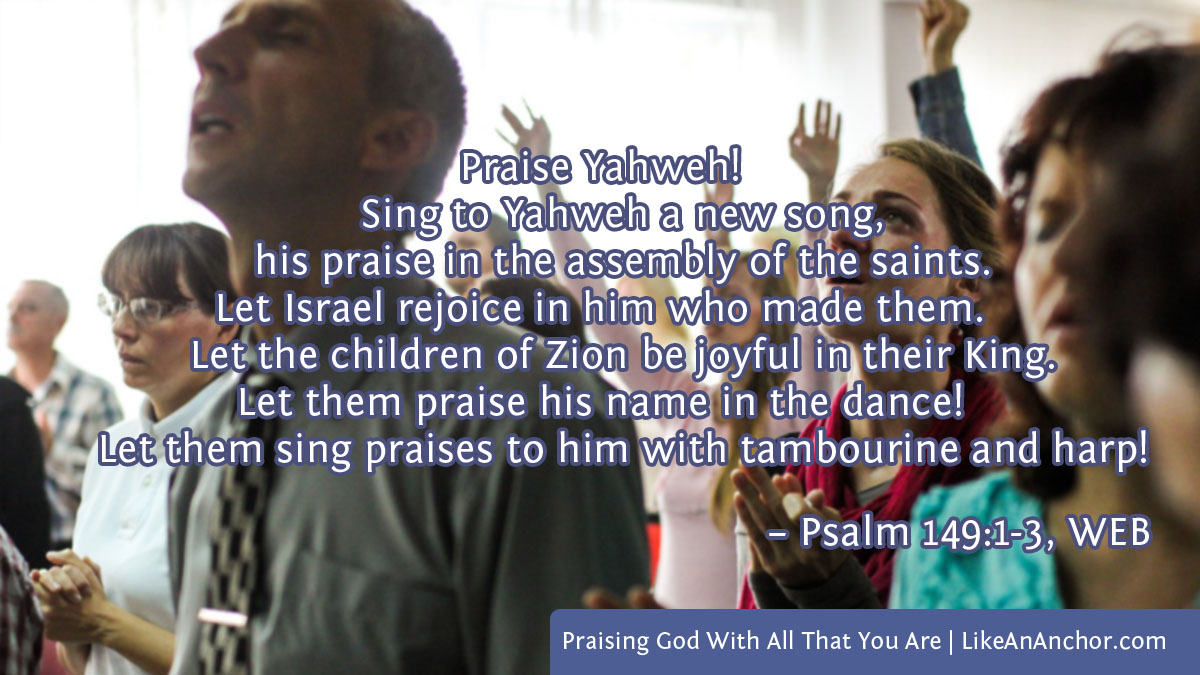
Praise (halal) Yahweh! Sing (shir) to Yahweh a new song, his praise (tehilla) in the assembly of the saints.
Psalm 149:1, WEB
Shir is typically used for hymns and psalms of lament. Both can be linked to praise. Many songs of lament “evolve into songs of praise in anticipation of God’s deliverance.” Hymns involve singing to God “in response to something already experienced” (TWOT 23781). Often, this type of song involves praising who or what God is or confessing/thanking Him for things that He has done. As I mentioned earlier, the topic “sing praise” is what prompted this blog post. You can download my free 30-day scripture writing plan and keep studying this topic on your own by clicking here.
The TWOT lists gadal (H1431) or gadol (H1419) in the sense of “to magnify” as one of the synonyms for halel (TWOT 500). You’re not likely to find it if you search for Hebrew words translated “praise” in English Bibles (it’s most often translated “great”), but the usage is linked to praise.
Great (gadol) is Yahweh, and greatly to be praised (halal), in the city of our God, in his holy mountain.
Psalm 48:1, WEB
I will praise (halal) the name of God with a song (shir), and will magnify (gadal) him with thanksgiving (todah).
Psalm 69:30, WEB
The root verb gadal means to “grow up, become great or important … praise, (magnify), do great things” (TWOT 315). In certain verb stems, it can mean “to magnify” or “consider great.” It’s often used to speak of God’s greatness or to talk about how God magnifies Himself. The adjective gadol has a similar range of meanings (TWOT 315d). Together, the two words appear a total of 643 times in the Old Testament.
Rum–lifting God high for praise
The TWOT lists rum (H7311) in the sense of “to exalt” as one of the synonyms for halel (TWOT 500). The root has three basic meanings: “literal height,” “height as symbolic of positive notions such as glory and exaltation,” and “height as symbolic of negative notions such as arrogance and pride” (TWOT 2133). We can “exalt God in praising” Him, or lift His name high. One specific derivative, romam (H7319), means “high praises” (TWOT 2133f).
May the high praises (romam) of God be in their mouths, and a two-edged sword in their hand
Psalm 149:6, WEB
Shabach–praise His mighty deeds
The verb shabach (H7623) only appears 11 times in the Old Testament. It means to praise, laud, or commend (BDB). Typically, it’s “used to praise God for his mighty acts and deeds” (TWOT 2313).
Because your loving kindness is better than life, my lips shall praise (shabach) you. So I will bless (barak) you while I live. I will lift up my hands in your name. My soul shall be satisfied as with the richest food. My mouth shall praise (halal) you with joyful lips,
Psalm 63:3-5, WEB
Praise (halal) Yahweh, all you nations! Extol (shabach) him, all you peoples! For his loving kindness is great toward us. Yahweh’s faithfulness endures forever. Praise (halal) Yah!
Psalm 117, WEB
Why Study Praise Words?
Image by Ben White from Lightstock
So why did we spend all this time looking at nine Hebrew words (more if you include derivatives from the root words) that all translate into English so similarly?
In an English Bible, “praise” appears hundreds of times, depending no the translation (254 in WEB, 259 in KJV, 328 in NET, 363 in NIV). It’s a vital concept in scripture, and something that we need to understand how to do if we’re to relate properly to God. One of our purposes for being here as Christians is to praise Him. Our lives should praise God, as well as our lips (Phil. 1:9-11; Heb. 13:14-15).
In Christ we too have been claimed as God’s own possession, since we were predestined according to the purpose of him who accomplishes all things according to the counsel of his will so that we, who were the first to set our hope on Christ, would be to the praise of his glory.
Ephesians 1:11-12, NET
If we just looked at the English word for praise, we’d think the definition was limited to “express warm approval or admiration of” and “express one’s respect and gratitude toward (a deity), especially in song” (definitions from Google and Oxford Languages). Studying the variety of Hebrew words related to praise gives us a much broader appreciation of praise. It’s more than just approval, admiration, respect, and gratitude. It’s a whole-life, whole-body, whole-heart expression of God’s glory, our thankfulness, and much more.
Years ago when I was studying the topic of prophecy in the Bible, I noticed a link between prophecy and music that I thought seemed strange at the time. When we think of prophecy, we typically think of foretelling future events. We might also think of “inspired speaking,” which is the more general sense of both the Hebrew naba (H5012 “prophecy”) and the Greek propheteia (G4394 “prophecy”). Thus, a prophet (nabiy [masculine] or nebiyah [feminine] in Hebrew and prophetes in Greek) is someone who shares a message inspired by God; they’re a spokesperson for Him.
It’s likely impossible to read the Bible without noticing the importance of music, especially in the Psalms. People of God sing a lot, often accompanied by lively music and dancing. With this in mind, perhaps the link between music and prophecy shouldn’t surprise me, but it did. I hear this much less often now, but when I was a teen I was warned repeatedly against the dangers of getting too caught up in the emotions of worship music. Those emotions could stir you up to ignore theologically questionable lyrics or make a fool out of yourself swaying and back and forth in church (or so the argument went). And yet, people in the Bible deliberately sought out music as part of not only their praise but also to help them hear God’s voice.
Prophets as Singers
Revisiting this study started with my mom suggesting that someone should put together a study on music for our monthly scripture writing group. So far, I’ve come up with 20 scriptures for the topic “Inspiring Music.” They’re not all direct links between prophecy and music, but they all have to do with inspiration and singing or playing musical instruments. Several of these verses have to do with prophets and prophetesses who used music when sharing inspired words.
Miriam the prophetess, the sister of Aaron, took a tambourine in her hand; and all the women went out after her with tambourines and with dances. Miriam answered them,
“Sing to Yahweh, for he has triumphed gloriously. He has thrown the horse and his rider into the sea.”
Exodus 15:20-21, WEB
Now Deborah, a prophetess, the wife of Lappidoth, judged Israel at that time. …
Then Deborah and Barak the son of Abinoam sang on that day, saying,
“Because the leaders took the lead in Israel, because the people offered themselves willingly, be blessed, Yahweh!
Judges 4:4; 5:1-2, WEB
With two of the Old Testament prophetesses singing like this, Brown-Driver-Briggs dictionary even includes “gift of song” as part of their definition for nebiyah. The Theological Wordbook of the Old Testament notes that it’s rare, but musicians are “designated nebi’im” (entry 1277). We see another example of this when David appointed “some of the sons of Asaph, Heman, and Jeduthun to prophesy as they played stringed instruments and cymbals” (1 Chr. 25:1-3, NET). It shouldn’t come as any surprise to us that music can be divinely inspired, but seeing it linked with prophecy underscores the importance God places on musical praise, worship, and teaching.
In addition to these examples of prophets and prophetesses as musicians, we also have an example of a prophet who listened to music.
Elisha said, “As Yahweh of Armies lives, before whom I stand, surely, were it not that I respect the presence of Jehoshaphat the king of Judah, I would not look toward you, nor see you. But now bring me a musician.” When the musician played, Yahweh’s hand came on him.
2 Kings 3:14-15, WEB
Here, three kings came to Elisha asking him to talk with God for them. Though he wouldn’t have responded to the kings of Israel and Edom, Elisha said he would seek God’s guidance out of respect for the king of Judah. In order to do that, he asked for a musician and it was while he listened to music that “Yahweh’s hand came on him.” It’s a fascinating precedent for someone using music to help them communicate and connect with God.
Music was a key part of worship in God’s temple, particularly after King David appointed singers and musicians for worship in the tabernacle. That type of ministry through music continued into Solomon’s day and beyond whenever kings and righteous leaders reinstituted true worship (1 Chr. 6:31-32; 2 Chr. 23:18; Neh. 12:44-46).
He [Hezekiah] set the Levites in Yahweh’s house with cymbals, with stringed instruments, and with harps, according to the commandment of David, of Gad the king’s seer, and Nathan the prophet; for the commandment was from Yahweh by his prophets. The Levites stood with David’s instruments, and the priests with the trumpets. Hezekiah commanded them to offer the burnt offering on the altar. When the burnt offering began, Yahweh’s song also began, along with the trumpets and instruments of David king of Israel. All the assembly worshiped, the singers sang, and the trumpeters sounded. All this continued until the burnt offering was finished.
Let the peace of Christ be in control in your heart (for you were in fact called as one body to this peace), and be thankful.Let the word of Christ dwell in you richly, teaching and exhorting one another with all wisdom, singing psalms, hymns, and spiritual songs, all with grace in your hearts to God.
Colossians 3:15-16, NET
When God looks at His church, there are some specific things He expects to see. He wants us to be at peace with each other and have peace inside us. He wants to see Jesus’s words in us “richly,” overflowing in “teaching and exhorting with wisdom.” And He wants to see us “singing psalms, hymns, and spiritual songs.” The context indicates that singing is part of our teaching and exhortation (our inspired and inspiring words); a conclusion reinforced by another letter Paul wrote.
And do not get drunk with wine, which is debauchery, but be filled by the Spirit,speaking to one another in psalms, hymns, and spiritual songs, singing and making music in your hearts to the Lord,always giving thanks to God the Father for all things in the name of our Lord Jesus Christ,
Ephesians 5:18-20, NET
When we’re filled with the Spirit, that’s going to inspire music both aloud and in our hearts. I know it can be hard sometimes to get excited about singing. Maybe you don’t like the way your voice sounds or you’re turned-off by the style of music at your church. I like singing, but there are some hymns that sound an awful lot like a funeral dirge to me and I just can’t work up much involvement singing those. But there are other hymns that I love, and when I’m at home I’m free to pick a style of Christian music I like and dance around singing them all I want. If we want to make music part of our worship, surely we can all find songs that match our tastes well enough that we can sincerely use them to glorify God. At the very least, we can appreciate the words of the music we sing at church and recognize the value God places on music.
In addition to the encouraging and exhorting aspect of “speaking to one another in psalms, hymns, and spiritual songs,” there’s also a link to thankfulness. Thanksgiving is a key aspect of praise and of song, and it should accompany our teaching, exhorting, and singing. (2 Sam. 22:50, Ps. 33:2, and others). In this as in so many other things, it comes down to the state of your heart. When we have God’s spirit inside us, want to encourage others, and have a thankful attitude, then godly music is one of the ways for us to both express our appreciation for the Lord and strengthen our relationship with Him.
A couple weeks ago, Susan Storm asked me to write an article about songs that INFJs love. When I asked some INFJs on Facebook for feedback on that topic, I was overwhelmed by the responses. It was far more than I could fit in just one article! I’ve compiled a Spotify playlist with the recommended songs, albums, and artists that you can click here to listen to. It’s over 6 hours long, and growing with each new comment. I’ve found several new favorites, and I hope you will too!
Coincidently, I finished writing this article shortly before I finished listening to Jordan Peterson’s “Maps of Meaning” lecture series. In the final lecture, he spends a few moments talking about music.
“Virtually everyone gets intimations of meaning from music. And I think music is hierarchically structured patterns that are representative of being laying itself out properly. … It is an abstract representation of proper being.” — Jordan Peterson, 2017 Maps of Meaning 12, time signature 1:51:00.
Music is meaningful to us on a level that I doubt most of us (me included) really understand, at least consciously. And, in the case of many of the songs INFJs list among their favorites, it really does prompt us to think about “being.”
We face our darker, hidden, hurting sides and think about how others may respond as we listen to “Demons” by Imagine Dragons.
Some of these songs represent irrepressibly hopeful ideas of the world, while others dive deep into brokenness and pain. Some are raw, some are happy, some beautiful, some hard to listen to. But for at least one INFJ out there, the different songs on this playlist are expressing the sorts of things “which cannot be said and on which it is impossible to be silent” (to quote Victor Hugo).
Anxiety and depression are two of the most common mental illnesses, and they often occur together. Just because its relatively common, though, doesn’t make dealing with both feel any less weird. Exhibit A, this image I ran across on Pinterest:
It’s overly simplified, of course, to say “depression is when you don’t really care about anything” and “anxiety is when you care too much about everything.” Still, these comments capture part of how strange it feels to simultaneously (or alternately) deal with depression and anxiety. “Having both is staying in bed because you don’t want to go to school and then panicking because you don’t want to fail. Having both is wanting to go see your friends so you don’t lose them all, then staying home in bed because you don’t want to make the effort.”
Anxiety and depression are going to show up a bit different for everyone who struggles with them, but for me it’s like one day I’m on-edge, jittery, and so distracted by my inner anxiety monologue that I struggle to remember how things actually happened. Then the next day I feel like a weight’s pressing down on me snuffing out all motivation and hope. And some days, the smothering feeling is there but I’m also anxious about stuff I should care about and there’s this weird fight going on in my head. It’s exhausting.
Holding on to hope isn’t easy when you’re fighting a struggle inside your mind that tells you the worst could happen and there’s no point in trying to do anything about it. But we’re also not helpless victims of our own minds. We can change the patterns of our thoughts. We can choose to hold on to hope even when there seems no reason for it, and the easiest/best way to do this is with the Lord’s help.
Yesterday my sister and I went to see a community theater’s production of the musical Jekyll and Hyde. It’s a show that our cousin introduced us to years ago through the soundtrack and we were excited to it on stage. I’m not sure I’d call this a favorite play, but the music is fantastic and the story line prompts some intriguing questions about the nature of human kind and how our personalities work.
Jekyll and Hyde is a classic tale of good and evil. The play is quite different from Robert Lewis Stevenson’s novel, The Strange Case of Doctor Jekyll and Mr. Hyde. In the original version, Jekyll develops a serum to separate his darker side because he’d already started indulging his vices and wanted to keep doing so without fear of discovery. The play offers a more compelling protagonist; a Jekyll searching for a cure to evil on a grand scale. If you’re curious, you can watch a really good high school production ofthe play on YouTube by clicking here.
This isn’t the sort of play that I recommend frequently. It’s dark. It’s complicated. It’s more sexual than the scandalized ladies sitting behind me expected. It doesn’t end happy (don’t look at me like that — you don’t get spoiler warnings when the book’s 132 years old). But it’s also a deeply compelling story that dives head-first into tough questions about the nature of man. Read more →








 Like An Anchor