Lies That Isolate Us

Lies That Isolate Us | marissabaker.wordpress.com We know how important a relationship with God is to our Christian walk, and last week we talked about how important it is for us to also have relationships with other believers. For some of you, that comes fairly easily — you have a church home where you feel welcome, and good friends who share your faith. Many of you feel much more isolated, through. Maybe there aren’t any options for fellowship in your area, but if you’re online reading this blog post you have at least one way to connect with fellow believers, if we’re willing to take advantage of it. Peter describes our “adversary the devil” as a “roaring lion” who walks about “seeking whom he may devour” (1 Pet. 5:8). When predators like lions hunt herd animals (like the sheep we’re so often compared to in scripture), they try to isolate one before going in for the kill. One of the tools our adversary uses to do this to us if the lies we tell ourselves that keep us from seeking out fellowship — things like “I’m not good enough,” or “I have nothing to offer,” or “No one values me.”

Let Them Love You

No matter how true these thoughts feel, they are not an accurate reflection of how God sees us. You say, “I have no value,” God says you’re so valuable that Jesus traded His own life to save you.

But God demonstrates His own love toward us, in that while we were still sinners, Christ died for us. (Rom. 5:8)

Jesus Christ’s was the most valuable human life ever, and that’s the price He and His Father paid for you. They didn’t do this because they “had to.” They did it because they thought you were worth it. Paul tells us that “Christ Jesus came into the world to save sinners, of whom I am chief,” and He came to save you as well (1 Tim. 1:15).

 Greater love has no one than this, than to lay down one’s life for his friends. You are My friends if you do whatever I command you. (John 15:13-14)

Jesus said this to His disciples, but He meant it for us as well. He died for you because He cares about you, and if you’re following His commandments you have the right to claim friendship with Him as well.

In this the love of God was manifested toward us, that God has sent His only begotten Son into the world, that we might live through Him. In this is love, not that we loved God, but that He loved us and sent His Son to be the propitiation for our sins. Beloved, if God so loved us, we also ought to love one another. (1 John 4:9-11)

Because of the love of God for us, we as His followers should have love for each other. This applies to us having and showing love, but also to us receiving love. You should be able to walk into a group of people who are following God and find love and companionship there. Sure there’ll be a few bad apples in most groups, but don’t focus on them — there’s usually more good people there who will love and befriend you if you give them the chance.

Accept Your Gifts

God loves, values and wants you, and He expects people following Him to love you as well. And that’s not where it ends. You might think you have nothing to offer God or a church group, but God tells us we’re each necessary to His family. God sees value in every life, and it is His desire for “all men to be saved and to come to the knowledge of the truth” (1 Tim. 2:4). He doesn’t give up on people, and He can work with anyone who seeks Him, including you. In fact, if you turn your back on Him, you’re depriving His family of someone He thought was important enough to call into relationship with Him. You’re not doing anyone a favor by “getting out of the way” or thinking they don’t need you.

But the manifestation of the Spirit is given to each one for the profit of all (1 cor. 12:7)

You might think it seems like everyone except for you has a spiritual gift, but God doesn’t say He makes exceptions in this. You do have gifts (click here to start discovering them), and He did have a reason for inviting you into His church.

For in fact the body is not one member but many. If the foot should say, “Because I am not a hand, I am not of the body,” is it therefore not of the body? And if the ear should say, “Because I am not an eye, I am not of the body,” is it therefore not of the body? If the whole body were an eye, where would be the hearing? If the whole were hearing, where would be the smelling? But now God has set the members, each one of them, in the body just as He pleased. (1 Cor. 12:14-18)

This is one reason that comparing ourselves among ourselves is not wise (2 Cor. 10:12). There is a wide range of available gifts, and you will fit much more comfortably into the body if you recognize your value and discover your gifts rather than trying to mimic other people. You are needed in your own unique way. If God wanted everyone to be the same, He wouldn’t have created so much variety.

And the eye cannot say to the hand, “I have no need of you”; nor again the head to the feet, “I have no need of you.” No, much rather, those members of the body which seem to be weaker are necessary. And those members of the body which we think to be less honorable, on these we bestow greater honor; and our unpresentable parts have greater modesty, but our presentable parts have no need. But God composed the body, having given greater honor to that part which lacks it, that there should be no schism in the body, but that the members should have the same care for one another. (1 Cor. 12:21-25)

God doesn’t want you to feel like you don’t fit in the body, and He doesn’t want anyone else to tell you that you don’t fit. His goal is unity, mutual respect, and genuine concern between members of His church. That’s what He wants for you, whether or not you think you deserve it. The truth is, none of us are “good enough” for God. That’s why Jesus had to die for us. Once we accept that sacrifice and repent, though, God does not intend for us to wallow in inferiority. He wants us to take the amazing gifts and opportunities He gives us and use them boldly. He wants us to take our place in His church and stop sabotaging ourselves with lies that keep us away from Him and from our brethren.

Does The Physical Matter?

People in the churches can’t seem to make up their minds about whether or not physical things are important. Here are a few examples that came to mind. They’re all specific to the church I grew up in, but I’m sure the basic idea can apply to other groups.

  • We say it’s better to have a printed Bible than just read off an electronic device because holding a physical book connects you to scripture more, but we think kissing a Torah scroll at a Messianic congregation is borderline idolatry.
  • We teach physical things from the Old Testament/Judaism like tassels on our garments and prayer shawls are done away with under the New Covenant, but heaven forbid a man stand up to speak without wearing a suit and tie.
  • We say it’s important to preach the gospel and do good works in the world, but many groups refuse to purchase or rent church buildings that we can put a sign out in front of, or to have any sort of physical presence in our communities.

What’s going on here? If the spiritual is all that matters, why do we hang on to certain physical aspects of faith? If the spiritual and physical both matter, which I believe is the case, why are we so contradictory in how we approach that truth?

What Are We?

Jesus told us, “God is Spirit, and those who worship Him must worship in spirit and truth” (John 4:24). That tells us, at least on a basic level, what God is. But what are we?

Now may the God of peace Himself sanctify you completely; and may your whole spirit, soul, and body be preserved blameless at the coming of our Lord Jesus Christ. (1 Thes 5:23)

In the Greek, the word translated “body” simply refers to our physical bodies, “soul” refers to the life-essence we have in common with animals, and “spirit” is the part of us that makes us human and which is able to communicate with God’s spirit.

The Spirit itself bears witness with our spirit that we are children of God (Rom. 8:16)

Now, in this human life, we have a natural body that contains a spirit. After Christ’s return when we are resurrected or changed, we shall be like God and have a spiritual body with a spirit. We are “sown a natural body,” and “raised a spiritual body” (1 Cor. 15:44).

The part of ourselves that is enduring is our spirits. When God “looks on the heart,” He is checking the state of our spirits. He is concerned most with the condition of the inner man. That does not, however, mean God doesn’t care about the part of us that’s physical.

Romans 7 Analysis

In Romans, Paul discusses how our spirits are related to keeping God’s law. He tells us that the law in the Old Testament was not enough by itself ot lead to eternal life. Rather, since everyone has sinned (Rom. 3:23) and the law gives knowledge of sin (Rom. 7:7), we end up dead as an indirect result of knowing the law.

But sin, taking opportunity by the commandment, produced in me all manner of evil desire. For apart from the law sin was dead. I was alive once without the law, but when the commandment came, sin revived and I died. And the commandment, which was to bring life, I found to bring death. (Rom. 7:8-10)

Does The Physical Matter?  | marissabaker.wordpress.comIf we could keep the law perfectly, it would lead to life. But we can’t keep the law perfectly, and so we incur the death penalty for breaking God’s laws. That is how a law and commandment that is “holy and just and good” can result in our deaths (Rom. 7:12). That’s why we need Christ’s sacrifice to supply what was missing in the Old Covenant — a way for our sins to be removed and the penalty to be paid (Rom. 8:3-4).

For when we were in the flesh, the sinful passions which were aroused by the law were at work in our members to bear fruit to death. But now we have been delivered from the law, having died to what we were held by, so that we should serve in the newness of the Spirit and not in the oldness of the letter. (Rom. 7:5-6)

Serving in the spirit doesn’t mean we ignore the law, though. Even when we’ve been cleansed by Jesus and our spirits are in communication with God’s Spirit, we are still human and still capable of sin. To be righteous in the spirit, we have to obey God by rejecting sin on both a spiritual and a physical level (Rom. 6:14-23).

For we know that the law is spiritual, but I am carnal, sold under sin. For what I am doing, I do not understand. For what I will to do, that I do not practice; but what I hate, that I do. If, then, I do what I will not to do, I agree with the law that it is good. But now, it is no longer I who do it, but sin that dwells in me. (Rom. 7:14-17)

This isn’t Paul shirking responsibility for his actions. He’s telling us that, while his spirit recognizes and agrees with the law, his fleshly human nature is still slipping away from perfection. There’s a war going on between our spirits and our sinful desires.

For I delight in the law of God according to the inward man. But I see another law in my members, warring against the law of my mind, and bringing me into captivity to the law of sin which is in my members. O wretched man that I am! Who will deliver me from this body of death? I thank God—through Jesus Christ our Lord! So then, with the mind I myself serve the law of God, but with the flesh the law of sin. There is therefore now no condemnation to those who are in Christ Jesus, who do not walk according to the flesh, but according to the Spirit. For the law of the Spirit of life in Christ Jesus has made me free from the law of sin and death. (Rom. 7:22-8:2)

The only way we can win the war between our two natures is through Christ. His sacrifice removes our death penalty, His strength makes it possible for us to keep the law, and His grace covers us when we make mistakes. With His help, we can serve the law of God with our minds and spirits, and also keep the laws God gave us as a guide for how to behave as a physical being.

Some Concluding Thoughts

Does The Physical Matter?  | marissabaker.wordpress.comThe New Covenant doesn’t take away from the laws and commandments — it adds an additional spiritual dimension (Matt. 5:17-30). What we choose to do physically is not less important now. We could say it’s actually more important, because it is indicative of the state of our hearts. We are already in trouble if we intend to sin in our minds — actually going through with it adds the sin of hurting others on top of the damage sin does to us on the inside. We will be judged by how well we keep the law, and we must take this seriously (James 2:8-13).

I don’t think we can separate the physical and the spiritual, nor should we. It is true that God is chiefly concerned with the state of our inner man, but if the inside is right then it will show on the outside. We need to support our spiritual lives with our physical selves by actively doing good and keeping the commandments. As humans, we still have physical bodies and even inside us we have human nature struggling with God’s spirit. Keeping God’s laws is a physical reminder of how important the spiritual is.

In the churches of God that I’ve grown up in, we teach that one of the reasons God still expects us to keep His annual Holy Days and weekly Sabbath is because humans tend to forget things without something to physically remind them on a regular basis. This general idea is also related to my praise and worship series, since I think that if we take physical expressions of praise out of our church services we’re refusing to involve part of who we are in our woship of God. To keep on track with God, we need something to do as well as something to think about.


Finding Your Gifts

Do you know what your gifts are?

Sometimes when I ask people this, their first response is to ask “What gifts?” or to stall and say something flippant like “I can fry an egg.” I think that’s one of the most heart-wrenching things I hear on a fairly regular basis. So many of us believe that there really isn’t anything unique about us, that there’s nothing special we can offer the world, that we don’t have an aptitude for something useful or interesting. We think we’re boring, normal, or mundane, and even if we do recognize some good qualities in ourselves, we think they are too small to do any good. Gifts? me? I don’t think so.

But everyone really does have gifts. Some of this is part of our personalities, and if you’re a Christian you probably believe in Spiritual gifts as well. I guarantee that there’s at least one thing (and probably several) gifts that you have. Even if you can’t see it yet there really is something that you are ridiculously good at, or a core part of yourself that offers something good to you and the world, or a talent just waiting to be used.

Hidden Gifts

Finding Your Gifts | marissabaker.wordpress.comI recently read an article titled How Your Greatest Insecurities Reveal Your Deepest Gifts by Ken Page (a psychotherapist, lecturer, and author who studies intimacy). He argues that the core parts of ourselves that we try to hide because we think we’re “too much” or “too little” are where our gifts dwell.

Over the years, I realized that the characteristics of my clients which I found most inspiring, most essentially them, were the ones which frequently caused them the most suffering.

Some clients would complain of feeling like they were “too much”; too intense, too angry, or too demanding. From my therapist’s chair, I would see a passion so powerful that it frightened people away.

Other clients said they felt that they felt like they were “not enough”; too weak, too quiet, too ineffective. I would find a quality of humility and grace in them which would not let them assert themselves as others did.

In his definition, your gifts are essential qualities that make you who you are. Most of us distance ourselves from our gifts and create “safe” versions of ourselves that don’t show the world who we really are. Ken Page’s focus is on expression our core gifts in intimate relationships, but if we discover who we are and what we have to offer it will impact other aspects of our lives as well.

His tips for discovering your core gifts are to look at the things that cause you the most joy, as well as the things that cause you the most pain. You will be most moved and inspired by positive experiences related to your core gift, and most hurt by negative experiences that touch on those sensitivities. For example, if one of your core gifts is honesty you will be drawn to other people who are honest and hurt deeply when someone you’re close to violates your trust. Here’s a link to one of Page’s more in-depth articles exploring this topic.

Personal Strengths

We spend quite a bit of time on this blog talking about personality types. Since I’m an INFJ on the Myers-Briggs scale, I’ll use my personality type as an example yet again. We can’t all be equally good at everything, and different personality types have different strengths. Some gifts that would be consistent with an INFJ personality type are a talent for reading other people, easily practicing empathy, and generating an inspiring vision for the future. On the other hand, most INFJs will not have a strong gift for impersonal evaluation of pros and cons in a situation, or for interacting with huge groups of people. For those tasks, you’ll need to track down a thinking type with a gift of logic or an extrovert with a gift for interacting with people.

Learning the strengths and weaknesses of your individual type is a good way to start tracking down your own unique gifts. The profiles on 16 Personality Types have a list of typical strengths and weaknesses associated with each type, and there’s also a free test you can take if you don’t know your type yet.

Often, the strengths of our personality types come to us so easily that we don’t think of them as a gift. It’s so easy for INFJs to pick up on other peoples emotions that it can seem like a slightly annoying thing we do automatically, rather than a unique gift we can use to relate to other people. ETSJs take charge of situations almost without thinking about it, and might not list leadership as a gift because it seems so normal to them.

Spiritual Gifts

God doesn’t make useless people. You are a child of God, and no matter how weak and helpless and even useless you feel God can work with you and make you strong (2 Cor. 12:10). If God is calling you and working with you through His Holy Spirit, then you’ve also been given one or more spiritual gifts. Paul tells us that “the manifestation of the Spirit is given to each one for the profit of all” (1 Cor. 12:7) and trust me, you’re not the exception to that rule.Finding Your Gifts | marissabaker.wordpress.com

Finding out what your particular spiritual gift is can be quite a challenge. Live Your Calling: A Practical Guide to Finding and Fulfilling Your Mission in Life by Kevin Brennfleck and Kay Marie Brennfleck has a chapter devoted to a spiritual gifts questionnaire. It’s more of a guideline than a definitive answer, though. When I took the evaluation, it told me I had and potentially used somewhere between 2 and 8 spiritual gifts. Didn’t really narrow it down much.

Other tests, like Spiritual Gifts Test, can also give you an idea of what your spiritual gift might be. It ranks your top three gifts, and gives a description of each. Ultimately, though, I think to discover what your spiritual gift really is requires prayer and action. Thinking about your spiritual gifts only gets you so far — you have to start using them and serving and seeing if you have a gift for that particular way of serving.

Learning about your particular gifts can give you more confidence in yourself, improve your relationships, and give you an idea of how you can serve others more effectively. I’m still discovering my gifts, but they’re already bearing fruit, including this blog. I wish you a similarly exciting journey!

Should God’s Daughters Prophesy?

As a jumping-off point for today’s post, I want to tell you a bit about a booklet my mother recently dredged up from an old filing cabinet. It was “The Christian Woman” by Ronald L. Dart (published 2000 by Christian Education Ministries). The first part was about the history of women’s (mis)treatment in the church over the years, contrasting that with the high value Jesus placed on women. After that he moved into more controversial waters of women’s role in the church, which is what I want to dive into today as well.

One of the things I appreciated about this booklet was the distinction Dart drew between personal and public ministries to explain why our churches have traditionally assigned preaching and teaching roles to men. He does not believe that women were not meant to have an active role in the church, but rather that their role should look different than men. It’s basically an extension of the different-but-equal mentality we’ve adapted toward the roles of godly men and women.

Prophetic Gifts

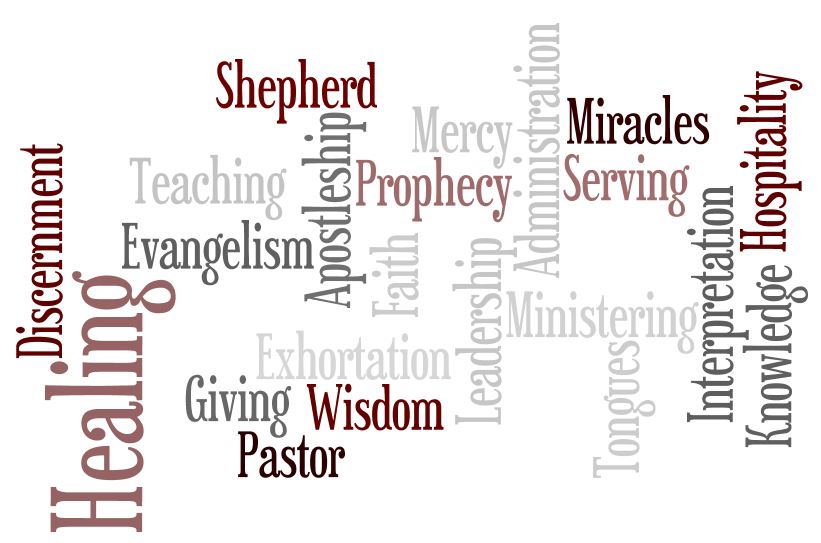
Near the end of this booklet, Dart addresses the idea of spiritual gifts in the church. He argues that because “There are diversities of gifts, but the same Spirit” that no one should be exulted or demeaned based on the gift they do or do not have, i.e. women should not be looked down on because they do have a gift/calling to preach. Quoting page 38, “there are many other gifts that are vital to the church — faith, healing, prophecy, discernment, and especially the greatest gift of all, love.”
Should God's Daughters Prophesy? marissabaker.wordpress.comThis surprised me a bit, because I know of people who wouldn’t include “prophecy” in a list of gifts that women might have. If you go with “inspired speaking” as the meaning of “prophecy” in this context, that’s too close to preaching and teaching for them to be comfortable with the idea of women being involved.

Yet God would not give someone a gift He did not intend them to use, and we can see quite clearly in Acts 21:9 that Philip the Evangelist “had four virgin daughters who prophesied.” This word translated “prophesied” is the Greek propheuo (G4395) and it can either mean “to foretell things to come” or “to tell forth God’s message.” A prophet in this sense is “one who speaks out the counsel of God with the clearness, energy, and authority which springs from the consciousness of speaking in God’s name and having received a direct message from Him to deliver” (Zodhiates). Women may not have been giving sermons in church, but they were not keeping silent about God’s message.

Another example in the New Testament of women prophesying is found on the Day of Pentecost in Acts 2. The opening verses say “they were all with one accord in one place” and that “they were all filled with the Holy Spirit and began to speak with other tongues, as the Spirit gave them utterance” (Acts 2:1, 4). We know from Acts 1:14 that this “all” included women, which is also mentioned when Peter explains what is going on.

But this is what was spoken by the prophet Joel: “And it shall come to pass in the last days, says God, that I will pour out of My Spirit on all flesh; your sons and your daughters shall prophesy, your young men shall see visions, your old men shall dream dreams. And on My menservants and on My maidservants I will pour out My Spirit in those days; and they shall prophesy.” (Acts 2:16-18)

My Gift?

I first became interested in exactly what the word “prophecy” refers to several years ago. There was a Bible study in our local church group about discovering your spiritual gifts. A quiz was passed out to help point you in the right direction, and my result was tied between the “cognitive” gift of prophecy and the “emotional” gift of mercy/compassion. I’m starting to see the mercy/compassion side more now as I become more aware of strengths in my personality type. The prophecy part, though, has been terribly confusing for me.

The word translated “prophecy” in the spiritual gifts passage in 1 Corinthians 12 is propheteia (G4394), and it is derived from the word used in Acts. The 5th, 6th, and 7th definitions in Zodhiates’ Complete WordStudy Dictionary of the New Testament help shed some light on what someone is supposed to do with a gift of prophecy.

(V) A prophecy is something that any believer may exercise as telling forth God’s word. …

(VI) Prophecy was a distinctive charisma (5486), gift, distinguishable from that of the apostle and the teacher. While the apostle was  a traveling missionary, the prophets and teachers were in general attached to a specific church. … Neither the prophet nor teacher was appointed by the apostles, as were bishops and elders; the gifts were an endowment of the spirit and both fulfilled the function of speaking in the Spirit.

(VII) That which is revealed constitutes a prophecy. The reception of such revelation and its communication did not entail states of rapture or ecstasy accompanied by unintelligible utterances. … Prophecy was a gift exercised with a consciousness of the subject, and it issued in something logically intelligible.

For years I had absolutely no idea what to do with this if it was indeed my gift. This blog has now given me an outlet, but I still wonder if there is something more I ought to be doing. Paul says, “he who prophesies speaks edification and exhortation and comfort to men” (1 Cor. 14:3). By this definition, the role of someone with a gift of prophecy is to build up others, encourage them towards virtue, and to console them. This can certainly be done in writing, and I pray my posts here could be described as words that edify, exhort, and comfort. But that doesn’t quite seem like enough.

I beseech you therefore, brethren, by the mercies of God, that you present your bodies a living sacrifice, holy, acceptable to God, which is your reasonable service. … Having then gifts differing according to the grace that is given to us, let us use them: if prophecy, let us prophesy in proportion to our faith (Rom. 12:1, 6)

Any one have thoughts on this? What should one do if one has the gift of prophecy? As we grow in the faith, our use of the gifts given by God should become more noticeable and effective, right? How should that look in “women professing godliness” (1 Tim. 2:10)?

Ways to Teach

I just quoted part of 1 Timothy 2 where Paul speaks about the conduct of women in the church. Reading on, we come to one of the (in)famous verses about women keeping silent in church.

Let a woman learn in silence with all submission. And I do not permit a woman to teach or to have authority over a man, but to be in silence. For Adam was formed first, then Eve.(1 Tim. 2:11-13)

The focus of these verses seem to be about not upsetting God’s ordained order, much like in 1 Corinthians 14. Because husband and wife relationships model the relationship between Christ and the church, husbands are the head in a marriage (Eph. 5:22-32). It would be indecent for the church to try and take over Christ’s roles, and it would be similarly unseemly for women to “usurp authority over a man” (as the KJV reads). While the conduct of unmarried women is not mentioned directly, I think we can infer that they should also behave in a respectful manner toward men in authority in the church, though no specific man has the authority of a husband over them.

This does not mean women could never teach under any circumstances. The word “teach” here in 1 Timothy 2:12 is didaskalia (G1319). Like prophecy, it is a spiritual gift (Rom. 12:7). Zodhiates says that “Prophecy was a specialized form of teaching,” and has the following to say about differences between the two.

The differences between the two apparently lay in the fact that while prophecy was the utterance of a revelation received directly from God, teaching was the utterance of what one had gained by thought and reflection. The teacher must be led and guided by the Spirit to be a true teacher and have genuine spiritual teaching, but what he said was in a real sense his own. Some prophets were able also to teach, but not all teachers were able to prophesy.

I’m not exactly sure which scriptures he uses to arrive at this distinction, so I quote it as “food for thought” and to segue into connecting teaching and prophecy as what I’ll call “gifts of meaningful instruction.”

We can find several examples of godly women in instructive roles. Both Priscilla and her husband were involved in teaching Apollo (Acts 18:26) and Paul calls them his “fellow workers in Christ Jesus” (Rom. 18:3). There’s the aforementioned daughters of Philip who prophesied (Acts 21:9). We can assume Timothy’s mother and grandmother both taught him (2 Tim. 1:5). Paul instructs older women to be “teachers of good things” and in particular to “admonish the young women” (Tit. 2:3-4). Women are described as praying and prophesying (1 Cor. 11:5). Miriam (Ex. 15:20), Deborah the judge of Israel (Judges 4:4), Huldah (2 Kings 22:14; 2 Chron. 34:22), Isaiah’s wife (Is. 8:3), and Anna (Luke 2:36-37) are all called prophetesses.

Decently and In Order

The important thing to remember if we want to teach as women in the church is that we must still hold to the instructions for godly femininity. If we are not adorned with a “a gentle and quiet spirit” while teaching, then we’re doing something wrong (1 Pet. 3:4). If our teaching challenges proper godly authority or is inconsistent with instruction that believers submit “to one another in the fear of God,” then something’s wrong (Eph. 5:21). We must not contribute to confusion in the church, but “Let all things be done for edification” (1 Cor. 14:26)

Let two or three prophets speak, and let the others judge. But if anything is revealed to another who sits by, let the first keep silent. For you can all prophesy one by one, that all may learn and all may be encouraged. And the spirits of the prophets are subject to the prophets. For God is not the author of confusion but of peace, as in all the churches of the saints.

Let your women keep silent in the churches, for they are not permitted to speak; but they are to be submissive, as the law also says. And if they want to learn something, let them ask their own husbands at home; for it is shameful for women to speak in church. (1 Cor. 14:29-35)

Both the booklet I referenced at the beginning of this post and Zodhiates’ commentary in my study Bible agree that this instruction of silence for women is specific rather than general. The church at Corinth apparently had a problem with maintaining order in church gatherings. The phrase “keep silent” is also used in verse 28 to instruct a man who speaks in an unknown tongue to stay silent if no interpreter is present.

Should God's Daughters Prophesy? marissabaker.wordpress.comThe word “to speak” used in this chapter is laleo (G2980) which, depending on the context, can simply mean to utter words or “to talk at random.” In the context of verse 34, Zodhiates says it should be interpreted as “uttering sounds that are incoherent and not understood by others.”  It is less an instruction for women to never speak, than it is a warning not to babble meaninglessly just for the sake of being heard.

I also find the emphasis on asking their husbands “if they want to learn something” interesting. That seems to indicate some women were interrupting the church meeting to ask clarifying questions or to debate something they really didn’t understand. That would conflict with Paul’s wrap up for this chapter: “Let all things be done decently and in order” (1 Cor. 14:40)

But I want you to know that the head of every man is Christ, the head of woman is man, and the head of Christ is God. Every man praying or prophesying, having his head covered, dishonors his head. But every woman who prays or prophesies with her head uncovered dishonors her head, for that is one and the same as if her head were shaved. (1 Cor. 11:3-5)

I’m not going to get into the head coverings discussion. I just want to point out here that Paul was discussing “God’s ordained order” (as my study Bible titles this section) and the fact of women praying and prophesying was mentioned rather casually. It is not the subject of this passage — it’s simply accepted as one of the things both men and women were doing in the church. There is a right way and a wrong way to pray or prophesy, but both men and women were speaking about God’s message. As far as  I can tell, we should be doing this still.

I don’t know for sure what this should look like in the churches today. I’m not ready to advocate women giving formal sermons, but women are studying their Bibles and many of us are learning things we feel like we should be sharing. There have to be more ways for us to serve than by supervising the snack table.

Spiritual Persecution

In the sermon I referenced in last week’s post, the speaker briefly touched on a point that I wanted to make the subject of further study. Since I also needed a topic for today’s post, I decided to “kill two birds with one stone,” as the saying goes. This first section is going to summarize relevant parts of that sermon, then I’ll move on to my own thoughts on the subject.

In 2 Timothy 3:12, Paul writes that “all who desire to live godly in Christ Jesus will suffer persecution.” There are no exceptions. However, as this speaker pointed out, we can all name Christians we know of who went through life without having to face the kind of persecutions mention at the end of Hebrews 11. His conclusion, from bringing in Ephesians 6:12, is that this verse includes persecutions from a spiritual source.

Not Against Flesh and Blood

The Armor of God passage in Ephesians talks about arming ourselves for our struggle against sin as if for war. It also gives us important information about who our enemies are and what must be done to overcome them.

Finally, my brethren, be strong in the Lord and in the power of His might. Put on the whole armor of God, that you may be able to stand against the wiles of the devil. For we do not wrestle against flesh and blood, but against principalities, against powers, against the rulers of the darkness of this age, against spiritual hosts of wickedness in the heavenly places. Therefore take up the whole armor of God, that you may be able to withstand in the evil day, and having done all, to stand. (Eph. 6:10-13)

In his commentary on this passage, Matthew Henry describes the kind of assault we can expect from this type of enemy, who he describes as “subtle,”an enemy who uses wiles and stratagems.”

They are spiritual enemies: Spiritual wickedness in high places, or wicked spirits, as some translate it. The devil is a spirit, a wicked spirit; and our danger is the greater from our enemies because they are unseen, and assault us ere we are aware of them. The devils are wicked spirits, and they chiefly annoy the saints with, and provoke them to, spiritual wickednesses, pride, envy, malice, etc. … They assault us in the things that belong to our souls, and labour to deface the heavenly image in our hearts; and therefore we have need to be upon our guard against them. We have need of faith in our Christian warfare, because we have spiritual enemies to grapple with, as well as of faith in our Christian work, because we have spiritual strength to fetch in. Thus you see your danger.  (Eph. 6:10-18, 1. [3])

Overcoming Through Christ

"Spiritual Persecution" marissabaker.wordpress.com
image from Stock.xchng

Seeing our danger is one step toward overcoming the adversary. We can’t fight something if we don’t recognize that is is putting us in peril. As in other areas of our lives, our focus should be on spiritual, not physical things. It is hard to be on guard spiritually if we are too focused on physical safety. Are we more worried about keeping our hearts, minds, and spirits safe than we are about protecting our lives? Perhaps this is one reason we are told, “do not worry about your life” (Matt. 6:25). To much focus on the physical distracts us from the importance of our spiritual future, the condition of our spiritual lives, and the danger from our spiritual enemy.

Be sober, be vigilant; because your adversary the devil walks about like a roaring lion, seeking whom he may devour. Resist him, steadfast in the faith, knowing that the same sufferings are experienced by your brotherhood in the world. (1 Pet. 5:8-9)

We must be on constant guard, steadfast in faith, and strong in the power of our Lord Jesus Christ. The line right before this warning about our adversary reminds us where our true strength come from: “humble yourselves under the mighty hand of God, that He may exalt you in due time, casting all your care upon Him, for He cares for you” (1 Pet. 5:6-7). To win a fight against a spiritual enemy and endure spiritual persecutions, we need the aid of our Spiritual Savior. When we fully submit to God, we can say along with Paul, “I can do all things through Christ who strengthens me” (Phil. 4:13).