Replacing Worry (Lessons from Zephaniah)

We live in the midst of a dangerous, confusing world, and it’s getting worse as we move ever closer to the time of Christ’s return.

And you will hear of wars and rumors of wars. See that you are not troubled; for all these things must come to pass, but the end is not yet. For nation will rise against nation, and kingdom against kingdom. And there will be famines, pestilences, and earthquakes in various places. All these are the beginning of sorrows. (Matt. 24:6-8)

Our first instinct when things get bad is to worry and panic. This is precisely what we’re told not to do. Easier said than done, though, isn’t it? Worry’s not something you can just turn off — you have to replace it with something else.

No Reason for Fear

Zephaniah prophesied during the reign of King Josiah, so things were going pretty well at the time for the nation of Judah. Even so, he warned about a time much like our own when things would start looking pretty bleak for God’s people. In the midst of these dark prophecies, though, Zephaniah’s book gives great reason for not giving in to fear.

In that day it shall be said to Jerusalem: “Do not fear; Zion, let not your hands be weak. The Lord your God in your midst, the Mighty One, will save; He will rejoice over you with gladness, He will quiet you with His love, He will rejoice over you with singing.”(Zeph. 3:16-17)

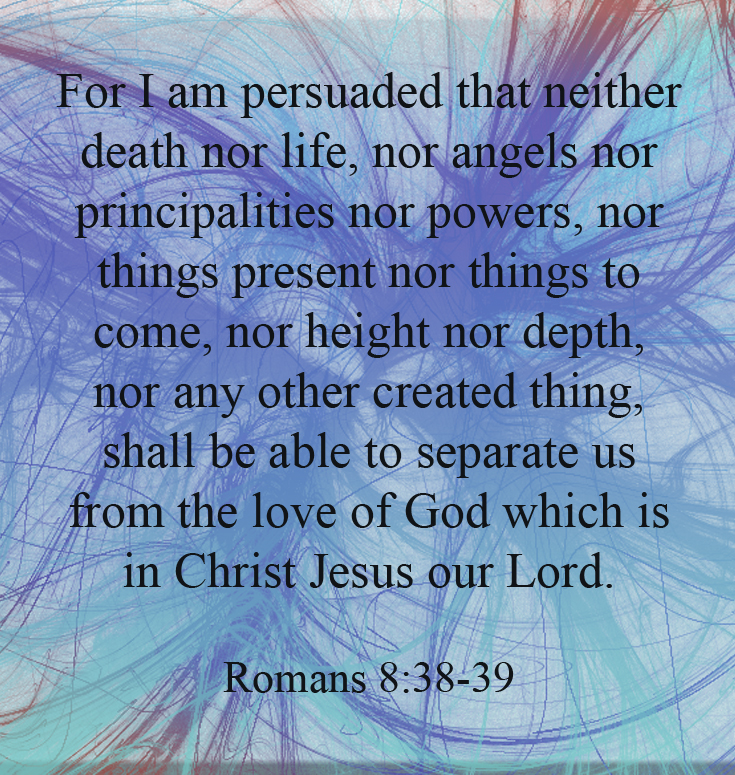
Replacing Worry | marissabaker.wordpress.comGod doesn’t just tell us not to have fear. He gives us assurances designed to make fear impossible. “Fear not” because God Himself is with you to save you. “Fear not” because of His steadfast love, which Paul says nothing can separate us from (Rom. 8:35-39). “Fear not” because the Lord delights in you (Deut. 10:15; Is. 62:4).

He Himself has said, “I will never leave you nor forsake you.” So we may boldly say: “The Lord is my helper; I will not fear. What can man do to me?” (Heb. 13:5-6)

I still struggle with removing fear on a practical level, but abstractly I know fear simply doesn’t make sense for a Christian. The God who created the universe personally guarantees that He won’t abandon you. I always find things I’m scared of less frightening if there’s a good friend beside me, and what better friend could we have to cling to for assurance and stability in times of fear than God Himself?

Live By Faith

We replace worry with faith by consistently turning to God.

Seek the Lord, all you meek of the earth, who have upheld His justice. Seek righteousness, seek humility. It may be that you will be hidden in the day of the Lord’s anger. (Zeph. 2:3)

Seeking after God and consistently following His commands is the best way to get close to Him, which is the best place to be in times of trouble. No matter what happens, our focus must stay on God as we live by faith.

Therefore you also be ready, for the Son of Man is coming at an hour you do not expect. (Matt. 24:44)

Living without fear doesn’t involve burying our heads in the sand and ignoring things that might make us afraid. Rather, it involves a watchful readiness while living in the faith and confidence of our Messiah.

Who then is a faithful and wise servant, whom his master made ruler over his household, to give them food in due season? Blessed is that servant whom his master, when he comes, will find so doing. (Matt. 24:45-46)

Replacing Worry | marissabaker.wordpress.comWhen we stand before Christ at the end of this earth or the end of our lives — whichever comes first — we want to be found “so doing.” Consistent growth and faithfulness will be rewarded.

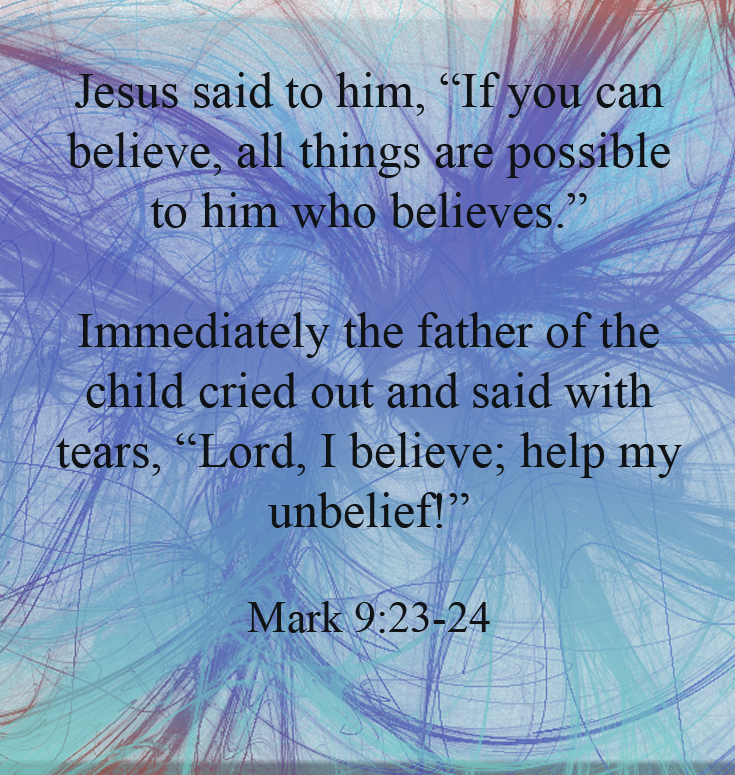
But what if you’re lacking in faith, and still suffering from worry? Ask God for help. He won’t turn down a sincere plea for help, even if it’s help with our unbelief.

 But let him ask in faith, with no doubting, for he who doubts is like a wave of the sea driven and tossed by the wind. For let not that man suppose that he will receive anything from the Lord; he is a double-minded man, unstable in all his ways. (James 1:6-8)

Brethren, let us pray for stability in our walk with God — to be grounded so firmly on the Rock of Jesus Christ that we won’t be tossed about with fear. Wavering and worry go hand-in-hand, and we need God’s help to overcome that and “continue in the faith, grounded and steadfast” (Col. 1:23).

Are Yoga and Meditation Okay For Christians?

I do yoga. I am a Christian.

This doesn’t bother me or seem like a contradiction. I avoid yoga teachers that give me “the creeps,” I’m so much healthier than I was before I started yoga (physically and in terms of dealing with anxiety), and far as I can tell it hasn’t had any sort of negative effect on my walk with God. But it bothers other Christians, so I don’t post about yoga on Facebook and rarely talk about it except with friends who I know also practice yoga.

Last week, a friend posted a link to this article: New Age, Occultism, and Our Children in Public Schools, which is an excerpt about yoga and meditation from the book How to Protect Your Child From the New Age and Spiritual Deception by Berit Kjos. In general, I tend to think writers like this are over-reacting in how they talk about yoga. Proponents of natural healing don’t refuse to use a medicinal herb because it was once linked with a religious healing ritual, so why should I worry that the asanas (physical movements of yoga) have roots in Eastern religions?

And yet, my research on the background of yoga has been cursory until very recently. I knew there were aspects of yoga that I was comfortable with (e.g. the movements and focused breathing) and aspects I was not (e.g. transcendental mediation), but I hadn’t done much study of the history and all the practices involved if you fully embrace all levels of yoga. Before I really responded to my fellow, genuinely concerned, Christians, I had to know more. Read more

Struggling With Questions For God (Lessons from Habakkuk)

As I study the minor prophets, I’m struck by how relevant their messages are today. Habakkuk wrestled with much the same questions that trouble believers in our own culture.

O Lord, how long shall I cry, and You will not hear? Even cry out to You, “Violence!” and You will not save. Why do You show me iniquity, and cause me to see trouble? For plundering and violence are before me; there is strife, and contention arises. Therefore the law is powerless, and justice never goes forth. For the wicked surround the righteous; therefore perverse judgment proceeds. (Hab. 1:2-4)

Why would God let a country founded on His law get so bad? How can He stomach the violence and corruption and rampant sin? Why isn’t He listening to us?

Struggling With God

The entire short book of Habakkuk is a back-and-forth between God and His prophet. After Habakkuk opened with his familiar questions, God responded. It wasn’t what Habakkuk was hoping for, though.

Look among the nations and watch — be utterly astounded! For I will work a work in your days which you would not believe, though it were told you. For indeed I am raising up the Chaldeans, a bitter and hasty nation which marches through the breadth of the earth, to possess dwelling places that are not theirs. (Hab. 1:5-6)

Habakkuk's Question | marissabaker.wordpress.comHabakkuk was understandably confused. He wanted action from God, but not this. The Chaldeans were a cruel people and God confirmed that their invasion would be “terrible and dreadful” as they “all come for violence” (Hab. 1:7, 9). Did the punishment really have to be so bad?

Are You not from everlasting, O Lord my God, my Holy One? We shall not die. O Lord, You have appointed them for judgment; O Rock, You have marked them for correction. You are of purer eyes than to behold evil, and cannot look on wickedness. Why do You look on those who deal treacherously, and hold Your tongue when the wicked devours a person more righteous than he? (Hab. 1:12-13)

I find it encouraging to read this and other stories where men of God struggled to understand His will. God is not obligated to explain Himself to man, and yet sometimes He does. He isn’t threatened or irritated by sincere, searching questions.

God’s Answer

What follows in chapter 2 answers Habakkuk’s question about why God would use a heathen nation to punish His own people. It is also a general statement about how God responds to wickedness.

Write the vision and make it plain on tablets, that he may run who reads it. For the vision is yet for an appointed time; but at the end it will speak, and it will not lie. Though it tarries, wait for it; because it will surely come, it will not tarry. (Hab. 2:2-3)

God basically starts out by telling Habakkuk to follow His instructions and be patient. Even when we don’t understand, God expects obedience. He doesn’t just leave Habakkuk with the answer, “Because I said so,” though.

Behold the proud, his soul is not upright in him; but the just shall live by his faith. (Hab. 2:4)

The Lord gives Habakkuk a guide we’re still using today, and which Paul quotes twice (Rom. 1:17; Gal. 3:11). “The just shall live by faith,” but that is not how Israel was living. Earlier, Habakkuk asked why God would punish Israel’s sin using a nation that was even more sinful than they. God points out here that no matter what Habakkuk thought about the Chaldeans, Israel’s sin still deserved judgement.

Chapter 2 proclaims “Woe” to people who are drunken, proud and never satisfied (2:5), to the violent (2:8, 17), to the covetous and those who plan to escape God’s wrath by their own strength (2:9-12), to those who scheme and take advantage of others (2:15-16), and to the idolaters (2:18-19). These problems were not limited to Israel or to a specific time, but God could not let His chosen people continue in such sin.

All For Us

Chapter 3 records a prayer that my study Bible notes was intended for singing as a Psalm and isn’t part of the exchange between Habakkuk and God. Given the subject matter, though, I suspect Habakkuk did write it after mulling over his talk with God and the answers he was given.

O Lord, I have heard Your speech and was afraid; O Lord, revive Your work in the midst of the years! In the midst of the years make it known; in wrath remember mercy. (Hab. 3:2)

Though he accepted God’s answer and knew his nation deserved punishment, there was nothing wrong with Habakkuk asking for mercy. We can do that today as well. His mercy is abundant (1 Pet. 1:3), and He has a long history of pardoning iniquity and holding back His wrath if we come to repentance, and of protecting His people in the midst of trouble.

If you have some extra time, click here to read all of Chapter 3. It’s an interesting picture Habakkuk paints of God — one full of power to execute vengeance, as well as one of a God full of glory and worthy of praise, who always acts for the good of His people even if it’s not how they expected.

You marched through the land in indignation; You trampled the nations in anger. You went forth for the salvation of Your people, for salvation with Your Anointed. You struck the head from the house of the wicked, by laying bare from foundation to neck. (Hab. 3:12-13)

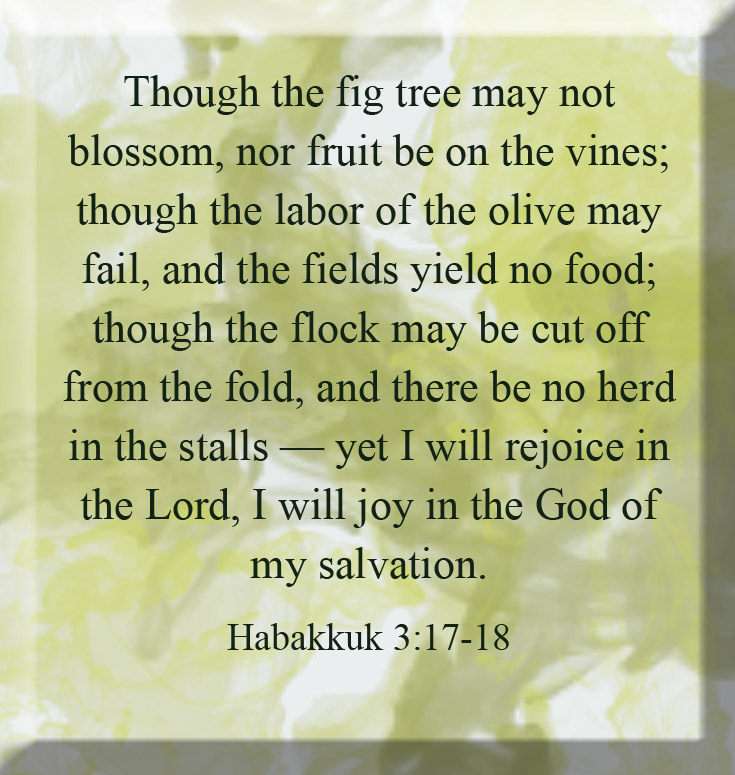
Habakkuk's Question | marissabaker.wordpress.comNo matter how bad it gets, Habakkuk says, “Yet I will rejoice in the Lord, I will joy in the God of my salvation” (Hab. 3:18). We can do the same thing, secure in the knowledge that God is committed to saving us who stay committed to following Him.

The Lord God is my strength; He will make my feet like deer’s feet, and He will make me walk on my high hills. (Hab. 3:19)


Behaviors, Boundaries and Bromance

Is what we consider appropriate behavior and boundaries as Christians based on the Bible, or on our culture?

Clearly, it’s a little of both. We avoid plain “thou shalt nots” (e.g. the culture says sex is great in many contexts; we teach sex is only appropriate in the type of marriage God set up in the garden of Eden), yet we tend to go with what’s culturally appropriate in how we interact with others (e.g. in Western churches we don’t “greet all the brethren with a holy kiss” though Paul and Peter both tell their readers to).

Part of this makes perfect sense. You don’t dress exactly like people did in Bible times because 1) you can’t find ankle-length robes for everyday wear in stores, 2) clothing designed for a Middle Eastern climate isn’t practical world-wide, and 3) these styles would be considered inappropriate or even immodest in some cultural contexts. So we apply the principle of dressing appropriately rather than trying to recreate Biblical fashion.

But what about other topics? How much should we go with what is culturally appropriate verses what is traditionally appropriate in Christian communities?

Brotherly Affection

marissabaker.wordpress.com

After my brother came back from teen camp, I learned that a pastor’s wife was concerned about the hand-holding, arms around shoulders, and hugging going on between the young men at camp. She was especially worried by the use of the term “bromance,” and how the teens’ behavior might be seen in light of the recent Supreme Court decision.

I understand why this upsets adults who have seen their culture change from “men don’t have feelings” to one that encourages male expression of emotion and accepts homosexuality (two things not necessarily related, except in this sort of discussion). I know why young men expressing affection for their guy friends scares middle aged and older adults. I’m just not sure God shares their fears.

Then he [Joseph] fell on his brother Benjamin’s neck and wept, and Benjamin wept on his neck. Moreover he kissed all his brothers and wept over them, and after that his brothers talked with him.(Gen 45:14-15)

Similar scenes play out when Esau and Jacob are reunited (Gen. 33:4), when Joseph sees his father again (Gen. 46:29), when the Prodigal son returns (Luke 15:20), and when Paul says good-bye to the Ephesians elders (Acts 20:36-37). Now, you might say they just got swept away in emotional reunions or partings and that this wasn’t common among friends and brothers, but what about this scene?

When Jesus had said these things, He was troubled in spirit, and testified and said, “Most assuredly, I say to you, one of you will betray Me.” Then the disciples looked at one another, perplexed about whom He spoke. Now there was leaning on Jesus’ bosom one of His disciples, whom Jesus loved. Simon Peter therefore motioned to him to ask who it was of whom He spoke. Then, leaning back on Jesus’ breast, he said to Him, “Lord, who is it?” (John 13:21-23)

Obviously Jesus wasn’t doing anything wrong — He never sinned! Yet if our young men in the church lean against each other at a supper table, we lecture them on the evils of “bromance.” We make a digression every time we teach on 1 Samuel 20 to explain that David and Jonathan weren’t gay and that there’s nothing wrong with close friendships between guys, but then we lecture young men who have close friends? Talk about mixed signals!

There are appropriate and inappropriate ways to interact with other people, but we can’t just make the blanket statement that the Bible forbids physical expressions of affection between two men (or two women, but “besties” aren’t my topic right now). I think we do our young people a grave disservice when we imply that there’s something unnatural about their friendships and make no effort to teach them how to express affection as men and as women. Just saying, “That’s bad, so don’t do it” isn’t going to work–touch is too important as a bonding mechanism among humans and there simply isn’t a Biblical basis for putting distance like that between friends.

Men and Women

All that being said about affection in friendships, there are stricter rules governing the interactions between men and women. I do think it is possible for men and women to be “just friends,” but the closer male and female friends get (physically or emotionally), the harder it is to keep the friendship casual. God created men and women to be attracted to each other–the very first human relationship was a romantic one (Gen. 2:18-24).

I find it interesting that in Genesis 20, when Abimelech takes Sarah away from Abraham thinking she is his sister, that God tells Abimelech in a dream, “I also withheld you from sinning against Me; therefore I did not let you touch her” (Gen 20:6). While this Hebrew word can euphemistically mean “to lie with a woman,” it’s not the typical word used for sex in the bible. Rather, it’s the word used to command Adam and Eve not to touch the forbidden fruit (Gen 3:3). For Abimelech, just touching another man’s wife would have been sin even though he did it in ignorance.

Flee sexual immorality. Every sin that a man does is outside the body, but he who commits sexual immorality sins against his own body. Or do you not know that your body is the temple of the Holy Spirit who is in you, whom you have from God, and you are not your own? For you were bought at a price; therefore glorify God in your body and in your spirit, which are God’s. (1 Cor. 6:18-20)

Though I appreciate the fact that we now live in a culture where I can give my guy friends a quick hug when I see them or put a hand on their shoulders in comfort, I wonder sometimes if we’ve reacted so strongly against the whole courtship idea of “never touch someone of the opposite sex” that boundary lines are becoming blurred.

More and more often at church events, I’m seeing guys and girls hanging on each other, sitting in each other’s laps and cuddling. Some of this is more than is even culturally acceptable among people who are “just friends,” and it confuses people when you try to explain you’re not in a romantic relationship (sometimes, it even confuses one of the two people involved in the friendship). I see no evidence that the Bible encourages or permits unrelated men and women to be as affectionate toward one another as they would be with their male or female friends.

Do not rebuke an older man, but exhort him as a father, younger men as brothers, older women as mothers, younger women as sisters, with all purity. (1 Tim. 5:1-2)

Notice that not only should we treat our brethren as family, but that we should do so “with all purity.” The woman in Song of Solomon wishes her beloved were seen by others as her brother so she could show him affection in public (Song. 8:1-2) — implying we can show our relatives a level of affection that would be inappropriate among friends and brethren (just as there are things you don’t do with your friends or siblings because they progress to a deeper level of intimacy only allowed in marriage).

Physical touch implies a certain level of intimacy, and different touches belong to different levels of closeness. I use this in my fiction writing all the time — a touch on the arm signals two people are comfortable with each other, an arm around the shoulder is a more intimate boundaries-invading touch that you don’t let just anyone do, hands on someone’s waist or lower back is even closer, and touching someone’s face is extraordinarily intimate (in writing romantic scenes, this often accompanies a kiss). We need to be aware of what our touch is communicating to people–both those we’re interacting with, and those observing us.

Judging What’s Right

In addition to the explicit and implied Biblical guidelines for interacting with same-sex and opposite-sex friends, there are a few other principles we need to consider.

Prove all things; hold fast that which is good. Abstain from all appearance of evil. (1 Thes. 5:21-22, KJV)

We’re not supposed to do things that appear evil or may be perceived as sin, even if we think it’s right and acceptable —  “do not let your good be spoken of as evil” (Rom. 14:16). Let’s say you’re a young person and you know in your heart that hugging and cuddling with your best friend is part of a pure, godly relationship. But what do you do if several people confront you about it, saying that it appears wrong and it’s causing other young people to stumble?

Therefore let us not judge one another anymore, but rather resolve this, not to put a stumbling block or a cause to fall in our brother’s way. (Rom. 14:13)

The freedom we feel knowing we did nothing immoral isn’t always enough. If it’s a question of whether or not to follow a clear command, then we always “ought to obey God rather than men” (Acts 5:29). But if it’s a case of something being permitted rather than commanded, we have to use our best judgement and think about how it impacts others.

There’s nothing “wrong” with a group of close male friends sharing hugs and acting closer than brothers. There’s nothing “wrong” with two female friends sharing a close, affectionate relationship. There’s nothing “wrong” with a woman greeting her brother in Christ with a chaste hug. But all these things can have a hurtful affect if we’re not careful. Just as a couple examples, how do our relaxed boundaries in female friendships affect women struggling with homosexual desires? how does a girl’s feeling that it’s okay to give her guy friends long hugs play with their emotions (or vice versa)? how do “bromances” affect the members of Christ’s body who are offended by the casual play on words?

It is good neither to eat meat nor drink wine nor do anything by which your brother stumbles or is offended or is made weak. Do you have faith? Have it to yourself before God. Happy is he who does not condemn himself in what he approves. But he who doubts is condemned if he eats, because he does not eat from faith; for whatever is not from faith is sin. (Rom. 14:21-23)

God is watching to see why we do what we do. He’s looking for faith, purity of heart, and a concern for how our actions affect other people. This might be as simple as young men avoiding the word “bromance,” two girls putting an arm around each other’s shoulders instead of sitting in each others laps, or guys and girls giving each other quick hugs instead of an embrace. Or it might require more thoughtfulness and self-examination about how your boundaries and behaviors are affecting other people, and yourself.

Update 9/22/2017: I don’t mean to imply that we must conform ourselves to other people’s standards. We are told to show consideration for our brethren and not do things with the intent that they stumble into sin, but our primary concern should be following God. So if we are going to do something that other Christians may consider unacceptable  we should be able to respectfully respond to them with Biblical evidence that we are behaving in a right and proper manner in God’s eyes. We don’t have to change just to make them happy but we should be able to support our actions from the Bible, just as we’d expect someone who asked us to change something to support their request from the Bible.

marissabaker.wordpress.com

Credits: Background picture for the images used in this post by Hernán Piñera, CC BY-SA via Flickr.

Save

Avenging and Saving (Lessons from Obadiah)

Avenging and Saving | marissabaker.wordpress.comObadiah is the shortest book in the Old Testament, and so far the most difficult for me to write about. When I started reading through and studying the minor prophets, I figured I should be able to come up with at least one blog post on each, since “All Scripture is given by inspiration of God, and is profitable for doctrine, for reproof, for correction, for instruction in righteousness” (2 Tim. 3:16).

About 300 years ago, Matthew Henry’s verse-by-verse commentary covered Obadiah in humbling detail. Reading it made me marvel at the depth of his appreciation for God’s word (he wouldn’t have any trouble coming up with 3 or 4 posts on Obadiah). Where I saw a prophecy against Edom, he saw (among other things) a record of God’s motivation for vengeance, promises of a bright future for God’s people, and some warnings for us as well.

“Vengeance is Mine”

The “vision of Obadiah” is about what the Lord God has to say “concerning Edom,” and none of it’s good.

Though you ascend as high as the eagle, and though you set your nest among the stars, from there I will bring you down,” says the Lord. (Oba. 1:4)

All their allies will turn against them (verse 7), all their wisdom be destroyed (verse 8), and their warriors slaughtered (verse 9). Why such a strong condemnation from our loving God?

For violence against your brother Jacob, shame shall cover you, and you shall be cut off forever. (Oba. 1:10)

God does not look kindly on those who persecute the people He loves, or on those who betray and do violence against family on an individual or national scale. Matthew Henry has this to say:

that one single crime which is laid to their charge, as filling their measure and bringing this ruin upon them, that for which they here stand indicted, of which they are convicted, and for which they are condemned, is the injury they had done to the people of God …. Note, Injuries to men are affronts to God, the righteous God, that loveth righteousness and hateth wickedness; and, as the Judge of all the earth, he will give redress to those that suffer wrong and take vengeance on those that do wrong. (Matthew Henry, notes on Obadiah 1:10-16)

In Luke 18, Christ gives a parable about how even an unjust judge will seek justice on behalf of persistent petitioners. How much more will the just God “speedily” “avenge His own elect who cry out day and night to Him” (Luke 18:7-8)? Even with these reassurances, though, it can be hard to wait on God. If someone hurt us, we want to hurt them back (or at least see them get their just desserts), and we wonder why it seems like God is taking so long to fulfill His promises. I’m sure that’s how the Israelites felt when they were attacked by enemies then looted and captured by Edom after thinking they’d escaped (Oba. 1:12-14).

Beloved, do not avenge yourselves, but rather give place to wrath; for it is written, “Vengeance is Mine, I will repay,” says the Lord. (Rom. 12:19)

When we are struggling to believe that God is there for us, we can look to past examples of God’s deliverance and avenging role for comfort. He does not abandon, and He does not forget.

The righteous God will render both to nations and to particular persons according to their works; and the punishment is often made exactly to answer to the sin, and those that have abused others come to be themselves abused in like manner. The just and jealous God will find out a time and way to avenge the wrongs done to his people on those that have been injurious to them. (Matthew Henry, notes on Obadiah 1:10-16)

Be A Savior

Of course, this has a warning side as well: don’t be the person who God has to seek vengeance against. If we believe God will avenge His people, then we also should believe that there will be consequences if we go around hurting our brethren.

Millstone -- not something you'd want hung around your neck. Photo credit: Frerk Meyer, CC BY-SA
Millstone — not something you’d want hung around your neck. Photo credit:
Frerk Meyer, CC BY-SA

Whoever causes one of these little ones who believe in Me to sin, it would be better for him if a millstone were hung around his neck, and he were drowned in the depth of the sea. (Matt. 18:6)

This is a serious warning. Yet how many times are children scolded in churches for minor transgressions that really boil down to the fact that they’re not adults? How many new converts are made to feel insignificant, unwelcome and devalued because they don’t already know something about our church? How often do supposedly mature Christians squabble, back-bite and spread division?

 For all the law is fulfilled in one word, even in this: “You shall love your neighbor as yourself.” But if you bite and devour one another, beware lest you be consumed by one another! (Gal. 5:14-15)

Matthew Henry follows this principle of “being aware” when discussing the Edomites’ transgressions listed in Obadiah. When reading the things God told the Edomites they “should not” have done, Henry turns it around on us.

Note, In reflecting upon ourselves it is good to compare what we have done with what we should have done, our practice with the rule, that we may discover wherein we have done amiss, have done those things which we ought not to have done. We should not have been where we were at such a time, should not have been in such and such company, should not have said what we said, nor have taken the liberty that we took. Sin thus looked upon, in the glass of the commandment, will appear exceedingly sinful. (Matthew Henry, notes on Obadiah 1:10-16)

We want the whole “vengeance is Mine” thing to work on our behalf, but we dare not forget that it can be directed against us as well. If we love God, we will keep His commandments and need not fear Him, but we must always have a healthy respect for Him and His immutable laws.

 For we know Him who said, “Vengeance is Mine, I will repay,” says the Lord. And again, “The Lord will judge His people.” It is a fearful thing to fall into the hands of the living God. (Heb. 10:30-31)

We don’t often like to think of this side of God, but He can be really scary. Christ is the Lion of the tribe of Judah, not a housecat. That’s Someone you want fighting for you, not against you — and that’s what He wants as well.

Then saviors shall come to Mount Zion to judge the mountains of Esau, and the kingdom shall be the Lord’s. (Oba. 1:21)

The mountain of Zion shall be saved; on it saviours shall come, the preachers of the gospel, who are called saviours, because their business is to save themselves and those that hear them; and in this they are workers together with Christ, but to little purpose if he by his grace did not work together with them. (Matthew Henry, notes on Obadiah 1:17-21)

That’s what we want — to be saved and to have the privilege of serving alongside Christ to save others. Let’s not endanger that by seeking vengeance for ourselves, attacking our brethren, or drifting away from God’s laws. Rather, let’s trust in God and strive to work alongside Jesus to help others.

Thoughts on John 9

I don’t often spend most of a week studying just one chapter of the Bible, but John 9 captured my attention and didn’t let go. It is the story of Jesus healing a blind man, and unlike many miracles which are recorded in just a few short verses, this story takes up an entire 41-verse chapter.

This chapter is packed full of interesting things to learn. I focused on three main points that I noticed for this post, but I’m sure there’s more. If anyone else feels moved to study John 9, I’d love to hear your thoughts!

A Reason For Suffering

Now as Jesus passed by, He saw a man who was blind from birth. And His disciples asked Him, saying, “Rabbi, who sinned, this man or his parents, that he was born blind?”

Jesus answered, “Neither this man nor his parents sinned, but that the works of God should be revealed in him. (John 9:1-3)

The assumption the disciples made is all too common, even today — that the bad things which happen to us and others are a kind of punishment. Sometimes, however, God allows trials of various sorts to affect us because they fit into His plan for doing good. In this particular case, the man’s blindness was used to introduce him to Jesus and demonstrate to other people that Jesus is the Son of God.

It worked, too. This healing caused a huge stir in the Jewish community. This was partly because of the spectacular nature of the miracle, and partly because Jesus healed on the Sabbath. As the Word of God, Jesus was the One who told Israel about the Sabbath in the first place — He knew how to keep it holy. Doing good on the Sabbath wasn’t a sin, but it did anger the Pharisees because it violated some rules they’d added.

 Therefore some of the Pharisees said, “This Man is not from God, because He does not keep the Sabbath.” Others said, “How can a man who is a sinner do such signs?” And there was a division among them. (John 9:16)

Though they publicly condemned Jesus, they weren’t so sure behind the scenes. This miracle made them think, and I wonder if some of them eventually became believers. Nicodemus couldn’t have been the only Pharisee wondering if maybe, just maybe, Jesus really was the Christ (John 3:1-2).

A Simple Testimony

After he was healed, the man who’d been blind doesn’t leap, shout, and tell everyone what happened. He didn’t do anything to call attention to himself, and only talked about the miracle when people started asking him what happened.

He answered and said, “A Man called Jesus made clay and anointed my eyes and said to me, ‘Go to the pool of Siloam and wash.’ So I went and washed, and I received sight.” (John 9:11)

After hearing this, the people took him to the Pharisees and he repeated his story again (verse 15). Not believing him, they called in his parents, who were scared of being excommunicated and wouldn’t say anything except to affirm that he had, indeed, been blind (verse 18-23).

So they again called the man who was blind, and said to him, “Give God the glory! We know that this Man is a sinner.”

He answered and said, “Whether He is a sinner or not I do not know. One thing I know: that though I was blind, now I see.” (John 9:24-25)

I think what the Pharisees were trying to do was convince this guy to say God healed him, and leave Jesus out of it. That never works — for “whoever denies the Son does not have the Father either” (1 John 2:23). When the Pharisees kept pressuring him, this man delivered a very simple testimony that enraged the Pharisees, who prided themselves on their intellect and knowledge of God.

The man answered and said to them, “Why, this is a marvelous thing, that you do not know where He is from; yet He has opened my eyes! Now we know that God does not hear sinners; but if anyone is a worshiper of God and does His will, He hears him. Since the world began it has been unheard of that anyone opened the eyes of one who was born blind. If this Man were not from God, He could do nothing.” (J0hn 9:30-33)

There’s something to be said for paying attention to “the simplicity that is in Christ” (2 Cor. 11:3). The man who went with the simple, obvious explanation — that Jesus is a good man who performed a miracle — was much closer to God than the thoroughly educated church leaders.

A Personal Connection

After testifying to Jesus’ work in his life, the Pharisees excomunicated the formerly blind man (verse 34). This relates back to an earlier verse, which tells us “the Jews had agreed already that if anyone confessed that He was Christ, he would be put out of the synagogue” (John 9:22). This doesn’t sound so bad to us today — if we get kicked out of one church there are plenty more right down the street. In the Jewish culture of Jesus’ time, though, it meant banishment from religious life.

In his definition of aposunagogos (G656), Zodhiates notes that the highest degree of “casting out” (there were three) is “an exclusion from all the rights and privileges of the Jewish people, both civil and religious. The offender was considered as dead.” Jesus warned His followers about this possibility in John 16:2. Following Jesus was a huge, dangerous step for Jews. It meant risking isolation from other people and, if you believed the Pharisees, from God.

Jesus heard that they had cast him out; and when He had found him, He said to him, “Do you believe in the Son of God?”

He answered and said, “Who is He, Lord, that I may believe in Him?”

And Jesus said to him, “You have both seen Him and it is He who is talking with you.”

Then he said, “Lord, I believe!” And he worshiped Him. (John 9:35-38)

We don’t often see examples of Jesus making follow-up visits with people He healed, but it is clear from these verses that He was keeping track of what happened with this man. As soon as He heard about the Jews excommunicating the formerly blind man, Jesus tracked him down to encourage him and confirm his faith. This man was cast out by the Jews, but he was welcomed by the Messiah.

I’m touched by the personal attention Jesus gave this individual, and the parallels with our own calling. Jesus healed him, apparently without being asked to, and changed his whole life. In much the same way, God may call us when we’re not even looking for Him and don’t know how desperately we need His life-changing power.

This healing opened the blind man’s spiritual as well as physical eyes. Many of us today can relate the rejection he experienced when he started to share the story of how Jesus touched his life. I hope we can also relate to the comfort of having a personal connection with this great Being, who doesn’t leave people alone to navigate their new-found faith.