Five Favorite Proverbs

Five Favorite Proverbs by marissabaker.wordpress.comFor our ladies’ book club next month at church, while people are getting caught-up on finding and reading the next book, we are studying Proverbs. This was inspired by the author of our last book, Liz Curtis Higgs, who is working through a 50 Favorite Proverbs Bible study on her blog. We’re each planning to bring a single Proverb to the group and talk about it. I’ve been preparing for this by reading Proverbs, and I’ve already found many more favorite proverbs than just one. Since I can’t take them all to our book club, I’ve decided to blog about them. I’ve selected five from the first ten chapters of Proverbs to share here.

In other news, my father has started a blog called Baptism For Life. If you like my Christian posts every Saturday, you’ll probably like his writings.

1: Repentance

Turn at my rebuke; surely I will pour out my spirit on you; I will make my words known to you. (Prov. 1:23)

This is wisdom personified and speaking, but I think from the way it is written (and the fact that, as scripture, it is inspired by Him) we can attribute these words to God. It is a promise, and a call to repentance. If we turn when we hear His reproof, instead of ignoring Him, He will pour out His spirit on us and teach us by revelation.

2: Security

But whoever listens to me will dwell safely, and will be secure, without fear of evil.” (Prov. 1:33)

This is a comforting reassurance of God’s protection for those who serve him — both to give them safety and to guard them from anxiety. Psalm 112:7 says, “He will not be afraid of evil tidings; his heart is steadfast, trusting in the Lord.” It is not necessarily that we will be protected from every bad thing, but a promise that God will be there for us through every thing. His peace “will guard your hearts and minds through Christ Jesus” (Phil. 4:7).

3: Fearless

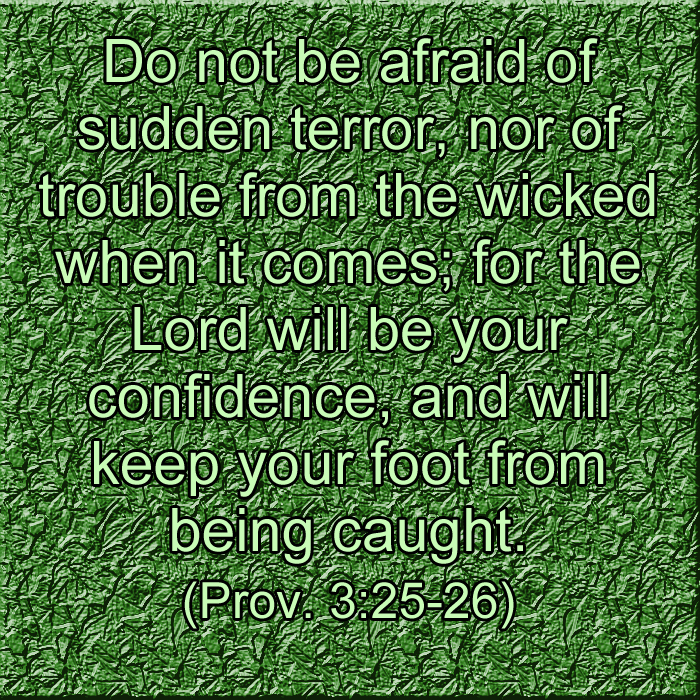
Do not be afraid of sudden terror, nor of trouble from the wicked when it comes; for the Lord will be your confidence, and will keep your foot from being caught. (Prov. 3:25-26)

I’ve always been partial to, and comforted by, the “do not fear verses.” I struggle with fear and anxiety, but it comforts me beyond measure to know that I can turn that fear over to my Protector, who is the most powerful Being in existence. His is our confidence, and no one is able to take us out of His hands (John 10:28-29).

4: Relationship

My son, keep your father’s command, and do not forsake the law of your mother. Bind them continually upon your heart; tie them around your neck. When you roam, they will lead you; when you sleep, they will keep you; and when you awake, they will speak with you. (Prov. 6:20-22)

I love this scripture necklace, and I plan to get one as soon as I can decide what verse I want (anything up to 50 characters). The artist is an Etsy seller.

As Liz Curtix Higgs said when writing about Proverbs 3:3 (which I would list as a favorite, but she covered it thoroughly in her post), we need to keep God’s words close to us. We need to read and study the Bible, continually binding it to our hearts, fall asleep with God’s words in our minds, and wake to let Him talk to us again. We might, as she also suggested, quite literally wear them around our necks.

5: Love

Hatred stirs up strife, but love covers all sins. (Prov. 10:12)

When I read this verse, I wondered why it wasn’t the first thing that came to mind when I thought of favorite Proverbs. The conditions of our heart spill out into our lives, either to stir up strife or to promote peace. When Peter quotes this proverb, he says “above all things have fervent love for one another, for ‘love will cover a multitude of sins'” (1 Pet. 4:8). This, along with 1 Corinthians 13, express how very important love is — “above all things.” We must be on guard that our lives are expressions of love that covers sin and promotes peace, rather than expressions of hatred that leads to discord.

What are some of your favorite Proverbs? Why do those verses speak to you?
Forgetting God

I was reading Hosea early this week when two phrases jumped out at me from this verse:

My people are destroyed for lack of knowledge. Because you have rejected knowledge, I also will reject you from being priest for Me; because you have forgotten the law of your God, I also will forget your children. (Hos. 4:6)

The phrases were “rejected knowledge” and “thou hast forgotten the law of God.” I also accidentally loaded an NIV translation which renders the word “forgotten” as “ignored.” I’m not sure which translation I like better — forgetting makes me think of gradually letting something slip your mind because you don’t think about it, while ignoring sounds more like a conscious choice. Either way, it is a dangerous thing to do with God’s law.

Hear the word of the Lord, you children of Israel, for the Lord brings a charge against the inhabitants of the land: “There is no truth or mercy or knowledge of God in the land.” (Hos. 4:1)

Destruction comes upon those who reject knowledge of God, and who forget God’s law. It is so very important that we continue to grow in knowledge of God and keep His commandments.

Knowledge of God

According to my study Bible, the Hebrew word translated “knowledge” is H1847 dha’ath. it refers to knowledge gained through the senses, and is the opposite of “folly.” Meanings include knowledge, insight, intelligence, understanding, and wisdom. “Knowledge of God,” Zodhiates writes, “describes the proper relationship between God and a man who truly obeys Him.”

"Forgetting God" by marissabaker.wordpress.comAnd this is eternal life, that they may know You, the only true God, and Jesus Christ whom You have sent. (John 17:3)

Jesus answered and said to him, “If anyone loves Me, he will keep My word; and My Father will love him, and We will come to him and make Our home with him. (John 14:23)

Knowledge of God increases as we grow into a closer relationship with Him. They are inseparably connected. If we reject knowledge of God, we reject a relationship with Him. As pointed out in the definition of dha’ath, a relationship with Him is dependent on keeping His laws. God cannot be in fellowship with a person who is walking contrary to Him.

And after all this, if you do not obey Me, but walk contrary to Me,then I also will walk contrary to you in fury; and I, even I, will chastise you seven times for your sins. (Lev. 26:27-28)

Do Not Forget

Take heed to yourselves, lest you forget the covenant of the Lord your God which He made with you, and make for yourselves a carved image in the form of anything which the Lord your God has forbidden you. (Deut. 4:23)

The Israelites were commanded, multiple times, to remember all God had done for them, and to teach their children His laws “That they may set their hope in God, and not forget the works of God, but keep His commandments” (Ps. 78:7). But “they forgot God their Savior,” and did not teach His laws to their children (Ps. 106:21). This set up generational cycles of forsaking God, punishment, repentance and forgiveness, and then forgetting God again.

Can a virgin forget her ornaments, or a bride her attire? Yet My people have forgotten Me days without number. (Jer. 2:32)

"Forgetting God" by marissabaker.wordpress.comCan you feel God’s heartbreak in this verse? His presence is what made His people beautiful and His grace clothed them in dignity, yet they cast Him away (Ezk. 16:8-14). It’s as unthinkable as a bride forgetting to put on her wedding dress before walking down the aisle, but it happened over and over again.

In Psalm 50, God addresses the wicked who “hate instruction” and  “cast My words behind you,” asking them “What right have you to declare My statutes, or take My covenant in your mouth?” (Ps. 50:16, 17). These people were thieves, adulterers, liars, slanderers, and evil supporters of others who committed sin (Ps. 50:18-20). Though they knew God’s law, they thought He would overlook their sins — an error He corrects.

These things you have done, and I kept silent; you thought that I was altogether like you; but I will rebuke you, and set them in order before your eyes. “Now consider this, you who forget God, lest I tear you in pieces, and there be none to deliver: whoever offers praise glorifies Me; and to him who orders his conduct aright I will show the salvation of God.” (Ps. 50:21-23)

As this last verse hints, there is an antidote to forgetting God. On the night of His betrayal, Jesus promised His disciples that He would send them the Holy Spirit, which would “teach you all things, and bring to your remembrance all things that I said to you” (John 14:26). Keeping God’s commandments puts us into a right relationship with Him, and gives us access to aid through the Holy Spirit.

The Law of God

To recap (since this has become a long post), God says in Hosea 4:6, “because you have forgotten the law of your God, I also will forget your children.” Keeping God’s law close to our hearts and minds, holding it in remembrance, is key to knowing Him and maintaining a lasting relationship.

The law of the Lord is perfect, converting the soul; the testimony of the Lord is sure, making wise the simple; the statutes of the Lord are right, rejoicing the heart; the commandment of the Lord is pure, enlightening the eyes; the fear of the Lord is clean, enduring forever; the judgments of the Lord are true and righteous altogether. More to be desired are they than gold, yea, than much fine gold; sweeter also than honey and the honeycomb. Moreover by them Your servant is warned, and in keeping them there is great reward. (Ps. 19:7-11)

"Forgetting God" by marissabaker.wordpress.comThis is why it makes no sense to say Jesus Christ did away with the law under the New Covenant. Keeping the commandments is how we show God and Jesus that we love Them (John 14:15, 21, 23; 15:10, 14). We can’t pick-and-choose which parts of the commandments we want to obey, either: “All Scripture is given by inspiration of God, and is profitable for doctrine, for reproof, for correction, for instruction in righteousness, that the man of God may be complete, thoroughly equipped for every good work” (2 Tim. 3:16-17).

“Do not think that I came to destroy the Law or the Prophets. I did not come to destroy but to fulfill. For assuredly, I say to you, till heaven and earth pass away, one jot or one tittle will by no means pass from the law till all is fulfilled. Whoever therefore breaks one of the least of these commandments, and teaches men so, shall be called least in the kingdom of heaven; but whoever does and teaches them, he shall be called great in the kingdom of heaven.” (Matt. 5:17-19)

Jesus warns that breaking “the least of these commandments” will make us “least in the kingdom of heaven.” Other scriptures reveal that a pattern of sin will block us from the kingdom all together (Gal. 5:19-21). Forgetting and rejecting God by turning our backs on keeping His laws is like asking Him to forget about and reject us. But, thankfully for us, the flip-side of this is that showing our love for God by obeying Him puts us into a personal relationship with Him that has incredible, lasting rewards.

He who has My commandments and keeps them, it is he who loves Me. And he who loves Me will be loved by My Father, and I will love him and manifest Myself to him. … If anyone loves Me, he will keep My word; and My Father will love him, and We will come to him and make Our home with him. (John 14:21, 23)

What Makes Us Remarkable

After healing a lame man in Acts 3, Peter and john are brought before the Jewish leaders to explain their actions. After hearing from Peter “that by the name of Jesus Christ of Nazareth … this man stands here before you whole,” the leaders marveled at them.

Now when they saw the boldness of Peter and John, and perceived that they were uneducated and untrained men, they marveled. And they realized that they had been with Jesus. (Acts 4:13)

When looking at Peter and John, the only exceptional thing the Jewish leaders noticed about them was that they had been with Jesus. Even the people working against Christ’s teachings could recognize that being in His presence had changed these fishermen who would otherwise be considered unremarkable.

Wisdom of the Poor Man

Not surprisingly, a similar thing happened to Jesus. He was not what people expected the Messiah to be, and some people rejected Him because He seemed so ordinary.

And when the Sabbath had come, He began to teach in the synagogue. And many hearing Him were astonished, saying, “Where did this Man get these things? And what wisdom is this which is given to Him, that such mighty works are performed by His hands! 3 Is this not the carpenter, the Son of Mary, and brother of James, Joses, Judas, and Simon? And are not His sisters here with us?” So they were offended at Him. (Mark 6:2-3)

"What Makes Us Remarkable" by marissabaker.wordpress.comThese people missed out on knowing the son of God because they rejected the wisdom of the poor man (Ecc. 9:16). All too often, we fall into the trap of rejecting someone because of an unfavorable first impression based on a stereotype rather than actually knowing them. Rejecting someone because of their lack of education and credentials isn’t solely confined to intellectuals, but I’m afraid it’s a trap that educated people might be more likely to fall into than others.  I’m very much in favor of education, but I do agree with this quote by Dr. J. Budziszewski: “there are some forms of stupidity that one must be highly intelligent and educated to commit.”

Now about the middle of the feast Jesus went up into the temple and taught. And the Jews marveled, saying, “How does this Man know letters, having never studied?” (John 7:14-15)

Instead of asking how they could know Jesus better, or listening when He explained that “My doctrine is not Mine, but His who sent Me,” the people accused Him of having a demon (John 7:16-20). Seeing this kind of rejection towards Jesus, it should not surprise us if people reject us as well. Christ warned His followers,

“If the world hates you, you know that it hated Me before it hated you. If you were of the world, the world would love its own. Yet because you are not of the world, but I chose you out of the world, therefore the world hates you. Remember the word that I said to you, ‘A servant is not greater than his master.’ If they persecuted Me, they will also persecute you.” (John 15:18-20)

That’s Not Fair

Not only will we be considered ignorant and foolish by the world for our belief in God, but in addition to that we are not usually remarkable by worldly standards before our calling either.

But God has chosen the foolish things of the world to put to shame the wise, and God has chosen the weak things of the world to put to shame the things which are mighty; and the base things of the world and the things which are despised God has chosen, and the things which are not, to bring to nothing the things that are,  that no flesh should glory in His presence. But of Him you are in Christ Jesus, who became for us wisdom from God — and righteousness and sanctification and redemption — that, as it is written, “He who glories, let him glory in the Lord.” (1 Cor. 27-31)

There’s a verse in Ecclesiastes that I’ve often seen used to talk about how life doesn’t always seem logical or fair that comes to mind in this context.

I returned and saw under the sun that — the race is not to the swift, nor the battle to the strong, nor bread to the wise, nor riches to men of understanding, nor favor to men of skill; but time and chance happen to them all. (Ecc. 9:11)

"What Makes Us Remarkable" by marissabaker.wordpress.comUsually when we talk about the unfairness of life, we only think of what is working against us. But “unfairness” happens in our favor as well. We just read in 1 Corinthians that we’re the weak, base, and poor of the world — where would we be if God only let the swift run the race (Heb. 12:1), only worked with the strong to win battles (Eph. 6:12-12), only fed those who were already wise (Mark. 6:34-42), only gave understanding to rich men (Mark. 10:23-25), and only showed favor to those who are skilled (Ex. 4:10-12)?

Be A Well of Water

I talked about Christ’s meeting with the woman at the well last week. This week, I’d like to focus on a specific verse from that interaction:

But whoever drinks of the water that I shall give him will never thirst. But the water that I shall give him will become in him a fountain of water springing up into everlasting life. (John 4.14)

Jesus told the woman that once He gives someone the gift of living water, they continue to receive a steady supply. We learn more about this a few chapters later.

On the last day, that great day of the feast, Jesus stood and cried out, saying, “If anyone thirsts, let him come to Me and drink. He who believes in Me, as the Scripture has said, out of his heart will flow rivers of living water.” But this He spoke concerning the Spirit, whom those believing in Him would receive; for the Holy Spirit was not yet given, because Jesus was not yet glorified. (John 7:37-39)

Here, we are clearly told this water is the Holy Spirit, and shown that the fountain Jesus spoke of in John 4 isn’t a tiny trickle that supplies just enough water for the person He gives it to — it is enough to supply a river that flows out from people who Christ is working with.

Don’t Stagnate

For you were once darkness, but now you are light in the Lord. Walk as children of light 9 (for the fruit of the Spirit[b] is in all goodness, righteousness, and truth), 10 finding out what is acceptable to the Lord. As I talked about on Monday, we all need outlets to keep from becoming stagnate. We have to share what we have been given. The Holy Spirit is supposed to be flowing through us an manifesting as fruits borne in our lives. “By this My Father is glorified,” Jesus said, “that you bear much fruit; so you will be My disciples” (John 15:8).

The fruit of the Spirit is love, joy, peace, longsuffering, kindness, goodness, faithfulness, gentleness, self-control. Against such there is no law. And those who are Christ’s have crucified the flesh with its passions and desires. If we live in the Spirit, let us also walk in the Spirit. (Gal. 5:22-25)

To briefly re-cap the analogy from Monday’s post, the Sea of Galilee is a source of freshwater because it has both an inflow and an outflow. The Dead Sea, on the other hand, has no outlet and is filled with brackish water. We are like that too. We either flow with Christ’s living water, or we become dead. We can’t be both alive and hoarding God’s gifts all to ourselves — “Does a spring send forth fresh water and bitter from the same opening?” (James 3:11).

Flowing With Life

"Become A Well" by marissabaker.wordpress.comIn 2 Timothy, Paul tells Timothy that he needs to “stir up the gift of God which is in you through the laying on of my hands” because “God has not given us a spirit of fear, but of power and of love and of a sound mind” (2 Tim. 1:6-7). A similar admonition is given to the whole church: “Do not quench the Spirit” (1 Thes. 5:19). There is a very real danger if we do not use the talents that God had given us (Matt. 25:14-20).

Every branch in Me that does not bear fruit He takes away; and every branch that bears fruit He prunes, that it may bear more fruit. (John 15:2)

We do not want to be the ones that the Father prunes out of the True  Vine for lack of fruit. We are to become more and more skillful “in the word of righteousness” and at some point grow to the point that we can “be teachers” (Heb. 5:12-14). We need  to learn this now, because in the future the Church will be teaching alongside Jesus Christ as His bride, living and working with the One who promises, “I will give of the fountain of the water of life freely to him who thirsts” (Rev. 21:6).

And he showed me a pure river of water of life, clear as crystal, proceeding from the throne of God and of the Lamb. (Rev. 22:1)

If we don’t become a well of water now, overflowing with God’s spirit and the fruts thereof, we will not be included in the inhabitants of the city that flows with God’s living water.

Come To The Well

We were talking about The Woman at the Well last week, in the women’s book group at church (we’ve been reading Bad Girls of the Bible by Liz Curtis Higgs). One of the ladies in the group suggested that this meeting in John 4 between Christ and the woman at the well might be symbolically connected with Isaac, Jacob, and Moses all meeting their wives at a well. Does the woman here symbolize the Bride of Christ, and His invitation for us to drink from the well of eternal life?

The Living Water

On Jesus’ journey from Judea to Galilee in John 4, He stops to rest at Jacob’s well. A woman comes to the well and the Lord asks her for a drink. She wonders at this, since men did not normally talk to women and Jews had no dealings with Samaritans. A Jewish man certainly didn’t ask a Samaritan woman for a drink.

“Living Water” by Simon Dewey

Jesus answered and said to her, “If you knew the gift of God, and who it is who says to you, ‘Give Me a drink,’ you would have asked Him, and He would have given you living water.”

The woman said to Him, “Sir, You have nothing to draw with, and the well is deep. Where then do You get that living water? Are You greater than our father Jacob, who gave us the well, and drank from it himself, as well as his sons and his livestock?”

Jesus answered and said to her, “Whoever drinks of this water will thirst again, but whoever drinks of the water that I shall give him will never thirst. But the water that I shall give him will become in him a fountain of water springing up into everlasting life.” (John 4:10-14)

This comparison between the Lord and a fountain or well of living water is not confined to this passage in John’s gospel. (Ps. 36:9; Jer. 2:12-13, 17:13; John 6:35).

Behold, God is my salvation, I will trust and not be afraid; For Yah, the Lord, is my strength and song; He also has become my salvation. Therefore with joy you will draw water from the wells of salvation. (Is. 12:2-3)

An Ambassador

In Genesis 24, Abraham sends his servant to find a wife for Isaac. When the servant reaches his destination, he stops at a well and asks God to show him a sign.

“Rebekah At The Well” by Michael Deas

Behold, here I stand by the well of water, and the daughters of the men of the city are coming out to draw water. Now let it be that the young woman to whom I say, ‘Please let down your pitcher that I may drink,’ and she says, ‘Drink, and I will also give your camels a drink’—let her be the one You have appointed for Your servant Isaac. And by this I will know that You have shown kindness to my master.” (Gen. 24:13-14

God answered this prayer, and Rebekah not only drew water for this servant and his camels, but agreed to follow him into a different country and marry a man she had never met. Like Abraham’s servant, Jesus Christ is a messenger sent by a father who is seeking to add someone to His family. Abraham’s servant and Christ both ask the woman for a drink, and end up offering her something even more valuable than water in a desert.

A Bridegroom

For Jacob’s meeting with Rachel and Moses’s meeting with Zipporah, the woman is a shepherdess who comes to the well to draw water but is prevented by an obstacle. This obstacle is removed by the man, who then waters her flock.

“Jacob Encountering Rachel with her Father’s Herds” by Josef von Führich

Now while he was still speaking with them, Rachel came with her father’s sheep, for she was a shepherdess. And it came to pass, when Jacob saw Rachel the daughter of Laban his mother’s brother, and the sheep of Laban his mother’s brother, that Jacob went near and rolled the stone from the well’s mouth, and watered the flock of Laban his mother’s brother. (Gen. 29:9-10)

Now the priest of Midian had seven daughters. And they came and drew water, and they filled the troughs to water their father’s flock. Then the shepherds came and drove them away; but Moses stood up and helped them, and watered their flock. When they came to Reuel their father, he said, “How is it that you have come so soon today?” And they said, “An Egyptian delivered us from the hand of the shepherds, and he also drew enough water for us and watered the flock.” (Ex. 2:16-19)

Like Jacob and Moses met their wives at a well and provided water for her flock of sheep, so does the Good Shepherd Jesus Christ meet His church and offer her living water (John 10:11-16). He is a Bridegroom seeking His bride, and as a new believer this woman at the well became part of that group.

Becoming A Fountain

We have been given the same offer as the woman at the well. Come to the source of eternal life and drink freely of the living water. Become the Lamb’s bride.

For I am jealous for you with godly jealousy. For I have betrothed you to one husband, that I may present you as a chaste virgin to Christ. (2 Cor. 11:2)

This incredible offer is blessing enough, but on top of that we are offered the  chance to share this living water with others. “But the water that I shall give him will become in him a fountain of water springing up into everlasting life” (John 4:14). He wants us to become fountains as well (Song 4:12-15).

I don’t often listen to contemporary Christian music, but of late I’ve become quite attached to Casting Crowns’ music. This song, from their CD “Come To The Well” seems an appropriate way to end this post.

Times and Seasons

I’ve been studying Ecclesiastes this past week, and a thought popped into my head that I would like to share with you. If you agree, disagree, or just feel like weighing in on this topic, let me know what you think.

To everything there is a season…

"Times and Seasons" by marissabaker.wordpress.comIn reading Ecclesiastes, I spent Thursday morning pondering the first half of chapter 3. The idea of time as portrayed here fascinates me — it seems cyclic, steady, patterned. In my KeyWord Study Bible, Zodhiates says that what Solomon discovers here “is that there is One who keeps the world in order — that is God.”

To everything there is a season, a time for every purpose under heaven: a time to be born, and a time to die; a time to plant, and a time to pluck what is planted; a time to kill, and a time to heal; a time to break down, and a time to build up; a time to weep, and a time to laugh; a time to mourn, and a time to dance; a time to cast away stones, and a time to gather stones; a time to embrace, and a time to refrain from embracing; a time to gain, and a time to lose; a time to keep, and a time to throw away; a time to tear, and a time to sew; a time to keep silence, and a time to speak; a time to love, and a time to hate; a time of war, and a time of peace. (Ecc. 3:1-8)

Another take-away from this section of scripture is the necessity of trusting in God for our security in life. Just a few lines later, Solomon reminds readers that “no one can find out the work that God does from beginning to end” (Ecc. 3:11). Though we cannot know what is coming in our lives or exactly how the times and seasons will play-out for us, we can have confidence in God and say with Solomon, “I know that whatever God does, it shall be forever. Nothing can be added to it, and nothing taken from it” (Ecc. 3:14).

For I know the thoughts that I think toward you, says the Lord, thoughts of peace and not of evil, to give you a future and a hope. (Jer. 29:11)

No Man Knows

With this in mind, let’s go to another place in the Bible where times and seasons are mentioned. Before Christ’s ascension to His Father in the book of Acts, His disciples asked, “Lord, will You at this time restore the kingdom to Israel?” (Acts 1:6). His response is interesting. “And He said to them, ‘It is not for you to know times or seasons which the Father has put in His own authority'” (Acts 1:7).

"Times and Seasons" by marissabaker.wordpress.comThis started me wondering if trying to pin down a date for Christ’s return is another symptom of the age-old problem people have of trying to find stability and control by taking matters into their own hands. I’m not talking about being watchful and knowledgeable about how events are prophesied to unfold — we are clearly instructed to do that (Mark 13:33; Luke 21:36; 1 Pet. 4:7). I’m talking about predictions regarding something we are specifically told is not for us to know.  In another place, Jesus Christ said even He did not know the day or hour: “But of that day and hour no one knows, not even the angels in heaven, nor the Son, but only the Father” (Mark 13:32).

Like Solomon, we have to learn to accept God’s timing and trust Him to be in control. He will work out all things for good, just like He has promised (Rom. 8:28).