Spiritual Persecution

In the sermon I referenced in last week’s post, the speaker briefly touched on a point that I wanted to make the subject of further study. Since I also needed a topic for today’s post, I decided to “kill two birds with one stone,” as the saying goes. This first section is going to summarize relevant parts of that sermon, then I’ll move on to my own thoughts on the subject.

In 2 Timothy 3:12, Paul writes that “all who desire to live godly in Christ Jesus will suffer persecution.” There are no exceptions. However, as this speaker pointed out, we can all name Christians we know of who went through life without having to face the kind of persecutions mention at the end of Hebrews 11. His conclusion, from bringing in Ephesians 6:12, is that this verse includes persecutions from a spiritual source.

Not Against Flesh and Blood

The Armor of God passage in Ephesians talks about arming ourselves for our struggle against sin as if for war. It also gives us important information about who our enemies are and what must be done to overcome them.

Finally, my brethren, be strong in the Lord and in the power of His might. Put on the whole armor of God, that you may be able to stand against the wiles of the devil. For we do not wrestle against flesh and blood, but against principalities, against powers, against the rulers of the darkness of this age, against spiritual hosts of wickedness in the heavenly places. Therefore take up the whole armor of God, that you may be able to withstand in the evil day, and having done all, to stand. (Eph. 6:10-13)

In his commentary on this passage, Matthew Henry describes the kind of assault we can expect from this type of enemy, who he describes as “subtle,”an enemy who uses wiles and stratagems.”

They are spiritual enemies: Spiritual wickedness in high places, or wicked spirits, as some translate it. The devil is a spirit, a wicked spirit; and our danger is the greater from our enemies because they are unseen, and assault us ere we are aware of them. The devils are wicked spirits, and they chiefly annoy the saints with, and provoke them to, spiritual wickednesses, pride, envy, malice, etc. … They assault us in the things that belong to our souls, and labour to deface the heavenly image in our hearts; and therefore we have need to be upon our guard against them. We have need of faith in our Christian warfare, because we have spiritual enemies to grapple with, as well as of faith in our Christian work, because we have spiritual strength to fetch in. Thus you see your danger.  (Eph. 6:10-18, 1. [3])

Overcoming Through Christ

"Spiritual Persecution" marissabaker.wordpress.com
image from Stock.xchng

Seeing our danger is one step toward overcoming the adversary. We can’t fight something if we don’t recognize that is is putting us in peril. As in other areas of our lives, our focus should be on spiritual, not physical things. It is hard to be on guard spiritually if we are too focused on physical safety. Are we more worried about keeping our hearts, minds, and spirits safe than we are about protecting our lives? Perhaps this is one reason we are told, “do not worry about your life” (Matt. 6:25). To much focus on the physical distracts us from the importance of our spiritual future, the condition of our spiritual lives, and the danger from our spiritual enemy.

Be sober, be vigilant; because your adversary the devil walks about like a roaring lion, seeking whom he may devour. Resist him, steadfast in the faith, knowing that the same sufferings are experienced by your brotherhood in the world. (1 Pet. 5:8-9)

We must be on constant guard, steadfast in faith, and strong in the power of our Lord Jesus Christ. The line right before this warning about our adversary reminds us where our true strength come from: “humble yourselves under the mighty hand of God, that He may exalt you in due time, casting all your care upon Him, for He cares for you” (1 Pet. 5:6-7). To win a fight against a spiritual enemy and endure spiritual persecutions, we need the aid of our Spiritual Savior. When we fully submit to God, we can say along with Paul, “I can do all things through Christ who strengthens me” (Phil. 4:13).

Reasons for Suffering

"Reasons for Suffering" marissabaker.wordpress.com
image from Stock.xchng

One of the best sermons we heard during the Feast of Tabernacles was titled “Why Will God Release Satan to Deceive the World Again?” (Sept. 24 sermon, link in Pacific COG archives). I could probably write half a dozen blog posts on different points he brought up, but for now I want to focus on just one. In the context of trying to see things from God’s point of view (such as understanding His decision to release Satan after the Millennium [Rev. 20:1-10]), the speaker brought up the subject of suffering. When we’re suffering, our automatic response is to want the suffering to end because we view it in a negative light, but God’s perspective can be very different.

Blessed Persecution

If we start reading the beatitudes, those who Christ calls blessed are not always in a condition we would consider a blessing. They are “poor in spirit” (Matt. 5:3), they mourn and weep (Matt. 5:4; Luke 6:21), they are hungry (Luke 6:21), they are hated (Luke 6: 22), and they are persecuted.

Blessed are those who are persecuted for righteousness’ sake, for theirs is the kingdom of heaven. Blessed are you when they revile and persecute you, and say all kinds of evil against you falsely for My sake. Rejoice and be exceedingly glad, for great is your reward in heaven, for so they persecuted the prophets who were before you. (Matt. 5:10-12)

I don’t know about you, but my first reaction when I’m feeling persecuted is not to “rejoice and be exceedingly glad” or to “leap for joy” (Luke 6:23). Yet we should be more like the apostles who, after they were beaten and commanded not to preach Jesus any more, “departed from the presence of the council, rejoicing that they were counted worthy to suffer shame for His name” and made themselves the target of more persecution by continuing to preach (Acts 5:40-42).

If we suffer with Him

The question, “Why would God allow suffering?” is frequently asked by those in the church and by those who have rejected belief in God. If He’s all powerful, we wonder, why would He allow such terrible things to happen? One answer, as pointed out in the sermon I’ve been referring to, is that God sees suffering in a different light than we do. Often, what we see as negative in this moment will ultimately be for our good. For example, in Romans 8, Paul writes that we will be glorified with Christ on the condition that we suffer as He suffered.

The Spirit itself beareth witness with our spirit, that we are the children of God: and if children, then heirs; heirs of God, and joint-heirs with Christ; if so be that we suffer with him, that we may be also glorified together. For I reckon that the sufferings of this present time are not worthy to be compared with the glory which shall be revealed in us. (Rom. 8:16-18, KJV)

This is certainly not the only scripture that talks of our glorious future as being conditional on present suffering. Here are a few more:

our light affliction, which is but for a moment, is working for us a far more exceeding and eternal weight of glory (2 Cor. 4:17)

if you should suffer for righteousness’ sake, you are blessed (1 Pet. 3:14)

But when you do good and suffer, if you take it patiently, this is commendable before God. For to this you were called, because Christ also suffered for us, leaving us an example, that you should follow His steps (1 Pet. 2:20-21)

Why is suffering so important?

Finding these scriptures and understanding that suffering is part of being a Christian is not hard. Accepting that there is a good reason for suffering in your life or in the lives of those you love is the hard part. And this is why I really appreciated this sermon message, because the speaker didn’t just tell people “suffering is good for you, be happy.” He pulled together an easy-to-understand analysis that moved logically from the proper reaction to suffering, to the reward for suffering, to the reason for suffering.

My brethren, count it all joy when you fall into various trials, knowing that the testing of your faith produces patience. But let patience have its perfect work, that you may be perfect and complete, lacking nothing. (James 1:2-4)

The reason for trials and testings and suffering is that it helps us learn to be like God. If we were dancing through life without a care in the world, we would forget how much we depend on God. If we never suffered for following Christ, we would have no sense of how much we owe Him for dying in our place. If we did not suffer the consequences of sin, we would never learn to hate sin as much as God does.

“Daddy, give me sixpence”

marissabaker.wordpress.comWe had evening services yesterday, so there was a whole free day to fill with activities. My plan was to find all the book stores in the area and visit each, but we ended up at two antique stores and a mall instead. There was, however, a used book store in the mall, so I have one of the bookstores here checked off my list. I was particularly glad we stopped because I finally found a copy of C.S. Lewis’s Mere Christianity in hardcover for less than Amazon.com sells the paperback.

Some time ago, I signed up for an e-newsletter through biblegateway.com that sends a C.S. Lewis quote every day. This morning, it was a quote from Mere Christianity. It’s long, but I’d like to share it with you, if you don’t mind.

As a great Christian writer (George MacDonald) pointed out, every father is pleased at the baby’s first attempt to walk: no father would be satisfied with anything less than a firm, free, manly walk in a grown-up son. In the same way, he said, “God is easy to please, but hard to satisfy.”

I think every one who has some vague belief in God, until he becomes a Christian, has the idea of an exam or of a bargain in his mind. The first result of real Christianity is to blow that idea into bits. When they find it blown into bits, some people think this means that Christianity is a failure and give up. They seem to imagine that God is very simple-minded! In fact, of course, He knows all about this. One of the very things Christianity was designed to do was to blow this idea to bits. God has been waiting for the moment at which you discover that there is no question of earning a pass mark in this exam or putting Him in your debt.

Then comes another discovery. Every faculty you have, your power of thinking or of moving your limbs from moment to moment, is given you by God. If you devoted every moment of your whole life exclusively to His service you could not give Him anything that was not in a sense His own already. So that when we talk of a man doing anything for God or giving anything to God, I will tell you what it is really like. It is like a small child going to his father and saying, “Daddy, give me sixpence to buy you a birthday present.” Of course, the father does, and he is pleased with the child’s present. It is all very nice and proper, but only an idiot would think that the father is sixpence to the good on the transaction. When a man has made these two discoveries God can really get to work. It is after this that real life begins.

I think this is a great way to look at our relationship with God as His children. There’s not a thing we can do to earn salvation on our own. The second paragraph in this quote is saying basically the same thing Paul says when he writes, “For by grace you have been saved through faith, and that not of yourselves; it is the gift of God,not of works, lest anyone should boast” (Eph. 2:8-9). Every good thing in our lives is a gift directly from God. All that is good in us is a result of His work in our lives. We bring nothing to our relationship with God but our broken selves, desperately in need of Him to make us whole.

Such a realization is important because we cannot have a relationship with God without humility, and we cannot have humility if we think we are doing God a favor by agreeing to be part of His family. God’s family will be made up of people who know they have nothing to offer God and are wild with joy that He wanted to work with them anyway.

Creation Will Be At Peace

As you’ll know if you’ve been keeping track of my last few posts, my family and I are currently celebrating the Feast of Tabernacles (Lev. 23:33-43). One of the things I always look forward to at the Feast is singing in the choir. Since 2004 or 2005, I’ve only skipped singing one year. I’ve developed quite a collection of favorite songs, including the one we sang yesterday called “Let Us Join Our Hearts Together,” “King All Glorious” (which I someday hope to sing the solo part for), and “Creation Will Be At Peace.”

“Creation Will Be at Peace” sums up the hope that is an integral part of the Feast of Tabernacles. After the tribulation and after Satan is bound for 1,000 years (which we just pictured while celebrating The Day of Atonement), creation will finally be at peace, as will humanity for the first time since the Garden of Eden. It is such an encouragement to attend the Feast every year and be reminded of the wonderful future God has in mind for the entire world."Creation Will Be At Peace" marissabaker.wordpress.com

The wolf also shall dwell with the lamb, the leopard shall lie down with the young goat, the calf and the young lion and the fatling together; and a little child shall lead them. The cow and the bear shall graze; their young ones shall lie down together; and the lion shall eat straw like the ox. The nursing child shall play by the cobra’s hole, and the weaned child shall put his hand in the viper’s den. They shall not hurt nor destroy in all My holy mountain, for the earth shall be full of the knowledge of the Lord as the waters cover the sea. (Is. 11:6-9)

Feast of Tabernacles

Happy Feast of Tabernacles! marissabaker.wordpress.comHappy Feast of Tabernacles! This holy day season is the most anticipated time of the year for my family, and for many of my friends. A whole eight days of getting away from “the world” (well, unless you’re in school and then there’s all that homework …), fellowshipping with other believers, and obeying the command to “rejoice before the Lord your God for seven days” (Lev. 23:33-43).

I’ve decided that one of the things I’m going to do this Feast to make it a little “extra special” is post something on this blog every day. I finished all of the writing that I needs done (copywriting articles, posts on my author blog), so I can focus my writing for the next week on fiction and fun things like this blog. Since I like writing so much, I’m really looking forward to that.


Reasons for Atonement

Today, the 14th of September/10th of Tishrei is the Day of Atonement, or Yom Kippur. It is, as far as my research can find, considered the holiest day of the Jewish year. That does not, however, mean this important day holds no significance for Christians. Like the rest of the Old Testament, God’s Holy Days were given to man for a purpose that did not expire when Jesus Christ instituted the New Covenant. Some things were replaced/filled to the fullest, such as animal sacrifices being fulfilled by Jesus Christ’s sacrifice (Heb. 7:26-28). Others were updated to be understood in a spiritual light, which is what I touched on in “Righteousness by Faith” and “Purpose of the Law.” In the case of God’s Sabbaths and Holy Days, we have ample evidence that Jesus Christ kept these days as Holy and that the New Testament church followed His example.

Loose The Bonds of Wickedness
The Day of Atonement (Yom Kippur) for Christians marissabaker.wordpress.comThe Day of Atonement is specifically referred to as “the Fast” in Acts 27:9. But knowing that Paul and his fellow believers observed the Day of Atonement only gives modern Christians an example to follow. That in and of itself is not an explanation for why this day should be observed. For that, we have to take a look at the Old Testament observance.

And the Lord spoke to Moses, saying: “Also the tenth day of this seventh month shall be the Day of Atonement. It shall be a holy convocation for you; you shall afflict your souls, and offer an offering made by fire to the Lord. And you shall do no work on that same day, for it is the Day of Atonement, to make atonement for you before the Lord your God.For any person who is not afflicted in soul on that same day shall be cut off from his people.And any person who does any work on that same day, that person I will destroy from among his people.You shall do no manner of work; it shall be a statute forever throughout your generations in all your dwellings. It shall be to you a sabbath of solemn rest, and you shall afflict your souls; on the ninth day of the month at evening, from evening to evening, you shall celebrate your sabbath.” (Lev. 23:26-32)

Leviticus 23 lists the most important days of the year in God’s calendar, yet Atonement is the only one where the people are told they will be “cut off” and/or “destroyed” if it is not properly observed. A possible reason for the significance placed on this particular day lies in the symbolism of fasting. In my Google searches looking for descriptions of the Jewish observance of Yom Kippur, I stumbled across a Christian website that had the following to say about Atonement. (To provide proper attribution, here’s the link [but I didn’t finish reading this article and I don’t know anything about the site].)

An Israelite’s refusal to fast, which resulted in the offender being cut off from the community (Leviticus 23:29) is the Old Testament’s equivalent of a person today refusing to repent, which will result in the offender being cut off from eternal life (Luke 13:3). Fasting is outward proof that the person doing the fasting is serious about repentance, which is vital for forgiveness.

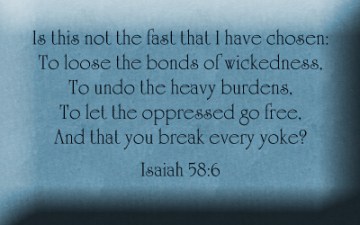
This idea fits in nicely with the purpose of fasting. In Isaiah 58, God answers Israel’s question about why He has no respect for their fasts by describing an acceptable fast. “Is this not the fast that I have chosen,” He asks in verse 6, “To loose the bonds of wickedness, to undo the heavy burdens, to let the oppressed go free, and that you break every yoke?”

Undo The Heavy Burdens

When we fast, it serves as a reminder of how much we need God and of the severity of our struggle against sin.  Going without food or water for 24 hours (or 25, in the Jewish tradition) reminds us how weak we are as human beings. The reminder of how much we need physical food and water — which is provided by God (James 1:17) — also helps us realize how much we are dependent on God for spiritual things. We are to hunger and thirst after righteousness (Matt. 5:6), but does my soul always long for God as much as my throat longs for water today?

As the deer pants for the water brooks, so pants my soul for You, O God. (Ps. 42:1)

O God, You are my God; early will I seek You; my soul thirsts for You; my flesh longs for You in a dry and thirsty land where there is no water. (Ps. 63:1)

Fasting should also remind us of our daily struggle against sin. I’m so used to drinking and eating that I have to consciously remind myself not to  grab a drink of water or open my dark chocolate and cashew stash today. While we were without God in the world, we were in a similar state of sinning without really thinking about it. But now that we have been redeemed by Christ’s sacrifice, we are to walk in newness of life and must make an effort to run away from sin and toward Christ (Rom. 6:4). Without His divine aid, we would slide back into sin.

Let The Oppressed Go Free

As we know, Jesus Christ’s sacrifice is what frees us from the heavy burden of sin (John 8:31-36). If freeing people from wickedness is also the purpose of fasting, it makes sense that fasting under the New Covenant would be related to the subject of repenting and accepting Christ’s sacrifice on our behalf.

In the Old Testament, the Day of Atonement was the only day of the year on which the High Priest could enter the Holy of Holies in the tabernacle or temple (Lev. 16:2-10; 16:29-34). It is, therefore, this day that is referred to in Hebrews when the writer says,

the priests always went into the first part of the tabernacle, performing the services.  But into the second part the high priest went alone once a year, not without blood, which he offered for himself and for the people’s sins committed in ignorance; the Holy Spirit indicating this, that the way into the Holiest of All was not yet made manifest while the first tabernacle was still standing. …

But Christ came as High Priest of the good things to come, with the greater and more perfect tabernacle not made with hands, that is, not of this creation. Not with the blood of goats and calves, but with His own blood The Day of Atonement for Christians marissabaker.wordpress.comHe entered the Most Holy Place once for all, having obtained eternal redemption. For if the blood of bulls and goats and the ashes of a heifer, sprinkling the unclean, sanctifies for the purifying of the flesh,  how much more shall the blood of Christ, who through the eternal Spirit offered Himself without spot to God, cleanse your conscience from dead works to serve the living God? (Heb. 9:6-8, 11-14)
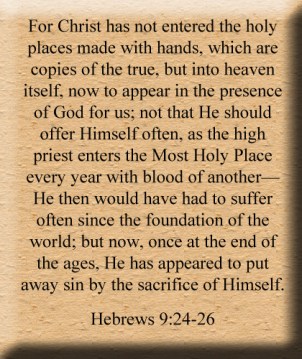
Christ’s sacrifice supersedes the physical animal sacrifices by a human priest, just as His priesthood supersedes the Levitical system. But doing away with the animal sacrifice does not do away with our need for repentance. Christ said His servants would fast (Mat. 6:16-18; Matt. 9:14-16), and our obedience to this (particularly in the commanded fast on the Day of Atonement) reminds us of our need for redemption. Fasting helps us draw near to God, shows us how much we need Him, and is a physical sign of our willingness to obey His commands.

Break Every Yoke

The third main element of the Day of Atonement in the Old Testament involved the “scapegoat” or the “Azazel goat.”

“And when he has made an end of atoning for the Holy Place, the tabernacle of meeting, and the altar, he shall bring the live goat. Aaron shall lay both his hands on the head of the live goat, confess over it all the iniquities of the children of Israel, and all their transgressions, concerning all their sins, putting them on the head of the goat, and shall send it away into the wilderness by the hand of a suitable man. The goat shall bear on itself all their iniquities to an uninhabited land; and he shall release the goat in the wilderness. (Lev. 16:20-22)

In the churches I’ve been a part of, this has traditionally been read as symbolic of Satan being bound so that he “so that he should deceive the nations no more till the thousand years were finished” (Rev. 20:1-3. Permanently removed in verse 10). I see no reason to contest this interpretation. Though God’s people have been freed by Christ’s sacrifice, we still have to deal with  living in a fallen world subject to Satan’s influence. The “whole creation groans” and is subject to “the bondage of corruption” until the time of Christ’s return and Satan’s removal (Rom. 8:21-22), which will finally fulfill the Day of Atonement. Today reminds us of the incredible hope God gives us that someday, the entire world will be released from Satan’s yoke and enjoy the true freedom found in being a part of God’s family.