Keeping The Law On The Way To Eternity

If you’re a Christian, it’s a good bet you’ve read and/or heard the Sermon on the Mount more than once. And if you’re like me, you probably think you’re pretty familiar with this straight-forward message Jesus delivered during His time here on earth. But in a sermon a few weeks back, the speaker said something that prompted me to take a deeper look.

I hadn’t thought before about what a radical message this must have seemed when first preached. Matthew even tells us people who heard Jesus were “astonished at his doctrine” (Matt. 7:28, KJV). Throughout Jesus’ words, a message is woven that tells us our human way of looking at things is wrong. Something that makes no sense to us might be exactly what God is looking for, and the things we’d consider reasonable might not be what He wants at all. This sermon is about showing us a new way of thinking and living.

Questions Of Law

Following the Beatitudes (which we talked about last week), Jesus described people who follow Him as salt and light. All the attributes listed earlier are meant to be visible in His people, showing the world good works that will cause them to “glorify your Father who is in heaven” (Mat. 5:16, WEB). Jesus then made a statement about how His teachings relate to the Old Testament Law and Prophets. People often like to take Paul out of context and say Christians today have nothing to do with the Law, but that’s not what Jesus (or Paul, for that matter) taught.

Don’t think that I came to destroy the law or the prophets. I didn’t come to destroy, but to fulfill. For most certainly, I tell you, until heaven and earth pass away, not even one smallest letter or one tiny pen stroke shall in any way pass away from the law, until all things are accomplished.

Matthew 5:17-18, WEB

The Greek word translated “fulfill” here means to fill to the fullest extent (G4137, pleroo). In other words, Christ’s coming crammed the law full of its intended meaning. Thayer’s dictionary says the word means “to cause God’s will (as made known in the law) to be obeyed as it should be and God’s promises (given through the prophets) to receive fulfillment.”

Whoever, therefore, shall break one of these least commandments, and teach others to do so, shall be called least in the Kingdom of Heaven; but whoever shall do and teach them shall be called great in the Kingdom of Heaven. For I tell you that unless your righteousness exceeds that of the scribes and Pharisees, there is no way you will enter into the Kingdom of Heaven.

Matthew 5:19-20, WEB

Clearly, Jesus still intends His followers to keep the commandments. Not only that, He tells them they have to do it better than the most legalistic religious leaders of their day. How on earth were they supposed to do that? And how are we supposed to do that today?
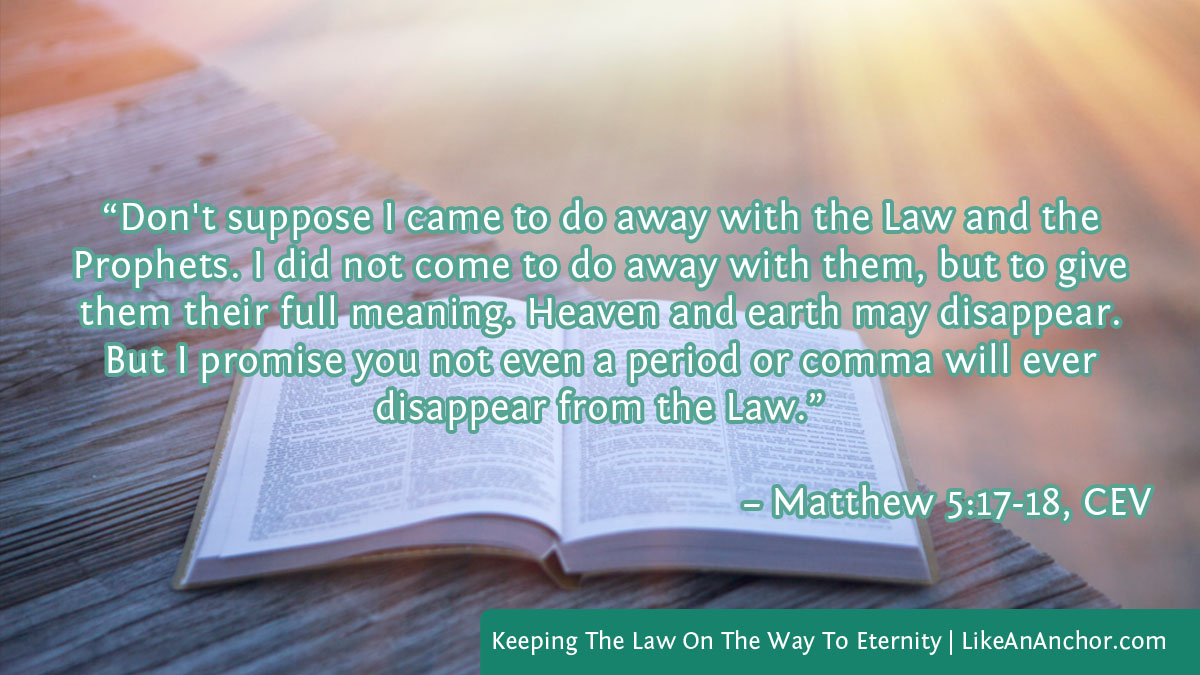
Image of an open Bible overlaid with text from Mat. 5:17-18, CEV version: “Don't suppose I came to do away with the Law and the Prophets. I did not come to do away with them, but to give them their full meaning. Heaven and earth may disappear. But I promise you not even a period or comma will ever disappear from the Law.”
Image by Lamppost Collective from Lightstock

Letter v. Spirit

Jesus explains how to keep the commandments in a fulfilled manner by contrasting the way things had been done with the way He wants them done. We might think of it as the letter of the law contrasted with God’s spirit and intent behind the law. Or better yet, we can say Jesus is clarifying God’s purpose for the Law. For example:

You have heard that it was said to the ancient ones, ‘You shall not murder;’ and ‘Whoever murders will be in danger of the judgment.’ But I tell you, that everyone who is angry with his brother without a cause will be in danger of the judgment; and whoever says to his brother, ‘Raca!’ will be in danger of the council; and whoever says, ‘You fool!’ will be in danger of the fire of Gehenna.

Matthew 5:21-22, WEB

It’s not enough to obey the law that says not to kill someone. Sin starts in the heart and that’s where God looks. He cares if you get to the point where you want to murder a person, not just if you actually violate the command “thou shalt not murder.” He even cares before you get to that point; if you’re unreasonably angry with someone or despise them as an empty headed fool, that’s enough to put you under judgement.

This pattern continued as Jesus kept teaching. Lusting after someone counts as adultery in your heart (Matt. 5:27-28). Divorce shouldn’t be done nearly so often (Matt. 5:31-32). Straightforward communication is better than swearing oaths (Matt. 5:33-37). We’re not to follow the human impulse to retaliate, even though it was allowed under the law (Matt. 5:38-42). We need to love our enemies if we want to be God’s children (Matt. 5:43-48). In many ways, God expects more of New Covenant believers, not less.

Going Beyond Law-Keeping
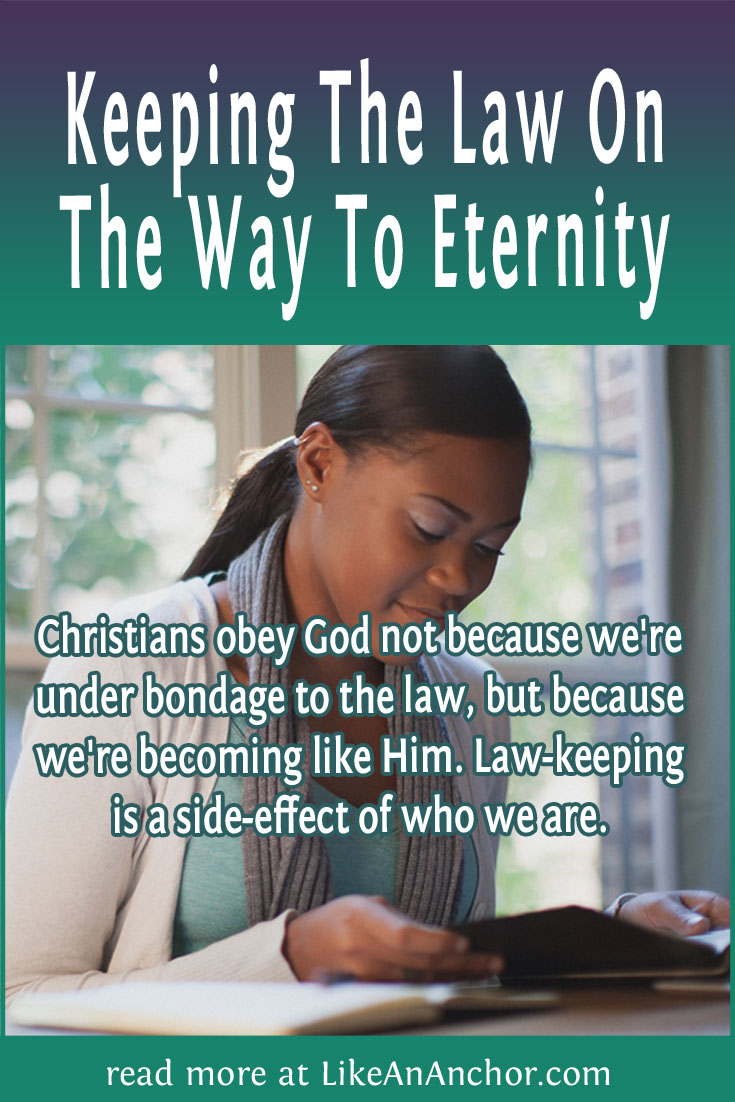
Image of a woman reading the Bible, overlaid with blog's title text and the words, "Christians obey God not because we're under bondage to the law, but because we're becoming like Him. Law-keeping is a side-effect of who we are."
Image by Pearl from Lightstock

Jesus’s expectations for His people go beyond the Law. The goals of living in the spirit reach higher than living by a strict code, though the spirit and letter both come from God and are connected. If we’re living in the spirit we are keeping the law on the way to becoming like God. Paul discussed this in Galatians, where he said, “walk by the Spirit, and you won’t fulfill the lust of the flesh” (Gal. 5:16, WEB).

Continuing in Galatians, Paul said, “if you are led by the Spirit, you are not under the law.” But right after saying that, he listed sinful things that spirit-led believers don’t do and says “those who practice such things will not inherit God’s Kingdom” (Gal. 5:18-21, WEB). He’s telling us that if we do things that break God’s laws, we won’t be in His kingdom even though the Law isn’t what saves us (Jesus does that).

We should keep the law because we’re walking in the spirit. It’s a side-effect of becoming like God. And so Christians today obey God, but they do it because they’re becoming like and following Him, not because they’re trying to make themselves righteous by their own power. It’s something we do on the way to eternity even though it’s not the method by which we get there.

Therefore you shall be perfect, just as your Father in heaven is perfect.

Matthew 5:48, WEB

Featured image by Matt Vasquez from Lightstock

Save

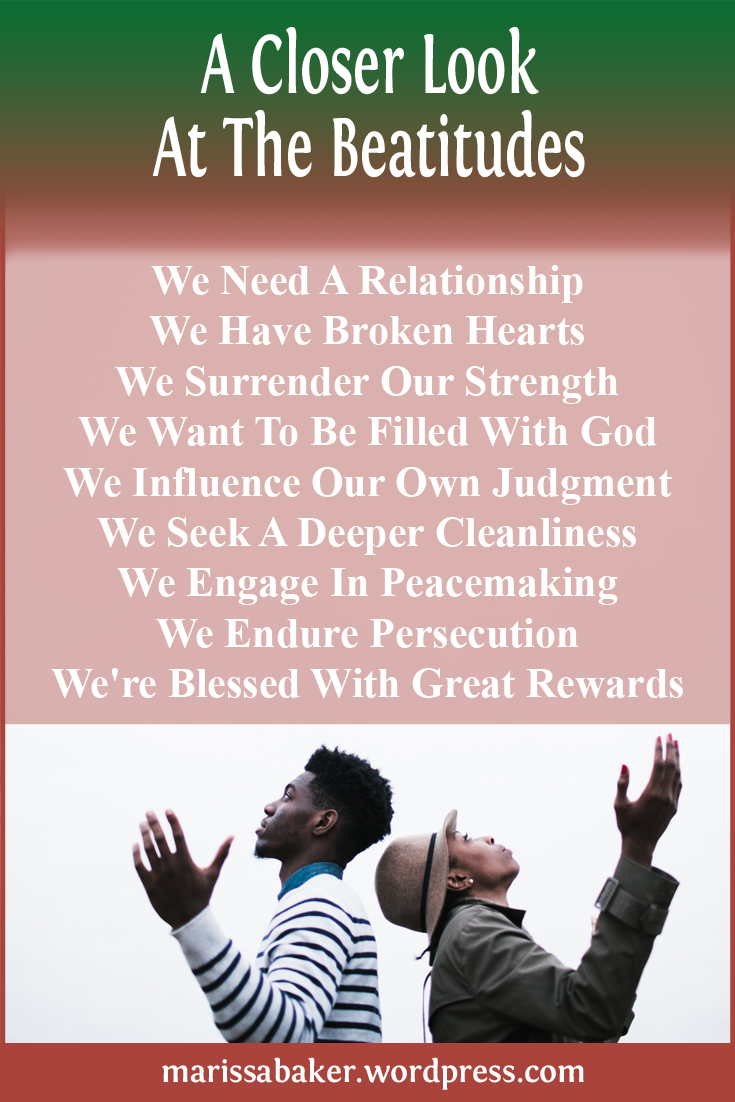
A Closer Look At The Beatitudes

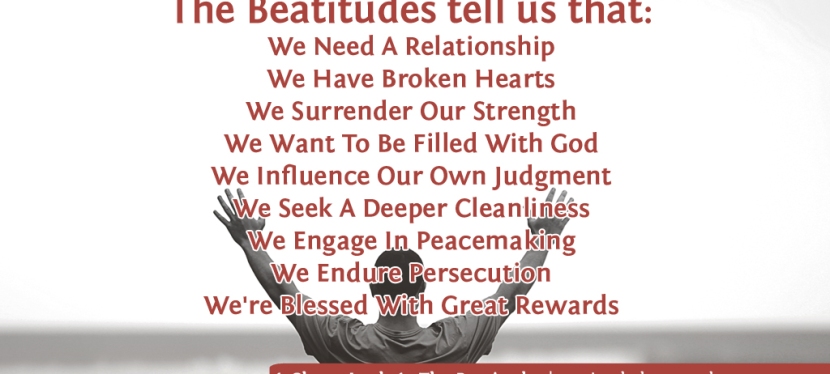
When Jesus delivered the Sermon on the Mount, He began at what we now call the Beatitudes. He says, “Blessed are” the sort of people who probably don’t feel all that blessed — those who are poor, mourning, meek, hungry and thirsty for righteousness, merciful, pure in heart, peacemakers, persecuted, and reviled. We don’t like being poor, or in grief, or humble enough to put others first, or attacked by the people around us. It’s hard work being a peacemaker, or showing mercy, or staying pure of heart, or constantly yearning to get closer to God’s righteousness.

It’s interesting that two of the beatitudes mention righteousness: “Blessed are they which do hunger and thirst after righteousness” and “Blessed are they which are persecuted for righteousness’ sake” (Matt. 5:6, 10, KJV). This word refers to “the condition acceptable to God” and/or “the doctrine concerning the way which man may attain a state of approval by God” (Thayer’s G1343, dikaiosune). It relates to our state of being and the way we live. In fact, when you think about it, all the beatitudes relate to something we do and/or become as we follow God.

A Closer Look At The Beatitudes | marissabaker.wordpress.com
Photo credit: Temi Coker via Lightstock

We Need A Relationship

Blessed are the poor in spirit: for theirs is the kingdom of heaven. (Matt. 5:3, KJV)

There’s more than one word that could be translated from Greek as “poor.” This one means “reduced to beggary” and “lacking anything” (Thayer’s G4434, ptochos). When we’re like that in our spirits, we’re really in a place to recognize how much we need a relationship with the Father and Jesus. We become the sort of person the Lord is talking about when He says, “to this man will I look, even to he who is poor and of a contrite spirit, and who trembles at my word” (Is. 66:2, WEB).

We Have Broken Hearts

Blessed are they that mourn: for they shall be comforted. (Matt. 5:4, KJV)

We all experience grief. The death of a parent, child, or dear friend. The loss of a hope held close to our hearts. The decay of a relationship. Betrayal from a friend. And even in the midst of that mourning, we’re blessed because God promises comfort (John 14:16-18; 2 Cor. 1:3-7). He can respond to our tears as powerfully as He did for David in the situation recorded in Psalm 6. Read more

Our Christian Nationality

A number of years ago I was sitting in a church service listening to the minister introduce his sermon topic for the day. One of the first things he said was, “Close your Bibles and put them on the floor. I’ve got something to tell you this morning.” Smacks of Bibles hitting linoleum is a sound I hope never to hear again. While teenage me wasn’t brave enough to stand up and walk out, I did keep my Bible open in my lap so I could do my own study while he lectured on American history.

The United States of America, rather than something out of the Bible, should feel like a strange topic for a sermon. And yet I’ve heard other sermons, though much less extreme, preached about this topic on a fairly regular basis. Typically, it’s presented as something like “the Biblical history of our country” or “America’s Christian heritage.” The speakers usually do turn to scriptures, but they may spend more time quoting founding fathers and presidents than they do Jesus.

Now, please don’t misunderstand me. This isn’t a rant against my country or an article condemning people who love the U.S. of A (which is why I didn’t post this 4th of July weekend, though it would have probably gotten more views then). Nor am I saying Christians teachers shouldn’t quote writings outside the Bible. My concern is that patriotism for our physical nation has gotten muddled up with our Christian faith as if the two are, or should be, interconnected. But I don’t think they should be.Our Christian Nationality | marissabaker.wordpress.com

Not Of The World

When Jesus walked this earth, He said He was “not of this world” (John 8:23, KJV). At the Passover, He started describing His followers that way as well (John 15:19; 17:14-16). We still have to live in this world, as Paul points out in 1 Cor. 5:10, but we don’t belong to it.

“We know that we are of God, and the whole world lieth in wickedness” (1 John 5:19, KJV). The present world is evil because it has fallen into sin and is under Satan’s sway (Gal. 1:4; John 14:30). I think most Christians would agree with that at least to a certain extent, otherwise we’d have no need for a Savior. But often, we think of this world’s evil as an abstraction. The world “out there” is wicked, “society” is evil, or there’s a spirit of wickedness at large “somewhere.” But maybe my neighborhood, this city, our country isn’t really all that bad.

Here in the U.S., we don’t yet face the sort of persecution that would serve as a constant reminder that this world isn’t a Christian’s home. I’m thankful for that, but I also wonder if it has made us lose sight of some important truths. The United States was founded with some Christian principles and a guarantee of a religious freedom, but it was never a “Christian nation” and it hadn’t even looked like one for a long time. And while you have the right as an American to get involved in pushing your country toward where you’d like it to go and a duty as a Christian to stand up for what’s right in God’s sight, this physical nation isn’t where we owe our primary allegiance. Read more

Is Your Church The Same As God’s Church?

How do you define “church”? A building where Christians worship, the clergy of a religious body, all the believers in a religion, a specific denomination, a public worship gathering — those are all definitions we use in the English language. If we say we “go to church,” we either mean the building or the service. If we say of a group, “this is my church,” we’re generally telling people which denomination we’re part of. If we say someone chose the church as a career path, we mean they went into the clergy.

But those definitions don’t really get at what “church” means in the Bible. In fact, the only part of our English definition that overlaps with the Greek word’s definition is “the whole body of Christians” (Merriam-Webster 3a). And because there’s such a difference, I think it’s important to look at what the New Testament writers were talking about when they discussed the church. We want to learn about how God sees His church, not just how human beings define it today.

Called Out Ones

In the New Testament, “church” is translated from ekklesia (G1577). It’s a compound word that literally means a “calling out” (Strong’s Dictionary). In general, it’s used of a “gathering of citizens called out from their homes into some public place.” In the church-specific sense, it’s “an assembly of Christians” that gathers in a specific place or “the whole body of Christians scattered throughout the earth” (Thayer’s Dictionary). Read more

I’m A Christian … Now What?

What do you do after becoming a Christian? You’ve acknowledged your need for a savior, repented of your past sins, confessed Jesus Christ as your Lord and Savior, and received the gift of God’s grace. The foundations are in place. Now what?

There are some Christians, even Christian teachers, who don’t really know how to answer this question. Those who teach we have no role to play in our salvations and that nothing’s expected of us after conversion are left in a tough pickle. One could, according to this theory, have someone convert to Christianity then go out lying, sleeping around, and stealing but still be considered saved as a part of God’s family. And even the good people who wouldn’t dream of doing something like that are still left with the question, “What do I do now?”

God answers this question for us in the pages of His Bible. You can’t do anything to make God owe you salvation; it is a gift that He chooses to give freely to those who respond to His call. But once you’ve been given this gift your life is supposed to change. Salvation transforms the way you live and gives us a purpose.

I'm A Christian ... Now What? | marissabaker.wordpress.com
Photo credits: Bart Lumber via Flickr and Neely Wang via Lightstock

Choose A Way

In Acts, Christians are described as people who follow “the way” of the Lord (Acts 9:2; 18:25-26; 19:9, 23; 22:4; 24:14, 22). It’s a metaphorical use of the Greek word hodos (G3598), meaning “a course of conduct.” When used literally, hodos refers to the roadway you travel on a journey. In both cases, use of this word implies motion, travel, and activity.

Christians aren’t meant to stagnate. They’re meant to walk through life in a certain way. We get to choose whether we’ll walk in the ways of men or the way of God. And God’s instructions in the New Testament for how to walk look a  lot like His laws about how to behave from the Old Testament. The law can’t bring salvation and it was never intended to. But it was a revelation of God’s character and He hasn’t changed. Our conduct still matters to Him.

Ephesians is a fantastic place to start diving deeper into this topic.  Here, Paul reminds his readers that they “once walked according to the course of this world.” They were “children of disobedience” influenced by God’s adversary and acting in ways contrary to God’s teachings (Eph. 2:2-3, WEB).

But God, being rich in mercy, for his great love with which he loved us, even when we were dead through our trespasses, made us alive together with Christ (by grace you have been saved)(Eph. 2:4-5, WEB)

Trespasses — sin — kills people. That’s why the choice of whether or not to follow God has always been presented as a choice between life and death (Deut. 30:15-18). Grace lets us choose life even after we’ve done things worthy of death. But it doesn’t give us license to sin or permission to sit around twiddling our thumbs. Read more

Being A Faithful Servant

Our salvation requires action. Even the most liberal versions of Christianity expect people to believe in and confess Christ even if they say you don’t have to do anything after that. And scripture takes it several steps further, saying that believers are also to repent of their past sins and then commit to following Jesus.

God wants relationship with us. Like all relationships, this is a two-way street. We’ll never be able to out-give or out-love God, or even come close to matching what He offers us. But He still wants us to give Him what we do have to offer: our hearts, minds, and souls. He wants commitment and faithfulness from those who’ve asked to be in relationship with Him.Being A Faithful Servant | marissabaker.wordpress.com

Parables and Responsibilities

Near the end of His life, Jesus’ disciples asked Him about signs signalling the end of the world and His second coming. After answering this question in Matt 24:3-44. He moved on to what’s expected of His followers while they wait. He tells them to watch and be ready, then He beings a series of parables.

Who then is the faithful and wise servant, whom his lord has set over his household, to give them their food in due season? Blessed is that servant whom his lord finds doing so when he comes. (Matt. 24:45-46, WEB)

The people waiting for Christ’s return are supposed to be doing something. In this particular parable, it has to do with how they treat their fellow servants. God cares about how you interact with the people around you. Having a relationship with Him is meant to transform that area of your life. Read more