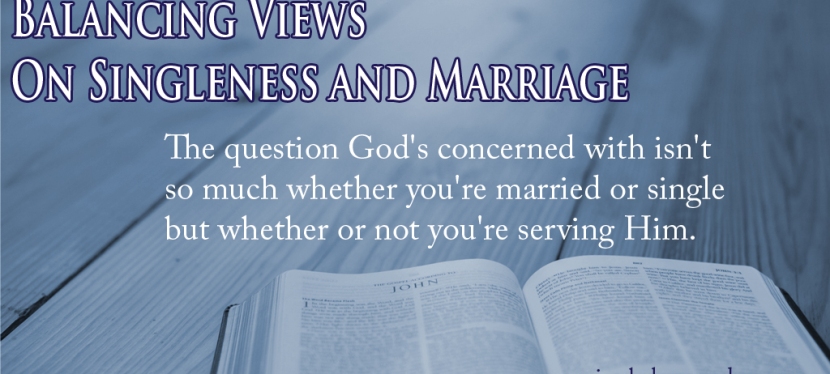
Balancing Views On Singleness and Marriage

Most modern Christian churches develop a culture that prioritizes marriage. We know marriage is a good thing and that it’s part of God’s plan for humanity. Marriage pictures the union between Christ and His church. Beyond the spiritual aspects, it’s also held-out to young people as a sort of “prize” for listening to what the Bible says about purity pre-marriage.

Since we think of marriage as such a good thing, we think of the opposite as something negative. Western culture is, on the whole, very binary. If something is good, the opposite is bad. Our minds don’t naturally consider that both could be good in the proper context. With this mindset, singleness is treated as less-desirable and if a single person doesn’t want to marry we think there’s “something wrong” with them. But is this really how God views things?

Seeking Balance

It’s a safe bet all my Christian readers know of the verses discussing marriage in a positive light. The marriage relationship was established at creation and in the New Testament Paul connects it to Christ and the church (Gen. 2:18-24; Eph. 5:22-32). Proverbs 18:22 maintains that “he who finds a wife finds a good thing.” Marriage is certainly seen as a good thing in the Bible. I’m not disputing that and I still hope someday to get married. But I think we make a mistake if we assume marriage’s goodness makes being single a bad thing. Read more
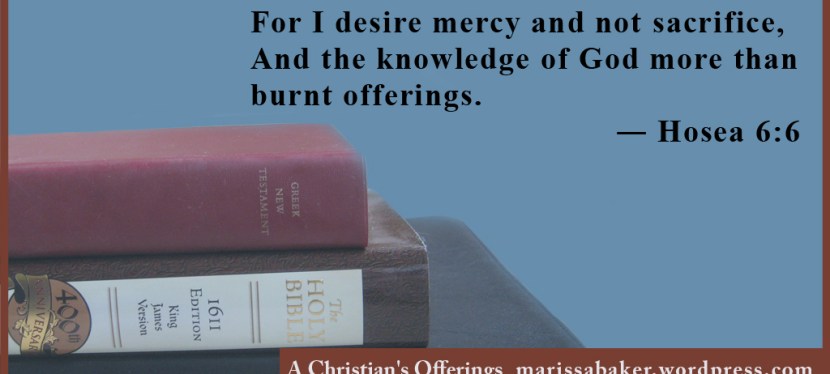
A Christian’s Offerings

I’m struck by how many sacrifices people offered to God in the Old Testament. It wasn’t just the sin offerings and blood sacrifices we know pointed to Christ. There were also burnt offerings, grain offerings, and peace offerings given for thanks or as part of a vow, or voluntarily in worship and devotion to God (Lev. 1:1-3:17; 6:14-23; 7:11-36).

The book of Hebrews makes it very clear that Jesus fully filled all the offerings for sin, trespass, and atonement. This High Priest “does not need daily, as those high priests, to offer up sacrifices, first for His own sins and then for the people’s, for this He did once for all when He offered up Himself” (Heb. 7:27). But how are the other offerings fulfilled today?click to read article, "A Christian's Offerings" | marissabaker.wordpress.com

I think most churches encourage monetary offerings and/or tithing, even if they don’t use those exact words. That’s not the only thing we have to offer though. In fact, it’s not even the primary sacrifice God expects from His people today.

Offering Ourselves

We’re to follow Jesus Christ’s example in all things, including offering ourselves. We won’t be the same type of sacrifice nor operate at nearly the same level, but in the most general sense that is what we’re expected to do.

I beseech you therefore, brethren, by the mercies of God, that you present your bodies a living sacrifice, holy, acceptable to God, which is your reasonable service. And do not be conformed to this world, but be transformed by the renewing of your mind, that you may prove what is that good and acceptable and perfect will of God. (Rom. 12:1-2)

God has everything He could ever need, yet He wants us.  We are a sacrifice that we offer to God with nothing held back as we fulfill the first commandment: “You shall love the Lord your God with all your heart, with all your soul, and with all your mind” (Matt. 22:37). Read more

Battling Our Thorns In the Flesh

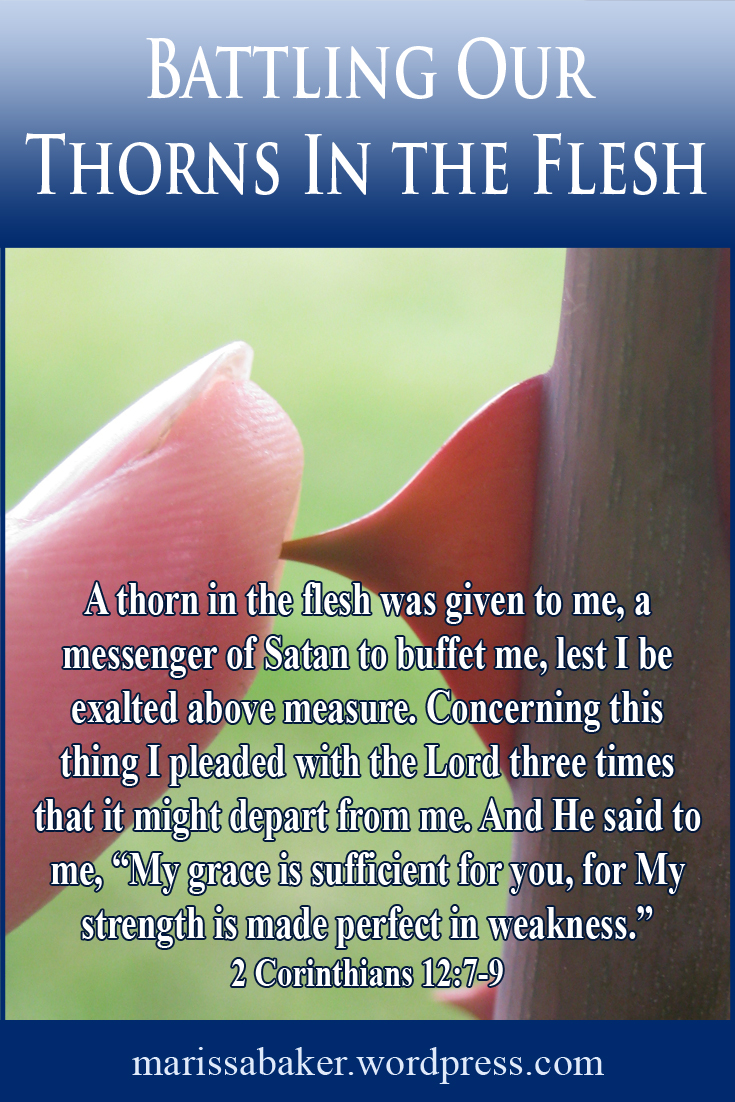
We’ve all “sinned, and come short of the glory of God” (Rom. 3:23, KJV). We know this, and repenting of those sins in our pasts and accepting Jesus as our savior to wash them away was a first step in becoming Christian. Even after conversion, though, we’re not perfect. God keeps forgiving us when we repent, but we still fall short of perfect obedience. I think it’s also fair to say all or most of us have struggled with some sins more than others.

I’m sure we can all think of someone else like this. Someone who you’d think has been in the church long enough to “get over” their bitterness, or lust, or covetousness, or whatever the particular problem is. But if we think about it, many of us are in the same boat. We’re often more understanding toward our own struggles, but we still have them. Or perhaps we’re even harder on ourselves than we are on others.click to read article, "Battling Our Thorns In the Flesh" | marissabaker.wordpress.com

So what do we do? How do we deal with our own sin struggles and react to those around us when they come short of God’s commands?

The Simple Answer

There are several ways people with a tendency toward a certain sin might react. They could ignore and hide it, ashamed to have thoughts and desires they know are wrong. They might flaunt it, choosing to live in sin because “that’s just how I am.”

The problem with the first is we have to face our struggles and talk about them with God, at the very least. You can’t overcome something you’re ignoring. With the second, the problem is that people who are openly and willfully sinning can’t be allowed to stay in the church (1 Corinthians 5). If you’re going to follow Christ, you have to stop practicing immorality. Read more

Our Atonement Today

A blessed Yom Kippur/Day of Atonement to you all. Earlier this month, I subscribed to Bible Gateway’s newsletter Holy Land Moments with Rabbi Yechiel Eckstein. It’s described as a way to learn about the Jewish background of Scripture by exploring the High Holy Days.

I’m finding it fascinating. I grew up keeping these Holy Days, but not always with much understanding of the Jewish perspective on them. While some of the Jewish tradition doesn’t relate to Christian observance of these days, they often teach a perspective that deepens my understanding. Take the Days of Awe for example. Using the 10 days between Trumpets and Atonement for self-reflection and repentance deepens the meaning of and my engagement with this holy time. And sometimes, the Jewish perspective sparks a thought about how my Christian perspective differs, such as today’s comment in the Holy Land Moments newsletter:

The central part of the Yom Kippur service is missing today. Chapter 16 of Leviticus is dedicated to the description and instructions for the Yom Kippur service that was performed when the Tabernacle and later the Temples stood. Today, we no longer have a high priest, nor do we participate in ritual sacrifices. So how do we achieve atonement?

Those who believe Messiah has come have a different answer to this question than those who don’t. Rabbi Eckstein writes,”There are three keys that take the place of the service performed in biblical times” and they “can undo our wrongdoings and change things for the better.” These things are “repentance, prayer, and charity.”

Our Atonement Today | marissabaker.wordpress.com
original photo credit: Nick Fullerton, CC BY via Flickr

While those things are important, I thank God through Jesus Christ my Lord that I’m not trying to atone for myself. There’s no way I could ever do enough or be good enough to undo my own sins. Today, we do have a High Priest and He has filled the ritual sacrifices with His perfect sacrifice (Heb. 7:23-28). The “central part” of Yom Kippur isn’t missing for Christians who keep this Holy Day — it’s more real than ever. Read more

Return to The Lord

Have you ever felt like your relationship with God wasn’t what it should be? I think if we’re honest, we’ve all had seasons in our lives where we knew we weren’t quite right with God. Some of us are going through that right now. Sometimes we know what put that distance in our relationship with Him, sometimes we’re not quite sure how we drifted away. We just know we need to get back.

The Jews and Messianic believers say the month leading up to Yom Teruah (Feast of Trumpets) and the 10 Days of Awe between Trumpets and Yom Kippur (Day of Atonement) are a season of teshuva. This word literally means “return.” It is derived from the word shub (H7725), which is the form used in scripture. When the Old Testament talks about people turning away from their sins, this is the word typically used (examples: 1 Kings 8:47; Eze. 14:6; 18:30). We also translate shub and teshuva as repentance.Shabbat Shuvah | marissabaker.wordpress.com

  • (Side Note: the English word “repent” in the KJV Old Testament is usually translated from nacham (H5162), to be sorry, and is most often used of God. However, our modern understanding of repentance is better expressed by shub or teshuva.)

The Theological Wordbook of the Old Testament says that all the “idioms describing man’s responsibility in the process of repentance … are subsumed and summarized by this verb shub. For better than any other verb it combines in itself the two requisites of repentance: to turn from evil and to turn to the good” (entry 2340).

Four Steps

Today is the Sabbath between Trumpets and Atonement. It’s traditionally known as Shabbat Shuvah, the Sabbath of Return. While repentance is something we do year round, this is a fitting season to think more deeply about where we stand with God and in what ways we need to turn back to Him. Read more

Top 5 Reasons for Christians to Keep God’s Holy Days

Today we celebrate Yom Teruah, also called Feast of Trumpets and Rosh Hashanah. But why? After all, I’m Christian and most people think of this as a Jewish holiday. Same goes for Yom Kippur/Day of Atonement, which we’ll observe 10 days from now, and Sukkot/Feast of Tabernacles that starts in two weeks.

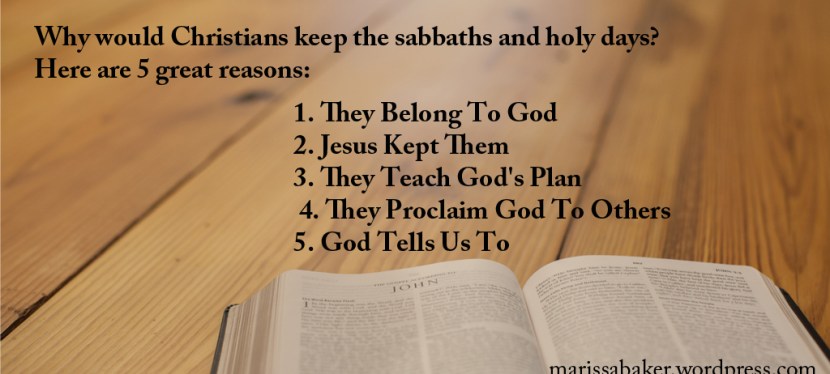
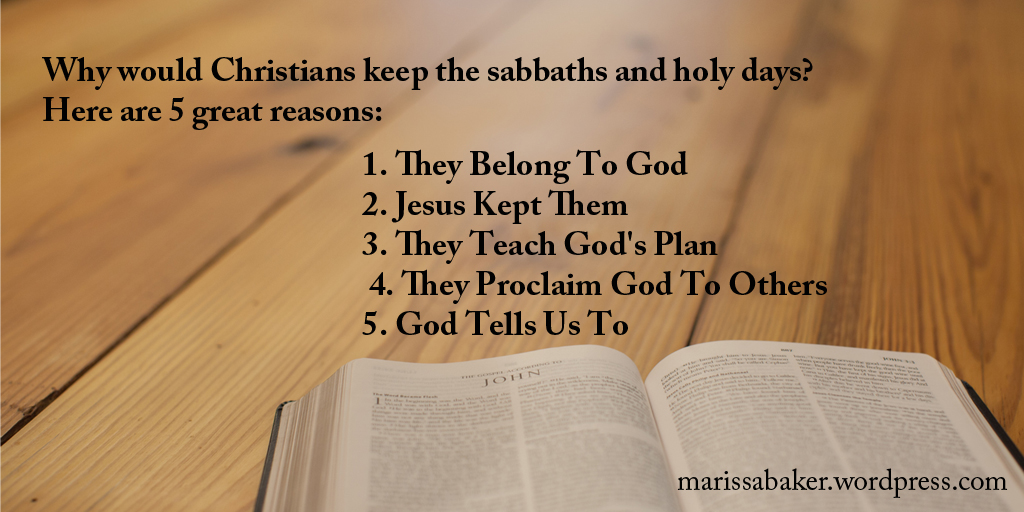
I believe these festival observances, along with others already completed this year, are for Christians today. When Jesus came to this world, it wasn’t to set up a new religion. He was the next step in God’s plan for the world and these days are part of the covenant He makes with His family. He’s still inviting us to gather for “reunions” at certain times of the year.Top 5 Reasons for Christians to Keep God's Holy Days | marissabaker.wordpress.com

1. They Belong To God

And the Lord spoke to Moses, saying, “Speak to the children of Israel, and say to them: ‘The feasts of the Lord, which you shall proclaim to be holy convocations, these are My feasts.” (Lev. 23:1-2)

The holy days aren’t Jewish or exclusively Old Testament. They belong to God Himself. We talk about Leviticus 23 as the chapter where God gives Israel the Feasts, but that’s not quite accurate. God doesn’t say, “Here are your holy days, Israel.” He says, “These are the feasts of the Lord, holy convocations which you shall proclaim at their appointed times” (Lev. 23:4). Read more