My churches have always taught the importance of Jesus Christ’s resurrection. I’ve even written about resurrection before, as part of the Foundations series. But I only focused on what the resurrection meant for individuals — that Christ’s resurrection makes our resurrections possible. I hadn’t really considered the implication of Christ’s sacrifice and resurrection on the entire world today.
Reading N.T. Wright’s book Surprised by Hope: Rethinking Heaven, the Resurrection, and the Mission of the Church has been eye-opening. He’s not really talking about things I’ve never heard before, but the way he frames his exegesis is making me think about Christ’s resurrection and the church’s mission at a depth I hadn’t pondered until now.
Wright places the resurrection in its historic context to show that what happened when Jesus rose from the grave three days after His Passover sacrifice was truly revolutionary. The Greek and Roman cultures believed in an immortal soul and the Jews believed in a resurrection, but no one was expecting Jesus (or anyone else) to rise from the dead in a renewed spiritual body. The risen Jesus was far too tangible and real to fit Greco-Roman ideas of afterlife and it was unexpected timing-wise from the Jewish perspective. This resurrection was sealed proof that Jesus was indeed the Messiah and that things on earth would never be the same again. Read more →
It’s been a year since I first started really digging into 1 Corinthians 11 and began wearing a head covering when I attend church services. I’d been wondering about 1 Cor. 11 for years, but hadn’t really looked into it all that deeply. None of the explanations about why we don’t cover today satisfied me, but I didn’t feel I had a good enough argument in favor of covering to go against my church tradition. I’d discussed it with a few women in my congregation, but they seemed confused by the passage and had decided that your hair is your covering and the “we have no such custom” phrase meant veiling/covering in church wasn’t necessary today.
Then a year ago I stumbled upon The Head Covering Movement through a blogger. Here was a group who took this passage seriously. They were ready to talk about what “because of the angels” might mean. They engaged directly with a variety of arguments against covering in a respectful way solidly rooted in scripture and history. They even had a good explanation for the phrase “we have no such custom.”
How I started covering
Flea market find — head covering for $1!
My first reaction was to talk with my mother, who was suspicious of the whole idea. I then reached out to a friend who’d been sending me “rants” about scriptures that didn’t make sense to him. My own “rant” went something as follows: “should I start wearing a scarf because this makes sense to me? or did I miss something in their interpretation of these verses that I shouldn’t agree with? Maybe my mother’s right that it’s not a big deal and it would be too distracting to people around me in church.”
Even before I heard back from him, I wore a wide headband to church that Sabbath. I thought it was big enough to count as a covering, yet not something I hadn’t worn before so it wouldn’t attract much attention. A few days later, my friend wrote something that helped confirm my decision: “It is good that you’re mindful of not causing a ruffling of feathers among fellow congregants, but we can only control so much of other people. … So, I would just encourage you to follow your conviction wherever that leads you. If people have a problem, it is their Christian duty to confront you about it, and I doubt anyone would still have a problem with you/your apparel upon inquiring about your intent in doing so.”
My friend is a smart man. I’d already taken baby-steps toward covering, but his encouragement was reassurance that I wasn’t just going “off the deep end.” I ordered my first cover from Garlands of Grace on July 15 (pictured in the featured image), and started building a collection of head scarfs. Since then, I’ve only had one person in the United Church of God groups I attend ask about the fact that I cover my head, but at my Messianic group there are a few other women who cover and the topic comes up more often. I’ve received compliments on how I wear them, as well as on the fact that I’m covering. One person said, “I appreciate that you wear a cover when you dance.” I’m not doing this to seek attention of course, but for someone whose love language is Words of Affirmation this support was invaluable.
Support for covering
In terms of scripture, the passage in 1 Corinthians 11:1-16 is the main support for the practice of Christian head covering. A few other scriptures tie in to it (such as Num. 5:18 instructing the priest to uncover the head of a woman accused of adultery), but this is the only place where it’s focused on. You can check out The Head Covering Movement for more in-depth analysis, but here’s what convicted me that covering is for the church today:
God’s created order for headship is the foundational reason for covering (v.2-3, 7-12).
It’s described as a dishonor and a shame for women to “pray or prophecy” uncovered (v. 4-6).
Paul says “nature itself” (including the examples of short hair on men and long hair on women) teach us covering is proper (v. 13-15). I also think this is support for the hair acting as a covering sometimes and an additional cover only being required when “praying and prophesying.”
The “we have no such” custom phrase grammatically refers back to the question in v. 13 of women praying uncovered. No where in scripture does Paul suggest people can ignore a command he writes about simply because they are contentious over it.
On top of those reasons, the arguments most people use against head covering are, for me, an argument in favor of it. They say it was a strictly cultural matter that no longer applies — that in Corinth, only prostitutes went about with uncovered heads and we don’t want to be mistaken for prostitutes. But Paul mentions no such thing and when we start throwing out commands because we think they’re strictly cultural we’re on a very slippery slope. On top of that, historical evidence shows the prostitutes referenced in this argument belonged to a Corinth of about 200 years before Paul’s writings and art of the time shows respectable women both covered and uncovered. The covering Paul talks about wasn’t based on a Greek or Roman practice (or even a Jewish practice, since both men and women covered in Judaism).
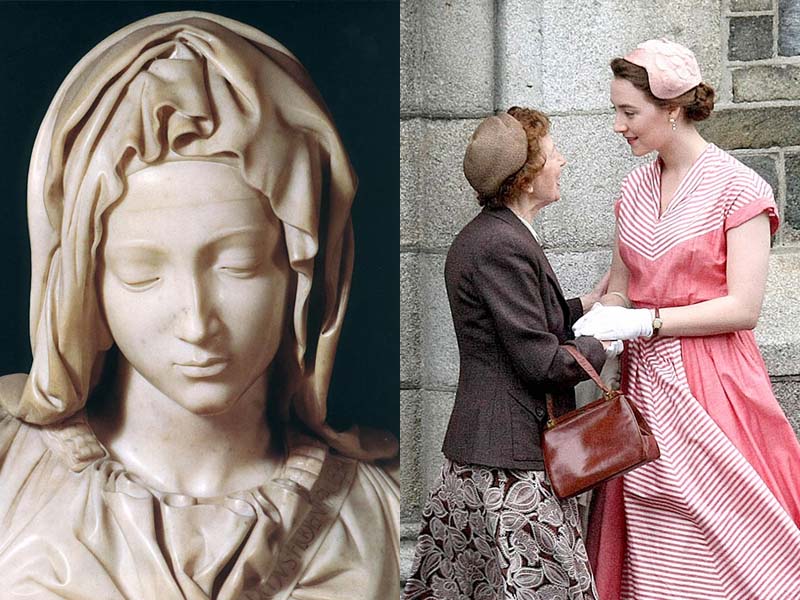
Left: Michelangelo’s The Pietà (1498-1499). Right: film still from Brooklyn (2015, setting 1952)
In reality, history shows us that head covering was practiced unanimously among Christian women for centuries. I hate to cite Wikipedia as a source, but in this case their article on Christian headcovering throughout history is unusually well-researched and more thoroughly cited than many other articles I’ve found online. Until a little over 50 years ago (with the sexual revolution and the feminist movement gaining traction), covering was the norm in church and often in public as well. Even fairly recently, no respectable lady would leave the house without a hat of some kind and she was expected to keep it on during church services. If you’re looking closely, you’ll notice this in well-researched historical dramas. Last year’s film Brooklyn, for example, was set in 1951 and ’52, and you’ll see Eilis removing a veil as she leaves a church in one scene and another scene where she’s wearing a pink cover at church.
While I don’t like to seem as if I’m pushing the notion of headcoverings on other people, I am doing this for a reason and a year of covering has only confirmed my choice. My encouragement to you today is to just take a closer look at this passage of scripture, and not to ignore it because we’re not sure what to do about it. Don’t start covering just because someone tells you to — study it and see if you’re convicted. And if you are, then don’t be afraid to start covering in church. Sure some people will probably think it’s strange, but as my friend said, “we can only control so much of other people.” If you’re convicted that you should be covering at church, then you’re doing it for God and not for what other people think (though you do want to try and avoid offending our brethren by how we practice covering).
Now, I don’t mean to sound like covering has been without its struggles or that it wasn’t a little weird at first or that I don’t still have questions. For example, how often to cover is still something I’m not clear on. I’m convicted of covering at church services (which is all The Headcovering Movement sees as necessary), but “praying and prophesying” could apply to other times as well. Do Bible studies count? What about dance practice, since the dancers pray as a group and sometimes I’m asked to pray aloud? I cover at home when praying in private, but should I cover for blessings on meals? or when writing these Sabbath blog posts, since that’s a sort of prophesying/inspired speaking? I’m not sure.
While thinking these things over, I’m keeping in mind that we can’t turn this into a legalistic thing, and I do think God hears prayers of uncovered women. Covering should be a way of honoring God, never something that stands between us and our Lord. But if it is indeed a command, and I believe it is, then it’s meant for our good, and that has been my experience. I’ve found that covering draws me closer to God and reminds me that I’m here to worship and to honor the Lord.
Newly converted Christians (and even many of us who’ve been in the church for years) often struggle with God’s expectations for them, especially when reading the Old Testament. And I’ll admit, the Law can look really daunting. The Jews traditionally say there are 613 commandments, or mitzvot, in the Torah. Because there’s no temple or priesthood anymore, some have estimated only about 270 of these laws are still applicable today.
Reading the “thou shalts” and “thou shalt nots” might feel overwhelming (“How could I ever keep track of them all?”), or sound unfair (“These don’t make sense; is God setting me up to fail?”), or seem stifling (“Why would He dictate my behavior in this area?”). To get around this, many modern Christians have rejected the Law completely and adopted the mentality that once you accept Jesus Christ as your savior there’s nothing else you need to do in order to be called a Christian.
This belief is mistaken. Jesus told people, “if you want to enter into life, keep the commandments” (Matt. 19:17). He also said He did not come “to destroy the Law or the Prophets” (Matt. 5:17) and that those who love Him will keep His commandments (John 14:15). Jesus thought the Law was not only relevant but also vitally important, and if we claim to follow Jesus we have to agree with Him. But how do we reconcile 613 (even “only” 270) commandments with Jesus’s statement that “My yoke is easy and My burden is light”? (Matt. 11:30). Where is the love and grace of our Savior in the strict rules of the Law?Read more →
So you’ve heard about the love and grace of Jesus and want to learn more. Maybe you even had another Christian lead you to Jesus and accepted Him as your savior. Then you sit down intending to read the Bible from start to finish and find something you weren’t quite expecting.
Genesis starts out with creation and the fall of man, then suddenly God’s wiping the whole earth out in a flood (Gen. 6:5-8). Next He’s scattering the people of Babel for building a tower (Gen. 11:5-9) and raining fire and brimstone down on Sodom and Gomorrah (Gen 19:24-25). Why does the God you know as forgiving and accepting seem so angry? Where is God’s love and grace here, in the Old Testament?
Many people give up on the Bible and/or their faith because God isn’t what they expect, or they go for a version of Christianity that highlights the New Testament and ignores any verses about uncomfortable topics like judgement and sin. But authentic Christianity demands something more of its followers. Jesus said, “Many are called, but few are chosen” twice in Matthew’s gospel (Matt. 20:16; 22;14). We don’t want to be the people who receive the seed of the gospel and then wither away because we have no root (Matt. 13:5-6, 20-21).
The lives of Christians are supposed to reflect the nature of our God. If we aren’t diving deep into His word, we won’t know who He is or what He requires, and we can’t grow roots into our faith. We can’t let misconceptions about or fear of His anger and expectations scare us away from getting to know Him. Read more →
Not too long ago, I heard an analogy on a Christian radio station that stuck with me. It was a pastor trying to convince listeners they need a church to fellowship with. He said that since the church is Jesus Christ’s body and He is the Head, if we say we want a relationship with Jesus and ignore the brethren it’s like telling your spouse, “I love you from the neck up, but I could do without your body.”
Vital Commandments
This analogy is not an exaggeration. John’s writings make very clear the high value Jesus puts on love among believers. If we can’t love our brethren, we’re actually incapable of loving God. Read more →
Is there anything we have to do in order to be a Christian? Some will tell you the answer is “no” — that salvation is a free gift and once you accept it you’re a Christian and there’s nothing else you need to do. Others will say “yes” — that you’re not a Christian unless you keep God’s commandments and follow Jesus Christ.
The truth is that God offers salvation freely, but you have to accept the gift on God’s terms. Those terms are called covenants — agreements that involve two parties binding themselves together with oaths. On the spiritual level, God initiates covenants, establishes the terms and promises, and binds Himself to the covenant oaths. These covenants are unfailing and sure, regardless of human action. We can choose whether or not to walk in covenant with God, but the covenant, and associated consequences for sin, stand whichever you decide.
Choose Covenant
“I make this covenant and this oath, not with you alone, but with him who stands here with us today before the Lord our God, as well as with him who is not here with us today,” Moses recorded in Deuteronomy 29:14-15. Not entering into covenant with God does not mean you’re getting out of consequences for sin — it means you’re choosing a path of death (Deut. 29:18-28). Read more →










 Like An Anchor