Gift of Mortality

We tend to approach death with a kind of horror, even though we know that it is not permanent (1 Thes. 4:13-18). It is natural to value life, to not want to die and to not want to lose the people we love. I think much of our longing to live forever comes from a desire God has given us to become part of his family. But sometimes I hear people say they want to live forever, and they mean an indefinite extension of our human lives here on the earth.  Personally, I wouldn’t want to live with myself the way I am now for that long.

Elves leaving Middle Earth, from The Lord of The Rings

When I think about the idea of immortality or living a really long time as a human, it makes me think of Tolkein’s elves in Middle Earth. Unless something interferes (they can be killed and they can fade away with grief) they’ll live forever. One of the things I find most interesting is that in The Silmarillion, the immortality of the elves is described as a sorrow and death is presented as a gift given to men.

the children of Men dwell only a short space in the world alive, and are not bound to it, and depart soon whither the Elves know not. Whereas the Elves remain until the end of days, and their love of the Earth and all the world is more single and more poignant therefore, and as the years lengthen ever more sorrowful. For the Elves die not till tile world dies, unless they are slain or waste in grief (and to both these seeming deaths they are subject); neither does age subdue their strength, unless one grow weary of ten thousand centuries; and dying they are gathered to the halls of Mandos in Valinor, whence they may in time return. But the sons of Men die indeed, and leave the world; wherefore they are called the Guests, or the Strangers. Death is their fate, the gift of Iluvatar, which as Time wears even the Powers shall envy.

Sown in Weakness

Death became something that every human being must face as a consequence of Adam and Eve’s sin. I wonder, however, if after the fall mortality might have been as much a gift as a curse. Yes, death is a penalty associated with disobedience to God and it is an enemy that will be conquered in the future. But the absence of death in our fallen state would not have been a kindness.

Foolish one, what you sow is not made alive unless it dies. And what you sow, you do not sow that body that shall be, but mere grain—perhaps wheat or some other grain. But God gives it a body as He pleases, and to each seed its own body. (1 Cor. 15:36-37)"Gift of Mortality" a blog post by marissabaker.wordpress.com

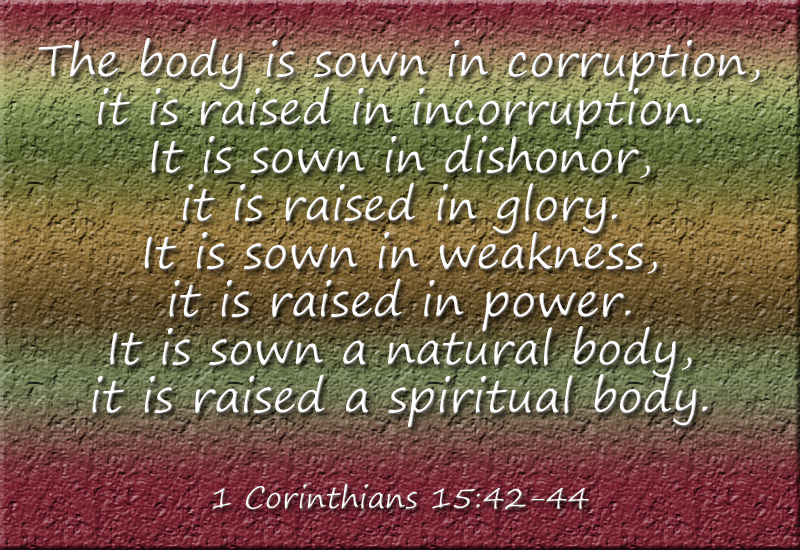
We are “bare grain,” as the KJV says, which after it dies to this existence will spring up into the far more glorious body that God gives us. Thank God that immortality is not give not us as we are now — corrupted, dishonored, weak, and natural. Living like this forever would not be a gift. We cannot have eternal life as we are now, nor would we want to. We need to be changed first.

For this corruptible must put on incorruption, and this mortal must put on immortality. So when this corruptible has put on incorruption, and this mortal has put on immortality, then shall be brought to pass the saying that is written: “Death is swallowed up in victory.” (1 Cor. 15:53-54).
When I Am Weak

"When I Am Weak" a blog post by marissabaker.wordpress.comI hope all of you had a wonderful Thanksgiving. My family gathered at my Uncle’s house for turkey, lots of mashed potatoes, euchre playing, and several enthusiastic Apples to Apples games that could probably have been heard by people driving by in their cars.

Today, I have another C.S. Lewis quote to share with you. As I think I mentioned in last week’s post, I’ve been reading The Problem of Pain. In chapter 6, he makes this statement: “tribulations cannot cease until God either sees us remade or sees that our remaking is now hopeless.”

Comfortable Dirtiness

To put this statement in context, Lewis was talking about human tendency to only turn our attention to God when things are going badly in our lives. When we are scared or in pain, we rush to God and ask him to take it away and bring us through the trial. But all to often, we try our best to forget the thing that brought us back to God as soon as that prayer is answered.

God has had me for but forty-eight hours and then only by dint of taking everything else away from me. Let Him but sheathe that sword for a moment and I behave like a puppy when the hated bath is over — I shake myself dry as I can and race off to reacquire my comfortable dirtiness, if not in the nearest manure heap, at least in the nearest flower bed. And that is why tribulations cannot cease until God either sees us remade or sees that our remaking is now hopeless.

We need our weaknesses and our sufferings to help bring us into God’s family. I did a search for the word “suffer” in the KJV, and found it used more than 50 times to refer to Christ’s suffering and/or the necessity of us following in His footsteps.

For to you it has been granted on behalf of Christ, not only to believe in Him, but also to suffer for His sake (Philippians 1:29)

Importance of Fire

Beloved, do not think it strange concerning the fiery trial which is to try you, as though some strange thing happened to you; but rejoice to the extent that you partake of Christ’s sufferings, that when His glory is revealed, you may also be glad with exceeding joy. (1 Peter 4:12-13)

The analogy of a refining fire is one that is frequently used in scripture. Gold and silver are purified by fire (Zech. 13:9), pottery needs fired to give it strength (Is. 64:8). We tend often think of fire as a bad thing, perhaps because of the association with fiery punishment. But fire in the context of trials has a positive connotation. Even if the affects are unpleasant, the result should be us moving ever closer to glory.

But may the God of all grace, who called us to His eternal glory by Christ Jesus, after you have suffered a while, perfect, establish, strengthen, and settle you. (1 Peter 5:10)

God Hasn’t Given Up

There are two ways we can take the idea Lewis expresses when he says, “tribulations cannot cease until God either sees us remade or sees that our remaking is now hopeless.” We can either get depressed and worn down by the realization that trials will not end until we are perfected, or we can look at trials as proof that God hasn’t given up on making us like Christ.

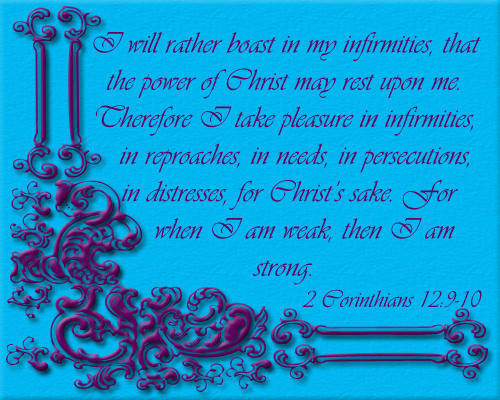
And lest I should be exalted above measure by the abundance of the revelations, a thorn in the flesh was given to me, a messenger of Satan to buffet me, lest I be exalted above measure. Concerning this thing I pleaded with the Lord three times that it might depart from me. And He said to me, “My grace is sufficient for you, for My strength is made perfect in weakness.” Therefore most gladly I will rather boast in my infirmities, that the power of Christ may rest upon me. Therefore I take pleasure in infirmities, in reproaches, in needs, in persecutions, in distresses, for Christ’s sake. For when I am weak, then I am strong. (2 Corinthians 12:7-10)

Free In Christ

I didn’t realize until I saw this post still in drafts that there wasn’t a Saturday post last week. Oops. Well, here it is now.

Then Jesus said to those Jews who believed Him, “If you abide in My word, you are My disciples indeed. And you shall know the truth, and the truth shall make you free …

“Most assuredly, I say to you, whoever commits sin is a slave of sin. And a slave does not abide in the house forever, but a son abides forever. Therefore if the Son makes you free, you shall be free indeed.” (John 8:31-32, 34-36)

What happens once we are made free from sin? Some people (especially those in Western cultures, I suspect) tend to think of freedom as license to do whatever they want. This is not what is meant by the freedom that we are given in Christ.

And having been set free from sin, you became slaves of righteousness. (Rom. 6:18)

The Bible reveals that we have only two options: service to sin or service to God. Though we are “not under law but under grace,” that does not give us license to disobey. Under the New Covenant, God’s commandments are still in effect, and He requires obedience from those who love Him (John 14:15, 21).

What then? Shall we sin because we are not under law but under grace? Certainly not! Do you not know that to whom you present yourselves slaves to obey, you are that one’s slaves whom you obey, whether of sin leading to death, or of obedience leading to righteousness? (Rom. 6:15-17)

"Free In Christ" marissabaker.wordpress.comThis does not mean we can earn eternal life by obedience — it is a free gift from God (Rom. 6:23). However, we can show by disobedient actions that we refuse to accept His gift. When we do that, it’s as if someone pulled us from a burning building and said, “Don’t go back in there,” and instead of obeying we marched right back inside because we thought the heat felt good.

Once we have been redeemed by Jesus Christ, we have to respond by walking not “according to the flesh, but according to the Spirit” (Rom. 8:1). We will surely slip and fall, but we have to stop willfully sinning and make a genuine effort to change and obey. The habit of our life has to become Christ-imitating instead of sinful.

For this is the will of God, that by doing good you may put to silence the ignorance of foolish men — as free, yet not using liberty as a cloak for vice, but as bondservants of God. (1 Pet. 2:15-16)

The Subject of Kneecaps

I’m a little fuzzy on the subject of violence in the Bible, and talking with or reading the opinions of other Christians doesn’t make it any less confusing. We can all agree murder is wrong. After that, there doesn’t seem to be much agreement at all. Should a Christian use violence, sometimes even deadly violence, to save someone’s life or defend themselves?

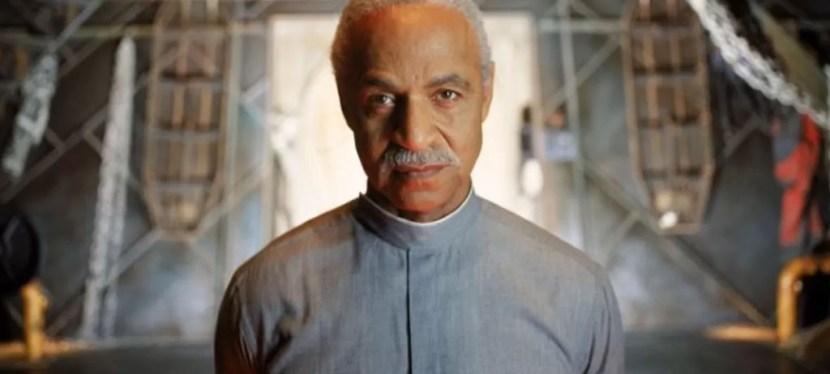
Zoë: “Preacher, don’t the Bible have some pretty specific things to say about killin’?”

Book: “Quite specific. It is, however, somewhat fuzzier on the subject of kneecaps.”

— Firefly, episode 9 “War Stories”

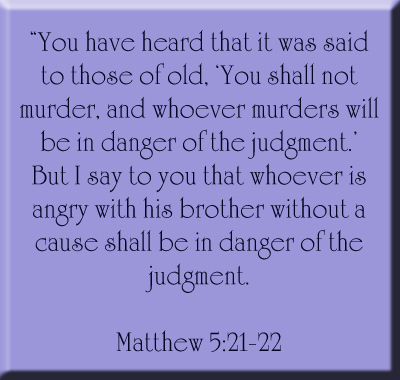
In this situation in Firefly, Shepherd Book armed himself and joined his shipmates to rescue Malcolm Reynolds from torture and death. He did not violate the commandment “You shalt not murder,” or even the King James’ rendering “Though shalt not kill” (Ex. 20:13). But does this kind of violence violate the spirit, if not the letter, of such commandments? If he had killed in self-defense, would it have been wrong?

Murder vs. Killing

I don’t think there is any question about murder being wrong. Even in societies without the Bible as a guide, laws against murder are usually part of the culture. It’s on the subject of “killing” where things get sticky for Christians. If someone is attacking your family, is it permitted to use violence to stop them? Does unintentionally killing someone who is trying to harm you make guilty of murder in God’s eyes?

The Hebrew word translated “kill” or “murder” in Exodus 20 is râtsach (H7523). Strong’s defines it as, “to dash in pieces, that is, kill (a human being), especially to murder.” Like many Hebrew words, the exact meaning is dependent on the context, and The Complete WordStudy Dictionary: Old Testament points out that the word is used “to indicate premeditated murder” as well as “an accidental killing,” slaying someone as an “act of revenge,” and “death by means of an animal attack.” Other scriptures help narrow down the definition, as C.S. Lewis points out in this quote from Mere Christianity.

It is no good quoting “Thou shalt not kill.” There are two Greek words: the ordinary word to kill and the word to murder. And when Christ quotes the commandment He uses the murder in all three accounts. … All killing is not murder any more than all sexual intercourse is adultery.

The Issue of Hate

Should Christians defend themselves? "The Subject of Kneecaps" marissabaker.wordpress.comC.S. Lewis was not a pacifist (he wrote a whole article on the “why” of this viewpoint, but I have yet to find a copy). I admire his writings, but there are other people whose opinions I admire who are adamant that it is wrong for a Christian to serve as a soldier and wrong for a person to kill someone in self-defense.

For some people, I think the distinction between murder and killing comes down to the idea of a death being accidental and/or premeditated. We know from the instructions God gives for cities of refuge (Joshua 20) that accidental killings  do not come under the death-penalty ascribed to murder. The reasons given for not condemning a man who accidentally caused his neighbor’s death are these: “he struck his neighbor unintentionally, but did not hate him beforehand” (Josh. 20:5).

People seem to go two ways on interpreting this verse. One: killing someone in self defense does not constitute murder because you “did not hate him before hand.” It was not a premeditated, vengeful killing, therefore it is considered an accident. C.S. Lewis seems to come down on this side when he says, “We may kill if necessary, but we must not hate and enjoy hating.”

Whoever hates his brother is a murderer, and you know that no murderer has eternal life abiding in him. (1 John 3:15)

Deliberate Self-Defense

The second argument I’ve heard goes something like this: planning to defend yourself makes the death premeditated. You might not be deliberately trying to kill a specific person, but if you intend to kill whoever attacks you and your family, the killing was planned. This also means you don’t fulfill the requirement “he struck his neighbor unintentionally.”

Something doesn’t sit well with me about this last viewpoint. Perhaps it’s partly the implication that most people who intend to defend themselves if attacked also have a desire to kill (which I don’t see in the people I know who are prepared to defend themselves). There are also elements of hypocrisy. The person who thinks self-defense is wrong will probably not hesitate to call 911, and if the person attacking them is killed by police officers I’m not sure they’d feel terribly guilty.

I don’t have much of a conclusion for this post. In theory, I tend to lean more towards C.S. Lewis’s views. In practice, though, one of the reasons I quit Tae Kwon Do is because I hated even practicing how to hurt people. What are your thoughts on this subject?

“Daddy, give me sixpence”

marissabaker.wordpress.comWe had evening services yesterday, so there was a whole free day to fill with activities. My plan was to find all the book stores in the area and visit each, but we ended up at two antique stores and a mall instead. There was, however, a used book store in the mall, so I have one of the bookstores here checked off my list. I was particularly glad we stopped because I finally found a copy of C.S. Lewis’s Mere Christianity in hardcover for less than Amazon.com sells the paperback.

Some time ago, I signed up for an e-newsletter through biblegateway.com that sends a C.S. Lewis quote every day. This morning, it was a quote from Mere Christianity. It’s long, but I’d like to share it with you, if you don’t mind.

As a great Christian writer (George MacDonald) pointed out, every father is pleased at the baby’s first attempt to walk: no father would be satisfied with anything less than a firm, free, manly walk in a grown-up son. In the same way, he said, “God is easy to please, but hard to satisfy.”

I think every one who has some vague belief in God, until he becomes a Christian, has the idea of an exam or of a bargain in his mind. The first result of real Christianity is to blow that idea into bits. When they find it blown into bits, some people think this means that Christianity is a failure and give up. They seem to imagine that God is very simple-minded! In fact, of course, He knows all about this. One of the very things Christianity was designed to do was to blow this idea to bits. God has been waiting for the moment at which you discover that there is no question of earning a pass mark in this exam or putting Him in your debt.

Then comes another discovery. Every faculty you have, your power of thinking or of moving your limbs from moment to moment, is given you by God. If you devoted every moment of your whole life exclusively to His service you could not give Him anything that was not in a sense His own already. So that when we talk of a man doing anything for God or giving anything to God, I will tell you what it is really like. It is like a small child going to his father and saying, “Daddy, give me sixpence to buy you a birthday present.” Of course, the father does, and he is pleased with the child’s present. It is all very nice and proper, but only an idiot would think that the father is sixpence to the good on the transaction. When a man has made these two discoveries God can really get to work. It is after this that real life begins.

I think this is a great way to look at our relationship with God as His children. There’s not a thing we can do to earn salvation on our own. The second paragraph in this quote is saying basically the same thing Paul says when he writes, “For by grace you have been saved through faith, and that not of yourselves; it is the gift of God,not of works, lest anyone should boast” (Eph. 2:8-9). Every good thing in our lives is a gift directly from God. All that is good in us is a result of His work in our lives. We bring nothing to our relationship with God but our broken selves, desperately in need of Him to make us whole.

Such a realization is important because we cannot have a relationship with God without humility, and we cannot have humility if we think we are doing God a favor by agreeing to be part of His family. God’s family will be made up of people who know they have nothing to offer God and are wild with joy that He wanted to work with them anyway.

Creation Will Be At Peace

As you’ll know if you’ve been keeping track of my last few posts, my family and I are currently celebrating the Feast of Tabernacles (Lev. 23:33-43). One of the things I always look forward to at the Feast is singing in the choir. Since 2004 or 2005, I’ve only skipped singing one year. I’ve developed quite a collection of favorite songs, including the one we sang yesterday called “Let Us Join Our Hearts Together,” “King All Glorious” (which I someday hope to sing the solo part for), and “Creation Will Be At Peace.”

“Creation Will Be at Peace” sums up the hope that is an integral part of the Feast of Tabernacles. After the tribulation and after Satan is bound for 1,000 years (which we just pictured while celebrating The Day of Atonement), creation will finally be at peace, as will humanity for the first time since the Garden of Eden. It is such an encouragement to attend the Feast every year and be reminded of the wonderful future God has in mind for the entire world."Creation Will Be At Peace" marissabaker.wordpress.com

The wolf also shall dwell with the lamb, the leopard shall lie down with the young goat, the calf and the young lion and the fatling together; and a little child shall lead them. The cow and the bear shall graze; their young ones shall lie down together; and the lion shall eat straw like the ox. The nursing child shall play by the cobra’s hole, and the weaned child shall put his hand in the viper’s den. They shall not hurt nor destroy in all My holy mountain, for the earth shall be full of the knowledge of the Lord as the waters cover the sea. (Is. 11:6-9)