Reading Slowly Through 1 Corinthians 12: Contextualizing The Spiritual Gifts

I’m a pretty fast reader. For reference, Goodreads tells me I’ve read 47 books so far this year. This is great when I’m in school or if I want to hit reading goals for the year or I need to quickly gather information. But it’s not all that helpful in Bible study. When we’re pondering the Bible, it helps to slow down and read carefully. This is a book for close reading, not for skimming.

My women’s scripture writing group at church started the topic “Spiritual Gifts” for July. I don’t have that list posted (we take turns compiling scripture lists and that one isn’t mine), but you can click here to download similar lists. For “Spiritual Gifts,” the first 12 days of the month are verses from 1 Corinthians, most from chapter 12 and a few in 13 and 14. As I started writing them this week, it forced me to slow down and I noticed some things I hadn’t before. Today, I’d like to take a deep-reading stroll through this chapter together.

Background for Discussing Gifts

With regard to spiritual gifts, brothers and sisters, I do not want you to be uninformed. You know that when you were pagans you were often led astray by speechless idols, however you were led. So I want you to understand that no one speaking by the Spirit of God says, “Jesus is cursed,” and no one can say, “Jesus is Lord,” except by the Holy Spirit.

1 Corinthians 12:1-3, NET

Why does Paul introduce the spiritual gifts section by talking about idols? It seems off topic, yet what he’s giving us is a way to tell if someone is “speaking by the spirit of God.” This is very relevant to discussing gifts fueled by God’s spirit. We’ll come back to this point in a moment, but Paul has some more groundwork to lay first.

Now there are different gifts, but the same Spirit. And there are different ministries, but the same Lord. And there are different results, but the same God who produces all of them in everyone.

1 Corinthians 12:4-6, NET

The Corinthian church had an issue with people breaking into factions (1 Cor. 1:10-13; 11:18), and Paul continues to address that here. He doesn’t want them to make the mistake of thinking that the different gifts and ministries provide a reason for dividing the church or devaluing certain people. Before informing them about spiritual gifts, he contextualizes it by sharing how to identify someone the holy spirit is working in (they acknowledge Jesus as Lord) and with a reminder that unity is important to God. The Lord works with different people differently, but that’s so they can all benefit the church body as a whole.

To each person the manifestation of the Spirit is given for the benefit of all.

1 Corinthians 12:7, NET

Here’s the final piece of foundational information for discussing spiritual gifts. God gives these spiritual gifts to each individual for the benefit of all. Also, remember that this is the letter where Paul says twice that you (plural) are the temple (singular) of God (1 Cor. 3:16-17; 6:19-20). He really wants to make sure his readers understand that God is building a unified church led by Jesus Christ (with many groups scattered around the world, all acknowledging Jesus as Head), not a bunch of little churches headed by Paul, or Apollos, or Peter, or any other human being.
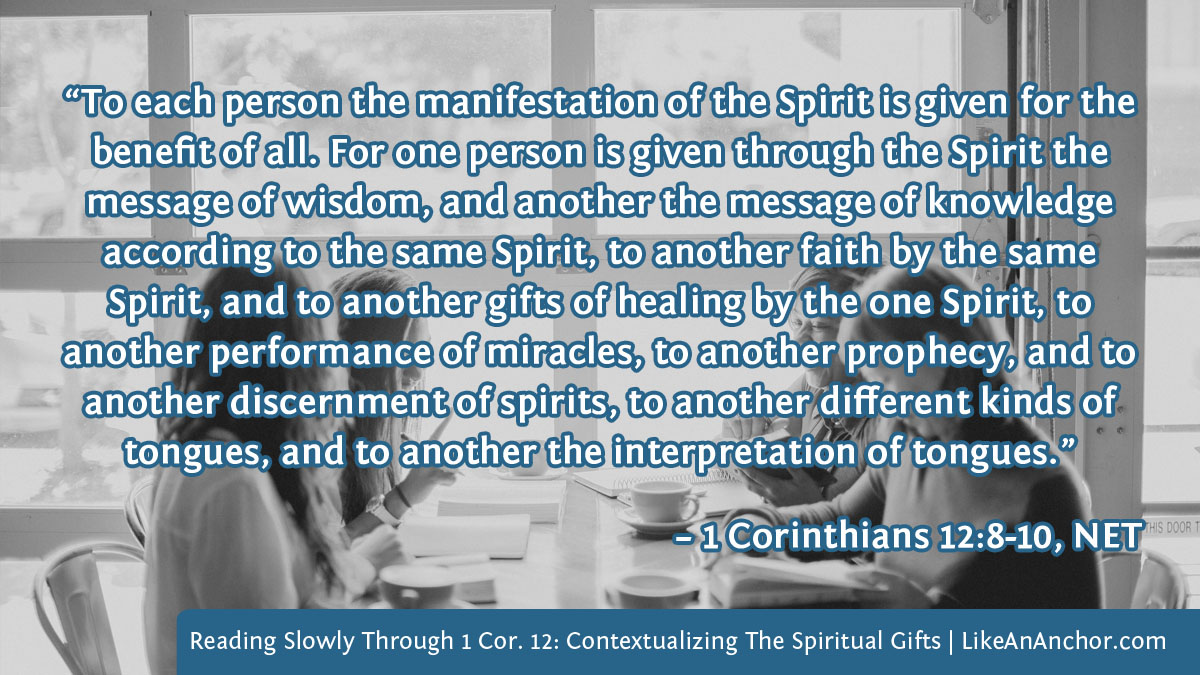
Image of four women studying the Bible together overlaid with text from 1 Cor. 12:8-10, NET version:  “To each person the manifestation of the Spirit is given for the benefit of all. For one person is given through the Spirit the message of wisdom, and another the message of knowledge according to the same Spirit, to another faith by the same Spirit, and to another gifts of healing by the one Spirit, to another performance of miracles, to another prophecy, and to another discernment of spirits, to another different kinds of tongues, and to another the interpretation of tongues.”
Image by Shaun Menary from Lightstock

Examining the Gifts

1 Corinthians 12:8-10 is one of a few different passages in the Bible that lists spiritual gifts. In Romans, Paul talks about the gifts of prophecy, service, teaching, exhortation, contributing, leadership, and mercy (Rom. 12:6-8). In Ephesians, he focuses on roles God gave in the church and talks about apostles, prophets, evangelists, pastors, and teachers (Eph. 4:7-13). Peter talks about love, hospitality, speaking, and service in relation to gifts (1 Pet. 4:8-11). Each list is a bit different. We’ll just focus on the one in 1 Corinthians today.

For one person is given through the Spirit the message of wisdom, and another the message of knowledge according to the same Spirit

1 Corinthians 12:8, NET

Let’s think back to the opening line about idols and understanding. Remember, Paul said, “I want you to understand that no one speaking by the Spirit of God says, ‘Jesus is cursed,’ and no one can say, ‘Jesus is Lord,’ except by the Holy Spirit.” This is particularly important to keep in mind for the spiritual gifts that also have non-spiritual counterparts.

Wisdom (G4678, sophia, intelligence, skill, expert knowledge) and knowledge (G1108, gnosis, knowledge and general intelligence) aren’t words exclusively related to Christianity. People can seem wise or knowledgeable without really having the type of true, divine wisdom and knowledge that comes from God (as Paul has already addressed in 1 Cor. 1-2). Given how much emphasis Paul put on the difference between human and divine knowledge at the beginning of this letter, I think he wants to make sure we don’t mistake human intelligence for the spiritual gifts of wisdom and knowledge. No matter how smart something sounds, if it doesn’t line up with truth then it isn’t the message (G3056, logos, word, intelligent speech) of wisdom or knowledge.

to another faith by the same Spirit, and to another gifts of healing by the one Spirit,  to another performance of miracles, to another prophecy, and to another discernment of spirits, to another different kinds of tongues, and to another the interpretation of tongues. 

1 Corinthians 12:9-10, NET

Seeing “faith” on a list of spiritual gifts puzzles me, kind of like seeing “mercy” and “service” on lists in Romans and 1 Peter. Those are attributes that all Christians are supposed to have. It is impossible to please God without faith (Heb. 11:6), so it’s something every one of His followers needs and which we all can have. This makes me wonder if some of the spiritual gifts have “levels” of sorts. Maybe we all have faith but perhaps some have a gift of super-abundant faith. And perhaps many of us–or maybe even all of us–have the potential to prophecy or heal or discern spirits, but some have that talent as a gift and are more likely to do so regularly.

Paul even says that we can pursue specific gifts and advises that we ask God for prophecy, which in this case means speaking “to people for their strengthening, encouragement, and consolation” (1 Cor 14:1-5). This seems to indicate that people can have multiple spiritual gifts and that we can ask God for more gifts, though of course we also need to accept that He’s the one who chooses which gift(s) will be best for each person.

Reiterating Unity

Image of four people walking into a church building with the blog's title text and the words "When we think of spiritual gifts, we often focus on figuring out which gift we have. As we do that,  we need to also remember Paul’s points that contextualize our desire for and use of such gifts.
Image by Pearl from Lightstock

After listing some spiritual gifts, Paul returns to the topic of unity in the body. This point is integral for understanding how to use the gifts God has given us and how to perceive the gifts God gives other people.

It is one and the same Spirit, distributing as he decides to each person, who produces all these things. For just as the body is one and yet has many members, and all the members of the body—though many—are one body, so too is Christ. For in one Spirit we were all baptized into one body. Whether Jews or Greeks or slaves or free, we were all made to drink of the one Spirit. For in fact the body is not a single member, but many. 

1 Corinthians 12:11-14, NET

Paul elaborates on this analogy by pointing out how silly it would be for one part of the human body to say it isn’t really part of the body, or for a part like an eye to tell another part, like a hand, that there’s no need for it (1 Cor. 12:15-26, NET). It’s the same level of ridiculousness if one person thinks, “Because I have this gift I understand more than everyone else so I’m leaving,” or if another were to say, “I don’t like people with this gift or role, so they shouldn’t be here in my church.”

 Now you are Christ’s body, and each of you is a member of it. And God has placed in the church first apostles, second prophets, third teachers, then miracles, gifts of healing, helps, gifts of leadership, different kinds of tongues. Not all are apostles, are they? Not all are prophets, are they? Not all are teachers, are they? Not all perform miracles, do they? Not all have gifts of healing, do they? Not all speak in tongues, do they? Not all interpret, do they? But you should be eager for the greater gifts.

And now I will show you a way that is beyond comparison. If I speak in the tongues of men and of angels, but I do not have love, I am a noisy gong or a clanging cymbal. And if I have prophecy, and know all mysteries and all knowledge, and if I have all faith so that I can remove mountains, but do not have love, I am nothing. If I give away everything I own, and if I give over my body in order to boast, but do not have love, I receive no benefit.

1 Corinthians 12:27-13:3, NET

We talked about this “way that is beyond comparison” a couple weeks ago in my post “The Necessity of Godly Conflict Resolution and Forgiveness.” Wanting spiritual gifts is good because when they’re used rightly, they benefit the entire church body. But unless love is guiding our actions, all the good things we do and all the gifts we might have are empty.

When we think of spiritual gifts, we often focus on figuring out which gift we have or how we can use our gifts. As we do that, though, we need to keep in mind the other points Paul makes to contextualize the right desire for such gifts. We need to remember that gifts are given to strengthen the whole body. They’re given to individuals so that we can contribute to God’s church. And the gifts aren’t the only important thing. They’re not even the most important. Love–which in today’s world is often seen as simple or weak and not nearly as important as something like knowledge or power–is actually the most important thing for followers of God to have inside them and display in their lives. Agape-love for God and others is the foundation for using God’s spiritual gifts properly “for the benefit of all.”


Featured image by Inbetween from Lightstock

Psalm 133: Unity Like Oil and Dew

Psalm 133 is a beautiful passage of scripture. It’s always been one that puzzles me, though. I like metaphor and poetic imagery, but I’m not sure what we’re supposed to learn from the analogy used in this psalm. It’s short, so I’ll quote the whole thing here:

Look! How good and how pleasant it is
when brothers truly live in unity.
It is like fine oil poured on the head,
which flows down the beard—
Aaron’s beard,
and then flows down his garments.
It is like the dew of Hermon,
which flows down upon the hills of Zion.
Indeed, that is where the Lord has decreed
a blessing will be available—eternal life.

Psalm 133:1-3, NET

The dew and oil analogies are linked by the word “flow.” There is something about unity among brothers that is like the way anointing oil flowed over a priest or dew flows down a mountain. I spent the past week studying this, and here’s what I’ve found so far. I’d love to hear any thoughts you have about this psalm in the comments!

Oil

The anointing that this psalm speaks of is recorded in Leviticus 8 and Exodus 29, though only the Leviticus passage records the oil being poured rather than just sprinkled (Ex. 29:1, 4, 21; Lev. 8:1-2, 20).

Then Moses took the anointing oil and anointed the tabernacle and everything in it, and so consecrated them. … He then poured some of the anointing oil on the head of Aaron and anointed him to consecrate him.

Leviticus 9:10, 12 NET

In this context, oil is used for consecration; to put something or someone “into the realm of God’s holy things” (NET footnote on Lev. 8:10). That’s what’s happening in the scene that David described when he was explaining true unity among brothers. The “brothers” in this psalm could refer siblings, of course, but in scripture “brothers” tends to be a phrase used to describe a group of people connected by belief in God (see, for example, Acts 2:29, 37; Rom 12:1; James 5:7-12). The familial unity we’re looking for here operates on a physical and a spiritual level.

Unity among physical and spiritual family members is connected to holiness and to priesthood. Indeed, Peter tells the New Testament church that God is building all of us up together “to be a holy priesthood” and that we are chosen as a “royal priesthood” (1 Pet. 2:5, 9). God wants us to be holy, to be united, and to be part of His “kingdom of priests” (Ex. 19:6; Rev. 1:6; 5:10).

Dew

When David talks about the “dew of Hermon,” geographically he’s referring to Mount Hermon located in “the distant north” relative to “the hills of Zion” (NET footnote on Ps 133:3). Typically, Mount Hermon is used in the Bible as a landmark (Deut. 3:8-9; Josh. 11:3, 17; 1 Chr. 5:23) and we don’t have much information about why David chose it as the mountain to mention in this Psalm. Given Mount Hermon’s location, it’s unlikely that dew which formed there would make it to Zion. This leaves us with a bit of a puzzle.

Thankfully for us, David gives us a clue how we’re supposed to interpret dew in this passage by saying the locations he mentions are “where the Lord has decreed a blessing will be available.” Connecting dew (an important source of water for plants and animals, and by extension people) with blessing is fairly common in scripture (Gen. 27:28; Deut. 33:13; Zech. 8:12). Conversely, holding back dew was a punishment (2 Sam. 1:21; 1 Kings 17:1; Hag. 1:9-10).

Your dead will come back to life;
your corpses will rise up.
Wake up and shout joyfully, you who live in the ground!
For you will grow like plants drenched with the morning dew,
and the earth will bring forth its dead spirits.

Isaiah 26:19, NET

As we can see in this and the other scriptures I linked to, dew is connected with blessings and growth. God even promises to “be like the dew to Israel;” healing and helping them grow and thrive (Hos. 14:4-6, NET). Unity fits into all this as well, helping the blessings that God gives like dew to flow out to more and more people.

Blessings that Flow

The blessings that come from brothers living together in unity don’t just stay in one relationship, or one family, or even one church group. They flow and spread like consecrating oil and growth-enabling dew. Unity is a good, excellent, valuable (H2896, tob), pleasant, delightful, and sweet (H5273, na’iym). It’s something precious; something which we grow into.

to build up the body of Christ, until we all attain to the unity of the faith and of the knowledge of the Son of God—a mature person, attaining to the measure of Christ’s full stature.

Ephesians 4:12-13, NET

We ought to “increase and abound in love for one another and for all” (1 Thes. 3:12, NET. Also Phil. 1:9). Like the holiness of a priest ought to result in service to the congregation and the dew which waters the ground ought to result in growth, so ought the relationships between believers result in unity, peace, and love that grows and spreads.

Image by Steve Buissinne from Pixabay

When Other People Don’t Think Like You, Focus on Thinking Like God

I’ve long been fascinated by Philippians 3 (even wrote a whole post about it). Here, Paul talks about the things he had before conversion–religious status, a good background, the best education, zeal for his faith–and then says all his “human credentials” count for nothing. Indeed, he regards “them as dung!” It is so much more valuable to know Christ “and be found in him,” not because Paul is righteous by following the law but because he has “the righteousness from God that is in fact based on Christ’s faithfulness.” And then with all that as background, he talks about how he keeps striving to live a godly life and will keep doing so until the end of his life in the hope of attaining “to the resurrection of the dead” (Phil. 3:5-12, NET).

This discussion is framed by Paul addressing a contentious issue in the church. He warns the Philippians to “beware of the dogs” (false teachers, see NET footnote), “beware of the evil workers, beware of those who mutilate the flesh” (those who wrongly teach physical circumcision is still necessary” and those who “rely on human credentials” (Phil. 3:1-4, NET). That is why Paul brings up his own credentials. He’s not attacking these other teachers and saying their credentials mean nothing because Paul doesn’t have any and wants to make himself look better. Rather, he has the credentials and he still says they’re worthless because “human credentials can produce nothing that is pleasing to God” (NET footnote on v. 15). It is with this foundation that Paul then says what I want to focus on today.

Brothers and sisters, I do not consider myself to have attained this. Instead I am single-minded: Forgetting the things that are behind and reaching out for the things that are ahead, with this goal in mind, I strive toward the prize of the upward call of God in Christ Jesus. Therefore let those of us who are “perfect” embrace this point of view. If you think otherwise, God will reveal to you the error of your ways. Nevertheless, let us live up to the standard that we have already attained.

Phil. 3:13-16, NET

So often, when we disagree with someone in the church we instinctively want to defend our point of view. But what Paul indicates is that our first response should be to ask God to reveal His mind.

The Mind of Christ

One of the central goals of our Christian walk is to learn to think like God does. He fills us with His spirit to transform us and make us part of His family. We have received the Spirit “from God, so that we may know the things that are freely given to us by God” (1 Cor. 2:12, NET)

The unbeliever does not receive the things of the Spirit of God, for they are foolishness to him. And he cannot understand them, because they are spiritually discerned. The one who is spiritual discerns all things, yet he himself is understood by no one. For who has known the mind of the Lord, so as to advise him? But we have the mind of Christ.

1 Cor. 2:14-16, quoting Isa. 40:13, NET

We must “arm ourselves with the same mind” Christ had so that we can live “for the will of God” (1 Pet. 4:1-2, WEB). Part of the “will of God” involves living in harmony with our brethren. That only happens when all of us are trying to think like Christ.

Now the God of perseverance and of encouragement grant you to be of the same mind with one another according to Christ Jesus, that with one accord you may with one mouth glorify the God and Father of our Lord Jesus Christ. Therefore accept one another, even as Christ also accepted you, to the glory of God.

Rom. 15:5-7, WEB

Like Minded in Him

When scripture says that Christians are to be like minded, it does not mean we reach whatever mutual consensus we want. Our like-mindedness comes from all of us putting on the mind of Christ. That “we have the mind of Christ” verse I quoted earlier is preceded in Paul’s first letter to the Corinthians by this:

I urge you, brothers and sisters, by the name of our Lord Jesus Christ, to agree together, to end your divisions, and to be united by the same mind and purpose

1 Cor. 1:10, NET

Paul goes on to talk about how ridiculous it is to divide the church over which teacher to follow (1 Cor. 1:9-17), the fact that there is no room for human boasting before God (1 Cor. 1:18-31), that our faith is based in God’s wisdom, and that through His spirit we get to put on Jesus’ mind (1 Cor. 2:1-16). It has quite a few parallels with Philippians 3, where Paul talks about the uselessness of human credentials and then urges continued faithfulness, which includes living in peace with your brethren.

It’s a familiar refrain in Paul’s letters. “Live in harmony with one another” (Rom. 12:15). “Be of the same mind … being united in spirit” (Phil. 2:2). “Agree with one another, live in peace, and the God of love and peace will be with you” (2 Cor. 13:11). The more like God we become, the fewer disagreements we ought to have with others who are also becoming more like God.

Continue Aligning Yourself With God

The principle we’re discussing is simple in theory: put on Christ’s mind and you’ll all be united. In practice, we’re all at different levels of growth. None of us have fully put on the mindset and attitudes of Jesus yet, and we don’t always agree on what putting on His mind looks like. Returning to Philippians 3,

Therefore let those of us who are “perfect” embrace this point of view. If you think otherwise, God will reveal to you the error of your ways. Nevertheless, let us live up to the standard that we have already attained.

Phil. 3:15-16, NET

Let us therefore, as many as are perfect, think this way. If in anything you think otherwise, God will also reveal that to you. Nevertheless, to the extent that we have already attained, let’s walk by the same rule. Let’s be of the same mind.

Phil. 3:15-16, WEB

When we disagree, we can ask God to reveal His mindset and align us with truth. When seeking this sort of like-mindedness, always ask for God’s perspective so you can understand what He wants you to see–not to help you understand human teachings or teachers. Our goal for spiritual growth is to be like our Father. Unity with other believers happens as a result of that goal, not as the central goal itself.

Paul also admonishes us to “live up to” or “walk by” the standard we’ve already attained. This goes along with verses like the one in James that says if you know to do good and don’t do it that is sin to you (James 4:17) and passages in Romans that indicate we’re judged based on how well we do God’s will rather than how well we understand the law (Rom. 2:10-16). Though we might not always agree with other Christians on the best way to follow God, we need to live in peace with others as much as possible, follow God as faithfully as we understand how, and always be seeking to align our thinking and mode of living more closely with Him.

Featured image credit: Pearl via Lightstock

Staying Loyal to Our Core Identity as Children of God, and Using It to Create Unity

Who and what are you?

We can all answer this question a variety of different ways. Our identities are multifaceted things — human, female, Christian, daughter, American, writer, friend, white, Midwestern (to give you some of mine). Some are chosen by us, some are given by God, nature, or other people. The things we identify with, wherever those identities come from, shape who are are.

Sometimes our identities might be in conflict with each other, or with those of other people. We need to be able to handle and resolve those conflicts. On the small scale, it might be something like “student” vs. “friend” (such as finding a balance between needing time to study and finding time to maintain friendships). On a larger scale, it might be something like “national” vs. “religious” (such as wanting to uphold your country’s ideals, but finding some of them at odds with your faith, and needing to choose between them). Or it could be an interpersonal situation where you find yourself interacting with people who have different political affiliations, ethnicities, faiths, and priorities than you do.

How we resolve these inner and outer conflicts says something about who we are and what we value. As Christians, we have an identity that is meant to be first in our priorities and underlie every other part of our lives. But we don’t always live as if this is truly the case. Sometimes we choose to put other beliefs and identities first, and if we do that too often it can damage our relationship with our primary identity as children of God.

Staying Loyal to Our Core Identity as Children of God, and Using It to Create Unity | LikeAnAnchor.com
Photo credit: Claudine Chaussé via Lightstock

The Problem of Conflicting Identities

I recently listened to a podcast episode titled “A First Step Toward Racial Reconciliation,” which was an interview with Mark Vroegop. His book Weep with Me: How Lament Opens A Door For Racial Reconciliation is coming out next month. In this interview, he talks about how the church should be the best place to resolve racial differences because “the gospel creates an identity that gets underneath all other identities.” Read more

The Problem With Following People (Including Yourself)

If you’ve been a Christian for any length of time, you’ve probably noticed people in the church don’t always act Christ-like. For many, the worst hurts they’ve suffered from another human being came from someone who called themselves “Christian.” Even if that’s not the case for you, I’m sure you’ve seen pettiness, hypocrisy, and other issues among God’s people.

Yet even though we know human beings aren’t perfect, there’s still a tendency to align ourselves with them. We’ve all known people who found a teacher they like so much they’ll follow him even if he contradicts the Bible. Maybe we’ve even been there ourselves, often without even realizing it. We might also have seen churches break into factions when leaders disagree over a point of doctrine, and then followed one of those leaders as the group splits apart.

When you go through something like that often enough, it’s easy to lose trust in other people. Maybe we stop relying on other Christians, or refuse to listen to the ministry, or become obsessively critical of others. We might decided we’re the only reliable authority on scripture and that it’s dangerous to listen to anyone else.

Wanting someone to follow as an authority, or rejecting others and their ideas to avoid getting hurt, are both natural human impulses. But that doesn’t make either of them a good thing. Whenever we trust a human being (including ourselves) more than God, we’re going to get into trouble. We need to find a balance that lets us live in unity with our brethren while following God first and foremost. Read more

Am I Using God’s Truth To Hurt Others Or To Help Them?

Last week we talked about the fact that speaking the truth in today’s culture can offend people. That’s something we were warned about in scripture — the world will hate us like they hated Jesus and preaching the cross is “foolishness to those who are perishing” (John 15:18-22; 1 Cor. 1:18).

But what about in the church? God’s intention is that there be peace and unity in His church, but we’ve all experienced times when that’s not the case. People in the church fight and bicker. They offend each other. They split church groups. And most would tell you that they’re speaking the truth and the other person is the one at fault.

We always have a responsibility to follow God faithfully and to speak about His truth. And we must always try to do that in a way that points people toward Him instead of pushing them away. However, we won’t always be able to present the gospel in a way that appeals to the world. Jesus preached truth perfectly and people still turned away (John 6:64-67). Within the church, though, we should be able to talk about the truth without hurting each other. So how do we do that?

You’re Not Here For You

Near the middle of his letter to the Ephesians, Paul addresses the question of how the people in God’s church should relate to one another. He talks about different roles Christ set up in the church (apostles, prophets, evangelists, shepherds, and teachers) and why (“for the perfection of the saints, to the work of serving, to the building up of the body of Christ”). The goal in all this is to “attain to the unity of the faith and of the knowledge of the Son of God.” We’re not to be immature Christians any more, easily swayed by new doctrines or tricky, wicked men (Eph. 4:11-14). Read more