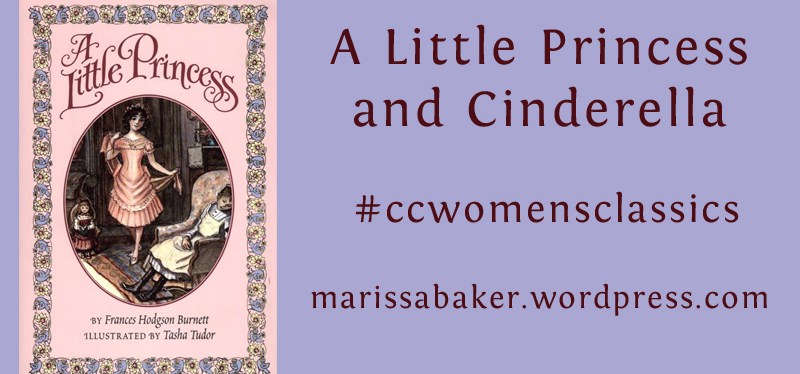
A Little Princess and Cinderella

Last week, I compared A Secret Garden to my favorite fairy tale, Beauty and the Beast. The subject of this week’s Classics Club post, A Little Princess by Frances Hodgson Burnett, has fairy tale elements which are even more obvious.click to read "A Little Princess and Cinderella" | marissabaker.wordpress.com

It’s pretty much the exact same story as Cinderella — an only child whose sweet disposition is unaffected by being spoiled is left in the care of an unkind woman after her father’s unexpected death. The austere and jealous guardian transforms the girl into a servant who lives in an attic and makes friends with rodents and birds. Eventually, a wealthy man swoops in and rescues her (Tweet about it).

There are even jealous “step-sister” figures in the form of some of the girls at the school (we’re looking at you, Lavinia). And you could call Ram Dass a “fairy godmother” of sorts, since he transforms Sara’s dingy attic into a princess room simply because he notices she’s so kind and wants to do something nice for her. It’s a key fairy-tale trope — eventually Magic (or it’s human equivalent) will step in and set things right if only you’re a good person.

Read more

The Secret Garden and Beauty and the Beast

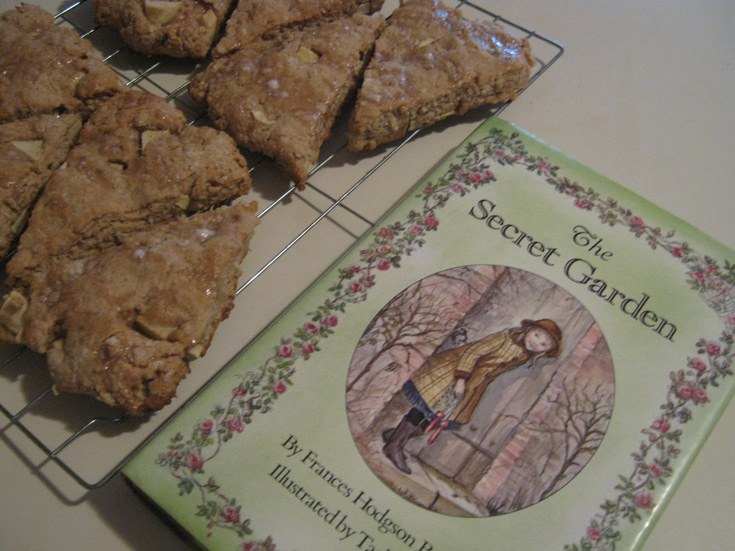
I suppose there might be better ways to spend a Sunday than baking scones, reading and blogging about books and watching Star Trek, but I really can’t think of any right now. They’re cinnamon apple oatmeal scones, and the books are by Frances Hodgson Burnett, and it’s classic Trek with Kirk, Spock and McCoy. Does it get any better?

The Secret Garden #ccwomenclassics | marissabaker.wordpress.com

Both The Secret Garden and A Little Princess are re-reads on my Classics Club book list. They were some of my favorite books as a child, and my sister and I watched the film adaptations over and over when we were younger. Since they also qualify for the Women’s Classic Literature event, I decided to make them my first classics reads for the new year.

I can’t tell you how much I wanted a secret garden. Actually, I never really outgrew that — I’m sure gardens surrounded by high stone walls covered with ivy are more alluring than ones just sitting out in the front yard where anyone can see them. That garden with its hidden door is probably why The Secret Garden was always my favorite of the two books. That and the fact that there were boy characters — books with just girls in them are nice, but books with boys and girls are better even when there isn’t a hint of romance. Read more

Classics Club: Anna Karenina

At 817 pages, Anna Karenina by Leo Tolstoy is the most daunting book I’ve yet read for The Classics Club. I chose the translation by husband-and-wife-team Richard Pevear and Larissa Volokhonsky. Their work translating Russian literature is highly acclaimed, and I liked the idea of a native Russian speaker and a native English speaker working so closely together on the translation. I found their Anna Karenina very readable.

It took me quite a while to read Anna Karenina, but I did enjoy it. The book was just so large it was hard to take everywhere, and I finished several thinner books for more portable reading. I think ‘intermittently’ was probably the best way for me to read Tolstoy. Usually I would read whole Parts in a chunk, but when it switched between different character arcs (and there were several), I needed a short break.

The main reason I was excited to read Anna Karenina was because my creative writing professor always talked about Russian writers as examples of superb character building. In this regard, Tolstoy did not disappoint. My sister, who’s reading War and Peace, said she noticed the same thing. The characters, especially his male characters, are nuanced people with depth of personality. I particularly enjoyed Levin and his story.

Three couples are at the centers of the novels main plots: Stepan and Dolly Oblonsky (Anna’s brother and sister-in-law), Kostya and Kitty Levin (Kitty is Dolly’s sister), and Anna Karenina with Alexei Karenin (her husband) or Alexei Vronsky (her lover). I know why Tolstoy chose Anna Karenina’s name as the title — she’s the only character which connects and influences all the others — but I was a little surprised not to see her play a more prominent (or at least more active) role in all the main plots.

Anna makes one decision — to enter an adulterous relationship with Vronsky — and then everything else just sort of happens. Her affair takes Vronsky out of Kitty’s life, which leads to Kitty’s very wise decision to marry Levin, but that’s the only affect Anna has on that plot line. Her main influence in the Oblonsky family storyline takes place at the beginning of the novel, before she even meets Vronsky. As relatives they cross paths throughout the book, but don’t influence each other much. For all the talk about her strong personality, Anna may be least active main character I’ve read. She takes the easiest road from the moment she throws her life in with Vronsky. She tells her husband only when she can’t bear not to. She won’t accept Karenin’s forgiveness because the self-awareness, growth and repentance necessary is too daunting. She doesn’t accept a divorce because it seems like such a final step that would separate her from her son. She refuses to take an interest in her daughter. She throws herself under a train because she can’t stop sabotaging the one relationship she has left, with Vronsky.

Here we get back to my caveat about Tolstoy’s really great characters mostly being male. I liked Kitty, I sympathized with Dolly, I partly understood Anna, but I didn’t empathize with them and they didn’t always feel real. Or maybe they were realistic, but I just didn’t like Anna and Dolly much? I’m not sure.

Plot wise, it did seem odd to me that the book continued so long after the title character’s death. These last chapters did tells you the main things that happened to Anna’s Alexies after her death, but didn’t follow them closely. Instead, it switched to wrapping up Levin’s subplot of spiritual awakening, which had absolutely nothing to do with Anna. Ending on that note made me wonder if the main point Tolstoy wanted his readers to take away wasn’t the tragedy of Anna’s unhappy families, but the beauty of Levin’s spiritual quest. Levin is also tempted by suicide, but he doesn’t take that route, and instead finds hope in his newly re-awakened faith in God that sits apart from any organized religion. Perhaps Tolstoy hoped his readers would progress on a path of faith, hope and happiness as well.


Click here to get a copy of Anna Karenina. Please note that this is an affiliate link. This means that, at no additional cost to you, I will receive a commission if you click on the link and make a purchase.
The Tenant of Wildfell Hall

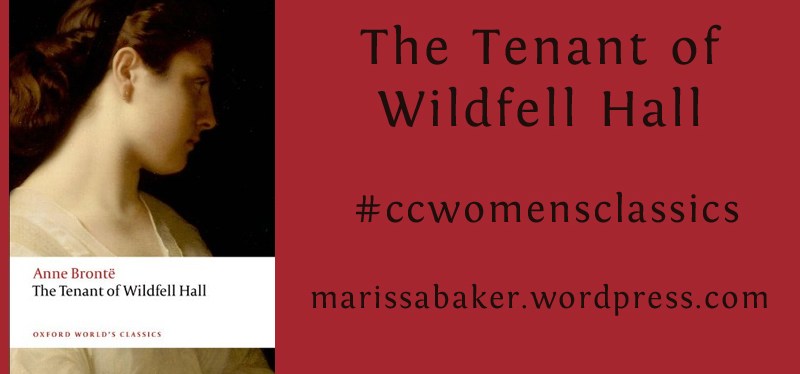
I, who never wanted an electronic reading device, read all of Anne Bronte’s The Tenant of Wildfell Hall on my phone. I recently upgraded to a cellphone that actually works where I live, and it also happens to be a smartphone tempting me with free classics on Google Books. I thought it would be easier to pull out my phone and read a little than trying to carry around the printed copy of Anna Karenina I was currently reading (and which I finally finished!).
Like her sister Charlotte did with Jane Eyre, Anne Bronte captivated me with her story. I read it while waiting for a repair on my car’s exhaust system. I read it while eating breakfast. I even read in the bathtub while praying I didn’t drop my phone in the water, but I had to know what happened next.

Stylistically, what caught my eye was that the bulk of the novel is narrated by the main character Gilbert Markham. I’m trying to think of any other female authors of this time period who wrote a first-person narrative from a man’s perspective, but haven’t so far. Read more

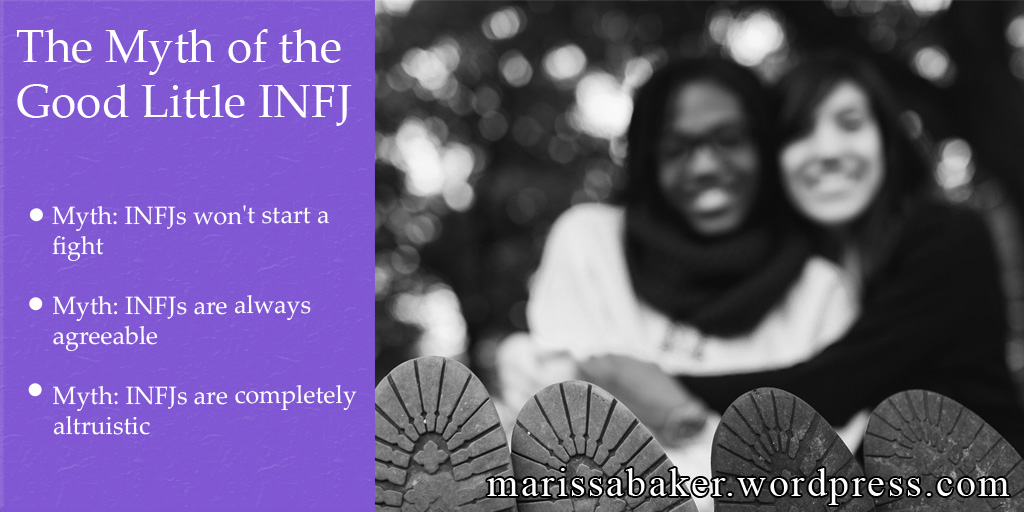
The Myth of the Good Little INFJ

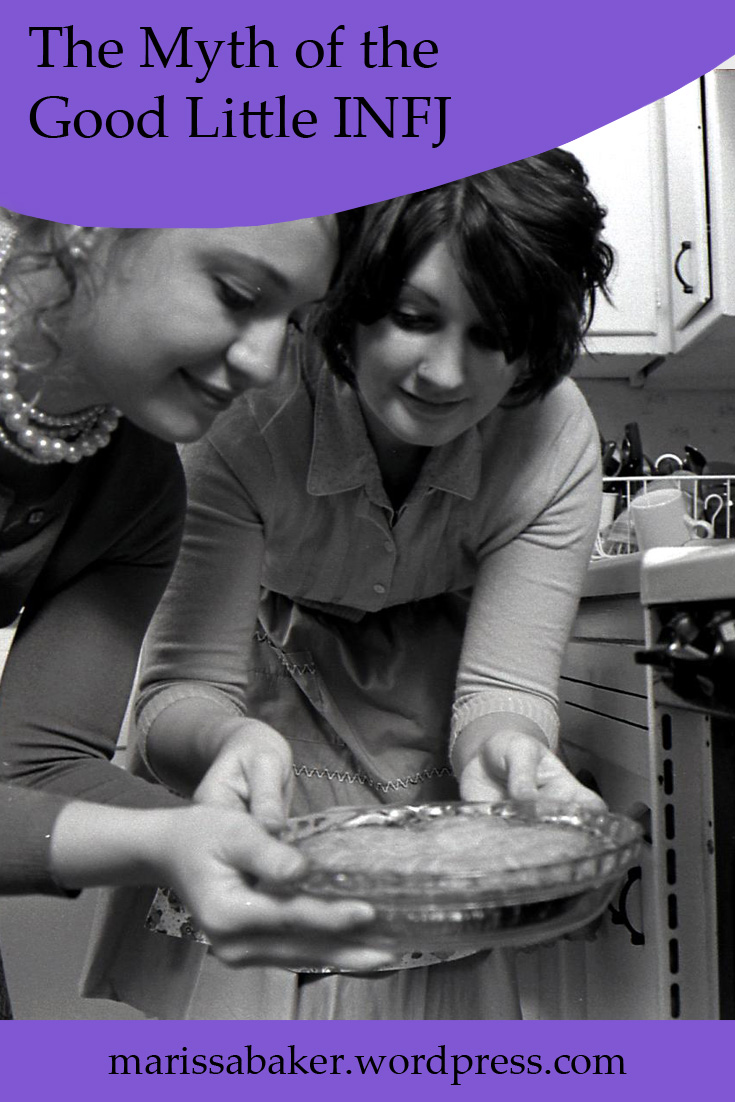
Last week, I stumbled across an article on Pinterest talking about female INFJs. Well, technically it was about INFj in the Socionics system, which is a bit different than the MBTI type and may include INFPs as well, but for purposes of this article we’ll just talk about INFJ types. The original article, written in 2011 by someone identified only as Beskova, paints a portrait of the INFJ type that is beautiful on the surface but doesn’t quite manage to reach their heart. It’s part of a disturbing trend in portrayals of INFJs, though this is the most extreme example I’ve seen.

Like many people who treat the INFJ type as quasi-mythical, this writer describes INFJs as flawless, naive, pure and submissive. They even describe a typical INFJ appearance: “Women of this type are very feminine and are delicate, modest and even shy. … They have a very ephemeral body, and sometimes lightly stooped posture.”

Reading on, it seems the INFJ has no faults. They never gossip or argue, meet adversity with mild gentleness, focus on humanitarian efforts, fit into any job, and submit themselves selflessly to helping the people in their lives. In short, the article says, “When a female INFj becomes your wife, know that in your home there lives a quiet angel” who “makes for one of the most obedient wives.”

The Myth of the Good Little INFJ | marissabaker.wordpress.com
photo credit: Cameron Nordholm

The biggest problem with this portrait of an INFJ isn’t just that it’s untrue; it’s the fact that INFJ women may try to fit into this mold if they end up in a relationship with someone who expects “their” INFJ to act like this. One thing that’s become clear in the months I’ve been reading things INFJs share online is that we’re one of the types most vulnerable to getting involved in unhealthy relationships with narcissists. And INFJ descriptions that make us out to be perfectly submissive and obedient aren’t helping discourage interest from unhealthy people.

Myth: INFJs won’t start a fight

It’s true that INFJs are one of the most conflict-avoidant types. Until a person does something the INFJ can’t live with, we’ll often just nod and smile at most conversations and suggestions. This happens with casual acquaintances when we don’t want to wast energy on conflict, and in closer relationships when we don’t want to deal with the emotional fall-out of conflict unless there’s a very good reason. I talk about this at greater length in my INFJ Handbook.

But if you think INFJs can’t get angry or won’t take a stand when things aren’t as they should be, think again. INFJs tend to draw a line in their minds, and once it’s crossed we’ll make sure we let you know. Once we get started, we’ll probably tack on a list of every other way you’ve ever let us down as well. The closer we are to you, the better we’ll know how to tear you apart (note: we’re not proud of this fact, and many INFJs work hard at controlling their anger). The best way to avoid this in a relationship is to keep open lines of communication, which is the number one thing many INFJs are looking for in a relationship. INFJs prefer to keep our emotions out in the open, and if we feel safe and heard then there’s no need to bottle up our feelings until we explode.

Myth: INFJs are always agreeable

In this socionics article, the writer talks about how INFJ women often need/want other people to make decisions for them. They write, “If you are her husband take responsibility for making major decisions in development of your family and she will with pleasure obey you.” Now, I’ll be honest — sometimes I do want people to make decisions for me. But if an INFJ is consistently told she can’t be trusted with important decisions and is left out of the planning process, then she’s going to stop trusting you.

The other party might not even notice an INFJ doesn’t agree with him if he’s expecting her to be what the article says: “friendly and dutiful, never quarrel nor ask much for themselves.” We place a high value on trust and communication in relationships, and assuming we agree with you instead of really asking us what we think is a good way to experience the INFJ door slam.

The Myth of the Good Little INFJ | marissabaker.wordpress.comA tip for people who know INFJs: If we don’t actually agree with you, or simply don’t care, we’ll typically make non-committal sounds, nod our heads, and avoid eye contact. If pressured to commit to something we don’t want to do or think, but won’t openly disagree with, we’ll try to push it off to an unspecified future date. When an INFJ actually agrees with you, we’ll make eye contact, our face will light-up, and we’ll say things like “Oh, yes” instead of just nodding. Usually, we’ll also be able to explain why we agree with you in specific terms.

Myth: INFJs are completely altruistic

One last quote from the socionics article: “watch that her emotional resources aren’t spent on her girlfriends, who inadvertently will use your wife as a psychotherapist. She will never refuse them herself, of course. Out of compassion. Therefore, it will be best if you take the matter into your own hands and limit the flow of those desiring to obtain psychotherapeutic sessions and useful advice from her.” Excuse me! What gives someone else the right to limit an INFJ’s contact with her friends? That’s the sort of controlling behavior that’s a huge red-flag in any relationship.

In addition to being incapable of taking care of herself, INFJ wives are apparently so dutiful they’ll do all the housework without any complaint even though they hate cleaning and cooking. For the record, this INFJ loves cooking and the housework doesn’t always get done in a reasonable amount of time. Also, one reason INFJs will avoid conflict and try to help people is because of how it affects us. Sometimes I do what people ask just because I don’t want to stay awake for three hours that night re-hashing every word of the resulting argument. It’s a self-protecting mechanism. That’s not to say INFJs don’t care about people — we do, deeply, and we will support our friends and family whenever possible. It’s a good thing. We can stretch ourselves too thin at times, but INFJs value their introvert time and don’t usually need someone to step in an control their lives to keep them from burning out. We’re not that altruistic.

In conclusion …

I may have dispelled some of the “mystic unicorn” aura surrounding INFJs, but perhaps that’s a good thing. Our rarity doesn’t make us better than other types, and type portraits that make us out to be something ephemeral and idyllic really aren’t helpful. As my siblings (and no doubt other people who INFJs have let into their lives) can testify, we’re not perfect.


If you’d like to know more about the INFJ personality type, check out my book The INFJ Handbook. I just updated it with a ton of new information and resources. You can purchase it in ebook or paperback by clicking this link.

Mighty Women

It seems odd to me that I’ve read the “virtuous woman” passage scores of times without bothering to look up the word “virtuous.” The Hebrew word, chayil, was mentioned in the first message given as my Feast of Tabernacles (Sukkot) site this year. I even had it in my notes, but forgot about it. God brought it to my attention again at the end of the Feast, when a man handed me a booklet titled “A Mighty Warrior: The Hebrew-Biblical View of A Woman” by Dr. Frank T. Seekins. I can take a hint — one Bible study/blog post coming right up!

Mighty Women | marissabaker.wordpress.com

Into The Hebrew

Chayil (H2428) carries the basic meaning of “‘strength,’ from which follow ‘army’ and ‘wealth'”(Theological Wordbook OT, entry 624). It’s used about 20 times of God’s might or power, and about 85 times to describe an attribute of people.

When chayil is used of people, there’s a marked difference in how it’s translated for men and women. For men, we find translations like “mighty man” or “mighty men of valor.” The Theological Wordbook of the Old Testament notes, “The individual designated seems to be the elite warrior similar to the hero of the Homeric epic.” For women, however, “it is translated ‘virtuous’ (ASV, RSV ‘worthy’ or ‘good’), but it may well be that a woman of this caliber had all the attributes of her male counterpart.”

While Biblical women were not typically warriors and did not serve in the army, we do have the example of Deborah acting the part of a “mighty woman of valor.” We also know from passages like Ephesians 6:11-13 and 2 Timothy 2:3-4 that all Christians are spiritual warriors. God’s women must be just as valiant as His men!

Your neck is like the tower of David, built for an armory, on which hang a thousand bucklers, all shields of mighty men. (Song 4:4)

O my love, you are as beautiful as Tirzah, lovely as Jerusalem, awesome as an army with banners! (Song 6:4)

Both these passages from Song of Solomon are descriptions that the male lover, who represents Christ, uses toward the female lover, who represents the church. Great men aren’t frightened of strong women; they embrace them as allies.

A Little More History

You might wonder why English translators decided to use “virtuous” or “good”for chayil when the Hebrew leans more toward “strong” and “mighty.” I suspect there were two reasons. Firstly, the original meaning of “virtue” in English was closer to chayil. It arrived in English around 1200 from Old French with the meanings, “force; strength; vigor; moral strength.” Originally, the Latin virtatum meant “high character; goodness; manliness; valor; bravery” (Online Etymology Dictionary).

Secondly, with prevailing attitudes of gender around the time early Bibles like the 1611 King James Version were released, translators were probably hesitant to call women “mighty” or “powerful.” By the 1590s, “virtuous” was losing the more martial aspects of the meaning, shifting toward moral characteristics. In reference to women, “virtuous” became used as a synonym for “chastity.” In the King James Version you can still see this word used for “power” in the New Testament passages where dunamis (G1411) is translated “virtue” (Mark 5:30; Luke 6:19, 8:46). In the New King James, references to Christ were changed from “virtue” to “power,” but the “virtuous woman” in Proverbs 31 only changes to a “virtuous wife.”

It’s true that high moral standards are essential for godly women. Commands regarding modesty and chastity are recorded elsewhere (1 Tim. 2:9), and the character of the Proverbs 31 woman is beyond reproach. But there’s more to being a “virtuous woman” than we might assume from what we’ve grown up hearing about “traditional gender roles.” The word “virtue” has suffered a similar fate as “meekness,” which our culture thinks of as synonymous with “doormat” while the original meaning carried the idea of strength submitted to God.

Mighty Women | marissabaker.wordpress.com

Allies in Battle

God created men and women to fight for Him together. They’re both supposed to be strong and they’re both supposed to support each other.

Men and women were created by God to be allies. As a culture, we have lost the concept of powerful allies; the very thing that Proverbs 31 is telling men to value. …

When a woman’s power is undercut, a situation is created where men and women become enemies. Instead of supporting each other, we battle and undermine God’s call to reflect Jesus relationship with His bride, the church. …

The Biblical concept is clear — A woman of power is to be valued and supported. It is God’s call for women (and men) to become mighty and powerful. (Seekins, p. 2)

I think many women balk at the Proverbs 31 model because it seems so domestic and submissive. “I don’t want to be a stay-at-home barefoot-and-pregnant good little wife,” some protest. “Why would God ask for such an outdated model of femininity?” But when we look closer at Proverbs 31, we find that’s not actually what it’s saying.

The first two descriptions show a woman who does her husband “good and not evil,” and who has earned his complete trust (Prov. 31:11-12). Her husband is respected by all, and it’s implied this is in no small part owing to her support as his ally (Prov. 31:23). In addition, she cares for the poor and needy, practicing the command to “love your neighbor” (Prov. 31:20). She’s respected by her children, husband and the community, and her opinion is highly valued (Prov. 31:28-29, 31).

The Proverbs 31 woman is shown actively doing productive things. She works with her hands, engages in trade “like the merchant’s ships,” and oversees workers in her household (Prov. 31:13-16, 19, 22, 24). She’s not full of anxiety because she has confidence in her ability to care for her business and family (Prov. 31:18, 21, 27).

Strength and honor are her clothing; she shall rejoice in time to come. She opens her mouth with wisdom, and on her tongue is the law of kindness. (Prov. 31:25-26)

It’s still an intimidating picture to try and live up to, but there’s no reason to reject it as demeaning to women. If anything, this “outdated” model is far more powerful than anything modern women’s empowerment movements have come up with.

When a woman understands her calling to be a mighty warrior and a perfect ally, she will conquer and control life. She will remember that the men in her life are not the enemy; her weapons are not meant to be used against them. The weapons of her strength and power are to be used against their enemies (Seekins, p. 23).

God calls all of us to “be strong in the Lord and in the power of His might” (Eph. 6:10). Both men and women need to recognize this, and embrace our roles as “heirs together of the grace of life” (1 Pet. 3:7), fighting as allies for and alongside the Captain of our Salvation, Jesus Christ.

Save