A Time To Return

If I asked you to define “repent” or “repentance,” what would you say?

We know it’s the thing you’re supposed to do when you’ve sinned and you’re coming to God asking for forgiveness. But is it just saying you’re sorry?

In English, “repent” means to express regret and remorse. While the Hebrew and Greek words translated “repent” in the Bible include that aspect of regret, the Biblical concept goes a step farther. Biblical repentance involves change. This change is a movement; an alteration in the direction of your heart and your life. The word image contained in both Hebrew and Greek is to turn away from sin and to turn toward God.

Unpopular Repentance

According to Oxford Languages (via Google), “repent” means “feel or express sincere regret or remorse about one’s wrongdoing or sin.” It came into Middle English “from Old French repentir, from re- (expressing intensive force) + pentir (based on Latin paenitere ‘cause to repent’).” There’s also something interesting going on with Google’s tracking for how often this word was used in English-language books between 1800 and 2019.
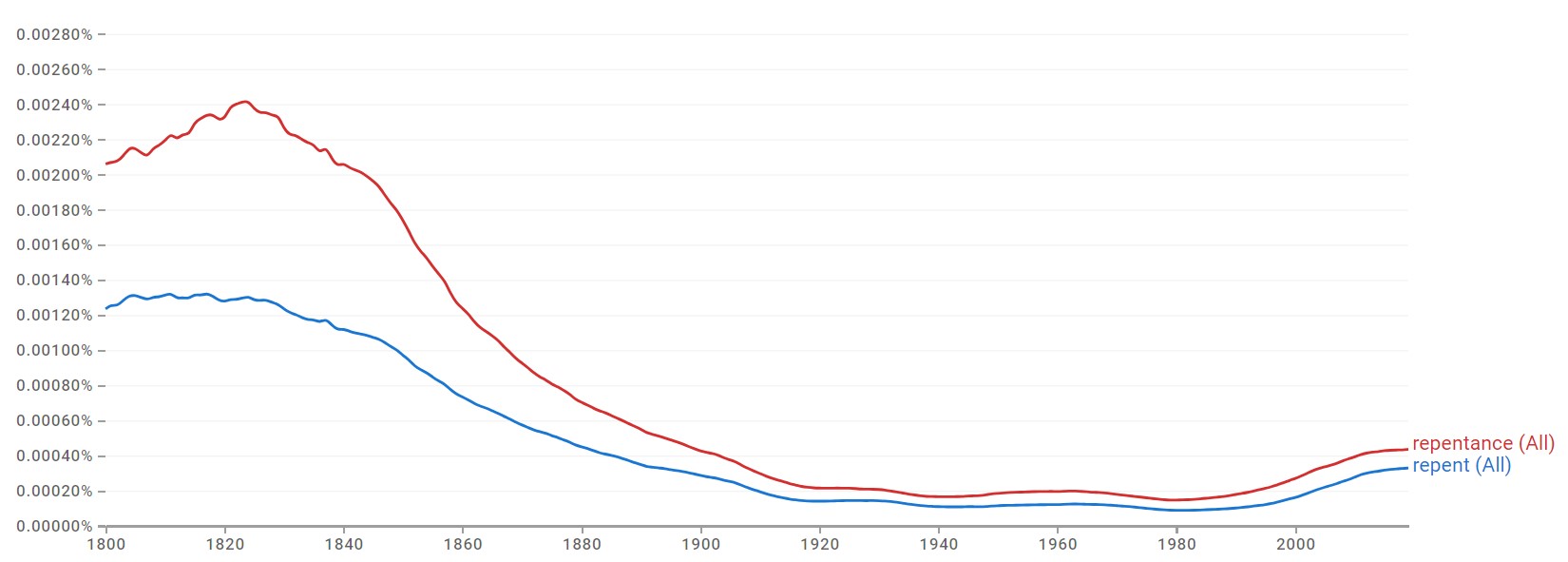
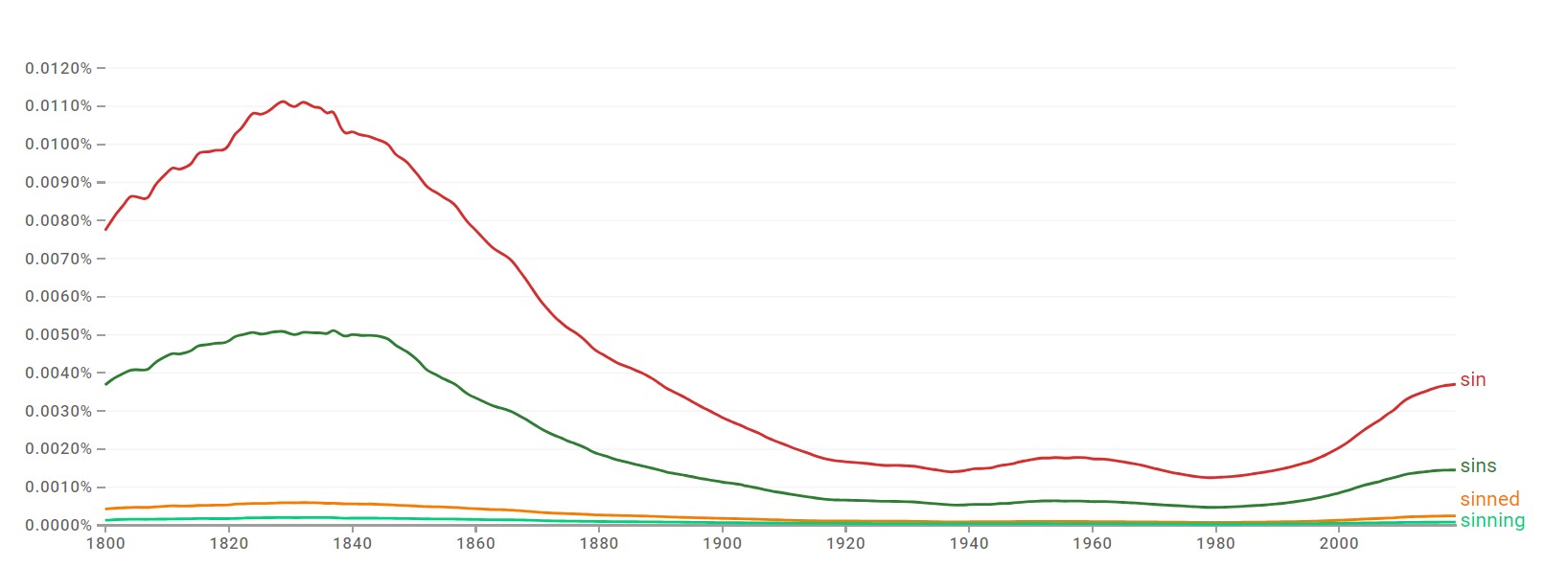
Evidently, repentance is not a popular idea (though I am intrigued by the recent uptick in usage after that slump in the 1900s). I don’t really think it will surprise any of us that “repent” and “repentance” are used less now than they were in the early 1800s. Repentance is something you need to do after you sin, and sin isn’t something we like to think about either. The more moral relativism takes hold in our society, the less people are willing to acknowledge sin is even a real thing since sin is the transgression of (God’s) absolute laws. The chart for “sin” in English language books looks very similar to the one for repentance.
But what about us today? If we’re sincerely following Jesus and love Him, He says we’ll obey His commandments. Commandments are contained in the law of God (Matt. 22:36, 40). The law and commandments are “holy, righteous, and good” (Rom. 7:12), and it is how God lets people know what sin is (Rom. 7:7-8). John says, “Sin is lawlessness” (1 John 3:4, WEB) or “the transgression of the law” (KJV). Paul further adds that “all have sinned” (Rom. 3:23). When Jesus came to this earth, one of His stated purposes was to call “sinners to repentance” (Luke 5:32), and it’s a message His disciples continued to preach (Acts 2:38; 3:19).

Putting all that together, we see that every human being is guilty of sin. Jesus can fix that problem, though. When sinners repent and follow Him, He takes away their sins (John 1:29; 1 John 3:5). Even after that, though, we still have a responsibility to keep His commandments because we love Him. And if we sin, then we need to repent again.

Returning and Changing

In Greek, one word translated “repent” is metanoeo (G3340). It includes the “regret or sorrow” aspect that is captured by the English word “repent,” but it also involves another step. The root words are meta (G3326: to be among or amidst, or to move toward that position) and noeo (G3539: “to exercise the mind, think, comprehend”) (Zodhiates entry G3340). Metanoeo is distinct from regret (metamelomai [G3338]) and includes “a true change of heart toward God” (Zodhiates). Thayer defines metanoeo as “to change one’s mind for better, heartily to amend with abhorrence of one’s past sins” (Thayer entry G3340). There’s a sense of turning around involved, as if when we sin we are walking away from God and when we repent we turn around and go toward Him again.

There’s another word for repentance in the New Testament as well. Zodhiates writes, “Metanoeo presents repentance in its negative aspect as a change of mind or turning from sin while epistrepho presents it in its positive aspect as turning to God” (Zodhiates entry G3340). He also notes that both of these words “derive their moral content … from Jewish and Christian thought, since nothing analogous to the biblical concept of repentance and conversion was known to the Greeks.” To understand what metanoeo and epistrepho (G1994) meant to early Christians, we need to look back at the Hebrew words expressing the same concepts.

Once again, we have two words that can be translated into English as “repent.” One of those, nacham (H5162) is typically only used of God “repenting” in the sense of “relenting or changing,” like He did when he delayed Nineveh’s destruction in response to their repentance (Theological Wordbook of the Old Testament [TWOT] entry 1344). In that story of Nineveh, we also see the Hebrew word more commonly used for human repentance, shub (H7725).

Jonah began to enter into the city a day’s journey, and he cried out, and said, “In forty days, Nineveh will be overthrown!”

The people of Nineveh believed God; and they proclaimed a fast, and put on sackcloth, from their greatest even to their least. The news reached the king of Nineveh, and he arose from his throne, and took off his royal robe, covered himself with sackcloth, and sat in ashes. He made a proclamation and published through Nineveh by the decree of the king and his nobles, saying, “Let neither man nor animal, herd nor flock, taste anything; let them not feed, nor drink water; but let them be covered with sackcloth, both man and animal, and let them cry mightily to God. Yes, let them turn (shub) everyone from his evil way, and from the violence that is in his hands. Who knows whether God will not turn (shub) and relent (nacham), and turn (shub) away from his fierce anger, so that we might not perish?”

God saw their works, that they turned (shub) from their evil way. God relented (nacham) of the disaster which he said he would do to them, and he didn’t do it.

Jonah 3:4-10, WEB

The basic meaning of shub is to turn or return. It is a Hebrew verb used frequently; “over 1050 times” in the Old Testament. While the Hebrew writers use many word pictures to describe repentance, all “are subsumed and summarized by this one verb shub. For better than any other verb is combines in itself the two requisites of repentance: to turn from evil and to turn to the good” (TWOT 2340). Like the Greek words that would later represent the same concept, Hebrew notions of repentance include both regret and turning away from sin and turning toward God. There’s always a sense of change; the verb shub is so connected with turning and change that it is even used of physical movement and coming back to a people or location (TWOT 2340).

The word shub is particularly important in it’s relation to “the covenant community’s return to God,” and one scholar concludes “there are a total of 164 uses of shub in a covenantal context” (TWOT 2340). Covenants are the way that God makes formal relationships with people; if we’re truly following God then we have made a covenant commitment to Him. Under the terms of a covenant, both parties involved have rights and responsibilities. In relation to repentance, both God and humanity have a role to play. The person repenting goes “beyond contrition and sorrow to a conscious decision of turning to God,” God freely extends His sovereign mercy, and then we continue in a commitment that involves “repudiation of all sin and affirmation of God’s total will or one’s life” (TWOT 2340). That concept is found in the Old Covenant, and is reinforced in the New Covenant (Acts 3:19; 26:17-20; 1 Thes. 1:9).
Trumpet Blasts As A Call to Return

In last week’s post, I talked about observing the Day of Trumpets (Yom Teruah). It is one of God’s special holy days, which He commands His covenant people to keep. It is a Sabbath day of complete rest, a day God calls His people to gather together, and “a memorial announced by loud horn blasts” (Lev. 23:24, WEB); “it is a day of blowing trumpets for you” (Num. 29:1, WEB). We traditionally say that in the New Covenant, the Day of Trumpets pictures the second coming of Jesus Christ, which will be heralded by trumpet blasts (1 Thes. 4:15-18).

We can also see the trumpet blasts as a call to alert us today of the need to return to God. In Jewish tradition, the Sabbath day that falls between Day of Trumpets and Day of Atonement (Yom Kippur) is called Shabbat Shuvah, the Sabbath of Return. As we just learned, shuvah/shub is the Hebrew word for repentance. As we move from Day of Trumpets to Day of Atonement, repentance should be on our minds.

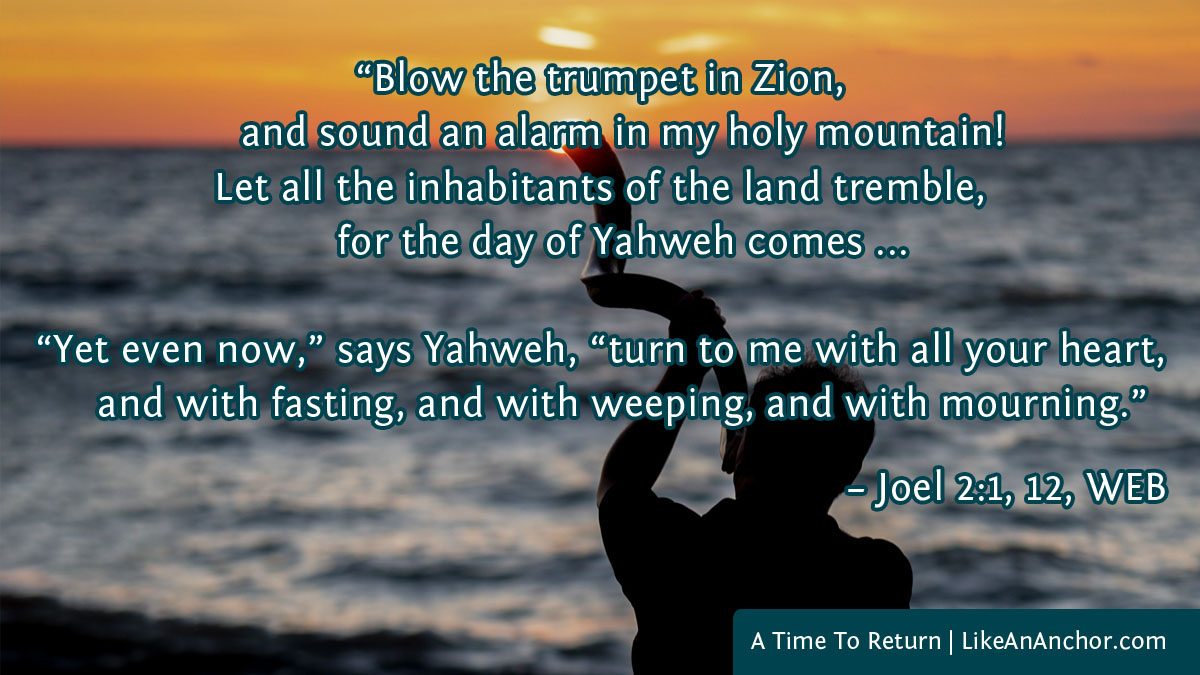
Blow the trumpet in Zion,
    and sound an alarm in my holy mountain!
Let all the inhabitants of the land tremble,
    for the day of Yahweh comes,
    for it is close at hand:
A day of darkness and gloominess,
    a day of clouds and thick darkness.
As the dawn spreading on the mountains,
    a great and strong people;
    there has never been the like,
    neither will there be any more after them,
    even to the years of many generations.

Joel 2:1-2, WEB

As Joel warns, the time before Jesu’s return (the day of Yahweh, or day of the Lord) will be a dark time for the world as a whole. The world is getting worse and worse as His return draws nearer, and Revelation reveals it’s only going to get even worse (like during the soundings of the seven trumpets given to angels; Rev. 8-11). When contemplating the coming of this day, Peter asks a pertinent question: “since all these things will be destroyed like this, what kind of people ought you to be in holy living and godliness?” (2 Pet. 3:11, WEB). He answers by saying that since we look for Jesus’s return, we should “be diligent to be found in peace, without defect and blameless in his sight” and “grow in the grace and knowledge of our Lord and Savior Jesus Christ” (2 Pet. 3:14, 18 WEB). Joel records a similar warning to turn back to following God faithfully.

Yahweh thunders his voice before his army;
    for his forces are very great;
    for he is strong who obeys his command;
    for the day of Yahweh is great and very awesome,
    and who can endure it?
“Yet even now,” says Yahweh, “turn to me with all your heart,
    and with fasting, and with weeping, and with mourning.”
Tear your heart, and not your garments,
    and turn to Yahweh, your God;
    for he is gracious and merciful,
    slow to anger, and abundant in loving kindness,
    and relents from sending calamity.
Who knows? He may turn and relent,
    and leave a blessing behind him,
    even a meal offering and a drink offering to Yahweh, your God.
Blow the trumpet in Zion!
    Sanctify a fast.
    Call a solemn assembly.
Gather the people.
    Sanctify the assembly.
Joel 2:11-16, WEB
Image of four people walking into a church building with the blog's title text and the words "As we're reminded of Jesus's approaching return, God calls us to repentance; to turn away from our own way of doing things and turn toward Him."
Image by Pearl from Lightstock

This year, we will observe the Day of Atonement on September 25, 2023. This is a solemn holy day when God commands us to rest completely and “afflict your souls” (traditionally understood to mean fasting). Reading Joel, I can’t help but notice that the trumpet blasts warning that the Messiah’s return is coming closer and closer also call us to fast and repent. God and the prophet Joel call out to readers, saying, “turn (shub) to Yahweh, your God!”

All of us are getting closer every day either to the end of our lives or to Jesus Christ’s return. One way or another, we have a limited time here on this earth. Keeping the Day of Trumpets and Day of Atonement remind us of that. They also remind us of the wonderful things the Messiah has done and is doing for His people. Because of Jesus’s atoning sacrifice, God graciously removes our sins when we repent, turning our lives around and (re)committing to following Him faithfully. We need that reminder of His awesome mercy, of our total dependence on Him, and of His promise to return and set things on this earth right.


Featured image by Pearl from Lightstock

Where Is Your Name Written?

I started this post partway through writing last week’s about God never forgetting His covenant with us. One of the verses I quoted in that post was Isaiah 49:16, where God says, “Look, I have inscribed your name on my palms.” I really wanted to study that, but knowing I’d probably not get back to the other post if I went off on a tangent, I saved it for this week.

One reason this verse caught my eye is that we’re in the midst of the fall holy day season. When I got the idea for this post, we were between Yom Teruah (Day of Trumpets) and Yom Kippur (Day of Atonement). A common Jewish greeting during the Days of Awe between Trumpets and Atonement is, “May your name be inscribed in the Book of Life!” The Jewish people see these days as a time of repentance, reconciliation, and reconnection with God. They hope that on Yom Kippur, God will choose to write their names in His book of life for one more year.

Yom Kippur was a key moment of yearly atonement; the only day when the high priest could enter the holiest part of the temple and present a sacrifice to cover the sins of all God’s people that year (Lev. 16). It wasn’t the only time for repentance, though, and the book of life isn’t explicitly connected with this day in scripture. Today, Yom Kippur is a reminder of His atoning sacrifice, a day to humble ourselves and recommit to God. It also looks forward to the day when Satan is put away and there are no barriers between God and His people.

I don’t think scriptures indicate that God decides on Yom Kippur whether or not your name is “safe” in His book for the rest of the year. He’s more dynamic and responsive than that–He’ll accept repentance and give salvation any time during the year. For believers today, Jesus’s sacrifice and the security that comes with being in covenant with Him is a constant thing. However, God does talk about writing our names (usually in a book rather than on His hands) and He does have a book of life. Now, with Yom Kippur a few days behind us and Sukkot (Feast of Tabernacles) beginning soon, this seems a good time to study how and where God writes our names.

The Lord’s Book

As I began this study, I started by searching for the phrase “book of life” in three different English translations: WEB, NET, and KJV. This particular phrase only appears once in the Old Testament, where David prays his enemies would be “blotted out of the book of life” (WEB) or “deleted from the scroll of the living” (NET). The NET translators suggest that this phrase (which appears nowhere else) likely refers to a census scroll listing the living members of a community, rather than a reference to God’s Book of Life as discussed in the New Testament.

When we think of God’s book where He writes righteous people’s names, we immediately think of the Book of Life. That phrase has become so closely associated with this book that it even shows up in traditional Jewish greetings. I can’t confirm this, but I assume this had become a well known name for God’s book in the Jewish community by the time Jesus came along, and that’s why His disciples use “Book of Life” in the New Testament writings. The Jewish people didn’t just come up with the idea of a book of life on their own, though; they got it from the scriptures.

The first reference we find to God writing someone’s name comes from Moses. After the golden calf incident, Moses went back to God to beg for mercy.

Moses returned to Yahweh, and said, “Oh, this people have sinned a great sin, and have made themselves gods of gold. Yet now, if you will, forgive their sin—and if not, please blot me out of your book which you have written.”

Yahweh said to Moses, “Whoever has sinned against me, I will blot him out of my book. Now go, lead the people to the place of which I have spoken to you. Behold, my angel shall go before you. Nevertheless, in the day when I punish, I will punish them for their sin.”

Exodus 32:31-34, WEB

This is a fascinating exchange. I’m guessing Moses must have had some unrecorded conversations with God about this book to even know it exists. From this conversation, we learn that Moses knew 1) his name was in this book and 2) his name could be removed. We also learn that God won’t blot one person’s name out in exchange for forgiving someone else–if He removes someone’s name, it’ll be because that person “has sinned against me.” We could also add to that “sinned without repenting,” since we know God is eager to offer forgiveness. An everlasting covenant with people who He’ll give everlasting life is His end-goal.

Image of a Hebrew scroll, with text from Jer. 31:33-34, WEB version: “But this is the covenant that I will make with the house of Israel after those days,” says Yahweh: “I will put my law in their inward parts, and I will write it in their heart. I will be their God, and they shall be my people. ... I will forgive their iniquity, and I will remember their sin no more.”
Image by me

Writing Those Who Belong

If you’re searching for information about books in the Bible, there are only a few tantalizing tidbits that speak of books God keeps and/or places where He writes down names. For example, Psalm 87:6 tells us that God “writes up the peoples” ( WEB), like He’s keeping a “census book of the nations” (NET). This seems to hint at two books God keeps–one where He records everyone and another (I assume the same one Moses talked about) where He writes the names of the righteous.

My frame wasn’t hidden from you,
when I was made in secret,
woven together in the depths of the earth.
Your eyes saw my body.
In your book they were all written,
the days that were ordained for me,
when as yet there were none of them.

Psalm 139:15-16, WEB

Then those who feared Yahweh spoke one with another; and Yahweh listened, and heard, and a book of memory was written before him, for those who feared Yahweh, and who honored his name. They shall be mine,” says Yahweh of Armies, “my own possession in the day that I make, and I will spare them, as a man spares his own son who serves him.”

Malachi 3:16-17, WEB

One thing we can clearly tell from these verses is that being written in God’s book is a good thing. It’s connected to God knowing you intimately. It’s where the names of people God calls “mine” are written. We also see hints at some of the things people who are written in God’s book do and who they are. They’re God-fearing, honor His name, and they speak with other believers. This is similar to how Jesus talks about the church in Sardis.

But you have a few individuals in Sardis who have not stained their clothes, and they will walk with me dressed in white, because they are worthy. The one who conquers will be dressed like them in white clothing, and I will never erase his name from the book of life, but will declare his name before my Father and before his angels.

Revelation 3:4-5, NET

Last week, we talked about a verse where Moses says God “cannot forget the covenant with your ancestors that he confirmed by oath to them” (Deut. 4:31, NET). There aren’t many things that God can’t do, but forgetting about the people He’s engraved in His palms and written in His book is one of them. While we are cautioned that it’s possible for a name to be “blotted out” or “erased” from God’s book, we’re also assured of God’s continuing commitment to those who do their best to follow Him. It takes perseverance and the humility to ask God for help since we can’t do this on our own, but we can overcome and walk with Jesus in the white clothing of righteous deeds (Rev. 19:6-8).

The Book of Life

The New Testament is where we start seeing the phrase “book of life.” Paul mentions it once, urging one of this readers to assist those “in the gospel ministry … whose names are in the book of life” (Phil. 4:3, NET). I wish we had records of Paul’s other teachings on the book of life. It sounds here like it’s common knowledge among his audience, though from our perspective this is the first time it’s mentioned in the New Testament. All the other information about it is in Revelation.

We already quoted one of the book of life verses from Revelation. Two others contrast those who will worship the beast power with those who are written in “the book of life belonging to the Lamb” and will stay faithful to God (Rev. 13:7-9; 17:7-9). The final verses look forward to a time beyond Jesus’s second coming, even after the Millennium and Satan’s final defeat (Rev. 19-20). These verses align closely with a verse from Daniel. Let’s look at all three of those verses.

“At that time Michael will stand up, the great prince who stands for the children of your people; and there will be a time of trouble, such as never was since there was a nation even to that same time. At that time your people will be delivered, everyone who is found written in the book. Many of those who sleep in the dust of the earth will awake, some to everlasting life, and some to shame and everlasting contempt. Those who are wise will shine as the brightness of the expanse. Those who turn many to righteousness will shine as the stars forever and ever.”

Daniel 12:1-3, WEB

Then I saw a large white throne and the one who was seated on it; the earth and the heaven fled from his presence, and no place was found for them. And I saw the dead, the great and the small, standing before the throne. Then books were opened, and another book was opened—the book of life. So the dead were judged by what was written in the books, according to their deeds. The sea gave up the dead that were in it, and Death and Hades gave up the dead that were in them, and each one was judged according to his deeds. Then Death and Hades were thrown into the lake of fire. This is the second death—the lake of fire. If anyone’s name was not found written in the book of life, that person was thrown into the lake of fire.

Revelation 20:11-15, NET

Now I saw no temple in the city, because the Lord God—the All-Powerful—and the Lamb are its temple. The city does not need the sun or the moon to shine on it, because the glory of God lights it up, and its lamp is the Lamb. The nations will walk by its light and the kings of the earth will bring their grandeur into it. Its gates will never be closed during the day (and there will be no night there). They will bring the grandeur and the wealth of the nations into it, but nothing ritually unclean will ever enter into it, nor anyone who does what is detestable or practices falsehood, but only those whose names are written in the Lamb’s book of life.

Revelation 21:22-27, NET

I feel woefully inadequate when it comes to writing about prophecy, but that’s where we find ourselves for these three verses. They’re talking about the resurrections that happen after Jesus’s second coming, in particular the resurrection after the Millennium when all the dead will come back to life and God opens the books (plural in Rev. 20:11). There are a few ways you could interpret this. The one I hear most often in my faith tradition is that God will open the books of the Bible so that people who’ve been resurrected can understand His law, then some time will pass so they have an opportunity to show Him how they’ll live with this new knowledge before the final judgement.

One thing we can say for sure is that God plans on deliverance, life, and light to come out of this. There’s an end for the wicked who refuse to live aligned with God’s way of life, but there’s also mercy and goodness and life for those who follow God. Here, we have a realization of God’s justice rewarding good and putting a merciful end to evil. These are sobering passages, but they also speak of a good future.

Writing God Inside Us

So where are our names written? If we’re following God, then they’re written on His palms and in His book of life. And it seems that’s where we’re going to stay unless we do something to get ourselves erased and then don’t repent. God deeply desires to give everyone eternal life (1 Tim. 2:3-4; 2 Pet. 3:9). He even writes Himself into us to help make sure that happens.

For if that first covenant had been faultless, no one would have looked for a second one. But showing its fault, God says to them,
“Look, the days are coming, says the Lord, when I will complete a new covenant with the house of Israel and with the house of Judah.
“It will not be like the covenant that I made with their fathers, on the day when I took them by the hand to lead them out of Egypt, because they did not continue in my covenant and I had no regard for them, says the Lord.
“For this is the covenant that I will establish with the house of Israel after those days, says the Lord. I will put my laws in their minds and I will inscribe them on their hearts. And I will be their God and they will be my people.
“And there will be no need at all for each one to teach his countryman or each one to teach his brother saying, ‘Know the Lord,’ since they will all know me, from the least to the greatest.
“For I will be merciful toward their evil deeds, and their sins I will remember no longer.”

Hebrews 10:7-12, NET

God’s law is an expression of His character; a guide for how we can be in a relationship with Him. And He’s writing it inside of our hearts at the same time He’s forgiving and forgetting our sins. We also have a role to play in this; in Proverbs, we’re told, “Don’t let kindness and truth forsake you,” “Keep my commandments and live! … write them on the tablet of your heart” (Prov. 3:3; 7:2-3). Just as we want God to write our names and keep them close to Him, so we should also “write” His words inside us as part of internalizing His character.

Featured image by Andrys Stienstra from Pixabay

How Should We Honor The Days God Sets Apart For Him?

Practicing righteousness. Learning to love. Developing the mind of God. Following Christ. Those are all essentials of the Christian life, and there are many “tools” God has given us to help us succeed in these goals. These include prayer, Bible reading and study, the Holy Spirit inside us, and fasting.

God’s Sabbaths and holy days are also vital, and often overlooked, gifts given to help us align with God and His ways. Keeping these days as God commanded helps line us up with His will, reinforces His plan, and deepens our relationship with Him. Just as responding to an invitation to get together with your physical family lets you build relationships with them, so does responding to our heavenly Father’s invitations help us build relationships with Him, our Bridegroom, and the other children in His family.

For many Christians, keeping God’s holy days is a foreign concept because they’ve been (incorrectly) told “that’s just a Jewish/Old Testament thing. But when you start to recognize there’s lasting value in the days God calls holy to Him, you come up against the question, How do you keep the Sabbaths in a way that honors God?

Even if you have been keeping these days for a while, you know this isn’t always an easy questions to answer. There are certain rules and guidelines in scripture, but they don’t answer all our questions. Plus, knowing what to do, and what not to do, in keeping the holy days is about more than a list of rules. It’s about honoring God’s instructions on how to come before Him. So let’s take a look at what God says to do for these days and how we can obey those commands in the spirit and from our hearts. Read more

Understanding The Days That God Calls Holy To Him

Did you know that there are certain days in the Bible that God calls holy? One of these holy times happens every 7 days and we call it the weekly Sabbath. The other 7 holy days happen at set times in the spring, early summer, and fall.

If you’re reading this when it was posted, the fall holy days ended a couple weeks ago and the spring ones won’t start again for 6 months. This in-between time seems to me like the perfect opportunity for those of us who do keep the holy days to reflect on their meaning, along with how and why we keep them. And if you’ve never observed God’s holy days before, I hope you’ll find value in learning about them and maybe even join us in keeping them.

All the holy days are outlined in Leviticus 23, and then expounded on in other passages as well. In this chapter they’re all called “set feasts” (mo’ed) and “holy convocations (miqra). This identifies them as appointments that God has set at specific times for specific reasons. We talked about these Hebrew words, and others that describe God’s holy days, in last week’s post (click here to read it).

Sabbath

“The children of Israel shall keep the Sabbath, to observe the Sabbath throughout their generations, for a perpetual covenant. It is a sign between me and the children of Israel forever; for in six days Yahweh made heaven and earth, and on the seventh day he rested, and was refreshed.”

Exodus 31:16-7, WEB

As spiritual Israel (Rom. 9:6-8; Gal. 3:29; Eph. 2:12-13), this is part of God’s eternal law that is transferred to us (see post “Inheriting Covenants“). The author of Hebrews talks about this topic from 3:7 to 4:9 and concludes, “There remains therefore a Sabbath rest for the people of God.” The Greek word sabbatismos literally means “keeping Sabbath” (G4520, Thayer’s dictionary).

The Sabbath (which happens every week from sunset on Friday until sunset on Saturday) is a time when we stop doing work and other things that clutter our weeks and enter God’s rest. It’s a time to gather with other believers in God’s presence, to learn from Him, and take on His delights as our own. The Sabbath reminds us of His plan, purpose, and presence, and let’s us practice His rest.

Further study: “Delighting In The Sabbath” by Brian Shaw and Isaiah Study: Joy in the Sabbath Covenant With God

Passover

When the hour had come, he [Jesus] sat down with the twelve apostles. He said to them, “I have earnestly desired to eat this Passover with you before I suffer.”

Luke 22:14-15, WEB

The Passover (Pesach in Hebrew) observance was instituted in Exodus 12, and Israel was told they should keep it and the Feast of Unleavened Bread that followed “throughtout your generations by an ordinance forever” (Ex. 12:14, WEB). Jesus changed/added to (depending on your interpretation) the symbols associated with Passover, but still told his followers to continue keeping it “in remembrance of me” (Luke 22:19; 1 Cor. 11:23-26).

For New Covenant believers, Passover reminds us of God’s deliverance and Jesus’ sacrifice. Drinking the wine and eating the bread symbolize our commitment to and participation in the New Covenant. Passover also lets us “proclaim the Lord’s death until he comes” (1 Cor. 11:26, WEB). It is a way for us to keep in mind of, and remind others, that Jesus died for our sins and that He will return.

Further study: “Passover Questions: Am I Ready To Hear What God Says?” and “Why I’m Keeping Passover On Nisan 14

Feast of Unleavened Bread

Purge out the old yeast, that you may be a new lump, even as you are unleavened. For indeed Christ, our Passover, has been sacrificed in our place. Therefore let us keep the feast, not with old yeast, neither with the yeast of malice and wickedness, but with the unleavened bread of sincerity and truth.

1 Corinthians 5:7-8, WEB

Beginning the day after the Passover, the Feast of Unleavened Bread (Chag HaMatzot) lasts for 7 days. The first and last days are both holy convocations and days when we do no work. For all 7 days, we eat nothing with leavening in it and we eat unleavened bread (Lev. 23:6-8; Ex. 23:15).

As we can see in this quote from Paul’s letter, the early New Testament church was still keeping this Feast. They were doing so in the spirit as well as the letter, recognizing that there’s a purpose behind the symbolism of putting leaven out and taking in unleavened things. These days are a yearly reminder to keep putting off sin and putting on Christ’s nature.

Further study: “Rhythms of Worship” and “Exodus To Corinthians: A Passover Message For The New Testament Church

Feast of Weeks

Now when the day of Pentecost had come, they were all with one accord in one place.

Acts 2:1, WEB

On the Sunday after Passover, ancient Israel performed a ceremony called Firstfruits or Wavesheaf (Lev. 23:9-14). From that day, you count seven Sabbaths plus one day to get 50 days, then o-bserve the Feast of Weeks (better known today as Pentecost or, in Hebrew, Shavuʿoth).

Pentecost is a fascinating holy day. It’s connected with the story of Ruth and our role as firstfruits in God’s harvest. It’s the day Jesus and His Father gave the precious gift of their Holy Spirit to the church. It’s also the only single day called by the Hebrew word a chag (the other holy days designated “Feasts” are the 7-day long Unleavened Bread and Tabernacles). There’s a great deal of significance in this day, and it’s there for us today as well as for earlier believers.

Further study: “Firstfruits from the Rejects” and “The Bridegroom’s Pledge

Day of Trumpets

Speak to the children of Israel, saying, “In the seventh month, on the first day of the month, shall be a solemn rest to you, a memorial of blowing of trumpets, a holy convocation.”

Leviticus 23:24, WEB

There’s not nearly as much information in scripture about the Day of Trumpets/Shouting (Yom Teruah) as for the other holy days, but that doesn’t mean it’s any less important. Many believers (and I think rightly so) see it as the holy day which points to Christ’s return because of the connection with trumpet blasts (1 Thes. 4:16; Rev. 11:15). It’s one of the “shadows” speaking to us of Christ’s reality (Col. 2:16-17).

Further study: “Preparing For The Bridegroom To Come Back” and “With The Sound of Trumpets

Understanding The Days That God Calls Holy To Him | LikeAnAnchor.com
Photo credit: slgckgc via Flikr

Day of Atonement

Yahweh spoke to Moses, saying, “On the tenth day of this seventh month is the day of atonement: it shall be a holy convocation to you, and you shall afflict yourselves; and you shall offer an offering made by fire to Yahweh. … It shall be a Sabbath of solemn rest for you, and you shall deny yourselves. In the ninth day of the month at evening, from evening to evening, you shall keep your Sabbath.”

Leviticus 23:26-27, 32, WEB

The Jews consider the Day of Atonement (Yom Kippur) as the most solemn and holy time of the year. It was the only day a human being could enter the Holy of Holies inside the temple, and even then only the high priest. There was also a ceremony of two goats — one killed for the sins of the people as a picture of Jesus Christ and the other banished as picture of what will happen to Satan (Lev. 16; Heb. 2:17; Rev. 20:1-3).

Today, Atonement reminds us of Christ’s sacrifice, looks forward to a time when Satan is removed from the picture, and invites us to think deeply about our High Priest Jesus Christ. It’s also the only specific day we’re commanded to fast, which in itself has a whole host of spiritual benefits. Exactly how to “fast” is debated, but most people I know (including me) believe it’s a fast of no food or drink for 24 hours. This holy day is briefly mentioned in the New Testament (Acts 27:9).

Further study: “Clean Temples For Yom Kippur” and “Fasting

Feast of Tabernacles

And then every survivor from all those nations coming against Jerusalem will go up year after year to worship the king, Yahweh of hosts, and celebrate the Feast of Booths.

Zechariah 14:16, LEB

The Feast of Tabernacles or Booths (Sukkot) is a week-long feast with an 8th day, the Last Great Day, on the end (Lev. 23:33-36; 39-44). It was a Feast that Jesus kept (John 7:1-10; 37-39), and this prophecy in Zechariah shows it will still be celebrated in the future. It’s a time when we’re told to stay in temporary shelters. Most people I know celebrate this Feast by traveling to a “Feast site” hosted by a church group, staying in a hotel (a place we live temporarily) or camping in a tent (a temporarily set-up shelter), and attending daily church services.

This Feast is a season of great rejoicing, followed on the 8th day by a solemn observance called an atsarah (click here to go to last week’s post on Hebrew words associated with the holy days). Tabernacles reminds us that we’re strangers and pilgrims on this temporary earth, but that a time is coming when God will establish His kingdom here and all people will live in His peace.

Further study: “Tabernacles and Temples” and “Do You Value The Gifts From Your Bridegroom?

Conclusion

This is a long post, but it’s just the briefest overview of the days God calls holy to Him. These days offer a weekly (in the Sabbath) and yearly (in the annual Feasts) rehearsal of God’s plan. He invites — and commands — us to keep these days with Him on His set appointed times because they matter.

“You shall keep my Sabbaths, and have reverence for my sanctuary. I am Yahweh.”

Leviticus 26:2, WEB

We keep His Sabbaths because He is Yahweh — the eternal Lord and the only true God. These days mean something to God, and therefore should mean something to His children. The Sabbaths and Feasts are appointments that God has set at specific times for His people to gather together for specific reasons. God places a high value on these days, calling them “holy” or set-apart for Him. As His children, we should value these days as well.

Free resource! Click here to download a chart summarizing these holy days, including the Hebrew words used for each, when and how they were observed, and New Covenant applications:


Featured image credit: tihanyitom via Pixabay

What Are God’s Holy Days and Why Would We Care?

Prayer is a time we can choose to come before God however we are, whenever we want, and whatever we need. In these cases, we’re sort of “in control” of the interaction. There are also times when God commands/invites us to come before Him on His terms. Those times when God “hosts” us are His weekly Sabbath and the yearly holy days.

Though I’ve been keeping the holy days outlined in Leviticus 23 my whole life, I hadn’t thought about them quite like this before. My family and I kept the Feast of Tabernacles (Sukkot) with a group in West Virginia this year, and one of the Bible studies there was called “Keeping A Holy Convocation.” It’s one of the best, most thought-provoking messages I’ve ever heard and it’s what prompted today’s post (click here to listen to that Bible study).

I won’t take the time here to address the question of whether or not modern believers should keep these holy days, but you can check out my posts “Top 5 Reasons for Christians to Keep God’s Holy Days” and “Rhythms of Worship” if you’re curious. One reason these days are important to us is that they teach us about God’s plan and His priorities, including who we’re meant to be in Him. They’re part of our identity as God-followers, which makes them a key part of our faith and it also relates to this blog’s theme of finding our true selves in God.

This is probably going to be the first post in a series, since there is so much to explore in this topic and I don’t want today’s post to become unreadably long. So for now, let’s just take a look at the ways God describes His holy days. There are 5 key Hebrew words that give us a picture of what these days are and why we should care about them.

Mo’ed

The word mo’ed (Strong’s number H4150) means an appointed time and/or place, as well as an assembly or congregation. The word is used 223 times in the Bible. It’s also translated “season,” as in its first use in Genesis:

God said, “Let there be lights in the expanse of sky to divide the day from the night; and let them be for signs to mark seasons, days, and years” (Gen. 1:14, WEB)

Mo’ed is used of the time for a baby to be born, the right season to keep a commanded Feast day, and for the place of a gathering and/or the people gathered. The Rabbi at my Messianic congregation defines mo’ed as the right person/people, in the right place, at the right time, for the right reason.

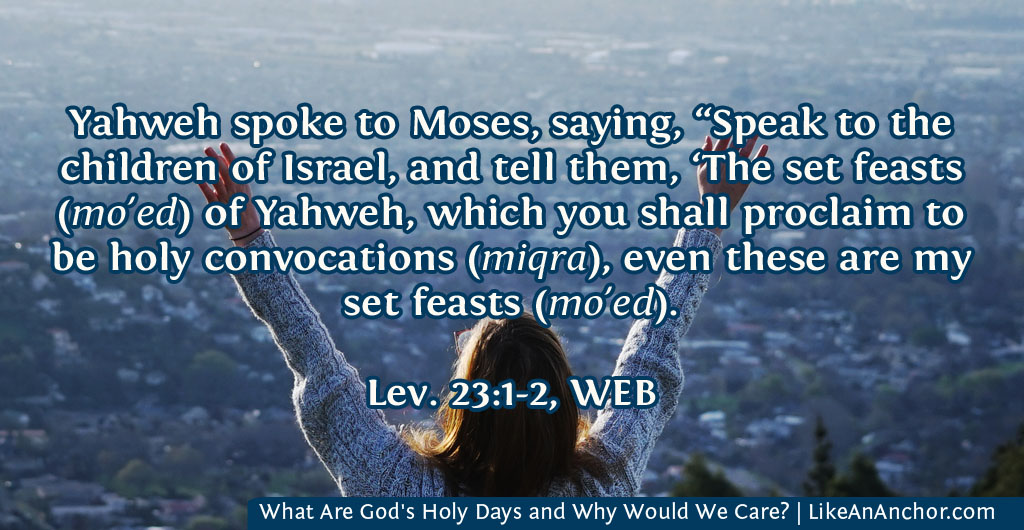
Yahweh spoke to Moses, saying, “Speak to the children of Israel, and tell them, ‘The set feasts (mo’ed) of Yahweh, which you shall proclaim to be holy convocations, even these are my set feasts (mo’ed). … These are the set feasts (mo’ed) of Yahweh, even holy convocations, which you shall proclaim in their appointed season (mo’ed). (Lev. 23:1-2, 4 WEB)

The root word of mo’ed is ya’ad (H3259), which means to appoint, assemble, meet, or betroth. The betrothal translation isn’t used much, but I find it interesting given how much the analogy of Christ as our bridegroom is tied-in with the holy days.

Miqra

Miqra (H4744) is considered a synonym for mo’ed and it’s used 23 times in the Bible. It refers to a rehearsal, assembly, or convocation (which means to call together, as for a meeting). God’s feast days are called “holy convocations,” marking them as meeting times set apart for His purposes.

Yahweh spoke to Moses, saying, “Speak to the children of Israel, and tell them, ‘The set feasts of Yahweh, which you shall proclaim to be holy convocations (miqra), even these are my set feasts. … These are the set feasts of Yahweh, even holy convocations (miqra), which you shall proclaim in their appointed season. (Lev. 23:1-2, 4 WEB)

Miqra can also mean reading aloud. Its root word qara (H7121) means to call, cry out, recite, or enunciate a specific message. In some cases, it means calling by or calling on a name.

They read in the book, in the law of God, distinctly; and they gave the sense, so that they understood the reading (miqra). Nehemiah, who was the governor, and Ezra the priest the scribe, and the Levites who taught the people, said to all the people, “Today is holy to Yahweh your God. Don’t mourn, nor weep.” For all the people wept, when they heard the words of the law. (Neh. 8:8-9, WEB)

The use of miqra to mean readings or callings is often connected to the Feasts. Here in Nehemiah, the people had just rediscovered the fall holy days and were devastated to learn how much they’d lost. As the story continues, we see them overjoyed at the chance to keep the Feast of Tabernacles (Neh. 8:11-18).

What Are God's Holy Days and Why Would We Care? | LikeAnAnchor.com
Photo credit: Ruby-Rose via Lightstock

Chag

The previous two words apply to all the holy days of God. This one, chag (H2282), is used more specifically. It means festival or feast, and refers to the three pilgrim feasts of God: Unleavened Bread, Pentecost, and Tabernacles. Chag appears 62 times in the Old Testament.

Three times in the year all of your males shall appear before Yahweh your God at the place that he will choose, at the Feast (chag) of Unleavened Bread and at the Feast (chag) of Weeks and at the Feast (chag) of Booths, and they shall not appear before Yahweh empty-handed. Each person shall give as he is able, that is, according to the blessing of Yahweh your God that he has given to you. (Deut. 16:16-17, LEB)

These holy festival seasons are described with a different word than the other holy days, and there are some differences in how they’re kept. For example, individuals are told to bring offerings during these days, but not on the other holy days. We’re also told to “keep” these days, which is the word chagag (H2287). Chagag is the root word of chag, and it means to hold or keep a feast. It can also be translated “dance” or “reel,” which connects to other instructions to rejoice in these days.

Shabbat

Shabbat and the closely related word shabbaton (H7676 & H7677) refer to a Sabbath observance. These words show up 122 times in the Old Testament. They are used of the weekly Sabbath and of the fall holy days (Lev. 23:24, 32, 39).

Six days shall work be done, but on the seventh day is a Sabbath (shabbat) of solemn rest (shabbaton), a holy convocation; you shall do no kind of work. It is a Sabbath (shabbat) to Yahweh in all your dwellings. (Lev. 23:3, WEB)

The root word is shabbath (H7673), which means to cease, desist, or rest, and that’s something we do on all the holy days. Though shabbat is not used of the spring holy days or Pentecost, instructions about these days still include the command to not work, so we tend to describe them as Sabbaths as well.

Atsarah

This last word only shows up 11 times in the whole Bible. Atsarah (H6116) means an assembly or sacred/solemn meeting of a company or group. The atsarah that belonged to God are among the things that Israel profaned.

When you come to appear before me, who has required this at your hand, to trample my courts? Bring no more vain offerings. Incense is an abomination to me; new moons, Sabbaths, and convocations: I can’t bear with evil assemblies (atsarah). My soul hates your New Moons and your appointed feasts. They are a burden to me. I am weary of bearing them. (Is. 1:12-14, WEB)

In a positive sense, atsarah is only used specifically of the Last Day of Unleavened Bread (Deut. 16:8) and the 8th day concluding the Feast of Tabernacles (Lev. 23:36). Its root word, atsar (H6113), means to restrain, retain, withhold, close up, or refrain. Apparently, these are two most solemn holy days that God commands.

Why So Much Repetition?

What Are God's Holy Days and Why Would We Care? | LikeAnAnchor.com
Photo credit: Pearl via Lightstock

I’ve heard it said that we should listen closely even when God says something once, but when He says something two or more times then we know it’s something to pay extra attention to. Not only does He talk about these holy days more than once, He uses five different words to explain over and over again how special they are.

The God who cared so much about these days in the Old Testament is the same God that we worship today, which should be reason enough for us to care about these days as well. I’m very much looking forward to studying deeper into His holy days, including how He talks about us keeping them and why He wants so much to share them with His people. I hope you’ll join me 🙂

Free resource! Click here to download a chart summarizing these holy days, including the Hebrew words used for each, when and how they were observed, and New Covenant applications:

Do You Value The Gifts From Your Bridegroom?

God has invited us to become part of the greatest love story ever told. As Jesus said, “The kingdom of heaven may be compared to a man — a king — who gave a wedding feast for his son” (Matt. 22:2), LEB). That’s what God the Father is doing. He’s inviting us to be part of the marriage He’s planing for His son in the key role of the bride.

The people listening as Jesus spoke this parable would have known about all the wedding customs implied by this comparison. If you want to learn more about what was involved in a father planning his son’s marriage, I recommend “The Ancient Jewish Wedding” by Jamie Lash (click to read). There’s a lot of incredible things in these traditions that point to Jesus, but we’ll just focus on one for today.

A Jewish bridegroom would give his bride gifts as part of the betrothal process. He’d seal the betrothal agreement and then go away for a while to prepare their new home, leaving a gift along with his pledge to return. The gift(s) were meant to remind the bride of her groom. Think of it like an engagement ring. It’s no surprise, then, that our bridegroom Jesus Christ also “gave gifts to people” (Eph. 4:7-8, WEB).

Gift Of the Spirit

As we talked about in my Pentecost post earlier this year, the holy spirit is the chief of our bridal gifts.

in whom you also, having heard the word of the truth, the Good News of your salvation—in whom, having also believed, you were sealed with the promised Holy Spirit, [which] is a pledge of our inheritance, to the redemption of God’s own possession, to the praise of his glory. (Eph. 1:13-14, WEB with “who” corrected to “which.” See article, “What Is The Holy Spirit?”)

The holy spirit wasn’t given until after Jesus was glorified and had fulfilled the other parts of establishing the marriage covenant (John 7:39). Only then did He and His father give “the gift of the holy spirit” (Acts 2:38). Each time God gives the holy spirit to a new believer, He’s marking us as belonging to the Bridegroom and pledging that He will come back and fulfill all His promises. Read more