A Time To Return

If I asked you to define “repent” or “repentance,” what would you say?

We know it’s the thing you’re supposed to do when you’ve sinned and you’re coming to God asking for forgiveness. But is it just saying you’re sorry?

In English, “repent” means to express regret and remorse. While the Hebrew and Greek words translated “repent” in the Bible include that aspect of regret, the Biblical concept goes a step farther. Biblical repentance involves change. This change is a movement; an alteration in the direction of your heart and your life. The word image contained in both Hebrew and Greek is to turn away from sin and to turn toward God.

Unpopular Repentance

According to Oxford Languages (via Google), “repent” means “feel or express sincere regret or remorse about one’s wrongdoing or sin.” It came into Middle English “from Old French repentir, from re- (expressing intensive force) + pentir (based on Latin paenitere ‘cause to repent’).” There’s also something interesting going on with Google’s tracking for how often this word was used in English-language books between 1800 and 2019.
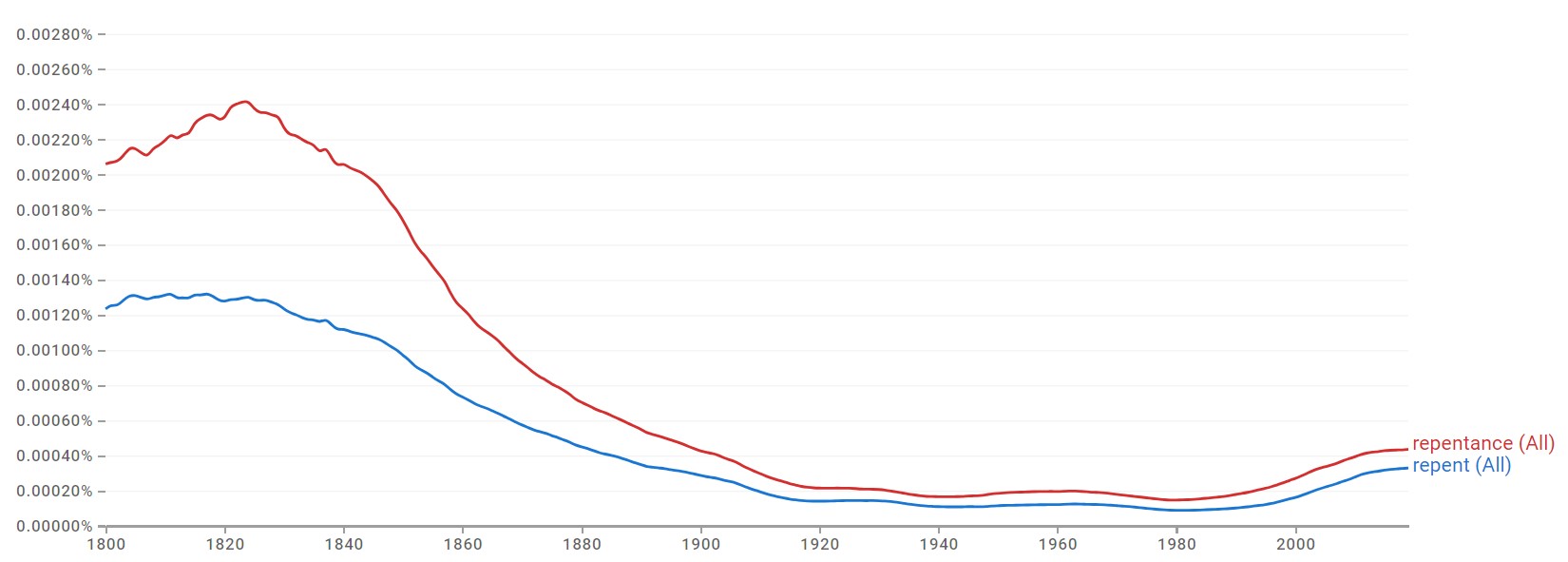
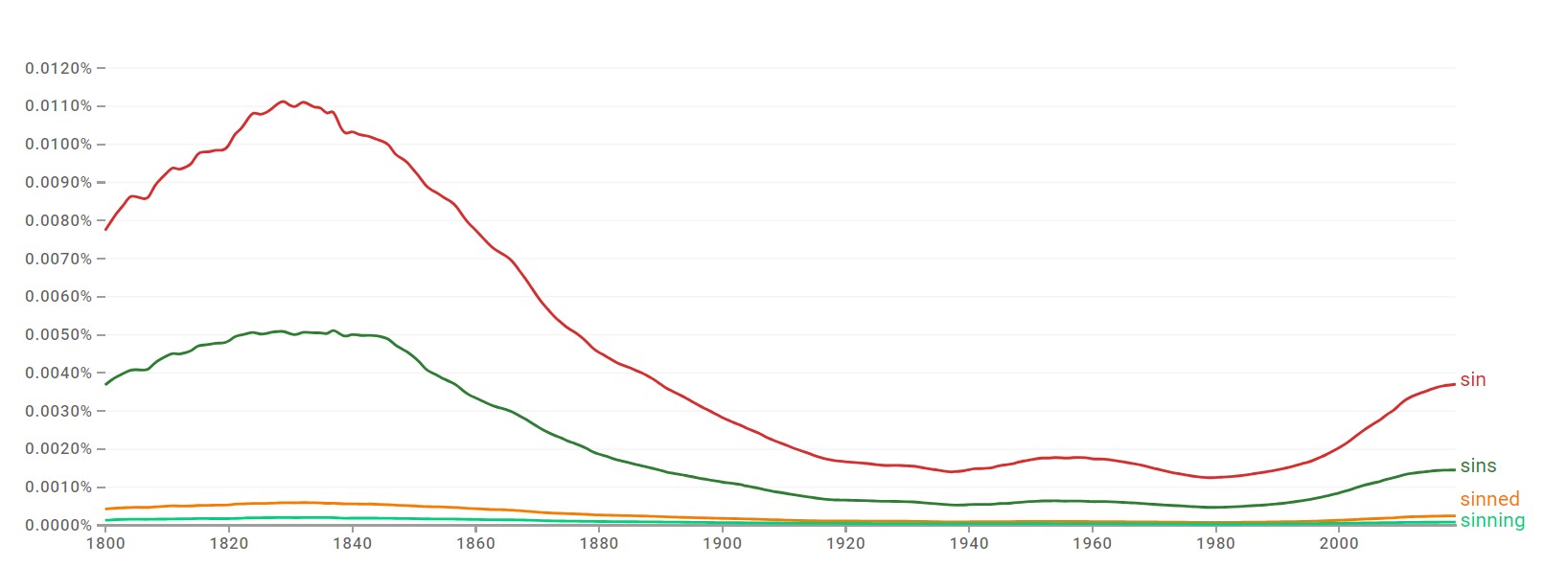
Evidently, repentance is not a popular idea (though I am intrigued by the recent uptick in usage after that slump in the 1900s). I don’t really think it will surprise any of us that “repent” and “repentance” are used less now than they were in the early 1800s. Repentance is something you need to do after you sin, and sin isn’t something we like to think about either. The more moral relativism takes hold in our society, the less people are willing to acknowledge sin is even a real thing since sin is the transgression of (God’s) absolute laws. The chart for “sin” in English language books looks very similar to the one for repentance.
But what about us today? If we’re sincerely following Jesus and love Him, He says we’ll obey His commandments. Commandments are contained in the law of God (Matt. 22:36, 40). The law and commandments are “holy, righteous, and good” (Rom. 7:12), and it is how God lets people know what sin is (Rom. 7:7-8). John says, “Sin is lawlessness” (1 John 3:4, WEB) or “the transgression of the law” (KJV). Paul further adds that “all have sinned” (Rom. 3:23). When Jesus came to this earth, one of His stated purposes was to call “sinners to repentance” (Luke 5:32), and it’s a message His disciples continued to preach (Acts 2:38; 3:19).

Putting all that together, we see that every human being is guilty of sin. Jesus can fix that problem, though. When sinners repent and follow Him, He takes away their sins (John 1:29; 1 John 3:5). Even after that, though, we still have a responsibility to keep His commandments because we love Him. And if we sin, then we need to repent again.

Returning and Changing

In Greek, one word translated “repent” is metanoeo (G3340). It includes the “regret or sorrow” aspect that is captured by the English word “repent,” but it also involves another step. The root words are meta (G3326: to be among or amidst, or to move toward that position) and noeo (G3539: “to exercise the mind, think, comprehend”) (Zodhiates entry G3340). Metanoeo is distinct from regret (metamelomai [G3338]) and includes “a true change of heart toward God” (Zodhiates). Thayer defines metanoeo as “to change one’s mind for better, heartily to amend with abhorrence of one’s past sins” (Thayer entry G3340). There’s a sense of turning around involved, as if when we sin we are walking away from God and when we repent we turn around and go toward Him again.

There’s another word for repentance in the New Testament as well. Zodhiates writes, “Metanoeo presents repentance in its negative aspect as a change of mind or turning from sin while epistrepho presents it in its positive aspect as turning to God” (Zodhiates entry G3340). He also notes that both of these words “derive their moral content … from Jewish and Christian thought, since nothing analogous to the biblical concept of repentance and conversion was known to the Greeks.” To understand what metanoeo and epistrepho (G1994) meant to early Christians, we need to look back at the Hebrew words expressing the same concepts.

Once again, we have two words that can be translated into English as “repent.” One of those, nacham (H5162) is typically only used of God “repenting” in the sense of “relenting or changing,” like He did when he delayed Nineveh’s destruction in response to their repentance (Theological Wordbook of the Old Testament [TWOT] entry 1344). In that story of Nineveh, we also see the Hebrew word more commonly used for human repentance, shub (H7725).

Jonah began to enter into the city a day’s journey, and he cried out, and said, “In forty days, Nineveh will be overthrown!”

The people of Nineveh believed God; and they proclaimed a fast, and put on sackcloth, from their greatest even to their least. The news reached the king of Nineveh, and he arose from his throne, and took off his royal robe, covered himself with sackcloth, and sat in ashes. He made a proclamation and published through Nineveh by the decree of the king and his nobles, saying, “Let neither man nor animal, herd nor flock, taste anything; let them not feed, nor drink water; but let them be covered with sackcloth, both man and animal, and let them cry mightily to God. Yes, let them turn (shub) everyone from his evil way, and from the violence that is in his hands. Who knows whether God will not turn (shub) and relent (nacham), and turn (shub) away from his fierce anger, so that we might not perish?”

God saw their works, that they turned (shub) from their evil way. God relented (nacham) of the disaster which he said he would do to them, and he didn’t do it.

Jonah 3:4-10, WEB

The basic meaning of shub is to turn or return. It is a Hebrew verb used frequently; “over 1050 times” in the Old Testament. While the Hebrew writers use many word pictures to describe repentance, all “are subsumed and summarized by this one verb shub. For better than any other verb is combines in itself the two requisites of repentance: to turn from evil and to turn to the good” (TWOT 2340). Like the Greek words that would later represent the same concept, Hebrew notions of repentance include both regret and turning away from sin and turning toward God. There’s always a sense of change; the verb shub is so connected with turning and change that it is even used of physical movement and coming back to a people or location (TWOT 2340).

The word shub is particularly important in it’s relation to “the covenant community’s return to God,” and one scholar concludes “there are a total of 164 uses of shub in a covenantal context” (TWOT 2340). Covenants are the way that God makes formal relationships with people; if we’re truly following God then we have made a covenant commitment to Him. Under the terms of a covenant, both parties involved have rights and responsibilities. In relation to repentance, both God and humanity have a role to play. The person repenting goes “beyond contrition and sorrow to a conscious decision of turning to God,” God freely extends His sovereign mercy, and then we continue in a commitment that involves “repudiation of all sin and affirmation of God’s total will or one’s life” (TWOT 2340). That concept is found in the Old Covenant, and is reinforced in the New Covenant (Acts 3:19; 26:17-20; 1 Thes. 1:9).
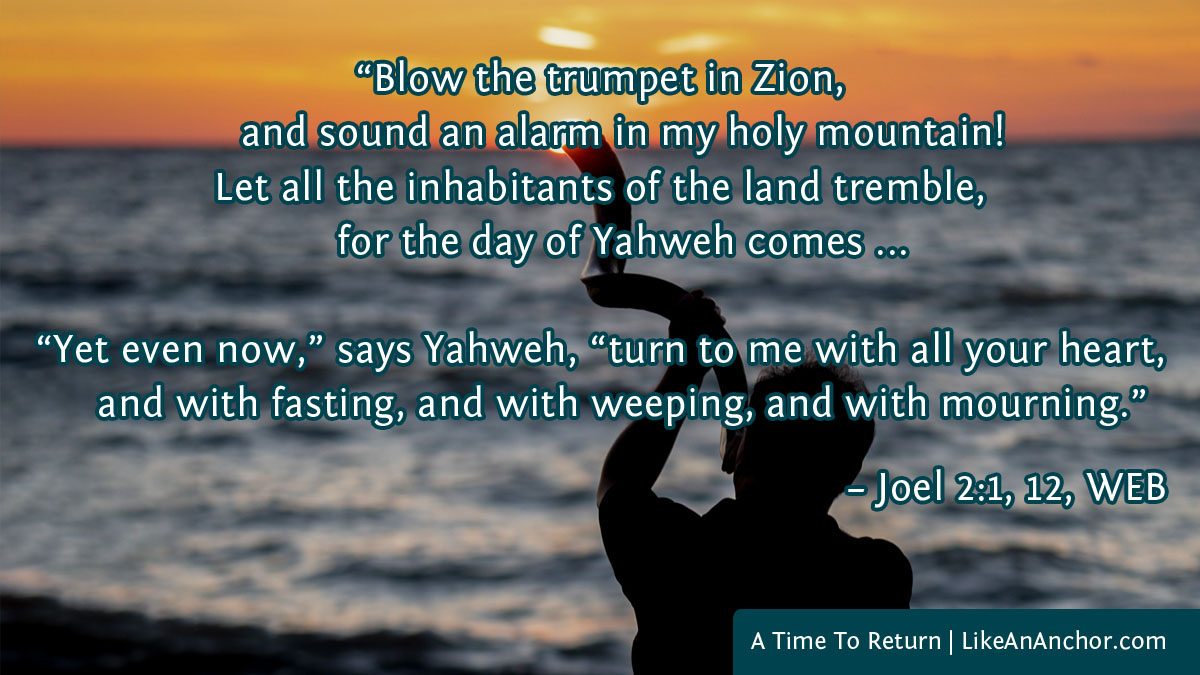
Trumpet Blasts As A Call to Return

In last week’s post, I talked about observing the Day of Trumpets (Yom Teruah). It is one of God’s special holy days, which He commands His covenant people to keep. It is a Sabbath day of complete rest, a day God calls His people to gather together, and “a memorial announced by loud horn blasts” (Lev. 23:24, WEB); “it is a day of blowing trumpets for you” (Num. 29:1, WEB). We traditionally say that in the New Covenant, the Day of Trumpets pictures the second coming of Jesus Christ, which will be heralded by trumpet blasts (1 Thes. 4:15-18).

We can also see the trumpet blasts as a call to alert us today of the need to return to God. In Jewish tradition, the Sabbath day that falls between Day of Trumpets and Day of Atonement (Yom Kippur) is called Shabbat Shuvah, the Sabbath of Return. As we just learned, shuvah/shub is the Hebrew word for repentance. As we move from Day of Trumpets to Day of Atonement, repentance should be on our minds.

Blow the trumpet in Zion,
    and sound an alarm in my holy mountain!
Let all the inhabitants of the land tremble,
    for the day of Yahweh comes,
    for it is close at hand:
A day of darkness and gloominess,
    a day of clouds and thick darkness.
As the dawn spreading on the mountains,
    a great and strong people;
    there has never been the like,
    neither will there be any more after them,
    even to the years of many generations.

Joel 2:1-2, WEB

As Joel warns, the time before Jesu’s return (the day of Yahweh, or day of the Lord) will be a dark time for the world as a whole. The world is getting worse and worse as His return draws nearer, and Revelation reveals it’s only going to get even worse (like during the soundings of the seven trumpets given to angels; Rev. 8-11). When contemplating the coming of this day, Peter asks a pertinent question: “since all these things will be destroyed like this, what kind of people ought you to be in holy living and godliness?” (2 Pet. 3:11, WEB). He answers by saying that since we look for Jesus’s return, we should “be diligent to be found in peace, without defect and blameless in his sight” and “grow in the grace and knowledge of our Lord and Savior Jesus Christ” (2 Pet. 3:14, 18 WEB). Joel records a similar warning to turn back to following God faithfully.

Yahweh thunders his voice before his army;
    for his forces are very great;
    for he is strong who obeys his command;
    for the day of Yahweh is great and very awesome,
    and who can endure it?
“Yet even now,” says Yahweh, “turn to me with all your heart,
    and with fasting, and with weeping, and with mourning.”
Tear your heart, and not your garments,
    and turn to Yahweh, your God;
    for he is gracious and merciful,
    slow to anger, and abundant in loving kindness,
    and relents from sending calamity.
Who knows? He may turn and relent,
    and leave a blessing behind him,
    even a meal offering and a drink offering to Yahweh, your God.
Blow the trumpet in Zion!
    Sanctify a fast.
    Call a solemn assembly.
Gather the people.
    Sanctify the assembly.
Joel 2:11-16, WEB
Image of four people walking into a church building with the blog's title text and the words "As we're reminded of Jesus's approaching return, God calls us to repentance; to turn away from our own way of doing things and turn toward Him."
Image by Pearl from Lightstock

This year, we will observe the Day of Atonement on September 25, 2023. This is a solemn holy day when God commands us to rest completely and “afflict your souls” (traditionally understood to mean fasting). Reading Joel, I can’t help but notice that the trumpet blasts warning that the Messiah’s return is coming closer and closer also call us to fast and repent. God and the prophet Joel call out to readers, saying, “turn (shub) to Yahweh, your God!”

All of us are getting closer every day either to the end of our lives or to Jesus Christ’s return. One way or another, we have a limited time here on this earth. Keeping the Day of Trumpets and Day of Atonement remind us of that. They also remind us of the wonderful things the Messiah has done and is doing for His people. Because of Jesus’s atoning sacrifice, God graciously removes our sins when we repent, turning our lives around and (re)committing to following Him faithfully. We need that reminder of His awesome mercy, of our total dependence on Him, and of His promise to return and set things on this earth right.


Featured image by Pearl from Lightstock
With The Sound of Trumpets

We begin this year’s fall holy days today (Sept. 16, 2023) with Yom Teruah, the Day of Trumpets (also called Rosh Hoshana). When I think of this holy day, one of the things that comes to mind is a choir song called “With The Sound of Trumpets” that I’ve sung a few times over the years when I was involved in church choirs. It’s a majestic, beautiful song based on passages in 1 Thessalonians and Revelation that describe Jesus returning to earth with trumpet blasts.

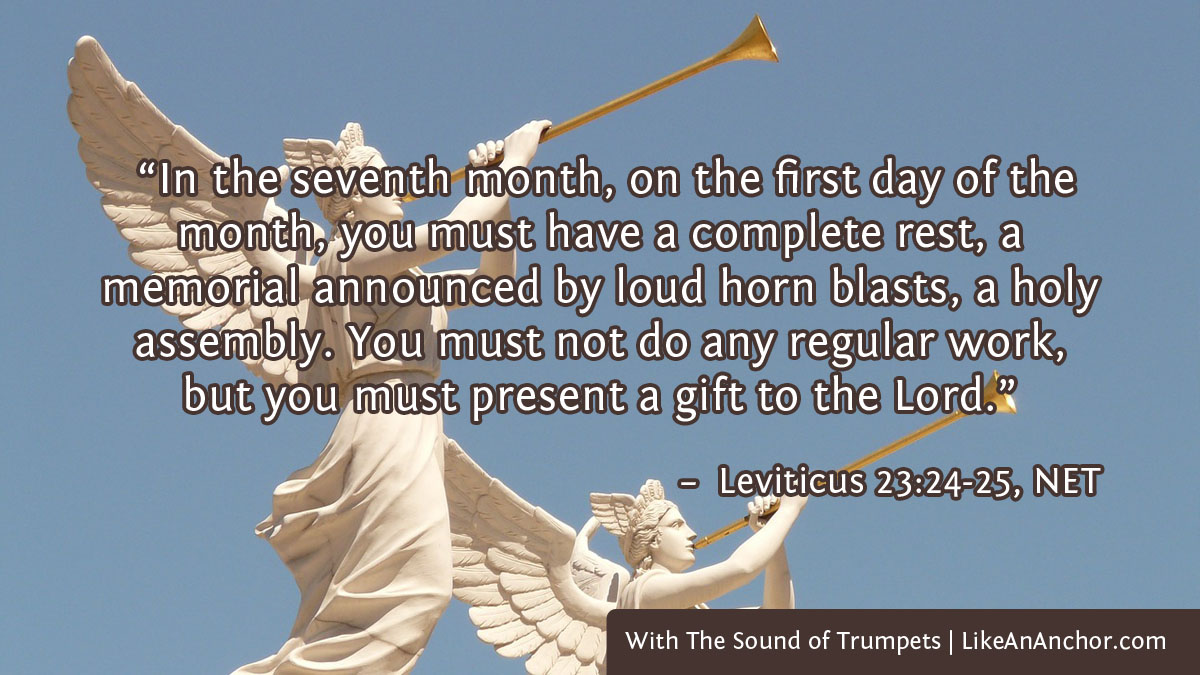
The Day of Trumpets is probably the holy day that we know the least about. In Leviticus 23, where God outlines all the holy days for Moses and the people of ancient Israel, He simply says this: “Speak to the children of Israel, saying, ‘In the seventh month, on the first day of the month, there shall be a solemn rest for you, a memorial of blowing of trumpets, a holy convocation. You shall do no regular work. You shall offer an offering made by fire to Yahweh’” (Lev. 23:23-25, WEB). The word “trumpet” or “horn” actually doesn’t appear in the Hebrew. It could more literally be translated “a memorial of loud blasts,” though horn/shofar sounds are what is likely being referenced (NET footnote). The word teruah can include battle cries, shouts of alarm or joy, and blasts of trumpets (BDB H8643).

Numbers adds a little more detail to the instructions for Day of Trumpets, but most of that is focused on the burnt offering and grain offering associated with the holy day. Each of the holy days had specific offerings/sacrifices connected with them. For Trumpets, it was “one young bull, one ram, and seven lambs one year old without blemish” for the burnt offering, each accompanied by a grain offering of “finely ground flour mixed with olive oil.” Then, there was “one male goat for a purification offering to make an atonement for you.” And since Trumpets always falls on the first day of the seventh month in the Hebrew calendar, all this was “in addition to the monthly burnt offering and its grain offering, and the daily burnt offering with its grain offering and their drink offerings as prescribed, as a sweet aroma, a sacrifice made by fire to the Lord” (Num. 29:1-6, NET).

But what about for us, the New Covenant church of God? We should still keep the days that God made holy, because they are important to Him (i.e. they are God’s holy days, not belonging to a single group or time) and because Jesus and His first-century followers kept these days (see “Top 5 Reasons for Christians to Keep God’s Holy Days” and “What Are God’s Holy Days and Why Would We Care?“). However, the sacrifices and offerings in the temple aren’t for us today–Jesus’s perfect sacrifice means there’s no more need for burnt offerings (Heb. 7:26-27; 9:23-10:12). For us, that just leaves, “On the first day of the seventh month, you are to hold a holy assembly. You must not do your ordinary work, for it is a day of blowing trumpets for you” (Num. 29:1, NET).

What Do We Do on the Day of Trumpets?

Aside from the burnt offerings God told Israel to make for each holy day under the Old Covenant, there are three details about the Day of Trumpets that we learn in Leviticus and Numbers.

  1. This day is “a complete rest” (Lev. 23:24, WEB) when “You must not do your ordinary work” (Num. 29:1, WEB). In other words, it is a Sabbath (the Hebrew word shabbâthôn appears in Leviticus).
  2. The Day of Trumpets is “a holy assembly” (Lev. 23:24; Num. 29:1, WEB). In Hebrew, this phrase is qôdesh miqrâ’, a meeting time that God has called and which He makes holy.
  3. This miqra is “a memorial announced by loud horn blasts” (Lev. 23:24, WEB); “it is a day of blowing trumpets for you” (Num. 29:1, WEB). The word translated “loud horn blasts” and “blowing trumpets” is terû‛âh.

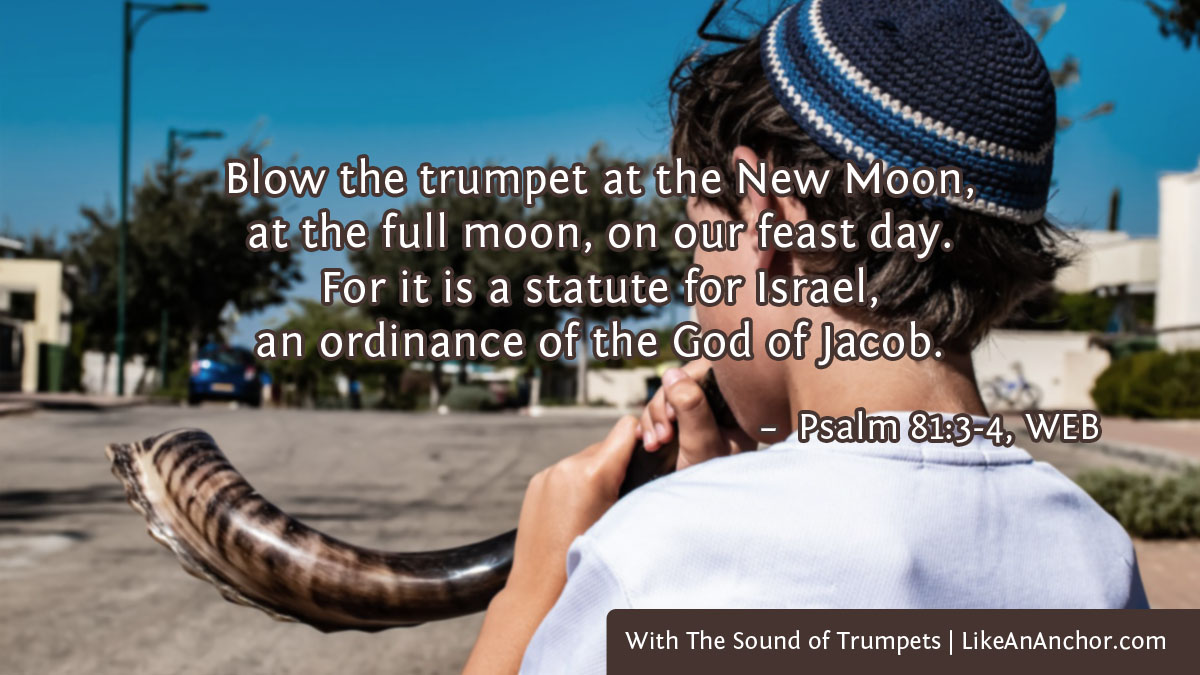
In my experience among Sabbath keeping groups, we’ve got the “holy assembly” part down. Every group I’ve attended with has a church service on Day of Trumpets, when we gather as an assembly of believers. Most of us have the Sabbath part down pretty well, too, though I’ve met some who don’t treat this as a day of complete rest. The trumpets part is a little more sporadic; the only group I attended with that consistently blew shofars and shouted with joy on Day of Trumpets was a Messianic group.

I’m consistently puzzled by why it’s not a standard practice among sabbath keepers to blow shofars or trumpets on the Day of Trumpets. I’ve been told that this was just “for Israel” and not us, but we call ourselves spiritual Israel (see Rom. 11) and say that we inherit other parts of the covenant God made with them (though on a higher, spiritual level) so I’m not sure why this would be an exception to that.

Charting the Festival Days

I’ve been thinking a lot recently about a study I did five years ago examining the different Hebrew words for the days that God calls holy to Him. In English, Bible translations might use words like “feast,” “festival,” “assembly,” or “convocation” to translate a few different words, and it’s not always consistent between different translations. This can muddy our understanding of the holy days and the distinctions in how God speaks about them.

For example, we often call all the holy days “feasts” and speak of “Feast of Trumpets” or “Feast of Tabernacles.” But of those two, only Tabernacles is a chag (feast or festival) in Hebrew. Trumpets is a day, yom. Both are mo’ed (appointed seasons). Trumpets and the first day of Tabernacles are miqra (convocations), but not the other six days of Tabernacles (though they’re still part of the chag). The eigth day of/after Tabernacles is a mo’ed, miqra, and atserah (solemn assembly). The only other atserah is the last day of the Feast of Unleavened Bread. We can lose track of these nuances in English.

To help myself keep track of and compare the Lord’s holy times, I made a chart. It lists all the days/observances outlined in Leviticus 23, with extra details drawn from other parts of the Torah, and notes on times the days show up in the New Testament. Here’s a copy of that chart if you’d like to download it:

Looking For The Lord’s Coming

For the spring holy days, it’s easy to find the parallels between Old and New Covenant. Passover pictured God delivering Israel from Egypt, and now it also pictured Jesus giving His life to deliver us from sin. Paul talks about how the Feast of Unleavened Bread pictured putting sin our of our lives and the way to keep the feast on a spiritual level as New Covenant Christians. According to Jewish tradition, Pentecost is the day that God established the Sinai covenant with Israel and delivered the Ten Commandments, then in the New Testament that’s the day He gave the church the Holy Spirit.

The fall holy days are a little less clear; they haven’t been fulfilled yet and Jesus hasn’t explained them to us as clearly as he did the ones connected with His first coming. Traditionally in the churches I attend, we’ve linked the Day of Trumpets with Jesus Christ’s second coming. We also say Atonement pictures God’s triumph over Satan (partly fulfilled by Jesus’s sacrifice), and Tabernacles pictures the millennium spoken of in Revelation and by the prophets. I think those assumptions for what these holy days picture seem reasonable and scripturally supported (but I still like to point out, for accuracy’s sake, that these links aren’t stated directly in the Bible).

Now we do not want you to be uninformed, brothers and sisters, about those who are asleep, so that you will not grieve like the rest who have no hope. For if we believe that Jesus died and rose again, so also we believe that God will bring with him those who have fallen asleep as Christians. For we tell you this by the word of the Lord, that we who are alive, who are left until the coming of the Lord, will surely not go ahead of those who have fallen asleep. For the Lord himself will come down from heaven with a shout of command, with the voice of the archangel, and with the trumpet of God, and the dead in Christ will rise first. Then we who are alive, who are left will be suddenly caught up together with them in the clouds to meet the Lord in the air. And so we will always be with the Lord. Therefore encourage one another with these words.

1 Thessalonians 4:13-18, NET

Trumpets and loud shouts are consistently linked with the events of Revelation leading up to Jesus’s return and with His second coming to earth (e.g. the seven trumpets of revelation and shouts of “hallelujah” and of warning). While there are arguments about the timing for all this and how it might line-up with holy days, the main thing we should notice is that Jesus is coming back. Like the virgins in Jesus’s parable, who didn’t know exactly when the bridegroom would return and waited for a shout to signal His arrival, we’re also waiting and listening for His return.

As we observe God’s holy Day of Trumpets this year, I pray that our hearts will be attuned and open to what He has to teach us through His special holy days. I pray we’ll reignite our anticipation for Jesus’s return, reminding ourselves that the future God promises us is a wonderful one. Sometimes, I think we can forget how great God’s plan is. We either get discouraged by how bad things are in the world today, or we get so used to it and complacent that we don’t really long for Jesus’s return. But Paul writes that even creation itself eagerly awaits the return of Jesus and our transformation as God’s children (Rom. 8:18-25). We can take comfort in God’s good plan for our future, and we should feel excitement about the prospect of our bridegroom-king returning.


Featured image by StockSnap from Pixabay

Song Recommendation: “With The Sound of Trumpets

Falling in Love With the God Who Plans to Marry Us

If you’re reading this blog post the weekend it was published, then Yom Teruah (Day of Trumpets, also called Rosh Hoshanna) is about to happen. This year, the first day of the seventh Hebrew month falls on Monday, Sept. 26. All around the world, people will blow shofars and gather to celebrate this day God calls holy to Him.

Last year, I wrote about the many different theories for what this day pictures. God simply calls it “a solemn rest for you, a memorial of blowing of trumpets, a holy convocation” (Lev. 23:24, WEB). There are several ideas about what this day pictures in the New Covenant now that Jesus has filled the Law up to its fullest extent (Matt 5:17-20; see Thayer’s definition of pleroo). I think the strongest argument links this day with Jesus’s return to claim His bride.

I’ve been thinking about love and marriage a lot lately. I recently started dating a man I’ve been friends with for years and I’m kind of in awe of how wonderful this relationship is; I thought we’d be good together but I hadn’t realized exactly how good. This giddy, happy, can’t-wait-to-see-him feeling is how we should feel as we wait for Jesus to come back to earth. We should be longing to see Him, eager to have our Bridegroom give us His new name (Rev. 3:12).

Promised in Marriage

I know the idea of being romantically in love with God and having Him in love with us makes some people uncomfortable. For some, thinking of Jesus as lover as well as Lord is a struggle; the in-love emotion seems a strange thing to try and balance with the respect due God. I suspect it’s a particularly weird analogy for men in the church, who are asked to picture themselves as a bride for their spiritual relationship to Christ while also modeling His role as Husband in their relationship with their own wives if they get married (Eph. 5:25-33). Still, church as bride and Jesus as Groom is one of the most common analogies for our relationship used in scripture, so it’s worthwhile to try and wrap our minds around it.

Usually at this point in a study about Jesus as our Bridegroom, I’d start talking about Jewish wedding traditions. Today, though, I want to focus just on how scripture talks about this relationship. For more on the Jewish background and historical context, check out my posts “The Bridegroom’s Pledge” and “The Bridegroom Cometh!

I wish that you would be patient with me in a little foolishness, but indeed you are being patient with me! For I am jealous for you with godly jealousy, because I promised you in marriage to one husband, to present you as a pure virgin to Christ. But I am afraid that just as the serpent deceived Eve by his treachery, your minds may be led astray from a sincere and pure devotion to Christ.

2 Corinthians 11:1-3, NET

There isn’t much room to argue with this verse. If we’re following Jesus, then we’re promised to Him in marriage. Our goal is to be pure for Him at that marriage; in other words, wholly faithful to Him now whatever our past was like. The “foolishness” Paul talks about here involves defending his apostolic mission from naysayers, moderate boasting about the mission God sent him on, and the shocking idea that his readers might listen to someone preaching “another Jesus” (2 Cor. 10-11). It isn’t foolish to think of Jesus as our future Husband. It’s foolish to let anything distract from our focus on being faithful to Him.

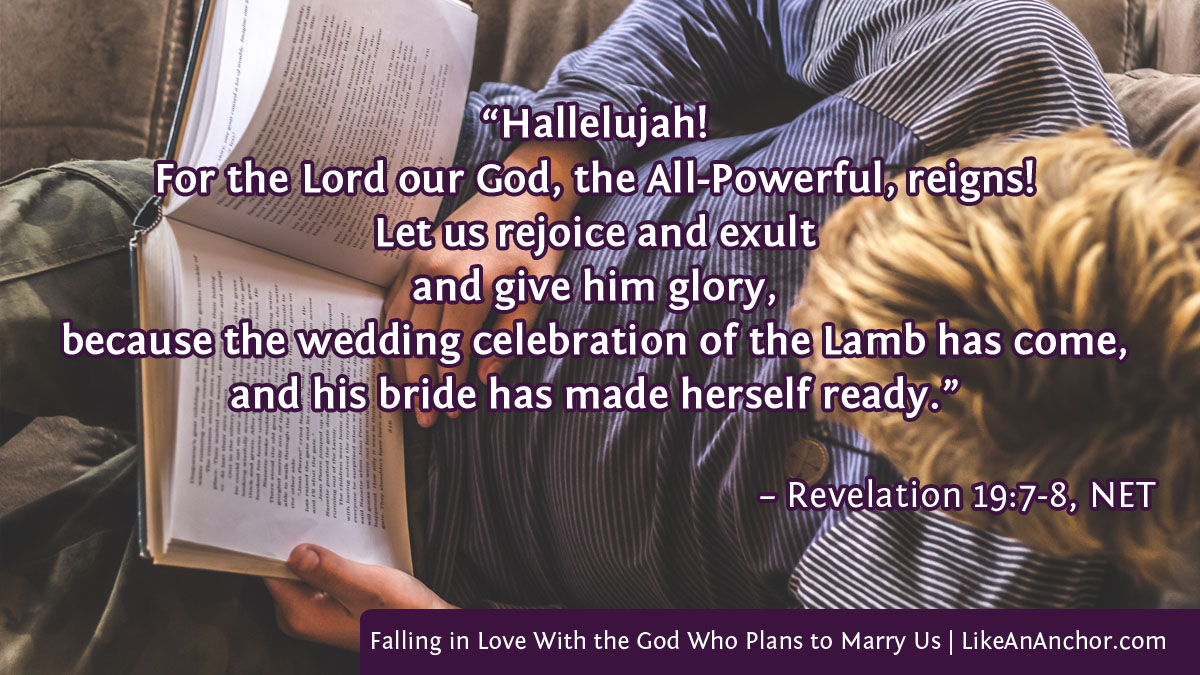
Image of a man reading a book, with text from Rev. 19:7-8, NET version: "“Hallelujah! For the Lord our God, the All-Powerful, reigns! Let us rejoice and exult and give him glory, because the wedding celebration of the Lamb has come, and his bride has made herself ready.”
Image by Creative Clicks Photography from Lightstock

The Marriage Covenant

If you followed along with my recent Isaiah study, you might remember that the topic of God’s marriage covenant with Israel came up in Isaiah 40-66. When God established His covenant with Israel at Mount Sinai (often called the Mosaic covenant), He was setting up a marriage relationship (see Is 54:5-8). They would be His people and He would be their God. When they stopped worshiping Him or brought foreign gods into their hearts, He took that as adultery. Ezekiel 16 summarizes this well.

“Yes, I swore to you, and entered into a covenant with you,” says the Lord Yahweh, “and you became mine. … You were exceedingly beautiful, and you prospered to royal estate. Your renown went out among the nations for your beauty; for it was perfect, through my majesty which I had put on you,” says the Lord Yahweh.

“But you trusted in your beauty, and played the prostitute because of your renown, and poured out your prostitution on everyone who passed by. … Moreover you have taken your sons and your daughters, whom you have borne to me, and you have sacrificed these to them to be devoured. …

“I will judge you, as women who break wedlock and shed blood are judged; and I will bring on you the blood of wrath and jealousy.” …

For the Lord Yahweh says: “I will also deal with you as you have done, who have despised the oath in breaking the covenant. Nevertheless I will remember my covenant with you in the days of your youth, and I will establish an everlasting covenant with you. … Then you will know that I am Yahweh; that you may remember, and be confounded, and never open your mouth any more, because of your shame, when I have forgiven you all that you have done,” says the Lord Yahweh.

Ezekiel 16:8, 13-15, 20, 38, 59-60, 62-63, WEB

Love story” is my favorite metanarrative the Bible gives us to describe the big, important story God is creating. When we pull back and look at God’s plan as revealed in the whole Bible, we see a story of romance where God married a people who were then unfaithful to Him, and whom He died for in order to bring back to Him. You’re simply never going to find a better love story than that. Even the most beautifully romantic fairy tales are pale reflections of God’s love for His bride. He’s passionate about us and He wants us in a faithful, lasting covenant relationship with Him.

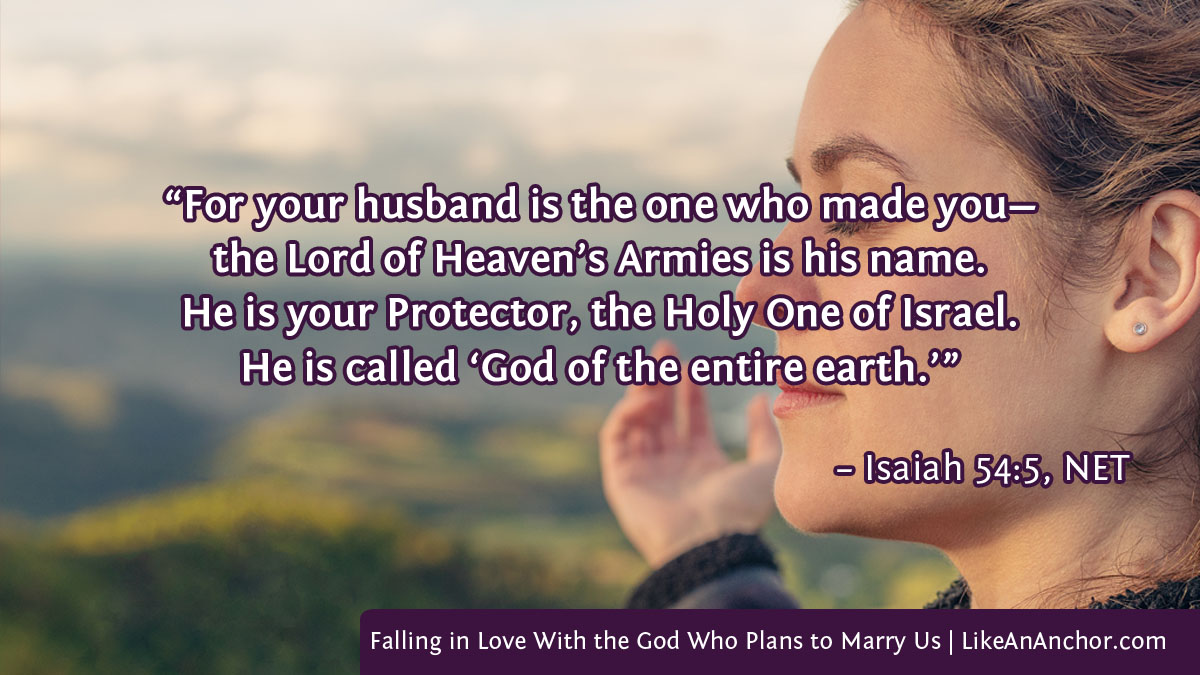
Image of a woman with rolling hills in the background, with text from Isaiah 54:5, NET version: “For your husband is the one who made you—
the Lord of Heaven’s Armies is his name. He is your Protector, the Holy One of Israel. He is called ‘God of the entire earth.’”
Image by PhotoGranary from Lightstock

Falling in Love With God

There’s a really interesting connection between love and obedience in the Bible. The greatest commandment is to “love the Lord your God with all your heart, and with all your soul, and with all your mind, and with all your strength” (Mark 12:28-34, WEB). All the other commandments depend on loving God and loving your neighbor (Matt. 22:36-40). Love is the basis for our obedience; the foundation for following God’s other laws. It’s also a lot easier to enjoy being obedient if you’re in love with God and trust that His commands are good for us.

But what if you don’t feel “in-love” with God? Real love is as much an action as it is a feeling, so we can (and ought to) do the things that people who love God do regardless of how we feel. As much as I enjoy relating to God’s word academically, though, I also think it’s appropriate to get excited about God and our relationship with Him. There’s likely more than one way to do this, but one of the things that helps me connect with my love for God is reading about His love for me.

Image of a smiling woman worshipping with the blog's title text and the words "As wonderful as it is to be in love with God now, how much more wonderful will it be after He comes back for us, marries His church, and establishes His 
kingdom here on earth?"
Image by Pearl from Lightstock

Yahweh appeared of old to me, saying,
“Yes, I have loved you with an everlasting love.
Therefore I have drawn you with loving kindness.”

Jeremiah 31:3, WEB

“I will betroth you to me forever.
Yes, I will betroth you to me in righteousness, in justice, in loving kindness, and in compassion.
I will even betroth you to me in faithfulness;
and you shall know Yahweh.”

Hosea 2:19-20, WEB

God, being rich in mercy, because of his great love with which he loved us, even though we were dead in offenses, made us alive together with Christ—by grace you are saved!

Ephesians 2:4-5, NET

In just those three verses, we see God passionately declaring His love for His people, and one of those people reminding us of the “great love with which He loved us.” The reality of God’s love is awesome. We were dead and His love brought us back to life. We made mistakes and He still wants to keep us with Him forever. He treats us with loving kindness and calls His love faithful and everlasting.

We are recipients of God’s love now, which is an incredible thing. We’re still waiting, though, for a time when things will be even better. When Jesus returns, we’ll “be like Him” and we’ll get to “see him just as he is” (1 John 3:2, NET). Make no mistake, Jesus is present with us now. We don’t get to see Him, though. Our conversations don’t happen face-to-face. As wonderful as it is to be in love with Him now, how much more wonderful will it be after He comes back for us, marries us, and establishes His kingdom here on earth? That’s the sort of wonderful, exciting thing we can look forward to as we begin this fall holy day season.

The Spirit and the bride say, “Come!” He who hears, let him say, “Come!” He who is thirsty, let him come. He who desires, let him take the water of life freely. … He who testifies these things says, “Yes, I come quickly.”

Amen! Yes, come, Lord Jesus.

Revelation 22:17, 20, WEB

Featured image Jess Bailey from Pixabay

Song Recommendation: “Even So Come” by Chris Tomlin

Isaiah Study: Let Us Go Up to the Lord’s Mountain

Way back at the end of June, we started a study on the last 27 chapters of Isaiah. This section (ch. 40-66) is all part of one long dialog where God speaks of revenge, redemption, and revelation. He’s open and emotional, calling out to His people, talking about how grieved He is by their sin, and saying how much He still loves and wants them. Some of the most famous prophecies of Jesus’s Messianic ministry are found here in Isaiah, including ones showing how much He suffered to save us.

Today’s article is our last post in this Isaiah Study series. With the fall holy days less than a month away (Yom Teruah/Day of Trumpets falls on Sept. 26 this year), it’s a great time to study and think deeply on the Lord’s plan for Jesus’s second coming, His millennial reign, and the new heaven and new earth that will follow.

We’ve already discussed this topic in the post about God’s declarations that He’s doing a new thing, but I don’t think we’re quite finished with it yet. Not too long ago, one of the ladies in my scripture writing group mentioned walking toward the Lord’s mountain as a key part of our spiritual journey. While I hadn’t put anything about the Lord’s mountain on my list of key themes in the first Isaiah study post, “mountain” shows up 21 times in the WEB translation of this section of scripture. Seven times it’s God talking about “my mountain.”

God’s Use of Mountains

Let’s start with some background on mountains. A lot of major Bible events happen on mountains. For example, that’s where Abraham went to sacrifice his son, and since God provided a substitutionary ram “it is said to this day, ‘On Yahweh’s mountain, it will be provided'” (Gen. 22:14, WEB). God also spoke to Moses on Mount Sinai when He gave Israel the Covenant (Ex. 24:12). Mountains aren’t the only places God speaks with people of course, but He seems to like mountains for some reason. More to our point, mountains picture where God chooses to place His people and where He says that he reigns. Look at what Israel and Moses say in a song of praise and deliverance:

“You, in your loving kindness, have led the people that you have redeemed.
You have guided them in your strength to your holy habitation. …
You will bring them in, and plant them in the mountain of your inheritance,
the place, Yahweh, which you have made for yourself to dwell in;
the sanctuary, Lord, which your hands have established.
Yahweh will reign forever and ever.”

Exodus 15:13, 17-18, WEB

During King David’s reign, God’s holy mountain became closely associated with Mount Zion, the City of David, and Jerusalem (Zion and Jerusalem are often used interchangeably now, but it seems originally they were twin cities). Zion is God’s holy mountain where He dwells and chooses to reign (Ps. 68:15-16; 74:2; Joel 3:16-17; Ezek. 20:39-41). This statement is literal, figurative, and prophetic.

God literally established Jerusalem/Zion as the focal point of His holy land and set kings up on its throne. On a figurative/spiritual level, He still reigns over that location and believers today “have come to Mount Zion, and to the city of the living God, the heavenly Jerusalem” (Heb. 12:22, WEB). In the future, “the mountain of Yahweh’s temple will be established on the top of the mountains,” all people will go to it for instruction, and “the law will go out of Zion, and Yahweh’s word from Jerusalem” (Micah 4:1-2, WEB). It’s this prophetic, forward-looking meaning of God’s mountain that figures most prominently in the Isaiah texts we’re focusing on today.

Walking Toward His Mountain

Isaiah’s message begins with mountains. By chapter 2, the book is talking about a future time when “the mountain of Yahweh’s house shall be established on the top of the mountains” (Is. 2:2, WEB). This passage mirrors the one we already quoted in Micah where people go up to God’s mountain and learn His law (Is. 2:1-4). This pictures something that’s still in the future for us; a time when God’s people will stand with Jesus on Mount Zion and (even after that) when “the holy city, Jerusalem” comes down from heaven to earth (Rev. 14:1; 21:10). We might not fully understand what God plans to do with His holy mountain in the future, but we know it’s a location of great joy where we’ll dwell with God and follow Him fully.

The Lord’s mountain is linked with Millennial imagery again in Isaiah chapter 11, where Gods says, “They will not hurt nor destroy in all my holy mountain” (Is. 11:9, WEB). In the future, even foreigners and outcasts “will worship Yahweh in the holy mountain at Jerusalem” (Is. 27:13, WEB); a worship that’s also associated with joy in keeping God’s holy festivals (Is. 30:29). By the time Isaiah’s readers get to the last 27 chapters that we’ve been studying, they’ve already heard quite a bit about God’s holy mountain.

Our faith isn’t one where a distant God hangs out on mountains to separate Himself from the people He rules. Rather, He’s calling us up to join Him where He dwells. First, though, He came down to dwell with us and invite us to join Him. The Servant Songs in Isaiah point to Jesus Christ’s first coming and His ongoing purposes. In the second song, the Servant speaks in the first-person about His plans and the work He does in concert with God the Father (Is. 49:1-13).

“I will make all my mountains a road,
    and my highways shall be exalted.
Behold, these shall come from afar,
    and behold, these from the north and from the west;
    and these from the land of Sinim.”
Sing, heavens, and be joyful, earth!
    Break out into singing, mountains,
for Yahweh has comforted his people,
    and will have compassion on his afflicted.

Isaiah 49:12-13, WEB

“Walk” is a common word picture in the Bible for living in the way that God wants us to. And that’s what you do on a road; you walk on it, in this case all the way to join the Messiah. It’s such a joyful thing that the mountains themselves start to sing (Is. 55:12) and the feet of messengers running over the mountains to bring this good news are called “beautiful” (Is. 52:7).

The Destination for Our Lives

Finally, we arrive at the end of the book. As God’s message through Isaiah draws to a close, He returns to the contrast between righteousness and wickedness that He’s brought up several times before. Here, He says, “you who forsake Yahweh, who forget my holy mountain” are destined for “slaughter; because when I called, you didn’t answer. When I spoke, you didn’t listen; but you did that which was evil in my eyes, and chose that in which I didn’t delight” (Is. 65:11-12, WEB). To walk away from God’s holy mountain is to walk away from God Himself. In contrast, those who faithfully serve God have a very different relationship with His mountain.

I will bring offspring out of Jacob,
    and out of Judah an inheritor of my mountains.
My chosen will inherit it,
    and my servants will dwell there.

Isaiah 65:9, WEB

God’s servants get to live with Him on His mountain forever. That’s the destination for our walk of faith here on earth. We want to be there when He brings this promise to fulfillment: “For, behold, I create new heavens and a new earth … I will rejoice in Jerusalem, and delight in my people … They will not hurt nor destroy in all my holy mountain” (Is. 65:17, 19, 25, WEB). The message God shares with us about the end of this world, right before Jesus’s second coming, has a lot of warnings and discussion of punishment, but there are also incredible promises of future peace and joy. Even when God’s justice demands punishment, He still talks about restoration and whorship.

“For I know their works and their thoughts. The time comes that I will gather all nations and languages, and they will come, and will see my glory.

“I will set a sign among them, and I will send those who escape of them to the nations, to Tarshish, Pul, and Lud, who draw the bow, to Tubal and Javan, to far-away islands, who have not heard my fame, nor have seen my glory; and they shall declare my glory among the nations. They shall bring all your brothers out of all the nations for an offering to Yahweh, on horses, in chariots, in litters, on mules, and on camels, to my holy mountain Jerusalem, says Yahweh, as the children of Israel bring their offering in a clean vessel into Yahweh’s house. Of them I will also select priests and Levites,” says Yahweh.

“For as the new heavens and the new earth, which I will make, shall remain before me,” says Yahweh, “so your offspring and your name shall remain. It shall happen that from one new moon to another, and from one Sabbath to another, all flesh will come to worship before me,” says Yahweh. “They will go out, and look at the dead bodies of the men who have transgressed against me; for their worm will not die, nor will their fire be quenched, and they will be loathsome to all mankind.”

Isaiah 66:18-24, WEB

And that’s the end of the book. While that final verse might be a bit shocking, the overall message is one of hope. God plans to “gather all nations and languages”–no one will be left out. His people will be just as enduring “as the new heavens and the new earth” that He plans to make. Our worship will endure as well; God says that “all flesh will come to worship” before Him on His Sabbaths.

We don’t have to wait until then to worship Him on His holy days, though. This incredible future is the time we get to picture as we celebrate Yom Teruah (Day of Trumpets), Yom Kippur (Day of Atonement), and Sukkot (Feast of Tabernacles) every fall. We also get a little taste of this final, glorious peace and rest each week as we observe the Sabbath (Heb. 4:9).


I hope you’ve enjoyed this deep dive into Isaiah 40-66 over the past couple months. With the exception of writing Study Guides for The Beatitudes (available on Amazon) and the Armor of God (coming out later this fall), I don’t think I’ve ever spent this long studying a single section of scripture. It’s exciting and awe-inspiring to me that there’s so much to learn from one relatively short chunk of scripture. I could keep writing about just this part of the Bible for another two months and still not have exhausted “the depth of the riches and wisdom and knowledge of God!” (Rom. 11:33, NET). For now, though, we’re going to bring this study to a close. As always, if you have any thoughts on this post or insights from your own study you’d like to share, please comment below 🙂

Featured image by Inbetween from Lightstock

How Should We Honor The Days God Sets Apart For Him?

Practicing righteousness. Learning to love. Developing the mind of God. Following Christ. Those are all essentials of the Christian life, and there are many “tools” God has given us to help us succeed in these goals. These include prayer, Bible reading and study, the Holy Spirit inside us, and fasting.

God’s Sabbaths and holy days are also vital, and often overlooked, gifts given to help us align with God and His ways. Keeping these days as God commanded helps line us up with His will, reinforces His plan, and deepens our relationship with Him. Just as responding to an invitation to get together with your physical family lets you build relationships with them, so does responding to our heavenly Father’s invitations help us build relationships with Him, our Bridegroom, and the other children in His family.

For many Christians, keeping God’s holy days is a foreign concept because they’ve been (incorrectly) told “that’s just a Jewish/Old Testament thing. But when you start to recognize there’s lasting value in the days God calls holy to Him, you come up against the question, How do you keep the Sabbaths in a way that honors God?

Even if you have been keeping these days for a while, you know this isn’t always an easy questions to answer. There are certain rules and guidelines in scripture, but they don’t answer all our questions. Plus, knowing what to do, and what not to do, in keeping the holy days is about more than a list of rules. It’s about honoring God’s instructions on how to come before Him. So let’s take a look at what God says to do for these days and how we can obey those commands in the spirit and from our hearts. Read more

Understanding The Days That God Calls Holy To Him

Did you know that there are certain days in the Bible that God calls holy? One of these holy times happens every 7 days and we call it the weekly Sabbath. The other 7 holy days happen at set times in the spring, early summer, and fall.

If you’re reading this when it was posted, the fall holy days ended a couple weeks ago and the spring ones won’t start again for 6 months. This in-between time seems to me like the perfect opportunity for those of us who do keep the holy days to reflect on their meaning, along with how and why we keep them. And if you’ve never observed God’s holy days before, I hope you’ll find value in learning about them and maybe even join us in keeping them.

All the holy days are outlined in Leviticus 23, and then expounded on in other passages as well. In this chapter they’re all called “set feasts” (mo’ed) and “holy convocations (miqra). This identifies them as appointments that God has set at specific times for specific reasons. We talked about these Hebrew words, and others that describe God’s holy days, in last week’s post (click here to read it).

Sabbath

“The children of Israel shall keep the Sabbath, to observe the Sabbath throughout their generations, for a perpetual covenant. It is a sign between me and the children of Israel forever; for in six days Yahweh made heaven and earth, and on the seventh day he rested, and was refreshed.”

Exodus 31:16-7, WEB

As spiritual Israel (Rom. 9:6-8; Gal. 3:29; Eph. 2:12-13), this is part of God’s eternal law that is transferred to us (see post “Inheriting Covenants“). The author of Hebrews talks about this topic from 3:7 to 4:9 and concludes, “There remains therefore a Sabbath rest for the people of God.” The Greek word sabbatismos literally means “keeping Sabbath” (G4520, Thayer’s dictionary).

The Sabbath (which happens every week from sunset on Friday until sunset on Saturday) is a time when we stop doing work and other things that clutter our weeks and enter God’s rest. It’s a time to gather with other believers in God’s presence, to learn from Him, and take on His delights as our own. The Sabbath reminds us of His plan, purpose, and presence, and let’s us practice His rest.

Further study: “Delighting In The Sabbath” by Brian Shaw and Isaiah Study: Joy in the Sabbath Covenant With God

Passover

When the hour had come, he [Jesus] sat down with the twelve apostles. He said to them, “I have earnestly desired to eat this Passover with you before I suffer.”

Luke 22:14-15, WEB

The Passover (Pesach in Hebrew) observance was instituted in Exodus 12, and Israel was told they should keep it and the Feast of Unleavened Bread that followed “throughtout your generations by an ordinance forever” (Ex. 12:14, WEB). Jesus changed/added to (depending on your interpretation) the symbols associated with Passover, but still told his followers to continue keeping it “in remembrance of me” (Luke 22:19; 1 Cor. 11:23-26).

For New Covenant believers, Passover reminds us of God’s deliverance and Jesus’ sacrifice. Drinking the wine and eating the bread symbolize our commitment to and participation in the New Covenant. Passover also lets us “proclaim the Lord’s death until he comes” (1 Cor. 11:26, WEB). It is a way for us to keep in mind of, and remind others, that Jesus died for our sins and that He will return.

Further study: “Passover Questions: Am I Ready To Hear What God Says?” and “Why I’m Keeping Passover On Nisan 14

Feast of Unleavened Bread

Purge out the old yeast, that you may be a new lump, even as you are unleavened. For indeed Christ, our Passover, has been sacrificed in our place. Therefore let us keep the feast, not with old yeast, neither with the yeast of malice and wickedness, but with the unleavened bread of sincerity and truth.

1 Corinthians 5:7-8, WEB

Beginning the day after the Passover, the Feast of Unleavened Bread (Chag HaMatzot) lasts for 7 days. The first and last days are both holy convocations and days when we do no work. For all 7 days, we eat nothing with leavening in it and we eat unleavened bread (Lev. 23:6-8; Ex. 23:15).

As we can see in this quote from Paul’s letter, the early New Testament church was still keeping this Feast. They were doing so in the spirit as well as the letter, recognizing that there’s a purpose behind the symbolism of putting leaven out and taking in unleavened things. These days are a yearly reminder to keep putting off sin and putting on Christ’s nature.

Further study: “Rhythms of Worship” and “Exodus To Corinthians: A Passover Message For The New Testament Church

Feast of Weeks

Now when the day of Pentecost had come, they were all with one accord in one place.

Acts 2:1, WEB

On the Sunday after Passover, ancient Israel performed a ceremony called Firstfruits or Wavesheaf (Lev. 23:9-14). From that day, you count seven Sabbaths plus one day to get 50 days, then o-bserve the Feast of Weeks (better known today as Pentecost or, in Hebrew, Shavuʿoth).

Pentecost is a fascinating holy day. It’s connected with the story of Ruth and our role as firstfruits in God’s harvest. It’s the day Jesus and His Father gave the precious gift of their Holy Spirit to the church. It’s also the only single day called by the Hebrew word a chag (the other holy days designated “Feasts” are the 7-day long Unleavened Bread and Tabernacles). There’s a great deal of significance in this day, and it’s there for us today as well as for earlier believers.

Further study: “Firstfruits from the Rejects” and “The Bridegroom’s Pledge

Day of Trumpets

Speak to the children of Israel, saying, “In the seventh month, on the first day of the month, shall be a solemn rest to you, a memorial of blowing of trumpets, a holy convocation.”

Leviticus 23:24, WEB

There’s not nearly as much information in scripture about the Day of Trumpets/Shouting (Yom Teruah) as for the other holy days, but that doesn’t mean it’s any less important. Many believers (and I think rightly so) see it as the holy day which points to Christ’s return because of the connection with trumpet blasts (1 Thes. 4:16; Rev. 11:15). It’s one of the “shadows” speaking to us of Christ’s reality (Col. 2:16-17).

Further study: “Preparing For The Bridegroom To Come Back” and “With The Sound of Trumpets

Understanding The Days That God Calls Holy To Him | LikeAnAnchor.com
Photo credit: slgckgc via Flikr

Day of Atonement

Yahweh spoke to Moses, saying, “On the tenth day of this seventh month is the day of atonement: it shall be a holy convocation to you, and you shall afflict yourselves; and you shall offer an offering made by fire to Yahweh. … It shall be a Sabbath of solemn rest for you, and you shall deny yourselves. In the ninth day of the month at evening, from evening to evening, you shall keep your Sabbath.”

Leviticus 23:26-27, 32, WEB

The Jews consider the Day of Atonement (Yom Kippur) as the most solemn and holy time of the year. It was the only day a human being could enter the Holy of Holies inside the temple, and even then only the high priest. There was also a ceremony of two goats — one killed for the sins of the people as a picture of Jesus Christ and the other banished as picture of what will happen to Satan (Lev. 16; Heb. 2:17; Rev. 20:1-3).

Today, Atonement reminds us of Christ’s sacrifice, looks forward to a time when Satan is removed from the picture, and invites us to think deeply about our High Priest Jesus Christ. It’s also the only specific day we’re commanded to fast, which in itself has a whole host of spiritual benefits. Exactly how to “fast” is debated, but most people I know (including me) believe it’s a fast of no food or drink for 24 hours. This holy day is briefly mentioned in the New Testament (Acts 27:9).

Further study: “Clean Temples For Yom Kippur” and “Fasting

Feast of Tabernacles

And then every survivor from all those nations coming against Jerusalem will go up year after year to worship the king, Yahweh of hosts, and celebrate the Feast of Booths.

Zechariah 14:16, LEB

The Feast of Tabernacles or Booths (Sukkot) is a week-long feast with an 8th day, the Last Great Day, on the end (Lev. 23:33-36; 39-44). It was a Feast that Jesus kept (John 7:1-10; 37-39), and this prophecy in Zechariah shows it will still be celebrated in the future. It’s a time when we’re told to stay in temporary shelters. Most people I know celebrate this Feast by traveling to a “Feast site” hosted by a church group, staying in a hotel (a place we live temporarily) or camping in a tent (a temporarily set-up shelter), and attending daily church services.

This Feast is a season of great rejoicing, followed on the 8th day by a solemn observance called an atsarah (click here to go to last week’s post on Hebrew words associated with the holy days). Tabernacles reminds us that we’re strangers and pilgrims on this temporary earth, but that a time is coming when God will establish His kingdom here and all people will live in His peace.

Further study: “Tabernacles and Temples” and “Do You Value The Gifts From Your Bridegroom?

Conclusion

This is a long post, but it’s just the briefest overview of the days God calls holy to Him. These days offer a weekly (in the Sabbath) and yearly (in the annual Feasts) rehearsal of God’s plan. He invites — and commands — us to keep these days with Him on His set appointed times because they matter.

“You shall keep my Sabbaths, and have reverence for my sanctuary. I am Yahweh.”

Leviticus 26:2, WEB

We keep His Sabbaths because He is Yahweh — the eternal Lord and the only true God. These days mean something to God, and therefore should mean something to His children. The Sabbaths and Feasts are appointments that God has set at specific times for His people to gather together for specific reasons. God places a high value on these days, calling them “holy” or set-apart for Him. As His children, we should value these days as well.

Free resource! Click here to download a chart summarizing these holy days, including the Hebrew words used for each, when and how they were observed, and New Covenant applications:


Featured image credit: tihanyitom via Pixabay